RECENTLY orders came from both the English and American consuls to the effect that all women and children of their respective countries should at once plan to leave this province. As it seemed best that we should follow this order, and as it was considered very unwise to send our wives down the river alone, Brethren O. J. Gibson and S. C. Harris accompanied them to Shanghai.
When Brother Gibson left here, it was his intention to return as soon as possible, bringing up a quantity of money for our use, also a supply of literature. Thus far during the revolution, practically all the banks in this vicinity have suspended business, so it has been very difficult for any one to obtain money. However, conditions in this respect are a trifle better than they have been.
In the meantime, conditions in the country seem to be going from bad to worse, and at present it looks as if the war might be a very formidable affair. So Brother Gibson will not return at present. I understand that all our people in inland China, except Brother Allum and me, have left their stations and gone to Shanghai; and now word has come that the brethren in Shanghai consider it unsafe for Brother Allum to remain in Hunan longer. They have therefore wired him to go to Shanghai. It is reported that to the north of Chowkiakow a few hundred miles several foreigners have been murdered.
When Chang-sha turned over to the revolutionary party, about a month ago, three officials were killed. A week later, the two leading generals in the army here were shot, it is said, by order of the provincial assembly. Their motives were thought to be untrue. On both of these occasions there was quite a little skirmish, and from fifty to one hundred shots were exchanged each time. Twice since, there have been executions by the military government, the last one being but four days ago. On this occasion three Chinese who were spreading anti-foreign literature were beheaded. They were thought to be hired emissaries of the Manchu party, who would be glad to strike a blow at the foreigners, and thus bring the revolutionists into trouble with the outside world. The Manchus seem to think that if they can in some way bring about foreign intervention, it will mean the prolonging of their power.
The danger to foreigners does not come from either party directly, but from soldiers who at times get “out of hand,” or from bands of plunderers, who take advantage of the unsettled state of the country. To illustrate: the government has been having hard work to control its soldiers here; on one occasion a Japanese steamship was fired upon, several shots taking effect, just because there was a soldier aboard whom some one was anxious to have brought to shore.
At the present time Chang-sha presents the appearance of a great armed camp. Tens of thousands are volunteering for military service, and drilling from morning till night is the order of the day. Practically every store, shop, and residence in the city has hoisted the white flag of submission to the new government. Thousands of Chinese, fearing trouble, have left the city, and thus many houses are vacant. The Chinese here have assumed an air of independence; thousands of their queues are coming off; and foreign caps, shoes, and clothing are in great demand. So far as I have observed, the average Hunanese is quite as friendly to the foreigner now as he was previous to the revolution.
The river here is falling quite rapidly, and this will mean that all the regular steamers will stop running until the rise of the water next spring.
Following the general meeting in Hunan, which was held during the last week of October, we have been conducting a Bible school, with twenty-five in attendance. A more earnest, promising class I have not seen in China. The session is from nine o’clock until twelve in the morning. In the afternoon the most of the young men go out with our literature. Considering the unsettled state of the country, it is really surprising to see the number of papers and tracts they sell. In the evening they study from seven o’clock till half past nine. Aside from drill work, our regular classes are three in number: first, study of the book of Daniel; second, study in Bible doctrine; and third, work in Romanizing the Chinese language.
One baptismal service was held at the close of our general meeting, and another doubtless will be held near the close of our Bible school, which we trust may be continued to the end of December. Five or six of the young men now in attendance will enter the canvassing work beginning with the new year.
At the close of our general meeting most of our native workers went to their respective substations, or took a fresh supply of literature to dispose of as they travel from town to town. Already most cheering reports have begun to come in concerning the success the Lord has given them, and the interests that are being awakened.
We have, therefore, every reason to praise the Lord for his prospering hand in this ever-triumphant message. And the revolution that is for the present hindering our work and scattering our forces, can be in the end but one of the “all things” that work together for good; for, when the clouds from the battle-fields begin to clear away, it will certainly be seen that the ancient land of Sinim has by this internal struggle for civil liberty been opened as never before to hear and receive the final warning from heaven. I believe as a people we should get ready for the greatest opportunity for missionary endeavor in China that has yet appeared.
Cook Islands
By GEO. L. STERLING
GEO. L. STERLING
As we read the columns of the good old REVIEW, and learn of the prosperity of the cause of God in the world to-day, it rejoices our hearts. The paper is always old by the time it reaches us, but full of truth which is ever new. Our courage to press forward with the message to the end was never stronger.
We have no startling news to report. We must here be content to labor along quietly, placing the truth before the people at every opportunity, scattering the autumn leaves of our literature, and leaving results with God. We are glad that we have a little literature in the Maori language. Another book is just off the press, and will be shipped to us shortly from Sydney. We plan to give this book a thorough circulation, and to do so as soon as possible. This field especially needs the printed page. Literature has a molding influence and a power to break down prejudice which nothing else possesses.
Our native paper, Tuatua-Moa, is doing a good work. We hope in the near future to increase quite materially its subscription list, thus making the paper more nearly self-supporting. We circulate13about twelve hundred copies monthly in a group of thirteen small islands. A little over one hundred copies are paid for yearly, at two shillings English money a year. The papers for free distribution are given out a month or two later. The news items are by that time old, thus a premium is placed upon the new paper.
News has reached us that Brother B. K. Piper and his wife, of New Zealand, have been appointed to this field. A letter received from Brother Piper states that they will come by the next steamer. Our hearts rejoice at this news, and we pray that the Lord will use our united efforts to the bringing of the message of Jesus’ soon-coming to the hearts of many in darkness in the Cook Islands. Pray for the success of God’s work.
Rarotonga.
Something You Can Do
By Daniel March
HARK! the voice of Jesus calling,
“Who will go and work to-day?
Fields are white, and harvests waiting;
Who will bear the sheaves away?”
Loud and long the Master calleth,
Rich reward he offers thee;
Who will answer, gladly saying,
“Here am I, send me, send me”?
If you can not cross the ocean
And the heathen lands explore,
You can find the heathen nearer,
You can help them at your door;
If you can not give your thousands,
You can give the widow’s mite;
And the least you give for Jesus
Will be precious in his sight.
Let none hear you idly saying,
“There is nothing I can do,”
While the sons of men are dying,
And the Master calls for you.
Gladly take the task he gives you,
Let his work your pleasure be;
Answer quickly, when he calleth,
“Here am I, send me, send me.”
—Daniel March.
West Africa
By W. H. Lewis
W. H. LEWIS
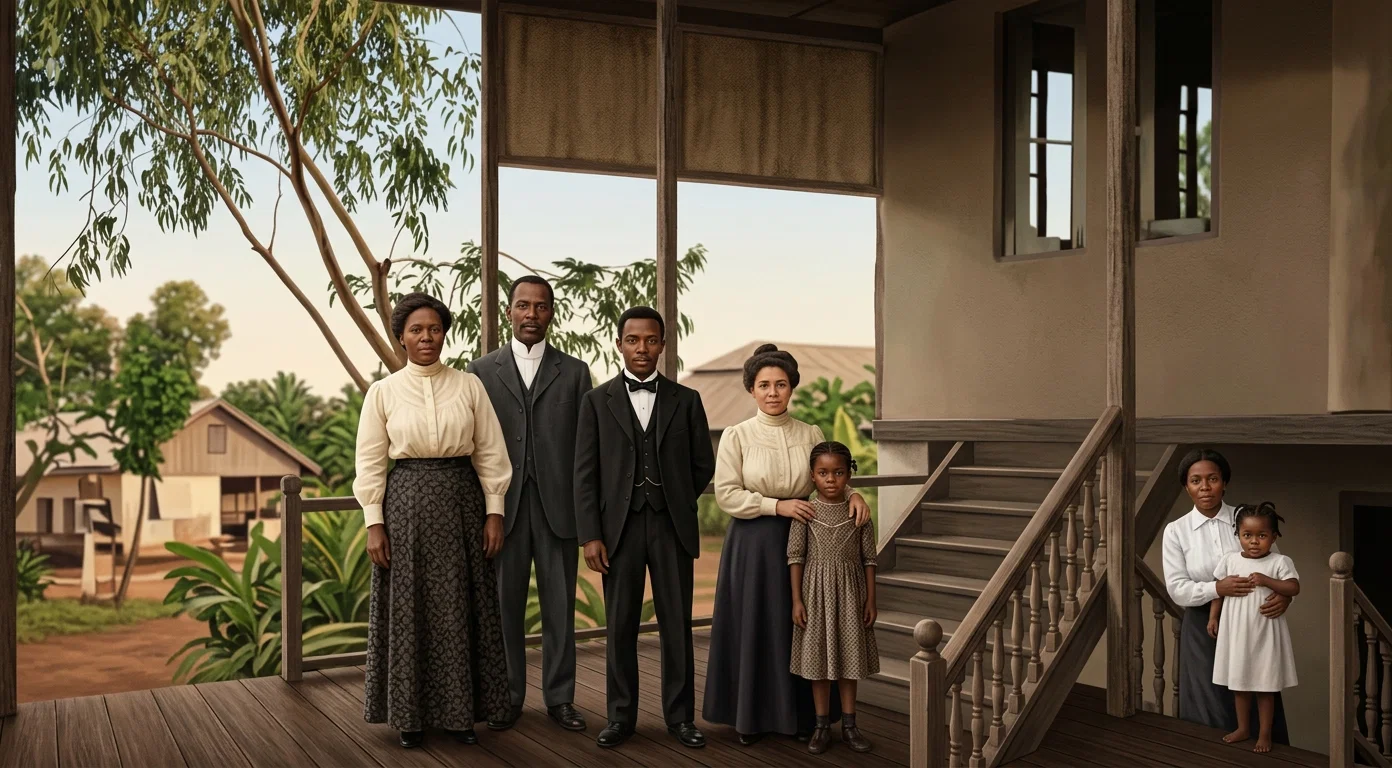
It is now about two years since we came to West Africa. On Jan. 12, 1910, my wife and I, with our two little girls, sailed from New York, and after a pleasant voyage of about a month, our ship cast anchor in the beautiful harbor of Freetown. We were met by Elder D. C. Babcock, whom we came to assist in the work. My wife and children were taken out to the mission home in a hammock (the mode of traveling here), while Elder Babcock and I walked. The mission home is located on the side of a mountain about one and a half miles from the wharf, and is just outside the city limits. It is the most healthful location in the vicinity, and one of the most beautiful places I have ever seen.
At the time we came here, neither Elder Babcock nor I dreamed of my entering the branch of work in which I am engaged. But the Lord, who has said that our ways are not his ways, seems to have planned it thus. A few days after our arrival, the manager of one of the leading English firms in Freetown, learning of my ability as a mechanic, requested Elder Babcock to allow me to repair a damaged truck, which they were about to ship to England for repairs. I did the work, and several similar requests followed in quick succession.
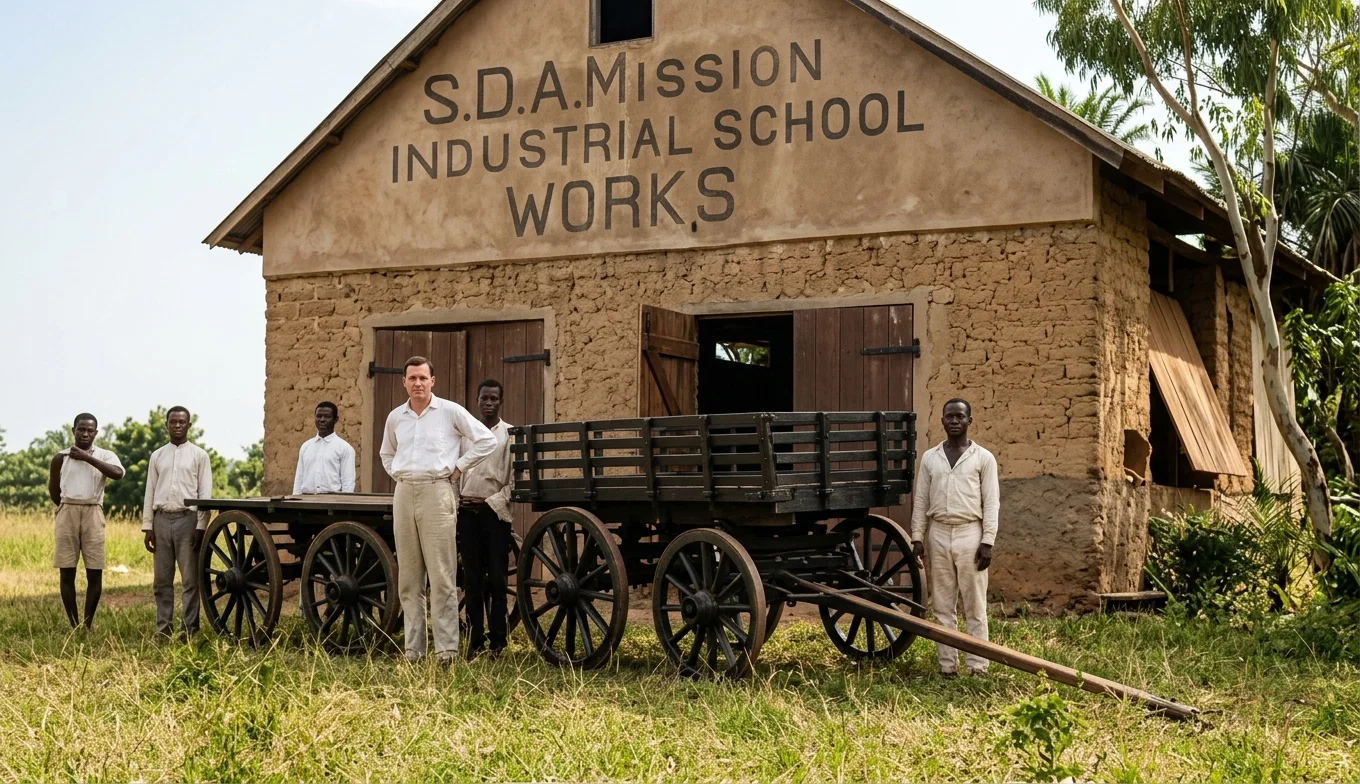
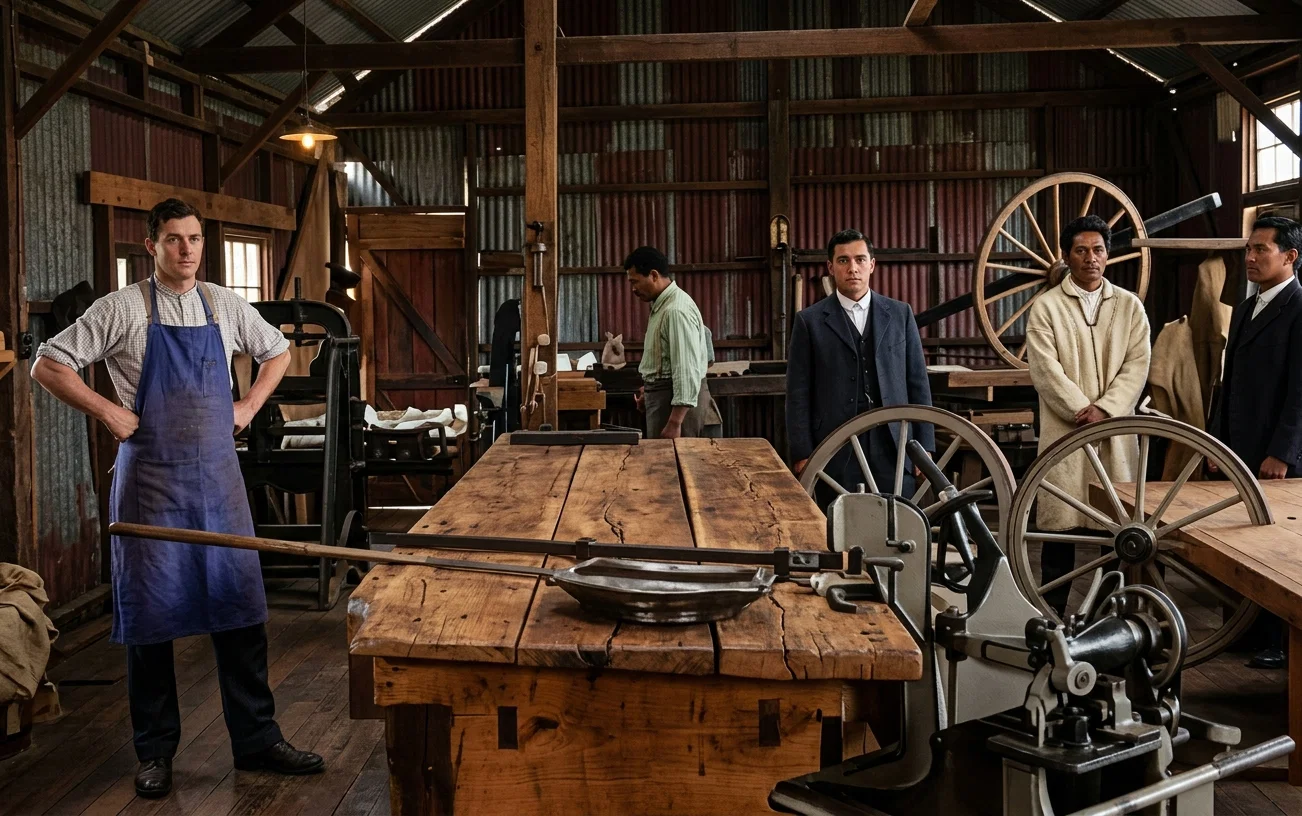
We then began to think of putting up a factory for building and repairing vehicles, employing our schoolboys as assistants. This would give them opportunity to learn a trade in connection with their school work. We began work in a little native shed ten by sixteen feet, and now we have a building twenty-five by fifty feet, and a work of wide-spread influence. I think Elder Babcock does not overstate it when he says that this has done more for the advancement of the work in this field than anything else that has been done, or ever could be done, by breaking down prejudice in the minds and hearts of the people, and in placing us on friendly terms with the government.
The governor, with his staff, visited our factory a few weeks ago, and expressed himself as highly pleased with our work. A few days later he sent the district commissioner to see us, who insisted that we take full possession of a piece of property situated in the interior, on which there are two or three stone and brick buildings, worth several thousand dollars. About three years ago we applied for this property for our school work, and were refused. Now, however, the government raises but little question regarding any application or request that we make of it. We find that in many ways our industrial work here at Waterloo is becoming a great power for good in spreading the message in this dark land.
THE WATERLOO MISSION HOME, WITH BROTHER AND SISTER LEWIS AT THE LEFT AND BROTHER AND SISTER BOLTON AT THE RIGHT
There are about fourteen boys in the factory, and some are becoming quite proficient in the work. While the work of training them is a very hard and laborious task, still we enjoy it, and are glad that our Heavenly Father has seen fit to give us a part in carrying this last message of warning to the world, and especially to this dark part of the vineyard, where Satan has such full and complete sway over the people.
THE WATERLOO WAGON-SHOP
During our first year in the field we all enjoyed very good health; but this year, while the two children and I have kept well, Mrs. Lewis has had a hard time, being in bed most of the time.
Taken as a whole, the past year has been a very hard one for the work on the West Coast of Africa. First came the death of our dear Sister French at Axim, and then the removal for a time of Brother French, on account of ill health, besides other discouragements in the work at that point. At Freetown and here we have been handicapped on account of the severe illness of Mrs. Lewis.
Yet despite all the efforts of the enemy, the work is moving onward. We have enrolled in our school twice as many students as we had at the beginning of the year. While we have been compelled to lay away two sisters, still our little church has had an increase of some ten or fifteen members, all of good courage and rejoicing in the light of this precious message.
The way has especially been opened for the pushing forward of our work into the interior. I took a trip into the hinterland in October, for the purpose of finding a location for establishing a mission station in the chiefdom of a paramount chief, who has a son in our school and factory. I had quite an interesting trip, but my heart was touched to see the superstition and heathenism which prevail on every hand. I passed through thirty or forty towns and villages, traveling three days overland. In only one did I find a mission of any kind operating, and on all sides I heard the Macedonian cry, Come over and help us. We would gladly answer all these pleas, but where are the men and means?
Pray the Lord of the harvest that his Spirit may strive with the hearts of many strong young men and women who are enjoying the precious privileges which a knowledge of this truth brings, that they may give themselves and their all for the advancement of the work in this part of dark Africa.
Waterloo.
A Trip Through South Bolivia
By Otto H. Schulz
OTTO H. SCHULZ
“COMMIT thy way unto the Lord; trust also in him; and he shall bring it to pass.” Ps. 37: 5.
July 19, 1911, I left home for a four months’ trip through south Bolivia. I planned this journey long ago, desiring to visit several cities, but it has been impossible to do so earlier. The trip was to be not only troublesome, but dangerous.
From Cochabamba, a prosperous city in the semitropical climate, a stage-coach drawn by eight mules was our mode of conveyance for a day and a half; then a ride of three hours on a railway train brought me to Oruro. This is a veritable city of the wilderness, with no shrubs nor green trees, but possessing rich mines of silver, copper, zinc, and a small amount of gold. A large German colony has established stores here of considerable importance.
INTERIOR OF WAGON-SHOP AT WATERLOO
Through the bishop’s interference in Cochabamba, I had lost a large number of orders, therefore I continued with the same book in Oruro. I had just made a start when the celebration of the feast of independence began, and it continued for a week. To my regret I was compelled to cease canvassing. The center of attraction was an open-air bull-fight. The whole city went out to view this spectacle, where the blood of men flowed freely. Wild cows and bulls were brought into a large square. Any one had a right to tear off the costly and handsome blankets hanging down from the head or body of the animals, on which gold coins were fastened. The tribunes sounded trumpets and beat drums, making a spirited sort of music to give courage to the people. Many of the people esteem a coin thus obtained more precious than life. The wilder the animals, the better for the spectators.
On the first day several persons received injuries of a more or less serious nature, and two lost their lives. One was stamped by a steer to a shapeless mass; and the other, caught on the animal’s horns, was thrown against a granite fountain standing in the midst of the square, breaking his neck. This sport continued for several days. This old Spanish custom is still in the veins of the Latin race, even the priests saying, “Let the people be merry.”
As Oruro has railroad connection and trading establishments operated by foreigners, especially Germans, this city is more liberal than others. So, without disturbance, I finished canvassing there.
Six weeks later I took train for Uyuni, a city near Chile. This is a small city, but is having a rapid growth. I could stay only two days there, as I did not wish to miss the weekly train going up half way to Potosi. At Uyuni I sold books and periodicals amounting to $25.
The Potosi railroad will be finished in May. The coach now runs between the end of the road and Potosi. The journey is very tedious. Eternal cold reigns at this elevation. A perpetual dusty wind blows. The country is rocky, broken by sandy plains, covered with gray, hard, thorny steppe-grass. Snow, and small lakes with deep blue water, give a change to the otherwise monotonous landscape. The dust inflames the eyes, the head aches, the feet get cold, there are piercing pains in the chest, the heart-beats increase. All these are the results of the high altitude. The road is marked by the bones of animals, and by graves of persons who have fallen prey to the mountain disease. The graves are marked with small crosses.
At this altitude of 15,000 feet only llamas can be used advantageously. They have greater endurance than other beasts of burden, and are easily provided for; but they are very slow and shy. Next are the donkeys and mules. They do not stand so much work as in lower regions, since the tractive power is twenty-five per cent less. Freight is five to ten times higher than in other countries. Horses are unknown here.
The journey by stage-coach was a terrifying one; six mules were harnessed to the coach, and the teamster was drunk and one-eyed,—a shameless fellow, stopping at every opportunity for more drink. We earnestly requested him not to do so, as our lives were in danger. He became very angry; and to show us his skill in driving, he drove with great speed down a narrow mountain pass, skirting the edge of most dangerous precipices, where the slightest accident would have hurled driver, team, and passengers to death on the rocks below. At any minute we could have been tipped over; but I sent up a prayer to the Lord for protection. Under God’s care I arrived safely at Potosi.
This city lies in the department of the same name. The Indian tribe of the Juras with the Quichua tongue lives here. Potosi (meaning “discovered”) is an old city, founded by the Spaniards in the year 1545. Its early name was Villa Imperial. In 1544, the Cerro (mountain) Potosi was discovered by Diego Hualljra. This mighty mountain next to the city, towering one thousand feet above the city, is rich in silver and other precious metals. Much silver was shipped from there to Spain centuries ago. Now it contains over one thousand mines. It is perhaps the highest city in the world, its altitude being about 15,000 feet above sea-level. It has about 25,000 inhabitants; 18,000 being Indians, and the rest whites. These people are very fanatical. The city has thirty churches and cloisters. Many old buildings adorned with the arms of Spanish noblemen bear witness to the Spanish greatness of past times.
As soon as it was known that I was selling books, I was warned to be very careful, as the priests would seek to have me put in jail. I was also told I would need a license, costing from $40 to $100. I laid all my plans before the Lord, knowing that he knows best, as it is his work. I only desired that his will be done. The Lord answered my prayer. Full of courage, I went to the city hall, placed the matter before the officials of the patent office, and gave them a good canvass. But the president of the municipality said, “You are an agent, and you must pay.” I was not satisfied, and told him that for a few weeks’ canvassing it would be too much money. They counseled together, and I began a conversation with the Heavenly Father. Fifteen minutes later a man came out and said, “You are free, but leave two books as presents here; one for the public library, another for the city hall.” I did so, and sold over $175 worth in about three weeks.
I felt a little downhearted on entering that city, seeing all the churches, monasteries, priests, etc. If trouble came, I knew I could not depend for help upon the prefect. He is a strict Catholic, and Protestants are his enemies. I was alone, far from home, a stranger, and no railroad connections nor civilized cities near by. Only through fervent prayers was I freed from this feeling of discouragement. I could feel the satanic power in that city.
Thanks to the Lord, only once was I taken to the police station. This time I was taken right off the street like a criminal. I was questioned about my work, etc., and asked if I was selling books against the faith (Catholic). I said, “No; the books contain the truth of God’s Word.” I was set free again, and the priests’ loop was once more loosened. I could see that Jesus was my unseen Saviour. I owe him much thanksgiving.
The Active Christian
By E. A. Elliott
It is only the pure in heart who may see God; then we must abhor sin and keep on abhorring it; we must not only be hearers of his Word, but doers of his will. The active Christian is alone the happy one.—E. A. Elliott.
God’s Purpose in the Home
By Iza E. Clement
IZA E. CLEMENT
Ever since the expulsion of our first parents from their Eden home, home has been the theme and song of “every nation, kindred, tongue, and people.” A return to the home that was lost through sin, has been the hope of all ages, the goal of the gospel from Adam’s time till the present day. Home is the all-embracing promise of God to his suffering people; and it has been their anchor all along the bloody, persecuted route of the church militant.
Hope of an eternal home that “fadeth not away” has led many to offer themselves as a sacrifice on the bloody altar of martyrdom. It has been the ruling motive in the lives of others, causing them to spend the greater part of their earthly allotment in foreign fields, among heathen people, that these might share with them in their hope of glory and a home everlasting; while still others have been moved by its allurements to leave their earthly home and all that was dear to them in this world, and brave the wrath of ocean storms and the carnage of battle-field, that a nation might be born wherein every man could worship God according to the dictates of his own conscience, and be unmolested in his quest of the home eternal. It has ever been the guiding star of the righteous ones of earth, and will continue to be so until their hope is realized in the home of the saved.
Not only has a forward look to the heavenly home been an inspiration to the fallen race, but a backward glance to the earthly home, its sacred ties and childhood joys, has been a potent factor in restraining the onward march of sin and crime, and in turning many lives into channels of righteousness. What stronger influence for right living, love, mercy, and truth can be wielded than that of the cherished memories of a Christian home, of the family circle, of childish happiness, of the soothing power of parental love and sympathy in hours of trial and distress or of physical pain and sickness?
The Saviour recognized the appealing force of “thoughts of home,” when he related the simple story of the prodigal son, which still lives in song and verse and in the hearts of men; and many there are who will testify that their steps have been turned homeward by its recital.
The prodigal, like many to-day, did not sense the blessing of home until he was beyond the reach of its bounties, a sinner and an outcast. But hardships and suffering cleared his vision; and the home once despised for the glamour of worldly pleasures, rose in reproachful magnificence before him. The memory of that far distant home, with its atmosphere of holiness and purity, its peace and plenty, where not only the family but the servants had bread and to spare, while he perished with hunger, awakened in him such a consciousness of guilt and unworthiness that his soul cried out in agony for even the most menial position there. His only thought, his one longing desire, was for home. As a penitent and an alien he would return; as a servant he would live and be content, if only he could find a place once more in its restful, sheltering embrace.
What better representation of the heavenly home can be found than that of the home where the spirit of Christ reigns? It was for this purpose that the earthly home was called into existence; and it was God’s express intention that the attributes of the heavenly home should be revealed in the earthly, and that by its influence sinners should be reclaimed and brought to the fold of Christ.
The earliest gift that the great heart of a loving Creator bestowed upon man was home. He gave him a garden planted by the Lord’s own hands, told him how to keep it, and then gave him a companion as a suitable helper to make that home a type of the one above.
The first chapter of James says that “every good gift and every perfect gift is from above, and cometh down from the Father of lights, with whom is no variableness, neither shadow of turning.” Of the only begotten Son we read: “Jesus Christ the same yesterday, and to-day, and forever.” Thus God’s purpose, through Christ, concerning the home that he gave to man has never changed, nor will it ever change, but it will continue the same until he has wrought righteousness in the earth.
The home is the cradle of the church, the stronghold of God’s love, the citadel of purity; and when rightly understood and its affairs cooperatively administered, it presents a most formidable front to the enemy of all righteousness. When God created that Eden home and placed in it the sinless pair, he laid down a principle against which “the gates of hell shall not prevail.”
How essential, then, that the home be kept pure, peaceful, elevated, sacred; for the triumph of the gospel, the expectations of Christ, and the assurance of love’s victory, are all centered in its limited but mighty confines.
College View, Nebr.
Thanks
By Joseph I. Breen
O, A PRAYER of thanks is a trifling thing
To give at the close of day
To the God above for the boundless love
He scatters along our way.
It’s a trifling thing which we all may give
With never an ounce of loss;
Yet it seems somehow that we never bow
The head till we’ve felt the cross.
It’s a trifling thing for a man to say,
“I’m grateful, my love, to you,
For the good you’ve wrought and the
joy you’ve brought,
And your heart of the truest blue.”
It’s a trifle, yes, but it seems to me
Worth all the time it may take.
Life, at best, is cold; and for love untold
Some hearts have been known to break.
— Joseph I. Breen.
That Word of Sympathy
By May L. Hanley
MRS. MAY L. HANLEY
It was the last evening train from the beach to the city of Tampico. The three little Mexican pupils were weary and fretful. The excitement of the afternoon, spent in bathing and playing upon the seashore, had abated; and now they were hungry, and wanted to be at home. “Why does the train stop so often?” queried little Felipe, and as if to ascertain for himself, he leaned far out of the window. “Mother said if you couldn’t keep Felipe out of danger, we couldn’t go to the beach again,” said Elena, crossly.
The tired governess exerted herself, and succeeded in attracting and holding the children’s attention, with stories of “when I was in the United States,” and of her childhood days; she was in the midst of the recital of Goliath and David when the train reached the city. They sat quietly listening until the car was almost emptied. As she arose with her little charges, it was plainly to be seen that the governess was weary and worn.
A hand was laid upon her shoulder, and she turned in astonishment, to look into the kindly eyes of an American woman. “Pardon me, but I want to say that I have watched you all the afternoon, on the beach. I am deeply interested in your happy management of those spoiled children. Pray do not be offended by a word of sympathy and appreciation from a stranger.”
How those tired eyes lighted up, and the drooping form straightened, as the governess replied: “O, thank you so much! Did you guess how discouraged I was? May you ever go about cheering up sad hearts.” A hearty clasp of the hand, and she was soon on the street and into the waiting carriage with her pupils.
Only a moment, but who can calculate the far-reaching benefit from that word of sympathy? Speak the cheering words now, for just the same opportunity may never come again.
Thomas, Okla.
Having the Best Time
“THE people who ‘have the best time’ do not always have the best name.”
Los Angeles (Cal.) City Work
By J. W. McCord; A. S. Booth
WHILE the McNamara trial brought Los Angeles somewhat prominently before the world, it takes more than a great crime to make a great city. Los Angeles is rapidly becoming such a city. The picturesque tokens of her pueblo birth are swiftly being displaced by skyscrapers, and tourists are flocking here by thousands.
The Lord is calling upon his people to work the cities, and we have found that he will bless those who undertake this work. Eighteen months ago, the writer, with others, began tent-meetings in South Los Angeles. During this time, our company held four tent efforts, and preached to a congregation that must have averaged fully 225 each evening. Our total expense for five tent efforts was about $1,950, and the donations for the same period amounted to more than $2,000.
As a result of the eighteen months' work, this tent company is able to report one hundred new Sabbath-keepers baptized and added to the church. In addition to this, there are a number from the last effort yet to be baptized. This brought about the organization of the eighth church in Los Angeles, with a present membership of 115. Two months ago this church began to build, and it now has a neat church in which to hold services.17
Methods of Work
Little need be said about our methods of work, as the same methods, no doubt, are being followed by our brethren elsewhere in the States. What we depend upon largely for results is up-to-date advertising, regularly and faithfully done; sermons not too long, but right to the point; house-to-house visiting; the cooperation of our people; and last but not least, the drawing power of a clean tent, pleasantly arranged. All this, of course, would be barren of results without the blessing of the Lord, and to him we ascribe all the glory. Surely the Lord has blessed us in our work, and we earnestly desire to be faithful to our trust.
New Work
The conference has recently moved into new quarters in the heart of the city. From this center we hope to reach the whole city.
Meetings have been held in the new hall, which is centrally located, for nearly two weeks. On an average, about 230 adults are in attendance. The interest is good.
We earnestly ask the REVIEW family to pray for the work in this great city, and especially that the Lord may use us to his glory this winter in the salvation of souls. J. W. McCORD, A. S. BOOTH.
The East Prussian Conference
By GUY DAIL
ONE year ago Western Prussia was separated from the Prussian Conference, and Eastern Prussia alone was made to constitute the territory of the East Prussian Conference. The first annual session of the East Prussian Conference since the division was held in Konigsberg, Dec. 19-24, 1911, and was attended by two hundred fifty of the nine hundred forty-one members that are seeking to hold up the banner in this province.
Aside from the conference workers, Elders J. T. Boettcher, president of the Russian Union Conference, H. F. Schuberth, president of the East German Union Conference, O. Luepke, principal of the Friedensau Industrial School, L. Trautmann, secretary of the East German Union, and the general canvassing agent of the Hamburg publishing house, Brother H. Boex, assisted us in the conference, giving much appreciated and valuable instruction. God's Spirit was with us from the beginning to the close of the meeting, and was manifested in the business transactions as well as in the public lectures and Bible instruction and seasons of prayer that were held each day. Sabbath was a day of special blessing. The entire congregation heartily rededicated themselves to God. The regular conference sessions were held in our new chapel in Konigsberg; the evening lectures were given in a fine hall located in the central part of the city. About three hundred persons attended the evening meetings.
The report of Elder O. Schwenecke, the president, showed that there had been an average of ten workers in the employ of the conference for the year 1911, and that the Lord had so richly blessed their efforts that there had been 185 additions by baptism and vote, with a net gain of 163. Four new companies were received into the conference at this time. The strong missionary interest of the delegates was shown by their gift of 2,643 marks for missions, 2,316 marks of which was cash. This brings the weekly average of gifts for missions up to ten cents a member for 1911.
We are happy to see an increase of about a mark a day in the average earnings of the canvassers of East Prussia for the year compared with 1910. There were on the average fourteen colporteurs employed in the conference, and their sales amounted to 21,104 marks.
The prospect is also good for securing a number of earnest young workers in this province, as nearly a dozen were recommended for the Friedensau school, who have been doing earnest missionary work in the young people's societies.
The outlook of the work in this field is promising. There is need for an increase in the tithe, which has fallen off on an average of two marks a member, as compared with 1910; but we have every reason to hope for an increase during 1912. May God give success, and hear the prayers of his people for the continued advance of the cause in East Prussia. GUY DAIL.