The Youth’s Instructor, Vol. 29, No. 36.

The Thousand Islands

The Youth’s Instructor

Sep 7, 1881

S. D. A. Publishing Association · Battle Creek, Mich. · Sep 7, 1881

The Thousand Islands.
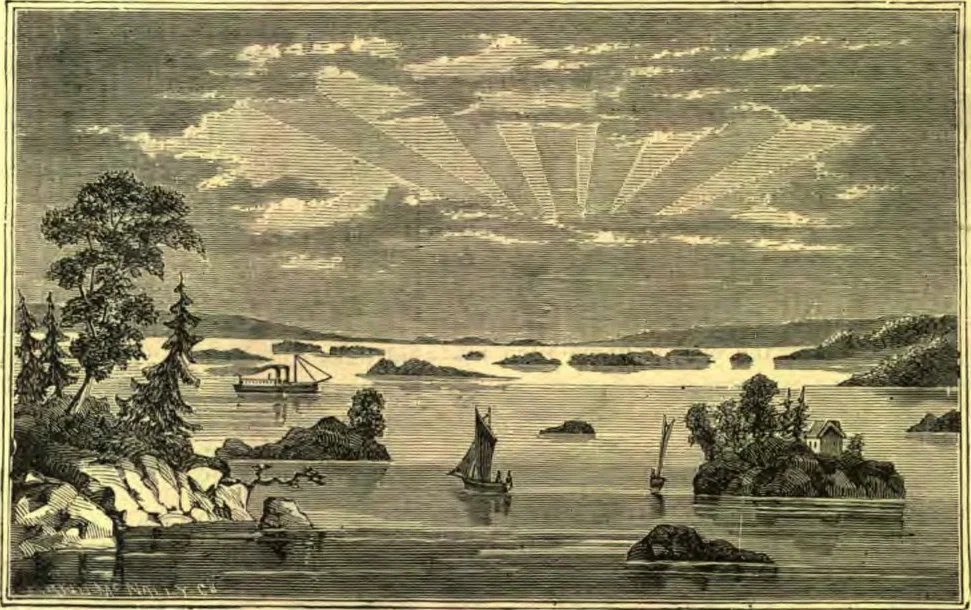
How many of you can tell where the Thousand Islands are? Well, take your geography and find the map of the State of New York. Now find the St. Lawrence River.
You will not find as many islands on the map as their name denotes; but just at the outlet of Lake Ontario is another lake called the Lake of a Thousand Isles, and in this are found the Thousand Islands. Although this group is called the Thousand Islands, it does not mean that there are but one thousand islands, for there are said to be about eighteen hundred. This group is the most numerous collection of river islands in the world.
For some time the question as to which government, Canadian or American, should have control of certain of these islands, was an open question, and serious disputes arose from time to time. Between the years 1820 and 1822 a company of persons was appointed by each government, and invested with the power to settle the question by fixing a boundary line. The line was originally drawn through the center of the river, and gave to the American government Long Island, the largest one of the archipelago. It is about twenty miles in length and nine miles in width. This island is situated in the St. Lawrence near the place where the river leaves Lake Ontario.
The Canadian government, seeing at once how disastrous to their defense in case of war, would be the occupation of this island by the Americans, proposed to exchange for it the large islands of Grindstone and Wells, between Clayton and Alexandria Bay, and Bernhardt near Ogdensburg. This proposition was accepted by our government, and accounts for the zigzag course of the boundary line among the islands.
In 1823 Elisha Camp, of Sackett’s Harbor, was given the exclusive right of the islands on the American side. These islands were owned after this successively by Sackett, Sanford, Yates, and finally came into the hands of Parson and Walton. In 1846 Cornwall and Walton purchased of Parson and Walton a tract of land which commenced at the head of Grindstone Island, containing 6,000 acres, for $3,000. With this purchase, the smaller islands for a distance of thirty miles were thrown in to make good measure.
In 1870 Cornwall and Walton concluded to sell these smaller islands separately in order to develop the region as a summer resort. In 1872 they deeded, free of charge, to Staples and Mott the site where the Thousand Island House now stands, and this large hotel was erected by them in 1872–3. With the building of this hotel commenced the history proper of the Thousand Islands as a summer resort.
It is stated that islands which eight years ago could be bought for $40 and $50, and were given to Cornwall and Walton, are to-day worth from $10,000 to $100,000. Hart’s Island, upon which Moore wrote a poem, was sold for $40, and now is valued at $25,000. Manhattan Island, for several years the residence of Seth Green, was bought for $50, but it is now valued at $10,000.
The four islands occupied by the wife and sons of Asa L. Packer were bought for $50, and now their value is estimated at $100,000, although it is thought that they could not be bought at any reasonable price. Of course these estimates include the improvements made, but this increase of valuation has been reached by a comparatively small outlay. I visited this charming summer resort in 1876, and never before had I seen such a variety of beautiful scenery. Wells Island, on which the Thousand Island Park is situated, is laid out in streets and parks and is very pleasant. The Methodists hold a camp-meeting on this island every fall; and several persons have bought lots and erected fine cottages, and in this delightful place, with the grand old St. Lawrence in full view, they spend the hot summer months.
At Alexandria Bay is located the Crossmon House, a mammoth hotel; and the summer that I was there it was said to be incapable of accommodating all who wished to find lodging there.
But it must not be supposed that all these islands are so valuable or so attractive. Many of them are simply rocky projections jutting above the water like the ones represented in the fore and back ground of the accompanying engraving. Others, however, which are so small as to have no name given them, are owned and inhabited by persons who take great pleasure in laying them out in gardens and flower-plots, and making them as attractive as possible.
But it would take an abler pen than mine, and more thorough acquaintance with these lovely specimens of God’s handiwork to give you a just idea of their beauty. And now if you have become interested in the Thousand Islands and wish to know more about them, my advice is, visit them another summer and see for yourselves.
S. N. Curtiss.

A CHILD’S FAITH.

In the Highlands of Scotland there is a mountain gorge twenty feet in width, and 200 feet in depth. Its perpendicular walls are bare of vegetation, save in the crevices, in which grow numerous wild flowers of rare beauty. Desirous of obtaining specimens of these mountain beauties, some scientific tourists once offered a Highland boy a handsome gift if he would consent to be lowered down by a rope, and would gather a little basketful of them. The boy looked wistfully at the money, for his parents were poor, but when he gazed at the yawning chasm he shuddered, shrank back, and declined. But filial love was strong within him; after another glance at the gift and at the fissure, his heart grew strong, and his eye flashed, and he said, “I will hold the rope.” And then, with unshrinking nerves, and his heart firmly strong, he suffered his father to put the rope about him, lower him into the wild abyss, and to suspend him there while he filled his basket with the coveted flowers. It was a daring deed, but his faith in the strength of his father’s arm and the love of his father’s heart gave him courage and power to perform it.

GOLDEN-ROD

WHEN the wayside tangles blaze In the low September sun, When the flowers of summer days Droop and wither one by one, Reaching up through bush and brier Sumptuous brow and heart of fire, Flaunting high its wind-rocked plume, Brave with wealth of native bloom,— Golden-rod!
When the meadow lately shorn, Parched and languid, swoons with pain, When the life-blood, night and morn, Shrinks in every throbbing vein, Round her fallen tarnished urn Leaping watch-fires brighter burn; Royal arch o’er autumn’s gate, Bending low with lustrous weight,— Golden-rod!
In the pasture’s rude embrace, All o’errun with tangled vines, Where the thistle claims its place, And the straggling hedge confines, Bearing still the sweet impress Of unfettered loveliness, In the field and by the wall, Binding, clasping, crowning all,— Golden-rod!
Nature lies disheveled, pale, With her feverish lips apart; Day by day the pulses fail Nearer to her bounding heart; Yet that slackened grasp doth hold Store of pure and genuine gold: Quick thou comest, strong and free, Type of all the wealth to be,— Golden-rod!
—All the Year Round.

THE GYPSIES.

A BRIEF SKETCH OF THIS SINGULAR PEOPLE.

Who has not heard of the gypsies? Who has not seen these strange wanderers? Who are they? Where did they come from? What about them?
The gypsies are a mysterious, vagabond race, classed with vagrants and thieves, usually living in clans, and scattered over the whole earth. They abound in every part of Europe, in Asia, and North Africa; more limited numbers stroll through the United States and Mexico, and they are found even in distant Australia. It is estimated that at the present time there are five million gypsies on the globe. As a general thing, they have no fixed habitation, but wander from place to place in the capacity of tinkers, musicians, fortune-tellers, horse-traders, cattle-doctors, etc., etc. The true gypsy is a versatile creature, being, as occasion may suit, a preacher, actor, showman, or trader, but ever a sharper, who will turn the penny to his own advantage.
In appearance, the gypsies are about the same in all countries, the prevailing characteristics being, tawniness of skin, long black hair, sparkling black eyes, snowy white teeth, and lithe and slender forms. They are quite insensible to cold and wet, and are capable of enduring great fatigue. Probably many generations of out-door life has had much to do with this. The gypsies are a proverb for their squalor, their indolent and careless life, and the vices of smoking and drinking. Many of the women, as well as the men, both chew and smoke tobacco.
The name gypsy is quite commonly supposed to be derived from the word “Egyptian.” They call themselves Pharaons, in allusion to Pharaoh; and Roma, a Coptic word which means men; and Sinte, probably from the Sind, or Indus, river, where large numbers are to be found. Among the nations they are known by epithets somewhat expressive of their character. The Hollanders call them Heidens, that is, heathens; in Denmark and Sweden they are known as Tartars; the German nickname for them is Zieh-gauner, wandering rogues; in Spain they are called Gitanos, a word expressing their craftiness; their Arabian name is Hara’mi, villains; in the Cypriote tongue (on the Isle of Cyprus) they are known by a word which means “a sword”; the Hungarians call them Pharao-népek, Pharaoh’s people; etc. In France they are called Bohemians, because when they first came to Paris, they traveled through Bohemia. The Scotch call them Tinklers, probably a mere variation of the word tinker. In Russia, Turkey, and Italy, they are called Zigani, Zingarri, and Zingani, which terms are supposed to be derived from a gypsy root which means “the dark men of Zind.”
Their origin, and the motives which led them to forsake their native soil, and become wanderers on the globe, are questions which have never been positively settled, though very wise heads have devoted much attention to the subject. It is a point upon which volumes have been written by the most careful thinkers, English, French, and German. Without doubt, portions of the gypsies in their migrations came from Egypt, or at least, through Egypt. Writers on gyptology believe them to have made their first appearance in Europe during the Middle Ages, and then afterwards, in vast hordes, in the fifteenth and sixteenth centuries. And it is quite generally maintained that the language denotes an East Indian origin. Many writers conjecture that the wars of the tyrant Tamerlane were the cause of this general stampede of the gypsies. In 1427 a band of these nomads first appeared at the gates of Paris, but the authorities would not allow them to enter the city. Others soon made their appearance, and were scattered by thousands through Germany, Spain, England, Russia, and, indeed, to the remotest parts of Europe.
The gypsies’ own story, which they most frequently gave of themselves was, that they originally came from “Little Egypt,” that the king of Hungary had compelled four thousand of them to be baptized, had slain the remainder, and condemned the baptized ones to wander seven years. Another version was that the Saracens had gone to war with them in Egypt, had subdued them, and forced them to renounce Christianity; that afterwards they had been conquered by the Christians, and that the pope had laid on them, as a penance for the renunciation of the true faith, a life of wandering for seven years, during which time they were not to stay in a bed! Many other idle tales they also related.
G. W. AMADON.
(Concluded next week.)

BROKEN

“Aren’t they just lovely?” Estelle Brownson held the quaint, dark blue cream pitcher aloft, to show how transparent it was.
“Oh, they are too pretty for anything!” declared Frances Holmes, her dear friend, and she wound her arm caressingly around a dark blue plate as she spoke. “I don’t believe another girl can bring such a charming array of old things as you can. How came your grandmother to let you take them?”
“I’m sure I don’t know; I didn’t expect it, she thinks so much of them. Grandpa bought them, you know, when they first commenced housekeeping, sixty years ago. Just think, Frances, of having been a housekeeper for sixty years! I was telling mamma about the old folks’ supper, how we were going to have all the nice, old-fashioned things we could get for the table; and I was complaining that our things were so distressingly new, when grandma said, ‘I suppose you would like the blue china tea-set to dress your table with.’ I gave a little scream, and said I guessed I would better than anything in the world, and when she said I might take it, I gave her such a hugging it nearly took her breath away. I would not have one of the pieces broken for anything. I am afraid it would break grandma’s heart. I shut Tiny up in the nursery for fear she would break something.”
[But somebody had let Tiny out of the nursery.]
“O Stella!” she said, as she came within hearing, “mamma says I may go to the supper, and she will dress me up in white pantalets, and a long-sleeved, high-necked, white apron, just as little girls used to dress years ago. Won’t I look too funny?” And the happy little girl whirled on one foot and came up with a thud against her sister just as she was turning to set the cream pitcher down. Down it went on the hard floor, and of course it broke into—I don’t know how many—pieces. Poor little Tiny! How suddenly the happy light went from her eyes, and her face grew pale. But Estelle did not see it; all she saw was the cream pitcher in hopeless ruins. “You naughty, careless, wicked girl!” she exclaimed, her voice hoarse with anger; “you hit my arm on purpose; I know you did! You are a perfect little nuisance! always in the way; the idea of your bunting up against me in that manner. You ought to be whipped severely, and I’ll tell mother so; see if I don’t. Come into the house this minute!” And she seized the arm of her frightened little sister, and dragged her up the steps and through the hall in frantic haste.
It was hours after that, in the cool of the afternoon, that Estelle knocked softly at the door of grandmother’s room, then slipped in and sat down in a sorrowful little heap at her feet. “O grandma!” she said, “have they told you? I’m so awfully sorry! I could cry for a week if that would only mend it.”
“So am I, child,” said grandma, knitting away quietly on her stocking; “I would cry, too, if that would do any good; but tears will not mend them; there were so many of them broken, too; that seems to make it worse.”
Then Estelle lifted her sorrowful face. “O grandma!” she said, “there was only one broken; that was bad enough; did you think there were more?”
Grandma gravely shook her white old head. “You are mistaken,” she said; “there was more than one, child; I was in the sitting-room at the time, and heard the crash. Let me see, ‘Bear ye one another’s burdens;’ that was broken, I’m sure; poor little Tiny had to bear her own heavy burden. Then, ‘Be ye kind one to another, tender-hearted, forgiving one another;’ I’m afraid that was dreadfully broken. Oh, there were a good many of them; I felt them rattling about my ears all the morning.”
“Not another word,” said Estelle. For ten whole minutes she buried her head in grandmother’s apron; then grandmother said softly, “Take them to Him, child, and try again.”—The Pansy.

THE TRUE FRIEND.

THE friend who holds the mirror to your face, And hiding none, is not afraid to trace Your faults, your smallest blemishes within; Who friendly warns, reproves you if you sin— Although it seem not so—he is your friend. But he who ever flattering, gives you praise, But ne'er rebukes, nor censures, nor delays To come with eagerness and grasp your hand, And pardon you, ere pardon you demand— He is your enemy, though he seem your friend.

Underneath Are the Everlasting Arms

ONE of the sweetest passages in the Bible is this: “Underneath are the everlasting arms.” It is not often preached from; perhaps because it is felt to be so much richer and more touching than anything ministers can say about it. But what a vivid idea it gives of the divine support! God knoweth our feebleness. He remembers that we are dust.

THE CHILD'S PRAYER.

His little dimpled hands were crossed, His face looked saintly fair, With upturned eyes of tender blue, And waves of golden hair, And by his dainty couch he knelt To lisp his evening prayer.
“Dear Lord,” he said, “I want to know If you will bless to-night All naughty, wild, and wicked boys— The boys who swear and fight! Please, too, to help those dreadful ones Who steal, and run away, And never, never do what’s right Through all the blessed day.”
Amazed his mother heard the plea, And wonderingly she said, “Why, what, my darling child, has put Such fancies in your head! Why don’t you pray for brother Charles And little cousin Fred?”
“Why should I pray for them, mamma? They’re good and happy, too; The Lord has done enough for them; I want him now to do Something for those poor, friendless chaps Who must be cross and bad, Because they’ve nothing in the world To make them good or glad.”
Oh, wisdom of the child’s pure heart, Oh, sweet and loving creed, That gives such tender, pitying thought To souls in direst need! Could schoolmen, with their varied lore, A larger lesson teach? Or churchmen, from their sacred desk, Diviner doctrine preach?

Educating the Head, Heart, and Hand

EVERY boy should have his head, his heart, and his hand educated. Let this truth never be forgotten. By the proper education of the head, he will be taught what is good and what is evil, what is wise and what is foolish, what is right and what is wrong. By the proper education of the heart, he will be taught to love what is good, wise and right, and to hate what is evil, foolish and wrong. And by proper education of the hand, he will be enabled to supply his wants, and to assist those around him.

One Brave Endeavor, One Grand, Sweet Song

MAKE thy life one brave endeavor, one grand, sweet song.

NEW-TESTAMENT HISTORY.

LESSON 46.—MIRACLE OF THE LOAVES AND FISHES.

In our last lesson, Jesus again reproved the Jews for substituting formalities for true godliness, and showed how they had set up their own traditions in place of the commandments of God. This reproof and instruction were given at Capernaum. And we read that he “went thence and departed into the coasts of Tyre and Sidon,” where he healed the daughter of the Syro-phoenician woman.
“And again, departing from the coasts of Tyre and Sidon, he came unto the Sea of Galilee, through the midst of the coasts of Decapolis. And they bring unto him one that was deaf, and had an impediment; and they beseech him to put his hand upon him. And he took him aside from the multitude, and put his fingers into his ears, and he spit, and touched his tongue, and looking up to heaven, he sighed, and said unto him, Ephphatha, that is, Be opened. And straightway his ears were opened, and the string of his tongue was loosed, and he spake plain. And he charged them that they should tell no man: but the more he charged them, so much the more a great deal they published it.”
And he went up into a mountain, and sat down there. “And great multitudes came unto him, having with them those that were lame, blind, dumb, maimed, and many others, and cast them down at Jesus’s feet; and he healed them: insomuch that the multitude wondered, when they saw the dumb to speak, the maimed to be whole, the lame to walk, and the blind to see; and they glorified the God of Israel. Then Jesus called his disciples unto him, and said, I have compassion on the multitude, because they continue with me now three days, and have nothing to eat; and I will not send them away fasting, lest they faint in the way. And his disciples say unto him, Whence should we have so much bread in the wilderness, as to fill so great a multitude? And Jesus saith unto them, How many loaves have ye? And they said, Seven, and a few small fishes. And he commanded the multitude to sit down on the ground. And he took the seven loaves and the fishes, and gave thanks, and brake them, and gave to his disciples, and the disciples to the multitude. And they did all eat, and were filled; and they took up of the broken meat that was left seven baskets full. And they that did eat were four thousand men, besides women and children.
“And he sent away the multitude, and took ship, and came into the coasts of Magdala.” Then the Pharisees and Sadducees came to him, and began to question him. They also tempted him by asking him that he would give them a sign from heaven. Jesus was grieved at their depravity, and sighed in spirit. He then said unto them, “When it is evening, ye say, It will be fair weather; for the sky is red. And in the morning, It will be foul weather to-day; for the sky is red and lowering. O ye hypocrites, ye can discern the face of the sky, but can ye not discern the signs of the times? A wicked and adulterous generation seeketh after a sign; and there shall no sign be given unto it, but the sign of the prophet Jonas. And he left them, and departed.”
“And he left them, and entering into the ship again, he departed to the other side. Now the disciples had forgotten to take bread, neither had they in the ship with them more than one loaf.”
“Then Jesus said unto them, Take heed and beware of the leaven of the Pharisees and of the Sadducees. And they reasoned among themselves, saying, It is because we have taken no bread. Which when Jesus perceived, he said unto them, O ye of little faith, why reason ye among yourselves, because ye have brought no bread? Do ye not understand, neither remember the five loaves of the five thousand, and how many baskets ye took up? neither the seven loaves of the four thousand, and how many baskets ye took up? How is it that ye do not understand that I spake it not to you concerning bread, that ye should beware of the leaven of the Pharisees and of the Sadducees? Then understood they how that he bade them not beware of the leaven of bread, but of the doctrine of the Pharisees and Sadducees.”

QUESTIONS.

1. For what did Jesus reprove the Jews in our last advance lesson?
2. What did he show them in regard to their traditions?
3. What called forth these remarks from our Lord?
4. Where did this happen?
5. Where did Jesus then go?
6. Where are these cities situated? See Notes.
7. What can you say of their history and present condition?
8. What noted miracle did Jesus perform in that country?
9. Whither did he go on leaving that region? Mark 7:31.
10. What route did he probably take in order to go through Decapolis to the Sea of Galilee? See Notes.
11. Where was the region of Decapolis principally situated?
12. What is the meaning of the word Decapolis?
13. What notable miracle did Jesus perform there? Verses 32–36.
14. As Jesus came nigh unto the sea, to what quiet place did he retire? Matt. 15:29.
15. Who came to him there?
16. What did they bring with them?
17. What did Jesus do for these afflicted people?
18. What caused the multitude to glorify the God of Israel?
19. After all that were infirm had been healed, what called out our Lord’s compassion for the multitude?
20. What did he say to his disciples?
21. What reply did they make?
22. How much provision had they on hand?
23. What command did Jesus give?
24. What did he do after they were seated?
25. How many people partook of this food?
26. After they were all satisfied, how much was taken up?
27. After sending away the multitude, what did Jesus do?
28. Where is Magdala situated?
29. In what direction must Jesus and his disciples have crossed the sea in going to Magdala from the place where the multitude were miraculously fed?
30 Who came forth at Magdala, and began to question him? Matt. 16:1; Mark 8:11.
31. What did Jesus say to them? Matt. 16:2–4.
32. When Jesus and his disciples had embarked again, where did they go? Mark 8:13.
33. What did the disciples forget to take with them?
34. How much bread had they?
35. What admonition did Jesus give them as they reached the other shore? Matt. 16:6.
36. What did they think he meant?
37. When Jesus perceived their thoughts, what did he say to them? Verses 8–10.
38. How did they then understand the figure which he had given them?

NOTES

Tyre and Sidon.—These were cities of Phoenicia, situated on the Mediterranean, and were formerly very opulent, and distinguished for merchandise. Both these cities were very ancient. Sidon was famous for its great trade and navigation. Its inhabitants were the first remarkable merchants in the world, and were much celebrated for their luxury. In the time of our Saviour it was probably a city of much splendor and extensive commerce. It is now called Saida, and is far less prosperous than in the time of Christ. Tyre was situated about twenty miles south of Sidon. It was originally built partly on a small island about half a mile from the shore, and partly on the mainland. It, too, was a city of great extent and splendor, and extensive commerce. It abounded in luxury and wickedness. The prophecies uttered against these cities, especially Tyre, have been remarkably fulfilled, till of this once proud city there remains little more than the sea-beaten ruins. For a fuller description of these cities and their history, see article in INSTRUCTOR No. 13 of present volume.
Decapolis.—Decapolis was a region of country lying mainly to the southeast of the Sea of Galilee, and bordering upon it. The word means the region of the ten cities; but just what cities constituted the ten is uncertain, since they are variously given by different authors. According to the Bible narrative, Jesus left the region about Tyre and Sidon and came through Decapolis to the Sea of Galilee. In order to do this, he must have crossed the Jordan some distance above the sea,—probably at Dan, one of the chief sources of that river,—then passed on eastward and southward until he came into the region of Decapolis.
Coasts of Magdala.—Mark says, in speaking of the same event, “The parts of Dalmanutha.” Mark 8:10. Magdala is now called Mejdel, and is situated a few miles north of Tiberias, in the land of Gennesaret, on the western side of the Sea of Galilee, or Tiberias, and directly east of Cana of Galilee. Says Thomson in his Land and the Book: “It is a wretched hamlet of a dozen low huts huddled into one, and the whole ready to tumble into a dismal heap of black basaltic rubbish.” Dalmanutha was probably a small village near to Magdala, of which no remains have been discovered. There is no contradiction in the statements of the two evangelists here, for they do not say that Jesus went to either of these towns, but only to the coasts or parts where they were situated.

TENT LIFE IN THE HOLY LAND.

What a charm there is in tent life on the hills and plains of Palestine! It presents such a contrast to the staid routine, alike of labor and recreation in our island home [England], to the rapidity and regularity of rail and hotel, that one can scarcely think himself in the same world. The sense of complete freedom, of absolute independence, is strange and new. Then there is the dash of danger, the exhilarating effect of pure air and exercise, and, above all, the magic influence of place—of sacred and historic associations ever crowding on the mind, suggested and awakened by names and scenes, all of them of hoary antiquity, and yet all familiar as household words and childhood’s home. Every spot on which we tread is holy. Every ruin we pass by has a place in history. Every mountain and vale the eye roams over has a story written in the oldest and best of books. All we see belongs to and illustrates the past. The costumes of the people, the implements of husbandry, the houses, the tents, are all such as were familiar to Abraham; and the salutations are the very same with which Abraham was greeted when he visited the Philistine lords at Gerar, or bargained for the field of Machpelah at Hebron. We roam through these hallowed scenes all the day, and when evening comes, we select some grassy spot beside bubbling fountain or old well. We dismount; and then, as if by magic, horses are picketed, tents are pitched, fires are kindled, and all got ready in true gypsy style—in patriarchal style, I should say—for thus the old patriarchs lived and traveled through these very hills and plains.—Syria’s Holy Places.

SCENES IN THE LIFE OF CHRIST.

LESSON. 33.—REVIEW.

  1. In his sermon on the mount what did Jesus say about the poor in spirit?
  2. What did he say about those who were persecuted for righteousness’ sake?
  3. How ought we to feel when people speak evil against us falsely because we serve the Lord?
  4. What did Jesus say about the meek?
  5. What about the merciful?
  6. What other kinds of people are blessed?
  7. What blessing did Jesus say each of these classes of people should have?
  8. How may we enjoy all these blessings?
  9. Can all be rich in money and such things?
  10. What other kinds of riches does the Bible tell us about? 1 Tim. 6:17, 18; James 2:5; Eph. 2:4.
  11. May we all become rich in good works, in faith, and in mercy?
  12. Which is the best kind of riches? Why?
  13. May we all become rich in this way?
  14. Should we be glad to have all men speak well of us? Why not?
  15. Should we be glad to have all good people speak well of us?
  16. To what does Jesus compare his disciples in Matt. 5:13?
  17. For what is salt useful?
  18. How are Christians like salt?—By their good example they keep the world from becoming wholly corrupt.
  19. What is said of salt that has lost its saving quality?
  20. How may Christians become like salt that has lost its savor?—By grieving away the Spirit of God, so that they no longer set a good example.
  21. How may Christians be the light of the world?—By their good works they may show all men how to live.
  22. What is meant by the law?
  23. Where was the law first given?
  24. How was it written?
  25. How many of you can repeat these commandments?
  26. What is meant by the prophets?
  27. How many of the prophets can you name?
  28. When did Isaiah prophesy?
  29. Who was king of Judah at that time?
  30. Tell something about the life of Jeremiah.
  31. When did Daniel prophesy?
  32. In his sermon on the mount what does Jesus say about the sixth commandment?
  33. What does he say about our conversation?
  34. Whom does Jesus say we should love?
  35. Whom should we bless?
  36. To whom should we do good?
  37. For whom should we pray?
  38. Who is it that continually sets us a good example in all these things?
  39. What did Jesus say about giving alms?
  40. What did he say about praying?
  41. Repeat the prayer which our Lord taught his disciples.
  42. What did he teach about fasting?

NOTE

Blessed are the poor in spirit.—The word blessed, in this and the following verses, is to be taken in in the sense of the word happy, that is, the people described are in a happy, or blessed, condition. “The poor in spirit.” This seems to mean those who have such a sense of the riches of grace that their present attainments seem exceedingly meager. Dr. Clarke says: “They are those who are deeply sensible of their spiritual poverty and wretchedness.” Such people are almost of necessity poor in the things of this life; for their minds are so set on obtaining heavenly riches that they do not seek to obtain the sordid wealth of this world. Such a condition would seem to lead directly to that hungering and thirsting after righteousness mentioned in verse 6.
Continue reading: JERUSALEM