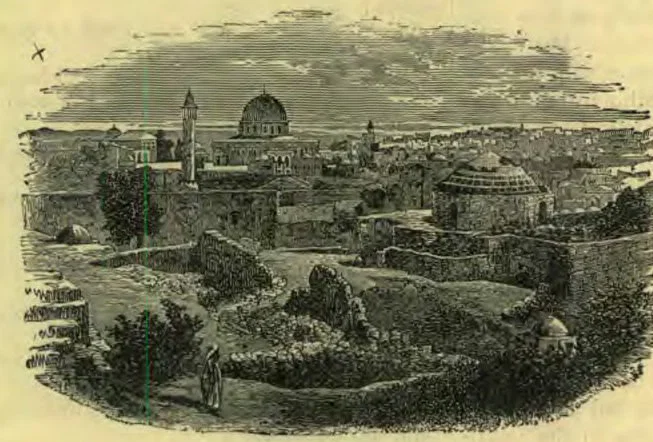
JERUSALEM, as the children will all remember, was the chief city of Palestine, and here it was that the temple stood, in which for so many years sacrifices were offered, pointing forward to Jesus, the Saviour of the world. In a little village a few miles from Jerusalem, he was finally born; and when he was about six weeks old, he was presented before the Lord in the temple at Jerusalem. Though he did not make this city his home, he often visited it during his life; and here it was that he was at last put to death on the cross by wicked men, and so became the great sacrifice for the sins of all the people of the world.
Since that time, the city has been almost destroyed, and though it has been partly built up, it is not and never will be the beautiful place that it was in Christ's day. If you were to visit Jerusalem now, you would not find the temple, for it was burnt long, long ago. On the spot where it stood, there is a large, curious-looking building, with a fine dome on the top. You can see it very plainly in the picture, which is a very good one of modern Jerusalem. You see the building looks a little like the pictures of the capitol at Washington. Well, this is called the “Mosque of Omar,” or the “Dome of the Rock.” A mosque, you know, is a Mohammedan church, and this one is called after a Mohammedan saint named Omar.
The mosque is built of marble, on a raised marble platform. The outside is covered with bright-colored tiles, which in the sun reflect all the colors of the rainbow. It has eight sides, instead of four, like our churches, and each side is sixty-seven feet long. The roof is supported by three rows of marble columns, one inside the other. On the top of the dome is a golden crescent,—the figure of a new moon,—which is the symbol of the Turkish power. We always see it on their national flag.
If you enter the mosque, directly under the dome you will be surprised to see a dark, rough stone rising up through the marble floor, five or six feet high. It looks very odd; and you will ask, “What does this mean?” You will perhaps be more surprised when you are told that it is this rock which makes the place so sacred to the Mohammedans, and which gives the mosque the name, “Dome of the Rock.” On this very spot, they say, Abraham offered up Isaac or rather offered up the lamb caught in the bushes, instead of Isaac. This, too, was the threshing-floor of Ornan, where the angel from Heaven talked with David, and which David bought that he might build an altar unto the Lord there. Here, too, David’s son Solomon afterward built the first temple. The story of David’s meeting the angel here you will find in the 21st chapter of 1 Chronicles.
Every Friday night a curious scene takes place near this mosque. Down in a valley there are some large old stones, which the Jews say were a part of the foundation wall of their temple; and they come every Friday night at the beginning of the Sabbath, and sit in a row opposite the stones, and cry. Then they kneel down and pray, with their mouths close to the stones, because they think that the prayers whispered between the cracks and crevices of these stones, God will be sure to hear. What Jesus said about the ruins of their beautiful temple and city has come to pass. The thought of it made Jesus weep, and now the sight of it makes the Jews weep.
Jerusalem is a sad and silent city, with piles of rubbish and ruins in and around it. The houses are mostly crowded and dark and the streets narrow and dirty. When we sing:— “Jerusalem, my happy home! Name ever dear to me!” we do not mean the Jerusalem where Jesus was when on earth, but the Jerusalem above, the beautiful home which he has gone to prepare for his people. You may read a description of this city in the 21st chapter of Revelation. By-and-by Jesus will come back and take all his children who have loved and obeyed him on earth to dwell with him in this beautiful city. Do you not all want a home in this New Jerusalem, which will stand forever, and never become ruined or old? E. B.
THE REGALIA.
The English crown-jewels are called the Regalia. They are valued at three million pounds, and are kept in the Tower of London.
The first kind of crown worn by kings was the diadem—a simple fillet of silk. Constantine the Great first used a diadem of pearls and rich stones, and soon after a hoop was added over the head, which made it more like the modern crown. The first crown, properly so-called, is that which appears upon a coin of Ædrid, son of Edward the Elder, about 949. At the time of Edward the Confessor, the crown was kept steady on the head by an ansula, or clasp, fastened under the chin, of which the two ends hang down on coins like lappets. From the time of Edward the Confessor all the English kings were crowned at Westminster Abbey, except Henry III. and Edward V., and there the Regalia were formerly kept, in an arched room in the cloisters, in an iron chest.
The state crown of Queen Victoria was made for her coronation with jewels taken from old crowns. It is composed of pearls, sapphires, emeralds and diamonds. In the center of a diamond Maltese cross, is the famous ruby, said to have been given to the Black Prince by the king of Castile in 1367. It was worn by Henry V. in his helmet at the battle of Agincourt in 1415. The famous Koh-i-noor diamond is exhibited with the Regalia, set as a bracelet. Its history is said to be “one long romance,” but well authenticated at every step. History says that it came into the Delhi treasury in 1304. It was called, in Eastern phrase, the Mountain of Light. After the capture of Lahore, it was presented by Lord Dalhousie, in the name of the East India Company, to the Queen, in 1850. The Brahmin sages have a hereditary belief that this stone possesses malign powers.
The Prince of Wales’ crown is of pure gold, without jewels. The Queen Consort’s crown is of gold set with precious stones. The Queen’s diadem is a circlet of gold made for the coronation of the consort of James II., at a cost of 110,000 pounds.
St. Edward’s staff of beaten gold, four feet seven inches in length, is called, in an account of the coronation of the wife of Henry III. (1236), “a jewel of the king’s treasury of great antiquity.”
The Royal Scepter, the Rod of Equity (of gold, three feet seven inches long), an ancient scepter found in the wainscot of the old jewel-house in 1814; a scepter of gold ornamented with large diamonds; one of ivory, mounted in gold, cross, and dove of white onyx, form a part of this wonderful Regalia.
The Orb is of gold, six inches in diameter, with bands set with diamonds and pearls; the gold cross is supported by an immense amethyst. The globe and cross, as a symbol of dominion, is very common on the imperial coins. The use of it in England dates as far back as King Alfred.
The Sword of Justice is borne before the sovereigns at coronations. The Coronation Bracelets and Royal Spurs are of gold, and are used at coronations. The ampulla, or eagle of gold, is used at coronations for the holy oil, which is poured from the beak into the gold anointing spoon. This ampulla is said to have been brought from France by Thomas à Becket. The spoon is supposed to have been used in the coronation of English monarchs since the twelfth century. It is of pure gold, with four pearls in the broadest part of the handle.
The gold salt-cellar of state is set with jewels, in the form of a round castle. The tops of the five turrets are for the salt. It was presented to the crown by the city of Exeter.
Added to these there is a baptismal font, formerly used at the christening of the royal family; a large silver wine fountain presented by Plymouth to Charles II.; sacramental plate, golden salt-cellars, coronation tankards, gold spoons, and a splendid banqueting dish.—Selected.
LOVE ONE ANOTHER.
“LITTLE children, love each other,”
’Tis the blessed Saviour’s rule;
Every little one is brother
To his playfellows at school.
We’re all children of one Father,
That great God who reigns above;
Shall we quarrel? No; much rather
Would we dwell like him in love.
THE LITTLE HERO.
THERE lived in Holland once a boy,
Who with one little hand
Held back the mighty sea, one night,
From deluging the land.
He was returning from the town,
To which he had been sent,
When, through the great sea-wall, he saw,
By chance a little rent.
He'd often heard his father say
The slightest break would grow,
And soon the mighty mass would sweep
Across the town below.
One moment's thought, and then he filled
The opening with his hand,
Hoping some villager might pass
Along the dyke of sand.
But all night long, through dark and chill,
He waited for the day,
While safe from harm, across the plain,
The sleeping village lay.
One faithful heart, one fearless hand,
May stay a tide of ill,
If only courage nerve the hand,
And love inspire the will. —Selected.
LETTER BUDGET.
Lula Green writes from Unity, Johnson Co., Iowa. She says: “I am ten years old. I have never written for your paper before. My father, mother, and two sisters have gone to Colorado for my mother’s health. I keep the Sabbath with my brother and sister and Sr. Adams and family, who is keeping house for us. I do not go to Sabbath school, as we do not live within twenty-two miles of one; but we have a little one at home every Sabbath.”
Emma J. Adams, of the same place, says: “I like our paper better than any children’s paper I ever read. We have a family Sabbath-school of nine members. I am the secretary. I am thirteen years old. We have some pretty flowers, and they make me think how nice the new earth will be. I want to be good, so I can meet all the Instructor family there.”
We also have letters from Maxey Scott, Anna Morton, Walter J. Blake, Harry F. Clemens, and Perry J. Lunger. We are just as glad to hear from these children as any, but their letters are so entirely after the same old story that it would hardly be interesting to print them. But do not be discouraged because your letters are not printed this time. You remember the old adage: “If at first you do n’t succeed, try, try again.” See if you cannot think of something that everybody else does not write, and so make a variety for the Budget. Now we hope every one of you will try again.