The Youth’s Instructor, Vol. 36, No. 24.

THE WHIPPOORWILL

The Youth’s Instructor

Jun 13, 1888

S. D. A. Publishing Association · Battle Creek, Mich. · Jun 13, 1888

THE WHIPPOORWILL.
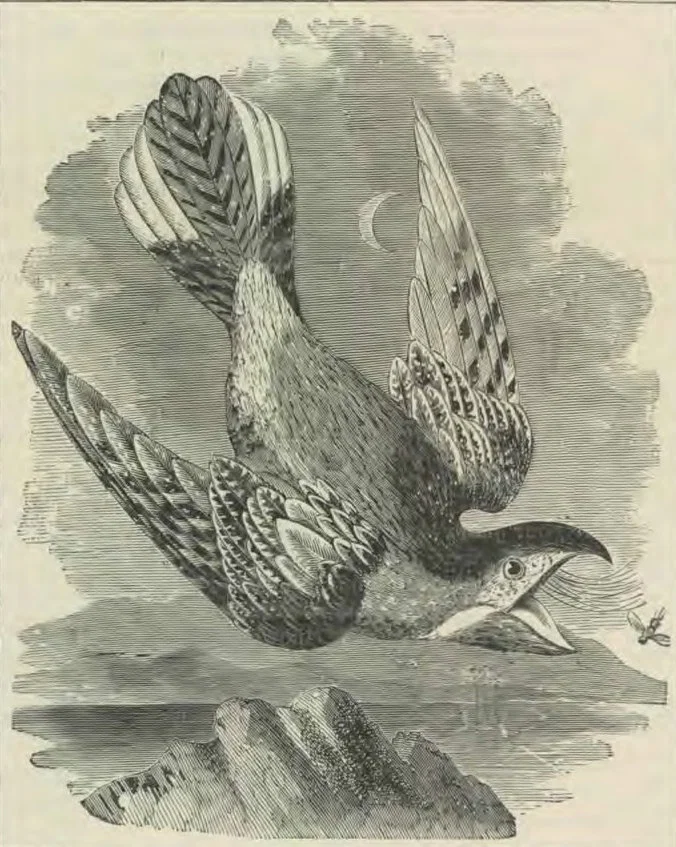
The study of that interesting class of animals known as birds, suggests these beautiful lines of Eliza Cook:—
“Birds, birds! ye are beautiful things, With your earth-treading feet and your cloud-cleaving wings; Where shall man wander, and where shall he dwell, Beautiful birds, that ye come not as well? Ye have nests on the mountain all rugged and stark, Ye have nests in the forest all tangled and dark: Ye build and ye brood 'neath the cottager's eaves, And ye sleep on the sod 'mid the bonnie green leaves: Ye hide in the heather, ye lurk in the brake, Ye dive in the sweet-flagged streams that shadow the lake: Ye skim where the stream parts the orchard-decked land, Ye dance where the foam sweeps the desolate strand.
“Beautiful birds! ye come thickly around When the bud's on the branch and the snow's on the ground: Ye come when the richest of roses flush out, And ye come when the yellow leaf eddies about.
“Beautiful creatures of freedom and light! Oh! where is the eye that groweth not bright As it watches you trimming your soft, glossy coats, Swelling your bosoms, and ruffling your throats? Oh! I would not ask, as the old ditties sing, To be happy as 'sand-boy,' or 'happy as king;' For the joy is more blissful that birds me declare, 'I'm as happy as all the wild birds of the air.'”
With strict propriety, birds may be ranked among earth's most beautiful creatures; and nowhere is God's wisdom more strikingly displayed than in the adaptability of the bird's formation to the element in which it moves. Even in its smallest parts, it is perfectly conformed to its natural habits of life, and to its different necessities.
To give it lightness and elasticity, its feathers and many of its bones are hollow receptacles, filled with air; usually its head is small and pointed, that its weight need not hinder its wings, which serve as balances and to carry it forward. Its tail also helps to preserve its balance, and to aid it in its ascending and descending flight. To increase its size, without adding materially to its weight, thus enabling it to float with greater ease and gracefulness in the air, different parts of the body are provided with bladder-like cavities which it can fill with warm air whenever occasion requires. And so, as noticed above, the most minute member of the bird is formed with a wise distinction to the office it has to fill.
Birds are divided into orders, formed according to the manner in which they procure their living. The most prominent division is into land and water birds. Of the former, there are five general divisions,—birds of prey; perchers, or sparrow-like birds; climbers, as parrots, woodpeckers, etc.; scratchers, or poultry birds; and runners, which includes the ostrich. Of the water birds, the chief division is into waders and swimmers. All are again divided and subdivided according to some marked characteristic.
One division of the percher family is known as night-jars, or night-hawks, which includes the common goatsucker of Europe, our common night-hawk, chuck-wills-widow, whippoorwill, and also a South American night-hawk. Like the owl, these all seek their food in the night-season.
The bird in our engraving represents a family of birds of nocturnal habits, the one known as whippoorwill. It traverses the country from Mexico through the Southern and Atlantic States, into Canada, and west into Missouri, never making its appearance in the North until all traces of winter have entirely disappeared. We are first reminded of its presence among us by its strange voice emerging from the forests after the shades of evening have gathered about us. It can be truthfully said of the whippoorwill that it “loves darkness rather than light;” for it hides itself among the leaves and underbrush of the woods while daylight lasts, and by its manner gives one the idea that it is a stupid bird. But with the setting of the sun and the appearance of nocturnal insects, it comes forth from its hiding places and begins its feasting and merriment, sailing through the air as lightly and swiftly as a balloon afloat.
The whippoorwill has a short, broad bill, with a mouth that opens very wide. This is always open when the bird is on the wing, which enables it to seize the insects with which the air abounds. The mouth, too, is surrounded with a sort of hair-like feathers, enabling the bird to retain its captured prey.
Its eggs are usually laid upon the bare ground or a few leaves. If any nest is made, it is but a slight apology for one. Only two eggs are laid, when the lady-bird in turn with the male sits upon them fourteen or fifteen days. The mother-bird has great affection for her young, and practices many deceptive tricks to keep intruders from them.
One peculiar feature which distinguishes the whippoorwill from the common night-hawk is its rounded tail, whereas the latter has a forked tail.
Its name is given it from the resemblance of its cry to whip-poor-will; but it often repeats its song so fast that it can be variously interpreted. It never sings while on the wing, but only when squatting upon the ground, the fence, or some adjacent object. Neither does it utter its cry by day. Beginning its song in the early evening, it keeps up its tune until midnight, or if a moonshiny night, still farther on; and at early dawn, bursts forth again, gradually diminishing as aurora appears in her gay attire.
Other things of interest might be mentioned of this bird, but we will close with the words of M'Lellan:—
“Lone whippoorwill, There is much sweetness in thy faithful hymn. Heard in the drowsy watches of the night. Ofttimes, when all the village lights are out, And the wide air is still, I hear thee chant Thy hollow dirge, like some recluse who takes His lodgings in the wilderness of woods, And lifts his anthem when the world is still; And the dim, solemn night, that brings to man And to the herds deep slumbers, and sweet dews To the red roses, and the herbs, doth find No eye, save thine, a watcher in her halls. I hear thee oft at midnight, when the thrush And the green roving linnets are at rest, And the blithe twittering swallows have long ceased Their noisy note and folded up their wings.”
M. A. C.

PRACTICE THAT PAYS.

Practice makes perfect, but perfection does not necessarily come from much practice. Everything depends on the character of the practice. The oftener we do a thing carelessly, the more firmly we fix the habit of not doing that thing well—the harder we make it to do our best when need comes for the exercise of our highest skill.
Habit counts for more than capacity in the conduct of life; and if our practice does not tend to make our best work habitual, so that it is easier to do well than ill, we will not be much advantaged by it.
In practical life, “well enough for the purpose” is a good rule. It is folly to put ten dollars’ worth of work on a five-dollar job. We do not finish a dooryard fence as we would a hand-rail of our stairway inside, nor a field fence like the fence about our house. The fine skill put upon the finishing of a carriage would be out of place upon a dump-cart.
A working-drawing, or an ordinary note of invitation, or a penciled memorandum, must be correct or clearly intelligible, but need not be artistic in style or finish. In all such cases it is not the doing, but the thing done, that is of importance. Doing for the purpose of self-training—indeed, for any purpose except sheer necessity in early life—comes under a different rule.
In youth, when our habits are forming, we misspend our time if we do anything—work or play—indifferently well. There is then no “well enough” except our very best. The thing we set out to make may not be worth much when it is finished, yet we cannot afford to make it badly. There is as little solid enjoyment in a piece of poor work as in a badly-played game. Besides, if the joining made, the blow struck, or the line drawn, is not true to the best of our ability, the practice got in doing it will hinder rather than help us toward that condition of off-hand, unconscious, habitual skillfulness which is the secret of easy and successful accomplishment.
We may not have—are not likely to have—the rare gifts which constitute genius, but we may draw near to, perhaps surpass, the achievements of genius, if in all our training work we never allow ourselves in anything to fall short of the best that we are capable of doing. Practice of this kind leads toward perfection; all other, away from it.
With the high demands and fierce competition of modern life, the chances are heavily against those who are capable only of third or fourth rate work. Every avenue of life is crowded with those who can do work that is just tolerably good; but superior workers are fewer. In every art or profession there is abundant “room at the top;” and the uncrowded workers, though few—rather because they are few—reap the lion’s share of the rewards. For the products of superior knowledge and skill there is always a demand at good prices, and the first-rate man or woman commands the situation, while the third-rate goes a-begging for something to do.
When one has learned how to do superior work, and has acquired the habit of doing it as a matter of course, it is as easy to do that rapidly as poor work; and the superior worker in every field of effort receives twice, thrice, often ten times the pay of the inferior worker. This unequal pay for equal labor is the price which the world offers for superior quality in work, and that quality is very largely the result of taking pains when working habits are being formed. Accordingly, we would say to our young friends: Don’t let your pastime work train you to be “botches.” You are making not playthings merely, but yourselves; and a bad job at that is the worst job you can undertake. Better be doing absolutely nothing than practicing anything in a careless, hap-hazard, hit-or-miss fashion. It is easier to learn good habits than to unlearn bad ones, and any practice that fixes bad habits—manual, mental, or moral—will not pay.—Golden Days.

THE HERO.

“Reuben! Reuben!” No answer. Reuben, my son, it is time to get up.” But Reuben did not want to hear. Nor did he feel like getting up. It was very cold. He drew the bed-clothes closer about his head, and turned over for another nap. Meanwhile his feeble old mother made the kitchen fire, pumped the water for the kettle, and went out in the ice and snow to feed the half-frozen chickens.
“Dolly ought to have been milked an hour ago,” she thought. “I wonder what ails Reuben? He gets up later and later every morning.”
About an hour afterward, Reuben came slowly down the stairs to breakfast. He looked somewhat ashamed of himself. But he replied in a sullen tone, when his mother spoke about the late hour for milking.
“I think we could do without a cow! It is a great bother to milk her morning and night,” he cried.
“I wish that I could attend to her, but I cannot do everything,” said the mother, with a sigh.
If Reuben had looked up just then, his heart might have reproached him at a sight of his mother’s weary and careworn face. She was a widow, and he was her only son. He intended to be a good son, but he did not go the right way to work. He spent many hours in reading about boys who had done remarkable things, such as run away from home, and come back, years afterward, with fortunes to surprise their friends, and enable their mothers to live like queens! “That is what I want to do for my mother,” he said. But instead of doing, he sat and dreamed.
One day he took up a pamphlet that was lying on the schoolmaster’s table. In it he saw a story called “The Hero.”
“Hello!” he cried. “What is this about? I want to be a hero.”
The story was something like this: A few years ago the traveler through Switzerland might have seen a charming little village, now, alas! no longer in existence. A fire broke out one day, and in a few hours the quaint little frame houses were entirely destroyed. The poor peasants ran around wringing their hands, and weeping over their lost homes and the bones of their burned cattle.
One poor man was in greater trouble than his neighbors, even. True, his home and the cows were gone, but so also was his only son, a bright boy of six or seven years. He wept and refused to hear any words of comfort. He spent the night wandering sorrowfully among the ruins, while his acquaintances had taken refuge in the neighboring villages.
Just as daylight came, however, he heard a well-known sound, and looking up, he saw his favorite cow leading the herd, and coming directly after them was his bright-eyed little son.
“Oh, my son! my son!” he cried, “are you really alive?”
“Why, yes, father! When I saw the fire, I ran to get our cows away to the pasture lands.”
“You are a hero, my boy!” the father exclaimed.
But the boy said: “Oh, no! A hero is a boy who does some wonderful deed. I led the cows away because they were in danger, and I knew it was the right thing to do.”
“Ah!” cried his father, “he who does the right thing at the right time is a hero.”
Reuben read the story two or three times, and then gave a long, low whistle, which meant that he was seriously considering something. “I wonder now if that is true,” he thought. “A hero is one who does the right thing at the right time. There are plenty of chances for me to be that kind of a hero.”—New York Observer.

THE EMPEROR WILLIAM.

On the morning of March 9th, between eight and nine o’clock, William the First, German Emperor and King of Prussia, died in his palace at Berlin. The Emperor was born in that city on March 22, 1797. He therefore lacked but thirteen days of completing the extraordinary age of ninety-one years.
No modern sovereign has witnessed so many startling events and so many vast changes in his own dominions as William did in the course of his long career.
As a boy, he was a witness of the dazzling military exploits of the first Napoleon, and of the utter abasement of his native Prussia under that conqueror’s heel. His mother was that beautiful and patriotic Queen Louise, who so passionately bewailed the humiliation of Germany, and who has long been enshrined in the German heart.
William, as a youth of eighteen, was present on the field of Waterloo, and there saw the final overthrow of the man who had conquered his father’s realm.
Trained from an early age for a military career, he was commissioned a captain in the Prussian army in 1813. From that time, for more than forty years, his time was, for the most part, absorbed in military duties, but he held meanwhile several civil offices, among them that of Governor of Pomerania.
When his elder brother, Frederick William IV., became incapable of reigning, by reason of insanity, in 1858, William was made Regent of Prussia. He finally ascended the throne in 1861, and had the wisdom and good fortune to place Bismarck at the head of his cabinet in the following year.
William became President of the North German Confederation in 1867, as the result of his great victory over Austria; and in 1871, after his armies had completely triumphed over France, he was chosen and proclaimed Emperor of Germany.
Thus the aged monarch lived to see Prussia, humiliated to the dust by the first Napoleon, raised to a far greater height of power than France; and Germany has become, under his lead, the most formidable State in Europe, and the arbiter of the nations.
William’s tastes were to a large degree military ones; and there is no doubt that he had more than ordinary military capacity. In political affairs, he was guided throughout his career as a sovereign by the strong will, resolute action, and keen prevision of Bismarck; a guidance to which he yielded, and which he never deserted. He had unusual ability for choosing wise and able advisers, and the strong good sense to support them when he had once accepted their service.
He had the true despotic temper and the haughty sense of royal power which have marked almost every ruler of Prussia. Yet he was not capricious or tyrannical in the use of that power. He believed that he had a divine right to rule according to his will, and also, that it was his duty to rule, for the benefit of his subjects, to the best of his ability.
When he first ascended the throne, he was exceedingly unpopular. He had put down rebellion in Berlin with an iron hand. The people at that time believed him to be a cold-blooded tyrant. But many years before his death he came to be loved and venerated by the Germans. They looked upon him as a noble representative of their race, as a patriarch of his people; and they were proud of the unprecedented triumphs which had been won under his sway.
William was frank, open, and simple-hearted in character; chivalrous in manner and disposition; a hard worker in his lofty office; and a prince who enjoyed life in its varied phases of labor and pleasure.
The aged Emperor’s death has left Germany in a condition of suspense as to her rulers. The new sovereign, Frederick the Third, is dangerously ill, of a malady which, it is widely feared, is incurable. His son and heir, now the Crown Prince William, who is twenty-nine years old, is little known generally, perhaps even in Germany, as to his character and political views and capacity.—Youth’s Companion.

JUNE

Oh, June, dear June, no other month With her can e'er compare. To us she has a fairer mien Than all the others wear. How lovingly her head is bent, As lightly poised in air, She drops upon the waiting earth A crown of roses fair. —Lizbeth H. Comins.

PRACTICAL HINTS FOR CHILDREN.

It is as easy to run intricate machinery smoothly and continuously without using oil, as it is for children to make their way successfully through life without possessing good manners, and practicing them every day at home, until they fit them as naturally as their clothes do.
As in eating our meals, we show most plainly our good or bad breeding, let us commence there. None of the following rules are new. Neither is the alphabet new; yet every one, if he has not mastered it, must do so before he can proceed in any branch of learning. It is an accepted fact that our language and our manners are the only standard strangers have to judge us by. It is a truer test of good breeding than the apparel we wear. And if for nothing else than order and a refining influence at your own parents' table, you should study some plain and indispensable rules of etiquette.
It is supposed that you always have clean hands and face.
Sit squarely in your chair, and close enough to the table to avoid dropping fragments into your lap.
Do not hold your head close over your plate, as if afraid or ashamed to face people.
Keep your feet up close to your chair; do not sprawl them under the table.
Never speak with your mouth full of food; it is very unpleasant to listeners.
Eat with your fork; your knife is merely to cut with.
Sip noiselessly all fluids. Smacking the lips or making unpleasant noises with the mouth or nose is exceedingly ill-bred anywhere, but especially at the table.
Do not whisper to your mates; it is disrespectful to older persons.
Avoid reaching across the board to help yourself. Ask some one to please pass the article; and in no case be guilty of rising in your chair to help yourself.
If your plate is to be replenished, quietly put the knife and fork on the table, resting the tips on a piece of bread, or holding them in your hand until the plate is returned. It prevents unpleasant accidents.
Never drum or put your elbows on the table while waiting to be served.
When you have finished your meal, put your knife and fork across your plate with the handles together; and if you wish to leave the table before the rest of the family, always ask your mamma, or whoever is at the head of the table, to please excuse you. If you have any traits that are sweet and agreeable, let the home folks have the benefit of them. Home should be heaven begun on earth; and if each acts his best, it cannot fail to be such—or if not heaven, at least the pleasantest spot this side of it. The Bible commands us to “be courteous.” It is for the comfort of those around us, and politeness is only another name for unselfishness. In practicing it, we are obeying the golden rule.
L. E. ORTON.

WHY DON'T THEY TAKE IT!

THAT unclaimed money in the Boston Savings Banks, why don't the owners take it? For twenty years various deposits have been lying there, gathering interest year after year, rolling up in larger and larger sums, gaining and growing like a snowball rolling down a hill in a winter thaw. All these unclaimed deposits amount to nearly half a million dollars. Where are the owners? James, Henry, Lucy, Mary, why don't you take the money, if you own it? Ah! we say, they are dead, asleep, forgetting and forgotten. If living, how they would press upon any resisting bank-door, claim and take their own!
Wealth unclaimed! Treasures at one's disposal, and yet not asked for! What are all the deposits in the world, compared with God's blessing of eternal life? That blessing is accessible to you, and yet have you never asked for it? How strange! You go by the doors of infinite blessing, and never knock! Ah, how much you will need it! When all the gold and all the silver of the earth could not buy you one hour of existence, how you will long then for the assurance that God has given you eternal life! Take the blessing now. Enjoy the bounty of God's mercy to-day! Can you afford to slight it?—Well-Spring.

Charity as the Foundation of Courtesy

CHARITY is the key to courtesy. Through its influence we become gracious in our bearing to all. It teaches us to speak evil of no one; think before speaking; to curb an angry tongue at all times; to disbelieve ill reports, and to be patient with everybody.

INTERESTING FACTS ABOUT VAPOR.

AFTER the sun goes down at night, the earth, cooling rapidly, soon cools the air near it, which consequently gives up a part of its moisture. This moisture forms in drops on the grass and leaves, just as it does on the cold pitcher in the warm room, and we call this “dew.” If it becomes cold enough, the dew freezes, and we then have a “frost.” On cloudy nights a frost is very rare, simply because the clouds act as a tent or blanket, and prevent the earth from becoming cooled so rapidly. Professor Tyndall has calculated that of all the heat daily received by the earth from the sun, and given off again into space, one-tenth is intercepted and absorbed by the vapor of water within ten feet of the earth’s surface. Hence, the vapor forming the clouds above, and extending in its invisible form down to the earth, absorbs the heat given off; and, like the glass screen in a hot-house, prevents the earth’s becoming so cool as to freeze the dew. This fact will enable us to understand, in part, why it is that deserts and all dry regions are subject to such sudden extremes of temperature, being very hot when the sun is shining, but becoming chilly as soon as the sun goes down.
Moreover, water, and consequently anything wet with water, takes up and parts with heat much more slowly than dry land; and water and other liquids, when evaporating, take away a great amount of heat with the vapor. The more rapid the evaporation, the greater the amount of heat taken up in a given time. This is the reason a drop of ether feels cold when placed on the hand. It evaporates so rapidly as to take away heat from the skin quicker than it is restored, and produces the same feeling as would a piece of ice.
Now we are ready to understand why it is that a hot day in dry climates is much less oppressive than in moist climates. People who live in the East and South, where the air is full of moisture, read that the temperature on a hot day in the West rises as high as 100° or 110°; and they think the West must, therefore, be a very uncomfortable place in which to live. But in reality it is not so, and for these reasons: In the dry Western air the perspiration from the body evaporates so rapidly as to keep the skin cool, and none of the heat given off is held in by a screen of moist air; so the body is kept cooler than it would be in a moist climate. But in the moister atmosphere of the East, evaporation is slower, and the heat of the body does not radiate so rapidly into space. Hence, the perspiration gathers in great drops, and saturates the clothes, while pulses throb and heads ache, till relief is sought by fanning. And this fanning cools the skin only because it increases evaporation by blowing air across its surface. This also explains why a warm, overcast, muggy day is so oppressive. I have ridden horseback all day over the dry prairies of Montana, with the temperature above 100° in the shade, and have not suffered the slightest inconvenience from the heat; while with the temperature at 90° in the humid air of Washington, I have sat in my office so overcome as to be scarcely able to work at all.—George P. Merrill, in April St. Nicholas.

OLD TESTAMENT HISTORY.

LESSON 26—SUGGESTIONS FOR QUARTERLY REVIEW.

INTRODUCTION.—What is given herewith is designed to assist the teacher in conducting the review of the lessons for the quarter. It is suggested that all the time usually allotted to the class recitation and the general review, or exercise, be given to the teachers, so that they can thoroughly consider the entire lesson in the class. It may be found profitable to devote the usual time for class work to a consideration of the questions, and then occupy the remainder of the time in considering the outlines of the lessons. While all the members of the class should become familiar with the outlines of the entire list of lessons, teachers may, if so advised by the officers of the school, provide for an interesting and valuable exercise, by assigning to different members, on the previous Sabbath, certain lessons, the outlines of which they will be expected to repeat from memory.

QUESTIONS.

1. Give a brief Bible description of the character of Abraham. 2. What was the foundation of Abraham’s righteousness? 3. Tell how Abraham’s faith was tested. 4. What made this such a test of his faith? 5. How did Jacob come to leave his father’s house? 6. Relate the dream which he had while on his journey. 7. What vow did he make? 8. Give proof that it is right for us to make such vows. 9. Where is this narrative recorded? 10. Relate the circumstances of Jacob’s wrestling with the angel? 11. Who was the angel? 12. What was the cause of Jacob’s importunity, and what did he receive? 13. For what purpose was this narrative recorded? 14. What led to Joseph’s being sold into Egypt? 15. How did he suffer there, and what for? 16. What subsequent position did he occupy? 17. What was the real cause of Joseph’s prosperity? 18. Show how God overruled the purposes of wicked men for good. 19. How did the Israelites come to settle in the land of Egypt? 20. After they became very numerous, what was done to them? 21. Tell how Moses was fitted for the work of delivering the people. 22. Relate the circumstances of his call to return to Egypt to deliver Israel. 23. What was God’s special object in delivering his people?

MUSICAL SANDS.

Your attention was at one time called to a few paragraphs descriptive of musical sands; but the S. S. Classmate notices sands still more musical, and probably the most musical of any yet discovered. We quote as follows:—
“There is on the peninsula of Mt. Sinai a hill called Gib el Nakus, or Mountain of the Bell, where musical tones are distinctly heard, and have excited much curiosity, and have given rise to various speculations concerning their origin. Some years ago a Lieutenant Newbold, of the Madras army, visited this curious hill. Setting off from Wadi Tor, after two hours’ riding and a short walk of half an hour, he reached the place, which he described as a bell-shaped hill, from three hundred and fifty to four hundred feet in height. On its western side, which faces the Red Sea, is a slope of about eighty feet, covered with a very fine quartzose sand, varying in depth from five to six inches to as many feet, according to the form of the sandstone rock which it covers. This is the spot from which the mysterious sounds issue. Not the slightest noise was heard; but their Arab guide, desiring them to wait still at the bottom of the slope, began to ascend, sinking to his knees at every step. The travelers soon heard a faint sound resembling the lower string of a violoncello slightly touched; and being disappointed at the result, determined to ascend themselves, in spite of the intense heat of the sun and the extreme fineness of the sand.
“On reaching the summit they sat down to observe the effect. The particles of sand set in motion agitated not only those below them, but, though in a less degree, those all around them, like the surface of water disturbed by a stone. In about two minutes they heard a rustling sound, and then the musical tone above alluded to, which gradually increased to that of a deep, mellow church bell, so loud that it recalled the rumbling of distant thunder. This occurred when the whole surface was in motion, and the effect upon themselves the travelers compared to what they supposed might be felt by persons seated upon some enormous stringed instrument while a bow was slowly drawn over the chords. They descended while the sound was at its height; and soon after, it began to lessen with the motion of the sand, until, at the end of a quarter of an hour, all was perfectly still again.”

UNCONSCIOUS WINKING.

Winking does not interfere with distinct vision, because the continuance of the impression of external objects on the retina preserves the sense of continuous vision. We close our eyes in winking about six times a minute, or 4,320 times a day of twelve hours, but open them again so quickly that we are not ordinarily aware of the act. Thus, by a reflex action, if we are awake twelve hours a day, we wink more than 1,566,666 times a year. The habit of winking significantly is a very bad habit, but the unconscious winking to lubricate the front of the eyeball is essential to good vision. If the eye is closed only one-fiftieth of a second in winking, in a lifetime of fifty years it is closed more than forty-three days without our being aware of it. We see distinctly for forty-three days with our eyes shut.—Prof. N. B. Webster.

GUARDING THE GOLD.

The Bank of England doors are now so finely balanced that a clerk, by pressing a knob under his desk, can close the outer doors instantly; and they cannot be opened again except by special process. This is done to prevent the daring and ingenious unemployed of the metropolis from robbing the bank. The bullion department of this and other banks are nightly submerged several feet in water by the action of the machinery. In some banks, the bullion department is connected with the manager's sleeping room; and an entrance cannot be effected without shooting a bolt in the dormitory, which in turn sets in motion an alarm.—Gazette.

Fireproof and Waterproof Paper Invented in Germany

HAVE you heard about the new kind of paper which has been invented in Germany? It is said that it cannot be burned, and that it will hold water. I cannot tell you how it is made, except that asbestos, and aluminum sulphate, and chloride of zinc, and resin soap, have to do with it. But keep your eyes wide open, and you will doubtless hear more about it before long.—Pansy.

OUTLINE OF LESSONS FOR THE PAST QUARTER.

LESSON 14.

HISTORICAL.—Abraham called to offer up Isaac.
PRACTICAL.—The test of faith—What is required in order to be a friend of God.

LESSON 15.

HISTORICAL.—Marriage of Isaac—Birth of Jacob and Esau—Character of each—Sale of Esau’s birthright.
PRACTICAL.—The Christian’s birthright, how obtained, its value, sin of despising it, and consequences to the rejecter.

LESSON 16.

HISTORICAL.—Securing of the patriarchal blessing by Jacob, and consequent enmity of Esau—Esau’s threatenings against Jacob—Jacob’s flight, his vision, and vow.
PRACTICAL.—Effect of God’s presence upon a place—Its purpose and influence in the assembly of his people—Nature and propriety of vows to God, and obligation to pay them.

LESSON 17.

HISTORICAL.—Life of Jacob with his uncle Laban—His return to the land of Canaan—Wrestling with the angel—Meeting and reconciliation with Esau.
PRACTICAL.—Ministration of angels—Condition of an unpardoned sinner—Necessity of steadfastness in prayer—The overcomer’s reward.

LESSON 18.

HISTORICAL.—Settlement of Jacob in Canaan—His family—Plot of Joseph’s brethren against him, and its execution.
PRACTICAL.—Purpose of the wicked concerning the just—Envy and its results.

LESSON 19.

HISTORICAL.—Joseph’s life in the house of Pharaoh—His temptation, how endured—Revenge taken upon him by Potiphar’s wife—Joseph’s imprisonment.
PRACTICAL.—Manner of enduring persecution and injustice—Value of faithfulness in duty and trust in God—Necessity and manner of resisting temptation—Treatment the righteous may expect from the wicked.

LESSON 20.

HISTORICAL.—Length of Joseph’s imprisonment—Dreams of the chief butler and chief baker, and their interpretation by Joseph—Joseph brought before Pharaoh to interpret his dream, and his consequent elevation to a position next to the king.
PRACTICAL.—True wisdom, and its possession—Necessity and value of trust in God at all times—The true source of ability to render valuable service.

LESSON 21.

HISTORICAL.—Prevalence of the famine—Action of Joseph’s brethren in consequence—Meetings with Joseph, and final recognition and reconciliation.
PRACTICAL.—God’s purpose concerning trials and afflictions—Importance of humility in order to exaltation—Character of labors in behalf of the erring—God’s ability to make the evil work of men result to his praise.

LESSON 22.

HISTORICAL.—Settlement of Jacob’s entire family in Egypt, and subsequent prosperity—Deaths of Jacob and Joseph, the enslavement of the Israelites, and the birth of Moses.
PRACTICAL.—God’s particular care for his chosen people—His purpose in permitting afflictions to come upon them—God’s overruling providence in raising up agencies for carrying on his work in the earth.

LESSON 23.

HISTORICAL.—Early life of Moses—First attempt to deliver his people—His sojourn in Midian—Call by the Lord to deliver Israel.
PRACTICAL.—Contrast between true and false riches—Wisdom of exchanging present enjoyment for future good—Futility of attempting to carry out God’s plans by our own methods—Necessity of thorough preparation to fitness for leadership in the work of God.

LESSON 24.

HISTORICAL.—God’s interview with Moses at Horeb.
PRACTICAL.—God’s sufficiency to supply to his servants all needed help in the performance of the work he commissions them to do.

LESSON 25.

HISTORICAL.—Moses’ return to Egypt—His meeting with Aaron, and their address to the elders of Israel—Application to Pharaoh for the release of the children of Israel, and the result.
PRACTICAL.—Assurance of success when engaged in the Lord’s work, if his directions are followed—God’s power to bring to naught the plans of the wicked, and to deliver his people from their oppression—Importance attached by God to the observance of his laws, especially the Sabbath.
Continue reading: MAKING SCARS