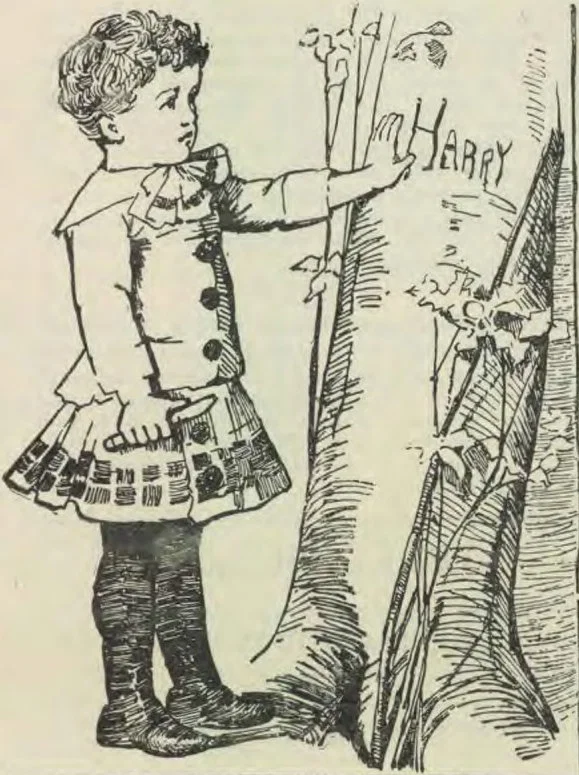
HARRY leaned out of the window, watching the postman going on his morning round, slipping letters into the door of one house, and hurrying down the walk to ring the bell at the next house, and leave a package that the letter hole in the door would not take in. So he kept on up the long street, and soon disappeared down the shaded walk leading to Harry’s house. It was a long walk, bordered with purple and white lilacs, and pink weigelias, and white syringa bushes, that made the air sweet through all the spring and early summer.
Presently there came a quick ring at the door bell. Harry jumped down from the chair and ran to answer it. The postman handed him a small package.
“I wonder what it can be,” said Harry, turning it over and over, as he went back to the sitting-room, where his mamma sat sewing. Then he spelled out the address—“M-a-s-t-e-r—Master, H-a-r-r-y—Harry, B-r-o-w-n—Brown; why, mamma, it’s for me,” he cried, “do cut the string quick!”
Mrs. Brown did so, and Harry unrolled a stout brown paper, a softer brown one, then a tissue one, and found inside the very thing he had always wanted—a jackknife, with one shining blade and a spotted brown handle. Folded up inside was a little note, which Mrs. Brown read to him. It said,—
“To my nephew, Harry Brown, in remembrance of his sixth birthday.
“Thomas Brown.”
“A jackknife! a jackknife!” Harry shouted, hopping round on one foot, and finally ending in a somersault that brought his heels down on old Rover’s back. Rover started up from his morning nap with a growl, and bounded through the door, while Harry followed at his heels to try his new possession on whatever cuttable thing presented itself. The back yard soon looked like the blazed path of a forest. The old maple-tree showed a huge white H on its bark, the corner of the weather-beaten wood shed turned a bright strip to the sun, and the smooth rind of the old beech-tree, after a continued struggle on the part of the owner of the treacherous knife, bore in letters great and small the word “Harry.”
Harry stood back to view his work, with a satisfied look, when a pair of strong arms caught him, and he was whisked up on Uncle Tom’s broad shoulders.
“So-ho! youngster! into mischief already,” he cried. “What do you suppose your father will say when he sees his trees ornamented after this fashion?”
“Why,” said Harry, “he won’t care, ’cause it will grow right up.”
“No it won’t,” Uncle Tom returned; “there will always be an ugly scar on the tree to show what a thoughtless little boy once did just for fun. The tree will try to mend its jagged coat, but the ridges and uneven bark will be left to tell the story. When you grow up to be a man, you will still see the place where you used your new jackknife.”
“Now,” continued Uncle Tom, “I saw this same little boy making some more scars the other day. I wonder if he knows what they were?”
Harry opened his eyes very wide. More scars? No, he didn’t know what they were. Hadn’t he got his jackknife only that very morning, and papa never would lend him his knife?
“I saw a little boy get angry at his sister,” said Uncle Tom, “and call her a ‘horrid, hateful thing,’ because she didn’t want to leave her sewing to play ball with him; he cried and stamped when mamma combed his hair and washed his face for dinner; and when she asked him at night if he had been over to Jack Benton’s, he said ‘No,’ while he knew he had been playing out in the back alley with Jack all the afternoon.”
“Well,” said Harry, while his face grew very red, “I didn’t go over there. Jack said I daren’t come out in the alley to play, an’ so I did. An’ I didn’t go over to Jack’s house, an’ Jack didn’t come over here.”
“But you knew your mamma didn’t want you to play with Jack.”
Harry grew restless; he thought Uncle Tom knew most too much about his affairs. So he said, uneasily, “I don’t see what that has to do about scars.”
“Why, it’s just like this,” replied Uncle Tom; “every time a boy does anything naughty, it makes a scar on his character, just as your jackknife did on the smooth bark of the tree. May be the boy can’t see it; but God always sees it, and sometimes his friends see it too. You would like to be a perfect man, wouldn’t you?”
“Yes, sir,” said Harry, straightening up, “I should like to be a pretty good man.”
“Well, then, you must try hard to mind mamma, and tell the truth, and be kind to everybody,” said Uncle Tom, as he gave Harry a swing on to the dining-room steps, and they went in to dinner.
W. E. L.
HELPING MAMMA.
THERE was most everything to do that day, Helen’s mother thought. If she had only known the day before, it needn’t have been so. But how could she tell beforehand that baby would be sick, and company come? It all happened just the same as if she had known it, however, and she had a headache besides.
Little Helen’s eyes were very sharp, and she knew that while the mother talked with her guests and smiled, that something was the matter.
Presently a pair of chubby arms crept up around the mother’s neck, and Helen whispered softly:— “I want to help you, dear mother.”
“Bless your little heart,” said the mother, turning and kissing the rosy cheek, close to hers, “you help me every day.”
“But I want to help you more, ’cause I guess your head aches,” said Helen.
“Yes, dear, it does; and if you want to help mamma most, you may go out into the yard and make a whole lot of sand cakes. I guess the baby’s sister will like that, don’t you? Take good care of her anyway, and don’t let her trouble the mother.”
“Now you mean me, I know,” said Helen. “I’m all the sister baby has;” and she looked as if she half wanted to pout. But she thought better of it; for there was a fine pile of sand in the yard that she was very fond of.
Long before tea-time there was a grand array of various kinds of cakes ready for whoever wanted them; and when bed-time came, the mother told Helen that she had “been the best little helper that ever was.”—Sel.
WAS IT, ROBIN, YOU?
By Georgiana Lee
Tell me, robin redbreast—
Tell me, robin, who
Warbled in the cherry-tree;
Was it, robin, you?
All about a love-mate,
Pretty, winsome thing.
Mrs. Robin Redbreast,
Wooed and won in spring!
Tell me, robin redbreast—
Tell me, robin, now,
Who sang in the cherry-tree,
Swinging on a bough;
Sang about a nest, all
Grass and moss-entwined,
A home-nest neatly fashioned,
Hair and feather-lined.
Tell me, robin redbreast—
Tell me, robin, pray,
Who piped in the cherry-tree,
Piped of treasures gray,
Gray and round and spotted brown:
Robin, tell me who
Warbled all these pretty things,
Was it, robin, you?
—Georgiana Lee.
Letter Budget.
FIRST is a letter from the “Sunny South,” from Hinds Co., Mississippi, written by MARK C. ABBY. It reads: “I received your letter requesting me to renew my subscription to your paper. I like the YOUTH’S INSTRUCTOR ever so much. My uncle who lives in Minnesota sent it to me. I would like so much to take it, but papa thinks he can’t afford it. I am a little boy ten years old, and belong to the Methodist church. I am raising some missionary cabbage. I have to work very hard every day with my papa. He has a vegetable garden, and ships vegetables North. I have three brothers living. My oldest brother died last January; but he died a Christian, and I want to meet him in heaven. I would like to get one paper with this letter in it; for I want my kind uncle to know that I am trying to be a good boy. I am very sorry I cannot take your good paper longer. Please print this. I get my mamma to write for me. She used to live there.”
ANTOINETTE M. HARTKORN, of WAYNE CO., Ind., writes: “I am a little girl eight years old, and I am reading the INSTRUCTOR. I am so glad that my mamma has learned to keep the Sabbath, and I am trying hard to keep it with her. It is very lonely for me now, as there were fifty or sixty of my little classmates in my Sunday-school, while last Sabbath there were only two of us in my class in our Sabbath-school. I am going to keep the Sabbath, so when the Saviour comes, I may go with him. I have a little brother three years old, and I am going to help mamma teach him to do what is right. I must tell you that Mr. Honeywell taught us to keep the Sabbath, and we love him dearly. My papa thinks he is real good.”
PEARL L. REES sends a letter from Tennessee. She writes: “I am a little girl nine years old. My papa is a minister, and is not at home much. I have a brother and one sister, but my sister is married now. My brother will go with papa with the tent this summer, which will leave mamma and me alone at home. I expect we will feel very lonely, but we shall not mind it so much because they are going out to try to make others happy. The Sabbath-school is held most of the time at our house. I study the INSTRUCTOR lessons. I also attend day school. I like to read the Budget letters very much. I have a Bantam hen. When I can find a buyer, I sell the eggs, and put all the money into the missionary box. I expect to give all the money I get this year to the missions. I am trying to be a good girl, hoping to meet the INSTRUCTOR family in the earth made new. This is my first letter to the Budget. I write with my left hand.”
STEVEN KIMBLE writes a letter from Stearns Co., Minn. He says: “I am ten years old. I want to write a letter for the Budget, and tell you about our missionary society. It is just for the children, and we call it ‘Busy Workers.’ We are going to do all kinds of work that it is proper for us to do to earn money. Then after paying a tithe of it to the Lord, one-half of the remainder is to be for missionary work, and the other half is to buy us good books to read. I am trying to keep all the commandments of God. My parents, two brothers, one sister, and myself have been keeping the Sabbath all winter. We live two miles from town, but we try to be always at the Sabbath-school, for we love to go. We have a little calf and a colt. My sister and I have some turkeys. I hope you will print my letter, and remember the Busy Workers when you pray.”
We have a letter from Orenna Co., Mich., written by EDNA CARR. She says: “I am so interested in the Budget that I thought I would write a letter. I am eleven years old. I go to Sabbath-school and study Book No. 3. I like my teacher. I have a pair of twin sisters four years old. Their names are Winona and Alzona. They like to hear me read the ‘Story of the Bible.’ They look so nearly alike that sometimes papa can hardly tell them apart. I tried working out a little last fall, for the first time, at fifty cents a week. I want to give something to foreign missions. I think I will have a missionary garden next summer. I am trying to do what is right so I can be saved.”