I was once defrauded of a small sum of money by a neighbor, in a business transaction; and although when I discovered it, shortly afterward, I felt somewhat indignant, I succeeded in driving the matter from my mind, and could not have been induced to believe that it would cause me any further trouble. A little later I learned from reliable sources that the man was addicted to such things, and as I listened again and again, and suffered my mind to dwell upon the matter, the offense increased in magnitude until the man seemed utterly odious. It was such a mean, little trick, to take advantage just because the opportunity was presented. I fairly hated him!
I was in the habit of praying each morning and evening for grace to follow in the steps of Christ, but as I came before God as usual one morning, the thought of the man and the wrong he had done me came to mind, and feelings of hatred and a desire for revenge were felt. I tried feebly to banish them, more because they made me uncomfortable than because of their hateful nature. This state of things continued for three days and nights, the wretchedness of which I shall not try to describe. I knew that God would not hear me while I was possessed of this spirit, and it seemed to hold me a helpless slave. As I failed to resist it and call upon God for aid in its expulsion, I became more and more thoroughly imbued with it. One night after retiring to rest (?), my blood seemed almost boiling in my veins, and I was alarmed at the paroxysm of unholy anger which seemed ready to plunge me into ruin by causing me to commit a great wrong; for I remarked to a friend by my side that I believed if I was where the man was, I would kill him. This remark caused my friend some surprise, no doubt, as it was a spirit so foreign to the general tenor of my life. However, true to his profession, he administered a mild rebuke. I wondered that I was willing to go to sleep without the spirit of peace reigning in my heart, but I did so.
The next morning I felt even more wretched than before. I could not get my thoughts fixed upon my studies,—I was going to school,—and there seemed an undefined dread continually menacing me as if something terrible was about to take place. I could endure it no longer. In my miserable condition I cried to God for relief, and at the same instant I said, with my whole heart, “I will, I must, forgive this man. It is an unreasonable and wicked spirit that I have been harboring.” I felt that I must be alone with God, and resolved that I would never leave his presence till he gave me the victory; so, leaving the schoolroom and seeking a retired place, I knelt before God to commune with him. In an instant, before I could open my mouth to utter a word,—for I nearly always prayed audibly,—I appeared to myself as the most guilty, unreasonable, and wicked wretch in existence. I felt that I was a hundred times meaner than the man I had considered my enemy, and then (I remember it as though it had been but yesterday) a spirit of pity came into my heart; and forgetting myself entirely, I began to call upon God that he would show mercy to him, for I felt that he had subjected himself to divine wrath. As my hard heart was broken, and the sweet, forgiving spirit of Jesus came in, how copious were my tears of gratitude.
It is twenty years since this experience, and though I have many times had to regret that I could not, or rather did not, possess more of that sweet heavenly grace that suffers long and is kind, I have never had a similar difficulty in overlooking either a real or an imaginary wrong.
PASSING EVENTS AND COMMENTS.
By T.
India Needs Help.—
Again starvation stares millions of India’s people in the face. A prolonged drouth has prevailed over nearly the entire country. Though recent rains have relieved present distress in a measure, no food can be grown and matured for months. Forty million people, says Dr. Barton, secretary of the American Board, are now actually starving. The report says that it is not the absolute absence of food that causes starvation, but the scarcity has raised the price beyond the possibility of the poor people to purchase. The great mass of India’s poor are always on the border of starvation. It is said that eighty million of people in India in ordinary times lie down every night upon the ground to sleep, having had but one scant meal that day. The average income for the people of that country is less than one cent a day for all the people. Bishop Thoburn says that more than fifty million people in India never have their hunger satisfied. In such a situation the dire terrors of famine always overhang the country, and a little change in conditions is sufficient to precipitate them upon the people. In some sections the people are desperate, and make riot upon those who are storing grain for higher prices. They steal in order to be put in jail, where they will be fed. They are willing to murder, because death stares at them anyway. O how thankful we should be for the blessings we have!
Exaggeration.—
An esteemed friend and laborer writes that he has been deterred from reporting for the REVIEW by seeing so much exaggeration in the reports. Others have made similar remarks in our hearing. We do not believe that our workers mean to exaggerate the results of their labors. But sometimes a cup seems to be full when much of it is froth. Some of the good seed falls on shallow ground; and some on thorny ground. Some falls on good ground. All spring up alike and together, and for a time it is hard to tell which is which. In a few months the facts appear, and then the earnest and honest worker sees where he has miscalculated in counting results. Some will regard him extravagant, others may call him dishonest; but he may be neither. There is very much of this overstating religious work.
The fact is that there is no place in this world where figures are so useless and so misleading, so vague and unsatisfactory, as in connection with the work of the gospel of Christ. Statistics furnish a sort of satisfaction to our interest or curiosity, but in reality they convey no accurate information. The reason why God did not want Israel to be numbered was probably to teach us that no figures computed by human ingenuity, and no man-made lines or distinctions can denote the actual number of God’s true children.
We are prone to shake our heads over the hundred and forty-four thousand, saying we don’t see where the Lord will get so many; or that the number is far too small to include all who will want to be saved alive when Jesus comes. Don’t let us worry about that. There is room yet—room for us and our friends and for all we can induce to come, and the number will not be 143,999. But what shall we do about reporting? Go on; and report your work honestly, candidly, as it looks when you write, whether you have three hundred converts or get hooted out of town. Results are God’s, after all. Do not depend on visible numbers as the criterion of your success. One is liable to be disappointed on one hand, or happily surprised on the other.
Death of Maceo.—
The death of this famous leader of the Cubans was confirmed by the testimony of his personal physician, who surrendered to the Spaniards, and by the capture of Maceo’s personal effects. But no sooner had this fact been acknowledged than the report went abroad that Maceo and his companions were the victims of a foul plot to murder them. It was stated that Marquis Ahumada, second in command under Weyler, had conspired with Dr. Zertucha to betray Maceo to death. Under pretence that Weyler desired to consult with Maceo in reference to peace, he and his staff were conducted through the Spanish lines, where, instead of being met by the marquis, Maceo was met by Major Cirujeda, who demanded his surrender. To this the chief replied, “Never!” and made a rush for liberty, but a volley laid him and his companions low. This report greatly excited this country, and for days it remained uncertain as to its reliability. Conflicting stories were in the air; no two who pretended to know told the same story. Although a week has passed away since these reports started, the facts are not as yet well known, though the story of betrayal is generally discredited. It is probable Maceo fell in battle.
The Triangular Trouble.—
As by common consent, the people of this country have adopted the cause of the Cubans in their struggle for liberty. Popular sentiment has placed this country on the side of the nearer and weaker party. But as a government, the American authorities have endeavored to maintain a silent neutrality. But Spain has felt very much exasperated over the evident unfriendliness of the people of this country toward the Spanish cause. The consequence has been a very bitter public spirit in Spain toward Americans, that has manifested itself plainly in talk and in some acts of violence. It is not stretching the truth to say that in some sections of this country this bitter feeling is fully reciprocated. So far as the people are concerned, a small amount of provocation would prove a spark to ignite the flames of war. And it would seem that the longer the Cuban struggle is drawn out, the more strained relations become. It is to be hoped that by some means the miserable war may be brought to a close, and thus a worse calamity be averted.
Curfew Must Ring at Night.—
So say various city councils here and there. Why?—Because children allowed to run the streets at night are a nuisance generally, and a menace to the peace and security of a community. Children given their liberty at night surely develop into lawless and dangerous people; therefore they must be kept from the streets. Parents are too indifferent to guard their own children, or children are too headstrong to obey their parents; hence policemen must become guardians of our families. The intent and purpose of curfew laws are doubtless very good and essential. But what shall we say of the parentage that makes such laws necessary? It is terrible and fatal folly! For parents to regard their children too virtuous to be led into evil is a delusion. If any parent desires to send his child straight to destruction, the shortest cut is to allow him out of the house after nightfall. T.
THE AMERICAN PLUTOCRACY.
By Uriah Smith
Apropos to the articles of Brother Magan, now going through our columns, on the parallel between our times and those which led on the French Revolution, we copy a few words from Professor Goldwin Smith, of the Toronto University. His article appeared in the December Forum. Speaking of the course now pursued by rich Americans, and the results to which, if continued, it must inevitably lead, he says:—
If rich Americans in the hour of peril, instead of remaining at their post of duty and doing according to their measure what Peter Cooper did, continue to crowd in ever-increasing numbers to the pleasure-cities and haunts of Europe, or spend their money at home in selfish luxury and invidious display, a crash will come and ought to come. The French aristocracy before the Revolution left their posts of social duty in the country to live in luxury and frivolity at Versailles. The end was the burning of their châteaux. American plutocrats who leave their posts of social duty for the pleasure-cities of Europe, will have no reason to complain if their châteaux some day are burned. Unfortunately, warnings are seldom taken by individuals, and almost never by a class, each member of which looks to the other members to begin.
Speaking of the political tornado which will ensue if the common people are forced to seek a redress of their grievances, whether real or imaginary, by violence, he says:—
Nothing less than a tornado is likely to reach the consciences of railway-wreckers and sugar trusts.
Other combinations equally villainous he might have named. And this is but one of the many voices with which the air is full, sounding the note of alarm. Blind must he be who cannot read the threatening portents on the darkening heavens, and very unthinking he who does not remember that just this state of things is predicted by the apostle James to occur when the Judge is standing at the door, and when a little longer patience on the part of the brethren will bring them even to the coming of the Lord. James 5:1–7. U. S.
INCREASE OF MURDER.
By M. E. K.
THE census reports indicate that murders are greatly increasing in this country. Without giving statistics over many years, which show a general increase of crimes of this nature, we will only compare the records of 1886 and 1895. In 1886 there were 1449 murders in the United States. In 1895 there were 10,500 murders, an increase of 700 per cent.! A statistician upon this subject has remarked that “a similar increase for the next ten years will give us more than 75,000 per annum”!
These are appalling figures. Ten thousand five hundred murders in a year in our country! This is about one murder for every eight thousand population. The Scriptures tell us that in the days before the flood, “the earth was filled with violence.” Gen. 6:11. Christ, describing the days which should immediately precede his coming, compared them with the days of Noah. With deaths by violence increasing at such an alarming ratio, and other crimes, as might be expected, also increasing,—for the same general cause underlies all crimes,—what hopeful outlook is there for the race, except the coming of Christ and the establishment of his kingdom, when the “meek shall inherit the earth”?
M. E. K.
VENTILATION IN WINTER.
By T.
There are but few topics of domestic economy which, in a rigorous climate, are more worthy of careful attention than this. In the warm season, with doors and windows wide open, we are wont practically to live in the open air. But when the cold blasts of winter come, our shivering forms bid us close up the avenues of the unwelcome chilly air. Economy of fuel demands that we keep the cold out and keep the heat in. So strong is the demand that most people are ready to comply even at the sacrifice of every trace of fresh pure air.
With our houses hermetically sealed and the temperature of the rooms raised to a high degree, while every pore of our bodies is wide open, and lungs are gasping for needed oxygen, exposure to sudden and great changes becomes perilous to life and health. Colds, coughs, consumption, pneumonia, and other troubles become common from the cause here mentioned. Pneumonia and all these troubles have increased in a proportion that corresponds with our developing an ingenuity in rendering our living and meeting rooms impervious to fresh air. Our forefathers, who lived in log cabins whose “chinking” gaped wide to wintry blasts, who often awoke on a winter’s morning to find a snow-bank across their beds, knew but little about that terrible scourge, pneumonia. They had plenty of wood, and if their backs got cold while they warmed their feet, they turned around and warmed the other side a while.
It is not claimed that those wintry blasts were the guardians of the health of our fathers. But could that crisp, pure air have been furnished them slightly warmed, and in such copious quantities, they might have escaped not only the pneumonia we have, but also many of the ills they had.
A writer in a late health journal of prominent reputation deprecates severely the weather-strips, battens, double windows, and every other modern contrivance for keeping out anything but the coarsest of cold winds. This writer glories in sleeping with windows open; and in the coldest weather opens wide doors and windows at least once each day.
While it is freely granted that such an arrangement is better than air-tight compartments, baking and steaming with heat and foul air, it is far from the best. Double windows are good things. Double doors are, too. And so are weather-strips, and any other contrivance to keep out sharp, piercing wind, which, when the air supply of the house is cut off, rushes impetuously into the vacuum caused by fires in stoves. Stoves and fireplaces carry off air very rapidly by draft and combustion. To supply this demand taxes crevices under doors, between sashes, under bases, and causes a strong inrush of outside air. Where no other provision is made, these would seem to be a necessity. Without them the air must soon lose its vitality, and respiration become unsatisfactory.
But if these are not best, what is better?—A better plan is to supply an abundant quantity of pure air by a system under your control. Don’t by all means try to live without the air. Do not depend upon open doors or windows or upon crevices in the same. Strong currents of biting cold air are not good. Introduce fresh air of a temperate quality in a gentle current.
In the first place, American houses are generally too warm. This is a matter of habit. People coming here from other countries at first feel stifled by our toasting temperature. On returning from Australia to this country, the writer had frequently to leave places of meeting, being unable to endure the heat of the rooms. A temperature below 70° is better than one above. Think of the change that shocks the system in going from a stifling room at 80° into the frosty air outside, where the mercury is 20° below!
Such a performance throws wide open the door for pneumonia and other deadly maladies.
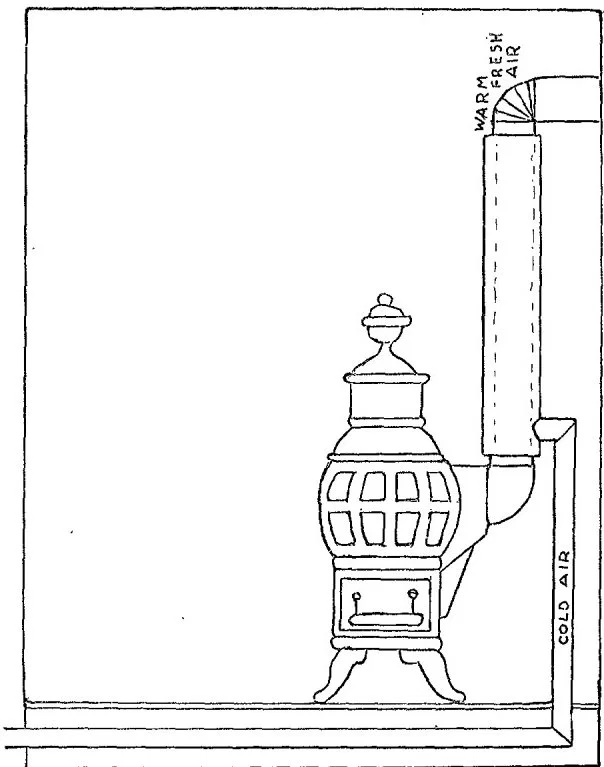
The suggestion may be carried out by laying a four-inch pipe of sheet iron, tin, or wood under the floor, connected at the outside end with a pure-air supply. Bring the pipe up through the floor at the stove. If you can do no better, liberate the air under the stove. A better plan is to heat it by passing it through flues in the stove, or by making an eight-inch jacket or outer pipe around the stovepipe, and letting the cold air into this jacket near the stove, let it out, heated, at the top of the room, as illustrated in the diagram. Or a jacket may be placed around the back of the stove with a narrow space between, and the cold air be discharged into that. In order to take foul air from the room, insert a four- or five-inch pipe into the stovepipe, and let it extend to within three inches of the floor. Foul air settles to the floor, and this simple device will draw it off.
From practical observation we are led to conclude that this simple contrivance for ventilation does not place any extra tax on the fuel supply, but rather diminishes it. There are but few houses where some such plan may not be devised. Some stoves are built with this in view. The absence of languor, headaches, and colds; the comfort and sound sleep that fresh air will produce, will abundantly compensate for all trouble and the little expense. T.
THE DOCTOR AND HIS PATIENTS.
By John Harvey Kellogg
FROM SANITARIUM PARLOR TALKS BY
J. H. KELLOGG, M. D.
MIND CURES.
THE influence of the mind upon the body is very great. A medical student was once told by his teacher that a certain decoction which he had swallowed had been given him by mistake, and was a powerful emetic, and in less than five minutes the student was vomiting. The influence of the mind upon his stomach emptied it completely.
Recent observations have shown that every process of the body is under the control of the mind,—that a certain portion of the body is under the control of a corresponding surface portion of the brain; that is, that part of it where the mental activity exists. The mind, or thought, is the result of the action of the convoluted portion of the brain, which lies at the surface. The brain that has the greatest vigor is the one that has the largest number of convolutions. The largest brain, in proportion to the spinal cord, is the most vigorous brain.
Observations heretofore made have seemed to show that women have less power of thought than men; but it has been shown that woman’s brain is as large in proportion to its spinal cord as that of man is in proportion to his spinal cord, so that as a rule woman’s brain is just as good as man’s. All the functions of the body are controlled by the little cells on the surface of the brain. All the vital processes are the result of the action of these cells. Viewed in the light of recent observations, we can understand how it is that warts may be driven away by mental activity of some sort,—how it is that those parts of the body which are very remote from the brain are nevertheless under its control. It is because there are nerves running from the brain to every part of the body.
A woman in France was put into a hypnotic state, and then told that a red-hot iron with the letters of her name painted on it had been applied to her arm. Three weeks afterward she found her name printed upon her arm, and the scars were there still. This was the result of a purely mental process. The skin was not injured at all; the peculiar effect was simply the influence of her mind upon the nerves which control that part of the body.
People often exhibit peculiar sensations as the result of disease. I remember one case in which a lady had a feeling that some part of her body was enormously large. Another thought that her head was very large. There are times when our heads feel heavy, and we can hardly hold them up. This is the case when one is tired and sleepy. Sometimes, when one has been walking a long distance and gets weary, his legs and feet seem so heavy that he can hardly drag himself along. Sometimes the hand seems enormously large, and so heavy that it seems as if it could not be lifted. Among others there is the sensation of floating in the air. One lady whose case came under my notice felt that she was not herself, and that her real self was lying beside her in the bed; she could not see her neighbor self, but she felt the sensation that her real self was lying beside her, and she said to me, “Sometimes I can see myself over yonder in the corner while I seem to be floating in the air.” She was not insane, but she had these morbid sensations, simply because that part of the brain which has the power of appreciating sensations of that sort happened to be abnormally active. All these feelings are the result of perverted sensation in the nerves, caused by neurasthenia, or nervous exhaustion. In this condition these abnormal sensations may be carried to a very extreme degree, till the head feels as “large as a wash-tub,” or the leg as large as the trunk of a tree.
The only cure for such sensations is not hypnotism,811but a removal of the cause by treatment of the nerves, or of the disease which has caused the nervous trouble.
KEEP THE LAMPS BURNING.
By Marcus L. Carpenter
BY MARCUS L. CARPENTER.
(Fremont, Mich.)
Upon a bleak and dismal strand,
Exposed to tempests’ fierce commotion,
A dreary lighthouse used to stand,
To light a cold and stormy ocean.
A gentleman who passed that way,
Used to the life of landsmen only,
Said, “Are you not afraid to stay
In this wild place? You must be lonely.”
“No,” said the keeper, “we’ve no fear;”
Then to his duty quickly turning,—
“We never think of self out here,
But keep the lamps all brightly burning.”
Ho! worker on time’s wreck-strewn shore,
Preparing for your Lord’s returning,
Forget thyself, for strength implore,
And keep your lamps all brightly burning.
GOD'S PURPOSE IN MANUAL WORK.
By Martha Watrous Stearns
BY MARTHA WATROUS STEARNS.
(South Lancaster, Mass.)
In the study of nature, the work of God’s hands, he designed that we should find subject-matter for our education, both manual and mental. Children are bound to imitate what they see, and are mere reflections of their surroundings, so we have the authoritative testimony: “Parents should be the only teachers of their children until they have reached eight or ten years of age. . . . The only schoolroom for children from eight to ten years of age should be in the open air, amid the opening flowers and nature’s beautiful scenery. And their only textbook should be the treasures of nature.”—“Testimonies for the Church,” Vol. III, page 137.
That does not mean that they should run the town or city streets to imitate the evil they see there, and then be sent to school to have it “trained out of them.” Schools should not be reformatories for rooting out evil which parents have, from neglect, allowed to grow in; rather, they should be places for continuing with more extended facilities the education of hand and mind already begun at home. God designed that the foundation of a child’s education should be laid in seeing and understanding that which would draw him closer to himself. In this study of nature we find a threefold education: The study of nature’s material things and their adaptation to our needs and manipulation for our needs, educates us physically; the study of the controlling laws of nature’s life and her “machinery,” educates us mentally; while the study of nature, as related to her Author, educates us spiritually. So to be truly educated, the children must have this triple study.
In the past the old pedagogues—the product of medieval-churchism—began by educating a child mentally, teaching him abstract truths, not recognizing that he is at first more of a physical than a mental being,—a human animal,—and that the abstract mental work given such an animal is as valueless as the mathematical tricks taught dogs, which will, on certain occasions, apparently add, subtract, and multiply accurately, indicating results by the correct number of barks. This may seem very wonderful to those who do not understand that this sort of “dog knowledge” is wholly dependent on the teacher. Even now there are people and institutions that do not recognize that a healthy mental life grows best from an education in physical things. The understanding of a correct use of what is seen—in other words, the education of the hands—will awaken the mental ability in a natural way and only so fast as it is needed.
Teachers often meet, in their schoolrooms, children whose minds are almost ruined by abstract teaching and too much teaching. They are sent to school when five or six years old, if not younger, and their minds are filled with abstract things that they do not know by experiment, but only by the “say so” of their teachers. They learn their “tables,” which are of about as much value to them practically as a Latin grammar would be. “Seven times seven are forty nine” they know, because their arithmetic says so; that is, seven figure 7’s make the figure 49. Poor things! One little girl, in her hungering after something definite in mathematical knowledge, originated the following plan: One was 1 because the figure was made with one mark. The thought of “two” she remembered by the two little “quirls” in the figure 2; “three” was 3, as it had two “curls” and a point in the middle; “four” had four points, one at the beginning of the figure, one at the angle, one at the top of cross line, and one at the bottom, and was therefore 4! So she reasoned till she could see some definite number expressed by all the figures.
Some minds, however, cease the struggle after tangible knowledge, submit to “stuffing,” and either develop into those paragons of virtue some teachers love,—walking transcripts of their textbooks,—or else relapse into a sort of hopeless chaos, a bottomless pit, into which teachers are paid so much per annum for sinking ideas,—mathematical, grammatical, and geographical,—which sink to rise no more except for an occasional resurrection on examination days.
Now the average teacher would much sooner teach some practical arithmetic, grammar, and geography; but if she did not fill the poor youngsters’ heads with profound knowledge, her “school board” and the “fond parents” would not think they were getting their “money’s worth.” Besides, the school board requires that a given amount of facts shall be sunk, in the given manner, in the given time, into the given number of unfortunate heads; and so the teachers go on, pouring in abstract truths in the prescribed manner. As even sieves will retain some sediment, if a sufficient amount of water is poured through them, so in process of time, if teacher and pupils survive the ordeal, the latter do accumulate a sort of sedimentary knowledge in the regulation schoolroom strata, known in common vernacular as “readin’, ’ritin’, ’rithmetic, ’gogra fy, and gramer.”
This sort of educating is like taking a six-months-old baby in one hand, and a bottle of milk in the other, and saying: “Now, my dear infant, it is highly important that you fully appreciate the value of this milk I am about to administer. You can never live in the world without the nutriment you obtain from it; it is therefore necessary that you understand that its constituent parts are, water, 86; albumen, 4.1; sugar, 5.2; fat, 3.9; salts, 0.8; total nutritive elements, 14!” Now most certainly, unless the baby was born on a theory, it would very sensibly kick and scream to be allowed to demonstrate the value of good milk in a practical way; and so will every natural, healthy child take his mental food because it tastes good, not knowing the science of it till long afterward, if he is allowed to gather it straight from nature, and is not stuffed with the nostrums of the dark ages.
THE HAIR.
By Dr. B.
Dyes of all kinds are to be shunned by those who have respect for their hair. Whatever change these may make in the color for the time, they destroy the hair steadily, and bring on sooner the fatal change. They not only show the man as half a humbug, whether he be a preacher, a senator, or a major-general, but they hasten the decay of the very ornament they would preserve, besides seriously endangering the health. No one who uses hair dyes habitually has a right to declaim against hypocrites or against drunkards, or against tight waists and tight boots. A temperance lecture by a dyed orator is a farce, and suggests a ludicrous issue of the man's labors. There are advertisements in the journals, sometimes indorsed by certificates from clergymen, of the harmless preparations for preserving and restoring the hair, for covering again the bald head, for changing scanty into flowing locks, but all these promises are delusive, all these seductive remedies insure more disease than they cure. They make fortunes for the vender at your expense. Rouge et noir for the hair is to be classed with the gambler's balls, which ruin far more victims than they enrich. He who “dyes daily” will die daily in another sense,—will ruin his nervous system in trying to save his hair.
With equal emphasis do we say, “Keep hot irons away from the hair.” Curling-tongs are a weapon of Satan's device, as deadly to the hair as the pincers and thumbscrews of the Inquisition. All the beauty of curls upon the forehead cannot compensate the injury done by the drying and destruction of these delicate canals. Let the hair have its natural way, but do not try to force it into frizzle and corkscrew by any fiery art. It is cheery, perhaps, in a winter's morning to see the smoking necks of the horses resting from their gallop; but no man or woman ought to show the spectacle of smoking hair, the odor of which is its condemnation. Curl-papers for children may possibly be tolerated by proud mothers, but when it comes to hot tongs for the hair, the anathema should be quick, positive, and stern. In the light of physiology, those who give heed to the seducing spirit of fashion, and lend their head to the hair-dresser's curling skill, really get the fate which Paul foretells to his brother in the Lord, and have their conscience as well as their hair “seared with a hot iron.”—Dr. B., in Journal of Hygiene.
FASHION REFORM.
A number of women in Paris have recently organized a society having for its object the suppression of the blind following of the dictates of fashion by women. The society has created considerable attention both at home and abroad, and has of course been variously commented upon—has been well ridiculed and opposed as well as praised, though most of its critics concede that there is some reason for its being.
To us it seems decidedly a step in the right direction for the reform of dress in relation to fashion. It is pitiful and ridiculous that in this day and generation women should so slavishly follow fashion, no matter to what senseless extreme it may lead them, and that a woman has to sacrifice all her sense of the fitness of things and give up her own tastes and ideas in the matter of dress to adopt each new fashion as it appears, no matter how unsuited and unbecoming to her figure and style, or else appear odd and even be considered eccentric by her neighbors.
The late fashion requiring us to wear immense sleeves is an example of this. No matter how unbecoming to herself this great breadth at the shoulders might be, every woman has had to adopt the voluminous sleeves,—a fashion that was unbecoming to most women, and was in itself senseless, extravagant, and inconvenient,—or else become the object of special comment.
That there is no reason for most of our changes of fashion this same sleeve will again serve as an instance. It has no sooner reached the limit in size to which it could possibly be carried—till it became a misery in winter, when the outdoor wrap had to be donned, and a grievance in summer, when it had to be kept at just the proper angle of extension—than fashion decrees that the sleeve will decline along the course by which it grew, till we are threatened with being obliged to wear, in the near future, a sleeve so tight that it will have literally to be peeled off the arm. There is neither sense nor reason in either sleeve, and both are assuredly unbeautiful in themselves and unbecoming to their wearers.
We have heard again and again, as an argument in favor of the constant and radical changes in fashion, that they are beneficial to trade, but this is a flimsy excuse for the vanity and frivolity of women. The manufacturers and dressmakers might suffer slightly in consequence, but this would be but a small item in comparison with the comfort and satisfaction that every woman would experience were she a law unto herself in the matter of dress.—Home Magazine.