The Youth’s Instructor, Vol. 35, No. 42.

A BRAZILIAN FOREST

The Youth’s Instructor

Oct 19, 1887

S. D. A. Publishing Association · Battle Creek, Mich. · Oct 19, 1887

A BRAZILIAN FOREST.

It would scarcely be a novelty to any of the readers of the INSTRUCTOR to see a forest, for unless he be on the vast prairies of the West, woods of some sort can be seen bounding the horizon; but it is probable that few of our number have ever been privileged to view such a one as is represented in the cut before us. Our own North American forests, common though they be, are a never-failing source of admiration, and have furnished a subject for the pen of poets and essayists innumerable. From the welcome time in earliest spring, when the first faint tinge of green is perceptibly blending with the hazy purple of the distant trees, till the last brown leaf has been stripped from the bare branches by the winter wind, every day seems to mark some change, calling forth fresh reflection. The glories of a monarch of the forest clad in all the fresh loveliness of summer, or arrayed in the gorgeous robes of autumn, what can surpass?
Though forests vary so with different climates, their attributes for calling forth admiration remain as much a part of themselves as root and leaf. Though they cannot vie with our Northern woods in the changeful beauty of autumn coloring, there is a majesty, a a splendor, about a tropical forest that those of the temperate zone cannot possess. In the lowlands of the South, moss, vines, and tropical shrubs twine about the tree trunks, hang pendant from their branches, choke up the pathways, and interlacing with each other form an inextricable net-work of twig and vine and leaf; but in the uplands, the trees, although attaining great height, are destitute of branches or parasites (for trees as well as animals have dependents that feed upon them, such as moss and some vines) for nearly, and sometimes over, one hundred feet. Imagine yourself in one of these vast cathedrals of nature. Beneath your feet is a thick carpet of dead leaves and vegetable debris, around you on every hand, towering skyward, are huge pillars, columns of the cathedral, supporting a vast dome of living green. The woods seem far above you, and you seem merely walking among a grove of straight sticks. The foliage is so dense that the sky is not visible, and but little light filters through, never the clear sunlight; but a soft, pleasant twilight surrounds you, and its accompanying “hush” adds to the solemnity of the scene. The impression received upon entering some such “green and pleasant glade” finds a fitting description in the last few lines of the poet Southey’s well-known passage on the banyan tree. The quotation is somewhat hackneyed, yet may be new to our younger readers:—
“Beneath was smooth and fair to sight, Nor weeds nor briars deformed the natural floor; And through the leafy cope which bowered it o’er, Came gleams of checkered light. So like a temple did it seem, that there A pious heart’s first impulse would be prayer!”
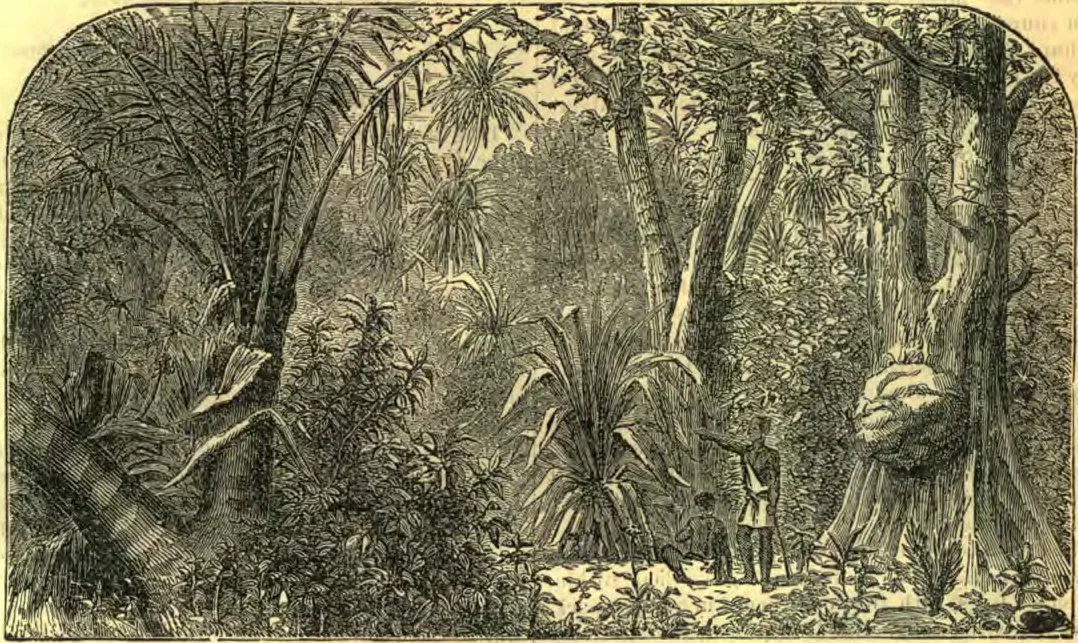
These trees are not nearly as large around, in proportion to their height, as one might expect; few of them can equal the “big trees” of California. The average circumference is from twenty to twenty-five feet, sixty feet being the extreme, while many of them attain the height of two hundred feet. It is hard to estimate the height of such tall trees, but we may adjust it to our comprehension thus: In our own forests, we have but few trees whose lower limbs cannot be reached by a commonly tall man; but it would take the added height of at least twenty such men to reach to the lowest branches of the trees in a Brazilian forest; and then think of from twenty to fifty feet of foliage still above that. Why, the tops of such a tree would make one of our largest, and that, too, of solid brush! Even their ferns and underbrush attain the height of our tallest trees.
The forests are so dense that each tree has necessarily very little “standing room” for its tremendous height; so to sustain it erect, it is furnished with “props;” that is, the ridge-like projections where trunk and roots unite grow very far up from the base, and are very large and thick. One traveler describes them by saying that the spaces between them would furnish fine stalls for several cattle.
A great many of these trees are leguminous, or pod-bearing, and as you walk along you stumble across huge flat pods, two or three feet long, some leathery in structure, others hard as stone. The beans rattle in them under your feet, or shell out in your path. Many trees, too, are nuciferous, or nut-bearing; indeed a goodly portion of our nuts are imported from South America. Some of the nuts grow in shells that look like large wooden dishes. They are called “monkeys’ drinking-cups,” and some species are even furnished with a lid. These shells are usually difficult to open; but the monkeys seem to have the secret, and the lazy, cunning natives utilize it to their own advantage. The monkeys will collect them and sit patiently hammering away for hours till they liberate the nuts, when the natives will attack them, and the monkeys in their rage will literally rain nuts at them to pelt them away. These are gathered up and loaded in the boats without further trouble.
The most useful of all these trees are the different species of the palm. On it the natives depend almost solely for food, drink, and clothing. They grow in almost every variety of form, their leaves varying from the delicate thread-like tufts and spirals, to the broad, flat “fan” six feet across. The trees in the more open forests are neither so tall or so regular in structure as in the denser. They grow into all sorts of grotesque contortions, some with huge excrescences like a camel’s hump, and some with their long branches dividing nearly at the root, and spreading out, like loving arms ready to embrace all that comes within reach. In many of these trees the natives build, or rather weave of palm leaves, their rude huts, as a protection, though slight, from the prowling beast and crawling reptile.
But it is in the low, flat border-land forests of the Amazon, that beast and reptiles of the most deadly kind choose their lair. There the interlacing branches are literally wrapped in clinging vines and feathery moss, forming a perfect labyrinth beautiful to behold, but whose charm is lost when the members of the animal kingdom it shelters are considered; and so the brilliantly plumaged but harsh tongued bird, the chattering monkey, the stealthy jaguar, the gliding cobra, alone are left to thread the intricate mazes of the tropical jungle. S. ISADORE MINER.

OUR AUTUMN MUSTER.

HARK! the muster call is sounding Over dale and over plain; By the hill-side, through the valley, Winds again the loud refrain. Summer's peerless days are over, Autumn follows in her track, And the school-bell's lordly summons Calls an eager army back.
Ah! through all the passing ages Kings have sent their mandates forth, And, responsive to the summons, From the south and from the north, From the eastward and the westward, All the land her legions sent, To the cause of king and kaiser Her best flower of manhood lent.
Ah! how gallant were the chargers! How the glittering harness shone! Every warrior felt the glory Of the cause he made his own. But with all the pomp and splendor, What was that array to this?— Little feet so young and tender, Lips yet warm with mother's kiss.
Yet they are our main defenders; In those helpless little hands Lies a power that ne'er was wielded By the strongest conqueror's bands. Watch them coming from the hillside, Watch them gathering from the sea, Falling into line wherever School or college chance to be.
Every autumn shall they muster, Bringing back a glorious spoil— Strength and courage—from the country, To be spent in winter toil. Ah, God help the hapless nation Where no bands like these are found Answering gladly to the summons When the autumn school-bells sound!
—Harper's Young People.

THE BOY WHO COULDN'T DO AN ERRAND.

MONTGOMERY HASTINGS was a bright, polite, nice-looking boy, ten years old. His parents had money enough to give him most of the pleasures and comforts that a reasonable boy would wish for. He was in the main a good boy, and had never had any great misfortune, except that the boys had changed his name from the respectable one his parents had given him to the short and idiotic nickname, Gum.
But Montgomery had one great failing; he never could do an errand. He would either forget what he was sent for, or lose the parcels after he had got them, or get the wrong thing. It really seemed as if his head was so full of play that there was no room for anything else. His father told him he would never succeed in business unless he could keep his mind on whatever work he had to do until it was done. His mother talked with him about his fault, and many times Montgomery made good resolves and promises, all of which, I am sorry to say, were forgotten before the time came when he could have put them into practice.
Mrs. Hastings, hoping to help her boy overcome his careless habits, would send him on errands purposely; but she never sent for any thing that cost much money, for it was pretty sure to be lost.
One day Montgomery came in and asked his mother if he could have a “candy-pull,” and invite some of the boys? She said, Yes, at once, and thinking to teach him a lesson in the art of doing errands, added,—
“You may take the jug and go and get a gallon of molasses now; for we have none in the house.”
Montgomery took the jug and started for the store with his head full of thoughts of the fun he would have with the candy. But on the way back the jug was pretty heavy, and just as Montgomery put it down on the walk a moment to rest his arm, he looked up and saw a lovely big knot-hole in the high fence behind which the “nine” of his town were playing against the “nine” of some other place.
Of course, every boy is interested in base-ball, and perhaps this was a pretty hard temptation; but anyway the knot-hole was soon covered with the eye of a small boy who had forgotten for the moment all about the candy-pull and the jug of molasses.
I don't know how long Montgomery watched the game; but I do know that when he finally turned away and got his mind on every-day affairs again, there was no jug to be seen. He looked up and down the street in blank surprise, but could not even see any one carrying a jug, nor has he ever seen that jug since, and that was six months ago. A man who asked what the trouble was, said, “It's more'n likely somebody seed it a-settin' thar 'n jest tuck it off,” and that's probably what happened to it. Montgomery had no candy-pull, and had to pay for the jug out of his spending-money. He lost so much pleasure, and seemed so sorry about it, that Mrs. Hastings thought he really must have learned the lesson she had tried so hard to teach.
Last week she sent him for a pound of sugar and a quart of beans. The store-keeper gave them to him in paper bags, with the ends turned in and the packages tied with string. But Montgomery thought they would carry easier if he had the ends of the bags to carry them by. So he sat down on the first door-step and took the strings off, setting one on the step while he untied the other. Now it happened that the steps had just been washed, and were still damp, and this made the bottoms of the bags wet; so when Montgomery started on, the bags were not so strong as they were before. But he did not know this, and went along whistling a gay tune. He had just learned to whistle, and, like all other boys in that state, when he was awake, his mouth was always puckered for a whistle when it was not absolutely necessary that he should use it to talk or eat with. He found the bags were very nice to keep time with, and was swinging and clapping them together in front of him at a merry rate, when suddenly the bottoms came out, and there was a pile of beans and sugar mixed on the pavement at his feet.
His whistling was stopped more effectually than it was the time his nervous aunt offered to give a dollar if he wouldn't whistle in the house for a week. He had no heart for anything so cheerful as whistling, but sadly scooped up the mixed groceries in his hat and walked slowly home.
Mrs. Hastings was almost discouraged when she saw this new failure, and Montgomery said,—
“It's no use, mother, I can't do an errand; something always happens. I s'pose when I'm a man I won't want to look at ball games or bang bags together; but now it seems to me I want to do everything I ought not to.”
“Well,” said his mother, as she emptied and brushed out his hat, “we will have to call you ‘the boy who couldn't do an errand.’”
Don't you suppose Montgomery could have learned?
—Christian Advocate.

HOLD! FIRE, IF YOU DARE!

The Island of Cuba is a colony of Spain. A short time since, an insurrection broke out, and the Spanish Government sent troops to put it down. A seaman, who was a native of America, but the son of British parents, was apprehended on a charge of raising recruits against the Government, and thrust into prison. There was no proof that he was guilty, and those who knew him best were satisfied that he was innocent; but the authorities condemned him to be shot. Against this sentence the English Consul, Mr. Ramsden, and the American Vice-Consul protested, in the name of England and of America, declaring their conviction that the prisoner was innocent of the charge that had been made against him, and demanding his immediate release. They stated also that if his life was thus taken, those who took it would be held guilty of murder by the English and American Governments. But the authorities would not yield. On the morning appointed for his death, the prisoner was marched out to the usual place of execution, in solemn military procession, and soldiers were selected to fire and take his life. But the Consuls were there also, and, in the name of England and America, read their protest in the face of the whole company, again demanding his release. The prisoner, now ready to be shot down, fainted; and there were strong signs of impatience among the Spanish troops, who seemed restless till they had despatched the poor seaman. Another consultation was held by the authorities, after which Mr. Ramsden was told that the remonstrance had come too late; the prisoner, they said, had already been sentenced to death for having taken up arms against Spain, and that sentence they must carry into effect. With this, the order was given to the firing party to “present.” An eye-witness describes what followed:—
“It was the work of an instant, and Mr. Consul Ramsden and the American Consul, rushing forward with the flags of their respective nations before the leveled rifles of the Spanish troops, and in front of the unfortunate man, shouted, ‘Hold!’ and throwing the English flag around himself, and addressing the officers in charge of the firing party, said, ‘Gentlemen, as a Consul of Her Britannic Majesty, I cannot stand innocently by and see this foul murder of an innocent man. It is my duty to protect his life; and if you are to take that life, you must take it through these,’—placing himself immediately in front of the condemned seaman, his eyes sparkling, while his manly form heaved with the indignation his speech had so heroically expressed. The American Consul, wrapped in the American flag, with the stars and stripes of the Union, stood abreast, the conduct of these two noble men being more than the Spaniards could comprehend. The emotion of the prisoner was intense; he was supported by the Consuls, and shed a profusion of tears. A consultation was again held by the Spanish authorities, the execution was stopped, and that day the sailor was set at liberty.”
Who can read this thrilling story without a feeling of deepest thankfulness to those brave men for their noble devotion in order to save a fellow-creature’s life? No wonder the soldiers could not fire, nor that the officers in command were unable to give the order to fire. There was a moral power and grandeur in the sight, which were overwhelming. We cannot but love our brave representative, while the flags of both countries were never more honored than they were by their Consuls on this occasion.
But may we not learn from this a yet higher lesson? Does it not illustrate how the sinner is saved by Jesus? Has he not taken every believer under the protection of his own righteousness, and is he not ready now to wrap around every sinner the blood-stained banner of the cross? Wrapped in this banner who can take away his life? And while we thus see in Jesus our substitute, do we not see also in the offering up of himself for us the love of the Father to a lost and perishing world? “Scarcely for a righteous man,” saith the Scriptures, “will one die; yet peradventure for a good man some would even dare to die. But God commendeth his love toward us, in that, while we were yet sinners, Christ died for us.” And as he “spared not his own Son, but delivered him up for us all,” surely with him also he will freely give us all things. “Why doesn’t God put an iron fence around hell, to prevent men from falling into it?” said a skeptic to a Christian one day; who replied, “Because he knows a better way, and that is, to put you ‘into Christ,’ who ‘has the keys of death and hell;’ and there you are not only safe from hell, but from ‘all the fiery darts of the wicked one.’” Dear reader, are you thus safe? Are you covered with the righteousness of Christ?—The Dayspring.

THE PETRIFIED FERN.

In a valley, centuries ago, Grew a little fern-leaf, green and slender. Veinings delicate, and fibers tender; Waving when the wind crept down so low. Rushes tall, and moss, and grass grew round it, Playful sunbeams darted in and found it, Drops of dew stole in by night, and crowned it; But no foot of man e'er trod that way,— Earth was young and keeping holiday.
Monster fishes swam the silent main, Stately forests waved their giant branches, Mountains hurled their snowy avalanches, Mammoth creatures stalked across the plain; Nature reveled in grand mysteries,— But the little fern was not of these, Did not number with the hills and trees; Only grew and waved its wild, sweet way; No one came to note it day by day.
Earth, one time, put on a frolic mood, Heaved the rocks and changed the mighty motion Of the deep-strung currents of the ocean, Moved the plain and shook the haughty wood, Crushed the little fern in soft, moist clay,— Covered it, and hid it safe away. O the long, long centuries since that day! O the changes! O life's bitter cost Since that useless little fern was lost!
Useless? Lost? There came a thoughtful man Searching Nature's secrets, far and deep; From a fissure in a rocky steep He withdrew a stone, o'er which there ran Fairy pencillings, a quaint design, Veinings, leafage, fibers clear and fine, And the fern's life lay in every line! So, I think, God hides some souls away, Sweetly to surprise us the last day.
—Mary L. Bolles Branch.

Chasing a Half Hour Across the Ocean.

“At seven o’clock sharp,” said the agent, as we purchased our tickets, “and the vessel will be in Liverpool Friday morning.” We were on hand bright and early, long before the time for sailing, and the passengers were on board, but the Wyoming was not quite ready. Wheat was pouring down from the elevator, and freight was coming on board, and a good half hour was gone before the vessel cast loose from her moorings and swung around down the harbor. Starting half an hour behind the time, we sailed as best we could. By noon on Wednesday we made 324 miles, noon Thursday added 304, Friday 312, Saturday 312, Sunday 301, Monday 302, Tuesday 300. Then the speed fell off. Wednesday we registered 283 miles, Thursday 285, and we had not overtaken our lost half hour. Thursday night we were at Queenstown. A tug steamed out into the river taking off the passengers and baggage, and with a very brief delay we were on our way again at eight o’clock. But the lost half hour was still ahead. All night and all the next forenoon we pushed on up through the Irish Sea and by the coast of Wales. If we could reach the bar by two o’clock we could pass over and be in Liverpool in an hour. They made what steam they could, but it was the same old story; the half hour was still ahead of us. At half-past two the vessel came to anchor at the Liverpool bar. The precious half hour is gone, and here we lie at anchor, thinking of the port which we cannot reach to-night. The lost half hour is the secret of it all. Ten times the money for the freight taken on board during that half hour, would not pay the loss caused by the half hour’s delay.
But this is not all. Early to-morrow morning a steamer starts from Hull for Sweden, and the last train leaves about seven o’clock this evening. One passenger is bound thither, but this lost half hour stands in the way, and a lost half hour means a week of waiting in a strange city until another steamer sails.
And so we muse and think how impossible it is to regain lost time and recall lost opportunities. The delay in the morning signified failure at the end. The lost half hour at the beginning of the voyage may defeat its purpose at the end. Alas! how many there are who are wasting the precious now, who through all their lives will chase the lost half hour, and finally come where opportunity is past, probation is ended, and the door is shut. There will be time enough then to muse and meditate, and lament the lost opportunity, when men who might have come in shall “stand without, saying, Lord, Lord, open unto us.”
The lesson of the lost half hour is this: “To-day if ye will hear his voice, harden not your hearts.” Behold now is the accepted time, and behold to-day is the day of salvation.—Little Christian.

PRAYER

LESSON 11.—PRAYING IN SECRET.

1. For what were the Pharisees condemned? Matt. 6:5; 23:14.
2. How does Jesus tell his disciples to pray? Matt. 6:6.
3. In what respect were they to avoid imitating the heathen. Verse 7.
4. Why were the heathen led to make this mistake? Same verse.
5. Why are these repetitions unnecessary? V. 8.
6. What was the Saviour’s custom in regard to secret prayer? Matt. 14:23; Mark 6:46.
7. How long was he sometimes alone in prayer? Luke 6:12.
8. What seems to have been the custom of the prophets with reference to secret prayer. 1 Kings 17:19–21; 2 Kings 4:33.
9. What appears to have been a habit with Isaac? Gen. 24:63.
10. Show that Daniel had set times for private devotion. Dan. 6:10.
11. What does David say about his habits of prayer? Ps. 55:17.
12. What was one of Peter’s times for prayer? Acts 10:9.
13. What record of personal pleading with God may be found in Gen. 18:23–32?
14. What touching petition is found in Gen. 19:19, 20?
15. In what words did Eliezer show the most unwavering trust in God? Gen. 24:12–14.
16. How did Gideon plead for a renewal of the miraculous deliverances of old? Judges 6:13.
17. What was there remarkable about the prayer of Hannah? 1 Sam. 1:13.
18. What prayer consists mainly of the most humble confessions? Ezra 9:5–15.
19. Under what strange circumstances did Jonah pray? Jonah 2:1.
20. What other prayers have already been noticed? Gen. 32:9; 2 Kings 20:2; 1 Chron. 4:10; Dan. 9:3, etc.

SUPPLEMENTARY QUESTIONS.

(1) With what earnestness did David seek the Lord? Ps. 119:10. (2) What were some of the chief objects of his prayer? Last part of the same verse and verses 35, 36, and 80. (3) How should we feel about covering our sins before God? Ps. 26:2; 139:23, 24. (4) How should we feel about knowing our own spiritual condition? Ps. 19:12. (5) On what should we depend for safety? Ps. 119:117. (6) In Jer. 10:24, for what does the prophet pray? (7) How are we taught to look upon the chastening of the Lord? Heb. 12:10, 11.

COMPENDIUM.

Jesus tells his disciples not to be like the hypocritical Pharisees (Matt. 6:5; 23:14), but rather to enter into the closet, and there pray to their heavenly Father, who is able both to see in secret and to reward openly. Matt. 6:6. They were also to avoid the heathen custom of making long prayers with needless repetitions, since our Creator knows our needs before we ask him. Verses 7, 8.
It was the Saviour’s custom to go away alone into a solitary place to pray (Matt. 14:23; Mark 6:46). The Bible gives instances in which the prophets Elijah and Elisha on most important occasions shut themselves up to pray in secret unto their God. 1 Kings 17:19–21; 2 Kings 4:33. Isaac also seems to have had a habit of going away into the fields at even to meditate alone, and no doubt to pray. Gen. 24:63. Daniel, too, had set times for private devotion (Dan. 6:10). David says that “evening and morning and at noon will I pray;” and Peter went up on the house-top to pray about the sixth hour. Noteworthy examples of personal pleading with God may be found in Genesis 18:23–32, and 19:19, 20. Eliezer, at the well of Laban, put up a prayer of unwavering trust in God. Gen. 24:12–14. Gideon urged a renewal of the miraculous deliverances of old. Judges 6:13. And Hannah gave an example of mental prayer, when putting up the most fervent petitions to God. Many of the prayers of Bible worthies have abounded in the most humble confessions, as may be seen in Ezra 9:5–15, Dan. 9:3–20, etc. Other examples of private prayer might be quoted. Gen. 32:9; 2 Kings 20:2; 1 Chron. 4:10; etc.

CONDENSED ANALYSIS.

1. Cautions against imitating the Pharisees and the heathen in their prayers. 2. Custom of our Saviour, of the prophets, and of the patriarchs, with reference to secret prayer. 3. The example of Peter, Eliezer, Gideon, and Hannah. 4. Prayers abounding in humble confessions, and other notable examples of the prayers of Bible worthies.

BAMBOO

It is safe to say that if the giant grass, generally called by its Malay name of bamboo, were suddenly removed from existence, very many millions of the human race would not know where to turn for the utensils of domestic life, or even for the very roofs which shelter them from the storm.
The bamboo has a hollow, round, straight, and very shining stem, of flinty hardness on its outside, so that thin strips of it, split obliquely to the surface, are often used for knives. It is jointed like grass, with rough, hairy sheaths on each joint and small, spine-shaped leaves, and, in favorable position, grows to be as much as eighty feet high, with graceful, waving stems. Even with this great height, the diameter of the stem at its thickest part would not be more than eight or nine inches.
There are few plants more common in the tropics than the bamboo, in both the Eastern and Western hemispheres, although by far the greatest use is made of it in the East. There the Malays and Cochin-Chinese systematically cultivate it. It is, unfortunately, so sensitive to cold that in temperate regions it can only be grown in hot-houses. Even there its growth is so rapid that it has been known to spring from the ground and attain a height of twenty feet in less than six weeks.
Most of the dried leaves which we see put round the tea which comes from Southern China are those of the bamboo. In the Malay Islands, with their millions of people, as well as in China, the small and tender shoots of the bamboo are preserved in vinegar, and other condiments added, and eaten with their rice diet, to give the insipid grain a flavor.
Common as it is, there is no more graceful or beautiful object than the bamboo clump, which grows to perfection along the rivers and creeks of Burmah. The clusters seem to wave a salute, with their delicate, spray-like tops, as the slight breeze, stealing along the water, sways them gently to and fro. Along some of the roads and paths of this low, hot country the smooth stems rise on each side with perfect regularity, and close overhead, at a great height, in a perfect gothic arch.
The Burman uses the plant even more than any other race, not only on land, but on the water, which is the principal avenue of travel and trade for them, putting it to every conceivable use. The main supports of his house are apt to be of solid timber, but the beams and rafters are sure to be of bamboo, the partition walls of the same, and the string which lashes rafter and beam together also from the same plant. The thatch which generally forms the roof, and the mats and pillows upon which the owner sleeps, are also of bamboo; while there is not a vessel or utensil in the whole establishment which is not formed, in whole or in part, of the same useful plant. On board his boat it is just as useful. The roof over the stern, and the cover which keeps his cargo from sun and rain, are of bamboo. If he is a fisherman, the larger cords of his net, and the floats which suspend it in the water, are of bamboo. It forms the stake to which his boat is made fast, and the pole with which he propels her in shallow water, while the anchor for holding her in mid-stream is made of bamboo, lashed together, and weighted with stone or ironwood.
We have all seen the beautiful lacquered work-boxes and jars of bamboo, and in Burmah these take the place of earthenware very largely in the domestic service. The builder makes his scaffolding of the long, light, strong wood; baskets and crates are woven from it; paper is made from some of its interior parts, and most buoyant floats or rafts carry down the streams great loads. For the yards of the sails of boats, and even for masts, there is scarcely anything better adapted than the light, strong, elastic bamboo, while most junks carry a life buoy of the same material, ingeniously made, and quite as good as cork in most of its qualities.—Golden Days.

Our Scrap-Book.

THOMAS JEFFERSON'S INGENUITY.

Two illustrated articles on Monticello, the home of Jefferson, are given in the September Century. We quote from one: “I think it is not generally known with what pleasure and zeal Jefferson brought his mind to bear, not only upon the development of his somewhat grand ideas in regard to a home, but upon the most minute and peculiar contrivances for convenience and adornment. He drew plans and made estimates for nearly everything that was built or constructed on his place. He calculated the number of bricks to be used in every part of his buildings; and his family now possess elaborately drawn plans of such bits of household furnishing as ‘curtain valances’; and the like. Many of his ideas in regard to building and furnishing he brought with him from France; but more of them had their origin in his brain. There were no bedsteads in his house, but in every chamber there was an alcove in the wall in which a wooden framework was built which supported the bed.
“In his study stood Mr. Jefferson’s writing-chair, which was made to suit his peculiar needs: the chair itself was high-backed, well-rounded, and cushioned, and in front of it extended a cushioned platform, on which Mr. Jefferson found it very pleasant to stretch his legs, being sometimes troubled with swellings of the smaller veins of these limbs. The writing-table was so made that it could be drawn up over this platform, legs and all, and pushed down when it was not in use. The top of this table turned on a pivot; on one side of it were his writing materials, and on the other was the little apparatus by which he made copies of all his letters. By his side was another revolving table, on which his books of reference lay, or were held open at proper angles. Near him also stood a pair of large globes; and, if he wished to study anything outside of this world, he had in the room two long telescopes mounted on brass tripods. Convenient also were his violins, one a Cremona, and the other the bass-viol saved from the Shadwell fire. Besides the bookshelves and the somewhat simple furniture of the library, there were a number of oddly contrived little closets, in which were stored his multitudinous manuscripts. There is a writing-table now in the possession of the family, which was frequently used by Mr. Jefferson, and which is very ingeniously contrived. Two of its four legs are hollow, and in these run rods resting upon springs by which the table can be easily elevated, the two other legs being also extensible, but in a different way. When Mr. Jefferson was tired of writing in a sitting position, he could stand up and raise this table to the desired height. When he wished to use it as a reading-stand, the top could be inclined at any angle, and a strip of brass was brought into use to keep the books and papers from sliding off.
“Opening from the library was a large room inclosed with glass, which was intended for a conservatory, but was used by Mr. Jefferson as his work-room. There he had a work-bench, with all sorts of carpenters’ tools, with which he constructed a great many of the small conveniences he invented.”—Interior.

GIGANTIC OAKS.

The largest oak now standing in England, writes a correspondent of The Scientific American, is the Cowthorpe oak, measuring seventy-eight feet in circumference at the ground. Tradition says at one time the tree and its branches covered an acre of ground. I visited this tree a few years ago, and although quite hollow and its interior made to serve for a calf-pen, some of its branches still have plenty of leaves and acorns. A few miles from Cowthorpe stands a farm-house. On the lawn stands a majestic oak, as to size and beauty such a tree as we seldom see in a month's walking tour. A certificate is kept in the farm-house which states that the tree on the lawn was an acorn planted from “the big oak at Cowthorpe.” Dates are given. The parliamentary oak in Clipstone park is supposed by the ancient chroniclers to be 1,500 years old. This park existed before the conquest (1066), and belongs to the Duke of Portland. The “tallest oak in England” belonged to the same nobleman. It was called the “Duke's walking-stick,” and was higher than Westminster abbey. The “three-shire oak,” near Worksop, is so called because its branches stand in three counties—Nottingham, Derby, and York. Perhaps the most productive oak was that of Gelemos, in Monmouthshire, felled in 1810. Its bark was sold for $1,000, and its timbers for $3,350. In the mansion at Tredegar park, in Monmouthshire, there is a room forty-two feet long and twenty-seven feet broad, the floor and wainscot of which are the product of a single tree felled on the estate. In Dr. Hunter's edition of “Evelyn's Sylvia” is a figure of the Cowthorpe oak already alluded to. About a mile and a half from Shrewsbury there formerly stood an oak forty-four feet in circumference at the base, twenty-seven feet circumference at eight feet from the ground. There formerly stood in Hainault forest, near Barking, Essex, a tree called the Fairlop oak, thirty-six feet in circumference. Mr. Gilpin, in his “Forest Scenery,” says that the tradition of the country traces this tree halfway up to the Christian era. This tree was naturally the pride of the villagers in the district, and according to the annals of the neighborhood received its name of Fairlop in this way: The farmer on whose estate the tree grew wanted to lop off a branch. The villagers objected. The farmer, however, in lieu of the branch agreed to give the parishioners a bean feast annually. This was agreed to, and the annual fair was called Fairlop. This tree fell some years ago, and I think its wood was made into a pulpit.—Chicago Times.

Great Yarmouth Windmill Drives Large Flouring Mill

One of the largest wind motors in existence is used for driving flouring machinery at Great Yarmouth, England. It has four sails, which are 40 feet 9 inches long by 12 feet 6 inches wide, and extend 100 feet from point to point. With a wind of 25 miles an hour, the windmill has 55 horse-power, and will easily make 120 barrels of flour in 24 hours. The building containing the flouring apparatus and supporting the motor is of 11 stories, stands 99 feet above foundation, and is 35 feet in diameter at the base, and 16 at the top. —Golden Censer.
Continue reading: KEEP THYSELF PURE