Sanitarium Health and Temperance Missionary Class.
By A. A. John
On the evening of the 2d inst., the class in the special course for health and temperance missionaries, which was inaugurated last year, held what was called (perhaps not inappropriately) its first commencement exercises. The attendance was so large that the Hospital parlor could not accommodate all, so many were seated in the hall. An appropriate hymn was rendered in full chorus, after which Eld. Mc Coy invoked the divine blessing upon the assembly. He then in a modest and impressive exordium presented a few of the many advantages which young ladies and gentlemen have who embrace the opportunities afforded those who take any of the prescribed courses of instruction which the managers of the Sanitarium have so generously provided.
Dr. J. H. Kellogg then presented an interesting epitome of the work of the institution, and gave a brief but most thrilling personal reminiscence. The boy of twenty years ago who was thought too delicate to attend school, and who was considered to be an early victim for consumption,—that dreadful malady to which one-seventh of all who die succumb,—on this occasion stood a fair picture of health, as a living monument illustrative of the results of adhering to the principles of rational health reform, with the attendant blessings of the Source of all life. The report of the Committee on Resolutions was introduced, and the preambles and resolutions, here appended, received the support of about a dozen enthusiastic speakers, and ultimately were adopted without a dissenting vote.
Dr. Kellogg, in replying, expressed his gratitude that so many were in sympathy with the principles to which the success of this branch of the work was due. Not only had this been shown by the large number who from the city had regularly attended the lectures during the course, but some of the more distant Conferences had sent persons of ability to take the entire work of the course, so that they could return to their respective fields better qualified to present the principles of hygiene and general sanitary reforms in a manner to elicit the respectful consideration of persons of scientific research.
About thirty were enrolled as regular class members, and of these perhaps a dozen had been sent by Conferences, or selected to take a somewhat leading part in this gospel-of-health work. Therefore, the Doctor amusingly suggested that they might be denominated “the twelve apostles.” A pathetic song was rendered by a quartet, and the interesting services were concluded with the benediction.
At the close of the meeting proper (which was of two and one-half hours’ duration) the class remained to receive their commission. In this another hour was very profitably spent colloquially, the results of which may be thus briefly summarized: The health and temperance missionary work is no independent movement, yet it is not an unimportant branch of the great work of reform in which the Lord is pleased to have all his people engaged. Therefore it is of the greatest importance that all who engage in it should not do so from mercenary motives, but from the stand-point of Christian philanthropists, earnestly endeavoring to unify gospel work wherever and by whomsoever performed, in harmony with the instruction of the great Teacher and Reformer who said to his disciples, “He that is not against us is for us.” The Committee on Resolutions presented the following:—
Whereas, It has been our privilege to attend the special course of the Sanitarium Health and Temperance Missionary Class, ending April 2, 1890; and,—
Whereas, The most painstaking efforts have been put forth by the instructors to give the class the fullest possible benefit of the valuable and exceptional instruction peculiarly adapted to this important branch of true philanthropic and Christian work; and,—
Whereas, In the class room, in the experimental kitchen, and in the chemical laboratory the principles of hygiene and sanitary reform so taught and practised by Dr. and Mrs. Kellogg, have stood the tests of common sense, science, and Inspiration; therefore,—
Resolved, That we are more than ever convinced of the soundness of these principles, and also of their great importance as a basis for moral and social reform; and that238in consideration of the exceptional advantages which have been afforded the class at the Sanitarium, we will, with divine help, do our best to so reflect in our lives the light of this gospel of health that its benign influences will materialize in a glorious health and temperance reformation among our fellow-beings.
Whereas, We have had inculcated principles during our stay here that will be of incalculable value to us personally, and will enable us to more efficiently engage in the work of helping our fellow-men; therefore,—
Resolved, That we extend our heartfelt thanks to our Father in heaven, and to our faithful instructors, Dr. J. H. Kellogg, Mrs. Kellogg, Prof. G. H. Bell, Eld. W. H. Wakeham, doctors Lindsay, Place, Belknap, and Hoenes, also to Messrs. McFarland and Alworth, and the managers and matrons of the institution for their kind consideration of our welfare, and the many privileges which we have enjoyed.
A. A. John.
NEW YORK.
By A. E. Place
AMONG THE CHURCHES.—Since General Conference I have held meetings with the churches at Buffalo, Olcott, Jeddo, Syracuse, S. W. Oswego, Auburn, Rome, Williamstown, Newburgh, Adams Centre, Mannsville, Watertown, Constableville, and Frankfort, and with the new companies who took hold of the truth last summer at Colden and Springville. I also had the privilege of attending the mass-meeting and the American Sabbath Union convention at Washington.
With most of the above churches I spent several days, and with some two weeks. A part of the time I labored with Bro. S. H. Lane, and for the past five weeks with Bro. F. M. Wilcox. Because of dearth of laborers in this Conference, our churches have had but little ministerial help for some time. We have felt sad to have it so, but have been at a loss to know how to do more. This winter we have put forth a special effort in this direction, and God has given us evidence from time to time of his approval. I feel that our efforts have also been appreciated by our brethren and sisters, and we as ministers have been encouraged. I have enjoyed my work better this winter than ever before, and have felt thankful to God for the privilege of laboring for, and becoming better acquainted with, those who are looking for the Saviour in his glory. The good effects of our last camp-meeting are still visible in those who attended; and though in some cases we had to face difficulties, I feel that the spirit generally is to trust God more fully, self less, and go forward. We have tried by God’s help to labor faithfully and impartially, and God’s Spirit has seemed precious and his grace sufficient.
Much of the time I have labored under great physical difficulties. For some time I have felt that I must give up my work for a year. Last December I was taken with neuralgia of the heart, and for a time little hope was entertained that I could live. That left me in a weak condition, from which I have been slow to recover. I believe that God has heard the earnest prayers of my brethren and sisters, and during the past few days I have been improving.
I expect to attend the quarterly meeting here at Rome April 4, 5, and Syracuse, April 12, 13, after which I shall try to take some rest till time for camp-meeting. May God grant that we may have one as good this year as last, and that many more of our brethren and sisters may be present to enjoy and take to their homes its rich blessings.
April 2.
A. E. PLACE.
PENNSYLVANIA TRACT SOCIETY.
By MRS. A. V. CHADWICK
Report for Quarter Ending Dec. 31, 1889.
No. of members
447
“ reports returned
297
“ members added
13
“ “ dismissed
8
“ letters written
277
“ “ received
148
“ missionary visits
4,789
“ Bible-readings held
502
“ persons attending readings
1,043
“ subscriptions for periodicals
494
“ periodicals distributed
5,839
“ pp. books and tracts sold, loaned, donated
357,353
Cash received on fourth Sabbath and other donations, $115.10. MRS. A. V. CHADWICK, Cor. Sec.
NEW ZEALAND TRACT SOCIETY.
By M. H. Tuxford
Report for Quarter Ending Dec. 31, 1889.
No. of members ................................ 117
“ reports returned ............................. 70
“ members added .................................. 6
“ “ dismissed .................................... 3
“ letters written ............................... 93
“ “ received .................................... 38
“ missionary visits .......................... 1,325
“ Bible-readings held .......................... 156
“ persons attending readings ................... 617
“ subscriptions obtained ....................... 10
“ periodicals distributed ..................... 215
“ pp. books and tracts sold, loaned, donated 206,944
Cash received on books, tracts, and periodicals, $427.70; on sales of subscription books, $1,647.12.
M. H. TUXFORD, Sec.
News of the Week.
FOR WEEK ENDING APRIL 12.
DOMESTIC.
—During March the public debt was decreased $11,389,857.48.
—The total debt on April 1, less cash in the Treasury, was $1,023,157,672.
—A shock of earthquake, continuing several seconds, was felt early Friday morning at Dover, Me.
—Samuel J. Randall, the noted Congressman, is lying at the point of death at his home in Washington.
—During an electrical storm at Paterson, N. J., Thursday, a quantity of ashes and potato bugs fell from the clouds.
—United States Minister to Spain Palmer has resigned, and it is said that Assistant Postmaster-General Clarkson will be sent to fill the position.
—Union County, Ky., is suffering from a deadly form of spotted fever, which first made its appearance near Henshaw. Many of the people have fled.
—Ten per cent of the coke ovens in the Connellsville, Pa., region will close next Monday for want of orders, throwing about 1,200 men out of employment.
—A fallen tree near Stanley, N. Y., ditched a Northern Central train, Wednesday night, all the passengers except an immigrant woman escaping serious injury.
—Horace Greeley's house at Chappaqua, N. Y., was burned last Thursday, and all the valuable letters left by the famous editor and statesman were destroyed.
—Prominent colored people in Augusta, Ga., at a conference last week, adopted resolutions denouncing the Republican party for defeating the Blair Educational Bill.
—Municipal elections were held in sixty cities of Kansas, April 1. Women elected their candidates in several places. At Salina the Anti-Suffragists placed a colored woman on their ticket, and elected her by a large majority.
—Thursday Mrs. Cornelia L. Washburn began suit for $5,000 in Bloomington, Ill., against eight saloon-keepers, or owners of buildings in which are saloons, on the ground that her husband lost his employment by frequenting the saloons.
—At a meeting at Guthrie, Oklahoma, Tuesday, a strong appeal was issued to the colored people of the country, praying that they pay no attention to the alleged outrages reported, and calling upon the colored race to join their brethren in that community.
—The monthly crop report of Michigan for April, places the average condition of wheat in the southern four tiers of counties at seventy, central at sixty-five, and northern at eighty-six per cent, being the lowest ever recorded in the history of the department.239
—The New York Sheriff's office is badly demoralized. Several of the deputy sheriffs have resigned, and Gen. Sickles has asked the police commissioners for five policemen to act temporarily as deputy sheriffs. Another deputy sheriff was indicted last Thursday for grand larceny.
—The House, on Wednesday of last week, passed the bill authorizing the construction of a huge suspension bridge over the Hudson River, between New York and New Jersey. The bridge is to have at least six railroad tracks and capacity for four more, and will cost about $40,000,000. It is to be finished within ten years, and will be the largest bridge in the world.
—The drink consumed by the working-classes of the United States last year cost $1,280,000,000, nearly twice the banking capital of the country, more than one-fourth the cost of all the mills and factories, and considerably more than one-fourth of the cost of all the railroads. Think of it! Mr. Powderly says: “The rum habit is the wage-earner’s greatest enemy.” Who can doubt it?
—The past week has been particularly noted for the prevalence of destructive storms. Among the places which have suffered from such visitations are Prophetstown, Ill., Harper's Ferry, Ky., Sharon and Norwalk, Ohio, Columbus, Ga., Denver, Col., Charlotte, Allegan, and Kalamazoo, Mich. Several persons have perished in the wreck of their homes, others have been killed by lightning, and the destruction of property has been immense.
FOREIGN.
—Emperor William's household servants threaten to strike for higher wages.
—The projected Congo railway will be 268 miles long, and will cost about $5,000,000.
—An insurrection has broken out in Mexico near Iguala, in the state of Guerrero.
—Negotiations looking to the withdrawal of British troops have begun between England and Turkey.
—It was reported, Monday, at Minneapolis, that the Indians on Court d'Oreilles Reservation are in danger of death by starvation.
—Emin Pasha has entered the German service at a salary of $5,000 a year, and will start at once for Central Africa with a large caravan.
—The English Admiralty say that the total abolition of masts and sails in all future fighting ships has become absolutely necessary.
—The Corean alphabet is phonetic and so simple that any one can learn to read in a day. Nearly all the women in Corea can read.
—Southern Russia is almost devastated by an army of field mice, which have ruined cultivated fields, and devoured dogs and small animals by the score.
—The German military bill which will be submitted at the coming session of the Reichstag, will demand a credit of from 40,000,000 to 50,000,000 marks.
—Dr. Peters, the German explorer who was reported to have been murdered with his party in Central Africa, is safe, and in communication with Major Wissman.
—The geographical and official name of Aspinwall is now Colon. Unless letters addressed to persons in that city shall be so directed, they will be returned to the writers.
—The new steamship “Majestic” made her first trip from Liverpool, via Queenstown, to New York in 6 days, 10 hours, and 30 minutes—the quickest maiden passage on record.
—The Berlin (Germany) Surgical Congress has declared that consumption is curable, through the performance of a surgical operation which removes the affected portions of the lungs.
—Paris is rejoicing because the Eiffel Tower has just been re-opened for the spring and summer trade. Every visitor to the French capital is expected to patronize the great curiosity.
—A dispatch from London states that Minister Lincoln will sail for America next month, and that his son's remains will be shipped at the same time for burial in the family vault at Springfield.
—It is positively stated in official circles that Queen Victoria is seriously considering the step of abdicating the British throne, in which event the Prince of Wales will become king of England and emperor of India.
—The largest vessel ever built in France, “La Touraine,” of 12,000 horse-power and more than 530 feet long, will be added to the fleet plying between Havre and New York this season. She has just been launched.
—German papers remark that the new rifle with which the German army is now being armed, is the third which has been adopted by the sages at Berlin since the summer of 1871, and each change has involved an expenditure of 110,000,000 marks.
—The list of Prince Bismarck's birthday gifts is an amusing one, but proves conclusively how dear the veteran diplomatist is to the popular heart. The gifts include two mastiffs, forty-three drinking mugs, over a hundred long pipes, meerschaum and wood, three hunting guns, many pounds of tobacco, a large arm-chair made of horns, several dozen canes, innumerable packages of preserves, cakes, and candies sent by farmers' wives, barrels of eggs, sides of bacon, Keibitz eggs from Platt-deutschland, half a sheep, a medicine chest containing a dozen bottles of some wonderful cure for rheumatism, hair pomade, brushes, cushions, rugs, and enormous salmon from Wales.
RELIGIOUS.
—The Senate adjourned over Good Friday.
—The Presbyterians have a church at Sitka, Alaska. At the last communion service twenty-five persons united with it.
—Representatives of eight prominent mission associations met in New York April 3, and protested against the Chinese Enumeration Bill now before the United States Senate.
—Resolutions protesting against any interference with their parochial schools were adopted, Friday, by the delegates to the Fort Wayne German Lutheran Conference, in session at La Porte, Ind.
—Mr. John Brown, a railroad engineer living at Augusta, Ga., is a member of a church which requires its members to refrain from work on Sunday. He has, in consequence, lost his position.
—The draft “New Creed” of the English Presbyterians proposes, it is said, to describe the Bible simply as “the word of God,” notwithstanding the energetic attempts of the latitudinarian section to interpolate the word “contains.”
—The German Lutheran Conference, in session at La Porte, Ind., Thursday, decided to use the ballot to defeat legislative candidates who would not pledge themselves to vote against the enactment of laws tending toward compulsory education.
—Judge Ryland, in his charge to the grand jurors at Sedalia, Mo., Tuesday, instructed them that the fashionable game of progressive euchre and church raffles are gambling, and contrary to law, and charged them to take cognizance of all such things.
—Monday a committee of the New York Methodist Episcopal Conference rendered a report declaring that the recent decision of the Wisconsin Supreme Court against the reading of the Bible in the public schools, is “un-American, pagan, and a menace to the perpetuity of our institutions.”
—The excitement is increasing among Erickson's followers in Oakland, San Francisco, Chicago, and Milwaukee over his prophecy that those cities are to be swallowed up by an earthquake. Many families have moved out of the towns and camped in the mountains. Several women have become insane.
—The Methodist Episcopal Church of Canada reported for its eleven conferences, for 1889, a membership of 228,959, and 217,757 Sunday-school scholars. It raised for missions $215,755, and has 489 missionaries, 596 paid agents, with returns from its missions of 46,944 members. It has Indian, French, and domestic missions, a Chinese work in British Columbia, and a foreign mission in Japan.
KANSAS, NOTICE!
By N. P. Dixon
THERE will be a canvassers’ institute held at Ottawa, commencing April 25, and lasting one week. The District Agent, Bro. W. R. Smith, has promised to be present to assist in giving instruction. We hope to see a good number come from other churches to get the benefit of the institute.
N. P. DIXON, State Ag’t.
STATE MEETING FOR OHIO.
By Ohio Conference Committee
The Ohio State meeting will be held at Columbus, April 24–29. All our ministers, district directors, Bible workers, church and T. and M. officers, Sabbath-school workers, and all those who desire or ought to engage in the work in any of its branches should attend.
The interests of the cause in the State will be considered, and plans for the summer’s work will also be arranged at this time. Those in the State who desire labor either in the churches or by tent effort, should make the same known to the Conference committee by letter immediately, or report at the meeting, so that all these things may be fully considered and acted upon intelligently.
Those who are desirous of having the camp-meeting held in their locality should be at this meeting either in person or by proxy, to make known the special inducements for, and advantages to be derived by, holding the camp-meeting at their place.
Canvassers and those desirous of entering this branch of the work will have opportunity for instruction, and should attend. The district canvassing agent is expected to be present. The president of the General Conference will be present, whose valuable council and instruction should be heard by all. Eld. J. H. Durland will be in attendance, to give special instruction in the Sabbath-school work. Our Sabbath-schools should avail themselves of this privilege to educate their officers and laborers. Good help is also expected in the Religious Liberty work. Brethren and sisters, come—come with the spirit of prayer, and may we earnestly seek God and obtain a blessing that will strengthen us for future labors. The General Conference goes to considerable expense to send laborers to these meetings, and it costs just as much to send laborers to talk to a score as to 200 of our brethren from all parts of the State. It is hoped that the influence of these meetings will be carried to every church in the State. Shall we not show that we appreciate these efforts? OHIO CONF. COM.
The Sabbath-School.
“The entrance of thy words giveth light.”—Ps. 119: 130.
11. Does faith require some evidence that God will perform what he has declared in his word? Ans.—No; it is its own evidence. When the Lord has made a declaration, faith grasps it and makes it real. There cannot be anything that can add strength to the simple word of God. Macknight well says: “Faith answers all the purposes of a demonstration, because, being founded on the veracity and power of God, these perfections are to the believer complete evidence of the things which God declares have happened, or are to happen, however much they may be out of the ordinary course of nature.”
12. When one knows the word of God, and still has no faith, what is he virtually doing?1 John 5: 10.
13. Relate the incident of the healing of the impotent man at the gate of the temple?Acts 3: 1–10.
14. By what was this man made whole? Verses 13, 16.
15. Give another instance of the power of faith.Matt. 12: 10–13.
16. Was the hand restored before the man stretched it out, or afterward?
17. What was it that enabled him to obey the command of Christ, to stretch forth his hand? Ans.—Simple faith in the promise of God.
18. Cite another instance in which the evidence is plain that it was simple faith that brought healing.Luke 8: 43–48.
19. For what purpose are the miracles of Jesus recorded?John 20: 30, 31.
NOTES.
The writer of Hebrews in chap. 10: 37, 38 quotes from Hab. 2: 3, 4, who is speaking prophetically to the people living in the last days. The book of Hebrews, like a great part of the Bible, was written not simply to those who lived in the writer’s day, but for all time until Christ should come. Prophecy is given as a light “until the day dawn.” 2 Pet. 1: 19. While the practical teaching connected therewith would be always applicable, the entire scope of the prophecy would only be met when that generation was reached to which it applied, and whose dangers, needs, and experiences accorded with the warnings and predictions. The book of Hebrews is of especial interest to those living in the last days. In the light which shines upon the sanctuary question, it can now be understood and appreciated; and to the people who understand this it is true that in “a little while, . . . he that shall come will come, and will not tarry.” That Paul did not believe that Christ’s coming was imminent in his day is shown by 2 Thess. 2: 1–3, and yet he speaks in the first epistle as though it was near at hand. (See 1 Thess. 1: 10; 4: 13–17; 5: 23.) Those who were instructed as to the times and seasons, who heeded the prophetic portion of the word of God and the apostolic injunction, would not be deceived in this respect. Again, the same God who gave that word still lives, and his faithful servants, of whom there have always been some, always have brought forth and will bring forth the “meat in due season” to the household of faith. Matt. 13: 52; 24: 45. When the time comes that the word is due, God will see that it is given.
“Now the just shall live by faith.” Some have erroneously read this as though the first word were the most prominent in the sentence, and that the apostle refers to some special time when the just shall live by faith. The word from which “now” is rendered in this instance is not an adverb at all, and is never used with any reference whatever to time. It is a conjunctive participle, having the force of moreover, nevertheless, besides, etc. It is often used, as in this instance, to introduce an additional thought. Such expressions are very common in the English. For an instance, see Ex. 16: 36. Since the days of Adam there has not been a time when the just could live in any other way than by faith.
Faith requires no evidence, but the simple promise of God. Its confidence in God is such that it grasps the promises and makes them real. Knowing that nothing is too hard for the Lord, and that he cannot lie, it cannot do anything else but believe as Chrysostom says, “Since what God giveth transcends reason entirely, it is but reason that we have faith.” God promises forgiveness of sins to those who believe. If we believe, our sins are forgiven; if we do not, they are not. Thus it is faith that takes the promises of God, and transforms them into facts.
NOTICE FOR MISSOURI.
By R. S. Donnell
Bro. H. D. Clark intending to leave the State, has resigned his position as secretary of the Conference, and Bro. W. B. Tovey, of Economy, Macon Co., has been appointed to fill his place. Let church clerks and all reporting quarterly to the Conference secretary, take notice.
R. S. Donnell, Pres. Mo. Conf.
INDIANA STATE MEETING.
By M. E. McMeans
To all interested in health and temperance, I wish to say that this important branch of the third angel's message will receive especial attention at this meeting. The subjects of domestic hygiene, social purity, &c., will be presented in a scientific and practical way. We hope to be able to devote one hour a day to the consideration of health and temperance questions. Canvassing for our health publications will also receive due attention. This branch of the work is rapidly coming to the front, and many are coming to realize its importance as an aid to the advancement of present truth. All who would like to engage in this branch of the work should make a special effort to attend this meeting. Eld. W. H. Wakeham, Field Secretary of the H. and T. Association, Eld. A. A. John, and sister Kate Nuding, who has just completed a course of training at the Sanitarium, will be present to aid in the work. All should come at the beginning and stay until the close of the meeting.
M. E. McMeans, Asst. H. and T. State Ag't.
LABOR BUREAU
Appointments.
“And he said unto them, Go ye into all the world, and preach the gospel to every creature.”—Mark 16:15.
PROVIDENCE permitting, a number of brethren from Battle Creek will meet with the church in Bedford, Mich., next Sabbath, April 19. Preaching may be expected.
THE Upper Columbia Health and Temperance Association will hold its annual session for the transaction of business, in connection with the camp-meeting at Milton, Oregon, May 14–21. E. L. STEWART, Pres.
LABOR BUREAU.
WANTED.—A good turner, Sabbath-keeper preferred. Address Sharp & Hobbs, 75 South Jefferson St., Battle Creek, Mich.
WANTED.—A home for a girl twelve years of age. For particulars, inquire of C. Loveland, Sanitarium, Battle Creek, Mich.
Travelers’ Guide.
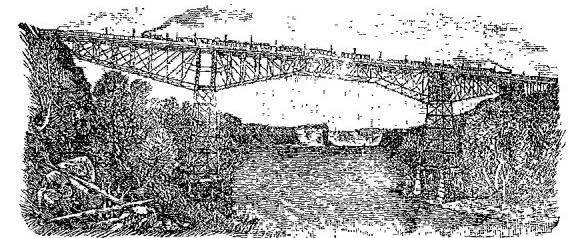
MICHIGAN CENTRAL NEW CANTILEVER BRIDGE, NIAGARA FALLS.
MICHIGAN CENTRAL
“The Niagara Falls Route.”
Corrected March 9, 1890.
O. W. RUGGLES,
General Pass. & Ticket Agent, Chicago.
GEO. J. SADLER,
Ticket Agent, Battle Creek.
Chicago & Grand Trunk R. R.
Time Table, in Effect Jan. 19, 1890.
GOING WEST. | STATIONS. | GOING EAST.
Boston; New York; Buffalo; Niagara Falls; Boston; Montreal; Toronto; Detroit.
Stations
Going west
Going east
Port Huron
Dep.
Arr.
Lapeer
Flint
Durand
Lansing
Charlotte
BATTLE CREEK
Vicksburg
Schoolcraft
Cassopolis
South Bend
Haskell’s
Valparaiso
Chicago
Arr.
Dep.
Where no time is given, train does not stop.
Trains run by Central Standard Time.
Valparaiso Accommodation, Battle Creek Passenger, Port Huron Passenger, and Mail trains, daily except Sunday.
Pacific, Limited, Day, and Atlantic Express, daily.
Sunday Passenger, Sunday only.
W. E. DAVIS,
Gen. Pass. and Ticket Agt., Chicago.
A. S. PARKER,
Ticket Agt., Battle Creek.
Obituary Notices.
“Blessed are the dead which die in the Lord from henceforth,”—Rev. 14:13.
JENSEN.—Died of la grippe, at Bridgewater, S. D., March 31, 1890, little Iva Pearl, only daughter of Fred and Alta Jensen, aged 8 months and 21 days. Bro. and sister Jensen mourn the loss of their loved one, but sorrow in hope, for she “shall come again from the land of the enemy.” Words of comfort were spoken at the funeral, from Isa. 51:12: “I, even I, am he that comforteth you.” Mrs. A. M. Gibson.
GEER.—Died in Pitcairn, St. Lawrence Co., N. Y., March 20, 1890, of chronic rheumatism, Angeline Geer, aged 53 years and 24 days. Sister Geer embraced the truth about thirty-one years ago, under the labors of Eld. Buck, in Edwards, St. Lawrence Co., N. Y., and a few years later joined the S. D. Adventist Church. She lived a consistent Christian life, and died in bright hope of a part in the first resurrection. She leaves a husband, two daughters, and three sons to mourn their loss. Words of comfort were spoken by the writer, from 2 Tim. 4:7, 8. H. H. Wilcox.
MARVIN.—Killed by a cyclone, near Trezevant, Tenn., March 27, 1890, our darling little Guy, who was born Nov. 23, 1883, and was therefore 6 years, 4 months, and 4 days old at the time of his untimely and tragic death. Little Guy was very unfortunate during his short life. When about eight months old his hip was dislocated, and consequently he was lame all through life, and from this he received many lesser injuries by falling; and yet for all his hard lot he was light-hearted, and seemed to enjoy himself as well as his more fortunate playmates. Little Guy belonged to our Sabbath-school, and was always prompt in answering the questions. His bright face and cheery voice will be missed in the Sabbath-school—and oh how much in the family circle! At the hour of his death he was at the home of Bro. N. S. Pearson, a near neighbor. The storm utterly demolished the house. Bro. and sister Pearson and their two little boys were all under the ruins of the house, but none were hurt except little Guy, who in trying to flee from the house was caught under the roof, and his little head so bruised that he died instantly. But we have some things to thank God for yet—it might have been so much worse! Our hearts are rent with the deepest grief, but our sorrow is not without a bright and blessed hope that we shall soon see our darling where angry cyclones with death and trouble will never come. Funeral sermon by Rev. Hughes (of the Baptist church), from 2 Kings 4:26. E. E. and Etta Marvin.
Pall Mall Gazette on the Catholicism of the Future
An article in the Pall Mall Gazette of Dec. 2, 1889, on “The Catholicism of the Future,” represents the pope as bemoaning the “bitter tribulation” in which he finds himself in Europe, but as finding great relief in contemplating the church in America. And yet the utterances of some of the Catholic prelates in this country are not at all after the tenor of the aspirations of the Catholics of the Old World. The article refers particularly to the address of Archbishop Ireland at the Baltimore Congress, and emphasizes some of its utterances. The aspiration of European Catholics to place the papacy back to the power it has once wielded, the address calls reaction, and he would have the church in America avoid that mistake. Then he describes reaction as “the dream of men who see not and hear not; who sit at the gates of cemeteries weeping over tombs that shall not be reopened, in utter oblivion of the living world back of them.” Such a man, says the Gazette, if he were pope, “would not wring his hands in anguish over the dead and buried temporal power. Neither would he root about in the scholastic tomes of Thomas Aquinas, or rely upon stimulating devotion by the granting of indulgences. For he declares: ‘We should speak to our age of things it feels and in language it understands. We should be in it and of it, if we would have its ear.’” This does not read as if any attempt on the part of the pope to get out of his present slough of despond back to the temporal power, would receive much encouragement from Catholics in America.