The Youth’s Instructor, Vol. 48, No. 4.

Making Lumber of California Big Trees

The Youth’s Instructor

Jan 25, 1900

Review and Herald Publishing Company · Battle Creek, Mich. · Jan 25, 1900

Making Lumber of California Big Trees
II
When a “steam donkey,” as the loggers call a traction engine, is used instead of the ox team to haul the logs from the forest to the track, the work is robbed of much of its picturesqueness. One’s sympathy can never be drawn out by an unfeeling mass of iron and steel. The oxen do not complain at being thus emancipated; but then, oxen never complain.
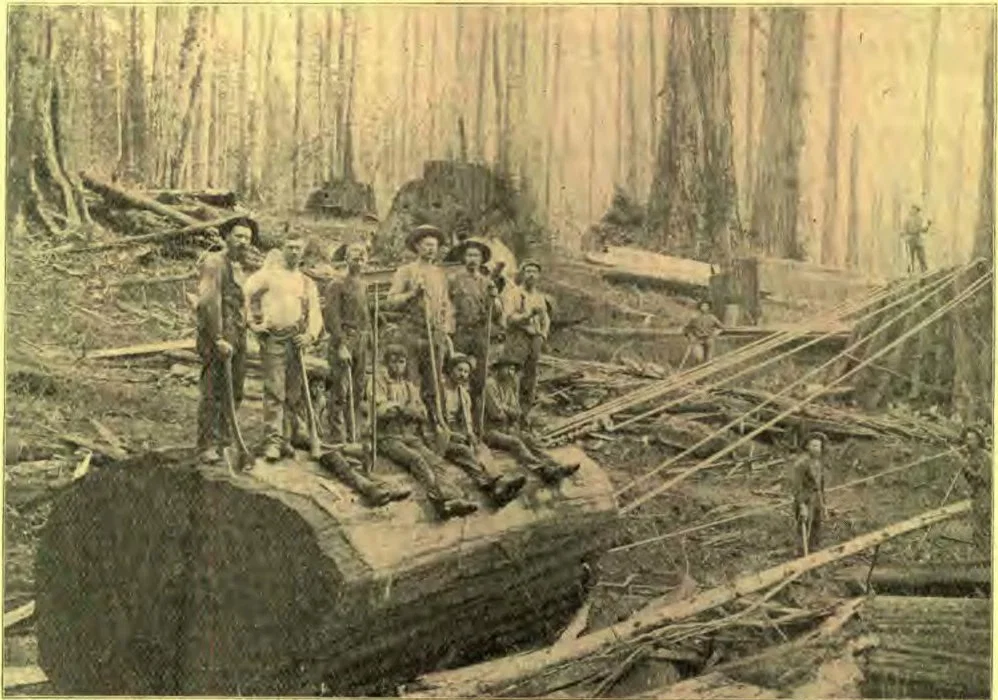
LOGGING IN THE REDWOODS.
When the work of the cattle or “donkey” is finished, the scene is truly a desolate one. All the good timber has been removed; all the refuse has been burned; and only the great stumps bear silent testimony to the majestic grandeur that is now gone forever.
Cut down a pine forest, and in a lifetime the marks of the ax have disappeared, and the forest is again ready for the lumberman. But it has taken thousands of years for the giant redwoods to attain their present size; and when they are cut down, all the young trees perish with them. In a few years the ground they once protected is covered with brambles and worthless shrubs,—a wilderness indeed.
It is a common saying among California lumbermen that a redwood stump will neither rot nor burn. I have seen some that were cut a generation ago, and I could see no more effect of time and weather on them than on one that had been cut only the year before. But redwood stumps have been destroyed, although I can not say how long it took to complete the process.
Some years ago, when a friend of mine was clearing land occupied by a forest of young redwoods (by “young” redwoods is meant trees not older than a century or so), he noticed that the trees always grew in circular clumps; and in grubbing out the stumps, he nearly always found the remains of a mammoth tree, which had once stood in the middle of the circle. Sometimes these stumps and roots bore evidence of having been destroyed by fire. This being the case, the destruction must have taken place before the young timber began to grow. Forest fires kill the young redwood timber, but they have little or no effect upon a sound tree of any considerable size.
It is probably a good thing for the coming generation that redwood stumps do rot so slowly. It is almost incredible to note the amount of lumber that is left in some of these stumps. I once measured one, and found that between forty and forty-five thousand feet of lumber might be taken from it without difficulty. The size of this stump did not greatly exceed that of hundreds of others that stood within sight. Of course it would not pay to handle these stumps while there is plenty of good timber to be had: but the good timber will not last forever; and when it is gone, it is more than probable that the despised stumps will be utilized.
Some, who claim to be conversant with the subject, estimate that the redwoods will, at the present rate of destruction, last two hundred years. Their judgment is probably biased by their pecuniary interests. Without claiming to be an authority in the matter, I think it is safe to say that before the rising generation has grown old, the redwood forests will be a thing of the past.
One would think that after the terrible destruction of timber in these forests, the logs would all be utilized, once they reached the mill. This, however, is not true, except of the small mills, situated near a thickly settled district, where the poor lumber can be sold at the mill. Near the large mills a fire is kept constantly burning; and to a casual observer, it would seem that more lumber goes into this fire than is piled up for shipment.
Around the outside of each log, next to the bark, is a few inches of white wood called the “sap.” This is much like the top of the tree, and makes such poor lumber that it does not pay to ship it. It is taken off in slabs, and goes to feed the voracious fire. When a tree has been “wind split,” there is a strip six or eight inches deep on each side of the crack that has turned black. This also helps to keep up the fire. The waste from these and other sources is so great that but a comparatively small portion of the tree is finally made into marketable lumber.
The best of redwood lumber is about the worst lumber on the market. It varies almost as much in color as it does in weight. Some is as white as pine, and some almost as red as blood, while every shade between is represented. Lumber cut from the butt of the tree seasons slowly. Once it does season, though it does not rot, it soon becomes so brittle that it is unsafe to use it in a building where any great strain will fall upon it.
All things considered, it is safe to conclude that what remains of the redwood forests might better be preserved as a recreation ground than cut down and turned into a wilderness.
J. EDGAR ROSS.

CENTRAL AMERICAN HOUSE PETS

It is not merely the odd forms and ways of my pet armadillos that make them the objects of my peculiar interest. I have been equally charmed with their intelligence, and with their evident attachment to myself. If, when they are near me, I suddenly move away from them, they come trotting at my heels in their comical way, as fast as their short legs can carry them.
Their gait is always a brisk walk or trot, never a gallop. Most of their movements resemble those of little pigs. They have learned to answer to their names, and come quickly when called. Curiosity is a prominent characteristic of the animal; if allowed free scope, they will explore every part of a strange place, trying to poke their sharp noses into every opening. Much of the day is spent in sleep. In lying down, one generally rests his head and fore-feet on the neck or back of the other in a very affectionate manner.
Their attachment for each other is remarkable, and is all the more noticeable when one is separated from the other. If I shut Jack up in a basket, Jill goes round and round outside, at times standing on her hind feet, and reaching to the top with her nose. When Jack is finally liberated, they put their heads together for a few moments, and then off they go on one of their tours of exploration.—Popular Science Monthly.

THE LESSON OF THE CURSE

AFTER Adam had sinned, the Lord said to him: “Because thou hast hearkened unto the voice of thy wife, and hast eaten of the tree, of which I commanded thee, saying, Thou shalt not eat of it: cursed is the ground for thy sake; in sorrow shalt thou eat of it all the days of thy life; thorns also and thistles shall it bring forth to thee; and thou shalt eat the herb of the field.”
The thorns and thistles not only represented the condition of Adam, but were a constant reminder of the fact that he had mingled evil with good by partaking of the tree of good and evil. They also represented the product of a heart that had become defiled by sin. The thorns and thistles were the result of amalgamation in the vegetable world. It now became necessary that man should till the ground. Food no longer grew spontaneously. “In the sweat of thy face shalt thou eat bread, till thou return unto the ground; for out of it wast thou taken: for dust thou art, and unto dust shalt thou return.”
Sin defiled the very atmosphere, and affected the animal creation as well as the vegetable world. It was not an arbitrary curse that God brought upon the earth; but “the earth also is defiled under the inhabitants thereof; because they have transgressed the laws, changed the ordinance, broken the everlasting covenant.” Isa. 24:5. Again: “So ye shall not pollute the land wherein ye are: for blood it defileth the land: and the land can not be cleansed of the blood that is shed therein, but by the blood of him that shed it.” Num. 35:33. The thorns and thistles came as the result of the curse. But Christ became a curse for us, that there might come a time when it could be said, “There shall be no more curse.”
The cleansing of the earth was shown, in the law, by pouring out, at the bottom of the altar of the burnt-offering, the blood of the sin-offering. Lev. 4:30. This was covered in the earth, and represented the blood of Christ. Lev. 17:33. The blood that moistened the sod in the garden of Gethsemane, issuing from the pores of our Saviour as he agonized in prayer for us, with the blood that ran from his side into the earth, was the precious price paid for the redemption of the earth. The earth was defiled by sin, and must be cleansed by the blood of Christ. The sin-offering itself, except that which the priest ate, was burned upon the altar; and while it is by virtue of Christ’s blood that the earth is cleansed, it is also shown in the law, by the burning of the sin-offering, that the earth will be burned by fire in the process of cleansing. It was purchased by blood; and when He who paid the price takes possession of his inheritance, and gathers out of his kingdom all things that offend, and all who do iniquity, and casts them into a furnace of fire, he will make all things new, and from the fire bring forth a new heaven and a new earth.
The significance of gathering up, and taking without the camp, in a clean place, the ashes of the burnt-offering (Lev. 4:12; Num. 19:9), is explained in Mal. 4:3, where is foretold the destruction of the wicked, who will be ashes under the feet of God’s people in the end. Satan will also be burned “to ashes upon the earth in the sight of all men that behold” him. Eze. 28:18. At this time “the wicked shall perish, and the enemies of the Lord shall be as the fat of lambs: they shall consume; into smoke shall they consume away.” Ps. 37:20. Thus the purifying of the earth by fire, after its purchase by the blood of Christ, was all typified in the sanctuary service. Every fire kindled to consume anything that defiles the earth should remind us of the final purifying of the earth by fire. Matt. 13:40. Type met antitype in our Saviour, who not only bore our sins, but also, in the cruel crown of thorns that bruised his sinless brow, bore the curse of the earth. As we destroy the weeds, thorns, and thistles in the cultivation of the soil, it should be an object-lesson to us of what the death of Christ will accomplish in the earth.
S. N. HASKELL.

A DREADFUL TREE

It is so dreadful that it is called “the devil tree.” It catches and devours birds, little wild beasts, and even human creatures, if they get within its fatal reach. Happily, there are very few places in the world where this monster tree grows. In the Island of Sumatra, in Australia, and lately in Mexico, it has been found. But it grows in out-of-the-way places, its roots twisted about great, bare rocks in dense forests, where few people go. It is not of very high growth, and its shape is something like a huge pineapple; it is about twelve or fifteen feet high, and ten or twelve feet around the base.
The leaves spring from the top of the tree, and hang down to the ground loosely, like the folds of a closed umbrella. They are dark-green, and as long as the tree is high. They are from fifteen to eighteen inches wide, and very thick. Above the leaves, on the top of the tree, are two round, fleshy plates, growing one above the other. From these plates there drips a juice which is rather sweet and very intoxicating. Around these plates are long, green, rope-like arms, or tendrils, much like the arms of a cuttlefish.
When a bird or wild animal climbs up to these plates to taste the juice, these long arms at once begin to rise and twist like snakes. The juice quickly intoxicates the creature that tastes it, and it begins to jump and struggle. This motion increases the action of the green arms; they wrap around their prey, and hold it close. Then the huge, board-like leaves begin to rise and close together, forming a mighty press, which crowds the struggling captive, crushing it into a soft pulp, which is drunk up by hundreds of little mouths upon the long arms.
When nothing is left but dry husk, skin, feathers, and bones, the leaves open and fall back. Then the plates spread out their honey, and are ready for another victim. The botanist who found the tree in Mexico thought he would venture to touch one of the arms. The little suckers seized so fast hold upon his finger that he could hardly pull it away; and as it was, the cruel plant stripped off the skin.—Selected.

BEREAN LIBRARY STUDY

Dan. 7:19-28; “Thoughts on Daniel,” pages 124-144
The regular Outline of these studies is published in the Review and Herald and also in the Missionary Magazine. What is here given is only supplementary, and should be studied in connection with the Outline.

NOTES ON LESSON 9

(January 28 to February 3)
1. The Symbol of Rome.—A dreadful beast, the like of which was never seen, is taken to represent the fourth kingdom. Fully to comprehend how completely Rome answers to the inspired description, would require a study of many pages of history. A few sentences taken from an extended description of the Roman people, reveal something of their spirit: “The Roman was a man of war. It was a famous band of robbers gathered there on the Capitol Hill. They built and fought. They spoiled their neighbors. They took what they could, and then took the remainder. Compunction there was none. To feel remorse was to be a woman. To kill was necessary. The reeking battle field, with its thousands of dead, but whetted the appetite for more. War was a business. Peace was tame.”
2. A Universal Empire.—When our Saviour was born in Bethlehem, Cæsar Augustus was emperor of Rome. The extent of his dominion is easily determined by referring to Luke 2:1. The “taxing” here mentioned means enrolling, or, as we now express it, the taking of the census. And as the decree went out to “all the world,” we may thus know the extent of the authority of—
“Rome, That sat on her seven hills, and from her throne Of beauty ruled the world.”
3. Royal Gluttons.—Every land and clime was drawn upon to supply the pampered appetites of Roman royalty. Hunters were sent into unexplored forests for game, and squadrons drained the seas in search of creatures strange and hitherto uneaten. The tongues of song birds, the brains of fowls, such delicacies as snails and mussels, were among the relishes of the banquet board.
4. Another Caprice.—This was the surprise that was generally expected by the guests at a banquet. Roman architects were skilled in producing startling effects; and the kings and nobles were extravagant patrons of this skill, delighting to astonish their guests with some marvel made for the occasion. Nero had the vaulted ceiling of his banquet hall so arranged as to revolve on an axis, thus producing one effect for day and another for night. Another emperor had the ceiling so constructed that when the guests took their places at the table, golden tubes shot out of the dome, and showered perfume on the banqueters. Sometimes flower petals were scattered from above in a similar manner.
5. A Question.—“If Rome is the queen of cities, why should not her pastor be the king of bishops?” was a question of the second century. Study carefully Nos. 3, 4, and 5 of the questions in the regular Outline. How shall we recognize the image to the beast, if we are not familiar with the origin and history of the beast itself?
6. A. D. 538.—The greatest opposition to the exaltation of the papacy came from three powers, represented as being “plucked up by the roots” before it. An imperial letter of the Emperor Justinian recognized the bishop of Rome head of all the churches. It is a significant fact that to this day the pope wears a triple crown, which is not true of any other monarch.
7. You Can Figure It Out.—Many persons suppose that the prophecies speak only in such general terms that they can admit of but a vague interpretation. The fact is that nothing is more exact than prophecy. It is exact even to dates. For instance, note the date of the establishment of the papacy; and figure out the number of years that power was to continue undisturbed, as mentioned in Dan. 7:25, using the Bible interpretation of a “time” (see Dan. 4:23) and of a prophetic day (see Eze. 4:6; Num. 14:34), and remembering that the ordinary Jewish year contained only three hundred and sixty days. In what year does the figuring show this must end?—1798. In that very year the pope was taken prisoner, and for a time the papacy did not exist. Why did not this occur a few years, or even a few months, before that date? It could not occur before, and it must occur then; for “the scripture can not be broken.”
8. “As a People We Are Called Individually to be Students of Prophecy.”—Such is the statement in No. 33, page 236, of the “Testimonies.” As these lessons are so important, no side-line of study is suggested in these notes, that the full time of study of each member of the Reading Circle may be given to the regular lesson.

NIGHT SONGS

The sun had sunk in silvery sheen Behind the hills of blue, And I in silence wandered on A foot-worn wood-way through.
The notes of wingèd singing sprites My eager steps beguiled, As there among the willow wisps They "wound their woodnotes wild."
Sweet songsters! could I learn your notes And trill the song you sing, I'd fill the air with music gay, And make the greenwoods ring.
I'd lighten every heart with song, In hamlet, field, or glen; I'd sing away the tears of woe, That chill the hearts of men.
I know I'd never weary, through Dark night or sunny day, Of turning shadows into song, And wafting gloom away.
Ye sweet-tongued warblers! warble on Your night-hymn of the glen; 'T is sunlight dipped in twilight dews, And turned to songs for men.
C. M. Snow.

THE FOUNDATION OF A SUCCESSFUL LIFE

The greatest monarch of his time ransacked his immense domain to find one hundred and twenty men of superior qualifications to set over his kingdom. Then three other men, more select, if possible, than these, were set apart as a governing board over them, and the choicest man among them was appointed chairman. That man was Daniel. Why was such preference shown him?—“Daniel was preferred above the presidents and princes because an excellent spirit was in him.” Dan. 6:3. The striking characteristics of this excellent spirit are brought to light in the fourth verse: “Forasmuch as he was faithful.” That was the secret. This faithfulness was rewarded in a most striking manner at least three different times in the remarkable experience of this remarkable man: First, when he took a definite stand for principle in reference to the diet question, and in ten days became fairer and fatter than his comrades, and soon knew ten times more than his teachers: second, when he unflinchingly read to the proud but dissipated Belshazzar his final doom; and the Lord rewarded him by allowing him to occupy the next to the highest position in the kingdom succeeding Babylon: and third, when, with a death penalty staring him in the face, he dared kneel down and worship the God of his fathers. His reward for this act was an unfurnished room in a den in which the most interesting objects were a company of half-starved lions; but it was as great a triumph for Daniel as were the two other experiences.
Do you believe the Lord has special favorites, and that Daniel was one of them? If so, you are greatly mistaken. The Lord is no respecter of persons. He is anxiously looking for some to-day who have the Daniel spirit in them, that he may make them equally as great object lessons to the world.
Has your soul ever thrilled with the thought that perhaps there were locked up in you possibilities that would yet respond to the Master’s touch? If so, don’t smother such thoughts; for God’s voice is speaking to you. Go to work at once to cultivate the qualities that lie at the foundation of the character of such men as Joseph and Daniel.
“Dear youth, what is the aim and purpose of your life? Are you ambitious for education, that you may have a name and position in the world? Have you thoughts that you dare not express, that you may one day stand upon the summit of intellectual greatness; that you may sit in deliberative and legislative councils, and help enact laws for the nation? There is nothing wrong in these aspirations. You may every one of you make your mark. You should be content with no mean attainments. Aim high, and spare no pains to reach the standard. . . . Balanced by religious principle, you may climb to any height you please.”—Mrs. E. G. White.
The difficulty with so many young people is that when God does begin to elevate them, they become giddy, and lose their heads. The way to prevent this is to gain balance and poise by adopting correct principles.
DAVID PAULSON, M. D.

JANUARY STUDY OF THE FIELD

PART IV: PALESTINE

  • (January 27 to February 3) *
1. Basis of Study.— For Part IV read “Palestine,” page 19 of the January Magazine. Let none of our young people fail to make the most of these studies. Upon them, to a great extent, rests the responsibility of giving this message to the world. “The church may inquire whether young men can be trusted with the grave responsibilities involved in establishing and superintending a foreign mission. I answer, God designed that they should be so trained in our colleges, and by association in labor with men of experience, that they would be prepared for departments of usefulness in this cause.”— “Gospel Workers,” page 295.
2. Our Work in Palestine.— In the spring of 1898 Elder H. P. Holser made his first visit to Palestine, and became convinced that the time had come for us to enter that field. At the Union Conference held in Hamburg in July, a recommendation was passed that a worker be sent there; and before the close of the meeting, Brother J. H. Krum, who had been laboring in Germany about four years, offered to go. For some time he had been burdened for Palestine; but fearing that his own feelings might mislead him, he had repeatedly sought the Lord in regard to the matter, and such clear evidence had been given that there was no room for doubt. Brother Krum speaks German and English, and began the study of Arabic, the common language of Palestine, as soon as he reached that field.
3. The First Experience.— The following letter was written by Elder H. P. Holser, from Jaffa, Palestine, Nov. 14, 1898: “I have been here a few days with Brother Krum, who, with wife and child, reached this place four weeks ago. About four hours after my arrival, their only child, eight months old, died. . . . Brother Krum rented a house on the highway to the plain of Sharon, between the two German colonies. He has room for a fair-sized meeting. Besides the Germans, many English-speaking people are here. Jaffa now has a population of thirty thousand. From our house top we have a good view over the sea, the orange groves, palm trees laden with dates, and the foothills of Judea to the southeast. The early rains have now begun.”
4. A Bible Land.— A visit to Palestine imbues the word of God with a new and vivid reality. The customs, dress, food, occupations, and modes of travel, as well as many of the dwellings, are exactly the same to-day as in the time of the Saviour. The agricultural implements are of the rudest kind. The plowman, with his primitive plow and pair of oxen, can prepare about half an acre a day. Various trades are followed, such as weaving, tanning, pottery-making, basket-making, dyeing, and fishing. Olives, grapes, figs, pomegranates, dates, mulberries, pears, peaches, apricots, apples, almonds, oranges, lemons, citrons, plums, quinces, and many other fruits are found in the land at this day.
5. The Ancient Dress.— The dress of the Syrian Arabs probably corresponds nearly to the dress of the ancient inhabitants of Palestine. The loose, flowing garments, turban, and slippers are still worn, the latter being put off upon entrance to a friend's house or a place of worship. The Oriental custom of sitting on the rug, mat, or divan, with the feet drawn up under the garments, demands that the practice of leaving sandals and shoes at the door shall still be observed.
6. The Passover.— The celebration of the Passover feast by a Jewish banker and his family in Jerusalem last year is thus described by a returned missionary: “Upon the table were the unleavened bread, the herbs, and the wine. To represent the lamb, they had a small bone of lamb on a plate. During intervals of eating and drinking, they read in concert and by turn, with their peculiar intonation, the Levitical law, with traditions bearing on the occasion. It was inspiring to see the intense interest, even of the children, as they read, and participated in the ceremonies. At one point in the ceremony the father cut off small bits of a pasty substance, representing the bricks, and then put it with herbs for the straw, all of which they ate to commemorate the bondage and burdens of Egypt. The latter part of the feast was their regular meal.” May the God of Abraham lay upon our hearts a burden to lead some of these zealous Israelites to accept the true Passover, and look forward to his soon coming with joyful expectation.
7. Sabbath in Palestine.— Theoretically, there are three rest days in Palestine—Friday, the Moslem day of worship; Saturday, the Sabbath of the Lord, observed by Jews and other Sabbath-keepers; and Sunday, observed by the majority of the Christians living there. The Arabs never use any other word than “Sabbath,” in speaking of the seventh day. The reason for this, they say, is that this has been the name for it from the beginning.

THE COLOR OF FRUITS

We have been studying the purpose of fruits (I use the word “fruit” in a broad sense), and have learned that their primary function, or use, is that of self-propagation. God commanded the earth to bring forth “the fruit tree yielding fruit, . . . whose seed is in itself.” And while the pulp and the juice were meant for food, the seed within was designed for a far different purpose. If you had all the flour, ground wheat or corn, there is in the world, and I had but one kernel of wheat or corn, and it the only kernel in the world, I should have far more than you; because in a few years my kernel could produce sufficient wheat or corn to fill all the fields of all the world. God not only made fruit for food, but he so made it as to keep us forever supplied.
There is also much to be learned from the colors of fruit. If the different fruits are not in some way carried from the tree or plant upon which they grow, they must nearly all fall in one spot. Only a few of these will be able to grow; the rest will be crowded out. How may these fruits be carried to other and distant places, where there is more room, and where they may have an opportunity for growth? In answering this question, let me ask another: Why are many of the berries so highly colored? They would be just as useful to us for food if they were the same color as the leaves; but being so bright, they are very conspicuous, and attract the attention of multitudes of birds. I have counted fully twenty different kinds of birds eating the fruit of the mulberry tree,—an unknown number of each of these kinds. The seeds of berries are not digested by many birds, and hence are scattered by them hither and yon. Do you catch the secret?—The berries are bright-colored to attract the birds; and the birds, by eating the berries, sow the seeds here and there.
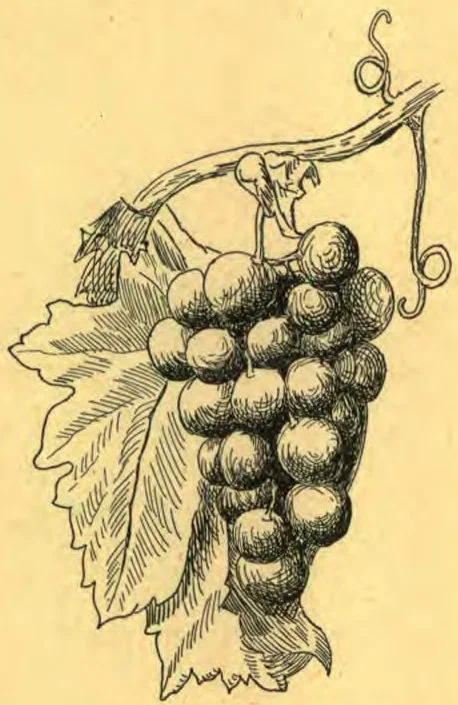
Does this help you understand why most grapes are purple? Why are they not red, like the cherry?—Well, we have seen that the color is to make the berry or fruit noticeable. The cherry, growing and ripening in the early summer, when the leaves are green, is easily seen, in contrast with the green foliage; for green and red are as opposite as opposite can be in color. But in the fall the leaves themselves become red; and if grapes were also red, they would not be easily seen. Grapes are generally blue or purple, sometimes green, and show forth in decided contrast with the fading and reddish leaves.
Unripe fruits and seeds are usually hidden away in the foliage, and are of the same color as the leaves. But when the fruits ripen, and the seeds are ready for the sowing, the fruits almost invariably take on a color strikingly in contrast with the color of the foliage. The different tones of red stand out best when surrounded and backed up by green; therefore, for plants with green foliage, a red coloring of the fruits is the most advantageous. On this account the strawberry, the raspberry, the currant, the wild cherry, and the red-berried elder are red in hue. On the other hand, red fruits would stand out but little against a background of foliage that has donned the red or yellow tints of autumn by the time they ripened; and accordingly the prune, the plum, and the grape are blue or black. Following out the same law of contrast, white berries occur principally in plants that cast their leaves before the fruit is ripe; standing out against the brown, black, or gray background formed by the leafless branches and the fallen leaves of autumn, these white fruits are easily seen.
But these are only a few of the means which God has devised, and which he uses, for the carrying out of his purposes. The birds and animals think only of satisfying hunger, and seek the fruits purely from self-interested motives; but nevertheless they thereby fulfill the will of God in sowing the seeds. Even so we ourselves, though seeking only the satisfying of self, often unwittingly carry out the great purposes of God; for he has ordained that even the wrath of man shall praise him, and the remainder, which is purposeless, he restrains. But how much better when we intelligently and in full measure learn his great purposes, and, forever yielding ourselves to the work, become co-laborers with him!
L. A. REED.

A RESPONSE

A LITTLE wayside pool, left by the rain, Earth-bound, nor fair, nor bright; But, see! the sun, low sinking, with its train Of gold and crimson light,—
A living, glowing color ecstasy, Freed from its earthly bonds,— To all the glory of the western sky The wayside pool responds.
A lowly life, humble and meek and still, Set in an obscure place, May shine with glory, living out God's will, Reflecting his own face.
— Alice Ranlett.

THE LAKE SUPERIOR MINING REGION

WHILE most of the readers of the INSTRUCTOR are aware that mining is one of the distinctive industries of the Lake Superior country, probably but few have any idea of the real magnitude of these enterprises, or of the extraordinary activity existing in the vicinity of this great inland sea. The rapidity with which the region surrounding Lake Superior is coming to the front as a producer of copper and iron, is without a parallel in the history of the mining industry. Millions of dollars are invested in the mining and transportation of the ores, and thousands of men are employed. Here also are in operation the most improved mechanical equipments and mining methods. The machinery used is indisputably the largest, costliest, and most efficient now in use anywhere.
The copper district is on the south shore of the lake, in Michigan, and contains one of the richest deposits of mineral wealth known to man. These mines were worked ages ago by the “mound builders.” The excavations, weapons, tools, etc., made by them were found by the white race when they took possession. Some of the copper in these mines is in an almost pure state, and is found in immense quantities. Two masses of the metal have been found that weighed over five hundred tons each, and were worth at the time of their discovery more than half a million dollars each. One of the mines—the Red Jacket—is being worked at a vertical depth of four thousand nine hundred feet,—the deepest mining shaft in the world. The output of the Lake Superior copper mines for 1898 was over one hundred and fifty-three million pounds of refined copper.
Lake Superior copper commands a higher price in the markets of the world than copper from any other district. This is due to its greater toughness and strength. Not only is the Lake Superior region noted for the quality and quantity of its copper, but it is the largest iron-ore producing district of the world, and the average quality of the iron ores obtained is not equaled by any other large producing district. During the last few years there has arisen an unprecedented demand for iron. To meet this call, a stream of iron ore, constantly increasing in volume, has been pouring forth from this northern land. The product of the Lake Superior iron mines for the year 1899 was seventeen million tons,—more than was produced by the whole United States in 1896. Notwithstanding this enormous supply, the price of ore has nearly doubled within the last half-year. Active preparations are making for an increased output next year; and it is believed by those interested in this gigantic industry that twenty million tons will be the record for the year 1900. The following remarkable record will give the reader some idea of the facilities for handling ore: On the nineteenth of last November, at Two Harbors, on the north shore of the lake, eleven ships were loaded in eleven hours, and sailed away carrying over forty-one thousand tons of iron ore.
The Lake Superior iron region comprises five districts, or ranges,—the Marquette, Menominee, and Gogebic in Michigan and Wisconsin, and the Vermilion and Mesaba in Minnesota. Much of this country was, fifteen years ago, a trackless wilderness. C. H. HARPER.
Continue reading: FAITH