The Youth’s Instructor, Vol. 48, No. 4.

Making Lumber of California Big Trees
Earlier text: Making Lumber of California Big Trees

FAITH

I KNOW there is a Country where death may never come To claim the happy children who call that country “home;” Where sickness never enters, nor any pain nor woe, Because this Blessed Book, the Bible, tells me so.
I know there is a River with healing in its tide, And all the ransomed nations shall walk along its side, Their happy voices blending with the music of its flow, Because this Blessed Book, the Bible, tells me so.
I know there is a City whose streets are all of gold, Along whose walls of jasper twelve pearly gates unfold,— A place whose shining beauty no mortal man may know,— Because this Blessed Book, the Bible, tells me so.
“BECAUSE THIS BLESSED BOOK, THE BIBLE, TELLS ME SO.”
I know that in that City there is a Great White Throne, Encircled with a rainbow, like to an emerald stone. There, Sabbath after Sabbath, to worship all shall go, Because this Blessed Book, the Bible, tells me so.
I know the King is coming to take his children home, And from that happy country they nevermore shall roam; And to that home in heaven I know that I may go, Because this Blessed Book, the Bible, tells me so.
ELIZABETH ROSSER.

JENNIE'S HAPPY THOUGHT

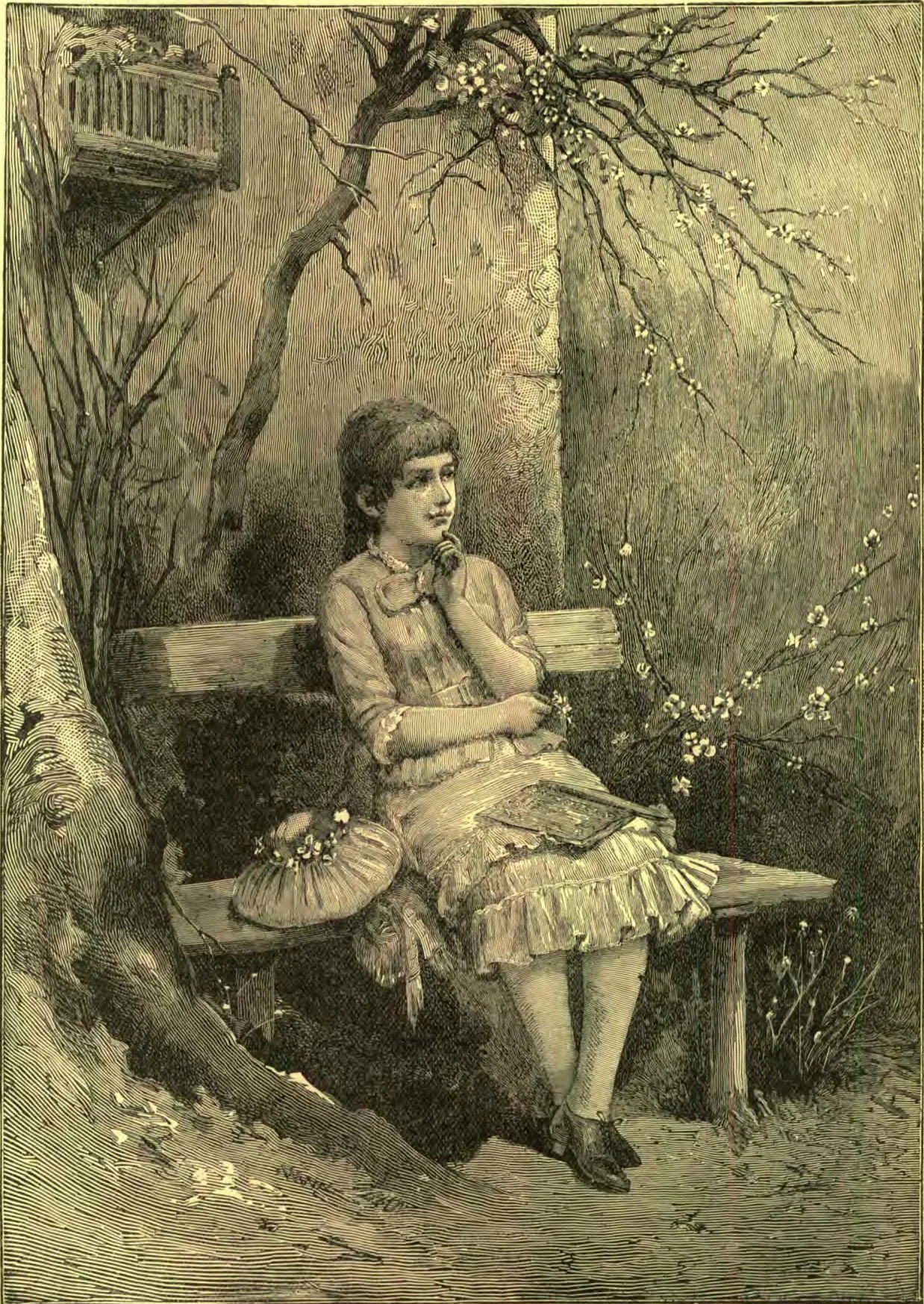
ONE bright afternoon Jennie came running into the house, her eyes shining, and her cheeks rosy from the frosty air. Mama looked up from her sewing with a smile of welcome.
“O mama,” cried Jennie, “I’ve had such a good visit at grandma’s! Uncle Will gave me a ride on Black Tom, and Aunt Jennie let me help her bake cookies!”
“I’m glad you enjoyed yourself, dear. But what is that parcel you have?”
“Why, Aunt Jennie had been making a new dress, and there was a little piece left, and she thought you might like it to make something for me.”
“Aunt Jennie is very kind,” said mama. “After you have put away your cap and cloak, we will look at it.”
A moment later Jennie brought her little chair, and sitting down at mama’s side, opened the parcel. There was a piece of blue cashmere in it.
“It is very pretty,” said mama; “but there is not enough to make you a dress. Besides, you have as many dresses now as you will need before you outgrow them.”
“Yes, mama, I know I have; and I told Aunt Jennie so. But she said she knew you would be able to put it to some use.”
“Well, perhaps we shall. But bring your work-box now, and take out your sewing.”
So Jennie put on her pink thimble, and took a square of patchwork from her orderly little box.
“I told grandma I should soon have enough blocks for my dolly’s quilt; and she said she would find me some pieces to begin a quilt for my own bed.”
“And what was grandma doing to-day, Jennie?” asked mama.
“She was knitting a pair of little mittens, mama. She’s just finished two pairs of stockings; and when she gets the mittens done, she’s going to knit a little hood. Then she’s going to send them all to the children’s home, for some dear little girl who has no mama or grandma of her own.”
“That is just like grandma; she is always thinking of others, and doing something to make them happy.”
“When I grow up, I’m going to do good, too,” said Jennie.
“Does my little girl think she must wait until she is grown before she can do good?”
“Why, no, mama! I didn’t mean that. I can help you, and do little errands; but I don’t have anything to give to the poor. O mama! yes, I have, too! May I give away the cloth Aunt Jennie gave me to-day?”
“It is your own, dear; do as you wish with it.”
“But whom shall I give it to? I don’t know any one who is very poor,” said Jennie.
“How about the little girl at the Home?”
“Oh, yes! and I can send it with grandma’s things, can’t I? Shall we make it into a dress, first?”
“Yes; I’ll help you make it,” said mama. “It is too late to begin it to-night; but to-morrow you may get the pattern of the dress you wore when you were three years old, and we will make it by that.”
It was a very happy little girl who danced in at grandma’s door two days later, carrying the finished dress. “Mama and I did find a use for the cloth, Aunt Jennie,” said she; “and it is going to keep company with the hood grandma is knitting.”
AUNT BETTY.

LAMPS

When we see the brilliant illuminative agents that modern invention has introduced into the world, we are likely to forget that there ever was a time when the Heaven-appointed rulers of the day and the night gave the only light known to man. Holy Writ proclaimed, ages ago, that man had sought out many inventions, and the lamp comes under this list.
As people became shorter-lived, they began to encroach upon the time God had given them for rest; and in order to do this, they must have light.
The first lamps were crude affairs; some were made candle fashion, with strips of rush or mullein for wicks. Then, as oil began to be used, little vessels were filled with it and some salt, and the pith of the rush stalk was put in for a wick. At first these vessels were open, but after a time they were made closed. This was a marked improvement.
The Greeks and Romans have left us many beautiful specimens of art in the form of lamps. Most of them are of terra cotta, and are oval-shaped; some are of bronze and other metals, and others are beautifully decorated with precious stones. These lamps were sometimes hung from the ceiling, but were oftener placed upon a stand made for the purpose. In the homes of the wealthy the oil, which was clarified animal fat, was perfumed, in order to destroy the unpleasant odor, and to lend an air of elegance to the surroundings.
Coming down to the time when our grandmothers made candles, we find still further improvement in artificial lighting. The rush-stalk wick was replaced by a cotton string, or rather, a little roll of soft cotton threads. When the housewife happened to be without candles, these wicks were sometimes placed in a vessel with animal fat, and so burned.
Next came the kerosene lamp; and how carefully, and with what fear, these lamps were handled! Some, declining to accept the new-fangled notions, clung to their beloved candles, substituting wax for tallow.
Gas, incandescent, gasoline, and other kinds of lights have followed in rapid succession. With the application of electricity to illuminating purposes, great improvements have been made in lighting the heretofore dark and dangerous streets and alleys in the large cities, as well as making bright and pleasant the churches, halls, and homes of the people.
What a wonderful transformation would be effected, should the world be suddenly deprived of its lamps, and men be forced to retire with the birds!
Mrs. A. G. Bodwell.

Asking How We Can Help God's Plans

It is one thing to ask God to help us in our plans; it is quite another thing to ask God how we can be helpers in his plans. Every man is glad to have God’s help; only now and then is a man found whose first thought is how he can help God. What is your chief desire in your morning prayer for the day? Your honest answer to that question may reveal to you your spirit and purpose in life.—Sunday-School Times.

THE PARROT IN ITS NATURAL HOME

ALTHOUGH the domesticated parrot is familiar to most of the readers of the INSTRUCTOR, all do not know it in its natural home. Many species of parrots are found in the tropical regions. In Bonacca, the most eastern of the Bay Islands, these birds are abundant. The most common parrot in this island is dark-green in color, with partially red wings and a bright yellow spot on the crown of the head. Those on the Island of Cayman are smaller, with red on the head in place of yellow. The bright plumage of these birds harmonizes beautifully with the evergreen foliage of these islands.
Although parrots may learn to sing when tamed, in their wild state they are anything but musical. When flying to and from their roosts, evenings and mornings, the mates act as if greatly attached to each other, keeping closely side by side. In making their nests they select a decayed spot in some lofty tree, make a hole in the soft wood with their hard bill, and enlarge it to a convenient pocket from one to four feet deep. Here are laid two white eggs, with nothing more to soften the nest than a few chips. Parrots feed principally on wild berries, but sometimes vex the planter by eating his bananas and plantains. In feeding their young, they swallow the food, and returning to the nest, disgorge it from their crops. The parrots’ enemies, such as hawks and man, make it difficult for them to raise their young. Last summer I noticed a pair, whose nest had evidently been robbed by hawks, perching on the limb of a large pine tree where they had nested, and crying pitifully.
Persons who wish parrots for pets or for commercial purposes take them from the nest when they are nicely feathered. The nests are usually in trees too large to span with the arms, so the men supply themselves with a rope as an aid in climbing. To the rope is attached a weight heavy enough to carry it over the first limb, and bring it to the ground again. A man is then fastened to the rope, and drawn up by his companion. If the nest is still higher, the process is repeated until it is reached; and if it is too far below the entrance, another hole must be made, in order to reach the birds.
W. CHAPMAN McCOY.

WHO FIRST MADE GLASS

Both the Phenicians and the Jews carried their glass productions into the world through trade. There were whole tribes of Jews engaged in the industry, even down through the Middle Ages. But neither the Jews nor the Phenicians can be looked upon as the inventors of glass. We find, for instance, that the Persians, at the time of Alexander the Great, were drinking out of glass vessels; that the Assyrians were versed in the art of making glass, as can be proved by discoveries at Nineveh; and also that the art of making glass and of imitating precious stones was known to the ancient Indians.
Of great importance with regard to the history of the manufacture of glass are also the ancient Egyptians. When one remembers the great industrial activity of these people, it is not surprising that, with reference to the making of glass, more numerous traditions of it are recognized by them than by any other people. Not only written, but also figurative representations, which are more than four thousand years old, have been handed down to our time. The wall reliefs in the groves of Beni-Hassan represent the manufacture of glass objects; they represent, among others, two glass-blowers at work. They are working with the blowing pipe, which they have dipped into a mass lying between them, and by means of which they blew out a vase. What extremely beautiful glass was manufactured, even at that time, is proved by a crystal glass found in the museum of the Louvre. The French, as well as the English museums, possess numerous artistic productions of that period, at the sight of which one is surprised; as in our time, and with our mechanical appliances, it is hardly possible to surpass them.
The Romans appear to have been the principal customers of the early Jewish glass-makers; and with the increasing luxury of that epoch the manufacture of glass increased, as it was not limited to the production of smaller useful objects, but extended to the building trades. That the manufacture of glass developed in an artistic sense to the highest point need not appear wonderful, with so extremely intelligent a people as the Romans. The treasures contained in the museum of the Vatican, in the French museums, and in the British museum bear testimony to their accomplished workmanship. In A. D. 210 there were so many glass-blowers in Rome that they had set apart for them their own quarter of the city. With the fall of the Roman Empire came also the decline of the art of glass-making; but with the extension of Christianity, the glass industry gradually again developed.—Feilden's Magazine.

MY TIMES ARE IN THY HAND

My times! what are they?— Yesterdays long past, To-morrows yet to dawn, and this to-day; The near and far, the first gleam and the last, Blended together in such wondrous way! All that I've hoped, or sought, or gained, or lost, All that I might have been, and still may be, All that life holds for me, and all the cost, These Thou art keeping evermore for me. “My times are in thy hand.”
That some deep joy thou ’rt hiding from me now I can not doubt; I dare not, if I could; Perchance ’t will come sad-eyed, with weary brow, But from thy hand there can come only good. The gladdest messengers of all the past Have worn disguise of sorrow or of pain; And can I doubt thy love to me doth last, Or fear to trust thy wisdom once again? “My times are in thy hand.”
“Thy hand!” Oh, safe, sure shelter, place of rest, Defense and shield, strong tower, eternal home! How safe am I! how infinitely blest! What that could harm from thy dear hand can come? Then gladdest welcome to this strange New Year, Which stands, reluctant, on the threshold still: Its days can bring me nothing that I fear, Since well I know those days fulfill thy will. “My times are in thy hand.”
— Union Signal.

A DESERTED HOME

It was no stately pile, with arch and dome With carven capital and lofty roof, And pediment and column, giving proof Of noble heritage of Greece or Rome. Nay, but this was a humble little home, Resting in solitude, apart, aloof, Woven of straws and twigs and woolly woof And tiny bits of moss and grassy loam. Yet fair it was and marvelously wrought, And molded by a robin’s downy breast, A busy architect, divinely taught To build a home wherein its young might rest,— A last year’s nest, found in an old hedgerow, Its only thatch a little cap of snow. — The Living Age.

THE MISSION OF THE HOLY SPIRIT

SABBATH-SCHOOL LESSON—NO. 5

THE MISSION OF THE HOLY SPIRIT

(February 3, 1900)
Lesson Scriptures.— John 16: 5-33; 17: 1-26.
Memory Verses.— John 16: 13, 14.
Time: A. D. 31. Place: Mt. Olivet. Persons: Jesus, disciples.

QUESTIONS

1. As a result of being told that Jesus was going away, what feelings filled the minds of the disciples? John 16: 5, 6. To encourage them, and to show that a real advantage would be gained by his leaving them, what promise did Jesus make? V. 7; note 1.
2. What would be the special work of the Spirit for the world? Vs. 8-11. In what way would his presence be known by the children of God? Vs. 12-15; note 2.
3. What did Jesus now say? V. 16. What conversation took place concerning this statement? Vs. 17-22. What gracious promises did he make concerning prayer? Vs. 23-27. What statement now opened the eyes of the disciples to the truth? What did they say to Jesus? Vs. 28-30.
4. To lead them to be distrustful of self, what did Jesus say to them in reply? Vs. 31, 32. Abiding in Christ, what portion awaited them? How were they to regard it? V. 33; note 3.
5. What wonderful petition did Jesus now offer? John 17; note 4. For whom did he specially pray? Vs. 6, 9, 20. Because of the fact that he was about to leave his disciples, what did he ask for them of the Father? Vs. 13, 15.
6. That they might be fitted to go into the world even as he had gone, what did Jesus plead to have done for them? V. 17. And that men might believe in his mission, what blessing did he ask for his church? V. 21. To the end that this spirit of unity might be in the believers, what is given them? V. 22.
7. How great is God’s love for the church of Christ? V. 23. What desire did Jesus express relative to his people on earth? Why does he wish them with him? V. 24.

NOTES

1. Although our Lord ascended from earth to heaven, the Holy Spirit was appointed as his representative among men. . . . Cumbered with humanity, Christ could not be in every place personally; therefore it was altogether for their advantage that he should leave them, go to his Father, and send the Holy Spirit to be his successor on earth. The Holy Spirit is himself divested of humanity, and independent thereof. He would represent himself as present in all places by his Holy Spirit as the Omnipotent.—Unpublished Testimony.
2. The first work of the Holy Spirit, that which he seeks to do for all men, is to reprove them for sin. Just as soon as they believe, and turn from sin, the Lord pronounces them righteous, and they are convinced that it is so. Then, with the blessing of righteousness, the Spirit of God gives the further assurance that, as children of God, the converted ones have passed from death unto life, that Satan’s power over them is broken, and that they are free. Their sins have gone before to judgment. 1 Tim. 5: 24. It is thus that the Spirit convinces of sin, of righteousness, and of judgment. But all this only makes the sinner a child of God. The work is but begun. From this point the Spirit takes up the work of teaching. Day by day, as the word of God is studied and thought upon, there come revelations of God’s goodness and power. Things that can never be told in words, but which may clearly be seen by faith, are brought from the throne of God, and find place in the believer’s heart. And, thus, day by day, he grows up into the likeness of his Master.
3. Jesus points out the hardships that await his people, not to cause them discouragement and gloom, but to enable them to prepare for them. It is a conquered world into which they are sent; therefore the children of God may always be of good cheer. He who met the enemy once, alone, now goes with his people as a constant companion. “Be of good cheer”!
4. Jesus is still the Son of man; and the prayer of John 17 is still offered in behalf of his people. The will of God is met in this prayer, and it will therefore surely be answered. Jesus now prays for you.

BIRD WISDOM

NEARLY everybody, who has been beyond the limits of the stone walks and brick walls has seen flying over the fields at some time or another the bird known as the American bittern, called, according to locality, the “swamp-pump” and the “stake-driver,” on account of its call. How many, I wonder, who are familiar with this marsh resident when in full flight have seen it at rest?—Not many, I venture to say. The bird will stand on the ground in its damp retreat without as much cover as has the ostrich when it pokes its head in the sand and imagines itself unseen; and one may pass within ten yards of the silent figure, and even see it, and yet never guess of a bird’s presence. Scientists have written reams about the protective coloring of the whip-poor-will, which enables it to become fairly a part of some lichen-covered limb. The white of the ptarmigan on the snowy heights and the brown of the partridge among the dead leaves of the forest have been commented upon time and time again as instances of what nature does to make her bird children become a part of their surroundings, that they may escape the eye of the destroyer; but the way in which the stake-driver of the swampy woodland stretches, keeps his presence there a secret when a prowler is about, seems to have escaped the notice of many naturalists.
In May last, with a companion, I was walking along a road at the edge of a swamp not many miles north of Chicago. A bittern rose from a point far to our left, and flapped its way lazily over the marsh to a damp place in a pasture covered with stumps, with a few standing trees scattered here and there. Through powerful glasses we watched the bird’s progress, and marked down the spot where he had pitched. We made directly for the place, and then began a search for the bird with our glasses. Every spot of ground within fifty yards was examined carefully, but not a feather could we see. Finally my companion, who had been looking steadily through his glass at one spot for what seemed fully five minutes, said, suddenly: “There he is! Look at the fifth stump.” At the fifth stump I looked. It was no stump at all, but Master Bittern himself, posed and making an almost perfect representation of one of the small blasted tree relics with which he was surrounded. He was only fifteen yards away. His body was perpendicular, his neck and head were drawn well down into his shoulders, and his beak was pointed straight upward, forming a prolongation of the line of his back.
“We will test his patience,” was our decision; and we sat down quietly, noted the time, and stared at that devoted bird for exactly one hour. During all that time he moved not at all. No neighboring stump was more firmly fixed than he. It seemed as if he had control of his feathers as well, for the passing breezes that stirred the lush swamp grass beyond failed to ruffle any part of his brown plumage. Finally, half ashamed of keeping the bird longer under such a strain, we walked toward him. Not till we were within a few feet of his resting place did he deign to move. Then he took four comically dignified steps away from us, and, rising, flew far down the little stream, which, in spring, makes its way through the heart of the swamp-land, the bitterns’ paradise.—Edward B. Clark, in Chicago Record.

To Reach BATTLE CREEK

FROM
CHICAGO, BUFFALO, DETROIT, OR TOLEDO,
Purchase Tickets Reading over the MICHIGAN CENTRAL
“The Niagara Falls Route.”
A First-class Line for First-class Travel between Chicago and New York and Boston. Elegantly equipped through trains pass Battle Creek in each direction daily.
R. N. R. WHEELER, Ticket Agent, Battle Creek.
O. W. RUGGLES, Gen’l P. and T. Agt., Chicago, Ill.

TAKE THE Canadian Pacific Railway

for . . . CHATHAM, OTTAWA, MONTREAL, LONDON, GALT, QUEBEC, WOODSTOCK, TORONTO, BOSTON, PORTLAND, and
All points in New England, the Maritime Provinces, Great Britain, and the Continent.
Illustrated literature, time-tables, and full particulars, upon application to—
J. FRANCIS LEE, GEN. AGENT,
Passenger Dept. 228 SOUTH CLARK ST., CHICAGO
Branch Offices: 76 Ottawa St., Grand Rapids, Mich. Room D, Chamber of Commerce, Cincinnati, Ohio. 315 Chestnut St., St. Louis, Mo.

Cincinnati Northern Railroad Co.

TIME TABLE NO. 3.

IN EFFECT SEPT. 24, 1899.
Trains Pass Battle Creek, as follows:

WEST-BOUND.

No. 21, Mail and Express — 6.58 P. M. No. 23, Accommodation — 2.07 P. M. No. 27, Local Freight — 8.25 A. M.

EAST-BOUND.

No. 22, Mail and Express — 8.25 A. M. No. 24, Accommodation — 1.45 P. M. No. 28, Local Freight — 5.30 P. M.
Direct connections are made at Toledo with all roads diverging. Close connections for Detroit and Cincinnati.
J. L. READE, Ticket Agt., Battle Creek.
E. R. SMITH, City Pass. Agt., 6 West Main St.

GRAND TRUNK RAILWAY SYSTEM.

Time-Card in Effect November 19, 1899.

C. & G. T. DIVISION.

WEST-BOUND FROM BATTLE CREEK.

Train Time
No. 9, Mail and Express, to Chicago 12.15 P. M.
No. 1, Chicago Express, to Chicago 9.00 A. M.
No. 3, Lehigh Valley Express, to Chicago 3.40 P. M.
No. 5, Pacific Express, to Chicago, with sleeper 1.10 A. M.
No. 75, Mixed, to South Bend 8.30 A. M.
Nos. 9 and 75, daily, except Sunday.
Nos. 1, 3, and 5, daily.

EAST-BOUND FROM BATTLE CREEK.

Train Time
No. 8, Mail and Express, to Ft. Huron, East, and Detroit 3.45 P. M.
No. 4, Lehigh Express, to Port Huron, and East 8.27 P. M.
No. 6, Atlantic Express, to Port Huron, East, and Detroit 6.50 A. M.
No. 2, Leih. Exp., to Saginaw, Bay City, Pt. Huron, and Detroit 6.50 A. M.
No. 74, Mixed, to Durand (starts at Nichols) 7.15 A. M.
Nos. 8 and 74, daily, except Sunday.
Nos. 4, 6, and 2, daily.
A. S. PARKER, Ticket Agent, Battle Creek.

Self-Pronouncing S. S. Teachers’ Reference Bible.
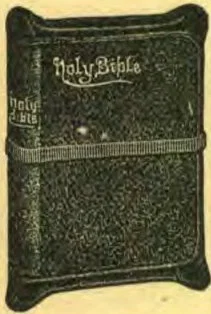
CONTAINS the celebrated Teachers’ Helps, comprising nearly 400 pages. Also a complete series of fifteen new maps.
Description.— Imperial Seal Binding, Tuck Edges, known as “Divinity Circuit,” Rounded Corners, Full Red under Gilt Edges.
We offer this Bible, post-paid, for only SIX NEW YEARLY SUBSCRIPTIONS at 75 cents; or TWELVE NEW SIX MONTHS’ SUBSCRIPTIONS at 40 cents.
We will also send it, post-paid, with the INSTRUCTOR one year for $2.25. For 20 cents extra we will stamp your name in gold upon the cover.

FOR EVERY'S DAY OF THE WEEK

SUNDAY:

“Keep your wants, your joys, your sorrows, and your fears, before God. You can not burden him; you can not weary him. He who numbers the hairs of your heads is not indifferent to the wants of his children.”

MONDAY:

“Then let us smile when skies are gray, And laugh at stormy weather, And sing life's lonesome times away: So worry and the dreariest day Will find an end together.”

TUESDAY:

Remember, you are not a tree, that can live or stand alone. You are only a branch. It is only while you abide in Christ, as the branch in the vine, that you will flourish, or even live.—Mc Cheyne.

WEDNESDAY:

“God's plans, like lilies pure and white, unfold: We must not tear the close-shut leaves apart; Time will reveal the calyxes of gold. And if, through patient toil, we reach the land Where tired feet, with sandals loosed, may rest, Where we shall clearly know and understand, I think that we shall say, 'God knew the best.'”

THURSDAY:

No cheating nor bargaining will ever get a single thing out of nature's “establishment” at half-price. Do we wish to be strong?—we must work. To be hungry?—we must starve. To be happy?—we must be kind. To be wise?—we must look and think.—Ruskin.

FRIDAY:

It is not the deed we do, Though the deed be never so fair, But the love that the dear Lord looketh for, Hidden with lowly care In the heart of the deed so fair. —Eben E. Rexford.

SABBATH:

“Cast thy burden upon the Lord, and he shall sustain thee: he shall never suffer the righteous to be moved.” Ps. 55:22.

Norwegian Reindeer-Hair Life-Preserver Vest Invented

A NEW life-preserver has been invented by a Norwegian. It consists of a vest padded with reindeer hair, which, even when wet, is lighter, as well as more buoyant and durable, than cork. This vest distributes the buoyancy, and allows the body more freedom than the ordinary life-preserver, thus securing greater protection to the wearer.

New School Magazine: The Industrial Educator

We have received a copy of a new school magazine, the Industrial Educator, organ of the Keene (Tex.) Academy. The aim of the journal is thus set forth in the introduction: “The object of the journal is twofold,—to represent the Keene Industrial Academy, and to serve as the organ of the Southwestern Teachers’ Association of Seventh-day Adventists. In the former capacity, it will record the progress of the academy, and give space to articles from teachers and students; in the latter, it will promote the establishment and efficiency of church schools, and bind more closely together the teachers of the Southwest.” All interested in the Keene Academy should have this journal. Issued monthly. Twenty-five cents a year.

Growing Strength Daily Through God's Help

We can not grow spiritually on our last year's experience, or last month's, or yesterday's, any more than we can build up strength for to-day's work by the food eaten then. Our adversary never relaxes his efforts to cause our fall; but out of this very thing, we may, with the help provided for even the weakest, become strong. We may, we must, gain new victories over self and temptation every day; and in this way, and in this way only, we shall go on from strength to strength. Are we so weak that it is entirely beyond our frail human will to overcome,—even to try to resist? If only we lift the heart to God, as did Peter in the despairing cry, “Lord, save me!” help will surely be given; the victory will be gained. We are told that every angel would be sent from heaven rather than that Satan should vanquish one believing child of God. Shall we not lay hold of the strength that our Heavenly Father longs to give every one of his children, to enable them to form pure, perfect characters?

EXTERMINATING THE GYPSY MOTH

THE introduction of the gypsy moth into eastern Massachusetts thirty years ago by a silkworm experimenter has resulted in the destruction of thousands of valuable trees and the expenditure of over one million five hundred thousand dollars. Some of the worms escaped, and twelve years later had become so numerous as to be a serious pest. In May and June of 1889 the caterpillars appeared in Medford, Mass., in such numbers as to remind one of some of the plagues of Egypt. In truth, they were little less than a plague; for they “gathered in masses sufficient to blacken houses and fences in certain districts, and devastated all sorts of foliage over extensive tracts, killing many trees. The dropping of the caterpillars on people and sidewalks was most disagreeable. The streets were filthy, and at night a sickening odor arose from the mass of caterpillars and pupæ.” They not only stripped the trees of foliage, but also attacked gardens, flower-beds, and even the greenhouses.
In 1890 the Massachusetts Legislature appropriated fifty thousand dollars for the destruction of the moth, and the following year it assigned to the State Board of Agriculture the gigantic task of exterminating the pest in that State. Since that time the work of destruction has been carried on with thoroughness and determination. During the height of the larval season last year, five hundred and seventy men were engaged in spraying the trees with lead arsenate, cutting off and burning infested branches, etc. Over twelve million trees were inspected, and nearly three million banded with burlap. The number of caterpillars and eggs destroyed can not be correctly estimated, but it is so large that, fortunately, the moth is becoming very rare.

OUR OWN WORK

EACH of us has a place to fill, a work to do. If we do our humble task faithfully, the very best it can be done, it may become a step on which to rise to something higher. But it is just as important in the sight of Heaven to do the little, unnoticed, unpraised duties well as to be faithful in the performance of so-called greater responsibilities. The Companion tells of an enthusiastic young motorman, whose interest in matters at large led him to neglect his own important work:—
“Tom liked to talk of the ideas seething in his brain—very generous, manly ideas they usually were, too. A quiet old gentleman sat one day just inside the door, reading his paper.
“‘What do you think of this Dreyfus case?’ demanded Tom.
“The man thought it was ‘scandalous,’ and Tom explained how scandalous it was at length. ‘If I had those fellows at Rennes to deal with,’ he cried, hotly, not heeding, in his excitement, the conductor’s bell. A woman with a child in her arms, running, breathless, to catch the car, stumbled and fell. By the time she was picked up and quieted, Tom had forgotten Rennes, and was in the Philippine Islands.
“‘Did you see that article on the Philippines this morning?’ he asked. ‘I read it, and it made my blood boil. I wish I was editor of a paper. I’d tell a few truths that would set this country thinking, sir!’
“Again the bell struck. Tom drove on, his mind set upon the salvation of the nation. A young woman on a bicycle, hearing the summons to the car to stop, tried to cross in front of it, and was pushed to the ground. Tom, terrified, stopped the car suddenly, and was intensely relieved when he found she was unhurt.
“The quiet old man, paper in hand, waited for him at the end of his route. ‘I am the superintendent of this road,’ he said. ‘I will give you one more trial. If you fail to give your mind wholly to your duties, you will be discharged. Your feelings on the war and the Dreyfus case may be very noble, but your duty is with that bar in your hand. That is your share in the world’s work. Don’t neglect it.’”
Continue reading: PAPERS WANTED