The Youth’s Instructor, Vol. 49, No. 10.

LOST IN OREGON CAVE

The Youth’s Instructor

Mar 7, 1901

Review and Herald Publishing Company · Battle Creek, Mich. · Mar 7, 1901

LOST IN OREGON CAVE
II
At The Meadows I found an old five-gallon oil-can, which I pressed into service as a camp-stove. On this I boiled water, and set some oatmeal cooking for my supper. Knowing that they would burn until my return, I filled the old can with pine knots, and started back after my wheel. It took longer to carry the unloaded wheel up the mountain than it had to transfer the heavy pack. It was nearly dark when I reached The Meadows again, and I saw that during my absence a herd of cattle had taken possession, upsetting the stove, knocking my kettle of oatmeal bottom up in the soil, and eating my salt. Fortunately, the kettle had a tight-fitting cover, and the oatmeal was fairly well cooked before the accident; so the loss of the salt was the only real damage.
It was late next morning when I started out, and I found that there were a confusing number of trails leading from The Meadows; but after a while I struck the right one, marked with a sign-board. I had to go down a steep hill for some distance, and the trail led through a patch of buck-brush so thick it would have been hard work to force a passage empty-handed. Of course with my heavily loaded wheel it was far more difficult. Had I been going up instead of down, it would have been well-nigh impossible. Once out of the brush, the trail led down the side of a deep cañon. After crossing the stream at the bottom, I came to the steepest part of the trail. It was so steep that it was hard to keep a foothold, and I simply had to lift the wheel up step by step. Fortunately, however, it was only a short distance to the top; and beyond that the trail was good until I reached the entrance to the cave. As it was Friday afternoon, I did not enter the cave that day, but pitched my camp, and began to prepare for the Sabbath.
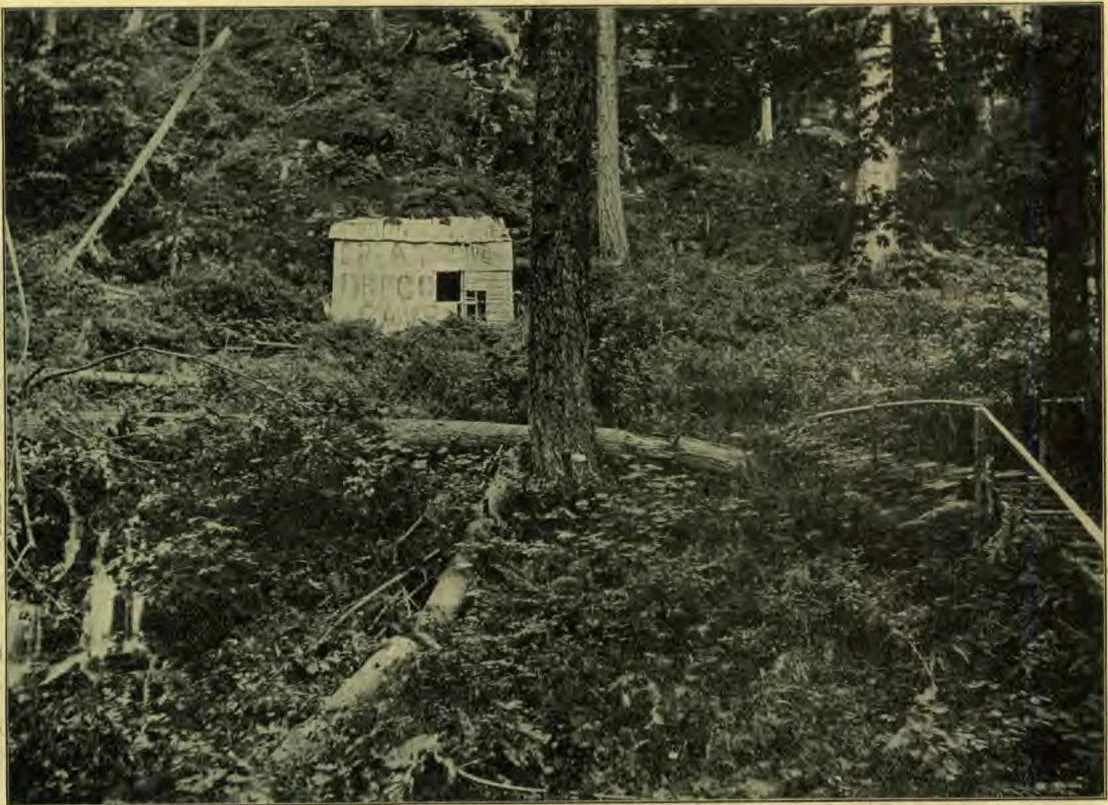
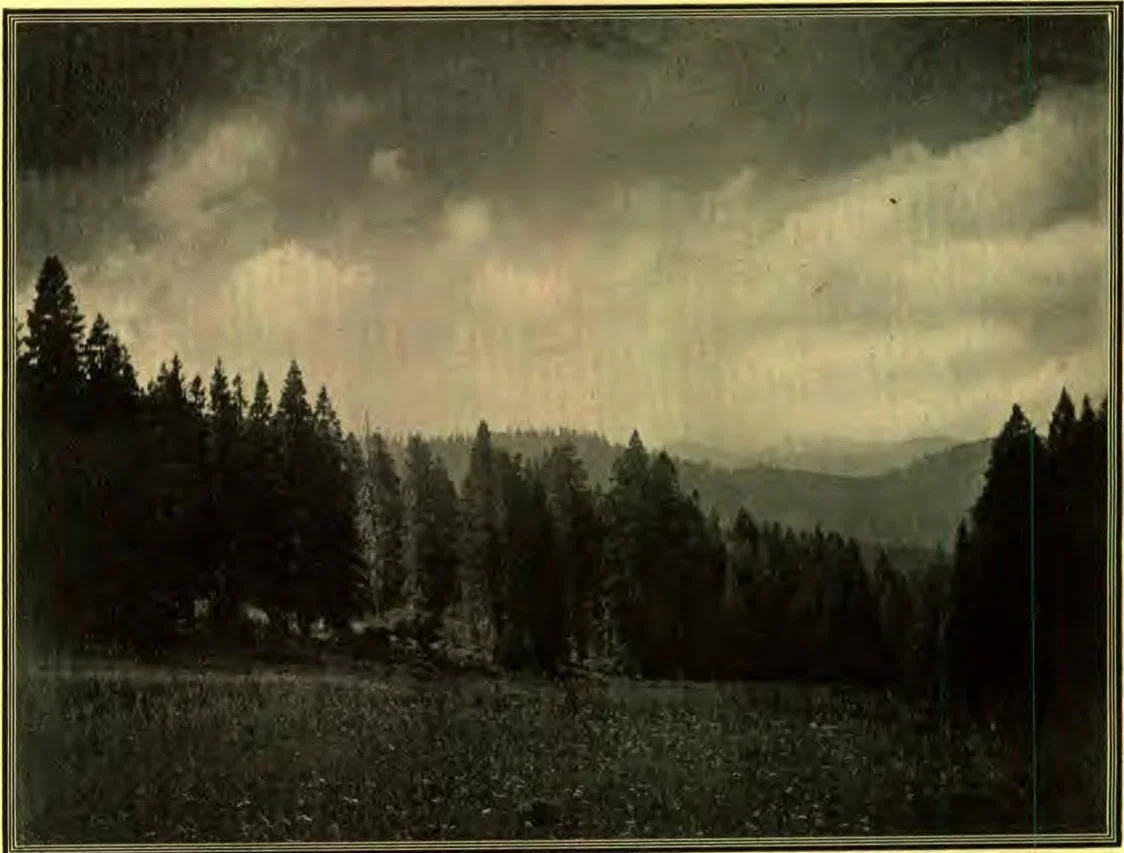
THE MEADOWS
THE MEADOWS
I spent a somewhat dreary Sabbath in that cold, damp cañon. The sunshine seldom reaches the bottom of the cañon; for it runs from east to west, and its sides are covered with dense timber.
After the Sabbath I went into the lower cave, but found it disappointing. There were few of the peculiar limestone formations so common in the upper cave, and no chambers of any size. The passages are all extremely rough, and in the main passage there is always a strong cold breeze blowing outward. It is very cold and damp, and not of sufficient interest to repay one for the discomfort experienced in an extensive exploration. I took no picture in the lower cave, as I had been told that the upper one was far more interesting.
Bright and early on Sunday morning I started into the upper cave, taking my camera and tripod with me. It was not so cold nor so damp as in the lower cave, but some of the passages were very narrow, and so low that I was often compelled to go on hands and knees. I found it difficult to handle the camera and tripod, and at the same time protect my candle from the water that dripped from the stalactites above, and the wind that blew in the main passage. So I left the camera and tripod, and went on to explore the cave, and pick out the spots I wished to photograph.
I found a few fairly large chambers, though none were of sufficient size to justify the reports I had heard. In fact, none were large enough to give a respectable echo. In many places, stalactites of limestone hung like great icicles suspended from the ceiling. Other formations along the wall had the appearance of banks of soiled, drifted snow, with icicles along the bottom, a drop of water suspended at the tip of each. It is the constant dripping of water that causes the formation of these stalactites. A drop of water charged with lime trickles through some crack or crevice in the rocks, and clings for a moment to the lowest point it can reach. Before it drops, it deposits on that point a few particles of the lime it holds in solution. Another drop follows, and still another, each contributing its mite to the formation of the stalactite. As the years pass, this grows larger and larger until, unless broken off by some specimen hunter, it falls from its own weight, or reaches the stalagmite slowly rising from the ground to meet it. In the latter case the two unite, and as the water continues to trickle down, form a pillar that usually spreads out at the top and bottom like an old-fashioned hour-glass. I saw a number of these pillars, but only two or three were large enough to be conspicuous. Often these pillars continue to grow sidewise until they meet, when they unite, and form a wall that finally loses all resemblance to the original formation, and takes on many fantastic shapes.
I had crawled through wet and muddy passages, bumped my head on the sharp edges of broken stalactites, and covered my clothing with lime and clay and candle drippings, until I was tired of it all. My contempt for all caverns in general, and for the Oregon Cave in particular, increased at every step until I reached a large chamber near the end of the cave. It was the largest I had seen, and I afterward learned that it is the largest in the cave. I climbed over and around the great boulders that covered the floor to the end of the chamber, and there found a ladder that seemed to lead nowhere in particular. I discovered, however, that it led to one of the most beautiful chambers in the cave. There are two ladders above the first one, with much hard climbing between them; but when the explorer reaches the upper chamber, called Floral Hall, he feels amply repaid for his work.
It is so difficult to reach this chamber that few persons undertake the climb, and as a result not many of the formations have been marred by curio seekers. In the passages leading to Floral Hall are several large, dome-shaped stalagmites, that yield a musical, bell-like tone when lightly tapped with a stick or stone. The pitch of this tone varies with the height at which the hollow domes are struck, so that one can almost beat a tune upon them. Floral Hall is a rather small chamber; but it makes up for lack of size by the variety and rare beauty of its formations.
THE LOWER ENTRANCE TO OREGON CAVE
As I turned to retrace my steps, I thought that if I could only step from that chamber into the open air, and thus save another trip through those tortuous passages, the cave would leave a better impression on my mind than would otherwise be the case. When I descended the last ladder from Floral Hall, and found myself once more in the Ghost Chamber, I looked at my watch, and saw that the day was half gone. Concluding that I had seen enough of Oregon Cave, I started back, intending to get my camera, take a few flash-light pictures, and then bid the cave a permanent good-by. But I was not to be let off so easily.
J. EDGAR ROSS.
(Concluded next week.)

JOY BEYOND

We think of the warmth of the springtime When winter’s cold snow flutters white; We wait for the coolness of twilight When summer’s hot sunshine glows bright.
When pain and distresses exhaust us, To visions of health how we cling! When weary, we eagerly ponder The rest that the evening will bring.
No night is too dark to make promise Of the morning that’s certain to dawn; No furious tempest can hinder The sunshine from following on.
The longer the outlook seems hopeless, The sooner some change we may see; The darker the present with trials, The brighter the future may be.
Thus ever will darkness be followed By something more cheerful and bright, Till time’s shadowed river has rippled To seas of eternity’s light.
MINNIE ROSILLA STEVENS.

PRIDE, WORLDLINESS, AND LOVE OF DRESS

LUCIFER fell when he became exalted because of his brightness. Pride was at the root of the first sin in the universe, and it has proved to be the means of producing the downfall of more than one soul. Christians should not be proud of the fact that they have to wear clothes, and seek to attract attention to their dress. It was not until sin entered the world that our first parents were compelled to wear clothing. The necessity for wearing clothes is, in itself, a constant reminder that we are a race of sinners; so, instead of seeking to dress to attract the attention of human eyes, and display his vanity to the world, the Christian should seek to adorn himself with the “ornament of a meek and quiet spirit,” and clothe himself with the garments of Jesus’ righteousness.
The desire to gratify pride by wearing fine clothes is at the bottom of the downfall of many a youth, as the city missionary well knows. I have in mind two cases that I think will serve to emphasize the danger of yielding to the desire for fine clothing and a love of display.
The first is that of a young woman, who had been rescued from the enemy’s snare in this wicked city. After the Lord had changed her heart, we learned that the cause of all her sad experience, and the evil into which the enemy had led her, was simply the desire to wear fine clothes. Her parents were poor, and could not dress her as she thought a young lady should be dressed; so she decided to go out into the world, and, whatever the cost, to wear seal-skin cloaks and satin dresses. This she succeeded in doing, but at a cost which it would seem no sane person would wish to pay.
Again and again I have been made sad to learn that the desire for dress, and that only, had been the cause of sending some bright young woman into a life that was in itself worse than death. Let every young woman who reads these lines beware lest she be entrapped by the snare of pride, and taken in the coils of vanity. Satan is at work at the very time when many will contemptuously toss their heads, and assure anxious parents and interested friends that they are “all right,” little realizing their real danger.
The second experience is somewhat different from the one already mentioned. This sister was an earnest worker for God. Providence had blessed her with rare opportunities to qualify herself for usefulness. These she seemed to be improving with a spirit of humility and earnestness. At a certain point in her experience she was thrown in contact with a number of youth who were not the most consecrated, and were somewhat given to display, dress, etc. For a while she held out, but soon her personal appearance indicated that she was beginning to succumb to the temptations that the enemy kept daily before her.
It is not necessary to relate the details. Week by week the change went on, until at the end of a year this sister did not look much like the plainly dressed, humble worker she used to be. Pride, fashion, and frivolity combined to wrest this once earnest soul from the service of God, and to launch her on the troublous sea of worldliness. It really seemed as if the enemy of her soul was about to succeed, when, by a peculiar train of circumstances, this worker was suddenly snatched from the influence of these associates, and transplanted into an atmosphere more spiritual, and a soil more favorable for moral growth. Her energies were enlisted in a work which called forth constant missionary effort, and where she daily beheld the terrible consequences of the love of dress upon the souls of scores of sin-stricken girls.
She became thoroughly aroused, and began to see whither she was drifting. She sought the Lord earnestly, and with one great effort threw aside the fetters that fashion had forged about her. The curling of the hair, the display in dress, the gold cuff-buttons, the fashionable hat and shoes, which had made their appearance one by one, almost unconsciously to her, were all flung aside at once; and, with an awful sense of the danger of pride, display, and dress, she sought that unbroken communion with the Father which it had once been her blessed privilege to enjoy.
If the young women who read the INSTRUCTOR could have a talk with this sister, she would solemnly warn them against these “little foxes” of pride and dress and fashion, which are sure to spoil the vine of Christian experience if they once gain access to it. Whether we eat, drink, dress,—whatever we do,—let us be sure that all is done to the glory of God. Our bodies are the temple of the Holy Ghost; and instead of distorting them according to the whims of fashion, we should be careful to adorn them with the virtues and graces of a Christian character.
W. S. SADLER.
1926 Wabash Ave., Chicago.

HOLD ON, BOYS

Hold on to virtue: it is above all price to you in all times and places.
Hold on to your good character: it is and ever will be your best wealth.
Hold on to your hand when you are about to strike, steal, or do any improper act.
Hold on to the truth: it will serve you well, and do you good throughout eternity.
Hold on to your good name at all times: it is much more valuable to you than gold.
Hold on to your temper when you are angry, excited, or imposed upon.
Hold on to God. He is the best treasure of earth and heaven.—Selected.

OH, TO BE SOMETHING, SOMETHING!

Oh, to be something, something, For the sake of God and man! It matters little how humble In the eternal plan. But oh, to be helpful, useful, That God may sometimes see That I am not all ungrateful For his love to mine and me.
I would not stay by the Master While his work remains undone. I would go from his feet to labor, And rest with the victory won. Thus, by each earnest effort For him and his I'd prove, Though in weak, unworthy fashion, My loyalty of love.
Oh, to be something, something! To feel, when the way grows dim Of earthly life and longing, That I did my best for him. The world may not know about it: It will be enough for me If the Master knows that something I tried for his sake to be.
— Selected.

ORIGIN AND RELIGION OF THE HAWAIIANS

THAT the Hawaiians are a branch of the Polynesian race, which anciently settled all the groups of islands in the central and eastern Pacific, is shown by their close physical and moral resemblance, also from the fact that they speak dialects of the same language, have similar religious rites, traditions, customs, system of tabus, etc.
It is thought that the Hawaiian Islands were inhabited as early as 500 A. D. The people who first settled here must have arrived very anciently, as human bones have been discovered under ancient coral- and lava-beds. The New Zealand natives (Maoris), who closely resemble the Hawaiians, have a tradition that their ancestors came, originally, from Hawaiki (Savaii, or Hawaii).
According to an ancient tradition, the Hawaiian Islands were discovered by a famous chief and fisherman named Hawaii-loa, who, after making several voyages, came with a large company of retainers, and settled in the islands. Wakea and his wife Papa were, according to Hawaiian genealogies, progenitors of the race. After the arrival of Hawaii-loa and his company, many generations, perhaps twenty-five or thirty, passed, during which time tradition is silent in regard to voyages either to or from the islands. During that time, however, many great works were constructed, among which may be mentioned the heiaus (temples), also the great fishponds along the coast of Molokai and in many other places.
After generations of seclusion from the rest of the world, intercourse with other islands in the South Pacific seems to have been renewed. Indeed, there seems to have been a general movement throughout the islands during the eleventh and twelfth centuries. After a time this intercourse is supposed to have ceased, as for about five hundred years before the discovery of the islands by Captain Cook, in 1778, we find no mention of any voyages in the ancient legends or songs.
One writer says: “The ancient Hawaiians were not savages, in the proper sense of the term, but barbarians of a promising type. When we consider that they occupied the most isolated position in the world, and that they were destitute of metals and of beasts of burden, as well as of the cereal grains, cotton, flax, and wool, we must admit that they made a creditable degree of progress toward civilization. The name of Captain George Vancouver is still cherished as that of a wise and generous benefactor to these islands. During his survey of the northwest coast of America in 1792-1794, he made three visits to the islands. He uniformly refused to sell firearms or ammunition to the chiefs, but gave them useful plants and seeds, and presented Kamehameha with the first cattle and sheep ever landed in the islands.”
The religious system of the ancient Hawaiians was similar to that of the other Polynesians. They believed all the powers of nature to be living, spiritual beings. Accordingly, volcanoes, thunder, meteors, whirlwinds, and sharks were feared, being regarded as either the work or the actual embodiment of malicious spirits. Sickness and disease were evidences of the displeasure of their deities. They also believed in the deified spirits of the dead, and that certain deities haunted special localities, while others acted as presiding deities over family and household affairs.
Even before the introduction of Christianity, the Hawaiians had many beliefs and customs corresponding with, or similar to, those set forth in the Bible. They believed in four great gods. Three of these were good gods; while Ku was feared as a dark and malignant being, who took pleasure in causing pain and suffering. Kane was believed to be the oldest and most powerful of the gods. From prayers addressed to him, we learn that he was regarded as the father of men and founder of the world. His was the abode to which great chiefs went at death. This abode, as well as that of the other three great gods, was in or above the clouds, where it had existed from the beginning. When Captain Cook arrived on the islands, the people believed him to be the god Lono, whom they were expecting to appear in fulfillment of an ancient prophecy; they also regarded the crew as supernatural beings.
Alexander says: “Between three and four o’clock P. M. [in 1778], Captain Cook went ashore with three armed boats and twelve marines. The moment he leaped ashore, the natives all fell flat upon their faces, and remained so until he had made signs to them to rise. They then brought a great many pigs, which they offered to him with plantain, while a long prayer was recited by a priest. Messengers were sent to Oahu and Maui to inform the chiefs there of the arrival of these wonderful beings. The messengers said: ‘The men are white; their skin is loose and folding; their heads are angular; fire and smoke issue from their mouths; they have openings in the sides of their bodies into which they thrust their hands, and draw out iron, beads, nails, and other treasures, and their speech is unintelligible!’”
The ice having stopped further exploration in the north, Cook returned to winter in the sunny isles which he had discovered. Here he was received with great veneration. An aged priest went on board, threw a piece of red kapa over his shoulders, and made an offering of a pig, reciting, in the meantime, a long prayer.
That afternoon Captain Cook went ashore. The people prostrated themselves at his approach. He was conducted to the temple of Lono, stationed in front of the sacred images, and the ceremonies which had taken place on the boat were repeated, after which he was anointed with the chewed kernel of cocoanut. The object of these ceremonies was to install him as the incarnation of the god Lono.
Whenever he went on shore, he was accompanied by one of the priests carrying a wand. This priest ordered all the people to prostrate themselves. Jarvis says of Cook: “He moved among them an earthly deity, observed, feared, and worshiped.”
LENA E. HOWE.
Honolulu, H. I.

EVERY LIFE A SUCCESS

THE Lord has great things in store for the youth; and no matter what may be the situation or surroundings of a young man or woman, God desires and expects something of real value to be accomplished. Even poverty in the extreme does not hedge up the road to a successful life. Many of those who are recognized as the greatest and noblest men have at some period in their lives shared with the poor in their suffering and distress. During the time of hardships they may have longed for an easier path, yet in after-life the value of trials and difficulties was seen and appreciated. In order to become strong, one must fight something, he must overcome something.
Among those who have learned this from experience stands the great German Reformer. “Luther was never ashamed of those days in which, oppressed by hunger, he used in sadness to beg the bread necessary for his studies and his livelihood. Far from that, he used to reflect with gratitude on the extreme poverty of his youth. He looked upon it as one of the means that God had employed to make him what he afterward became, and he accordingly thanked him for it. The poor children who were obliged to follow the same kind of life, touched his heart.
Likewise the reformers Huss, Zwingle, and Melanchthon, who were chosen of God to carry forward his work, and to help dispel the moral darkness that hung over Europe, were men from the lower class of society. Paul found the same condition in his day. He said: “For ye see your calling, brethren, how that not many wise men after the flesh, not many mighty, not many noble, are called.” It was well known that the disciples of Christ were unlearned and ignorant men. In early life they had no opportunity for an education; but when the Great Teacher began his work, their opportunity arrived, and for three and one-half years they improved it, sitting at the feet of Jesus. When they finally went forth with the gospel of Christ, the world “marveled; and they took knowledge of them, that they had been with Jesus.” The enemies of truth were determined to silence their voices, but before they were hushed, the tidings of a risen Saviour had been proclaimed “to every creature which is under heaven.”
That Life which, of all that have been lived on the earth, was pre-eminently successful, whose results span eternity, was begun in the lowly manger. Jesus never attained worldly fame, wealth, or position: instead, he was despised, rejected, and so poor that he himself testified, “Foxes have holes, and the birds of the air have nests; but the Son of man hath not where to lay his head.” All this poverty he took upon himself that we might become rich. He “endured” because of the “joy that was set before him;” and his joy is realized when we endure “as seeing him who is invisible.”
“God does not bid the youth to be less aspiring. The elements of character that make a man successful and honored among men,—the irrepressible desire for some greater good, the indomitable will, the strenuous exertion, the untiring perseverance,—are not to be crushed out. By the grace of God they are to be directed to objects as much higher than mere selfish and temporal interests as the heavens are higher than the earth. And the education begun in this life will be continued in the life to come.” “‘Eye hath not seen, nor ear heard, neither have entered into the heart of man, the things which God hath prepared for them that love him.’ Even in this life we may catch glimpses of his presence, and may taste the joy of communion with Heaven; but the fullness of its joy and blessing will be reached in the hereafter. Eternity alone can reveal the glorious destiny to which man, restored to God’s image, may attain.”
ROY F. COTTRELL.

A SONG OF LABOR

Rest! What have I to do with rest?— I, who am like a cart sore pressed, Which, groaning 'neath its load of sheaves, The road along the valley leaves, And toils toward the mountain crest!
Rest! What have I to do with rest, Who am like the honey-bees, which test The nectar in the summer flowers, Seeking a store for winter hours, And hiveward, homeward, bear the best?
Rest! What have I to do with rest, Who am like a bird that builds her nest, And fills it up with fledglings weak, Of untaught wing and tuneless beak, And warms the nestlings in her breast?
Rest! What have I to do with rest,— A mother by small hands caressed,— A temple-builder 'neath the mask Of homely toil and common task,— By hope upheld or fear oppressed?
Rest! Yes, another day I'll rest! When I have done my little best, And down the sky the shadows creep, He'll give me, “his beloved,” sleep, With still hands folded on my breast.
ELIZABETH ROSSER.

NOAH'S GREAT - GRANDFATHER

Do you all know, dear youth and children, who Noah's great-grandfather was? Perhaps you could not call to mind just now who he was, but let us see. Noah's father was Lamech, and Lamech's father was Methuselah, the oldest man that ever lived. Methuselah's father was Enoch, who was translated without seeing death. That makes Enoch Noah's great-grandfather, does it not? Enoch was a holy man, a type of all who, when the Lord comes, will be alive, to be translated as Enoch was.
Enoch was a prophet, a preacher of righteousness. A fragment of one of Enoch's sermons is found in Jude 14: “And Enoch also, the seventh from Adam, prophesied of these, saying, Behold the Lord cometh with ten thousands of his saints, to execute judgment upon all, and to convince all that are ungodly among them of all their ungodly deeds which they have ungodly committed, and of all their hard speeches, which ungodly sinners have spoken against him.”
You see that the special topic of Enoch's preaching was Christ's second coming. People sometimes say that Mr. Wm. Miller, or some one living in the last century, was the first one to preach the second coming of the Lord, but that is a mistake. Of course, Enoch knew about the flood that was to come upon the earth in Noah's time; he knew about the first coming of our Lord to suffer and die for us; but his mind seemed to leap away over these important events, and dwell upon the second coming of Christ. He speaks of the Lord's coming “to execute judgment.” That was not at his first coming; for when he was here the first time, Jesus said: “And if any man hear my words, and believe not, I judge him not: for I came not to judge the world, but to save the world.” John 12:47. But he will judge the world at his second coming. Acts 17:31; 2 Tim. 4:1. Enoch spoke of our Lord's coming “with ten thousands of his saints,” or angels. When he came the first time, he came in humility; he was born in a manger, and was known as the son of a carpenter. It is when he comes the second time, that he comes in power and glory with his mighty angels. Matt. 25:31; 2 Thess. 1:7, 8.
“By faith Enoch was translated that he should not see death.” Heb. 11:5. It seems that Enoch's mind dwelt so intently upon the second coming of the Lord, and the translation of the living righteous at that time,—that his faith so took hold of the power of God to translate righteous men and take them to heaven without their seeing death,—that the Lord granted him the privilege of knowing this translating power by experience. Enoch walked with God, and kept his mind on the Lord's coming till his faith in that event enabled him to know in advance its power and glory.
So we see very plainly that the glorious subject of Christ's second coming is by no means a modern idea, inasmuch as it was preached by Enoch before the flood. If it was right to preach it then, and inform the people about it, how much more necessary is it now, when Jesus is about to come again. F. D. STARR.

THE BALANCE

The bookkeeper sat on his long-legged stool, with the light pulled close over his books. The clock struck ten, and with a gesture of despair he pushed back the stool and stood up, leaning over the ledger, and digging his elbows into its pages, while he groped nervously with his fingers at the roots of his disordered hair.
It was the trial balance again, and only “out” one dollar even. It must be in the footings somewhere! He had been over them three separate times already, yet it could hardly be anywhere else. It is true that there was a doubtful item there of thirty-eight cents; but it was no use bothering with that, because, if added, he would have one dollar and thirty-eight cents, and if subtracted, he would have sixty-two cents, and that was not likely. Well, he would try the footings again.
Eleven o’clock, and his weary brain ached. A voice kept saying: “Thirty-eight cents! thirty-eight cents!” Suddenly the bookkeeper stopped, thought a moment, and said to himself, “I’ll just have a look at that thirty-eight cents, anyway.” He looked. A glance convinced him that he had an error of thirty-eight cents, and that it must be added to the other. It made the error worse, but the real difference was now apparent. Rapidly he ran over the pages, and stopped in a moment at an item of sixty-nine cents.
“Let me see, that would be half of one dollar and thirty-eight cents. I’ll have a look at that item.”
Sure enough, there was the item posted to the wrong side of the ledger. Back it went to its place, and with a sigh of relief the weary young man shoved the books into the safe, turned out the light, and went home.
Friend, do you fear that the admission of an error will make the balance greater against you? If you would get right with God, find out where you stand. Do not determinedly follow up one thing when God wants you to settle another. You will never have anything but a forced balance, never have lasting peace, until you take the items one by one, and with Christ’s help make them right.—Selected.

SPIRITUAL INDIGESTION

Some people are continually studying themselves; their vivid imagination pictures before them just how their food is being digested; they are almost momentarily conscious of each heartbeat. This is not an ideal condition to live in. God intends that we shall accept right principles, and then have faith to believe that he will care for us physically. The maintaining of such an attitude as has just been outlined is a sure way to encourage dyspepsia.
Others treat their souls in the same way, and thus are sowing for spiritual indigestion. They continually worry whether or not they are getting enough food out of the Bible to nourish them; they do not feel that they are receiving any benefit from their Bible study. They forget that when we begin to feel our physical food, it is an evidence that something is abnormal. When they are seeking to feel their spiritual food, they are simply praying for spiritual indigestion.
The only way to get immediate effect from physical food is to take stimulants. In a similar manner, one may read a whole chapter in the book of Acts, and perhaps get no immediate sense of stimulation from it, while if he reads some cheap take-off on the gospel, or some religious novel, it will seem to bud and blossom out into fervent enthusiasm at once; but, like the effect produced by stimulants, it is short-lived. Food that we do not feel is being digested, and transformed into energy; and when an emergency arises, and we are brought face to face with a soul that needs spiritual energy, we shall be surprised to find that we have stored-up energy that can be readily utilized to an extent we little dreamed.
DAVID PAULSON, M. D.

THE WINTER HOME OF THE MUSKRAT

Although most boys have seen muskrats, and know that they burrow in the banks of streams and ponds, perhaps all do not know that there are some muskrats which build more pretentious winter homes for themselves. These furry aristocrats select as a site for their house a shallow spot in some swamp or quiet stream, and on a moonlight night in the fall of the year they may be seen at work on their new dwelling. Some gather sticks, and others dried grass and bunches of fallen leaves. With this building material in their mouths, they swim out to the spot they have chosen, and begin to build a mound, leaving a hollow space in the middle. When the house is finished, it looks very much like a pile of leaves such as the gardeners rake up on the lawns in the autumn; but in reality it is very firm, for besides the strength given by the sticks, which are laid between layers of leaves, the whole mass is soon frozen stiff, often remaining so all winter.
But within the thick walls is a snug little chamber, where the muskrats sleep in the day-time, sometimes on a flat stone or log over which the house has been built, and sometimes on a sort of shelf made on purpose. The doorways are under the water, and the owners have to dive if they wish to go in or out. When the river or swamp is frozen over, they sometimes have to swim for a long distance under the ice, and the bubbles of air which they breathe out as they shoot along may often be seen from above.
They generally go out at night; and landing at some opening near the shore, canter off to a cornfield, to glean the ears left here and there by the farmers. Sometimes they will visit an old barn, and carry off apples, turnips, or almost any other vegetables which may be stored there. They are also very fond of fresh-water mussels, and gnawed mussel-shells will generally be found along streams inhabited by muskrats.
It is always easy to know the tracks of a muskrat from those of any other animal. In the first place, the hind feet, which are slightly webbed, are very much larger than the front ones, and are set on the leg at an angle. The trail shows these peculiarities plainly. In the second place, there is always a line running between the marks of the paws. This is made by the sharp-edged tail, which the animal trails along the ground as he runs.—Selected.

TWO WATCHES

It is expected that an enormous watch will be exhibited at the St. Louis World’s Fair in 1903. It will have a polished metal case. It will lie on its back, and be so large that people will be able to walk among the moving wheels. It will be nearly seventy-five feet in diameter, and more than forty feet high, with neat little stairways running all about it. The balance-wheel will weigh a ton, and the “hairspring” will be as thick as a man’s wrist. The mainspring will be three hundred feet in length, and made of ten sprung-steel bands two inches thick, bound together. Guides will point out and name every part. The watch will be wound by steam regularly at a certain hour during the day.
It is interesting in this connection to read that there is in Berlin a watch which measures one fourth of an inch in diameter, its face being about the size of the head of a large-sized tack or nail. It weighs less than two grains Troy, and keeps perfect time.—Selected.

WHICH WAY?

ROUND-ABOUT is a tiresome way, And a long and hard way, too. Avoid that path, or you'll go astray, As so many travelers do; For a thousand paths of fear and doubt Make a labyrinth of Round-about.
Straight-ahead is the way to take, If you wish to reach your goal; Climb you must, and your back will ache, And to strength you'll pay a toll; But you can not miss your aim, 'tis said, If you keep along with Straight-ahead.
— Frank Walcott Hutt.

THE POPPY-LAND LIMITED EXPRESS

THE first train leaves at six P. M. For the land where the poppy blows; The mother dear is the engineer, And the passenger laughs and crows.
The palace-car is the mother’s arms; The whistle, a low, sweet strain. The passenger winks, and nods, and blinks, And goes to sleep in the train!
At eight P. M. the next train starts For the Poppy Land afar. The summons clear falls on the ear: “All aboard for the sleeping car!”
But what is the fare to Poppy Land? I hope it is not too dear. The fare is this,—a hug and a kiss, And ’tis paid to the engineer.
And I ask of Him who the children took On his knee in kindness great, “Take charge, I pray, of the trains each day That leave at six and eight.”
“Keep watch of the passengers,” thus I pray; “For to me they are very dear, And special ward, O gracious Lord! O’er the gentle engineer.” — Edgar Wade Abbot.
Continue reading: A SNOW STORY