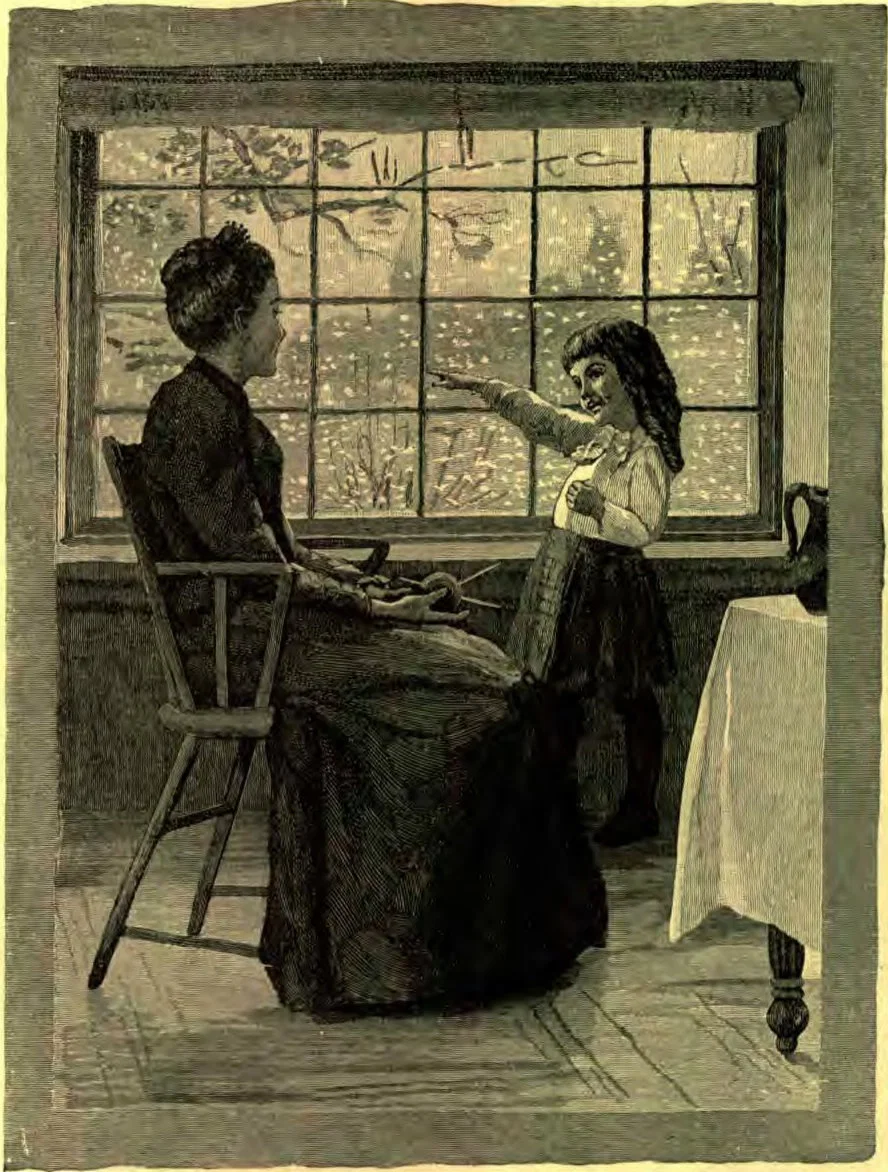
“PIT-PAT, pit-pat,” whispered the big flakes against the window, where Laurence Dean stood looking out, not too cheerfully, at the falling snow. He was just getting over the whooping-cough, and was anxiously waiting for a fine day and dry walks, so he could play outdoors again. Yesterday had been so pleasant that he thought winter was quite gone; now here was the snow again. But Laurence was a brave boy; and though he felt and looked disappointed, he did not cry.
“Mama,” said he, after a few minutes, “it sounds like talk,—that little ‘pit-pat’ sound the snow makes. What is it trying to say?”
“As soon as I put my bread in the oven, I’ll come and listen. There, that is done. Yes, I hear the snow whispering. Perhaps it is trying to tell you its own story. Listen, and I will repeat it for you:—
“‘I am only a visitor here, little boy; and I am glad you treat me politely, and do not cry and pout when you see me coming. My true home is in the far, far north. There I live all the year, and see many wonderful things. Ice covers all the ocean. Great masses break off, and float away to the south, often striking together with a noise like thunder. The north star is overhead, and the Great Dipper circles above me. In the spring the sun is low in the sky; day by day it rises higher, and for many weeks in summer it never sets. But it is always so low, and its rays are so slant, that it never gets warm enough to thaw me off. As summer wanes, the sun drops lower and lower in the sky, until, one day, it sets at midnight: every day it rises a little later and sets a little earlier, until by and by it does not rise at all. Then there are weeks of darkness; only the frosty-looking stars twinkle, and the beautiful northern lights quiver across the sky. At last there is a faint light in the south; every day it increases a little, until the sun shows its face again above the horizon, and it is spring once more.”
“‘There are no plants in my far northern home; no trees, no flowers, no singing birds. But there are fierce, white bears, and seal, and walrus with great tusks. People? Oh, yes; there are people, too,—people who love their northern homes as well as you love yours. And I am very useful to them; for where there is no wood nor stone nor brick to be had, what would they do for houses if they could not build them of snow blocks?”
THE SNOW-STORM
“‘There is another place where I am always at home, and that is on the tops of high mountains. There it is always cold, even in summer; and where the mountains are in hot countries, I can look down on, first, the mosses, grass, shrubs, and plants that like cold climates; then on trees, grains, and fruits; and at the foot of the mountain, great forests, burning sands, or sunny seas. In the cooler countries I creep down the mountainsides into the valleys, in fall and winter; but with the return of spring, I go back to the mountain-top, where, all summer, I feed the rivers that water the valleys below.
“‘Do you know what would happen if I did not come? Let me tell you. I have a lively cousin, often called Jack Frost, who is always on the lookout for some one or something to bite. In the fall he nips gently, almost in play; but in the winter he bites very hard indeed. So, before the coldest weather comes, the kind Father, who clothes even the grass of the field, sends a soft, thick snow-blanket, that the bitter cold may not so hurt the tender plants that many of them would die.”
“‘Last night I was not snow, but vapor; and it was so warm I thought I was going to be a raindrop. Then I was glad, for I thought I should like to help wake the early flowers; but this morning a cold breeze from my old home in the north struck me, and I had to come to you as snow.’
“And that is the end of the story for this time,” said mama; “for here come Fred and Neal from school, and they are going to build a big snow-man right before the window, so you can have a share in the fun.” AUNT BETTY.
A LITTLE WORKER
I’m only a little worker,
Yet the kingdom needs my hands,
And day by day they gladly
Will do my Lord’s commands;
And day by day he’ll give me,
My happy childhood through,
Some task of patience or of love
Which only I can do.
— Selected.
Better to Suffer Wrong Than Do Wrong
It is better to suffer wrong than to do wrong, and happier to be sometimes cheated than not to trust.—Samuel Johnson.
“CHAMELEON” LIZARDS
In the winter of 1893-4 there arose in the cities of the Northern States a sudden fashion for wearing or keeping the little glittering Southern lizards of the species known to naturalists as Anolis principalis, but commonly called, in the South, and not without some propriety, chameleons. These little creatures do not belong to the same genus as the real chameleon, which is a native of Asia or Africa, and is sometimes found naturalized in southern Europe.
The true chameleon's body is raised high on his strong legs, and he differs from all other lizards in having his toes divided into opposable groups, like a parrot's foot. His neck and tail are thick, and he clings to the branches of trees with his tail. Our Southern Anolis is much smaller, and in every way different except in its ability to change its color.
It is this accomplishment that makes people call it a “chameleon.” It will mimic natural colors very completely, changing in a short time from a dark and rich bronze to a glittering emerald. On a palmetto leaf, watching for insects, it is almost invisible.
In any of the great Southern parks or cemeteries these lizards are a beautiful sight. In their appearance and movements they are not at all repulsive. In the cemeteries they take refuge in the crevices of old tombs, coming out in the heat of the day, lively and eager, to feast upon the insects that abound at that hour.
The chameleons consume so many noxious insects that they are very useful; and many people were deeply concerned when, during the prevalence of the foolish fashion for these creatures in the North, boys and men swarmed into the cemeteries and parks at Tampa, Mobile, and other Gulf cities, and pounced down upon the poor little lizards, carrying them off in great numbers.
The Anolis has one characteristic which makes him rather easy to catch. When he sees an enemy approaching, he darts into a hiding-place; but he never seems to think it necessary to pull his tail in after him, and is readily caught by that appendage. As he is harmless, his pursuers do not hesitate to catch and hold him in their hands.
Shipped to the North, the lizards captured in the raid to which I have referred were exposed for sale in jewelers' and other dealers' windows, anchored to pins thrust into boards, with little gilt or gold chains fastened about their necks. Many women and girls actually wore them in their hair, or fastened to their gowns. Others bought them to keep among flowering plants.
But it presently became apparent that though some of the captive lizards lived in health and apparent happiness in conservatories and other well-warmed places where they had enough to eat, most of them languished and died.
It was difficult to find food for them. It is a mistake to suppose that these lizards, like the “horned toads” of California, will go a long time without food. After three or four days without their natural sustenance, the Tampa and Mobile lizards began to eat off each others' tails, and some of them died of starvation. Many others were killed by cold.
So the societies for the prevention of cruelty to animals began, very properly, to interfere. The exposure and sale of lizards was completely stopped in several cities of the North. The traffic was suddenly at an end; and the harmless little creatures were no longer disturbed in the Southern cemeteries—except by their old enemies, the cats, which are so fond of them that they will even leave fish to catch and eat a lizard.
But there are many “chameleons” of this species who live on happily in Northern conservatories, or, for that matter, all over private houses where plants, but no cats, are kept.
One of these favorably situated lizards, with which I am well acquainted, will do as an example of his kind. He is a beautiful little creature; his body is about three inches long, and his tail about three and a half. His belly is white, and his back, generally speaking, is of a pale emerald-green.
Most of his life he spends in the window among the plants, but occasionally he disappears in some unknown nook for hours.
He catches what insects he can find, and is fed others. He particularly likes chocolate creams, and appears to thrive on them. He comes running when whistled to, crawls readily upon the palm of the hand of any one who will caress him; and when he reaches this position, holds up his head to have the under side of his chin scratched—an indulgence of which he is exceedingly fond.
He is, indeed, always eager to be stroked and petted in any way, and nestles very lovingly against his mistress's cheek. He is quite frankly affectionate and perfectly harmless. He shows no “temper” nor viciousness under any circumstances. Placed on the dining-table at meals, he will go from plate to plate, moving about them merely, without disturbing them, waiting patiently to be given crumbs.
If a finger is thrust into his somewhat ample mouth, he will hold playfully to it, and may even be lifted and carried about in this way; but there is nothing like a bite in the gentle grip which he takes.
The owner of this little lizard declares that he has more virtues and fewer failings—since he seems to be entirely without failings—than any other pet she ever possessed.
In coloring, these lizards are certainly among the most wonderful of creatures. Their varying tints are undoubtedly produced in the same way in which those of the true chameleon are supposed to be produced; namely, by means of the overlapping of little scales, or layers, of skin, in which there are pigments of different colors, and which the lizard is able to move in such a way that the scales, or layers, are presented varyingly to the light.
When the little tame lizard of my acquaintance basks on a large green leaf in the sunlight, he often has a most exquisite emerald hue; but if a cloud passes before the sun, his bright color will fade almost entirely away. This seems to show that the chameleon's bright colors are in a great measure the result of reflections from his iridescent little scales.
These points on his surface tend to reflect, in turn, the colors which are reflected upon him from objects upon which he lies, such as foliage, the brown bark of trees, a white wall, etc. It is not known that the chameleon himself has any conscious power to change his own color to that of the object on which he lies. Nevertheless, it is plain that these lizards, like the genuine chameleons, have a great deal of strong and variable color in their skins, independent of reflection. Several of them together upon the same surface, which is of a uniform and neutral color, will sometimes show as many tints as there are lizards.
Our Southern lizards will stand the Northern indoor climate if properly taken care of, whereas the genuine chameleon of Africa or Asia soon languishes and dies, even under protection, in a cold climate.—Youth's Companion.
Temple of God Opened.—The eighteenth verse of Revelation 11 brings to view the judgment, which is followed by the opening of the temple of God, revealing the ark. When the work in the earthly sanctuary was completed, and the Saviour cried, “It is finished,” the veil of the temple was rent from the top to the bottom, revealing the most holy place to the gaze of all. It was thus in the typical service; and when the work in the great antitypical temple in heaven is completed, and the Saviour says, “It is done,” then, as John saw in vision, the temple of God will be opened, and the ark will be seen. When that glorious veil is parted, the glory of God will flood the whole place; and no man will be able to enter the temple until the seven plagues are poured out. The most holy place was opened to the eye of faith in 1844, when our great High Priest entered within the second veil, the judgment was set, and the books were opened.
The Moon under Her Feet (Rev. 12:1).—At the first advent of Christ the world seemed almost enveloped in darkness,—even at Jerusalem the office of high priest was sold to the highest bidder,—but notwithstanding the apparent moral darkness, there were still in the earth God-fearing men and women, who were longing and praying for the Saviour’s advent. They were widely scattered; many of their names are no doubt unknown except upon the books of heaven, but some are given in earthly records for our encouragement. The wise men of the East, Zacharias and Elizabeth in the hill country, Simeon in Jerusalem, and Anna within the precincts of the temple,—all these were pleading for the promised Saviour. When the Lord looked upon his true church, he ignored all the hypocrisy and deceit practiced by his professed people; and looking upon the faithful, praying ones, he compares the church to a woman clothed with the sun,—woman in her purity, as he made her in the beginning, when she was clothed with light and glory. True consecration to God is precious in his sight.
This pure, earnest, praying company were standing upon the moon, or Jewish economy,—the Mosaic dispensation, as it is often called. As the moon reflects the rays of the sun, so this service reflected the bright rays of the Sun of Righteousness. “It was the gospel in figures.” The Jews were not standing upon this foundation; they rejected the teachings of Moses, even while they prided themselves upon following him. Jesus said to them: “Had ye believed Moses, ye would have believed me: for he wrote of me. But if ye believe not his writings, how shall ye believe my words?” John 5:46, 47. The Jews had removed the firm foundation of belief in the Mosaic economy for a sandy foundation of forms and traditions. The true Christian church then stood, and will always stand, upon the foundation given to Adam, Abraham, Isaac, and Jacob. They saw the light that flashed from the Levitical laws and sacrificial offerings. The moon still remains under the feet of the Christian church, emitting a mild, gentle light to all who will gaze upon it. The sacrificial service of the Old Testament is the foundation upon which the cross of79Christ, and the glorious structure of the Christian church, as brought out in the New Testament, are built. It is a wonderful foundation, and will bear close scrutiny; the stones are living stones, and emit beautiful rays of light, which richly repay the labor of digging deep for the treasure.
Beauty That Speaks to the Imagination
Things are pretty, graceful, rich, elegant, handsome, but, until they speak to the imagination, not yet beautiful.—Emerson.
Best Stories FROM THE Best Book
since its publication, has met with a most gratifying reception. It grows in favor day by day. Everyone is delighted with the book upon first sight, but the more thoroughly they become acquainted with it, the more they realize its inestimable value. We know it is appreciated from the many kind words our friends have to say concerning it.
AN EXCELLENT HELP FOR CANVASSERS
PAW PAW, MICH.
The truths presented in “Best Stories” certainly make it a work that can not fail to bring much-needed light to many who have been reading the Bible for years. It is an excellent help for our canvassers.
GEO. MATTESON.
A READY SELLER
ELLIOTT, PENN.
I like “Best Stories” very much. It is a ready seller, and an excellent book for young persons to sell.
F. E. PAINTER.
Pennsylvania State Agent.
AN INSPIRATION TO THE CHILDREN
SOUTH LANCASTER ACADEMY,
SOUTH LANCASTER, MASS.
I find “Best Stories” very attractive to the children, as the illustrations are so beautiful, and the story so simply and impressively told. We are using it as a reader for beginners, with much enthusiasm and inspiration on their part.
SUSIE SISLEY.
This is just the book for children and young people to sell. It is a beautiful book, pleasing to the eye, and contains many fine illustrations. The fifty pages of “Easy Lessons” are a drawing feature of the work. It is a volume of which the children never tire.
Heavy paper, cloth back covers .......... 75c
Heavy paper, board covers .......... 50c
Thin paper, edition, limp paper covers ...... 25c
For particulars, address your—
Tract Society; the Review and Herald Pub. Co., Battle Creek, Mich.; or the Pacific Press Pub. Co., Oakland, Cal.
1. When Joshua was told by the Lord that he should lead the children of Israel into Canaan, what did he do? Joshua 2:1; note 1.
2. What report did the men bring back? Vs. 23, 24.
3. When the Israelites had reached the River Jordan (Joshua 3:1), what did Joshua command them? Why? Joshua 3:5; note 2.
4. When the morrow had come, what order was given to the priests? How did they obey? V. 6.
5. What did the Lord then say to Joshua concerning himself? Verse 7.
6. What instruction was to be given to the priests who carried the ark? V. 8.
7. As the priests would obey these words, what did the Lord say would take place? V. 13; note 3.
8. What was the condition of the Jordan at this time? V. 15, last part.
9. How did the Lord fulfill his promise when the people followed his command? Vs. 14–16; note 4.
10. What was the position of the priests with the ark while the people were passing over? V. 17.
11. When the people had all crossed over, what word came to Joshua from the Lord? What was Joshua to command them? Joshua 4:1–3.
12. How did Joshua obey? Vs. 4, 5.
13. Why was this to be done? Vs. 6, 7; note 5.
14. Besides building an altar in Gilgal (v. 20), what did Joshua set up in the river? V. 9.
15. As he had promised, what did the Lord do for Joshua that day? V. 14.
16. When all was done as the Lord commanded, what did God say to Joshua? Vs. 15, 16.
17. When the priests had obeyed, what took place? Vs. 17, 18.
NOTES
1. Moses had sent out twelve spies to view the land, and make a report. If their report had been what it ought to have been, it would not only have encouraged the people, but would have been a real help in conquering the country. But the one thing that the Lord wanted the spies to find out was that the people in Canaan were weak and afraid. Caleb and Joshua did find this out (Num. 14:9), and told the people to fear not; but they were not believed because of the false report of the other ten. Now that the time had again come, Joshua, too, sent spies; but he sent only two. These two, like Caleb and Joshua, learned what God wished, and brought back the word: “Truly the Lord hath delivered into our hands all the land; for even all the inhabitants of the country do faint because of us.” And the people believed their words. The people of Canaan were just as faint forty years before, but Israel would not believe it, and so would not go up. Now, when they believed, the work of entering the land was easy. So it is with us. God has prepared the way for us, and our enemies may be overcome if we will but believe.
2. The people were commanded to sanctify themselves; that is, to put away all sin, because it is only for a pure people that the Lord can perform his greatest “wonders.” If young people nowadays would give up everything for Christ, and live pure lives, God would do wonderful things for them, and they would find the Christian life a life of joy and peace. Will you not have it so, dear student?
3. The ark represented the presence of God. God wanted his people to know that it was he who cut off the waters of the river. But the priests, his ministers, were to stay with the ark until Israel had all crossed over; in other words, they were to work with God for the sake of the people. The plan is the same now. The Lord is the one who does the work; it is he who keeps the floods of sin from destroying his people; but his servants are the ones through whom he shows his power. God asks great things of his ministers, and the people have a right to expect great things. The minister should always be one who stands so close to Jesus that simply by his presence he will help the people to find salvation, just as the priests in the river kept its waters from drowning their brethren and sisters.
4. At the time when Israel passed over, the Jordan River was a vast, roaring, rushing tide. To the human eye it looked as if it could never be crossed in any way. And the people could not have crossed it if God had not been with them. But all things are possible with God, and are also possible with those who serve him, and walk with him. All that the Lord asks is that we do just as he says. We are not to wait to see how, but to go ahead without seeing anything more than God’s word, and trusting in that. If we believe God, he will do the work; and we can show, by what we do, that we believe him. God did not tell the Israelites how the Jordan was to be opened, but he told them to walk right into the water. When their feet were dipped into the stream, the Lord did his part. Our part is to believe: God’s part is to do the work. We are to believe, knowing that God must save us; but we are also to act, to work as if it all depends on us.
5. God wants his people to remember his wonderful works. Ps. 111:4. As we see how good the Lord has been to those who have lived before, we shall know just how good he is to us. It gives courage and strength to remember and talk of the Lord’s goodness.
FAULTS
FAULTS are like young spiders,—little and insignificant at first, but, if let alone, they grow; spin webs that accumulate dust, and darken the windows of the soul, through which character shines out; and deform the whole man. Better destroy the little spiders before they are old enough to spin; better correct the faults while they are small, lest they not only deform the character, but so bedim the moral vision that the soul can not discern between truth and error, right and wrong, a noble and an ignoble life.— Religious Telescope.
Contentment With What We Have
By Auerbach
He who isn’t contented with what he has, would not be contented with what he would like to have.—Auerbach.
Baby’s First Wardrobe
By Mrs. F. M. Kellogg
HYGIENIC PATTERNS
Complete outfit, based on healthful principles—22 PATTERNS, together with a beautiful booklet on the proper care of infants, sent postpaid for 50 cts. Full directions for making, showing necessary material, etc. Address—
MRS. F. M. KELLOGG,
36 Washington Ave., Battle Creek, Mich.
GRAND TRUNK R’Y. SYSTEM.
By W. C. Cunliffe
Taking Effect Dec. 16, 1900.
Trains leave Battle Creek.
WEST-BOUND.
No. 9, Mail and Express, to Chicago … 12.15 P. M.
No. 1, Chicago Express, to Chicago … 8.30 A. M.
No. 3, Lehigh Valley Express, to Chicago … 3.50 P. M.
No. 5, International Express … 2.17 A. M.
No. 75, Mixed, to South Bend … 8.30 A. M.
Nos. 9 and 75, daily, except Sunday.
Nos. 1, 3, and 5, daily.
EAST-BOUND.
No. 8, Mail and Express, East and Detroit … 3.45 P. M.
No. 4, Lehigh Express, East and Canada … 8.22 P. M.
No. 6, Atlantic Express, East and Detroit … 2.10 A. M.
No. 9, Express, East and Detroit … 6.50 A. M.
No. 74, Mixed (starts from Nichols yard) … 7.15 A. M.
Nos. 8 and 74, daily, except Sunday.
Nos. 4, 6 and 9, daily.
W. C. CUNLIFFE, Agent,
BATTLE CREEK.
THE APPLES OF GOLD LIBRARY
The first number of the Apples of Gold Library for 1901 is a personal talk by W. S. Sadler, entitled, “Some One Cares for Your Soul,” and is addressed to all who have for any reason fallen into discouragement. It contains the simplicity of the gospel, and can not fail to help those who read it thoughtfully. If you have a discouraged friend, one who is in darkness, and who feels that he is bearing a heavy burden alone, this number of the Library will help him.
“Food: Its Mental and Moral Value,” a paper read by Mrs. Mina Mann before a W. C. T. U. convention in California, is another helpful and very practical number of this excellent little Library. All who prepare food for their families should read it, with all others who, whether they eat or drink, would do all to the glory of God.
The price of the Apples of Gold Library is ten cents a year. The two numbers mentioned contain eight pages each, of the size to slip into an envelope, and are sold at the rate of fifty cents a hundred. Address the Pacific Press Pub. Co., Oakland, Cal.; or the Review and Herald Pub. Co., Battle Creek, Mich.
For Every Day of the Week
Sunday:
“Thou camest not to thy place by accident: it is the very place God meant for thee.”
Monday:
“We are what we have thought:
Of thought our lives are wrought.”
Tuesday:
Success is to be measured not so much by the position one has reached in life as by the obstacles he has overcome while trying to succeed.—Booker T. Washington.
Wednesday:
God made you for an end. Find out what that end is; find out your niche, and fill it. If it be ever so little, if it is only to be a hewer of wood and drawer of water, do something in this great battle for God and truth.—Spurgeon.
Thursday:
“Oh, let us not wait to be just, or pitiful, or demonstrative toward those we love until they or we are struck down by illness, or threatened with death! Life is short, and we have never too much time for gladdening the hearts of those who are traveling life’s journey with us. Oh, be swift to love! make haste to be kind!”
Friday:
If you think Christianity a feeble, soft thing, ill adapted to call out the manlier features of character, read here, “Quit you like men.” Remember, too, “He that ruleth his spirit is better than he that taketh a city.” He who conquers passion in its might is every inch a man. Say what you will, the Christian conqueror is the only one who deserves the name.—F. W. Robertson.
Sabbath:
“Judge not, and ye shall not be judged: condemn not, and ye shall not be condemned: forgive, and ye shall be forgiven.”
Sixth Annual Report of the Chicago Medical Mission
The Sixth Annual Report of the Chicago Medical Mission and Allied Charities is a neatly illustrated booklet of sixty-five pages, giving a full description of the buildings, methods, and work of the Medical Missionary Society in Chicago. A classified report of expenditures for the six months ending Nov. 1, 1900, with a statistical report, and a statement of the financial needs of the enterprise, is given. Price, five cents. Address The Life Boat, 1926 Wabash Ave., Chicago, Ill.