As the United States War College and the Naval Academy are objects of special regard by those who are interested in the national defense and in the standing of our government among the nations of the world, so, we believe, the Washington Foreign Mission Seminary is an institution dear to the heart of every advent believer, who is "looking for that blessed hope, and the glorious appearing of the great God and our Saviour Jesus Christ." This institution was established in 1907, in response to a definite demand from the foreign field for more and better-trained missionaries. It is a necessary factor in a great missionary enterprise.
The plans on which the Seminary is operated are the result of much earnest study and prayer on the part of the Foreign Mission Board and the workers in the school, coupled with the experience gained in the conduct of the school and in the management of our foreign mission work.
Prominent Features
The prominent features of the Seminary might be enumerated as follows:—
1. Personal acquaintance between missionary appointees and the members of the Foreign Mission Board. This means much in the testing of appointees, in placing them in the fields for which they are best fitted, and in the future relations between the missionary and the Mission Board.
2. Study of special mission fields. Definite knowledge of a proposition is a necessary prerequisite to its solution. So a thorough knowledge of a mission field,16with its climate, people, religious and social conditions, and the previous missionary efforts in its behalf, will enable the missionary candidate to go out better equipped and with a far greater chance for success than otherwise. These special studies include a class in the city problems.
3. Studies in the message. Before sending men and women to the uttermost parts of the earth, the church should make sure that they have their tidings ready. Thorough review of the fundamentals is given at the Seminary, besides advanced work in Bible and history.
4. Special methods and practical training in Christian work. A series of lectures on denominational organization and work by General Conference men gives to the students of the Seminary the benefit of the broad and varied experiences of these leaders in the work. Special classes are also conducted in methods of ministerial, colporteur, medical evangelistic, and Bible work, and a definite time each week is devoted to practical work along these lines. Thus students are "tested and proved that it may be seen what their adaptability is."
5. Study of languages. Many missionaries fail because they never master the language of the people for whom they labor. Experience has demonstrated that it is advantageous in some cases to begin this study at home. Spanish and French are taught regularly, and Oriental language work arranged for as the needs demand. Consideration is being given to the science of phonetics as a preparation for the study of any language.
6. Special training in medical evangelistic work. There is a great demand from the foreign fields for well-qualified nurses, and it is important that all missionaries know the elements of the treatment of disease. The Seminary is endeavoring to meet both these needs, and this is an encouraging feature of the work. A dispensary established among the poor of Washington the first of May, has prospered beyond our own expectations. The clinical advantages and the opportunities for genuine missionary effort are most excellent. A new feature along medical and practical lines this year is a course in hygienic cooking.
7. Industrial studies. The foreign missionary, of all workers, must be practical. Successful work is being done in farming, dairying, printing, poultry raising, dressmaking, and millinery.
8. Review of the fundamentals of literature and science. Those who have neglected academic science and mathematics can get them at the Seminary. Special attention is given to academic and collegiate work in English, including journalism and Biblical literature. A class will be conducted in English for those who need hastily to review the fundamentals of English grammar and composition. It is poor policy to send to a mission field to learn a foreign tongue those who have not been able or have not seen fit to become proficient in their own.
Constituency Meeting
At the meeting of the constituency held at Pittsburgh April 17, 18, 1912, the work of the Seminary was carefully considered. Elder A. G. Daniells and others set before the meeting the great value of the work that the school is doing, emphasizing the importance of our present effort to combine Biblical research, medical instruction, and practical experience in Christian work. The following resolutions were adopted:—
"Whereas, There is a crying need for gospel medical missionaries in the great unworked fields of the non-Christian world, and in the cities of our own land as well, and,—
"Whereas, The Washington Foreign Mission Seminary and the Washington Sanitarium, in harmony with the instruction that led to their establishment, have been located side by side in order to co-operate in the training of workers for missionary service, and,—
"Whereas, An effort is being made by these institutions to unite more fully in the training of graduate nurses and others as medical missionary workers,—
"1. Resolved, That we heartily approve of this effort, and encourage the board of directors to persevere in perfecting and carrying forward this plan of work.
"2. Resolved, That we commend the action of the District of Columbia Conference in cooperation with the Seminary and Sanitarium in establishing a dispensary in the city of Washington, as a center of medical missionary effort, to help the poor and unfortunate, and to give our missionaries in preparation a training in medical and gospel work.
"3. Resolved, That we heartily approve of the work done by the Seminary in giving students preparing for the ministry and the Bible work, practical field experience in connection with their studies.
"4. Resolved, That we continue to co-operate in every way possible with the District of Columbia Conference in carrying forward evangelistic and medical work in and about the city of Washington."
The enrolment for the year was 173. Counting on the basis of the enrolment of the previous year, eliminating the undergraduate nurses and those taking chorus work only, the enrolment would be 130, or twenty more than the previous year.
A board of trustees was elected, and is now constituted as follows: W. T. Knox, A. G. Daniells, L. A. Hansen, M. E. Kern, H. R. Salisbury, Dr. George Thomason, Dr. H. N. Sisco, F. M. Wilcox, and J. L. McElhany.
The personnel of the Seminary and Sanitarium board is the same, and the two institutions are operated as one enterprise. Thus every effort is being made to conduct here an all-round educational effort for the preparation of workers for the great world field.
Announcements for 1912-13
The executive committee of the board as at present constituted is as follows: L. A. Hansen, general manager,—chairman; Dr. H. N. Sisco, medical superintendent Washington Sanitarium; M. E. Kern, president Foreign Mission Seminary; G. W. Chase, steward,—secretary; F. L. Hommell, Sanitarium house manager; C. Sorenson, Head of Seminary Bible Department.
Dr. H. C. Menkel, on furlough from India, has been retained for the year, to teach the class in India missions and to assist in the medical work. We are hoping for a large class of volunteers for India.
J. A. P. Green, leader of the colporteur work in Mexico, has been secured to teach that work here, and we are expecting a large class of experienced canvassers to take this work as a preparation for colporteur work in Spanish and other fields.
The Seminary opens this year on September 4. All who desire to attend, or who wish information, should write the undersigned at Takoma Park, D. C., for a copy of the Annual Announcement, application blanks, etc.
M. E. KERN, President.
New Jersey Camp-Meeting
By R. T. Dowsett
The New Jersey camp-meeting and conference for 1912 is now in the past, but its influence, blessings, and joys will long remain in the hearts of those present. The one regret was that all the believers in New Jersey were not present. However, the attendance was splendid.
The camp was located very pleasantly, a little to the south of the city of Plainfield. This place is noted as the headquarters of the Seventh-day Baptist denomination.
The conference meetings were Spirit-filled gatherings, and will bear fruit during the year to come. Three churches, with a combined membership of forty, were admitted into the conference. Success has attended the labors of the conference workers. The literature sales during 1911 amounted to $6,000; but the sales for 1912, thus far, record a valuation of $5,000.
The Sabbath services were special seasons of refreshing. The Lord blessed the labors of Elders B. G. Wilkinson and R. A. Underwood, who led these services. Some persons surrendered for the first time, while all in the camp consecrated themselves anew. During the afternoon service of the second Sabbath of the meeting, brethren and sisters representing thirteen nationalities took part. The State of New Jersey in itself is a great foreign field. Over 650,000 of the inhabitants are foreign born, and 750,000 additional are of foreign parentage. As the voices of the Danes, Norwegians, Scandinavians, Poles, Slavs, Bohemians, Hollanders, Welsh, Germans, and others of a foreign tongue mingled with the English, songs of rejoicing ascended from the camp. When we consider the characteristics of the various nationalities as well as the different dispositions, and then see the message shaping a character for each which blends so harmoniously, it is marvelous.
The contributions in cash and pledges for home and foreign work amounted to $1,625. Elder A. R. Sandborn was re-elected president of the conference. The brethren associated with him on the committee are Elders W. H. Smith and J. G. Hanhardt, and Brethren H. J. Adams and J. M. Gaff. Brother W. B. Walters continues his work as secretary and treasurer. The educational work will be looked after by Mrs. A. E. Rambo, while H. A. May has the young people's work, and G. E. Grey the book work.
Six tent efforts will be conducted this season. Three of these efforts follow the camp-meeting at Plainfield. The foreign interest will receive its share of labor.
Eighteen were baptized at the camp, while others will receive this rite as soon as they return to their home church.17Elders R. A. Underwood, F. M. Wilcox, B. G. Wilkinson, A. J. Haysmer, N. S. Ashton, S. M. Butler, Dr. H. C. Menkel, and the writer were the laborers present from outside the conference, who, with the local ministers, labored for those encamped. Elder J. E. Jayne, formerly a laborer in New Jersey, felt it a duty and a privilege to spend the last Sabbath and Sunday with us. His visit was a blessing to himself as well as to the brethren and sisters of the conference.
The New Jersey Conference, while small in territory, is great in volume, and to properly warn her great cities and take the message to the thickly populated rural districts, reaching the various nationalities, is a big problem; but the definite work of the meeting was a new inspiration for worker and lay member to labor with greater activity.
R. T. DOWSETT.
A Trip Into Portuguese East Africa
By C. Robinson
Brother S. M. Konigmacher and I have just returned from the Portuguese territory. We found a site for our new mission in a good locality, where there are quite a number of natives. We are now applying for permission to commence operations.
There are two missions established in the Portuguese territory, the Jesuit and the Dutch Reformed; naturally they have settled where the natives are most numerous; but the spot we have chosen is near enough to the center of the country to enable us to reach with the message of salvation every one residing there.
We are praying daily that God will order events so that we can enter our new field as quickly as possible.
I have not time to write a full account of the trip, as I must leave to-morrow to visit some out-schools, and there is much to be done in the meantime. I hope to report more at length later.
C. Robinson.
The Publishing Work
By N. Z. Town
Conducted by the Publishing Department of the General Conference
N. Z. TOWN - - - - - Secretary
Literature Sales at the Minnesota Camp-Meeting
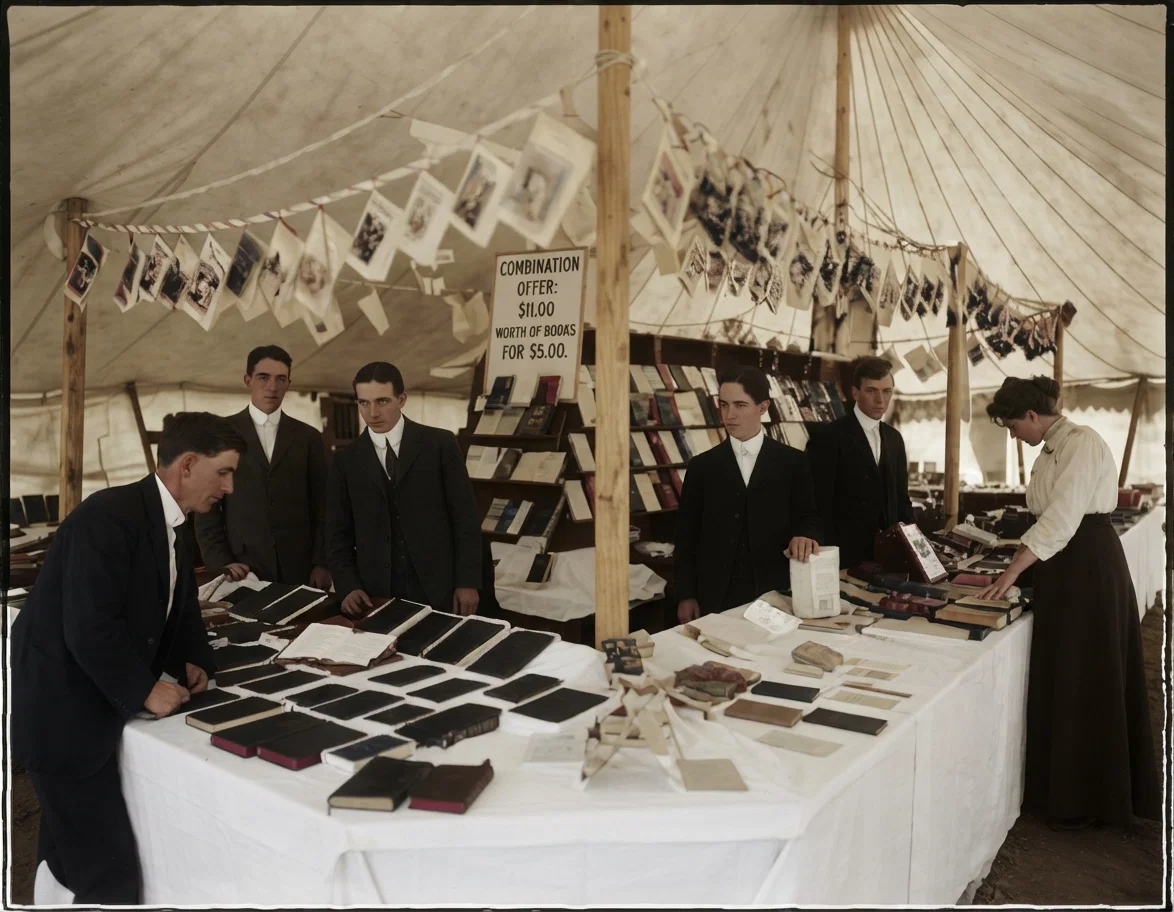
UPON arrival at the camp-ground in Minnesota, one's attention was first attracted by the splendid array of literature in the book-tent, which stood just at the entrance of the grounds. Brother H. R. Gay, the tract society secretary, and his associates spared no pains in their efforts to make a display of books and magazines that would be attractive. The accompanying cut gives a partial view of this display.
BOOK-TENT, MINNESOTA CAMP-MEETING
One of the special features of the sales was a combination offer of several of our large books at a reduced price, which enabled our people to get eleven dollars' worth of books, retail value, for five dollars. This combination offer was advertised from the desk in the large tent, and a number of those present availed themselves of it.
The total sales of literature during the camp-meeting amounted to $1,025, a gain of about $200 over the previous year. It was good to see our brethren and sisters taking home quantities of literature to circulate among their friends and neighbors. May the blessing of God attend this seed sowing.
Earning Scholarships in Cuba
By Editor
Just before the close of the last term of school at the Seminary, Brother Henry Brown arrived in Washington en route for Spain. On reaching this city and learning of the advantages of the Seminary, he asked that his going to Spain might be postponed to enable him to take a year's work in the Seminary. This was granted, and Brother Brown went to Cuba to earn his scholarship. He writes as follows:—18
"We have all been doing well since arriving. The success which Brethren Shidler, Spicer, and Colthurst have had is indeed wonderful. The Lord has also blessed me. I have already delivered $125 (American currency) worth of books, and have been here less than a month. I have about $150 worth of orders that I can count on delivering."
The Lord is blessing in a special way those who have given themselves for service in the colporteur work in the needy mission fields. We shall be glad to hear from still others who are willing to go out and follow the example of these young men who have gone to Cuba.
Crimea
By D. Isaak
SEBASTOPOL.—Believing that a short report of our work in this city will be of interest to the readers of the REVIEW, I shall tell how it has developed.
Every reader, I believe, will know where the peninsula of Crimea is located; if not, it will be well to look it up. Every map of the world, of Europe, or of Russia has it. Here, in the years 1853-55, was fought a great battle. Then the Turk received help, but lost all property in Russia. Large monuments and forts are yet to be seen in Sebastopol as signs of that battle. This city is called a city of war. Not only are large battle-ships anchored and munitions stored here, but air-ships are now being used.
We are glad for the work the Lord is doing in Sebastopol. About four years ago we started our work here, and at present we have a good Russian church of seventy-two members. When I visited them last, about a month ago, fifteen arose requesting baptism. Others are continually being added, and we expect soon to have a hundred members here.
An earnest young Russian worker who attended the school in Friedensau, is doing excellent work. The Sabbath-school is in good order, and the lessons are well learned. Children and all love to come to the Sabbath-school and meeting. They are pleased to be enrolled with the Sabbath-schools of the people of God over the whole world. Our worker here has also started a young people's band, called Bible class, at which the older brethren are also attending, as we are not allowed to have young people's meetings. This church has already two young brethren in the work, one of whom is in far-off Siberia.
On Sunday morning, upon calling on some brethren who have started a bakery for the manufacture of unfermented bread,—called here bublike (a small circle-formed bread),—we passed by the two large barracks of the soldiers and sailors. Here our attention was called to the hundreds of holes in the walls of the sailors' buildings, which were made by the soldiers' bullets in the autumn of 1905, when the sailors were striking, and hundreds of them were killed. We also passed by the dark prison, where one of our young brethren is confined, under sentence for two years. May the Lord soon bring deliverance. D. ISAAK.
Field Notes
By Editor
FIVE persons were recently baptized at Dexter, Maine, by Elder A. J. Verrill.
A SABBATH-SCHOOL of fifteen members was recently organized at Columbia, S. C.
ELDER J. J. MARIETTA reports the baptism of four adults, who united with the Washington Court House (Ohio) church. Twelve members have been added to the Cleveland church.
ELDER E. B. HOPKINS reports the organization of a church of twelve members at Jefferson, Tex. During the last few weeks twenty new members have been added to the church at Dallas, as the result of a series of tent-meetings. Ten additions are reported from the Oplin church.
Christian Education
By H. R. Salisbury
Conducted by the Department of Education of the General Conference
H. R. SALISBURY - - - Secretary
The Educational Council at Loma Linda
THE annual meeting of the Department of Education of the General Conference was held this year at Loma Linda, Cal., from May 31 to June 6, the members present being those in charge of our union training-schools. The council was called at Loma Linda in order that those in charge of our advanced schools might get in closer touch with the work and workers of the College of Medical Evangelists, as the students attending that college are drawn largely from our schools, and the pre-medical course is given in these schools.
Four meetings were held each day, beginning at 6:30 A. M. and closing at 9:30 P. M. Those present were Frederick Griggs, president of Union College; Dr. W. A. Ruble, president of the College of Medical Evangelists; C. W. Irwin, president of the Pacific Union College; O. J. Graf, president of Emmanuel Missionary College; E. C. Kellogg, president of Walla Walla College; M. L. Andreasen, president of the Danish-Norwegian Seminary; G. E. Nord, principal of the Swedish Seminary; C. B. Hughes, principal of the Keene Academy; C. L. Stone, principal of the Graysville school; and the writer.
Aside from the members of the department mentioned above there were present at different times Pastors G. A. Irwin, E. E. Andross, W. C. White, J. A. Burden, C. Santee, R. S. Owen; Drs. Abbott and George; Professors Lucas, Price, and Robison. We enjoyed the presence of these brethren, and they were invited to join with us in our discussions.
The following are some of the resolutions of general interest which were passed during the meeting:—
Voted, That we express our appreciation of the excellent work done on the journal Christian Education, and that we approve of the plan outlined by the chairman for the enlarging of the Home department, believing that it will greatly advance the usefulness of the magazine, and increase its circulation.
Voted, That we reaffirm the vote taken at the Berrien Springs convention which provided that as a minimum two hours' work a day be required of each student.
Voted, That the college which has given fourteen years of preparatory work to the student entering the medical college, grant to him a degree of Bachelor of Arts at the completion of the third year of his medical course, upon recommendation of the faculty of the medical college.
Whereas, The College of Medical Evangelists has been established by the counsel of the spirit of prophecy for the training of physicians and medical evangelists; and—
Whereas, Our young men and women are in great danger of losing their faith in God's Word and their interest in the work of this message if subjected to the influences of medical schools where religious instruction is not a part of the curriculum, we therefore—
Recommend, To our young people who are contemplating the medical work, that they attend the College of Medical Evangelists rather than any other medical college; because we believe by so doing they will be much more efficiently prepared for the work in the great advent movement.
Recognizing the need for properly trained teachers, not only in our church-schools, but in our academies and colleges, we feel the necessity of strengthening our normal departments, and to this end suggest the following:—
1. That the director, and critic teachers in our normal departments shall have completed at least the advanced normal courses, and shall have had experience in teaching in our own church-schools.
2. That graduates from our normal departments be encouraged to begin their work in our church-schools rather than in academies or colleges.
3. That proper facilities for practise work be provided in connection with each normal department, and that our boards of management be urged to properly equip the practise school in the way of charts, maps, manual-training apparatus, and all other equipment necessary to successful school work, including agriculture.
4. That our church-school boards and officers of conferences be urged to pay a sufficient wage to our church-school teachers to warrant them in securing normal training for their work.
We recommend, 1. That to secure uniformity in our work, all academies not operating as union conference training-schools, and desiring to carry work above the tenth grade, shall do so only upon the advice and counsel of the union conference committee together with the Department of Education of the General Conference; and—
2. That our academies shall be protected in securing their attendance by the union conference schools not accepting non-resident pupils below the eleventh grade without a mutual understanding between the union conference school and the officers of the conference in which the academy is located.
Two entire sessions were occupied in discussing the best means of training more Bible workers for our schools, and how our schools can send a greater number of ministers and Bible workers into the field. A committee was appointed to give this matter careful consideration, and report at an early date. Many other important subjects which have to do with increasing the efficiency of our schools were discussed, and plans laid for the carrying out of the resolutions.
Evening after the Sabbath the faculty and students of the medical college gave a reception to the visiting delegates. We were glad of this opportunity to get better acquainted with the doctors, medical students, and nurses, and a most profitable evening was spent. We greatly appreciated the hospitality of the Loma Linda Sanitarium shown us during our stay in their midst.
Gospel Workers' Department
By A. G. Daniells
Their divine calling, qualification, and preparation. Methods of labor, plans, etc.
Conducted by A. G. DANIELLS
The Importance of the Gospel Ministry
Some Valuable Quotations
THE quotations given this week relate to the very important and responsible place the ministry occupies in the gospel plan of salvation. Ministers are Christ's "ambassadors," "stewards of the mysteries of God."
Ideals
"Ideals are inspirations, incentives to effort, calls to come up higher. They fill us with a blessed discontent of the past, and stir us with an eager longing to do better things. They make a dead level impossible in any calling. Of all men, the man in the ministry is the one who should have ideals. The ideal 'consecration,' the ideal 'life,' the ideal 'stewardship,' the ideal 'church,' the ideal 'kingdom,'—he can tolerate nothing less than these. They are set before him by his Lord.
"For the attainment of these God-appointed ideals, one of the God-appointed means, and the chief, is the ministry of the word of God by the man of God. And in the prosecution of this ministry, the ideals of it we hang up in our sky, if worthy, though they may shame our past, will nevertheless prove incentives to higher things. So that idealizing in the ministry is not theorizing, nor ballooning, nor getting lost in the clouds. It is lifting a standard."—The Ideal Ministry, by Herrick Johnson, D. D., page 7.
Ministers Are Christ's Ambassadors
"Since his ascension Christ has carried forward his work on the earth by chosen ambassadors, through whom he speaks to the children of men, and ministers to their needs. The great Head of the church superintends his work through the instrumentality of men ordained by God to act as his representatives.
"The position of those who have been called of God to labor in word and doctrine for the upbuilding of his church, is one of grave responsibility. In Christ's stead they are to beseech men and women to be reconciled to God; and they can fulfil their mission only as they receive wisdom and power from above. Christ's ministers are the spiritual guardians of the people entrusted to their care. . . .
"The minister who is a coworker with Christ will have a deep sense of the sacredness of his work, and of the toil and sacrifice required to perform it successfully. He does not study his own ease or convenience. He is forgetful of self. In his search for the lost sheep19he does not realize that he himself is weary, cold, and hungry. He has but one object in view—the saving of the lost."—The Acts of the Apostles, pages 360, 362.
The Exalted Work of the Ministry
"Jesus had called his disciples that he might send them forth as his witnesses, to declare to the world what they had seen and heard of him. Their office was the most important to which human beings had ever been called, and was second only to that of Christ himself. They were to be workers together with God for the saving of the world. As in the Old Testament the twelve patriarchs stand as representatives of Israel, so the twelve apostles were to stand as representatives of the gospel church."—Desire of Ages, page 291.
"I have often said that no monarch’s throne and no presidential chair is so exalted as a pulpit in which a living preacher presents a living Christ to dying souls."—The Young Preacher, by Theodore L. Cuyler, page 3.
"In every calling there must be belief in its great value before there can be intense ardor in its prosecution. It is not in the nature of mind to be stirred deeply by what it deems a trifle. Patriots are not born of low ideals. The things for which a man is willing to die are great things to him. The poet thinks no other art like his; he calls it divine. So, too, the painter and the sculptor; they have exalted conceptions of their work. Hence they come to their canvas and marble all aglow, with an enthusiasm that burns within them. And the canvas and the marble catch their spirit, and glow and breathe and speak under their touch. If an artist thinks meanly of his art, it will be mean art that is born in his studio. So, a conception of the gospel ministry as merely a respectable means of livelihood—a kind of bread-and-butter conception—will beget a tame ministry. If it is thought to be godlike, the godlike will appear in the heavenly doing.
"It behooves us, therefore, at the very outset of our discussion, to inquire what those vital features of the gospel ministry are that set it apart from every other ministry, and that stamp it as superior to every other ministry. And if we find there are such features, then to grasp these several ideas, to weigh them, and to come under the spell of their charm and power so that they shall cease to be mere intellectual beliefs, and become vitalized spiritual forces, is to be on the sure road to an ideal gospel ministry.
"What, then, are those ideas, unique and matchless, transcendent in their worth and of eternal consequence, that give the gospel ministry its peculiar glory and sanctity? They are: Its permanent function, its supreme aim, its ruling spirit, its subject-matter, its preeminent business, its central theme, its eternal sanctions, and its cooperating agent.
"The ambassadors of Christ who have hitherto come nearest to an ideal gospel ministry have been stirred the most mightily by these ideas. This has been the characteristic mark of their stewardship. They have widely differed in many respects—physically, intellectually, temperamentally, emotionally. The giants in Israel that have done great things for God—that have had a wide hearing and multiplied victories—have not all been intellectual giants. Some have been distinguished for wide scholarly research; some have had a soaring imagination; some have been logic on fire; some have been signally endowed with sanctified common sense. . . .
"But these all, and a multitude more of winners and builders of souls, were alike in this: they intensely believed in, and were supremely dominated by, the several ideas that are here named as stamping and distinguishing the ideal gospel ministry."—The Ideal Ministry, by Herrick Johnson, pages 13-15.
"A preacher may not be a great man, but he must preach great matters. His pronouncement is sublime. The little child who holds a geography in his hands holds a geography of a whole round world. He is a lad; but the geography is a planetary concern. Initial to any dignified preachment, is the sense of its sheer immensity. To sail a toy boat on a puddle is quite a different employment from sailing a toy ship on an ocean. To some men preaching is sailing on a puddle. To such men, need it be said, preaching is a childish performance. A big man at a trivial task is ridiculous. Except a gospel be voluminous as an ocean, to preach is a petty employment. A stupendous gospel makes its proclamation a regal performance. . . .
"The lure of the gospel is the lure not of wages, not of leisure, not of prestige, but the lure of things to be done, which, if not undone, this world would be left a wreck along the shores of the universe. If the gospel be not utterly necessary, it is utterly unnecessary. There is no halfway permission or commission to this Christ apostolate. Man is so great and so lost in the theory of Jesus as to lift all that touches him into the supreme passion of the world.
"Unless a man feels this like the hack of a sword or the fierce jab of a spear, he must not preach. He is not big enough to preach to whom this gospel is not supremely great. Except a man’s ministry be momentous, he himself is trivial.
"What think you, preacher, is your task sublime? Does it summon a strange enthusiasm to dawn and noon like glorious Mt. Tacoma of the Pacific Sea? If not, then you have missed your task. Let go. You will with dull certainty fumble a task whose magnitude you can not appreciate nor approximate. Men so little as to think the gospel lean must not undertake to preach it."—The Pastor Preacher, by Wm. A. Quayle, pages 17-19.
Luther’s Estimate of the Ministry
"There is no more precious treasure nor nobler thing upon the earth and in this life than a true and faithful parson and preacher. The spiritual preacher increaseth the kingdom of God, filleth heaven with saints, plundereth hell, guardeth men against death, putteth a stop to sin, instructeth the world, consoleth every man according to his condition, preserveth peace and unity, traineth young people excellently, planteth all kinds of virtue in the nation; in short, he createth a new world, and buildeth a house that shall not pass away."—The Work of Preaching, by A. S. Hoyt.