News Items: Railway, Queen, Ambassador, and Rubber
Page 2
The Youth’s Instructor
Apr 18, 1916
Review and Herald Publishing Assn. · Takoma Park Station, Washington, D. C. · Apr 18, 1916
News Items: Railway, Queen, Ambassador, and Rubber
CHICAGO'S new railway station is to cost $60,000,000.
CARMEN SYLVA, Dowager Queen Elizabeth of Roumania, recently died.
CHARACTER is higher than intellect. . . . A great soul will be strong to live, as well as to think.—Emerson.
DAVID R. FRANCIS, who was Secretary of the Interior in Cleveland's Cabinet and former governor of Missouri, has accepted the post of ambassador to Russia, to succeed George T. Marye, who has resigned.
TWO hundred and fifty men at the University of Virginia report that they have earned $88,892 toward their education, or an average of $352 for each student. They earned $47,840 before entering the university, and $41,052 after.
IN States where the prohibition question is to be voted on in the fall, why not follow the example of one brother who purchased twenty copies of the TEMPERANCE INSTRUCTOR ANNUAL, gave each of twenty friends a copy, urged each “to read the paper, give it away, and then to talk.”
RUSSIA is said to have solved two of her most pressing problems, the disposal of 140,000,000 gallons of vodka stored up since the decree forbidding its use, and the obtaining of rubber, by putting them together in the hands of scientists. The Russian-American Journal of Commerce says that, as a result, for the first time a practical method of making synthetic rubber has been worked out.
MR. JOHN BURROUGHS, the author-naturalist recently visited Washington. He spent ten years of his young manhood as a government clerk in the national capital. He was employed in the Treasury, and he wrote his first book during his spare moments while in charge of the Treasury vault. It is interesting to note that he once grew cabbage, turnips, potatoes, etc., on the spot where the Senate Office Building now stands.
THROUGH the operation of rigid quarantine regulations and by the muzzling of dogs, England has been able completely to stamp out rabies. What is declared to be the first case since 1902 occurred recently in a dog that was being held in a six months' quarantine, which the English law imposes on all canine pets brought into the country. It is said that Australia and New Zealand have never had any cases of rabies. Sweden, Norway, and Denmark are practically free from the disease.
DR. WILLIAM HOWARD DOANE (1832-1915) died in South Orange, N. J., on Dec. 23, 1915. He is well known as a writer of hymns, the most successful perhaps being “Safe in the Arms of Jesus.” It was through Dr. Doane that Ira D. Sankey was won to evangelism, and his own most effective work as an evangelist hymn writer was done for Moody and Sankey. Some of his other hymns are “Draw Me Nearer,” “Rescue the Perishing,” “Tell Me the Old, Old Story,” “Nearer the Cross,” and “Saviour, More than Life.” Many of his hymns were written in collaboration with Miss Fanny Crosby. Their last hymn, “At Eventime Let There be Light,” was completed shortly before his death.
This Toy Takes Itself Seriously!
By Russell Lough
FROM Boot to Ravenglass, in West Cumberland, England, is a new toy railroad which has just reached completion. The gauge is but fifteen inches, the size of track that appears in nearly all our American amusement parks, and the engine and whole train are so tiny that when they are working full-passenger capacity, it would seem that one strong man could pull the combination behind him with a piece of cord, and not exert himself particularly.
This railway, however, will not allow itself to be the object of laughter. It is there for a serious purpose. It traverses seven miles of mountains and glens, the garden spot of the Cumberland, in which a regular railroad would seem a sacrilege against nature. Here and there along the right of way, small open spaces come into view. These are the characteristic, well-groomed little-residence communities of western England, and from these the small railroad gets its patronage of sleek, well-groomed English landlords, who only occasionally find travel necessary in the course of their well-ordered lives.—Russell Lough, in Illustrated World.
How Alaska Got Its Name
By Frank Carpenter
THE territory before it was purchased by the United States was known as Russian America. All kinds of ridiculous titles were suggested for its new name. One was “The Zero Islands;” another, “Andy Johnson’s Polar Bear Garden;” and a third, “Walrus-sia.” The treaty was called the polar bear treaty, and the Senators who favored it were dubbed the Eskimo Senators. The name Alaska was finally chosen at the instance of Charles Sumner, who said that it was the title which the natives used, and which, translated, means “The Great Mainland.” — Frank Carpenter.
Lincoln Scattering a Shower
By R. B. Hassell
If I were to paint a picture of Lincoln, I would call my picture “Lincoln Scattering an April Shower.” It would be of that morning in Springfield when he saw the girl standing in the open door crying. He learned that the baggageman had forgotten to come for her trunk, and she was likely to miss her train. He quickly shouldered the trunk and strode off with giant steps to the depot. There might not be much dignity in the picture, but there would be lots of heart.—R. B. Hassell.
For Right Is Right, Since God Is God
By F. W. Faber
For right is right, since God is God,
And right the day must win;
To doubt would be disloyalty,
To falter would be sin.
—F. W. Faber.
The Awakening Year
By George Taggart
ARBUTUS, anemone, spring beauty, and violet—
Loveliness on every hand now the wakening days beget;
Sweetest fragrance, hope, and cheer to us all the flowers bring;
Glad the earth, reclaimed, revived; God is seen in everything.
Bluebird, robin, martin, too, voicing brightest roundelays;
Feathered hosts in myriads hail the dawn of golden days.
Sweet their songs of promise true for new blessings pure and rare,
Spreading tidings of God's love here and there and everywhere.
April's showers, May's sweet flowers,—harbingers of brighter days,—
June, July, and August coming, with the summer's glow ablaze.
All the world's a temple fair, wherein men their hymns upraise
To the God whose gifts are free for our simple faith and praise.
—George Taggart, in the Christian Herald.
Booker T. Washington’s Successor
By Matilda Erickson
MATILDA ERICKSON
The great work that Booker T. Washington inaugurated, Maj. Robert Russa Moton has been called to solidify and conserve. That he is deemed well fitted for the place is evinced in a letter written to him by President Wilson. It reads:—
“My Dear Principal Moton:—
“I am sure I am giving voice to the feeling of the vast majority of those interested in education in this country, and particularly in the education of the Negro, when I express my gratification at your election as principal of Tuskegee Institute. I have known something of the special work you have been trying to do for the people of your race and of the spirit in which you have undertaken it, and I believe that your selection as the head of the Tuskegee Institute means the promotion there of the best, most practical, and most hopeful ideals for the development of the Negro people. I take pleasure in extending to you my sincere congratulations.
Very truly yours,
“Woodrow Wilson.”
A warm friendship existed between the former leader and his successor, and it is probable, had it been Washington’s privilege to choose the hands that should clasp the reins that were falling from his own, that he would have named the man who has been called to fill the vacancy.
Booker Washington once said, “Moton is one of the best-read men and one of the most interesting men to talk with I have ever met. Education has not spoiled him. It has not embittered or narrowed him in his affections. He has not learned to hate or distrust any class of people, and he is just as ready to assist and show kindness to a white man as to a black man, to a Southerner as to a Northerner.”
Major Moton is the descendant of an African chief, and of pure Negro stock. His first American ancestor was brought from the West Coast of Africa in 1735, and was sold to a planter in Virginia. In this same State, Major Moton was born Aug. 26, 1867. His father was foreman of a large plantation, and his mother the cook of the household. With his mother’s help he learned to read. Later one of the daughters of the planter taught him for one hour a day. For a time he remained in the family as house boy, and “he considers what he learned under their tutelage as one of his best inheritances.”
In 1885 young Moton, who had already become quite a leader among his Negro friends, entered Hampton to take a regular course of study. He was graduated in 1890. For a time he thought of studying law, but soon was employed as a teacher in Hampton, where, with the exception of a few vacations, he has been working constantly up to the time of his recent call to Tuskegee.
“He has been for more than twenty years the commandant of cadets and disciplinarian at Hampton Institute, directly assisting Dr. Frissell, and has had every sort of administrative problem to meet, with both Negro and Indian students. To him also have fallen many of those delicate adjustments in the relationships of the white and Negro races around which center the most difficult problems in Southern life.”
Thus for years the new leader has been preparing, all unconsciously, for the important post awaiting him. While he is not considered so magnetic as Washington, “he is a strong and able speaker and a strong, sensible, and tactful man.” In 1912 he founded the Negro Organization Society of Virginia, which has greatly improved sanitary, agricultural, educational, and moral conditions among at least fifty per cent of Virginia Negroes.
But it is his policy for Tuskegee that interests us most. Ray Stannard Baker says, “Three principles underlie all Major Moton’s advice to his people, and will indicate the nature of the program he will advocate for Tuskegee:—
“First, the Negro must develop a strong racial consciousness. Concerning this, he [Major Moton] says, ‘Having demonstrated that his faculties and susceptibilities are capable of the highest development, it must be true of the black race, as it has been true of other races, that it must go through the same process and work out the same problems in about the same way as other races have done.
‘Let us not deceive ourselves, blighted as we are with a heritage of moral leprosy from our past history, and hard pressed as we are in the economic world by foreign immigrants and by native prejudice; our one surest haven of refuge is in ourselves; our one safest means of advance is our implicit trust in our own ability and worth. No race that despises itself, that laughs at and ridicules itself, that wishes to God it were anything else but itself, can ever be a great4people. There is no power under heaven that can stop the onward march of ten millions of earnest, honest, inspired, God-fearing, race-loving, and united people.’
“Second, the Negro must have a high moral ideal. He says, ‘It is no reproach to a Negro to say that his history and environment in this country have well-nigh placed him at the bottom of the moral scale. This must be remedied if the Negro is ever to reach the full status of civilized manhood and womanhood.
‘We must be united to stop the ravages of disease among our people, united to keep black boys from idleness, vice, gambling, and crime; united to guard the purity of black womanhood, and, I might say, black manhood also. It is not enough simply to protest that ninety-five out of every hundred Negroes are orderly and law-abiding. The ninety-five must be banded together to restrain and suppress the vicious five.’
“Third, the Negro needs intelligent industry. He says, ‘We must not be misled by high-sounding phrases as to the kind of education the race should receive, but we should remember that the education of a people should be conditioned upon their capacity, social environment, and the probable life which they will lead in the immediate future. If the Negro will add his proportionate contribution to the economic aspect of the world’s civilization, it must be done through intelligent, well-directed, conscientious, skilled industry.
‘God has given the Negro here in this Southern country two of the most fundamental necessities in his development—land and labor. If you don’t possess this land and hold this labor, God will tell you, as he has often told other races, to move on.’”
Booker Washington found that the mass of the Negroes of the South held in their hands a great gift that they knew not how to use. That gift was the freedom which the Civil War bequeathed to them. They were clamoring for the highest intellectual attainments, apparently regardless of their present unfitness, and seemingly without any thought of increasing their own usefulness. But Washington taught the dignity of labor and the importance of “catching up with their conferred rights,” and through his years of successful leadership in Tuskegee he succeeded in developing a system of practical education that gave to the world skilled and independent workmen, strong and useful citizens.
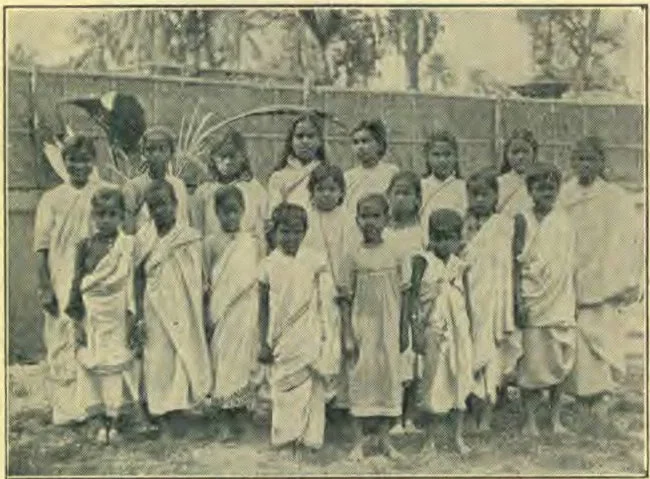
Seventh-day Adventist girls of our boarding school
It becomes the duty of the successor in this great movement not to establish for Tuskegee a reputation, but to preserve it; to extend its influence, to increase its usefulness, and to keep alive the principles for which it stands.
A Letter from India
By Della Burroway
DEAR YOUNG PEOPLE: For many years we have wanted to open a school for our Seventh-day Adventist Bengali girls. At last our wish is realized. Many of our girls have been lost to us because of the prevailing custom of child marriage, and the inferior position of Indian wives.
Calcutta girls' school building
Almost without exception, when our girls reached the age of twelve or thirteen they were given in marriage by the parents; and often when a suitable Seventh-day Adventist young man was not to be obtained, the girl would be given in marriage to one who would not permit her to keep the Sabbath. The parents did this because, being poor, they felt they could not support a growing girl when there were several younger children in the home.
We have realized that the only way to save these girls would be to open a school where they could be educated for the work. In the boarding school, we have eighteen ranging in age from six to eighteen years, also thirty-four Hindu and Christian day scholars, making a school of fifty-two.
One little widow has been given over to us to train and keep for the work. Some of the girls came from homes where the parents were too poor to furnish necessary clothing. One girl came to us wearing a bit of torn cloth scarcely large enough to cover her body.
The garments for our Indian girls made by the children of Oregon are surely proving a blessing. They are supplying poor children of two schools with clothes.
Notwithstanding the extreme poverty of some of the children, and the fact that most of them have never been in school, they have bright minds and can learn readily. Although we have had them but one month, they have committed John 3:16, Psalms 23 and 103:8, 13, and the Lord’s Prayer, and are now learning the ten commandments.
Dear young people, pray for your little Bengali Indian sisters, that God may use them in helping finish the work. DELLA BURROWAY.
Calcutta.
Experiences at Sea
By N. Z. Town
IN the year 1895, as I was returning to England from the General Conference, about six o’clock one morning, while most of the passengers were still in their cabins, we suddenly felt our ship shake as if it were scraping over a rough cobblestone road. We soon learned the cause. A man from the steerage had jumped overboard. The officer on the bridge5saw him. He gave orders to reverse the engines, and running to the stern of the boat, he mounted another bridge and jumped in after the man. He succeeded in getting to him, and held him up until a boat was lowered. For this act of bravery the officer received a purse of sixty pounds sterling from the first-class passengers.
The ship that signaled for help
In October, 1910, I took a boat in Barcelona, Spain, for Brazil and Argentina. The second day out from Barcelona, about 1 P. M., as we were sailing down the Mediterranean, with beautiful weather and a perfectly smooth sea, suddenly we heard the cry, “Un hombre en el agua!” (A man overboard.) Women wrung their hands, some of the men wept, and there was general excitement. The ship stopped, a boat was lowered as quickly as possible, manned with eight men, who put off to look for the unfortunate man. For nearly an hour we circled around and looked, until finally the man was discovered and picked up. But the rescue was too late; he was already dead.
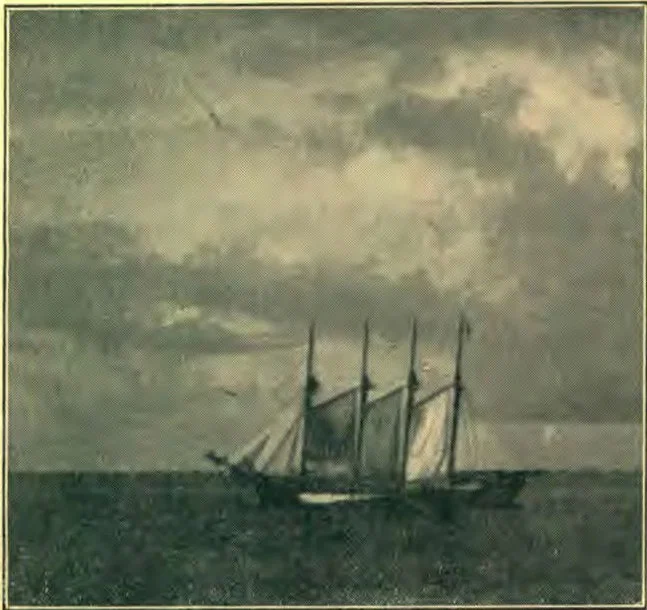
On our recent trip to South America no one jumped or fell overboard, but the fifth day out from New York, about six o’clock in the morning, when the engines stopped we knew that something out of the ordinary had happened. As we rushed up on deck to learn what it was, we saw on our port side not very far away a four-masted sailing ship lying to, and talking with our ship. When the officers of our ship first sighted her, she flashed to them a signal of distress. So our captain gave orders to slow down and see what was needed. It was soon learned that they were asking for a doctor. As soon as this word was received, our ship stopped, a boat was lowered, and our doctor was taken off to give help if he could.
When the doctor returned, he reported that the sailing vessel was already thirty-two days out from Philadelphia, bound for Rosario, Argentina. About two weeks before we sighted her, she encountered very severe gales, during which one man had a leg broken, another an arm, and a third “had his ribs stove in.” The poor men had been suffering for two weeks with no one to set their broken bones. Then, too, their boat was leaking and filling with water at the rate of six inches an hour. The doctor did what he could to relieve them, and they decided to put into Porto Rico for further repairs.
When I asked our captain if there was any written law which governs in the matter of helping ships in distress, he replied, “Only the law of sympathy and kindness in the heart.”
What a blessing that sympathy for those in distress or danger has not altogether been eradicated from the hearts of men! And how should we, who see the danger of a perishing world, be stimulated to go out of our course or relinquish our own time or cherished plans, if thereby we can help one soul in need!
N. Z. TOWN.
Be Sure Your Sin Will Find You Out
By H. L. Tolhurst
BOHAHAU is a brown-skinned boy of eighteen years, a native of the Tonga, or Friendly, Islands, in the South Pacific. He lives at the mission station, and, with a number of other boys, works for his tuition. As one of his brothers is a baptized believer, Bohahau has for years been in contact with the truth of the Bible. But being a wild, careless lad he paid but little attention to spiritual things. After coming to live on the mission farm, however, a change could be seen working in his life, and he settled down in sober earnest to his lessons. He was faithful in the execution of every duty, while his efforts to learn English certainly deserved success. After a time tobacco and unclean foods were “rejected,” to use his own expression. He was the first of our boys to request baptism, and we entertained high hopes on his behalf.
But one Sabbath recently this boy, after taking the mission horse for a drink, entered a native house where a number of Tongans were assembled. A young woman present offered him a cigarette. According to Tongan custom, to refuse it is an insult, and is considered an indication of hatred, or at least of an unfriendly attitude. This evil custom is a great temptation to the young men, and on this occasion it proved too much for the one in question. He hesitated; he yielded. Leaving the scene of defeat, he immediately turned his footsteps toward the mission, feeling ill at ease and under condemnation for the part he had acted, yet hoping to keep the matter a secret.
Meanwhile, some of the boys were in their native houses on the mission property, smoking or chewing tobacco, in violation of the regulations. Being informed of this, I made investigation, testing the breath of each. Just as this piece of unpleasant work was finished, and those found guilty were being reproved, our friend Bohahau entered the house where we were. Imagine his surprise on being promptly challenged and invited to submit to the same test the others had undergone! Of course, the telltale smell of tobacco was there, though in his surprise and confusion he allowed one sin to lead him into another, and at once denied having used it.
A little later a very repentant Tongan boy came to make a confession. How swift had been detection in his case! I believe the Lord thus ordered it, that the lad might receive help just where and when it was needed, and thus be saved from drifting into a dangerous course of action. He himself shared this opinion, and the turn events had taken impressed him greatly. He was advised to avoid the particular temptation that had so easily overcome him. It was the native custom, and not the tobacco, that gained a victory on this occasion. We hope he will benefit from this experience, and realize that nothing is hidden from God, though it may be possible to deceive our fellow men.
H. L. TOLHURST.
Haapai, Tonga.
The Meaning of Christianity
“THE moral ideal in Christianity is incomparably higher than it is in any other religion, pitifully short as Christian countries come of realizing it. But the peculiar difference that separates Christianity from all other religions lies elsewhere. The other faiths say that religion consists in doing something for God; Christianity is God’s offer to do something for man. Christianity says that God wants nothing from man except for man to receive what God longs to give. Christianity says that the only possible thing a man can do for God is to do something for his fellow men.”
“I wish I could understand what you mean when you say that God offers to help us,” said Tom earnestly.
Dr. Brown pondered a moment before replying.
“Suppose I should say to you (and you knew I was telling you the exact truth) that Jesus of Nazareth had returned to this world just as he was in Palestine nineteen hundred years ago, with the same human sympathy and tenderness, the same unbounded love for each individual, and the same wisdom and power that he showed then. Suppose you were borne down by some terrible burden,—some worry or anxiety or disappointment or weakness or fear,—and suppose I should tell you that you could go into yonder room and tell him all about it, and that he would put all his sympathy at your disposal and apply all his power to your relief. Suppose I should say that if you did as he told you, he would go with you everywhere and always be at hand ready to help you through your difficulties. How would all that affect you?”
“Why,” said Tom, “I’d rather get into that room than do anything I ever thought of doing!”
“I am sure you would,” said the doctor. “But what I have said is about as near to the fact, as the New Testament declares it, as words can come. Hundreds of thousands of the best and purest and noblest of the race have borne their testimony that that has been their experience. They have been certain that God in Christ has been with them; that he has given them unspeakable help and comfort and inspiration; that they never could have done what they have done unless he had been with them. Even if you yourself have not yet had that experience, you cannot ignore the multitudes that no man can number who have had it. That is the unique thing about Christianity. That is what the New Testament says Christ is always offering to give.”—Youth’s Companion.
Only a Stud
By H. M. Sparrow
A FEW weeks ago I tidied my room, and in doing so, found a dozen or more small bone studs. My first thought was to dispose of them by use of the refuse box. Suddenly it came to my mind to call one of the boys and ask if he could make use of them. With this in mind I went out, looked around, and saw Philip, one of our head teachers, coming from the direction of the river.
“Philip,” I said, “come to my window.”
When he reached the window, I handed him the studs.
“O, teacher,” he said, “can it be possible that God has seen my need? I’ve just come from the river. This old stud you see is one Alfred (also a head teacher) found by the river that some one else had dropped, and I begged him for it, as I lost my last one yesterday.”
A few seconds later I thought he had gone, so I opened my window to see, and there was Philip standing beside the wall.
“Philip,” I said, “what is the matter?”
“O teacher, I’m only thanking my Father for the care he has for his children.”
Was not God’s hand in this little incident?
H. M. SPARROW.
Somabula Mission.
Don't be a Mummy
By Claude E. Holmes
Moses was once on the way to the royal cemetery of Theban-hill mummies, but he changed his path toward the wilderness, that he might live with the wandering children of God. Had he not made that decision, and cast off the purple vestments of Egyptian glory, we might today look upon his mummy in some museum.
That choice was made through a knowledge of the true education. There were two paths which appeared before the mind of Moses. The distance between them may not have seemed far while he viewed them, but as time went by Moses found that they were as far apart as heaven and earth. For now he is in heaven, and his royal successor a mummy on earth.
You are making decisions today which will be as far-reaching in their results as was the result of Moses’ decision. Look for the teacher that will guide you the way Moses was led by his mother.
When you begin your school work, my young friend, do not “keep back part of the price,” but make all your efforts count. Throw your strength into getting something definite and eternal.
A little of the right kind of training will do wonders. Do you know that mosquitoes stopped the French nation from digging the Panama Canal? The mosquitoes did not succeed in doing that with the United States. Why?—Because an energetic man ferreted out the cause. Maybe it is some little thing that is keeping you from having success in clearing up the King’s highway. Investigate. Talk with some of our faithful teachers; possibly they can discover your difficulty. Have you ever consulted them?
CLAUDE E. HOLMES.
Possible Immunity from Cancer
THE Rockefeller Institute announces through the Academy of Science at Washington a discovery by two of its investigators whereby immunity from cancer, it is hoped, may be obtained. The investigation was conducted by Drs. James B. Murphy and John J. Morton over a period of two years.
They discovered that in the white lymph cells of the blood there are necessary factors in making animals immune from cancer. A decided increase of the white lymph cells gives absolute immunity, the physicians declare they ascertained. The investigators treated several mice with a serum of lymphoid tissue, and say the number of white lymph cells in the animals almost doubled within a few days. The increase of the cells can either be natural or through the injection of lymph tissue. It was found also that two kinds of animals and humans were immune from cancer—those naturally immune and those in whom immunity was induced through the previous injection of the lymph tissue.
It must be remembered that this investigation is yet in its infancy, and that still the only hope for cancer sufferers (and it is a good hope) is in very prompt surgical treatment.—Christian Endeavor World.
Missionary Volunteer Society Programs for Week Ending April 29
The programs for the Missionary Volunteer Societies, Senior and Junior, for this date, with notes, illustrations, and other helpful material, will be found in the Church Officers' Gazette for April.