The Youth’s Instructor, Vol. 64, No. 16.

News Items: Railway, Queen, Ambassador, and Rubber
Earlier text: News Items: Railway, Queen, Ambassador, and Rubber

The Northern Latin American Mission

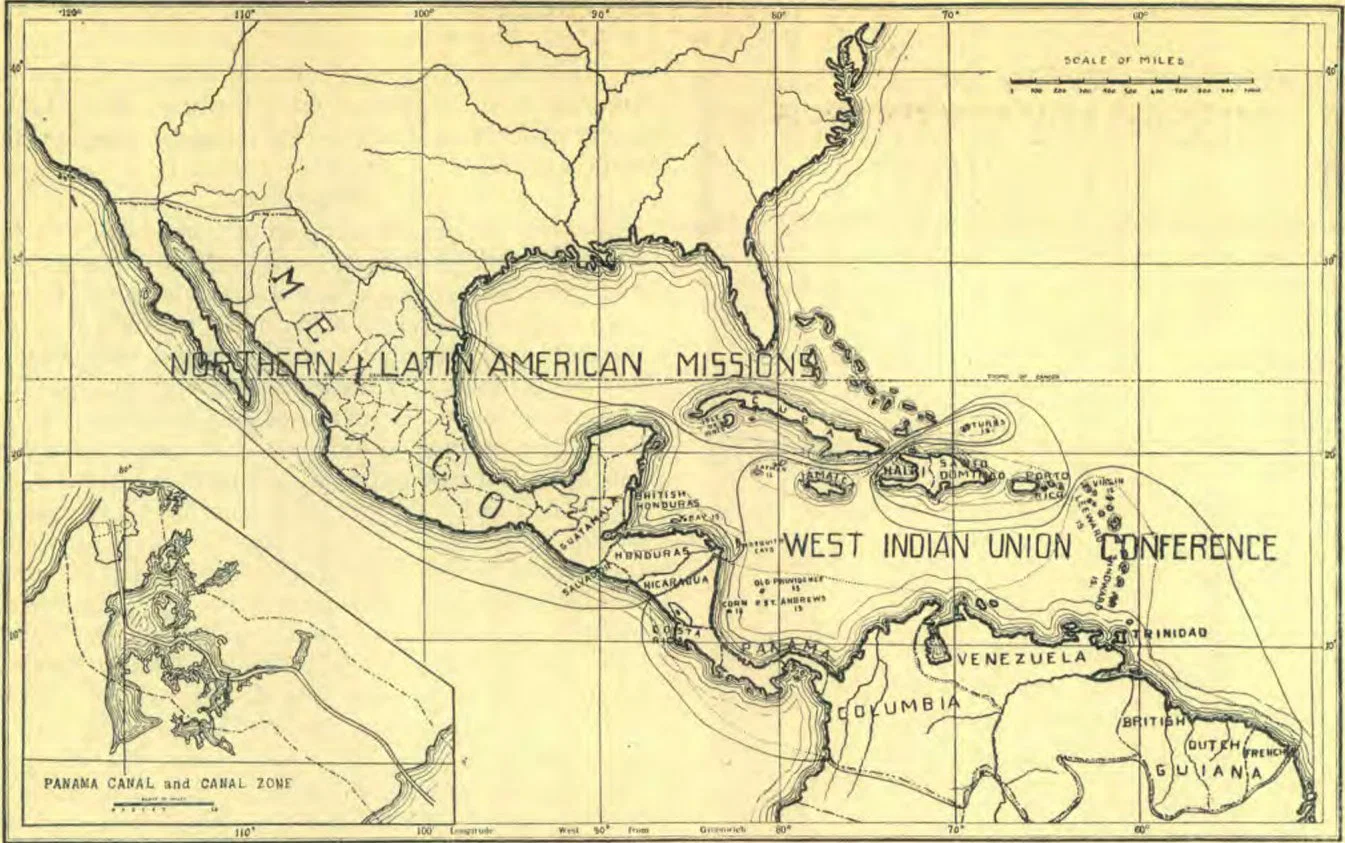
THIS Spanish mission field, lying just to the south of the United States, since the last General Conference has been organized into a separate mission group, largely because of its one common language, the Spanish. A portion of its territory was released by the West Indian Union, while Mexico, a separate mission, has been added. The field now includes Mexico, Guatemala, Honduras, Salvador, Cuba, Haiti, and Porto Rico. This field, at the request of the different missions comprising it, was placed under General Conference direction; and Elder N. Z. Town, who has spent years in South America, and is familiar with the Spanish language, was asked to take the general supervision.
The population of this group is 25,000,000. The territory lies between 30° and 13° north latitude, and between 65° and 92° west longitude, bringing the field well into the semitropical climate, the heat being governed largely by altitudes. That portion of this mission territory lying farthest south in Central America is in a general way, because of its tablelands, about as livable as the islands lying to the north.

Mexico

The republic of Mexico, lying immediately to the south of the United States, with which it has a common border of 1,500 miles, contains an area of 767,000 square miles. Its length from north to south is about 2,000 miles. The inhabitants in the last census numbered 15,000,000. Of these about twenty per cent are pure white, forty per cent mixed, and forty per cent Indian. The Catholic Church has had almost complete control for four hundred years, and such has been her course that very few of the people have any respect for the church. There is a sort of latent superstitious regard for the church buildings and the church rites, but there is really no heart religion, nor confidence one in another. It is the lack of this confidence that is at the root of all the troubles in Mexico. Among the leaders, each one desires to rule, and is afraid to trust any one else. It would seem that if Rome had desired to uplift the people, she has had a splendid opportunity; but after all this time, seventy-five or eighty per cent of the people can neither read nor write. If they could be educated and given fair and honest treatment, there is no reason why the Mexican people might not take rank with any other people of the world. But no nation that has been under Rome has ever advanced very rapidly in true civilization and culture.
As to the climate, I will let another speak:—
“We are accustomed to consider Mexico as lying entirely south of the United States, and as entirely hot and tropical; but nearly one half of the area is north of the southernmost points of the United States. Furthermore, one half of its area, even much of that extending into the tropics, is cool and temperate.
“Mexico lies at the meeting place of two zones, the temperate and the torrid; and from its geographical position, combined with its varying altitudes, possesses a greater variety of soil, surface, and vegetation than any equal extent of contiguous territory in the world. Basking in the sunshine of the tropics, her head pillowed in the lap of the North, her feet resting at the gateway of the continents, her snowy bosom rising to the clouds, she rests serene in the majesty of her might. She guards vast treasures of gold and silver, emeralds and opals adorn her brow, while the hem of her royal robe, dipped in the seas of two hemispheres, is embroidered with pearls and the riches of ocean.
“Mother of Western civilization! cradle of the American race! a thousand years have been gathered into the sheaf of time since her first cities were built. When the Norsemen coasted our northern shores, she had towns and villages, and white-walled temples and palaces. When the Pilgrims landed on Plymouth Rock, a hundred years had already passed since the soldiers of Cortés had battled with the hosts of Montezuma. In no country in the world can you pass so rapidly from zone to zone,— from the blazing shores of the heated tropics to the region of perpetual winter, from the land of the palm and vine to that of the pine and lichen,— for in twelve hours this can be accomplished, and the traveler may ascend a snow peak with the sands of the shore still upon his shoes.”
The work of the message began in Mexico about twenty-five years ago, and although it has not made rapid advance, still there are now believers scattered from one end of the land to the other, with centers in the northern, central, and southern parts. For the last two years it has been almost impossible to travel in the country, and for that reason it has not been possible to visit the different companies. But word comes from nearly all of them that they are still faithful, and that in almost every place there are quite a number who are awaiting baptism. Even this year, in the midst of the many stupendous difficulties, the work is going forward. One brother sold over $900 (Mexican) worth of literature in the state of Yucatan during the month of January.
One of the most interesting and promising fields is in the southern part, in the state of Oaxaca. Here we have four or five companies of believers among the Zapotecan Indians. Statistics show that there are more than 500,000 of these people. They are religiously inclined and in many respects are in advance of other inhabitants of Mexico. It was from this tribe that the renowned President Juarez, who gave the country its present constitution and effected the separation of church and state, came. During the last year our only worker among these people was turned aside to the Millennial Dawn doctrine, so that at present there is no laborer for this part of the field. There is here an opening that ought to be filled. This section of the country has been in peace during all the trouble in other parts. The present year our canvassers made a short visit to this district, and labored with success.
Mexico is waiting and hoping for the cessation of the revolution, in order that the work may be carried forward. We are confident that from this land of darkness there will come many to have a part with us in the everlasting kingdom that is soon to be set up.

Guatemala

Guatemala is a republic, with an area of 48,290 square miles and a population of nearly 2,000,000. It extends from the Atlantic (or Caribbean Sea) to the Pacific, the latter having the much larger coast line. Mexico lies to the west and north, Salvador and Honduras to the east. The maximum length and breadth of the country is nearly the same, 250 miles. Its principal city is its capital, Guatemala City.
The aboriginal inhabitants were mostly agriculturists at the time of the Spanish invasion, and offered little resistance. They were put under subjection, and now their descendants outnumber those of the invaders by about twelve to one. Roman Catholicism is the prevailing religion, although Protestant missionaries are protected. Our work has gained a small foothold in the country, principally in Guatemala City.

Honduras

Honduras has been divided into a North Honduras Mission and a South Honduras Mission. What was a conference in the north (including British Honduras) was by their request turned back into a mission in 1915.
Honduras has a republican form of government, with 46,250 square miles and more than 700,000 inhabitants. Honduras, east of Guatemala, has a short line of Pacific Ocean coast, with a long one on the Caribbean Sea. It is sparsely inhabited for its size. Along its northern and eastern seacoast it is low and hot, while most of the interior is mountainous. The soil and climate on the upland plateaus favor stock raising, and the staple crops of the temperate zone are raised.
A large proportion of the native population is of mixed blood; there are also Spaniards and Indians of pure blood. The workers in Honduras are laboring to plant the seeds of Bible truth in the interior, pioneering by securing colporteurs to sow the field with gospel seed.

Salvador

This is the smallest of the Central American republics. It has an area of 7,225 square miles, with a population of more than 1,700,000. It lies directly south of the west portion of Honduras, its whole coast line of 139 miles bordering on the Pacific. It is very mountainous. Politically, as well as physically, the prevailing conditions may be described as volcanic, as the country has suffered greatly from revolutions. Salvador is the last republic in Central America to be entered with the third angel’s message, Brother and Sister John L. Brown having but recently settled there.

Cuba

Cuba is the largest island in the West Indies. It is separated from Florida, since the railroad connection was made with Key West, by only a little more than a night’s voyage. The island, with an area of 45,000 square miles (about the same as the State of Pennsylvania), is a place truly beautiful for situation. Cuba is 730 miles long, varying in width from 20 to 100 miles. Its harbors are good, most of them being well protected by land, around its 6,500 miles of coast line.
A mountain chain extends the entire length of the island, many of its peaks reaching an altitude of 5,000 feet. The effects of the long reign of Catholicism, with Spanish rule, are still seen, the island having been started upon its independent career at the termination of the Spanish American War, in 1898. Since then, as the regulations for sanitation have been more and more put into effect, the island has, in large part, been converted into a beautiful place in which to live. Cuba boasts of 200 varieties of birds. Wild ducks, pigeons, quail, turkeys, and guinea fowl are found in abundance.
Havana, the capital, is Cuba’s principal city, being only 90 miles from Key West, and 1,240 miles from New York. The headquarters of our mission have been established at Santa Clara, which has a population of 16,000. Much literature has been sold throughout Cuba. Plans are now on foot to strengthen its evangelistic force in order to follow up interests created by this literature.

Haiti

The island of Haiti lies a little south of east of Cuba, separated from it by the Windward Passage, or channel, about sixty miles wide. The island is divided into nearly equal parts, Santo Domingo occupying the eastern half, and the republic of Haiti the western. The latter portion of the island, commonly known as Haiti, is the more densely populated. Haiti has been for several years in an almost constant upheaval politically because of revolution. The term for president is seven years, but no president for some time has lived to fill out his term of office. At present United States troops are stationed on the island to insure peace until a stable government shall be established.
Santo Domingo has a separate government, but so far has been worked largely by canvassers from Porto Rico. Haiti has several laborers, with quite a thriving mission work established.

Porto Rico

Porto Rico, an elongated square, or parallelogram, about ninety miles east of Haiti, is a thriving island under the United States flag. The island is a little less than 100 miles long east and west, and about 35 miles wide north and south. It is about equally distant, or 1,500 miles, from New York and Cadiz, Spain. It belonged to Spain prior to the Spanish American War. Porto Rico enjoys a splendid climate. The average temperature is 80° F., 95° being its extreme summer heat. Even then the nights are cool. In winter the temperature drops to 65° and 55°. This is very cold weather for Porto Ricans.
The two largest cities are San Juan (pronounced Sān Hwān’), the capital (32,000), and Ponce (28,000) with its port, which is practically a part of Ponce. Mayaguez (Mā-yā-gwās’) and Arecibo are the two next important cities. Our work began in these last-named cities when Brother B. E. Connerly, supported by the New York Conference, began colporteur work and the publication of a little Spanish paper on the island. A good strong force are now at work, with success, in different parts of the island.
T. E. BOWEN.

The Bible Year

Assignment for April 23 to 29

April 26: Psalms 2, 45, 22.
For helps and suggestions on this assignment, see the Review of April 20.

To Bible Year Members

ALL who began to read the Bible through in 1915, enrolling in the Bible Year, and who for any reason were unable to finish in 1915, but who faithfully complete the reading at any time during 1916, will be sent a copy of the William Miller Bible Card. This card shows a clear picture of the Bible that William Miller used in his study of the prophecies of Daniel and the Revelation. On the reverse side is a facsimile poem by Mr. Miller, written shortly after the disappointment in 1843.
In order to secure this card, those who enrolled in the Bible Year in 1915 should send a letter to their conference Missionary Volunteer secretary stating that fact, and also that they have completed the work.
MISSIONARY VOLUNTEER DEPARTMENT.

Our Missionary Volunteer Work Everywhere

RECENTLY the Italian church in Chicago organized a Missionary Volunteer Society with thirteen members. Soon its membership grew to twenty-five. Many of these Missionary Volunteers were formerly Catholics.
One hundred and forty-six young people in Kentucky have promised to read the Bible through during 1916.
More than six hundred young people in the Western Washington Conference are enrolled in the Bible Year.
“Practically all the young people have and use the Morning Watch Calendar, and a great many of our older people are using it, too,” writes the Missionary Volunteer secretary of Orange Free State, South Africa.
“About the Morning Watch Calendar: All the societies use it, the church members use it, and we are carrying a supply around to every convention. It is certainly worth many times what it costs,” writes another Missionary Volunteer secretary.
A young woman in Mississippi helps care for the farm, teaches school, attends Sabbath school and young people’s meeting, takes the Bible Year course, observes the Morning Watch, and has had time to become a member of Attainment recently. Are you more busy than she?
“The common expression I hear from those who are following the chronological readings, or the Bible Year as outlined in the Calendar,” writes a conference secretary, “is, ‘I never enjoyed reading my Bible through and keeping the Morning Watch as I do this year.’”
The secretary of the Northern Illinois Conference writes: “The Missionary Volunteers have been loyal to the cause. Last year they distributed 116,794 tracts and papers, besides being active in other lines of Christian work. Seventy-six received the Standard of Attainment certificates, while thirty-three read the Bible through, and one hundred and forty completed the Reading Course. There was given to missions $2,043.56, thus passing our goal by more than $500. The Juniors did a splendid work. Their offerings built about forty mission schools in Africa. Harvest Ingathering funds collected amounted to $127.08, which passed the goal by $16.08.”
At the recent Lake Union Conference session, the president of that union said: “We have 213 Missionary Volunteer Societies, with 3,199 members. A year ago the report gave 200 societies and 2,967 members. If God ever directed in the creating of any department in our work, we believe he led us to begin the Missionary Volunteer Department.”

For the Finding-Out Club

THE following questions formed a part of the General Information test given the pupils of the Germantown Friends’ School of Germantown, Philadelphia:—
1. To what country is each of the following ambassador: Von Bernstorff? Brand Whitlock? Henry van Dyke? Walter H. Page?
2. Who are the following: Booker T. Washington? Anna Howard Shaw? Sarah Bernhardt? Thomas Mott Osborne? John R. Mott? Mrs. Rorer? William Dean Howells? Charles E. Hughes? Sir Douglas Haig?
3. For what purpose does the Bell Telephone Company allow free calls?
4. To what city was Paul of Tarsus going when he saw the vision?
5. What city was the seat of our government in 1783?
6. What is the motto of the Boy Scouts?
7. If you can count from one to two hundred in one minute, how many minutes will it take you to count a million?
8. Who discovered radium?
9. Which foreign nation exerts the greatest influence upon China?
10. On what island were United States marines recently landed to restore order?
11. What Welshman is minister of munitions in Great Britain?
12. What new policy in the Philippine Islands has been adopted?

Answers to Questions in Instructor of March 21

1. Gallipoli is a seaport in Turkey in Europe, on the east coast of the peninsula of the same name.
2. Sofia is the capital of Bulgaria.
3. Austria-Hungary bounds Serbia on the north and west; Roumania and Bulgaria bound it on the east; and Turkey on the south.
4. Saloniki belongs to Greece. It is a Thessalonician city to whose church St. Paul wrote two of his epistles. It belonged to the Turks for many years, but was transferred to Greece after the first Balkan War. “Saloniki’s history is a story of wars and rumors of wars. It was named by Philip of Macedon for his daughter Thessalonica, who was, of course, a sister of Alexander the Great; and the young lady was thus named because her father, on the day of her birth, won a great victory over the Thessalians. So we see how much of history is bound up in that one name, which today, only slightly modified, appears in the headlines of our newspapers.”
5. Montenegro is on the Adriatic Sea.
6. General Joffre is in command of the French army.
7. The prime minister of England is Herbert Henry Asquith.
8. Von Bethmann-Hollweg is chancellor of Germany; Poincaré, president of France; Venizelos, ex-prime minister of Greece; Briand, premier of France; Von Hindenburg, famous German general; General French, British field marshal, who has lately been succeeded by Sir Douglas Haig; Sir Edward Grey, English minister of foreign affairs; Viviani, French Minister of Justice.
9. Ruler of Germany is Kaiser Wilhelm II; of Greece, King Constantine; of England, King George V; of Italy, Victor Emmanuel III; Bulgaria, King Ferdinand; Russia, Czar Nicholas; Turkey, Sultan Mohammed V.

Members of the Finding-Out Club

T. D. Sanford Frances C. Rosenkrans
Milton K. Dymot Earle Stiles
Helen Salisbury W. C. Van Gorder
Harold E. Beasley Mrs. Blanch Spriggs
George F. Webb2 Norman Lee Marsh
Harold W. Clark

Table Showing Work and Workers in the Northern Latin American Missions

NAME OF MISSION YEAR ENTERED WORK WORKERS IN CHARGE OTHER WORKERS RESULTS
Cuban Santa Clara 1904 Mission headquarters Training School Evangelical Colporteur F. G. Lane S. H. Carnahan and wife S. E. Kellman A. N. Allen H. S. Mould A. U. Cochran A. E. Doering Ruth McCully Mrs. A. F. Burgos Miss Grace White G. E. Holmes J. E. Anderson and wife H. C. Goodrich 4 churches
Guatemala Guatemala City 1908 Evangelical J. B. Stuyvesant and wife Chas. F. Innis and wife 1 church 1 school
Haitien Cape Haitien 1905 Evangelical A. F. Prieger and wife E. A. Curdy M. N. Isaac Arioste Pean Jules J. Baptiste M. Brutus 8 churches
Mexican Tacubaya 1893 Headquarters Evangelical Publishing Colporteur G. W. Caviness and wife H. E. Meyer and wife J. A. P. Green and wife W. S. Swayze and wife J. W. Erkenbeck Juan Robles S. Marchisio E. W. Thurber and wife E. R. Johnson and wife C. P. Martin and wife Carlos S. Nicolas W. F. Mayers 4 churches
North Honduras Coxen Hole, Ruatan 1908 Evangelical Isaac Baker C. M. Paden and wife Dr. A. J. Hetherington C. Jones and wife S. J. Bennett Hipoloto Moncada Mrs. Eliza Perry 7 churches
Porto Rican Santurce 1901 Headquarters Evangelical William Steele and wife Dr. J. F. Morse G. D. Raff and wife Rafael Lopez D. D. Fitch and wife C. E. Moon and wife Jessie C. Butler C. N. Moulton Miss Edith Frye Miss Ethel Frye 1 church
Salvador San Salvador 1915 Evangelical John L. Brown and wife
South Honduras Tegucigalpa 1915 Henry Brown

Blessings for the Obedient

(Texts for April 23 to 29)
ONE who had been an earnest Christian for years said, “If only we are obedient, there will never come a time when we cannot know what our next duty is. One disobedience, however, breaks the continuity of the guidance, and the thread may be hard to find again. Those who follow Christ never walk in darkness.”
Not only will the obedient know what to do next, but they will have strength to do it. The Bible says, “None of his steps shall slide.” Christ abides in the hearts of those who obey. That is the secret of their successful living. For every duty he is their strength; for every disappointment he is the antidote; in all the vicissitudes of life he is their peace,—a peace which no earthly trials can destroy. Through Christ, who is their all and in all, they have grace to do all things and to endure all trials.
Obedience to God enriches the life. That is another blessing. Of the obedient the psalmist says, “He shall be like a tree planted by the rivers of water, that bringeth forth his fruit in his season; his leaf also shall not wither; and whatsoever he doeth shall prosper.” As the olive tree enriches the soil in which it grows, so those who obey God will enrich the community where they live. They will make it a better community; they will inspire their friends to live better lives; in them people will find help in time of trouble, comfort in the hour of sorrow, and friends in every time of need. And all this and much more, because in the life of the obedient, Christ is living again to bless others.
“As some rare perfume in a vase of clay Pervades it with a fragrance not its own; So when Thou dwellest in a mortal soul, All heaven’s own sweetness seems around it thrown.”
And the blessings of the obedient will never cease. When all the sorrows and joys of earth are ended, God will lead his obedient children into their eternal inheritance; “and God shall wipe away all tears from their eyes; and there shall be no more death, neither sorrow, nor crying, neither shall there be any more pain: for the former things are passed away.”
MEDITATION.— Abraham’s obedience brought blessings to the entire world. In so far as the children of Israel obeyed God, they prospered. David declared, “The Lord rewarded me according to my righteousness: according to the cleanness of my hands hath he recompensed me.” As I meditate upon these and all the other thoughts brought out in the texts this week, I become more deeply concerned over the common weaknesses of which I am conscious. Do I realize that complete victory demands complete obedience in all things? Do I realize that only through complete obedience can I build for eternity? Only by obeying fully can I have Christ abiding in my life. I am in this community to save souls, and I must make it my first duty to obey my Master, for thus, and only thus, shall I be able to lead others to Christ. So I pray daily that I may realize more and more fully that “victory is never final until it is complete in righteousness.”
SPECIAL PRAYER.— India and Burma are the special subjects for prayer this week. Pray as earnestly for the workers there as you would like to have us pray for you were you there facing their problems, sharing their sorrows and hardships. Pray for the workers in India and Burma; pray for the work there; pray for the young people who are stepping out into the light of the gospel of Jesus Christ.
M. E.

God Does Not Fail

A FEW years ago, while riding in a crowded Western train, a dear little white-haired woman took a seat by my side after carefully arranging the pillows for her aged invalid husband across the aisle. After a while our conversation drifted to things of God, for, of course, I wanted to know of her Christian life, and was delighted with the blessed testimony she gave. I think it was one of the sweetest stories I ever heard of God’s care for the needy.
She told me of their early pioneer days in the Northwest, and how, though many miles from the railroad, and with very few neighbors, they organized a Sunday school and had such good times together, as many a pioneer can remember. They were so far from town that the winter supplies had to be laid in before the deep snow came, for in that prairie country many a man has lost his life in the fierce blizzards that sweep over hundreds of miles of flat country.
They were right in the midst of one of these long, cold, snowed-in winters, when unexpected company came in the shape of two men who had escaped from jail and walked over the snow to the settlement. The one reason that their feet were not frozen was because they had bound them in papers. In a few days the constable arrived in pursuit, but he had not been so fortunate, for his feet were frozen. There was nothing to do but to keep them until the thaw came; but what about food, with three extra men?
The little mother was a Christian, and so did her duty. When the flour got low, she borrowed all she could, but the neighbors’ stock to give was soon gone. The constable said to her, “You had better turn us out and save your children.”
She said, “You know what would happen to you if I did.” It meant death to them.
The last batch of biscuits was made, and her faith was pretty low, but a psalm that morning had given her God’s promise to care.
Later one of the boys went out toward the corral on an errand, but came running back to say there was something in the corral. The men went out and found several young deer that had drifted in with the storm. O what a blessing to have meat in time of famine! Either that day or the next the postman arrived with several sacks of flour, and so God proved his power to keep his promise.—Selected.

Pussy Willow

THE brook is brimmed with melting snow, The maple sap is running, And on the highest elm a crow His coal-black wings is sunning. A close green bud the mayflower lies Upon its mossy pillow; And sweet and low the south wind blows, And through the brown fields calling goes, “Come, Pussy! Pussy Willow!” Within your close brown wrapper stir; Come out and show your silver fur! Come, Pussy! Pussy Willow!”
Soon red will bud the maple trees, The bluebirds will be singing, And yellow tassels in the breeze Be from the poplars swinging, And rosy will the mayflower be Upon its mossy pillow, But you must come the first of all— “Come, Pussy!” is the south wind’s call; “Come, Pussy! Pussy Willow!” A fairy gift to children dear, The downy firstlings of the year: “Come, Pussy! Pussy Willow!” — Selected.
Continue reading: At the Eleventh Hour