The Youth’s Instructor, Vol. 31, No. 17.

THE TOMBS OF JERUSALEM

The Youth’s Instructor

Apr 25, 1883

S. D. A. Publishing Association · Battle Creek, Mich. · Apr 25, 1883

THE TOMBS OF JERUSALEM.
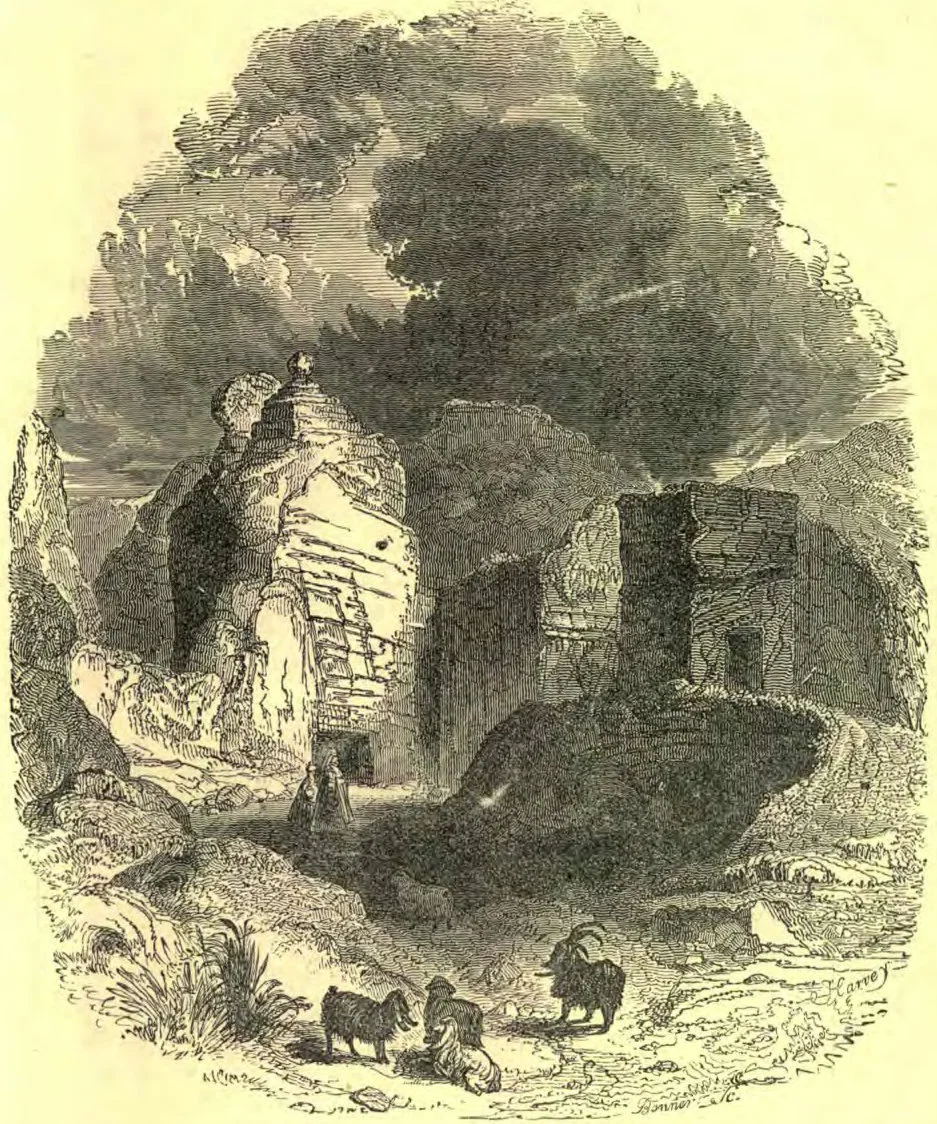
The tombs are among the most interesting monuments of Jerusalem. The temple has not left one stone upon another; the palaces of Solomon and Herod have alike crumbled to dust; the Jerusalem of the prophets and apostles “became heaps” centuries ago; but the tombs remain almost as perfect as when the princes of Israel were laid there in glory. Indeed, the graves of Jerusalem are said to be more numerous than its houses.
The tombs of Palestine are very different from those of our country. Here we are familiar with the grassy mounds and marble monuments which fill the cemeteries, and which pass away almost as quickly as man himself. But in Jerusalem the tombs are rock-hewn caves, appearing in cliff and glen and mountain-side, as lasting as the rock itself. Wherever the face of a crag or a projecting rock affords space for excavation, there is sure to be a sepulchre. Some of these tombs are small grottoes, with only one or two receptacles for bodies; others are of great extent, containing chambers, galleries, and passages, almost without number. Some of them have several stories, into which you descend by holes or rude steps. The doors are low and narrow, so as to be shut by a single slab, which is sometimes round and sometimes square or oblong. This slab was called golal, which means “a thing rolled,” from the fact that it was rolled back from the opening in a groove made for it. The stone being heavy and the groove generally inclining upward, considerable strength was required to move it. This explains the anxious inquiry of the women at Christ’s sepulchre, “Who shall roll us away the stone?”
The tombs are most numerous in the valley of Jehosaphat, or Kidron, east of the city, and in the valley of Hinnom, south of the city. The rocky sides of these valleys are literally honey-combed with sepulchres. A very good representation of some of them is given in the accompanying picture. Mr. Porter says: “On one occasion, after a long visit to Zion, I walked down through the terraced corn-fields on its southern declivity into the deep glen of Hinnom. The sun was low in the west, and the ravine, with its rugged cliffs and dusky olive groves, was thrown into deep shadow. Not a human being was there, and no sound from the city broke in upon the silence. The high rocks along the whole southern side are filled with tombs, whose dark mouths made the place still more gloomy. Already the jackals had left their lairs, and numbers of them ran out and in of the sepulchres, prowling among the rocks and through the olive trees. As I wandered on down Hinnom toward the Kidron, I observed that the tombs became more and more numerous, until at length, at the junction of the valleys, every available spot in the surrounding cliffs and rocks was excavated. They are mostly plain chambers or groups of chambers opening into each other, hewn in the soft limestone, without any attempt at ornament, save, here and there, a molding around the door.”
The same traveler speaks also of a visit to the little village of Silwán (Siloam), in the valley of Jehosaphat. This is a town of tombs, though the living have expelled the dead, taking possession of their homes. The inhabitants have a bad name, and are known to be lawless vagabonds. Mr. Porter says: “It is a strange, wild place. On every side I heard children’s prattle issuing from the gloomy chambers of ancient sepulchres. Looking into one, I saw an infant cradled in an old sarcophagus [stone-coffin]. The larger tombs, where the ashes of Israel’s nobles once reposed, were now filled with sheep and goats.”
A mile or so north of Jerusalem is a very interesting sepulchre, called the “Tombs of the Judges.” There are other tombs cut in the rocks around, but these are striking from the beauty of the entrance way and the extent of the chambers within. Here, as in the other tombs, are openings, or shelves, called loculi in the rocky sides of the sepulchre, in which the bodies of the dead were placed. They are usually dug straight into the rock, and open at the end instead of the side, the feet facing the chamber. The opening was then closed with a slab of stone, and sealed. In some cases the shelf for the body was cut lengthwise, the side opening toward the chamber. Such, it is thought, was the tomb of our Lord. There are more than sixty of these loculi, or sleeping places for the dead, in this one sepulchre. Though their name, “Tombs of the Judges,” has no authority, it is evident that they were made for persons of rank and wealth.
A half mile nearer the city is a sepulchral cave of still greater interest, though less extensive than the one just described. It has long been known as the “Tombs of the Kings,” and was supposed to be the resting place of the Jewish monarchs. There is, however, now much doubt among scholars as to this being true. This is the finest tomb about Jerusalem, and though plain on the outside, the inner court and chambers are beautifully ornamented with carved work. Nearer still to the city is another interesting sepulchre, the so-called “Tombs of the Prophets,” containing loculi for about thirty bodies.
There are so many interesting things to be told about these tombs of Jerusalem that there seems no place to stop. It seems strange that of all the structures of eighteen centuries ago the homes of the dead should alone remain. It is a fit symbol of the death and burial of the pride, the glory, and the riches of that people who drew on themselves the just anger of God, killing his Son, and crying, “His blood be on us and on our children.”
“Tribes of the wandering foot and weary breast, How shall you flee away and be at rest? The wild dove hath her nest, the fox his cave, Mankind their country,—Israel but the grave!”
E. B. G.

A SPRING DAY.

When the warm sun, that brings Seed-time and harvest, has returned again, 'Tis sweet to visit the still wood, where springs The first flower of the plain.
I love the season well, When forest glades are teeming with bright forms, Nor dark and many folded clouds foretell The coming-on of storms.
From the earth’s loosened mold The sapling draws its sustenance, and thrives; Though stricken to the heart with winter’s cold, The drooping tree revives.
The softly warbled song Comes from the pleasant woods, and colored wings Glance quick in the bright sun, that moves along The forest openings.
When the bright sunset fills The silver woods with light, the green slope throws Its shadows in the hollows of the hills, And wide the upland glows.
And when the eve is born, In the blue lake the sky, o’erreaching far, Is hollowed out, and the moon dips her horn, And twinkles many a star.
Inverted in the tide Stand the gray rocks, and trembling shadows throw, And the fair trees look over side by side, And see themselves below.
Sweet spring-time! many a thought Is wedded unto thee, as hearts are wed; Nor shall they fail, till, to its autumn brought, Life’s golden fruit is shed. —Longfellow.

GIFTS MONEY CANNOT BUY.

The season for holiday-giving is over. Some of our young friends have already begun to put away small sums with which to purchase Christmas gifts next December.
Have you also thought that there are gifts you can make to your parents and brothers and sisters and friends through all the revolving year—gifts which cannot be bought with money, yet which will be cherished and remembered by those you love long after the presents of the gladsome gift-time have been forgotten?
Kindness, obedience, cheerfulness, gentleness, and politeness are gifts of priceless value, which never tarnish nor grow gray with age.
When father comes in, weary and may be a trifle cross, greet him with a kiss, and see that he has his slippers and gown and the evening paper and the easiest chair, and that the lamp is shaded just right. If he does not feel like reading, tell him the bright things that have been said and the pleasant incidents that have occurred through the day.
When mother leaves her thimble in the basement or forgets her pocket-book or wants an errand done, do not wait until she asks or commands your assistance, and then give a reluctant assent, but offer quickly and cheerfully to bring the forgotten articles or to go on the desired errand.
Always speak pleasantly and courteously to the help; say, “If you please,” “No, I thank you,” and “I would rather not,” instead of the impolite and ungracious “I won’t,” “I can’t,” “No,” and “Yes.”
When James is puzzled over an example in arithmetic, or Susie has broken the point from her pencil, or Robbie has lost his book or slate, or the baby is fretful or peevish, let your clear brain and ready hands and tireless patience help them all. They will never forget it. And when next Christmas you offer your friends the gifts you have prepared for them, the memory of these daily gifts throughout the year will add a hundred-fold to the appreciation with which they will accept your offerings.—S. S. Advocate.

CLOSE OBSERVATIONS.

I said a short time since to one of my pupils, a young lady who would graduate at the close of the term, and who is a good scholar, “How long have you occupied that room of yours in the boarding-hall?”
“Nearly three years.”
“It has one large window, has it not, with large panes of glass? How many panes of glass are there in the window?”
She was surprised that she did not know.
“There are many trees in our school-grounds, most deciduous, and a very few evergreens. Among those immediately around the school-buildings, are the fir or pine more abundant?” I asked; and again she was surprised to find that she did not know. She will not soon forget the object-lesson.
When I first began to teach school in the country, I said to a bright boy, one pleasant spring morning, who had a long mile to come to school every day, “Well, my young man, what did you see this morning on your way to school?”
“Nothing much, sir.”
I said, “To-morrow morning I shall ask you the same question.”
The morning came, and when I called him to my desk, you would have been surprised to hear how much he had seen along the road—cattle of all sizes and colors; fowls of almost every variety; sheep and lambs, horses and oxen; new barns and houses, and old ones; here a tree blown down, and yonder a fine orchard just coming out into full bloom; then a field covered over with corn or wheat; here a broken rail in the fence, there a wash-out in the road; over yonder a pond alive with garrulous geese and ducks; here he met a carriage, and there a farm-wagon; and not only had he seen all these and many more things in the fields and by the wayside, but, looking up, he had noticed flocks of blackbirds going north to their summer home. He saw the barn and chimney swallows flying about in every direction; there he had noticed a kingbird making war on the crow, and here a little wren pursuing a hawk; yonder he had seen robins flying from tree to tree, and over there the bobolink mingling his morning song with that of the meadow-lark. In a word, he had seen so much to tell me that I had not time before school to hear it all. A new world had sprung up all around him; earth, water, and air were now full of interesting objects to him. Up to this time he had never learned to look and think. Things around him had not changed in number or character, but he had begun to take note of them.
How many of my young readers have never watched the insects creeping over the ground or up the trees! What do you know about their ways? Do you ever watch the clouds in their movements across the heavens, or at sunset when they are golden with the rays of the setting sun? How many objects there are in air, earth, and water worthy of our closest study if we would only learn to take note of them!
Wherever you go, my young friends, always be observing and thoughtful. Let me also advise you to begin now, if you have not already done so, to keep a diary. At the close of each day write down something you have seen or heard or thought worthy of memory. This habit will make you not only observing and thoughtful, but will enable you in after-years to call up the scenes and incidents of your past life, and give many an hour of useful and delightful entertainment.—Golden Days.

“GOD CAN’T WAIT.”

A BRIGHT, four-year-old boy in a friend’s family was feeling tired as the day drew to a close, and came to his mother that he might say his evening prayer before going to bed.
“Wait a little while, Ernie,” said his mother; “I am busy writing a letter. When that is done, you may say your prayers.”
The little fellow waited a minute or two very patiently, and then coming back to his mother said,—
“Mamma, don’t you think prayers are more precious than writing letters? God can’t wait.”
Ernie’s mother laid aside her letter at the gentle rebuke, and the evening prayer took its right place first.
The apostle Paul says, “I exhort, therefore, that, first of all, supplications, prayers, intercessions, and giving of thanks be made for all men.” 1 Tim. 2:1. We too often neglect the prayers till everything else is attended to. But we should “seek first the kingdom of God, and his righteousness.”
If the Lord had not bidden us to come boldly to his throne, we never should have dared to come; but since he has bidden us thus to come, how dare we stay away? He is waiting for us,—waiting to be gracious. Shall we keep him waiting? Would we make a king, or a ruler wait for us? How much less should we expect the Lord to wait on our delays.—Little Christian.

PERFECTION

A FRIEND called on Michael Angelo, who was finishing a statue; sometime afterward he called again; the sculptor was still at his work; his friend, looking at the figure, exclaimed, “You have been idle since I saw you last.” “By no means,” replied the sculptor. “I have retouched this part, and polished that; I have softened this feature and brought out this muscle; I have given more expression to this lip, and more energy to this limb.” “Well, well,” said his friend, “but all these are trifles.” “It may be so,” replied Angelo, “but recollect that trifles make perfection, and that perfection is no trifle.”—Colton.

Seeds of Kind and Holy Words

Good, kind, true, holy words, dropped in conversation, may be little thought of, but they are like seeds of fruitful trees falling by the way-side, borne by some birds afar, haply thereafter to fringe with beauty some barren mountain-side, or to make glad some lone wilderness.

Spring Is Coming Full of Mirth

Oh! ho, ho! the winds are saying, Spring is coming full of mirth; You can hear her footsteps patter Lightly on the bright green earth. Storms may wake and winds be blowing, Clouds be full of gentle rain, Yet, be sure the grass is creeping Upward to the light again.

NEW-TESTAMENT HISTORY.

LESSON 132.—AN ANGEL BRINGS THE APOSTLES OUT OF PRISON.

Among others who sold their possessions, and brought the money to the apostles, was a man named Ananias, who claimed to give all that he had received for his property, but really kept back a part of the price. When this man brought his money to the apostles, Peter said, “Ananias, why hath Satan filled thine heart to lie to the Holy Ghost, and to keep back part of the price of the land? While it remained, was it not thine own? and after it was sold, was it not in thine own power? why hast thou conceived this thing in thine heart? thou hast not lied unto man, but unto God.” When Ananias heard these words, he fell down dead; and great fear came on all who heard these things. Some of the young men present wrapped up the dead man, and carried him out, and buried him.
About three hours later, Sapphira, the wife of Ananias, came in, not knowing what had been done. Now she and her husband had planned this deception together; and when Peter said unto her, “Tell me whether ye sold the land for so much?” She said, “Yea, for so much.” Then Peter said, “How is it that ye have agreed together to tempt the Spirit of the Lord? behold, the feet of them that have buried thy husband are at the door, and shall carry thee out.” Then the woman fell down dead at the apostle’s feet, and the young men, coming in, and finding her dead, carried her forth, and buried her by her husband. When these wonderful things came to be known, the church, and all who heard of these things, were in great fear.
But the mighty works of the apostles did not stop here; they wrought many signs and wonders, and were held in great honor by the people. So great was the power of their words and their miracles, that multitudes, both men and women, believed on Jesus, and joined themselves to the company of disciples. The faith of the people became so great that they brought forth their sick into the streets, and laid them on beds and couches, believing that the shadow of Peter, falling upon them as he passed, would be sufficient to restore them to health. The fame of these miracles spread throughout the country, so that the sick and insane were brought from other cities to Jerusalem to be healed; and none were brought in vain.
The growing strength and success of the cause of Jesus so enraged the high priest and his friends that they laid hands on the apostles, and put them in the common prison. This, however, was in vain; for the angel of the Lord came by night, and opened the prison, and brought them forth, saying, “Go, stand and speak in the temple to the people all the words of this life.”
Obedient to this instruction, the apostles entered the temple early in the morning, and taught boldly. Meanwhile the high priest and his associates called the council together and all the senate of the children of Israel, and sent to the prison to have the apostles brought forth. The officers who went on this errand, not finding those whom they sought, returned, saying, “The prison truly found we shut with all safety, and the keepers standing without, before the doors; but when we had opened, we found no man within.” When the high priest and the captain of the temple and the chief priests heard this report, they were greatly perplexed, not knowing what would be the end of these things. While they were thus troubled in mind, one came to them, saying, “Behold, the men whom ye put in prison are standing in the temple, and teaching the people.” The captain and his officers were then sent to bring the apostles before the council, but dared not treat them roughly, for fear of being stoned by the people. When the high priest saw these fearless men before him, he said, “Did not we straitly command you that ye should not teach in this name? and, behold, ye have filled Jerusalem with your doctrine, and intend to bring this man’s blood upon us.” Peter and the other apostles then made reply, saying, “We ought to obey God rather than men. The God of our fathers raised up Jesus, whom ye slew and hanged on a tree. Him hath God exalted with his right hand to be a Prince and a Saviour, for to give repentance to Israel, and forgiveness of sins. And we are his witnesses of these things; and so is also the Holy Ghost, whom God hath given to them that obey him.”
When the priests and rulers heard these words, they were cut to the heart, and counseled with reference to taking the lives of the apostles. But one Gamaliel, a Pharisee, and a doctor of the law, a man highly esteemed by all the people, commanded that the apostles should be taken aside. Then he addressed the council, saying, “Ye men of Israel, take heed to yourselves what ye intend to do as touching these men. For before these days, rose up Theudas, boasting himself to be somebody; to whom a number of men, about four hundred, joined themselves: who was slain; and all, as many as obeyed him, were scattered, and brought to nought. After this man rose up Judas of Galilee in the days of the taxing, and drew away much people after him: he also perished; and all, even as many as obeyed him, were dispersed. And now I say unto you, Refrain from these men, and let them alone; for if this counsel or this work be of men, it will come to nought; but if it be of God, ye cannot overthrow it, lest haply ye be found even to fight against God.”
This address seemed to please all the council. So when they had called the apostles, and beaten them, they charged them not to speak in the name of Jesus; and then let them go. The apostles went forth from the council, rejoicing greatly that they were deemed worthy to suffer shame for the name of Jesus. “And daily in the temple, and in every house, they ceased not to teach and preach Jesus Christ.”

QUESTIONS.

  1. Who, among others, brought to the apostles the money obtained by selling their possessions? Acts 4: 36, 37; 5: 1.
  2. What deceit and dishonesty were practiced by Ananias?
  3. When he brought his money to the apostles, what did Peter say to him?
  4. What was the effect of these words upon Ananias?
  5. What was done with the dead man’s body?
  6. Who came before the apostles about three hours after this?
  7. Of what was she still ignorant?
  8. What question did Peter ask her?
  9. What reply did she make?
  10. What did Peter then say to her?
  11. How were his words fulfilled?
  12. How did the apostles continue their mighty works?
  13. What effect had these miracles upon the people?
  14. What faith was manifested?
  15. How far did the fame of these miracles extend?
  16. How were the cities about Jerusalem benefited by these manifestations of God’s power through the apostles?
  17. How did the high priest and his friends regard the growing strength and success of the cause of Jesus?
  18. How did they try to stop the work?
  19. How were the apostles delivered?
  20. What instruction did they receive from the angel?
  21. How did the apostles obey this command?
  22. While this was going on, what steps were taken by the high priest and his associates?
  23. What report was made by the officers who were sent to bring the apostles before the council?
  24. How did the priests and rulers receive this intelligence?
  25. What further news did they presently receive?
  26. What orders did they at once give?
  27. Why were the officers afraid to treat the apostles roughly?
  28. When Peter and his companions had been brought before the council, what did the high priest say to them?
  29. How did the apostles reply? Acts 5: 29–32.
  30. What effect had these words upon the priests and rulers?
  31. Who stood up in the council, and exposed the folly of their proceedings?
  32. What advice did he give? Verse 38.
  33. By what reasoning did he support this counsel?
  34. What instances did he give of leaders who had come to nought?
  35. What course was taken by the council after hearing these words?
  36. In what did the disciples rejoice, as they left their persecutors?
  37. How did they heed the commands of the council? Verse 42.

NOTES.
Ver. 1. Ananias was the Greek form of the Hebrew word Hananiah. It signified the same as John, or Johanan, and meant “The Lord be gracious.” Sapphira is either connected with the sapphire, as a precious stone, or from the Hebrew word signifying pleasant or beautiful. The names of these people were favorable and beautiful, but their principles were bad.
Ver. 6. And the young men. The youth of the congregation; very probably young men whose business it was to attend on the congregation, and perform various offices when the Christians celebrated their worship.—Mosheim. Carried him out. Beyond the limits of the city; no burials were allowed within the walls.—Vincent. And buried him. In the East an interval of only a few hours is left between death and burial. In Jerusalem to-day, the rule is not to defer burial more than three or four hours after decease.—Rev. Com. Burial was probably hastened somewhat in this case, and the body interred without the honors—washing, anointing, etc.—ordinarily paid to the dead.—Abbott.
Ver. 9. At the door. Are near at hand. They had not yet returned. The dead are buried without the walls of cities, and this space of three hours, it seems, had elapsed before they returned from the burial.—Barnes.
Ver. 20. All the words of this life. Stress is laid upon the words this life, the existence of which the Sadducees denied. The term refers to the life in Christ, the everlasting life which they shall have who believe in him.—Schaff.
Ver. 21. They entered into the temple early in the morning. The words indicate a time as soon as possible after day dawn.—Cambridge Bible. The temple had already opened its gates to the worshipers and traffickers accustomed to resort thither. Hence the apostles could begin their work of instruction as soon as they arrived. The people of the East commenced the day much earlier than is customary with us. During a great part of the year in Palestine, the heat becomes oppressive soon after sunrise, and the inhabitants therefore assign their most important duties and labors to the early hours of the day. Worship is often performed in the synagogue at Jerusalem before the sun appears above Olivet.—Hackett. The council . . . and all the senate. The former has been understood to consist of the Sanhedrim, the latter of the elders, heads of families, men of great experience, who were summoned on occasions of special importance; a council of laymen.—Canon Cook.
Ver. 30. On a tree, i. e., on a cross made of the wood of a tree.—Schaff.
Ver. 32. And so is also the Holy Ghost. His testimony was publicly borne by the miracles performed by the apostles through his power, the speaking with tongues, and the shaking of the house.—Rev. Com.
Ver. 34. Gamaliel, a doctor of the law. This scribe was the celebrated Gamaliel the elder, and the grandson of Hillel, the famous founder of one of the rabbinical schools. He was held in high estimation as a most learned and devout Pharisee.—Ibid.
Ver. 37. In the days of the enrollment. Not that alluded to in Luke 2: 2, but one made after the dethronement of Archelaus (6 A. D.), when Judea was converted into a Roman province with a view to taxation. It was in consequence of this taxing that Judas of Galilee revolted.—Ibid.
Ver. 38. Refrain from these men. Cease to oppose them, or to threaten them.—Barnes.
Ver. 40. They beat them. This cruel punishment was inflicted on the naked back of the sufferer. The scourge generally consisted of two lashes knotted with bronze, or terminated by hooks; it was looked upon by Romans as so shameful a chastisement that it was forbidden to be inflicted on a Roman citizen.—Ibid.

CHICKIE'S PUZZLE.

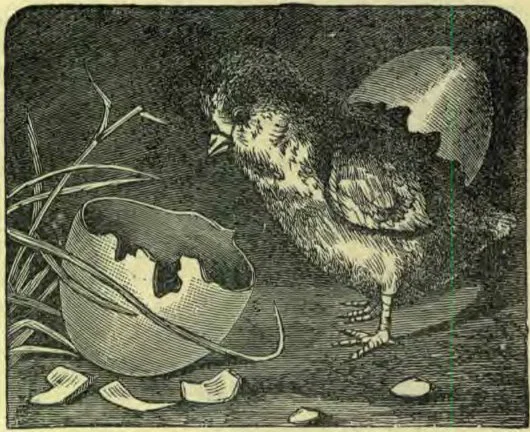
I'd like to know how it happened, I can't understand it a bit; A moment ago I was curled up so, There was naught I could do but pick.
So I picked and picked, and by and by There came a great crashing sound; And first thing I knew the shell was in two, And I standing safe on the ground.
M. A. S.

A PERSIMMON PICNIC.

WILLIE and his little sister Fannie wished very much to go to the woods for some persimmons. When they asked their mother if they might go, she said, “Yes, if you can get Cousin Robert to go with you and take care of you.”
Cousin Robert was quite willing to go with them; and as he was several years older than they, he made the walk very pleasant by telling them about the different trees, flowers, and animals they came across as they searched the woods for a persimmon tree.
At last Cousin Robert called the attention of Willie and Fannie to a tree having a very rough bark on three sides, and entirely stripped of bark on the fourth side.
“This,” said he, “is a good persimmon tree, because, you see, the squirrels have scraped all the bark off from one side running up and down it.”
The children were very glad to see this tree, and stationed themselves beneath it, so that they might be all ready to pick up the persimmons when Cousin Robert shook the tree. Pretty soon the persimmons began rattling about their ears, and the excited children began to pick up, as fast as they could, the soft pink balls.
“Take care, youngsters; wait until I come down. Be sure not to eat any except those that are very soft and juicy!”
But the warning came too late; for just then Fannie could not help laughing to see Willie jump up and down, snapping his fingers.
Those of my readers who have never visited the South, and have never seen persimmons, will not understand Willie’s discomfort unless I explain the reason. Persimmons are something like plums, only they are pink; and they contain five seeds the shape and size of pumpkin seeds. When fully ripe, and fit to eat, they are so soft that the slightest touch will crush them to a jelly, but if eaten before they have reached this state—which the children call “mushy”—they pucker the lips, tongue, and throat so badly that the unfortunate person does not care to taste persimmons again, for that day at least.
Poor little Willie! His fun was spoiled for awhile, because he was in too great a hurry. Cousin Robert gave him a piece of candy, which consoled him a little, but he did not take much interest in the persimmons that afternoon.
When they returned home, and Fannie had related the incidents of their pleasure trip, their mother told the children that a good lesson had been taught them that afternoon.
“You will find all through life, my dear children, that it is not wise to be in too great a hurry to taste its pleasures. Many seeming joys prove as disagreeable as the unripe persimmon was to Willie’s mouth.”
“I don’t quite understand,” said Fannie.
“I will try to explain more fully then. When Willie saw that large plump persimmon lying at his feet, he thought, Oh, how nice that will taste! and put it in his mouth, only to find out that it tasted very bad, and puckered his mouth sadly. So when a boy sees a glass of wine or whisky, and thinks it will taste so good, he finds out before a great while that such drinks leave a dreadful taste in the mouth and a terrible mark upon the soul.
“There are many vices which at first sight seem quite harmless, many sinful pleasures which appear very attractive. Be careful, pray constantly to God, asking him to watch over you and keep you from falling into sin. Never have anything to do with pleasures that are doubtful, that you are not quite sure are right. Let all such alone; there are plenty about which there can be no question. Never do anything that you are not quite sure is right, no matter how pleasant it may seem to you. Sooner or later the disagreeable part will come, making you so unhappy that you will wish you had let the questionable thing alone. Be sure your persimmon is fully ripe.”—Ruth Argyle.

THE BEES’ POCKETS.

Bees are very curious little creatures, and the most useful of all the insects that fly. They are only about an inch long, and what wonderful work they do, making so much honey and wax for us all summer long! They know, too, about every flower in our gardens, and all the signs of the weather; and then they are so kind to their children. When they make their honey, I wonder if you know how they get their materials. Let me tell you.
Bees have slender pointed hairs upon their heads. The yellow hairs upon their legs, which we can see with the naked eye, turn out to be hard, horny sort of combs which they use in the gathering and storing of the pollen of flowers.
Besides this, the bees have two little baskets upon their thighs which are the very perfection of side pockets, just such as we should want for a similar purpose.
But what do you think they do with these pockets? They first tuck their little heads into the heart of the rose or lily, or other sweet flower, for honey. In doing so, they cover themselves all over with the yellow dust, which is the pollen. Then they take their fore-feet and brush it very carefully from the hair, and pass it on to the middle feet, and on again to the hind feet, when it is safely packed in these little pockets on the thighs. As soon as they are loaded down, they fly away home, and put it in some secret place.
Some of the pollen is given to their babies, and some of it is worked up into wax. This, you know, is used to make the cells. Some of it, called propolis, they use to punish intruders, giving them a sort of “tar and feathering.”
The bees are so industrious, that in five days, by the use of these pockets, they can half fill the hive with honey-comb.
And then the wax is used for a great many other purposes. When you look at your beautiful dolls, don’t forget that they are really made by the bees.
Much more might be told you about these industrious little creatures. But you can find out a great deal for yourselves, my dear young friends, if in the summer you hunt up a hive and watch the doings of the bees carefully.—Aunt Georgy.

Letter Budget.

Lettie E. Clements, of Hollis, N. H., sends her first letter to the Instructor. She says: “My oldest sister takes the Instructor, and we all like it. We do not go to Sabbath-school, for we are twelve miles away; we have a Sabbath-school at home. I hope to meet the Instructor family in heaven.”
Alberta L. Hall writes from Birnamwood, Wis.: “I am eleven years old. I like the Instructor, and am going to get some subscribers for it. I live in the northern woods of Wisconsin. In the spring there are beautiful wild flowers here, and there are a good many porcupines too. There are no Sabbath-keepers here, so we have a family school. I would like to correspond with some of the readers of the Instructor who live in the West.”
Minnie O. Hart writes from Knoxville, Marion Co., Iowa: “I have written for the Budget once before, but did not see my letter printed. I am ten years old. We have a good Sabbath-school here. I learn my lessons from Progressive Bible Lessons No. 3. A little girl who goes to school here thinks she will take the Instructor. I am trying to get up a club, and I hope to hear from some one who has got one.”
Ethel F. Coffee writes from Freeport, Maine. She says: “I am eight years old. I have a baby sister, and her name is Bertha May. I take the Instructor, and like it very much. I had a gray squirrel. He jumped into a corn barrel, and father caught him by putting a shorts sack over the top, and getting him to run out of the barrel into it. He then put him in a box. I sold him for fifty cents.”
Willie and Arthur Bradley write from Rensselaer Falls, N. Y., that they go seven miles to Sabbath-school every Sabbath. They like to go. Willie has read the New Testament through. Their ages are ten and twelve years.

SABBATH-SCHOOL MAPS.

Twelve-sheet Map, illustrating the travels of St. Paul, 81x170 inches. $18.50
Eight-sheet Map of Palestine, 81x116 inches. 12.50
Eight-sheet Map, illustrating the Travels of St. Paul, 81x116 inches. 12.50
Peninsula of Mt. Sinai, 52x72 inches. 5.00
Old-Testament Map of Palestine, 41x58 inches. 3.00
Old-Testament Map of Palestine, 28x41 inches. 1.50
New-Testament Map of Palestine, 41x58 inches. 3.00
New-Testament Map of Palestine, 28x41 inches. 1.50
Map illustrating the Travels of St. Paul. 1.50
(The above are on cloth without rollers.)
Map illustrating the Travels of St. Paul, (boards) 13½x18½ inches. .50
Travels of St. Paul, (card) 5½x3½ inches. .04
Same on paper. .03
A Bird's-eye view of the Holy Land, in colors, varnished and mounted. 50x78 inches. With an index to all the principal places, rivers, and mountains of Palestine. 8.00
“Bird's-Eye View of the Holy Land can be sent only by express. Twenty-five per cent discount to Sabbath-schools. The others will be sent by mail on receipt of price.”
Address, YOUTH'S INSTRUCTOR, Battle Creek, Mich.

You have reached the end of this edition.

The Youth’s Instructor · Apr 25, 1883