Sower divine!
Sow the good seed in me,
Seed for eternity.
'Tis a rough, barren soil,
Yet by thy care and toil,
Make it a fruitful field
An hundredfold to yield.
Sower divine,
Plow up this heart of mine!
Sower divine!
Quit not this wretched field
Till thou hast made it yield;
Sow thou by day and night,
In darkness and in light.
Stay not thy hand, but sow;
Then shall the harvest grow.
Sower divine,
Sow deep this heart of mine!
Sower divine!
Let not this barren clay
Lead thee to turn away;
Let not my fruitlessness
Provoke thee not to bless;
Let not this field be dry,
Refresh it from on high.
Sower divine,
Water this heart of mine!
—H. Bonar.
Our Japanese Colporteur Wagon
By W. D. Burden
W. D. BURDEN
Wherever the sound of the third angel's message is heard, one of the chief mediums for its spread is the printed page. From the beginning of our work in Japan, we have felt the need of literature. Here we are among a people numbering more than forty million, but very few of whom speak any other than their native tongue, and it takes many years for a foreigner to acquire proficiency in it.
Three years ago we began the publication of the Owari, an eight-page monthly, which has ever since been faithfully sounding forth the message for these times. About a year and a half later Brother Wade had “Steps to Christ” translated into Japanese, and stopped at nothing until it was published. Now we have added to these standards “His Glorious Appearing.” We hope soon to have a press of our own on which to print other books, tracts, and leaflets. Already some have contributed liberally toward this enterprise, but we should be glad to have others add to this fund. If any of our people in America or elsewhere are living where they can use any of our Japanese literature, one yearly subscription for the Owari may be obtained for thirty-five cents, or one copy of “Steps to Christ” or of “His Glorious Appearing,” postpaid, for twenty cents. A liberal discount will be allowed where several copies are ordered, or where they are wanted for missionary work.
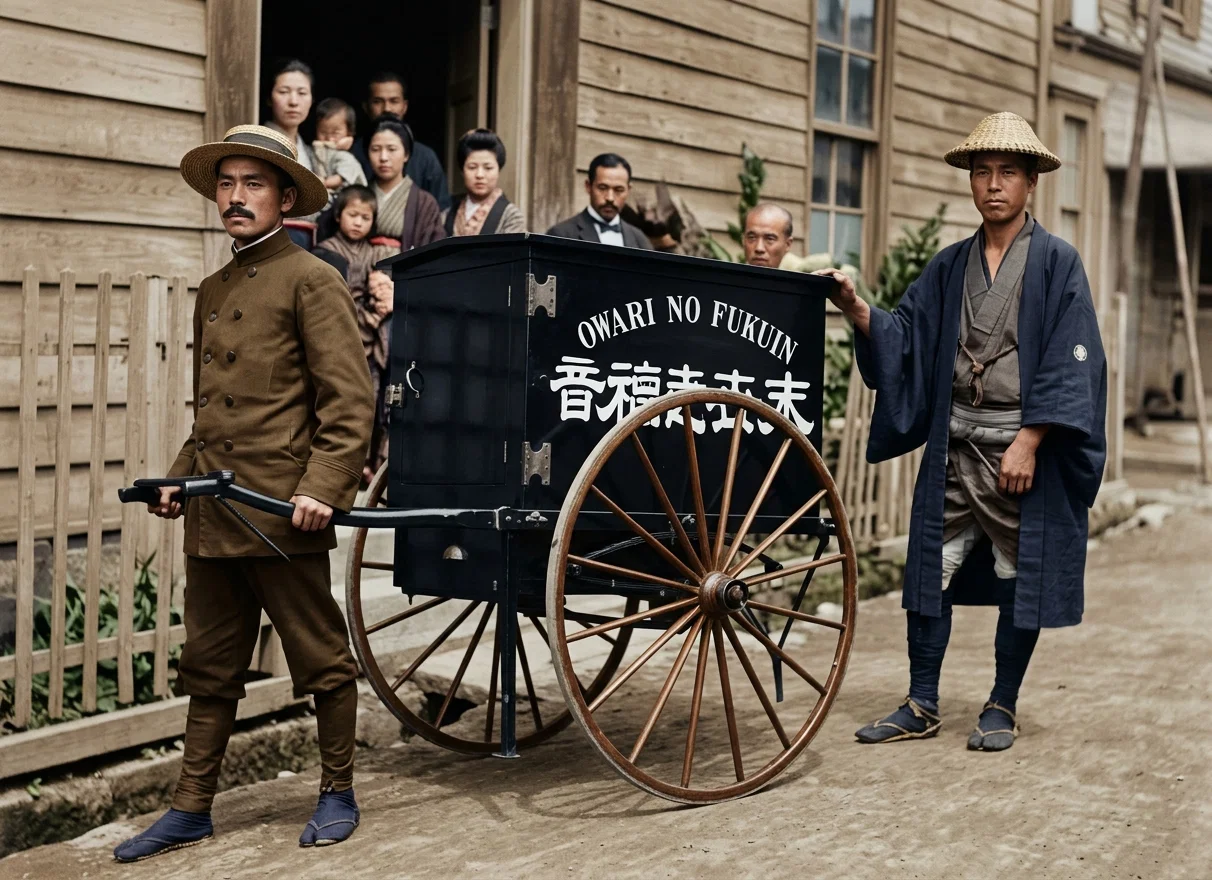
Another forward step, for which we praise the Lord, is the starting of a colporteur wagon, which is shown in the accompanying cut. It will elicit inquiry; for the name of our paper is on it, both in English and in Japanese. The two workers who go with it, Brethren Kuniya and Matsukura, are both devoted laborers, and though this is somewhat of an experiment, we trust that with God's blessing it may prove a great aid in carrying the truth to the country districts.
THE JAPANESE COLPORTEUR WAGON
In Tokyo frequent festivals are held in honor of the different temples, and for some time past we have sought these occasions for holding street meetings. A short time ago there was one of these held in the park near our Shiba station. The park was lighted up with large Japanese lanterns, and for several blocks the streets were lined with small stands selling various wares and confections, while here and there were found small shows or theaters. The Buddhist priests were holding their meeting in front of their temple, so we took a position some distance to one side. Before long it became evident that they had decided to stop our work if possible. Taking their stand right beside us, some priests with banners began preaching. Soon another company began on the other side of us, and finally a third company, coming directly in front of us, completely shut us in, for just back of us was a high bank. Finding that we did not stop preaching for all this, they stopped, and began shouting, “Mash their wagon,” “Break their lantern.” At last we concluded not to give out any more papers, for many of them were being destroyed. One man asked for a paper, and I gave it to him. He was well dressed in European clothes, and appeared like a gentleman, but grabbing the paper with his hands and teeth, he tore it into shreds, and threw it in our faces.
Failing to stop us by other measures, the whole crowd, which by this time numbered several thousand, tried to rush on to us. Fortunately, some of those near us, either out of sympathy or as a means of self-defense, resisted the press. Just then a policeman made his appearance before us, and holding his lantern aloft, forced the crowd back. After a little the policeman disappeared as suddenly as he had come, and sometimes I have wondered if it might not have been an angel in disguise, for the people seemed ready to swallow us up. Again the crowd tried to overrun us, and this time came also a shower of dirt, sticks, and stones. After several attempts they succeeded in turning our wagon upside down. What they might have done next I cannot say, but two policemen came to our rescue. They said that if we wished to continue, they would protect us the best they could, but they feared such a crowd. We told them that we did not wish to make any trouble, so would withdraw if we could get out. They cleared a way for us to pass through the crowd, helped us to get the wagon right side up, and escorted us part way home.
Many times during the evening's experience the words of Paul sounded in my ears, “If after the manner of men I have fought with the beasts at Ephesus.” When the truth begins to stir the people, the devil is sure to stir up opposition. But all he can do only helps to spread the truth. After we stopped giving out the papers, I saw some hunting around on the ground to find the little scraps to read. Seeing this, I again began giving out the papers, and continued as long as our supply lasted.
Brethren, remember the work in these far-off lands, and bear us before the throne of grace, that we may stand faithful to our post, let come what will.
Tokyo, Japan.
Giving
“God’s love hath in us wealth upheaped;
Only by giving it is reaped.
The body withers, and the mind,
If pent in by a selfish rind.
Give strength, give thought, give deeds,
give pelf,
Give love, give tears, and give thyself.
Give, give, be always giving;
Who gives not is not living.
The more we give,
The more we live.”
Foolish Preaching and Its Meaning
THERE is a great difference between foolish preaching and the “foolishness of preaching.”—United Presbyterian.
Alaska
By Mrs. Othnier
MRS. OTHNIER
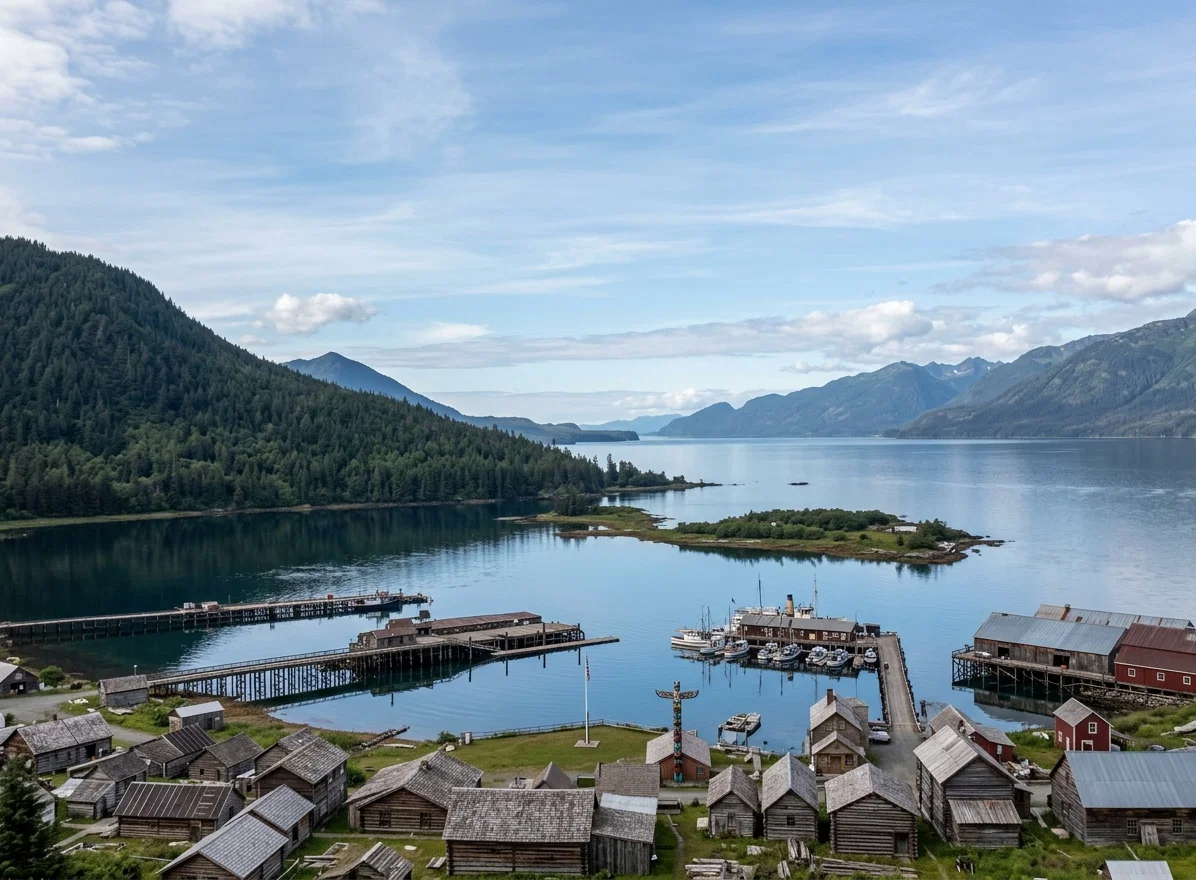
ONE of the most interesting of the old towns in southeastern Alaska is situated at the northern extremity of Wrangels Island. In 1834, sixty-eight years return ago, Baron Wrangell, then governor of Russo-America, also chief director of the Russo-American Fur Company, sent Lieutenant Dionyrius Zaremba from Sitka to establish a small stockade post at this point, which he called Ft. Dionyrius. Their principal object was to prevent the Hudson Bay Company from building a fort on Russian territory. However, it became the chief trading station of the two companies.
WRANGEL, ALASKA
In 1867, when the United States bought the Territory of Alaska, two companies of United States infantry were sent to this place, the name having now been changed to Ft. Wrangel. The buildings of the soldiers were quite interesting. A two-story log cabin with two wings extending at right angles with each other, formed two sides of a parade ground, while other buildings used as officers' quarters, formed the third side, leaving the southern exposure free to see the approach from the water.
A blockhouse, fifty feet high, the sides of which were perforated with loopholes, was an imposing structure. The buildings were all erected in such a substantial manner as effectually to guard against surprise or assault from the Indians.
In the center of the parade ground stood a flagstaff, and near it one of the most unique specimens of totem poles found in Alaska.
The troops were withdrawn after three years.
In 1871 we again have Ft. Wrangel as one of the most important points in Alaska, as in that year occurred the first mining excitement in the interior of this country. Rich placer gold was discovered in the Cassiar district of British Columbia, near the head of the Stikine, a river navigable for about one hundred and fifty miles from Wrangel. All supplies were transported on it by light draft steamers, and then to the mining camps by pack train.
The old miners tell of stirring times when the men returned from the gold fields to spend the winter in Wrangel.
In 1875, as people had gathered there in large numbers, it was thought best to return the militia; they remained two years this time.
In a few years mining in that locality with gold pan and rocker ceased to pay. It was the opinion that sometime the mines would be operated under the hydraulic system; but fields so much richer have been found that to-day Ft. Wrangel is a village, with a population of five hundred and seventy-five, probably second in number of natives to Sitka, and always a place of much interest to the tourist. It is the first stopping place in Alaska of any importance, for the north-bound steamer.
The totem poles are found here in greater numbers and variety than at any other native settlement. The final resting place of some "good Indians" is also here. A great variety of curios may always be found at this place.
One article in which there is some trade is the garnet stone. There are two mines about four miles from Wrangel. In the rough these stones are half imbedded in a brittle slate and sandstone, but when cut and polished, they are quite handsome. A brilliant specimen of Alaska diamond is also found near here.
The chief industries of this place at present are carried on by means of a sawmill and fish canneries. On the waters embraced in the Wrangel district are eleven canneries and thirteen salting stations. To keep up this supply there are three salmon hatcheries, which turn out nine million young salmon annually. Wrangel is still one of the largest fur-trading stations of southeastern Alaska; in fact, it is the hunter's paradise. In one season 400 bear skins, 300 beaver, 200 land otter, 500 martin, 5,000 mink, besides wolves, wolverines, hairseal, and deer, were caught and sold to the merchants.
Ten years ago the Catholics and Presbyterians each had a mission at Wrangel; but when the population decreased, the Catholic church was abandoned, and is now a mass of ruins. The Presbyterian church burned down, but has been rebuilt. Services are held on Sunday mornings for the natives, by the aid of an interpreter, and in the evening for all who care to attend. But six white people are members of the church.
Some of the Indian houses present a neat appearance, but inside are devoid of comfort, and in some cases several families occupy one room with a general fireplace in its center.
There are the Thlingit Indians, divided into two clans, Wolf and Raven, and these into various tribes. A native never marries one of his own clan. They are quick observers, imitative, willing to work, handy with tools, and shrewd bargain drivers. Their curios rapidly advance in price when the tourist season approaches.
They have many vices which have not been checked by contact with civilization.
One of their chiefs will occasionally give a potlatch, though not so elaborate as in former years. Dancing, feasting, and drinking are freely indulged in at such times, and presents of food, calico, and money are distributed among the natives.
Some of the finest timber in this section, is in the vicinity of Wrangel. The spruce, hemlock, red and yellow cedar, birch, and pine are common varieties. The yellow cedar will admit of a beautiful polish, and will probably be used for furniture and finishing purposes.
There is a pretty, sandy beach, forming a semicircle of about three quarters of a mile; and when the people return home, in the late fall, from their season's work, the different craft lying at anchor present a novel and interesting scene.
Characteristics of the Brazilians
By W. H. Thurston
W. H. THURSTON
THE Brazilians are a warm-hearted, impulsive people, slow to forget a kindness, and quick to show one. They are extremely courteous, and look with disdain upon the brusque manners of Americans, who are in too great haste to be polite. They always have time to show every courtesy possible. In business transactions any rudeness or brusqueness is quite unpardonable, and one can expect to find little favor at their hands unless he is prepared to accept and return their courtesies, and await their movements with patient politeness. It is quite too warm in that country for people to hurry, and they never do, nor do they wish others to. Nothing is ever done to-day which can wait until to-morrow, and patience is a much-used and much-abused word in their vocabulary. It will be repeated to one many times, if he tries to hurry them. Espera and paciencia, wait and patience, are almost the first words a foreigner learns.
They are very patient with foreigners, and will not laugh at their mistakes, no matter how ludicrous they are, but will generally offer a polite correction. The words “to direct,” or “lead,” and “to digest” are very similar—dirigir and digerir. A German minister just beginning to preach in the Portuguese had occasion to use the former word a number of times in his sermon and prayer, but instead used the latter—a very ludicrous mistake; but not once did his congregation break through their becoming gravity, and he had no idea of his14blunder until another German friend told him of it after service.
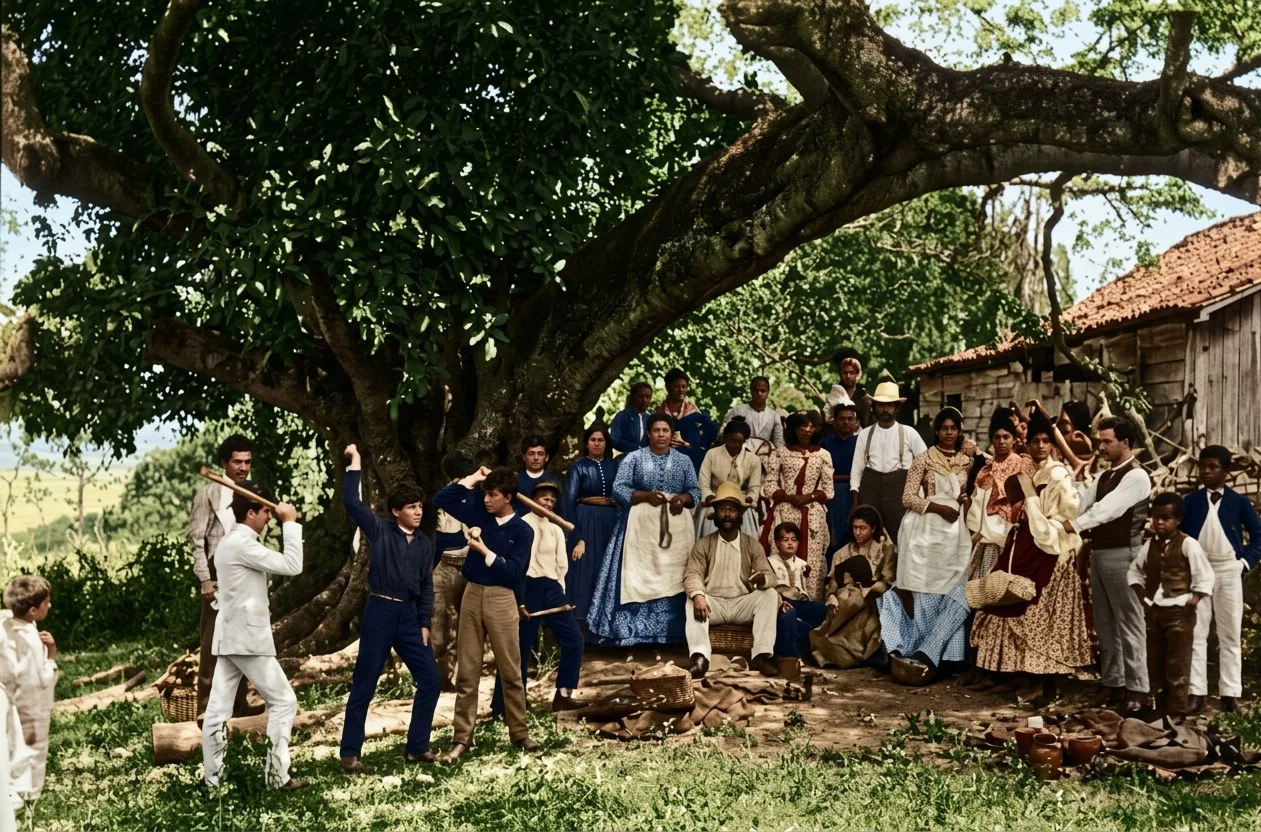
BRAZILIAN PICNIC PARTY UNDER A FIG TREE
The warm climate and the excessive use of stimulants make the Brazilians very excitable, and they gesticulate constantly while in conversation, talking very fast and loud. They are also easily stirred to anger and to fanaticism, and missionaries are often subjected to mob violence. They are kind to their children, and bestow a great deal of affection upon them, while the children, in turn, are taught to respect and reverence their parents and elderly people. The women have few household cares, as their homes are rather scantily furnished, their food simple, and clothing is so expensive that they cannot afford a large wardrobe; so the greater part of their time is spent in idleness. As a consequence, they are saved much worry and work, and do not age so fast as American women. They are fond of display and of bright colors, and are dressy, bestowing special care upon their hair and hands.
As a rule, the people are very superstitious, and have some most absurd ideas about sickness and misfortune. They do not believe that diseases are contagious, but that they are sent or withheld by God; and if death visits the family, it is because God willed it.
One thing which is very painful to the foreigner is the great cruelty with which animals are treated. There are no laws for their protection, and very little sentiment in their favor, and they are beaten, tortured, and starved in the most heartless manner. Together with this there is great disregard of the value of human life, and murders and suicides are distressingly frequent. In fact, vice and crime stalk abroad at noonday, as it were, and in the most heartsickening manner. One can only wonder at the great forbearance of a merciful God in not blotting these large cities out of existence. But it is almost more wonderful how he can be so patient with us who, having the light and truth which these people need to lift them out of their bondage and night, are so slow to take it to the perishing millions. How sad to think that we have been so neglectful of our duty, which, if performed, would have brought the Saviour ere this, and ended all earth’s woe.
Thus far the Brazilians have been quick to accept the gospel as it is presented to them, and there are a goodly number of honest souls in that dark land who are ready and waiting for the third angel’s message.
General Notes
IN a recent letter Brother J. A. Leland, of Guadalajara, Mexico, reports that five persons have begun to attend their services as the result of the mission work in the city.
BESIDES the opportunity to circulate much literature in the Boer camps in South Africa, our brethren have had the privilege of sending quantities of papers on the transports to the island of St. Helena; and when they last wrote, they were planning to send a quantity to Ceylon. Truly, this is sowing beside all waters.
THE situation in Colombia still is such that Brother Hutchins can do but little work outside of Bocas del Toro. In his last letter, written May 28, he stated that it was expected that the decisive battle would be fought that day, and matters would then be settled. They are well, and are enjoying much of the blessing of the Lord in the midst of trying times.
WE have received an interesting program of the closing exercises of the little industrial school at Karmatar, India. In addition to the native orphanage school, a boarding school has been conducted for the children of our own people, most of whom are of Calcutta. Karmatar is a beautiful and healthful location for a school. It is here that Brethren Robinson and Brown are buried. The premises are rented for a series of years.
IN 1859 one native in the Fiji Islands could buy another for seven dollars, and then butcher him and eat him without molestation. To-day the Bible is in nearly every house, and nine tenths of the people assemble every week in churches for worship.
A MEETING for the workers was held in Georgetown, British Guiana, the latter part of May. Elder Babcock writes that their workers’ meeting in the city was followed by meetings for the public, which created quite an interest, several having decided to obey the truth.
MISSIONARIES in India bear united testimony to the fact that the country is ripe for evangelistic work of the most aggressive kind, but laborers and the means to keep them in the field are needed to bring about a religious movement that shall have the most marked influence on the whole country.
THE gospel has made remarkable progress in Corea during the past year, judging from the fact that of the five thousand baptized members of the church not one half were professed Christians a year ago. Both teachers and medical workers are sadly overworked in this field, as they have far more to do than they are able to accomplish.
BROTHER W. G. KNEELAND reports two baptisms at Erin, in the southern part of Trinidad. One of the converts was brought into the truth through the efforts of a canvasser who was sent there a few months before. The interest is increasing in the Port of Spain church. They are now doing twice as much missionary work as they were a year ago.
MISSIONARIES of different denominations agree in the one fact—that there never was a time in the history of missionary work in China when openings were multiplying faster and as extensively as at present. The American Bible Society agent in China reports that the Chinese manifest an extraordinary eagerness to have the Bible. He writes that “there seems to have been a wonderful reaction all over the empire from the bitter persecutions of last year, and in no part is this more apparent than in many districts where the disturbances were the greatest. The call for the Scriptures is unparalleled. On the last steamers which left for the north before the close of navigation for the winter, we sent the largest shipment we ever made to Tientsin and Peking. The demand for Scripture is something marvelous, and every one thinks we are only at the beginning of a great movement.” A similar report comes from the British and Foreign Bible Society. They write: “The brightening prospects of Christian missions in China may be judged by the following facts: During the first eight days of the present year orders were received at our Shanghai depository for upwards of 150,000 copies of Scripture, of which about 15,000 are Bibles and Testaments.”
Canvassing in Mexico
By A. G. Bodwell
AFTER an absence of four months and eleven days, I am at home once more. As many of the brethren in the States were inquiring about a good location to settle in, it was decided that I should take a trip through the southern part of the republic to spy out the land. Accordingly, leaving Mexico City, the trip to Oaxaca was made by train. Here it became necessary to buy a horse, as the railroad went no farther. The journey southward was continued until Tapachula was reached, which is within a few miles of Guatemala, passing through Tehuantepec, Juchitan, Tonala, and many smaller towns. All these towns were canvassed for our Spanish paper, Bibles, and Testaments, and many thousand pages of tracts were given away on the following subjects: Sabbath question, second coming of Christ, importance of studying the Bible, and living by faith; also many leaflets setting forth the benefits to be derived at our sanitarium in Guadalajara were distributed.
In the towns of Tehuantepec and Tonala I sold fifty copies of “Steps to Christ,” forty-nine of “Christ Our Saviour,” and six of “Patriarchs and Prophets.” These were sold for cash in less than two weeks’ time, besides selling many Bibles, Testaments, and papers, and taking eighty-seven paid subscriptions for our Spanish paper, the most of which were for one year. Many more of our books could have been sold, but I did not have them, and could not wait for them to be sent to me. In Tonala after I had sold all my books, others came wanting more. One man sent me a note and the money, asking me to send him a copy of “Patriarchs and Prophets;” others stopped me on the street, and asked for “Patriarchs and Prophets.”
Leaving Tapachula, I started for the Atlantic coast, crossing the Sierra Madre Mountains. The first large town that I reached was Comitan; from there I went to San Bartolomé, and next to Tuxtla Gutiérrez, the capital of the state of Chiapas. My first day’s work here was on Sunday, and I obtained thirty-seven paid yearly subscriptions for our paper; and in five and one-half days one hundred and thirty-seven paid subscriptions were secured. All of these were for one year, except six, which were for six months. I succeeded in gaining an entrance to the government building, and obtained subscriptions from nearly all employed there.
From Tuxtla Gutiérrez I went to Chiapa, and from there to San Cristobal. This place is said to contain eighteen or twenty churches, and thirty priests, about one for every five hundred people, as its population is fifteen thousand. The rains began, and I left before finishing the town; for I was told that I had a hard road ahead of me, and after the rains began, it would be much worse. After six days of hard riding, I arrived in Pichucalco, which is quite a commercial center. One day while on the road to that place, I made my regular day’s ride, and obtained thirty-eight paid yearly subscriptions; and the first day in Pichucalco thirty-six yearly subscriptions were secured.
After leaving Pichucalco I visited Teapa, and from there I went to San Juan Bautista, where I sold my horse, and took a river steamer for Frontera. After transferring my baggage to an ocean steamer, and while waiting for it to start, I canvassed the captains and officers of some of the river boats, and some of the houses near the river front, and obtained quite a number of subscriptions. While on the steamer going to Vera Cruz, I obtained a subscription from the owner of a large ranch who seemed to be quite interested. I arrived in Vera Cruz after a pleasant ride of about twenty-three hours on the Gulf; and after passing through the custom-house took the train that night for Mexico City, where I arrived early the next morning.
The state of Chiapas has an excellent climate, is well watered, and the land is well adapted to farming and stock raising. The people are very friendly. The priests have not as much control over the people as in other parts of the republic. In my judgment, it would be an excellent field for families wishing to do self-supporting missionary work. Land can be bought for fifty cents an acre, or more. There are only two missionaries in the entire state, and they have recently gone there; one is a Presbyterian, and the other belongs to the Plymouth Brethren. I would like to give some of the experiences that I had, and also a description of some of the places, but time and space will not permit.
Much of the time I have worked twenty hours out of the twenty-four. Sometimes I would get up at twelve, one, or two o’clock in the morning, saddle my horse, and ride until seven, eight, nine, or ten in the morning, when I would stop at a town and canvass it, finishing perhaps about five or six o’clock in the evening, when I would saddle my horse and ride until twelve, one, or two at night. I would then spread my blankets on the ground, and sleep until daylight, after which I would canvass that town. Sometimes I would make my breakfast on two or three cold tortillas (tortillas resemble pancakes somewhat, except they are made from corn instead of flour, and when cold are not very palatable). The Lord has kept me in health and strength, for which I praise his great and holy name.
I traveled six hundred and thirty-four miles by rail, about fifteen hundred on horseback, and about six hundred by water. And from February 1 to May 31 (four months) I received from sales of books, papers, and subscriptions $540.71, Mexican. Of this amount $489.60 was received from sales and subscriptions for the paper. In all, I obtained eight hundred and sixteen paid subscriptions for the paper. I obtained some subscriptions from the peons, but the most of my subscriptions are from the leading men of the nation, from judges, secretaries of courts, lawyers, doctors, customhouse officials, chiefs of police, army officials, captains and officers of boats, merchants,
mechanics, and ranch owners. My expenses were very high, but I sold enough Bibles and Testaments with what I made in exchange in money above the regular subscription price of the paper, to pay all my traveling expenses, except $12.30, gold; so the $540.71 was all clear except $12.30, gold, for my expenses. It costs us one hundred dollars a month to print our paper. But in four months I turned in more than enough above my expenses to print it for five months.
I also had the privilege of giving treatment to some who were sick, and of giving quite a number of Bible readings and talks to those who were interested. After I had sold all my Bibles and other books, and while working with the paper, many of the people asked me for books and Bibles. The field everywhere seems to be ripe for the printed page. The Lord has gone before us, and prepared the hearts of the people. Some of our faithful canvassers in the States have written me in regard to coming to Mexico to scatter the printed page; but we cannot encourage them to come yet, because of the high price for which we would have to sell our books brought from the United States in order to make any profit on them. What we need is a small printing plant to publish books and papers, so that we can offer our literature to the people at a reasonable price. I am glad to hear of the step the Pacific Press has taken to establish a plant in Mexico. I believe it is a move in the right direction. A. G. BODWELL.
An Open Door to the Great Educational Institutions
By David Paulson
LAST summer at our Chicago Branch Sanitarium we gave a health banquet for a number of the leading educators and students of the Chicago University. In an after-dinner speech one of the officials of that great school extended to us an earnest invitation to establish a restaurant near the university.
We secured suitable rooms near the main building, and opened our doors the middle of last October. Brother and Sister Mussleman took the immediate supervision of this work, and have labored faithfully, without any financial remuneration whatever, for the success of this enterprise.
For a time the expenses exceeded the receipts, but little by little the interest in this manner of living began to take deeper root, until now between four and five hundred meals are served daily, and recently many have had to be turned away for lack of room. The enterprise is becoming a financial success. Among its patrons are members of the faculty and the very best class of students, who speak in a most appreciative way of this effort.
This work has given us an opportunity to reach a class of people whom it would have been extremely difficult to reach in any other way.
Similar institutions ought to be opened at all our educational centers and in many of our leading cities. There ought to be a number of young men preparing themselves to fill the position of head cooks; also a number of married men and women of some executive ability, who have developed a good degree of patience and forbearance, should be fitting themselves to take the supervision of these enterprises. Some of each of these classes are constantly with us, acquiring16the necessary training and experience for the purpose of connecting with similar enterprises elsewhere.
We would be glad to correspond with those who desire to come here for this purpose, as there are many things in the establishment, equipment, and maintenance of such a work that will involve useless expenditures and bitter discouragements in the hands of inexperienced workers, no matter how well meaning and sincere their motives may be.
DAVID PAULSON.
First Impressions of Walla Walla College
By C. C. Lewis
AFTER five days of wearisome travel and vexatious delay, I arrived at the Pendleton camp ground on the morning of May 25, the last day of the meeting, in time to speak once upon the subject of Christian education, and to form the acquaintance of many of the brethren and sisters of the Upper Columbia Conference. I also met quite a number of old friends whom I had known as students and fellow teachers of former days.
The next day I went to College Place, and spent a day with the business manager, Brother C. D. Hobbs, looking over Walla Walla College, the scene of my future labors for some time. And it gives me pleasure to report that I am highly pleased with all that I have seen. I am acquainted with the buildings and equipment of all but one of our larger educational institutions in the United States, and can speak understandingly when I say that Walla Walla College compares favorably with the best equipped of them all.
The convenient and beautiful main building, comprising dormitories, offices, and recitation rooms under one roof; the abundant supply of pure, cold spring water, conveyed in iron pipes from its source two miles away, and forced by hydraulic rams into tanks which command every needful point of kitchen, laundry, boilers, sewer, lawn, dairy, and farmyard, with a copious overflow passing on to gladden the orchard and garden below; the sleek, well-kept road and draft horses; the dairy of Jersey and Holstein cows, supported by fifty acres of sweet-scented alfalfa meadow, just blossoming now for the first cutting; the shops and appliances for practically pursuing various useful industrial studies; the pretty village, with its watered gardens and irrigating streams, nestling at a friendly yet respectful distance from the college hill; and the Walla Walla valley, made joyous by many swiftly running streams, as its name indicates (Walla Walla, water, water), with its wheat fields stretching away to the beautiful Blue Mountains in the distance,—all these elements combine to form an ideal retreat for the student. And the writer must be pardoned for saying that the scene causes chords long silent to vibrate once more in the heart of one whose boyhood days were spent within sight of the Adirondack region of northern New York, where hills were wooded and green, and rivers abundant and clear, and who could never quite forget his native surroundings, nor become entirely reconciled to the monotonous prairies and muddy, or waterless, rivers of the Middle West.
But enough of sentiment. I find Walla Walla College well equipped for aggressive work in Christian education. It has an efficient faculty of earnest, Christian men and women. It offers scientific, literary, ministerial, normal, musical, medical preparatory, commercial, and industrial courses of study. It has in practical operation farming, gardening, fruit growing, dairying, poultry raising, bee keeping, broom making, blacksmithing, printing, and health food making; and it expects to introduce house painting, shoemaking, dressmaking, tailoring, tentmaking, and carpentry as soon as suitable persons can be found to take charge of these industries. If any know of good, reliable Seventh-day Adventists who are skilled workmen in these industries, and who desire to attend school a few years, or have children to educate, they will confer a favor upon the managers of the college by writing them the particulars.
In short, Walla Walla College is established in this great Northwestern country, and has ample facilities for training laborers in every department of the work to carry the gospel message into the farthest corner of its territory. It has four organized conferences and three mission fields to support it. In its territory are hundreds, if not thousands, of young people who should be obtaining its benefits. It has accommodations for rooming and boarding one hundred and fifty students, and for instructing as many more. Will not the friends of the institution unitedly work and pray for its prosperity? And shall not the coming term find the school filled with an earnest, God-fearing class of men and women who can be trained into efficient laborers in the Master's vineyard?
All who are interested are invited to write for calendars and for our new, supplementary circular containing important announcements concerning matters decided upon since the calendar was issued; and they should please remember that the address of all connected with Walla Walla College is College Place, Wash., not Walla Walla.