We reached Liverpool Wednesday, August 19, in the afternoon, and immediately proceeded to London, arriving at 6:30 P.M. It was a beautiful ride through the evergreen country. Such a wonderful relief it was after days on the desert of the salt, salt sea. But such wonderful green means much rain, and England has been soaked with it for the last three weeks. Rain, and cold, and almost cyclonic winds, and many sad wrecks at sea, were the characteristics of the closing weeks of August, and one accustomed to the drier atmosphere of America feels the cold. It seems like November weather.
We spent two Sabbaths at the Surrey Hills Hydropathic, our sanitarium at Caterham, about fifteen miles south of London, in beautiful hilly Surrey. While the sanitarium is right in the town of Caterham, and has in front no great spacious lawns, it is in a beautiful spot after all. Many of our readers will remember that this rest for the weary and healing home for the sick was purchased in part by donations from America, so the institution started practically out of debt. It has made a fairly good profit, has purchased another good building, better equipped itself for efficient service, and has done much charitable work besides. It is conducted by Dr. A. B. Olsen, who is assisted by his brother, M. E. Olsen; the efficient matron is Miss Mable Pringle.
There is talk of selling the sanitarium, and building at Stanborough Park, north of London. It would seem that there is room for a sanitarium in both places. In and around San Francisco is a population roughly speaking of a million. There are at least five sanitariums in operation, and all of them we believe are paying. To one on the wing it looks as tho there ought to be more than one of these light-bearing, health-giving institutions among the ten millions of the metropolis of the world. To hold every center of light and life well established, and establish as many more as possible, ought to be good policy in the work of God.
THE publishing house of the International Tract Society is located at a beautiful spot, near Watford, twenty miles south of London, on an estate formerly occupied by a gentleman who beautified it by setting out trees of many lands in a surrounding strip of woods, enclosing a broad expanse of meadow land. Here are situated the old mansion house, now used for school purposes and dormitory building for students. At a little distance stand the publishing office and food factory, and several cottages erected by the Society and rented to workers. A new college building is soon to be erected. The educational work is under the supervision of Professor Lacey, assisted by Mr. W. H. Wakeham, Mr. W. T. Bartlett and others. It is doing, we learn, excellent work.
At the publishing house is printed the Present Truth, edited by Mr. W. T. Bartlett, and the Good Health, of which Mr. M. E. Olsen is editor. The former has a circulation of about 25,000 weekly, and the latter of 50,000 to 75,000 monthly, both largely sold by agents. The office has three cylinder presses and two jobbers, with a very efficient and economical power plant. Books are printed here, but it has been found cheaper to get full binding done in London. Altho two miles from the station, the office is within the freight limits, and the railway companies collect and deliver the freight.
All kinds of health foods are made and shipped to various parts of England by the food factory. The manager of the Society is Mr. W. C. Sisley. Altho full of work, he kindly showed us around the estate. Our visit with him and his family was a pleasant one. Here also we met Elder Fitzgerald, president of the British Union Conference, and Elder Meredith, president of the South England Conference. Work was reported as prosperous in all parts of the United Kingdom, and a new conference had just been organized in Scotland. Great Britain with its teeming millions is a large field. May God's blessing richly rest upon His workers.
LABOR conditions in England are serious; they always are, or at least would be so counted in America. What we mean is there are always many out of work, but the conditions have been greatly exaggerated in American papers. Wherever one goes, he sees appeals for recruits to the military service, and there is ever an appeal for men. Conscription is seriously advocated by many. England has had excellent crops during the past year, and there is not nearly the distress that there has been in years past. The old age pension law goes into effect soon, which will help many, and no doubt some relief will come from the new patent law, by which foreign importers must manufacture the goods sold, if at all reasonable, in the United Kingdom. If not, after a reasonable time, the patent becomes void. German and American firms have flooded the country with goods manufactured outside, but for which patents have been issued by the British Government. England can not do this in Germany or America, and she rightly feels that the interest of her people should be guarded. But there bids fair to be serious labor situations in the future.
THIS is the dull season in public affairs. All governmental institutions are closed except the executive offices; the royal family are off on the Continent and elsewhere, and even the great preachers are on their vacations, while inferior speakers occupy the pulpits. For instance, Dr. Clifford, the great Baptist preacher, is in Germany, Mr. Campbell-Morgan is in America, Mr. Campbell has at this writing just returned from his vacation.
Yet there have been three things of more or less interest of late. One is the Congress of moral education, about to begin, which will consider the necessity of such teaching. It is recognized that more than intellectual education is imperative. But it is to be doubted whether this Congress will do much more than note the need. Religious education is the only true basis, but the state can not give that.
The Trades-Union Congress at Nottingham, altho large, has not been particularly conspicuous in results. There has, in fact, not been the strongest agreement among the delegates. This is clear, however, as in the United States, the labor unions are coming to be more and more in politics. Some of the papers here declare that their influence as represented in Parliament is out of all proportion to their numbers. But politicians, or those seeking for political preferment, are quite likely to be affected by an aggressive minority which acts as a unit. Socialism is permeating the labor ranks, and the question of the future is a serious one to the old conservatism.
The most important of the three things which we mentioned above is the great Eucharistic Conference in London, with the presence of Cardinal Vanutelli, the representative of the Pope, and a multitude of cardinals and high prelates. The chief aim of the Congress is to emphasize the faith of the Catholics in the doctrine of transubstantiation, and their loyalty to the See of Rome, and also to impress upon the English people the greatness and power of Roman Catholics.
THE reception of the pope's legate has been more than necessary, it seems to us, to satisfy the extremest ambition of mortal man. Greater homage could not have been paid to earthly monarch. Men cheered him and spread carpets before him, and knelt in the streets to receive his blessing, forgetting the injunction of the apostle Peter, "Neither as being lords over God's heritage but being ensamples to the flock."
LIBERALITY — WHENCE?
REPEATEDLY did the papal legate speak of the liberality of England in granting to all freedom of worship. A high procession was planned bearing "the host," with the clericals in full canonical dress, a thing forbidden by the law of England. The police gave permission, the Protestant Alliance protested, and the Home office and government said nothing till the arrangements were made and the route planned in the ancient boundaries of Westminster City, now a London district. Then the protests reached the ear of Mr. Asquith, the prime minister, and request was made by him that the carrying of "the host" be abandoned. Of course, there was dissatisfaction against the government for not acting sooner, but it would probably have caused trouble if the illegal act had been carried out. The streets for a block or two were jammed only as they can be in London, and an act or accident might easily have caused a scandal.
THERE are two things in this matter which ought to come home to the conscientiousness of our Roman Catholic friends: (1) They profess to stand for obedience to law, for recognition of lawful authority. Certainly this procession is no part of their regular worship, and they could lose nothing by not performing it. Why did they wish to do an unnecessary act contrary to civil law? (2) England is a "liberal country." Would any Catholic country on the face of the earth permit a demonstration directly against the faith of that church? If England had been a Catholic country, no Protestants would have been allowed such freedom, and Catholics know it. What, then, makes England the liberal country she is? — It is the Protestant principles which have wrought the change. Do Catholics who have enjoyed such freedom wish to swing England and the United States back to the Dark Ages? If the Catholic church never changes, and these great nations become Catholic, we shall as sure as truth have a recrudescence of the Inquisition and times of persecution and a rekindling of the Smithfield fires. It is time to pause and think. The "more sure word of prophecy" has also spoken. But more of this hereafter.
The first five days of this week's readings close the wonderful book of Daniel. Chapter 7 is a prophecy of the persecuting kingdoms of earth under five different symbols; chapters eight and nine, a prophecy of Christ's priesthood and the work of the enemy against that priesthood; a wonderful time prophecy of 2,300 days, used in the great 1844 movement, but those who used it were mistaken in the event to take place at the end of the 2,300 days. Those days began in 457 B.C., and ended in 1844 A.D. Daniel 10 and 11 is another great prophecy of the nations, beginning with the Grecian power, taking up the divisions of Alexander's kingdom and tracing down through to the same events indicated by the other prophecies, the closing of God's work in the earth and the second coming of Christ. The twelfth chapter of the book presents for our consideration some of the events to occur when Christ shall stand up to reign, for so the expression "stand up" means when used in these chapters. We are also clearly told that these words of Daniel were not wholly understood by him and were not to be understood by him, for the visions were shut up and sealed till the time of the end. This time began about 1793-98, when prophecies of the end began to be fulfilled. There are several periods of time in this chapter which we have not space to develop.
Hosea is the first of the minor prophets. He lived about 200 years before Daniel; in fact, Hosea was contemporary with Isaiah, prophesying during the reigns of Uzziah, Jotham, Ahaz, and Hezekiah, kings of Judah, and of Jeroboam II in Israel. His name means "salvation." He was the last of the great prophets of the northern kingdom, and predicted the coming captivity of that kingdom with a great deal of definiteness. The moral condition of the Israelites is shown, and the certain desolation of the nation predicted. People, priests, and princes are all guilty of gross iniquity, yet he looks forward, beyond even these apostasies in Israel, to the time when the Lord shall restore His people. There are some very fine passages and moral precepts of great worth in the book.
Our New Testament readings include the last five chapters in Romans and the first four in 1 Corinthians. Paul's letter to the church in Corinth, as reckoned by some, was written between the years 52 to 54 A.D. Divisive tendencies had crept into the church. Different persons were calling themselves by the names of the apostles. The epistle was written in part to correct these. He also shows the wonderful love that he has for his converts; presents strong testimony regarding spiritual gifts, and a masterly chapter on the resurrection.
With Our Inquirers
By Editor
"If ye will inquire, inquire ye."
[All questions to this department will be answered which to the editors will seem to minister to the good of the readers and to the mission of the paper. The same question can not be answered repeatedly in the same volume. The name and address must accompany question, not for publication, but as an evidence of good faith, and that answer may be made by letter if deemed advisable. It is well always to enclose a stamp for reply.]
2636.— Why Had They Met Together?
One claims that the disciples were met in the upper chamber upon the first day of the week for worship, and it was their mode of worship which caused them to bar the doors for fear of the Jews. Please explain the text.
C. E. S.
The question is a very simple one if we will read the scriptural accounts in Mark 16:14; Luke 24:33-43; John 20:19, 20; Acts 1:13. Mark tells us that Jesus upbraided them for their unbelief. Surely they could not have met there to worship Him if they did not believe He was risen. Luke tells us that they were frightened when they saw Jesus, and He had to put forth evidence that they could grasp and see to convince them that He was raised from the dead. Therefore they did not meet to worship Him. John tells us that when they went home they shut the doors for fear of the Jews. A mode of worship implies custom, principle. Surely the disciples had not even begun any mode of worship. Luke tells us in Acts that they met where they lived; they simply went home, most of them discouraged, fearful, doubting, disbelieving, in no mood to worship, when Jesus met with them. There is not a scintilla of evidence to indicate that they were met for worship; and when Jesus met with them, the day had passed, and the second day had begun.
What are the cities of Israel? If Christ is talking to His disciples of to-day, then verse 23 of Matthew 10 must apply to the disciples of to-day also.
C. K.
The cities of Israel are the cities which were in the land of Palestine when Jesus lived there, and when He talked with His disciples. It was the twelve He sent out, and they were to go to the lost sheep of the house of Israel. He sent them before Him, and He himself followed them. His instruction has been left on record for all time, and when the children of God come to that condition of heart and mind that they will count salvation from sin more than all else in the world, God will add unto them other blessings. Every principle in the teaching of our Lord, worked out in His own day, is binding now, but just the very circumstances and the particular commands which were given them may have application only to that time. Many of these important truths which our Saviour spoke, apply at all times, in all lands, under all circumstances.
2638.— Taking Off Hats.
Should not women and girls as well as men and boys take off their hats before entering the church?
M.
Our querist may find help, perhaps, in the study of 1 Cor. 11:3-16. The whole matter of head-covering is largely a matter of custom. The Jews (men) keep their hats on during their services in the synagogue. Everywhere it is customary for women to wear their hats in services of all kinds. It might be more reverent to remove them. Oftentimes it would be more pleasant to sit behind women if their hats were removed. But what would some of the sisters do with some of the wonderful inventions of the milliner's art, surmounting an equally ingenious and complicated fashion in the hair-dressing line? And then where would they put these marvelous creations? It might be better, sister, to remove them; and we venture to suggest it, but we can not enforce it. Better kindly to agitate and educate and leave the question, as God leaves it, with each individual soul.
Why do your people keep the Sabbath, when it is only to be throughout generations? A generation means a race, kind, breed, people of one period or age.
M. A. M.
We have condensed the above question to save space, but we have given the core of principles involved.
Generations means more than generation. The covenant blessings to Israel were under the word, "commanded for a thousand generations," outspanning this world's brief testing of sin,—an expression denoting eternity. God chose Israel for all eternity. It is to Israel that all the promises are made. Rom. 9:4. A Gentile if saved at all must be saved as Israel. Eph. 2:11-22. There is no promise to him outside. It will be a city, the gates of which are named after the twelve tribes of Israel, into which the redeemed will enter. Why not join them and be among those who "keep the commandments of God and the faith of Jesus"? Rev. 14:12.
Dependence upon God.
By W. N. Glenn
1. UPON whom is every man dependent?
Upon "God that made the world and all things therein, . . . seeing He giveth to all life, and breath, and all things." Acts 17: 24, 25.
2. What is every man's position in this world?
Every one is a servant. "Know ye not, that to whom ye yield yourselves servants to obey, his servants ye are to whom ye obey; whether of sin unto death, or of obedience unto righteousness?" Rom. 6:16.
3. Whose servant is every one naturally?
"Whosoever committeth sin is the servant of sin." John 8: 34. "All have sinned." Rom. 3: 23.
4. Has man no power to uplift himself or his fellow man?
"Put not your trust in princes, nor in the son of man, in whom there is no help." Ps. 146: 3.
5. What was the result of Israel's trust in man?
"Ye have plowed wickedness, ye have reaped iniquity; ye have eaten the fruit of lies; because thou didst trust in thy way, in the multitude of thy mighty men." Hosea 10:13.
6. To whose power, then, shall we look for freedom?
"Look unto Me, and be ye saved, all the ends of the earth; for I am God, and there is none else." Isa. 45: 22. "If the Son therefore shall make you free, ye shall be free indeed." John 8: 36.
7. What has God promised dependent man concerning the necessaries of life in this world?
"Trust in the Lord, and do good; so shalt thou dwell in the land, and verily thou shalt be fed." Ps. 37: 3. "Seek ye first the kingdom of God, and His righteousness; and all these things shall be added unto you." Matt. 6: 33. "Bring ye all the tithes into the storehouse, that there may be meat in Mine house, and prove Me now herewith, saith the Lord of hosts, if I will not open you the windows of heaven, and pour you out a blessing, that there shall not be room enough to receive it." Mal. 3:10.
8. What protection to the harvest does obedience in this duty secure?
"I will rebuke the devourer for your sakes, and he shall not destroy the fruits of your ground; neither shall your vine cast her fruit before the time in the field, saith the Lord." Verse 11.
—W. N. Glenn.
'Harvest Great; Laborers Few.'
By Lucy C. Alden
How white the harvest everywhere,
The whole earth's acres wait!
What pity, Lord, Thy men are few,
With all the growth so great!
Who, who, will go and reap to-day,
Or who the reaper send
To save the grain ere harvest pass,
And golden summer end?
—Lucy C. Alden.
Fijian Food
By J. E. Fulton
The Fiji Islands—No. 1
By J. E. Fulton
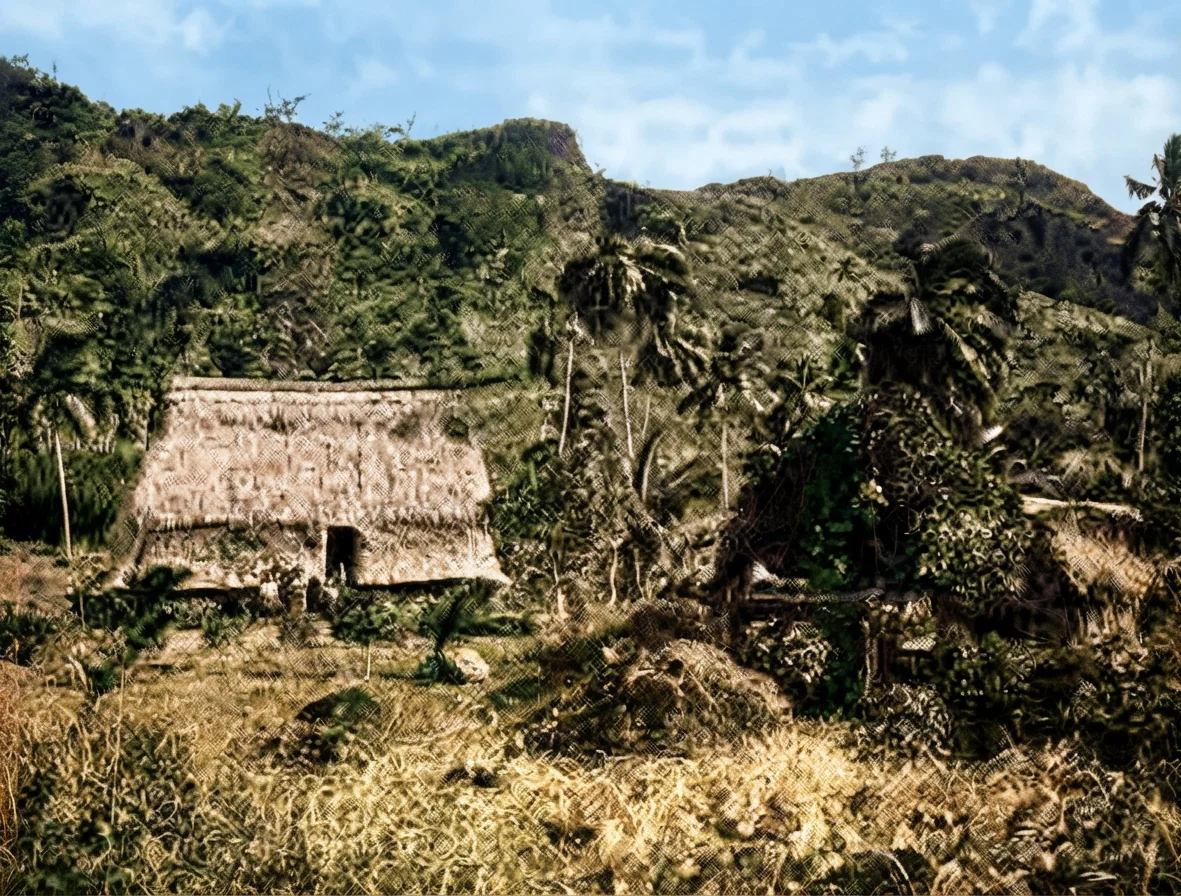
FIJI comprises about 225 islands, eighty of which are inhabited. Two of the islands, Viti Levu (big Fiji) and Vanua Levu (big land) are islands of considerable size, Vanua Levu being as large as Jamaica. Neither Vanua Levu nor Viti Levu is called an island by the natives. To them they correspond to continents, and the outlying smaller bodies of land are called by the name of yanuyanu, or islands. Most of the islands are rough and mountainous, and on Viti Levu there are mountains rising to the height of 4,500 feet. There is abundant evidence of volcanic origin in the many tall, sharp-pointed, conical hills of basaltic formation, which at some remote age were the craters of active volcanoes. In the hot springs of Savu Savu Bay, we still have the present indication of volcanic heat. The accompanying picture will show something of the rugged contour of many of the islands, as well as the dense vegetation which abounds in spite of the forbidding rocks.
A Characteristic Fijian View.
All the islands are surrounded to a great extent by coralline reefs, whose beautiful tints and varied and delicate structure always excite admiration; some of these are covered with a sufficient depth to support vegetation, and others are half concealed by the combing waves that spend their fury in impotent efforts to destroy the little insects that quietly build the mighty barrier. In addition to the reefs there are sunken patches of branching coral, whose brilliant colors, reflecting the rays of the tropical sun, seem like enchanted gardens.
All of the islands are quite well watered, especially the large islands, there being some rivers of considerable size in both Viti Levu and Vanua Levu. There is necessarily a great deal of moisture arising daily which makes the heat sometimes quite oppressive. But the heat is again often tempered by delightful breezes from the sea. The nights are usually cool and pleasant.
The population of Fiji stands at about 122,000. The Fijians are a well-made, stalwart race. The mountaineers show the frizzy hair and dark color of the Melanesian, while the coast tribes betray the strong admixture of Malay and Polynesian blood. They are a kind, hospitable, well-behaved race, there being very little crime among them. Considering the fact that when the Gospel found them in 1835 the Fijians were a race of cannibals, carrying on cruel tribal wars, it is truly a triumph of what God's grace can do for the human heart.
Fijian Food.
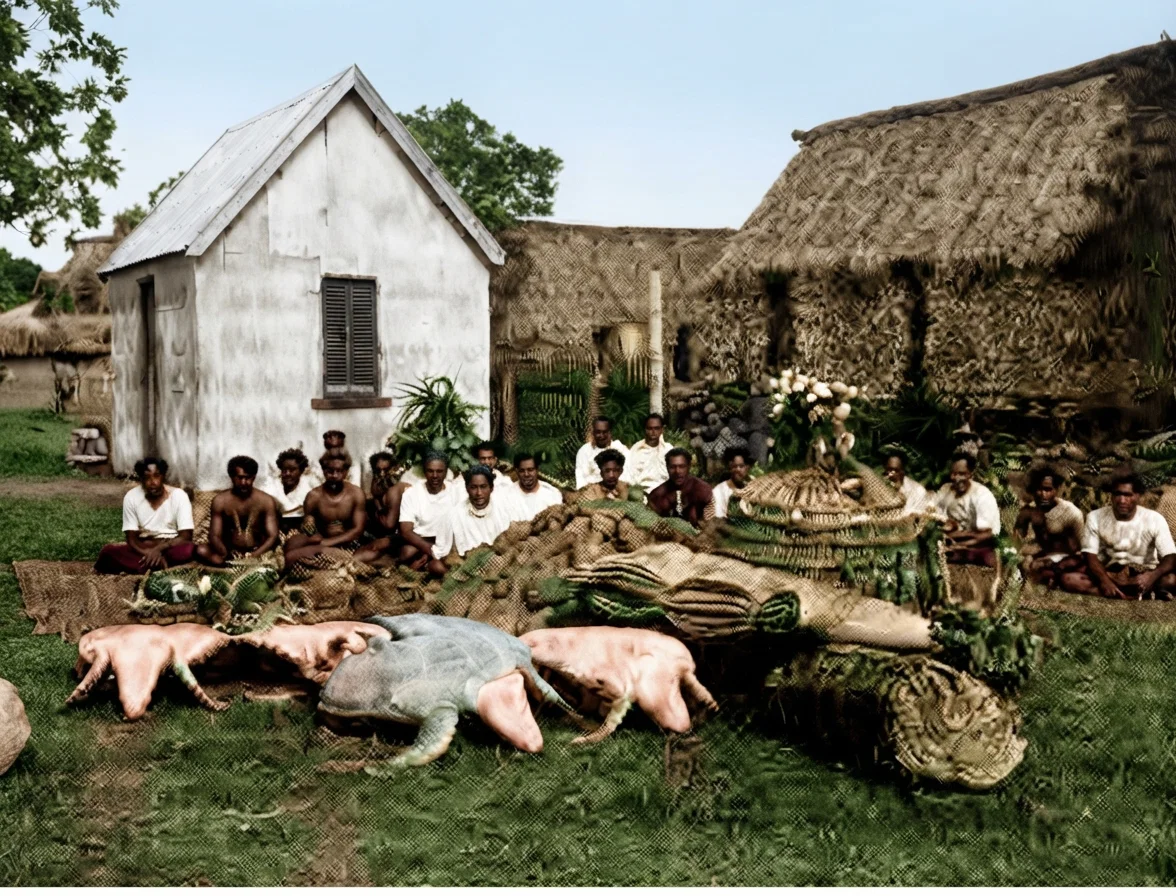
In the cut we have presented before us the preparations for the magiti, or feast. Those large creatures, turned on their backs, in the forefront of the picture, are turtles. These are regarded as a great delicacy, and in former days were supposed to be the food only of the chiefs. The turtles are turned on their backs so that they will not escape, for in this attitude they are helpless. They are often kept for several weeks in this condition, without food, waiting for the feast-day. The turtles are very tenacious of life, and even after they are cut into pieces, each piece of flesh seems alive, and the heart has been known to beat for hours after being separated from the body.
In the center of the picture is a pile of yams, and back against the small house is a pile of taro. These are native vegetables, the staple articles of diet in Fiji and other islands. They are something like potatoes, and are prepared in similar manner.
You notice also bundles of mats and tappa cloth. This is likely a wedding-feast and these are for gifts. The bridegroom must always be well provided with mats, not only for himself, but more especially as presents to the parents or relatives of the bride.
Feast at Bau, Fiji.
A large basket shown in the picture encloses a large porker. A feast can hardly be thought complete without the swine. There will likely be baskets of fish and other foods. And when the time arrives to have the food prepared, a large pit is made, and into this are placed logs of wood which are set on fire. Large stones are heated to an intense heat in this fire, after which the burning wood is raked out, and the stones leveled for the food to be put in. Yams, taro, fish, turtle, and pig, all go into this pit, and are covered over with leaves, and then with earth, and left to roast. In ancient times human flesh was prepared for food in this identical way. When pigs or turtles were difficult to obtain, men could easily be procured. Many are living to-day who were witnesses of these things. The forearm was thought to be the best part of the human body. How revolting is the thought! How marvelous has been the change!