Your ShelfYour Projects

Review and Herald, Vol. 77, No. 1.

COME OUT FROM AMONG THEM, AND BE YE SEPARATE
Earlier text: CONFERENCE—DISTRICT 3

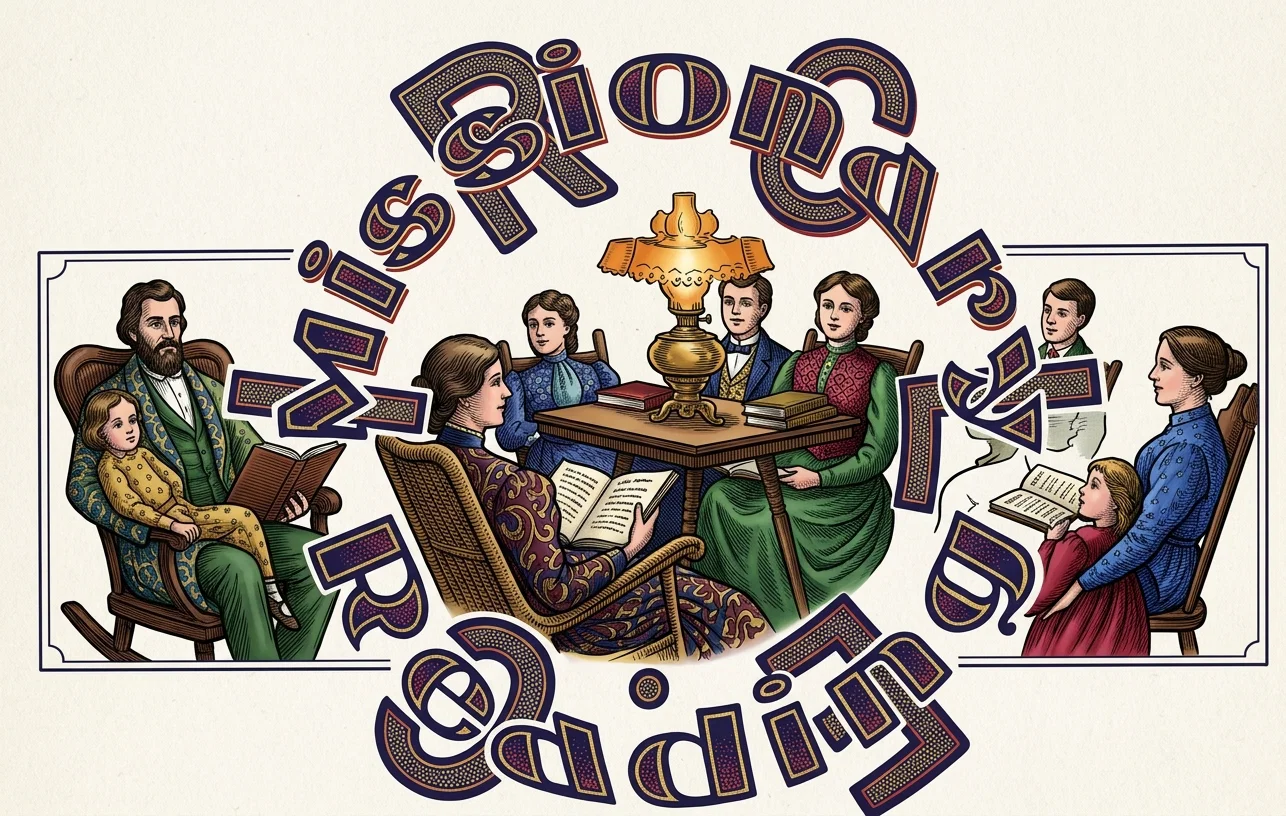
The Missionary Reading Circle

Embraces a study of the fundamental principles of the third angel's message, and of our various lines of missionary work in foreign lands.
The great and rapid movements on the world's financial and political checkerboard are of such a nature as to cause the financiers and potentates of earth much concern. “But ye, brethren, are not in darkness, that that day should overtake you as a thief.” “But take ye heed; behold, I have foretold you all things.” Christ tells us in Luke 21:25, 26 that “there shall be signs in the sun, and in the moon, and in the stars; and upon the earth distress of nations with perplexity; the sea and the waves roaring; men's hearts failing them for fear, and for looking after those things which are coming on the earth.” The first three signs referred to are all in the past; what about the remaining ones mentioned? You have but to read the headlines of our daily papers to see the fulfillment of the Saviour's great prophecy. Reader, where are we in the stream of history and the field of prophecy? It is high time for us to learn a lesson of the parable of the fig-tree, and study the prophecies as never before. The issue is before us, and if successfully encountered, must be understood.
Join the Missionary Reading Circle, invite your neighbors and friends to attend the studies, see that they are supplied with a copy of the Berean Library from which to prepare the lessons.
Berean Library No. 3 is now being mailed to the regular subscribers. The subscription price, four numbers per year, 75 cents. You should place your order at once with your tract society, or with the—
REVIEW AND HERALD PUB. CO.,
Battle Creek, Mich.

Facts for the Times

A Reference Book that should be in the hands of every member of the Missionary Reading Circle.
It contains historical extracts, candid admissions, and important testimony from eminent authors, ancient and modern, on the great themes of prophecy, which will be found helpful in the study of the lessons under consideration in the Berean Library at the present time.
The following are a few of the chapter headings found in the book:—
The Holy Scriptures,                     Sun Worship, The Prophetic Symbols,                 How Sunday Took the The Increase of Knowl-     edge,                                     Place of the Sabbath, The Law of God,                         The Sabbath During the The Sabbath of the Lord,             Dark Ages,                                                  United States Government,                                                  The Millennium.
The work contains 19 chapters, 329 pages, substantially bound. Price, English cloth, only 75 cents, postpaid.
Address your tract society, or the—
REVIEW AND HERALD PUB. CO., Battle Creek, Mich.

Is the Sabbath Question a Dead Issue?

The following extract will answer the question: “We sometimes think that the Pilgrim Fathers were too severe in their legislation against immorality. There was a law in the colonial statutes of New England that for flagrant violation of the Sabbath the offender was to be hanged. We may say this was wrong; but let me ask, Were they nearer or farther from the moral law as interpreted by the Mosaic legislation than we are? Under the Mosaic law, a man guilty of idolatry and Sabbath-breaking was to be executed, and I apprehend that we ought to return to that order of things to-day, and execute the penalty for the violation of the moral law.”
After reading this most extraordinary statement, which was made at the National Reform convention recently held in one of our Eastern States, no one will consider for a moment that the Sabbath question is a dead issue. The question may arise, Which is the Sabbath, the first or the seventh day of the week? An honest delineation of the Sabbath is found in Andrews’s “History of the Sabbath.” This book should be studied by every careful and candid student of the Scriptures. If you are not already in possession of a copy of the work, you should secure it at once. Contains 548 pages, table of contents, appendix to authors quoted, index to scriptures cited and subjects referred to.
PRICES, POSTPAID.
In pamphlet, three parts, in sets.......................... $ .75
Cloth, sprinkled edges....................................... 1.50
Half morocco, gilt edges.................................... 3.24
Address your tract society, or the —
REVIEW AND HERALD PUB. CO., Battle Creek, Mich.

Michigan Central

"The Niagara Falls Route."
Corrected Nov. 19, 1889.
EAST
8 *Night 12 6 10 14 †Eastern 20 36 *Atlantic
Night Express. Detroit Accom. Mail & Express. N. Y. & Bos. Spl. †Eastern Express. Jackson Accom'n. Atlantic Express.
Chicago pm 9.35 am 6.45 am 10.30 pm 3.00
Michigan City 11.25 8.43 pm 12.08 4.40
Niles am 12.40 10.15 1.00 5.37
Kalamazoo 2.10 7.30 pm 12.10 2.08 6.52 pm 6.00
Battle Creek 3.00 8.10 1.00 2.42 7.28 6.49
Marshall 5.00 8.38 1.30 3.09 7.51 7.10
Albion 3.50 8.57 1.50 3.30 8.11 7.30
Jackson 4.40 10.05 2.35 4.05 8.50 8.15
Ann Arbor 5.55 11.10 3.47 4.58 9.43
Detroit 7.15 pm 12.25 5.30 6.00 10.45
Falls View am 5.02
Susp. Bridge 5.17
Niagara Falls 5.30
Buffalo am 12.20 6.14
Rochester 3.13 9.50
Syracuse 5.15 11.50
Albany 9.05 pm 4.15
New York pm 1.30 8.15
Springfield 12.10 6.19
Boston 3.00 9.05
WEST
7 *Night 13 3 †Mail 5 *New 23 *West'n 13 37 *Pacific
Night Express. N. Y. Bos. Ch. Spl. †Mail & Express. New Express. West'n Express. Kalam. Accom. Pacific Express.
Boston am 10.30 pm 3.00
New York am 1.00 6.00
Syracuse 8.10 am 2.00
Rochester 10.00 4.05
Buffalo am 12.05 5.24
Niagara Falls 6.02
Falls View 6.34
Detroit pm 8.20 am 7.29 am 8.25 pm 12.40 4.35
Ann Arbor 9.43 8.18 9.40 1.38 5.45
Jackson 11.15 9.20 11.05 3.30 2.40 7.30
Battle Creek am 12.40 10.30 pm 12.25 4.35 3.50 9.08
Kalamazoo 1.40 11.05 1.20 5.15 4.28 10.00
Niles 3.15 pm 12.22 2.05 6.05
Michigan City 4.20 1.20 4.10 7.05
Chicago 6.30 3.00 6.05 8.55
Daily. Daily except Sunday. Trains on Battle Creek Division depart at 8.05 a. m. and 4.10 p. m., and arrive at 12.40 p. m. and 6.10 p. m. daily except Sunday.
O. W. RUGGLES General Pass. & Ticket Agent, Chicago.
R. N. R. WHEELER Ticket Agent, Battle Creek.

Dwight L. Moody Dies

DWIGHT L. MOODY died at his home, in Northfield, Mass., Friday, Dec. 22, 1899, aged sixty-two years.

Medical Missionary and Gospel of Health

THE first number of the Medical Missionary and the Gospel of Health, since the uniting of the two, is on our table. We are sure that all the readers will be pleased with the present arrangement. This is an excellent number.

Government and Consent of the Governed

IN Congress two weeks ago, one of the leading members made a speech in argument that “governments derive their just powers from the consent of the governed,” provided only that the governed are capable of so consenting, and of governing themselves.

New Protestant Movement in Austria

THE new Protestant movement in Austria is steadily gaining. The editor of their paper was put under the ban a short time ago by “the prince-bishop” of the diocese. The editor, like Luther, publicly burned the bishop’s bull. The prince-bishop had him arrested and brought to court; but the judge dismissed him.

Senator Hoar’s Resolutions

IN the United States Senate, Senator Hoar has introduced resolutions affirming that this republic “adheres to the doctrines which were in the past set forth in the Declaration of Independence, and in its national and State constitutions.” Whatever may become of the resolutions, that there could ever be occasion for offering them is remarkable.

The Papacy and the United States in Cuba

A CERTAIN Monsignor Sbaretti came from Rome to the United States in 1894 as auditor of the apostolic delegation of the papacy here. About a month ago he was appointed bishop of Havana, Cuba. And it is announced that he was selected for that bishopric “on account of his knowledge of canon law, the Constitution of the United States, and the method of procedure in our courts,” and with all this because of “the prominence in Havana of questions concerning the property of the Roman Catholic Church.” If that is not the forming of a union between the papacy and the United States government in Cuba, then what more is needed to make such a union? And the constitution of the United States, which this Romanist is said to know so well, is not the Constitution ordained and intended by the Fathers of this nation; but, the constitution as it was made Catholic by the argument, declaration, and decision of the United States Supreme Court, Feb. 29, 1892,—the constitution which, because of that decision, Pope Leo XIII commanded all Catholics to take in one hand, with the Catholic Bible in the other, and go forward to bring this country into unity with the Catholic Church.

The Bible and the Century Dictionary

The editor of the Christian Advocate wisely says: “With the Bible and the Century Dictionary one might be shut up for ten years, and come out at the end a prodigy in almost all that the world knows up to the date of the last impress.”

Diligent Canvassing for the Truth

A YOUNG sister writes: “I am at home, taking care of the old folks, and canvassing when I can, as it rains so much. I have been selling the World’s Harvest number [of the Signs of the Times]. I worked thirty-nine hours and sold one hundred and twenty-five papers.” There are thousands who have just as good opportunities as has this sister, and many of them far better. Why should not all these be as diligent as is she in speeding the truth? That World’s Harvest number is good for a long while yet.

Training the Army for War

ONE of the recommendations of the secretary of war, in his annual report to Congress, is that there shall be continued exercise and training of the army “in large bodies of troops,” in times of peace, under conditions “as nearly as possible approaching those of actual war;” that is, that there shall be frequent maneuvers after the manner of Germany and the other great war empires of Europe. And why should all this be? When could such armies really be needed in the United States? And how could they ever be needed anywhere else? But since this is regarded a necessity, it can be only expected, if not intended, that they shall be used somewhere else.

Consecrated Fallacies

THE North American Review of December, 1899, published an article on “Consecrated Fallacies.” And the consecrated fallacies discussed and “exploded” are that “all men are created equal,” and that “governments derive their just powers from the consent of the governed.” The writer holds that these statements were only fallacies when they were first promulgated in the Declaration of Independence; but that the sacrifices and sufferings of the Fathers of the republic consecrated them; and so they have remained until now; but now it is time to abandon the consecration, and let the statements stand simply as the fallacies which they always were. He declares that it is not true, and never was true, that all men are created equal. And all the rest of the article is to the same purpose.

National Reformers Promote Roman Catholicism

The National Reform leaders are among the best promoters of the Roman Catholic cause in the United States: they are practically agents of the papal cause. About two weeks ago, at the Presbyterian Ministers’ Association, New York City, “Rev.” David G. Wylie read a paper entitled “The Services of the Roman Catholic Church to American Civilization.” And when one of the ministers present said that “from the paper itself” he must “assume, that it had been written after a conference with Roman Catholic priests,” Mr. Wylie replied that the paper had been written “after consultation with the Catholic Church ecclesiastics, from Cardinal Gibbons and Archbishop Corrigan down.” And so the National Reformers are still carrying on their nefarious work.

The Single Mind in Government

In the issue of Harper’s Weekly of Dec. 30, 1899, there is an article by one of the regular staff of the Weekly’s writers, advocating a one-man power in the government of the United States: advocated not as a theory, nor in the mere form of a proposition for discussion; but as a present “essential,” demanded by “a course of national progression.” There is much said in favor of this in the article,—too much to quote here,—but the substance of it all is in the following ominous words:—
The fact is that the power to make treaties, if we are to enter into a course of national progression, or retrogression,—call it what you will, but involving those close mutual relations which Jefferson described as “entangling alliances,”—must include the power to make conventions quickly and secretly, and the power to abide by them. Moreover, it is essential that the single mind with which our government deals, must be met by a single mind on our side.
It is true that this is advocated only in the matter of treaty-making, just now; but when a one-man power shall be exercised only that far, it is only a question of time and circumstances when it will be exercised in anything else that “the single mind” may choose. And the first steps toward this have already been taken. Repudiation of the principles of a republic by this nation, is going on as steadily as is the ticking of the clock. And that means that it is going on very rapidly.

"THE PERIL OF THE REPUBLIC."

In one of the Readings in the Week of Prayer—“The Sign of the Final Sign”—there was pointed out the important place among the signs of this time that is occupied by the apostasy of this nation from the principles of republican government, and attention was called to how far this apostasy has already progressed. Prof. P. T. Magan, of Battle Creek College, has written the history of this apostasy up to the end of 1899. This history has been printed by the Fleming H. Revell Company, of Chicago, under the expressive and impressive title of “The Peril of the Republic.” In the history of the principles of this republic and the apostasy of this nation from its principles as a republican government, this book—“The Peril of the Republic”—stands just as “The Two Republics” and “The Rights of the People” stand in the history of the apostasy of the nation from the principles of its Constitution as a Protestant government. And as it is the apostasy of the nation from the principles of its Constitution as a Protestant AND republican government, that constitutes the complete sign; so this history of the apostasy of the nation from republican principles is just as important and just as much to be studied and understood by those who would be ready, as is the history of the apostasy of the nation from Protestant principles. The apostasy from the principles of a republic is the inevitable consequence of the apostasy from Protestant principle. If you would know this most important history of this time, you will have to read “The Peril of the Republic;” for the history is given nowhere else. The book is handsomely bound in red cloth, has 196 good-sized pages, and the price is one dollar. Address Fleming H. Revell Company, 63 Washington St., Chicago; 158 Fifth Avenue, New York City; or 154 Yonge St., Toronto, Ontario.

You have reached the end of this edition.

Review and Herald · Jan 2, 1900