The Youth’s Instructor, Vol. 35, No. 46.

CHRIST WALKING ON THE WATER

The Youth’s Instructor

Nov 16, 1887

S. D. A. Publishing Association · Battle Creek, Mich. · Nov 16, 1887
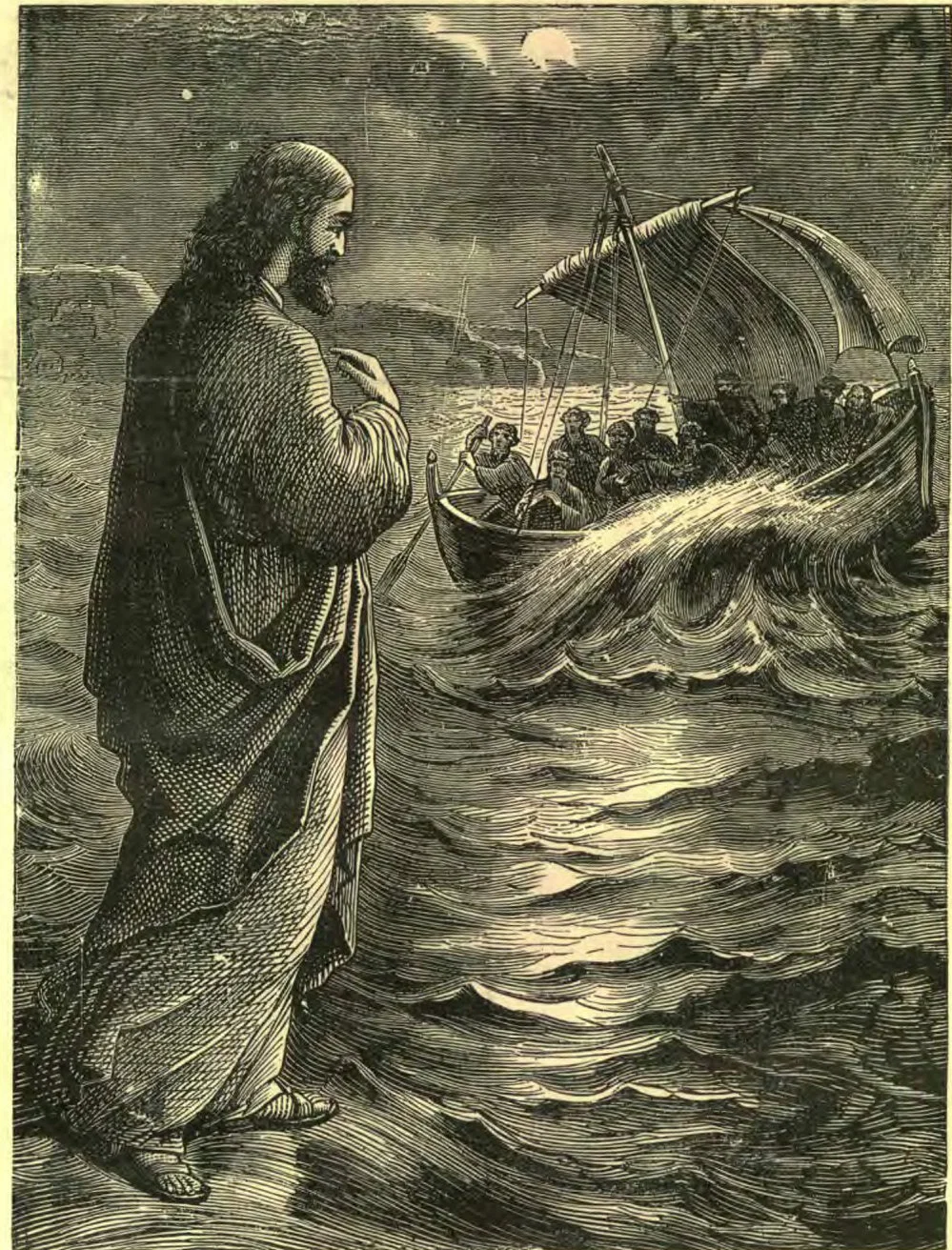
CHRIST WALKING ON THE WATER.

THREE of the evangelists,—Matthew, Mark, and John, give us an account of a remarkable miracle wrought by the Saviour on the Sea of Galilee. It was the circumstance of Jesus walking upon the water, in a violent tempest, as is so forcibly represented in the accompanying engraving.
The time, place, and occasion of this miracle are all very interesting to consider. Please open your Bibles at Matthew 14, and the sixth chapter each of Mark and John, and read the full history. By turning to John, we find that after the Saviour had miraculously fed the five thousand, the people were so impressed with his teachings that they said, “This is of a truth that Prophet that should come into the world.” Then the excited multitude, who hoped that the time had come for the Roman yoke to be broken off, were determined to come and take Jesus by force and make him king. The divine Redeemer, to guard against such an unwise transaction, immediately directed his disciples to take the boat and proceed to a place not far from Bethsaida, which was near to Capernaum, while he dismissed the multitude. It is more than probable that the disciples were highly pleased with the intentions of the people, and were very reluctant to embark; for Matthew plainly says, Jesus constrained them to get into a ship and leave.
The Saviour then compassionately dismissed the people, and afterward went up into a mountain alone, to engage in prayer.
In the meantime the disciples were in trouble. After entering the vessel, a wild wind swept down from the mountain gorges, and the bosom of the lake was furiously agitated. The dark night set in, and the disciples toiled at the oars, making but little headway. It was but a few hours' work in fair weather to reach the point they wished to make; but now they were driven off their course, their boat the plaything of an angry tempest. All the long, dark night, with tireless sinews, did the poor disciples buffet with the waves, at any moment liable to be engulfed by the waters. Doubtless they often thought of Jesus, and wished that the commanding presence of their Master was with them in the storm. Their faith was most sorely tried.
But had Jesus forgotten his disciples? Ah, no! When the disciples went to sea, their Lord went to prayer. In the distance, his divine eye pierces the darkness, and he sees the trouble and danger of his few followers. He would not suffer a hair of their heads to perish. “And in the fourth watch of the night Jesus went unto them, walking on the sea.” At first the disciples cried out for fear, and supposed that they had seen a spirit or apparition, as they saw the figure of a man stepping toward them upon the billows. But soon the well-known voice of the Saviour is heard in comforting tones, saying, “Be of good cheer; it is I; be not afraid!”
How soothing, how full of comfort those precious words must have sounded to the tempest-tossed disciples! Doubtless they were speechless with joy, and almost beside themselves. Their fears are gone, and the storm is forgotten, as they hail Jesus as their deliverer.
But the interesting narrative continues: “And he went up unto them into the ship, and the wind ceased.” Then the disciples, and the others that were with them in the bark, came and worshiped Jesus, saying, “Of a truth thou art the Son of God.” “And immediately the ship was at the land whither they went.” Thus we see that one miracle immediately succeeded another.
Our extremity is the Lord's opportunity. Jesus appeared to his disciples at the very moment they needed him most.
They “toiled in rowing.” We must use the oars on the tempestuous voyage over the sea of life, as did the disciples in that stormy night on the sea. Though the wind was “contrary,” and the disciples were likely to perish by the tempest, they did not tack about and come back to Jesus, and tell him they could not get to the place he wished them to go; but they did the best they could under the circumstances.
“It is I; be not afraid.” In the midst of their keenest sorrow, Jesus appeared to his disciples with a comforting message. Let us add to our faith courage.
Jesus' presence with his people, on the sea of life, is enough to make them cheerful, even though in the midst of a storm. G. W. A.

AUTUMN'S PROMISE.

“Whose seed is in itself, upon the earth.”
THE wild flowers cease their straying By every moss-grown wall, And where the winds are playing, The oak leaves fade and fall. The little herbs grow musty With overmuch of rain, The clinging vines grow rusty Where dew too long has lain.
We link with autumn only The tokens of decay, The meadows brown and lonely, The early-darkening day, The leaves that burn so brightly The fire not long can last, The flowers o'er which so lightly The breath of frost has passed.
But when the west winds wander, And when the frost is keen, In woods and pastures yonder A wondrous thing is seen, And when the rain-drops patter, And winds blow hard, I know Full many a seed they scatter,— These hands that early sow.
Full blithely they are doing, The work we can but guess, The while we all are rueing The Autumn's hopelessness; From brier and bush receiving The seeds they only reap, And with the kind earth leaving, The germs she well will keep.
Our eyes cannot discover, So dull they are and slow, How close the breezes hover, How far, on errands, go. The fragrant herbs withhold not Their treasure as they pass; Their thick-sown field is told not Down in the fading grass.
Beneath the vexing sadness That haunts the woodland ways, Wrapped in the glow and gladness Of happy harvest days, In every cheerful burden, The reapers bear along, I see a nobler guerdon, Unsung in harvest song.
In ruddy fruit, or golden, In ears of corn, or wheat, This added wealth is holden,— A promise strong and sweet. Dearer than grains that perish The clattering mill to feed, The farmer e'er must cherish, The precious, fragrant seed.
And Autumn's promise seemeth A sweeter, surer thing, Than that of which one dreameth Among the bloom of spring. A promise of the treasures Of all the unborn years,— A song of all their pleasures Sings Autumn in our ears.
— Christian Weekly.

PERSEVERING

The following story is one of the traditions of a manufacturing firm in Glasgow, Scotland. Thirty years ago, a bare-footed, ragged urchin presented himself before the desk of the principal partner, and asked for work as an errand-boy.
“There’s a deal o’ rinnin’ to be dune,” said Mr. Blank, jestingly, affecting a broad Scotch accent. “Your first qualification would be a pair of shoes.”
The boy, with a grave nod, disappeared. He lived by doing odd jobs in the market, and slept under one of the stalls. Two months passed before he had saved enough money to buy the shoes. Then he presented himself before Mr. Blank one morning, and held out a package.
“I have the shoes, sir,” he said quietly.
“Oh!” Mr. Blank, with difficulty recalled the circumstance. “You want a place? Not in those rags, my lad; you would disgrace the house.”
The boy hesitated a moment, and then went out without a word. Six months passed before he returned, decently clothed in coarse but new garments. Mr. Blank’s interest was roused. For the first time he looked at the boy attentively. His thin, bloodless face showed that he had stinted himself of food for months in order to buy these clothes. The manufacturer now questioned the boy closely, and found, to his regret, that he could neither read nor write.
“It is necessary that you should do both before we could employ you in carrying home packages,” he said. “We have no place for you.”
The lad’s face grew paler, but without a word of complaint he disappeared. He now went fifteen miles into the country, and found work in stables near to a night school. At the end of the year he again presented himself before Mr. Blank.
“I can read and write,” he said briefly.
“I gave him the place,” the employer said, years afterwards, “with the conviction that in process of time he would take mine if he made up his mind to do it. Men rise slowly in Scotch business houses, but he is our chief foreman.”—Christian Advocate.

A PEEP AT AFRICA.—NO 8.

SOUTH AFRICA.

In 1806, the country really entered upon a new era; for it then virtually became a British Colony. For several years the European settlers were troubled much by the natives, who stole their corn and cattle, burned their dwellings, and made war upon them. At the solicitation of Lord Somerset, Governor of the Colony, in 1819 England encouraged quite a large number of persons to go to South Africa. Lord Somerset, in making his appeal to the Home Government regarding the matter, gave a candid report of the dangers as well as the attractions that settlers would meet with; but when the Chancellor of the Exchequer (the treasurer) in 1819 asked the House of Commons to vote $250,000.00 for the encouragement of emigration to Cape Colony, nothing was said about the difficulties that would be met by those who should go. The country was described as “unrivalled in the world for its climate, natural beauty, and fertility.” When this vote was passed, a great many wanted to go, no less than 90,000 applying for permission to embark. Five thousand of these were accepted and given a free passage.
Three transport ships, the Nautilus, Ocean, and Chapman, entered Algoa Bay in the spring of 1820; and during the following months of that year, about a score of other ships followed, conveying the remainder of the emigrant band. The place where they landed had no name at that time; so the Governor, anticipating that it would in the future become an important town, named it “Port Elizabeth,” after his deceased wife. If you will get your geography, and turn to the map of Africa, you will find this place on the southern coast. Port Elizabeth is 450 miles from Cape Town by water, and not quite as far as this by land. Among the emigrants referred to was the Scottish lyric poet, Thomas Pringle. The first two or three years were years of privation and hardship. Wheat, which had been sown extensively, proved a failure, and the Colonists were kept from starvation by the liberality of England and India.
From 1825 to 1837 the Cape Dutch Colonists, dissatisfied from various causes, continued moving into the interior. Their avowed object was to get beyond the control of the British Government. It is said that in about two years, from five to ten thousand voluntarily left their homes on the coast regions. They sold their property for whatever they could get, “many a good estate being hastily exchanged for a wagon and team of oxen, and some for even less value.” A recital of their adventures in the wilds of Africa, among warlike tribes, would not be in place here, but it will be sufficient to say that in after years they became the founders of the “Orange Free State” and the “Transval Republic.”
In 1850, Sir George Grey, who before this had successfully governed affairs in South Australia and New Zealand, was appointed Governor of Cape Colony. He did much to improve the condition of the people. About this time a most singular and fanatical movement was in progress among the natives of Kafirland. A prophet named Umhlagaza arose, claiming that he held converse with the departed Kafir heroes and chiefs. The message which he pretended that these dead heroes sent through him to all living Kafirs was, that if they would destroy all their cattle and corn and cease to cultivate the soil, it would be very much to their advantage; and that when this instruction was carried out, the past heroes and all the dead of the Kafirs were to arise, all cattle would also be restored to life, and the white man and the Fingoes (a tribe hostile to them), would all be swept from off the earth. The object of the delusion was to incite the natives, after their cattle and food were all destroyed, to make war on the Colonists; but there was so little unity in their plans for carrying out their purposes, that their efforts proved a failure. Indeed, the course they had pursued proved their own destruction. Thousands upon thousands of cattle were destroyed, and also large quantities of corn, to such an extent that hunger began to make fearful havoc among the followers of this fanatical prophet. It has been estimated that 25,000 Kafirs perished by the famine which they had themselves created. Like the Indians of North America, many of the native tribes are becoming extinct.
D. A. ROBINSON.

NEW ORLEANS, OR THE CRESCENT CITY.

Nearly all the large cities in the United States have received a nickname from some circumstance connected with their origin or early history. New Orleans is called the Crescent City. We want to tell you why it was so named.
Within the limits of the city, the Mississippi makes a sudden turn to the south, then to the east, and then toward the north, thus forming two sharp but regular arcs of a circle. The business portion of the city lies in one of these arcs, on the convex side, and it is from this circumstance that New Orleans derives its nickname. The city extends along the left bank of the river for ten miles. The principal part of it is on the left or east bank. On the right bank of the river the city has two suburbs, called Gretna and Algiers, which are four miles in extent.
It is supposed that the waters of the sea once covered the spot where the city now stands. The soil was formed by the deposit of silt brought from the interior of the continent by the river. The first settlement was made by the French under Bienville, in 1718. He gave the place the name of New Orleans in honor of the family then reigning in France. In the year following, the settlement was abandoned on account of a heavy overflow. In 1727 the Jesuit Fathers and the Ursuline Nuns arrived, and made the establishments which exist to-day. A large portion of the religious people and the principal institutions are Catholic.
In 1769, the city was visited with that dreadful scourge, the yellow fever. It was brought in a British vessel hailing from Africa, with a cargo of slaves. In 1803, France ceded the territory of Louisiana to the United States. New Orleans at that time contained about 8,000 inhabitants. The population has since rapidly increased.
Nearly every race on earth is represented in the city. All shades of color can be seen, from the pale Caucasian to the ebony sons of Africa. The Creoles, or descendants of the Latin race, predominate. The American element proper comes next, and the German, Jews, and Irish follow in order mentioned. The principal business men are Jews. They have a number of fine synagogues in the city. Their services are usually held on Friday night. They form several different sects. They all believe in the seventh-day Sabbath, but all do not keep it. The men have the odd custom of keeping their hats on during the services, and they request strangers to do the same.
At the present time there is a railroad in process of construction from Ship Island, situated in an arm of the Gulf of Mexico, to a place called Gulf Port on the coast of the State of Mississippi. Piles are driven down upon which the track will rest. It is feared by the citizens of New Orleans that this will cut off the Ocean traffic from the Crescent City. Gulf Port, now inhabited by pine trees, bids fair to become the metropolis city of the South. It will be 118 miles nearer Chicago than any other southern port, and the cost of traffic will be 25 per cent less. Preparations for the building of the city have already commenced, and considerable excitement is manifested. E. HILLIARD.

WHO? WHY? HOW LONG?

WHO should work for missions, God's kingdom to advance? Each and all, both great and small, Whoever has a chance.
Why? Because He bids it,— Because so great the need; If one wants bread, he must be fed, Or he will starve indeed.
How long shall we keep at it? How soon may labor cease? We must keep on till all are won Who'll serve the Prince of Peace.
And so we, here, from year to year, Keep up our Mission Band; We must not pause, for still the cause Needs every heart and hand.
—Children's Work for Children.

TO SCHOOL-BOYS.

Every boy cannot carry off the first prize for languages or mathematics in his school, but every boy can be perfect in conduct if he will. And for the comfort of those boys who do not rank first in class I will say, that although rank in class is always worth trying for, and every boy is bound to do his best, yet it is not always the most brilliant scholars who make the most successful men.
I was reading not long since the experience of a gentleman who gained a part of his education at that historic school, the oldest one in America, which is called the Boston Latin School. He says:—
“I came home from this school at the end of the first month with a report which showed that I was ninth in a class of fifteen; that is about the average rank which I generally had. I showed it to my mother because I had to.
“To my great surprise and relief she said it was a very good report. I said I thought she would be displeased because I was so low in the class.
“‘Oh,’ said she, ‘that is no matter. Probably the other boys are brighter than you. God made them so, and you cannot help that. But the report says you are among the boys who behave well. That you can see to, and that is all I care about.’”
That boy is now Rev. Edward Everett Hale, one of our wisest philanthropists, and one of our most brilliant writers.—Christian at Work.

A REMARKABLE TREE.

In the Bible we often find people compared to trees; and as I walk through the woods, I find myself thinking that the different trees are like my different acquaintances. There is a white birch that found itself in the middle of a big rock with very little earth in which to grow; but it has conquered every difficulty, and has put out its slender roots until they have encircled the rocks, and reaching far into the ground underneath, have raised the mass in their slow but sure growth. I have named that tree after a friend of mine, a delicate girl whose family and circumstances were like the big rock and little earth. But she made the best of her circumstances, and by her own unaided efforts reached out a root here and another there, until she had made her own growth sure, and raised her family with her.
Then there are the gay trees that don their bright dresses long before the sedate trees have thought of putting off their working clothes. There are the evergreens—the Quakers among trees—who keep on their quiet dress year after year, and live their sturdy lives in places where other trees would die of monotony.
But the tree I started to write about is in Sullivan County, N. Y., and reminds me of men, who, though past the scriptural limit of life and usefulness, are still hale and hearty and doing grand work. This tree is an apple tree, whose circumference six inches from the ground is 14 feet 5 ½ inches, and seven feet from the ground, 11 feet 7 inches. It has a single round trunk, and its mean height is over 50 feet. It has been bearing fruit over seventy years, and still shows no signs of declining usefulness. It is certainly a fine sample of a “green old age.” And any one is fortunate when, like the tree, his years are more than three-score and ten, if their strength be not “labor and sorrow.”—Christian Advocate.

Reading Without Reflection Like Eating Without Digesting

To read without reflecting is like eating without digesting.—Burke.

FALL CRICKETS.

I SHOULD like to call the attention of the young readers, writes I. N. L., in The Examiner, to a little insect familiarly known in Central New York, and perhaps in other localities, as the “Fall Cricket.” He is of a pea-green color, an inch or more in length—a grasshopper rather than cricket, I think, for he is both hopper and flyer.
My attention was first called to him when I was a boy, because he was a sign that just six weeks from his first note the first frost would occur, and farmers planned accordingly. Corn must be cut up, if possible, and everything secured from harm by the time indicated. Since then, whether student or educator, I have been a close observer of him, not as a sign, but because he is interesting.
He is a great musician, perfect in time and intonation. His compass is at least an octave, and the number of notes varies from twenty to two hundred a minute. The time for the concert is at night, though a piper may be heard occasionally during the day if his covert is well protected, or the day dark.
Now take a seat with me about sundown. Listen! There are several notes from a single insect, and he stops. Another strikes up like him and stops; then another and another, till perhaps ten or twenty have done the same. Since temperature governs largely, there has been a variety of pitches, some higher, some lower; and the rate has varied, some faster, some slower. This process is kept up for perhaps an hour, until at last all have the same key and the same time. Were it not for the volume of sound, you would say there was but a single performer.
All night this is kept up with no lull; if you listen in the early dawn, you will find the rate diminished and the key lower. Still time and tune are perfect.
As cold weather approaches, the orchestra diminishes in number until, at last, one or two seem to be performing their own death march—a note once in two or three seconds, as low as it is unmusical.—Sel.

PRAYER

LESSON 15.—OUR SAVIOUR'S RECORDED PRAYERS, Continued.

PRAYER FOR HIS DISCIPLES.

1. When Jesus had finished his work of teaching, and of giving a spotless example to men, what prayer did he offer? John 17:4, 5.
2. For whom did he specially pray at this time? Verse 9.
3. What did he ask for them? Verse 11.
4. What attendant blessings did he invoke for them? Verses 15, 17.
5. Who are included in this prayer? Verse 20.
6. What state of unity does he pray that they may all maintain? Verse 21.
7. Why does he so earnestly desire this degree of oneness? Verses 21, 23.
8. Why does he pray that all his disciples may finally be with him in glory? Verse 24.

THE PRAYER IN THE GARDEN.

9. What prayer did Jesus make just before his betrayal? Matt. 26:39.
10. Which of the disciples were nearest to him at this time? Verse 37.
11. What did he say to them about his feelings? Verse 38.
12. What did he ask them to do? Same verse.
13. What did he say to them when he returned from prayer and found them sleeping? Verse 40.
14. What admonition did he give them? Verse 41.
15. How many times did he make the same prayer, and find the disciples asleep at each return?
16. How great was the agony of his prayer? Luke 22:44.
17. How was he strengthened? Verse 43.
18. What command has this same Lord left us? Mark 13:35–37.

SUPPLEMENTARY QUESTIONS.

1. What passages teach that the prayers of the saints may aid the minister to speak with power, to gain a hearing, and make his work acceptable? Eph. 6:19, 20; Col. 4:3; 2 Thess. 3:1.
2. In what other important ways may the minister be helped by the prayers of Christians? 2 Cor. 1:11; 2 Thess. 3:1, 2; Phil. 1:19.
3. What part should Christians be sure not to forget while trying to secure proper ministerial labor? Matt. 9:38.
4. How are we exhorted to pray earnestly for all men, especially for those who are in authority? 1 Tim. 2:1, 2.
5. What special instruction did the Saviour give his disciples with reference to prayer? Matt. 6:5–7.
6. How was the Saviour himself accustomed to pray? Matt. 14:23; Mark 6:46; Luke 6:12.
7. What examples may be given from the record of prophets and apostles? 1 Kings 17:19–21; 2 Kings 4:33; Dan. 6:10; Ps. 55:17; Acts 10:9.

COMPENDIUM.

When Jesus had finished his work of teaching, and of giving a spotless example to men, he made a very earnest and touching prayer for his disciples. It opened thus:—
“I have glorified thee on the earth: I have finished the work which thou gavest me to do. And now, O Father, glorify thou me with thine own self with the glory which I had with thee before the world was.”
In John 17:9 he says, “I pray not for the world, but for them which thou hast given me.” In verse 11 he says, “Holy Father, keep through thine own name those whom thou hast given me, that they may be one as we are.” In verses 15 and 17 he prays that they may be kept from the evil, and that they may be sanctified through the truth.
But his prayer was not confined to those who were then his disciples; for in verse 20 he says, “Neither pray I for these alone, but for them which shall believe on me through their word.” Thus his prayer reaches every believer from that time until he shall come again; and he prays, “That they may all be one, I in them, and thou in me, that they may be made perfect in one, and that the world may know thou hast sent me, and hast loved them as thou hast loved me.”
He also prays that they may be with him hereafter in order that they may behold his glory.
Just before his betrayal, while in the garden of Gethsemane, Jesus prayed, saying, “O my Father, if it be possible, let this cup pass from me: nevertheless, not as I will, but as thou wilt.” To Peter, James, and John, who were near, he said, “My soul is exceeding sorrowful, even unto death: tarry ye here, and watch with me.” On returning from his prayer, he found them sleeping, and said, “What, could ye not watch with me one hour? Watch and pray, that ye enter not into temptation.” Three times he went away and made the same prayer, and three times he found his disciples sleeping when he returned.
While praying, his agony was so great that Luke says, “His sweat was as it were great drops of blood falling down to the ground.” “And there appeared an angel unto him from heaven, strengthening him.”
This same Lord left us this most solemn admonition: “Watch ye therefore: for you know not when the Master of the house cometh, at even, or at midnight, or at the cockcrowing, or in the morning; lest coming suddenly, he find you sleeping. And what I say unto you I say unto all, Watch.”

CONDENSED ANALYSIS.

1. The Saviour's prayer for his disciples:—(a) Having finished his work upon the earth, he asks to be reinstated in his former glory. (b) He prays not for the world, but that his disciples may be one, that they may be kept from the evil, and sanctified through the truth. (c) The prayer extended to include all who should afterward believe on him. (d) He prays that all his disciples may be with him to behold his glory in his coming kingdom.
2. The prayer in Gethsemane:—(a) He submissively asks that the cup may pass from him if the fulfilling of his mission will allow of it. (b) His extreme agony. (c) The strengthening angel. (d) A solemn admonition to all believers.

PAPER IN THE MECHANICAL ARTS.

There seems to be no end to the multifarious uses to which paper can be put in the mechanical arts and in the manufacture of almost every article which enters into use. In many cases it is even usurping the place of iron and steel. The latest paragraph in this direction is from Chamber's Journal, which reads as follows:—
Doors, which one would think were polished mahogany, but that they swing so lightly and are free from swelling, cracking or warping, are composed each of two thick paper boards, stamped and molded into panels and glued together with glue and potash and then rolled through heavy rollers. These doors are first covered with a water-proof coating, then painted and varnished and hung in the ordinary way. Few persons can detect that they are not made of wood, particularly when used as sliding doors.
Black walnut is said to be getting very scarce in this country, but picture-frames are now made of paper and colored like walnut, and are so perfect that no one could detect them without cutting them. Paper pulp, glue, linseed oil and carbonate of lime or whiting are mixed together and heated into a thick cream, which, on being allowed to cool, is run into molds and hardened.
Drawing-rooms can be set off by handsome pianos manufactured from paper, a French invention. A beautiful musical instrument of this kind has lately been an object of great curiosity to the connoisseurs and musical savants of Paris. The entire case is made of compressed paper, to which is given a hard surface and a cream-white, brilliant polish. The legs and sides are ornamented with arabesques and floral designs. The exterior, and as much of the interior as can be seen when the instrument is open, are covered with wreaths and medallions, painted in miniature by some of the leading artists of Paris. The tone of this instrument is said to be of excellent quality, though not loud. The broken, alternating character of piano music is replaced by a rich, full, continuous roll of sound, resembling somewhat that of the organ. Only two of these instruments have been made. One is still on exhibition; the other has been sold to the Duke of Devonshire.—Exchange.

CURIOUS FACTS.—NO. 3.

There is iron enough in the blood of 42 men to make a plough-share weighing about 24 pounds.
A man is half an inch taller in the morning than at night, owing to the relaxation of the cartilages of the spinal column.
It is estimated that nearly two years’ sickness is the lot of every person before he is 70 years of age, or ten days per annum as the average. Until 40 years it is not half of this, but after 50, it rapidly increases.
The dwarf, Jeffrey Hudson, was 3 feet 9 inches, and Count Borowlaski, 2 feet 4 inches tall.
The skeleton of a man weighs from 12 to 16 pounds, and the blood, 27 or 28 pounds.
Turtles have been known to live for 120 and even 200 years.
In 1813 a boa constrictor was killed which measured 14 feet 6 inches in length. In his stomach were found several animals partly digested.
The eyes of a fly consist of immense numbers of convex lenses. In the eye of a dragon-fly, over 25,000 have been counted.
In the summer of 1829, a shower of crabs fell with heavy rain in the yard of the poorhouse at Reigate, England, each weighing two ounces.
Wild ducks fly 90 miles per hour, swallows a little faster, and the swift flies over 200 miles an hour.
There are 6 or 7 generations of gnats in a summer, and each lays 250 eggs.
The jump of a flea, grasshopper, or locust is 200 times its own length, equal to the jump of a quarter of a mile for a man.
Many spiders, moths, and beetles counterfeit death when in danger, and no torture will make them show signs of life while the danger continues.
A single female house-fly produces, in one season, 20,080,320 young!
A toad was found in a well, at Organ, France, which had been covered up for 150 years. It was torpid when found, but revived on reaching the air.
Spiders have four pouches for spinning their threads, each pouch having 1,000 holes. The web is the union of 4,000 of these threads. No spider spins more than four webs. When the fourth has been destroyed, it seizes on the web of another.
The art of paper-making has reached a point where a growing tree may be cut down, made into paper, and turned out as a newspaper, all within thirty-six hours.
The explosive force of gunpowder when confined is 6½ tons to the square inch. In dry air it will speed a bullet 1700 feet in one second. In damp weather, only 1200 feet.

ODD WAYS OF THE CELESTIALS.

CHINAMEN have a habit of storing 40 or 50 cents in 10-cent pieces in their ears, to save, no doubt, the trouble of feeling in their pockets for such small change. Another curious thing in connection with the Chinese is their custom of putting coins of various denominations in the mouths of the dead. These coins fall into the hands of the coolies, who scrape the bones of the disinterred bodies, and through them pass into general circulation. It is said that a $50 gold slug was found in the mouth of a Chinese body disinterred at the Chinese Cemetery recently, while it is a frequent occurrence to find gold $5 and $10 pieces. Taking into consideration the foregoing facts, it is, indeed, an unsafe habit to put money into one's mouth, especially when it is not known whether the Chinaman ever washed his ear, or whether the deceased died of leprosy, smallpox, or something else as bad. Some ladies have a bad habit of putting small change into their mouths previous to paying the car conductor, who, in turn, puts the money into his mouth while making change. To those who practice this habit this bit of information should be a warning.—San Francisco Examiner.

IN GREEN PASTURES.

You know what green pastures are, you who have so often driven the cattle into them, and watched how gladly they ate the tender blades of green grass; not the dried, shriveled grass of a time of drouth, but the tender herbage that springs up after the warm, refreshing showers. It is in such fields that the cattle thrive.
When the Lord has given his people a great many good things for the body and the soul, he speaks of their being fed and lying down in green pastures. He pictures his people under the figure of sheep, and their blessings, “green pastures,” “good pastures,” and “fat pastures.”
Sometimes when you are studying the Bible, you will find it very pleasant to hunt up all the texts that have the word pasture or pastures in them, and see what great blessings the Lord has named under the figure of pastures for his sheep, or people.
And so we often think of the readers of the INSTRUCTOR, as feeding in good and green pastures. We liken their many blessings in the carefully prepared Sabbath-school lessons, the children’s meetings, the “precept upon precept” in the INSTRUCTOR, and all their other good instructions, as so many green, fat pastures, where, to use another figure, they may “grow up as calves of the stall.”
In these uncommon times, dear children, you have special opportunities. Like Timothy of old, you may, from a child, know the Holy Scriptures, which are able to make you wise unto salvation, those texts which shall in times of great temptation be your shield and buckler.
There is coming a day, not very far in the future, when the Great Shepherd will seek out his flock, and “feed them in a good pasture, upon the high mountains of Israel.” There will be one fold, and one Shepherd; the pastures flowing with everlasting springs, the herbage will not wither; the Lord being the Shepherd, his sheep shall not want.
If you belong to his “little flock” when he is seeking out his sheep, you will be one of his “good fold” by and by. At that time, the promise is, “We may dwell safely in the wilderness, and sleep in the woods;” for there will be nothing to harm or destroy in all God’s holy mountain, or in all the new earth. Let us each be wise, and daily “grow in grace and a knowledge of our Lord Jesus,” so that we may feed in his good pastures when his flock is no more a prey to the enemy.
M. J. C.

SPECIAL PREMIUM OFFER.

SABBATH READINGS.

For every new subscription, accompanied with 85 cents, we will give either of the four volumes of SABBATH READINGS. These are composed of choice sketches, stories, poems, etc., adapted to the wants of youth and children, and contain more reading matter than can be found in many dollar books. Remember, for only TEN CENTS in addition to the regular subscription price, each NEW subscriber obtains the paper one year and the above-mentioned valuable premium.
Address, YOUTH'S INSTRUCTOR, Battle Creek, Mich., Or, PACIFIC PRESS, Oakland, Cal.
Continue reading: THE DOG OF ST. BERNARDS