The Youth’s Instructor, Vol. LII, No. 22

The Chinese New-Year

The Youth’s Instructor

May 31, 1904

Review and Herald Publishing Assn. · Washington, D. C. · May 31, 1904

The Chinese New-Year
To residents in Occidental lands the ways of the Oriental are strange and interesting. The Chinaman writes from right to left and from top to bottom; the Hindu covers his head and bares his feet in the presence of his superiors; the Japanese saws by pulling his implement instead of pushing it; and the Malay tailor sews with the point of his needle away from his body, instead of toward him, as in the case of Western tailors; that is to say, he pushes the needle outward instead of inward.
In like manner the Chinese New-year is an event of far greater importance than is our New-year to us. It is a “movable feast,” as the reckoning depends upon the time of the moon rather than that of the sun.
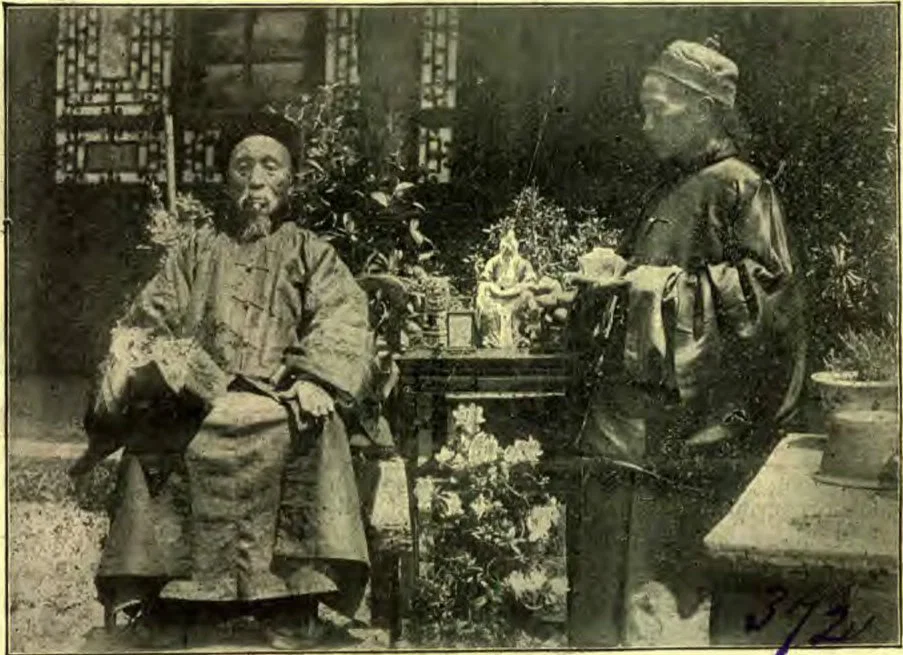
CHINESE LITERATI
CHINESE LITERATI
It may come as early as the middle of January, or as late as the middle or end of February.
All business transactions that can possibly be closed up are adjusted; all debts paid; all stock taken; all profits for the old year reckoned up; the entire house receives its annual cleaning; and the greatest excitement, especially among the children and youth, prevails at an increasing degree as the New-year approaches. The rich have new garments made, and new decorations added to the house and grounds. The poor always afford some little addition to their cheap finery, and all work is laid aside the day before the first day of the Chinese new year, which is called the “little New-year.” More or less of a fusillade of firecrackers is heard on the evening preceding the New-year’s morning, and all through the night, too, for that matter. The amount of money expended in this way runs up into the thousands in a small community of Chinamen, and in China proper it must reach the millions. They have small crackers and large crackers, crackers in bunches, and crackers one by one. They fasten them in long bunches or ropes from two to twenty feet long, having the smaller ones at the bottom, and increasing in size as they ascend, until the last ten or twenty are giant crackers. Last of all there is a thick round bunch of rather small ones, which go off rapidly with a whir-r-r-r! These ropes are suspended from a second-story window or a pole in the ground. The streets are impassable for horses and carriages, and the foot-passenger must keep his wits about him if he does not want to get into trouble. The ground is always red with the rent and riddled remains of the crackers that have been exploded, particularly in front of the Chinese houses and stores. A Chinese New-year without firecrackers would be like a Fourth of July on which no boy should be heard letting off a dozen or more bunches of fireworks. There is this difference, that while to the American child the fireworks are a useful adjunct in giving expression to his exuberant spirits, to the Chinese boy there is something more than that. It is a sort of religious performance by means of which the evil spirits are frightened away, and a safe and propitious beginning made for the new year, which it is hoped will bring much prosperity and happiness.
There is no doubt whatever that the Chinaman has, or thinks he has, a jolly good time at New-year, and it doesn’t end with one day’s sport either. For two whole weeks he abandons himself to the pleasures and festivities of the season, which are of great variety, and furnish far too much opportunity for dissipation and drunkenness, not to mention gambling, which is one of the Chinaman’s worst vices. Free rein is given to his passions, and instead of being a time of merrymaking it is a time of sorrow because of losses at the gaming-table.
However, if the Chinaman is unfortunate or has occasion to sorrow, he carefully hides his feelings; for it would be bad taste and out of keeping with his fatalistic ideas to weep over losses that had to come to him anyway.
One of the ways in which the Chinese find pleasure is in decorating themselves with gorgeous attire, if their circumstances permit. They not only dress in brocaded silks of the most delicate tints of yellow, orange, pink, lavender, and blue, but the women especially load themselves with costly jewelry of various designs and set with precious stones. The gorgeousness of their apparel is beyond the imagination of one who has not seen them dressed in their most elegant robes.
The long outer garment is made of the most expensive silk, usually brocaded, and covered with the most elaborately embroidered flowers done in silk of various colors upon the darker background of peacock blue or deep sea-green. The borders of a rich orange are also embroidered in silk flowers, dragons, birds, or beasts of fantastic forms, drawn from Chinese mythology. The shorter, coat-like garment is perhaps of a delicate rose or cardinal, similarly ornamented. The shoes are of another color, but harmonizing with the rest of the costume. The head-dress is perhaps encrusted with diamonds, and the fingers loaded with diamond rings, while the ornaments about the neck are equally rich and elaborate. In fact, here may be seen a fine illustration of that luxuriousness which we read about in the first book of Kings in connection with Solomon’s magnificent equipage. It is also shown in the description of the temple which Solomon built.
New-year’s time is an excellent opportunity of beholding what the Oriental imagination is capable of in the matter of dress. It throws a very clear light also upon the apostle Paul’s instruction to the church concerning women wearing “braided hair, and gold or pearls or costly raiment.” Peter also alludes to the same thing in his first epistle, thus indicating that it was a fundamental principle of Christianity to put off such forms of ornamentation as unbecoming a modest Christian woman.
We have the same difficulty here. The one thing that absorbs the thoughts and mind of native women above all others, is the matter of dress. And gold is the great desideratum without which no woman is willing to be seen upon the streets. From this it will be seen how it is that these Oriental women are tempted to do things that no virtuous woman will do, in order to gratify this vanity that in all ages has been so great a snare to their sex.
If they are wealthy, they can gratify to the fullest extent this love of jewelry, but when they are not, they often gamble, in hope of gaining money to be spent thus. I have had trouble with some of our Christian women over this very thing. They must have gold ornaments. They thought about it and talked about and dreamed about it almost incessantly until I came to feel a perfect hatred of the very word for gold. I had to read them the Bible teaching upon this subject, and show them the evil of it all, but it has taken years to begin to open their eyes to the wrong of it. The Holy Spirit alone can work the change necessary before they are sufficiently spiritually minded to let go of these vanities.
But to return to the New-year festivities. On the first and fifteenth day of the first month the children are exempt from punishment, no matter what they do. You may be quite sure that they make good use of their liberty, although their wholesome fear of their elders keeps them within reasonable bounds. In the case of the youth it is not so well; for they are allowed to go about the town and to smoke and gamble and drink wine and beer; that is, the boys are allowed to do so; of course the girls must remain shut up in the home. They find ways of availing themselves of the liberty which the New-year brings for a day or two, we may be sure. From these things we can understand how true it is that, as an educated Chinaman of Singapore said recently, “The boys are given too much freedom, and the girls too little.” All this, of course, tends to ruin the morals of the boys, and to rob the girls of all independence of spirit or character.
Very early on the morning of the New-year the young men and their elders start out with their large red paper calling-cards with their names written in Chinese characters in black. Many of the babas, Chinamen descended from Malay mothers and Chinese fathers, have their cards printed in Malay with the Roman letter. They sometimes start out as early as four or half-past four in the morning, so as to get their calls all made before the heat of the day; also because a late caller is quite certain to be regarded as wanting in devotion to the customs of the race. It is good form, so to speak, to call early.
After returning home they are usually so weary and sleepy that they take a siesta, or rest, and then prepare for the pleasures of the afternoon and evening. Each one has his circle of friends, just as Western people do, and he meets them at feasts especially arranged for the celebration of the New-year festivities and good cheer. At these feasts they observe most punctiliously the etiquette prescribed by long ages of custom. Their code of manners touching these things is far more elaborate and precise than anything known in Western social circles.
The tables must be placed in just a certain position, and the host has a particular seat prescribed for him, and he may sit in no other. Each dish has its proper place on the table, and under no circumstances may it be placed elsewhere. The different courses are served in just one order, and all the details connected with them must be strictly observed, or the gentleman is regarded as boorish and untaught in manners.
The government licenses gambling, and those who wish to gamble must go to the licensed gaming-house; but of course there is continual gambling in private which escapes the notice of the police altogether, very frequently because the man whose business it is to see transgression has suddenly become blind to all that he sees. Bribery is a wonderful cataract on the eyes of the police. A missionary Bible woman in Singapore once saw a Scotch inspector of police hide a bank-note in his shoe at the door of a Chinese house where the women were gambling. Now and then through the perfidy of some loser in the game, his confederates are reported to the authorities, and thus he is revenged for the losses he has suffered at their hands. This, however, is an exceptional case. By far the worst gamblers are the Chinese women who squander all their own and their husband’s possessions in the hope of winning large fortunes. The shut-in life of these women is largely responsible for this. They are limited to the walls of their own or their husbands’ house till the habits of a lifetime are fixed upon them, and being restrained by the traditional Chinese exclusiveness, they are very much limited in their range of diversions. They can not read, and so they are superficial mentally. They must find some way to kill time and amuse themselves, and consequently gambling furnishes the excitement, and the hope of gain the fascination, that lead them on to their own and their husbands’ ruin. Only a day or two ago one of the leading Dutch merchants here lost fifty thousand guilders (twenty thousand dollars) through the gambling propensities of the mother-in-law of a Chinese business man who failed. This woman would stake not tens or hundreds, but thousands of guilders upon the issue of a single game. Of course she lost, and ruin resulted for her son-in-law; for he had to supply her with money, or suffer another form of disgrace which is dreaded more than failure in business, the disgrace of a family quarrel and being made the subject of every man’s quizzing and questioning.
Well, to return to the New-year. The government grants a license to the Chinese at their New-year (and the Malays at theirs) to gamble as much as they like without restraint; so in passing along the narrow streets, one sees groups of small boys collected around some old man of very shabby appearance, gambling for cents. In another place may be seen a crowd of young men squatting in a circle, their heads almost touching in their eagerness to see how the dice will fall. There is more or less loud talk, with now and then an angry altercation, and then the silence of the grave as they watch with devouring eyes the man in charge of the game shaking and casting the dice. The stakes are in silver.
It is sad beyond expression to see what power Satan has over the minds of men through this appeal to the worst passions of the human heart. It honeycombs all Oriental life. With the Malay the game-cock is the greatest fascination and large sums are expended not only upon the finest breeds of fighting cocks, but in bets on the results of a fight. This instinct to fight is so widely extended and so deeply seated that if you have a dozen hens and chickens, you have to separate the hens, or they kill one another’s chickens. Hens will fight with all the fierceness of the veteran cock of a hundred battles, and even little chicks hardly out of their shells will stand with bill to bill, and spar and strike in true imitation of their elders. We tried to keep a few fowls the year we were in the mountains at Fort de Kock, but this constant fighting made life a burden, and so we sold them all, and got some ducks instead. We ate the eggs, but not the fowls.
One of the most amusing things, at New-year’s and on other festive occasions, is to watch a crowd of grown men as well as children stand for hours before a Chinese Punch and Judy show. The story, of course, is more dignified and more interesting, but they do not understand a word of what is said; for it is all rendered in Mandarin. They have learned most of these popular stories from hearing them read or narrated by some wayside story-teller.
I must say that some of these exhibitions are very cleverly executed for marionette shows. The lifelike movements and attitudes are striking. The costumes are elaborate and suited to the characters. More interesting still is the live show itself. I remember at Singapore ten years or more ago seeing a great variety of these outdoor theatricals at the time of “All Souls’ day” celebration of the Chinese. By the way, there is a striking similarity between the so-called “Christian” festival and this pagan feast-day for the benefit of all the souls of the dead.
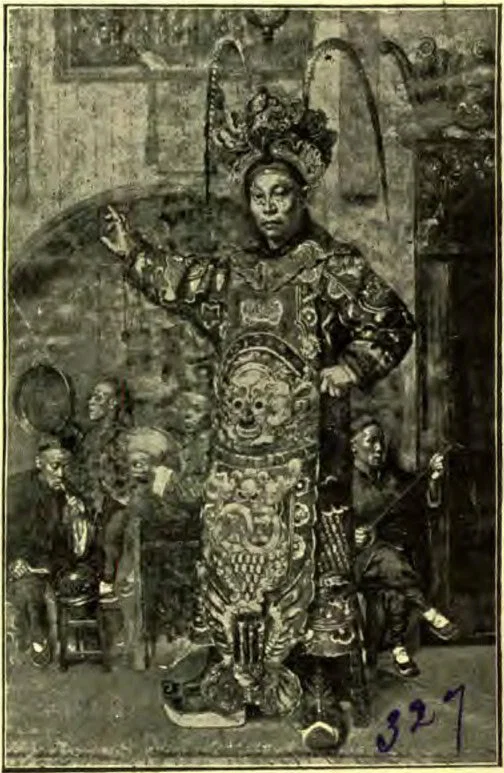
The glitter and dazzle of the costumes of these actors (see small cut on first page) was something most surprising, and must have entailed enormous expense. It was a fine example of Oriental splendor, and is not often witnessed.
Practically no business is undertaken at the New-year, except in the shops and stores that supply the public with necessary food and clothing. All care is thrown off, and the time is devoted to revelry and pleasure.
R. W. MUNSON, Missionary in Sumatra. (To be continued)
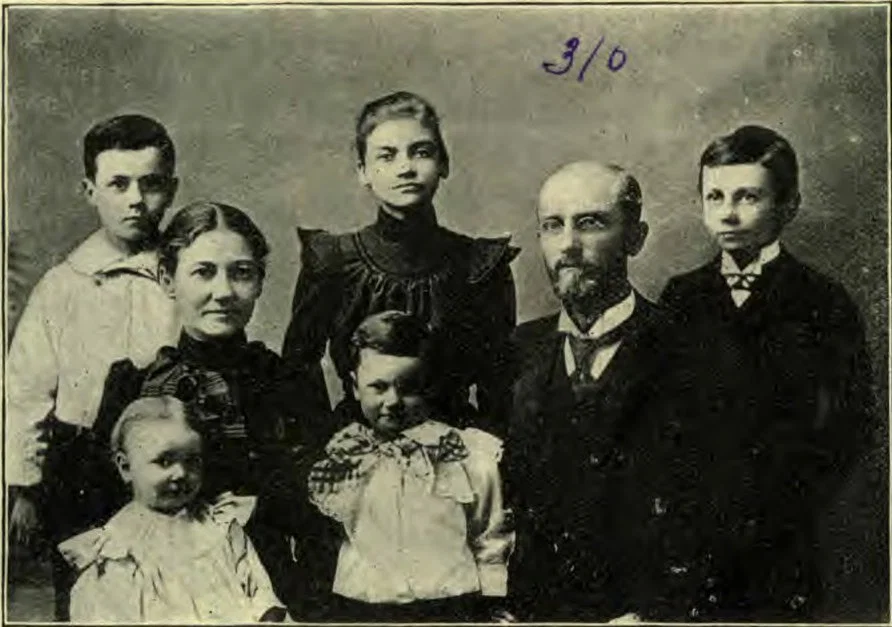
The picture on this page is of Elder Munson and his family.

The Heavenward Call

WHAT shall I do, my Lord, my God, To make my life worth more to thee? Within my heart, through earth abroad, Deep voices stir and summon me.
Through strange confusions of the time I hear thy beckoning call resound; There is a pathway more sublime Than yet my laggard feet have found.
The dearest voice may lead astray: Speak thou! Thy words my guide shall be, O, not from life and men away, But through them, with them, up to thee.
It is not much these hands can do: Keep thou my spirit close to thine, Till every thought thy love throbs through, And all my words breathe truth divine!
With souls that seek thy pure abode, Let my unfaltering soul aspire; Make me a radiance on the road; A bearer of the sacred fire!
—Lucy Larcom.

Why the Maple Makes Maple Sugar

THOUGH the Indians made maple sugar long before Columbus landed, and the Pilgrim Fathers in New England learned from them the art, which has been practised by white folk ever since, the phenomenon of the sweet sap-flow has remained up to now a partial mystery.
How does the sugar maple tree manufacture sugar? Why does it do so? What is the chemical process involved? And, finally, what is the mechanical cause of the spring flow of sap, when the tree is tapped, which amounts to something like fifty quarts for a good-sized maple.
Answers to these questions can now be given fully for the first time, thanks to a scientific study of the subject which has just been completed by the agricultural experiment station at Burlington, Vermont. That State produces one third of the country's entire yield of maple sugar, and, quite naturally, it afforded the most appropriate field for the investigation.
The tree is a sugar factory. Primarily, however, it is a starch factory, storing away food in the form of starch in its leaves and woody cells. The food is wanted for spring growth; but the sap can not dissolve starch, and so the latter is transformed by a special ferment into sugar, and, in the shape of a very dilute sirup, as one might say, is carried to all parts of the plant, to build up its living tissues.
This explains how the tree makes sugar, and why it manufactures such a product. But what is the cause of the sap-flow when the maple is tapped? That was, indeed, a most difficult problem; but it has been solved. The sugary sap in spring-time, it appears, travels outward to the twigs and growing leaves, and the sun's heat causes it to expand, exerting a pressure downward toward the roots below. When a hole is bored in the trunk, the juice is forced out.
It seems quite simple when explained, but the riddle of the maple was no easy one. To understand it one should realize that the inner body of the tree is a mass as lifeless as so much brick or stone. The life of the plant is in the sap-wood, next to the bark, which is made up of closely packed cells and vessels. Water enters through the roots and ascends the trunk, bringing food for tissue-building.
Eventually it escapes by evaporation through the leaves, which, under the influence of sunlight, manufacture starch, and, later, convert it into sugar.
The starch is stored away in the sap-wood cells in summer, and is transformed into sugar, for use the following spring, by the action of certain microscopic organisms called “enzymes.” These organisms cause a sort of fermentation, which brings about the metamorphosis, the sugar, as already explained, being dissolved by the watery sap, and carried in solution to the growing parts of the maple. The supply of sirup produced in this way is so plentiful that, by judicious tapping, many gallons of it can be drawn off annually without injury to the tree.
Various ingenious means have been employed by the scientists to ascertain every possible fact in regard to the physiology of the tree. Thermometers were placed at various heights, on the trunk and along the branches, to record the temperature of different parts of the maple, and ingenious indicators (with dials) were so adjusted as to show the force of the sap pressure at various heights. It was found that the sap pressure came from above, and not from the roots, and that it was greatest on sunshiny days. As for the temperature, it was much higher in the outer twigs and branches than in the trunk.
In late winter and early spring there is a great flow of water up through the trunk of the maple, which at all times contains much gas, within the cells of the sap-wood. The sunshine from above causes the gas as well as the water to expand as the branches at the top are warmed, and thus the pressure downward toward the roots becomes very strong. Then comes the sugar-maker, with his pail and auger, and through a hole bored in the trunk he draws the dilute sirup.
From what has been said, it will easily be understood why a maple with plenty of foliage and exposure to sunshine is a good sugar-maker. If, on the other hand, its leaves are scanty, and the supply of sunlight is inadequate, it is a poor producer. A sunny summer, other conditions being equal, brings a large crop of sap the following spring. So closely related are cause and effect in this matter, that a visitation of defoliating caterpillars will seriously lessen the sugar output of a region for the next season. The maple leaf is the starch-maker, and any damage that it suffers is reflected in the sugar production.
Maples well exposed to the sun give richer sap as well as more of it. Sap that contains three per cent of sugar is of good quality, but some trees do a trifle better, while others fall as low as two per cent. A good-sized tree ought to yield three pounds of sugar, which represents, it is estimated, from four to nine per cent of the total sugar contained in the maple. The larger percentage is for small trees.
It was found by experiment that most of the sap came from the wood nearest the bark, representing a depth of not more than one and one-half inches. Three inches, the scientists say, is deep enough to bore into the biggest trees. Sixty-three per cent of the total sap-flow is obtained between 9 A. M. and 12 M.; in the afternoon the flow steadily diminishes.
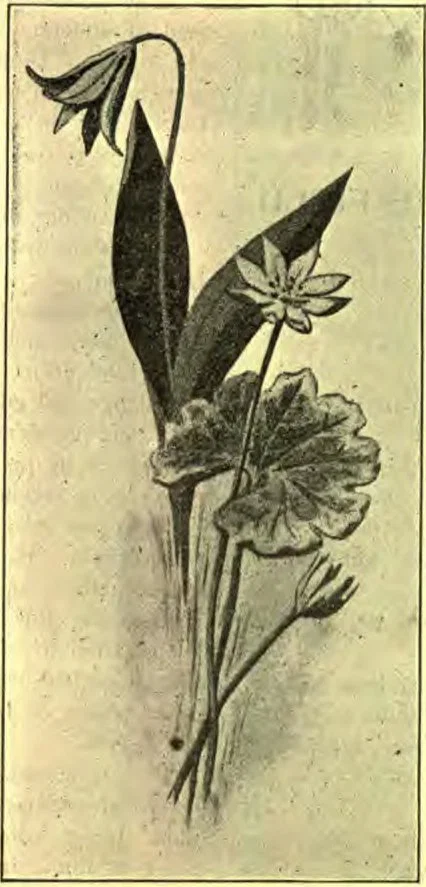
ADDER'S TONGUE AND BLOODROOT
Early settlers in New England, especially in Vermont, depended almost entirely upon the maple for their supply of sugar for domestic purposes. To-day maple sugar is an article of luxury, and to obtain it in a pure state has become difficult, owing to the prevalence and ease of adulteration. About forty-five million pounds are produced annually, representing a money value of three million dollars. The bulk of it is made in six States,—Vermont, New York, Ohio, Michigan, Pennsylvania, and New Hampshire, named in the order of their output,—and these furnish ninety-five per cent of the sugar and over eighty per cent of the sirup. Vermont supplies from a quarter to a third of the gross yield—from one third to two thirds of the sugar, and a tenth of the sirup. Her farmers realize not far from a million dollars annually from this industry; an interesting fact, when one remembers that the Indians tapped the maple trees in the forests and boiled the sweet sap in exactly the same fashion as is now adopted by the white men who have fallen heirs to their landed possessions.—Rene Bache, in Youth's Companion.

Lilacs

Ah, I've seen the pussy-willow With dainty, furry faces; I've found the pretty violets Abloom in shady places; The jonquil and the crocus Have told me of the spring, And in the orchard up and down Has glanced the bluebird's wing.
But here's the purple lilac That lifts its fragrant plumes, And sends a waft of sweetness Through homely cottage rooms, Its hardy branches tapping Against the farmhouse eaves, The flowers it gives us growing In generous, waving sheaves!
I'm sure the mother robin Is very glad to see The lilacs' screen about her Wee nest and fledglings three. And father wren is singing In pure delight to-day That spring is here already, And summer on the way.
And I am glad our Father Whose love is over all, Who counts the stars by number And sees the sparrow fall, Has sent again the lilacs To make the garden fair, And waft their honey sweetness Upon the wandering air.
— Margaret E. Sangster.

The Yellow Adder's Tongue

AMONG the joys of childhood in the country, that of searching for and welcoming the wild flowers is one that affords especial delight.
As acquaintance deepens our interest and increases our love for these little friends of the woods and fields, let us study together for a short time this unassuming flower, known as the Yellow Adder's-tongue. Very early in the spring when the sharp, purplish point first appears above ground, it looks like an adder's tongue. This is not the only name it bears, for it has several titles. Dog's-tooth violet is one, but it is wrongly applied, as it is not a violet at all. Trout lily is more applicable, since “the leaves are speckled like a trout, and because it loves brooks where trout hides.”
It was Mr. Burroughs who suggested Fawn Lily “because a fawn is also mottled, and the two leaves stand up with the alert, startled look of a fawn's ears.”
There is also a long hard name which some find difficult to remember; it is the Latin—Erythronium Americanum.
The adder's-tongue belongs to the aristocratic lily family. It grows from Nova Scotia to Florida, and westward to the Mississippi, blooming through the spring months, from March until May. We are familiar with only the pale-yellow, purple-marked blossom in the West, but there grows a white variety.
It loves the moist, open woods and brooksides, or shady spots in swampy places near the country roadsides.
The flower is terminal, solitary, and nodding, by which we mean that the plant bears a single blossom on the summit of the stem, and that it is not stiff and erect as some plants are, but bends gracefully from the top.
If you look at the perianth, or flower part, you will find six slender, recurved sepals and no petals, six stamens and one pistil. Some botanists, however, regard the flower as having three sepals and three petals.
The leaves are oblong, lance-shaped, of a pale-green color, mottled with purple and white. The stem rises from a corm or solid bulb, like the crocus.
We have read that the first settlers of Pennsylvania, remembering their “harbinger of spring” in the old world, called this early comer in the new land, “the yellow snowdrop.”
The speckles, or spots, help to guide fertilizing bees and butterflies to the nectaries found at the base of the flower, while the nodding blossom hinders robbers from crawling up the stem and stealing the nectar.
Children, and older ones too, who rightly study the things of God all about them, grow happier and wiser as the days go by; therefore don't forget to make friends with the things of nature.
CORNELIA SNOW.

The Roses Speak of the Rose of Sharon

“THE roses speak of the Rose of Sharon, The lilies of Christ of the vale: And every sweet flower unfolds his power, And his love that never can fail.”

A Sad Sight

“I DISCERNED among the youth, a young man void of understanding.” Prov. 7:7. Here is a sad sight. “Understanding,” or reason, is the glory of human nature. It is “the candle of the Lord,” to light us on our destiny. Where this is not, you have a traveler on a devious path without light; a vessel on a treacherous sea without rudder or compass.
Who is the young man void of understanding? He is one who pays more attention to his outward appearance than to his inner character. He spends more time at his toilet than with books. His grand effort is not to train his faculties in knowledge and goodness, but to have a fine presence and gentlemanly deportment, to make an impression by his person. This is sad, for it is folly; it is sacrificing the jewel for the casket.
He is one who seeks happiness without rather than within. He looks for pleasure, not in the contemplation of elevating subjects, and in the harmonious flow of holy sympathies, but in the gratification of his sensual nature. The tavern, the saloon, the ballroom, the theater, and various other places of like nature, are where he seeks his heaven.
This is a sad sight. Such a young man is “void of understanding;” for all true happiness must spring from within. The well of true joy must be found in the heart, if anywhere.
He is one who identifies greatness with circumstances rather than with character. To wardrobes, office, rank, wealth, he looks for true greatness, rather than to the cultivation of a noble character by diligent study and virtuous deeds. He who acts thus is “void of understanding.” True greatness is in the person, else nowhere.
He is one who is guided more by the dictates of his own nature than by the counsels of experience. He acts from the suggestions of his own immature judgment. To attend to the counsels of his seniors, his parents, and those who are further advanced in the path of life, he proudly deems beneath his dignity. The lessons of the past are nothing to him. “The bible of experience has no verse worthy of his notice. He is his own master. He will be taught by no one, not he.” He who thinks thus is “void of understanding,” and acts a lamentable part.
He is one who lives in show and ignores realities. He who lives in those pursuits and pleasures which are in vogue for the hour, and neglects the great realities of the soul and eternity, is “void of understanding.” And how lamentable a sight is this: the sight of a young man living and acting thus without understanding, a young man thus forming a wretched character for manhood and age—a young man, the hope of the future. Solomon intimates that he only saw one of this class among many. In this age, alas! they abound. They crowd almost every street, appear in every circle, and throng our places of resort.
Thoughtful men feel solemn at the sight. God looks down with pity, and longs to have these souls walk in the light he so freely sheds abroad everywhere. “The entrance of thy word giveth light; it giveth understanding unto the simple.” Ps. 119:130. ARTHUR FOX.

JUNE STUDY OF THE FIELD

The Orient

(June 11)

OPENING EXERCISES:—

Singing.
Scripture Reading — Isa. 49:1-16.
Prayer. (Let a number take part.)

FIELD STUDY:—

China’s First Missionary. Review, April 21.
The Karmatar Training-school. Review, April 14.
Our Work in Sumatra. Review, April 28 and May 5.
Lessons From the War in the East. Review, May 5.
Messages (one minute each) from Brazil, Cuba, Costa Rica, British Honduras, Canton (China), Paris (France), Sin Tsai Hsien (China).

CLOSING EXERCISES:—

Developments in Rome, A Sign of the Times. Three minutes. Review, April 21 and 28, May 12.
Prayer.

Using the Map at Mission Meetings

Notes

The use of the map will add materially to the interest of this meeting. Our work in the East is enlarging, and we can well afford to devote one entire service to a consideration of it. It may be desirable to drop out the messages from the field for one Sabbath. It depends upon the time at your disposal, and the number who take part. Aim always to make the meeting a spiritual blessing. E. H.

Other Missionary Garden Workers

An interesting force of missionary gardeners is found in Waverly, Maryland, in connection with the church-school. Four gardens have been planted, and each contains lettuce, radishes, sweet peas, and sweet corn. The teacher describes the work thus: “The corn is so arranged that it forms the dividing line between the gardens. At the front of the yard is a flower-garden having a row of grain with fancy striped leaves, then a row of brightly colored cockscomb for a background. Besides a few small flowers, we expect to have pansies and pinks. These have been started in boxes in the house. As yet the plants have not made their appearance because of the dry, cold weather; but we hope with the blessing of God to have many vegetables and flowers to sell for the missionary work.
“While sowing the seed, the children were taught the parables of seed-sowing, and I found that the practical part added more interest to the lessons. We learned that as each expects to reap what he sowed in his garden, so he must expect to reap the fruit of every act of his life. Among many other lessons was one that seemed of special importance. As great care was taken to properly prepare the soil for our garden seed, so we must allow God to prepare the soil of our hearts that the good seed sown in the schoolroom and elsewhere may spring up and bring forth a hundredfold.
“Sow thy seed, be never weary; Let no fears thy soul annoy, Be the prospect ne’er so dreary, Thou shalt reap the fruits of joy.”
“Thus while planting the seed to obtain means for carrying the gospel to others, we trust that we ourselves learned more thoroughly some of the real, gospel principles.”

The History of a Word

MISS BLAKE, our teacher, had been giving one of her talks on “Success,” and during the course of her remarks she spoke particularly on the theme of honesty and frankness. She had made her talk the more interesting by taking examples from the lives of great men who had achieved success through frankness in all their dealings. I was very much impressed with the subject, and on our way from the lecture-room the thought revolved in my mind, What is the meaning of this word “frankness,” and where did it originate? So, being aroused to the question, I decided to look it up. I turned to the dictionary, and found many things pertaining to this much-used word.
I learned that the Franks were a powerful German tribe which, at the breaking up of the Roman empire, overthrew the Roman power in Gaul and took possession, founding the Frankish monarchy, and gave origin to the name France. The Franks were then the ruling people, and were honorably distinguished from the Gauls and degenerate Romans, among whom they established themselves, by their independence, their love of freedom, and their scorn of lies.
They had, in short, the virtues which belong to a conquering and dominant race in the midst of an inferior one. And thus it came to pass that by degrees the name “Frank,” which may have originally indicated merely a national, came to involve a moral distinction as well; and the word “frank” was synonymous not merely with a man of the conquering German race, but was an epithet applied to a person possessed of certain high moral qualities. And thus in men’s daily talk, when they speak of a person being “frank,” or when they use the word “franchise” to express civil liberties and immunities, their language is the outgrowth, the record, and the result of great historical changes.
Thus, you see, is the history of that little word which signifies one of man’s strongest and most beautiful characteristics.—Thomas’ De Cator.
Continue reading: Thirsty Little Travelers