The Youth’s Instructor, Vol. LII, No. 22

The Chinese New-Year
Earlier text: The Chinese New-Year

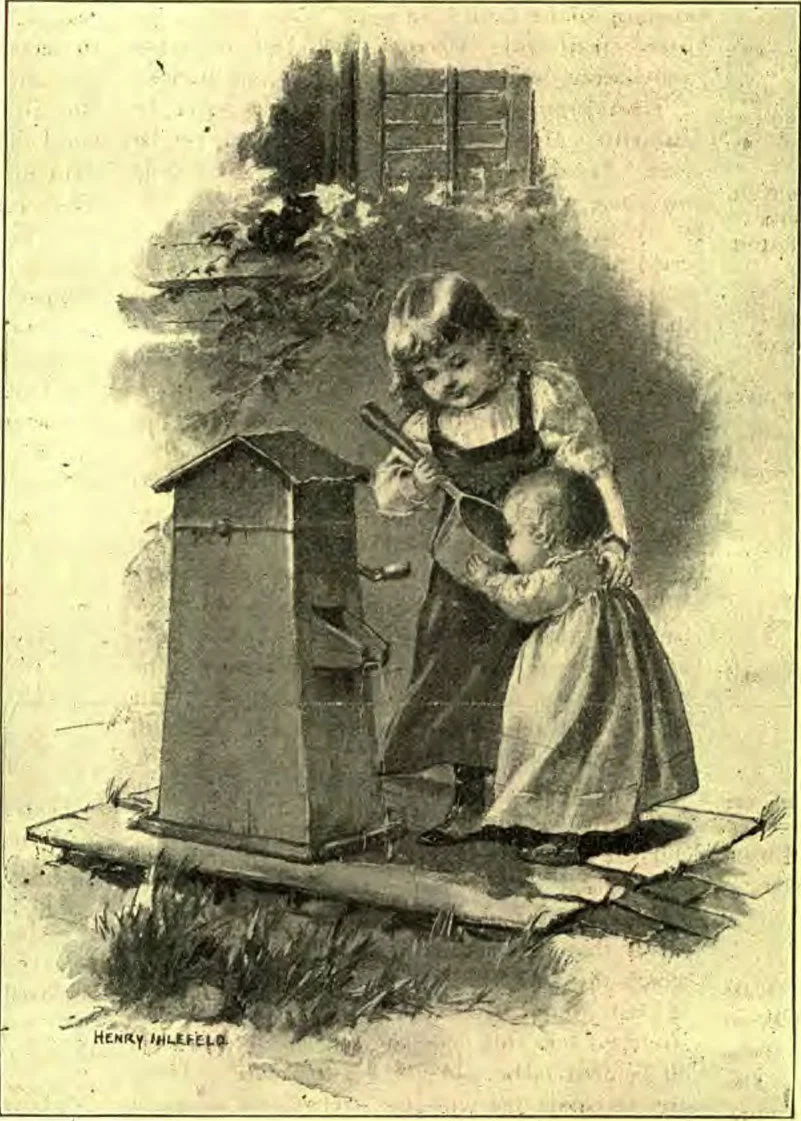
Thirsty Little Travelers

Two little travelers are Teddy and May. Long journeys they take in their morning's play, Exploring the brooks, the garden and lane. They range through the pasture and fields of grain; They visit points of the greatest renown Without so much as a shilling or crown. Their forests are stretches of waving grass, Their ocean the meadow, and there, alas! They often are shipwrecked among the flowers, And suffer delay for long, sunny hours. But though to marvelous places they fare, Their wanderings have but one end, for this pair Always return with a hop, skip, and jump, To refresh themselves at the dear old pump.
— Youth's Companion.

The Fate of Old Abe, the War Eagle

While the capitol building at Madison, Wisconsin, was burning on the twenty-seventh of February last, boys and girls, as well as men and women, wandered about the capitol park, exclaiming: “O, it is too bad they can’t get poor Old Abe out!” “O, why can’t they save poor Old Abe?”
Perhaps there are few boys who do not know something of the history of Old Abe, the war eagle of Company C, of the Eighth Wisconsin Regiment.
In the spring of 1861 Old Abe was an eaglet in a great, untidy nest in a tree among the Wisconsin forests. An Indian—Chief Sky, of the Chippewas—discovered his home on the banks of the Flambeau River, and capturing him, sold him for a bushel of corn. The purchaser, in turn, sold him for five dollars, and in the autumn of 1861 he came into the possession of Company C, of the Eighth Wisconsins, which was just then departing for the war. The soldiers named the bird Old Abe, in honor of President Lincoln. They made for him a perch in the form of a shield shaped like a heart, which, embellished with the stars and stripes, was mounted upon a staff and borne aloft beside the regimental flag which it was the glory of this company to carry.
The bearing of Old Abe at the head of the regiment called forth such wild enthusiasm that before leaving Wisconsin, Company C was offered two hundred dollars for him. When the Company reached St. Louis, the amount was raised to five hundred dollars, but the soldiers refused to sell him.
Old Abe seemed to realize the importance of his position, and conducted himself like a soldier. No soldier was braver in battle than was he. Though he was a target for many shots, and although the Confederate General Price once said, “I would rather capture the Wisconsin eagle than a whole brigade,” still the soldier bird was never wounded nor taken prisoner. He was a constant source of inspiration to the men. When the battle raged most fiercely, then it was that Old Abe appeared to be in his element; for, flapping his wings in the midst of the furious storm, he held his head erect, faced the flying bullets, and screamed his defiance.
TEDDY AND MAY
TEDDY AND MAY
Old Abe seemed always to know when there was danger in the night, and his note of warning more than once saved the soldiers from threatened danger. At times he was full of fun. On one occasion he snatched a chicken from a frying-pan, and whirled off like a rocket with his prize, amid the cheers of the soldiers and the execrations of the cook. He would often visit the tents, overturning buckets of water, tearing clothing, and committing all kinds of pranks. He never forgot an injury done him. One day he endured the insults heaped upon him by a negro boy who persisted in tormenting him; thereupon he attacked the lad savagely and drove him out of the camp, and was never afterward known to be friendly to the colored race.
One day he discovered a cup of peach brandy, which he promptly appropriated to his own use, and the soldiers saw the humiliating spectacle of their proud eagle staggering like a drunken man, but that was the only time he so misbehaved.
After the war was over, Old Abe came into the possession of the State of Wisconsin. The Captain of Company C, on presenting the bird to the governor, said, “Old Abe has been a good soldier, never flinching in battle nor on the march.” Although his fighting days were over, he did not cease to hold a conspicuous place in the public eye. He was carried about in processions and parades and made an object of interest at fairs, reunions, and conventions without number, sometimes appearing in a carriage or riding majestically on a cannon, or borne by his keeper on the old familiar perch, and everywhere greeted with cheers. He was one of the popular features of the Centennial Exposition in Philadelphia, and in the winter of 1878-79 he was a conspicuous figure at the old South Church Fair at Boston. Among his visitors there were a number of blind children, who longed to touch his plumage, as they could not see him. His keeper, willing to gratify the wish, placed his arm around the eagle’s neck and head, thus protecting them from his sharp beak, while they tenderly stroked his glossy feathers.
Once while attending a State fair, a dominick cock was given him for his dinner, and the crowd watched to see him devour his prey, but, strange to say, the eagle regarded the young fowl with favor and spared his life, the pair dwelling together in harmony until the close of the fair, when the cock was liberated.
When at home in Madison, Old Abe occupied a room in the basement of the State house, but he frequently visited Lake Monona for a plunge bath, and was often seen in the capitol park mounted upon an old cannon. In the spring of 1881 Old Abe died in the arms of his sorrowing keeper. The first thought was to bury him with military honors in the capitol city cemetery, where lie hundreds of soldier dead, but it was finally decided to have him mounted and kept in the war museum of the State house. Here the remains of the brave old soldier for years occupied a prominent position, still winning the attention of old and young, until a few weeks ago the cruel flames reduced what was once “Old Abe—The War Eagle,” to a handful of ashes.—The American Boy.

MYRTLE AMICK

Kindness

KINDNESS makes sunshine wherever it goes. It is one of the purest traits which find a place in the human heart. Each should have a kind word for every one; it may give happiness to some for a whole day, though it should not discourage one if his kindness is not acknowledged, for it is seldom that it does not have an influence for good. A kindness which appears very small to the giver, may seem great to the receiver, and may be the means of doing a vast amount of good.
One should not permit ease or any worldly pleasure to contract his affections, and cause him to become selfish; but he should think of the sorrow and distresses of others, and seek to relieve them. When a Christian, kindly habit is formed by one, its acts flow on like a stream, purifying his own life and that of others.
Kindness does not consist in gifts alone; a word may often be more effective. Surely all can afford to speak at least a few kind words each day, and thus bring cheer to many. Now is the time to scatter the seeds of kindness.

MYRTLE AMICK

Human Hands

The molding of the potter’s vessel, the beating of the golden flowers for the candlesticks in the holy place, the breaking of the bread,— these all required the ministry of human hands. The cutting of the diamond, the pruning of the vine, the beautiful painting, the duties of home and household, innumerable tasks, call for their aid. “Whatsoever thy hand findeth to do, do it with thy might.” Hands can not work that way without some “heart” behind them. Sir Philip Sidney says, “He serves best who serves because he loves.” What a touch of beauty is added to work that has the heart—the might—behind it! How we prize anything that a friend has made for us, because there is love behind the deed.
“Beautiful hands are those that do Work that is noble and good and true, Moment by moment the whole day through.”
It may be the gentle touch of the nurse on the fevered brow, or it may be the caress of sympathy, which is meant to give help to one bowed beneath the weight of sorrow or discouragement.
Human hands! How much they may do to make the world’s burden lighter! I remember reading of a family in which there were several girls, of various dispositions and tastes. But when anything needing painstaking or responsibility came to the household, the statement would invariably come, “Oh! Margaret will do that.” Always Margaret! And hers were the hands that were missed when she went to the country for a rest; then the buttons were missing from Bertie’s coat, and the rent in Alice’s dress was not mended, and many other things were there that missed the ministry of the faithful hands. Her enjoyment of music and art and nature was no less than that of her sisters, but she did what her hands found to do, cheerfully and with her might.
We may not all have the same way of being useful; our talent may not be so great as that of another, but our best, accepting reproof for that, if necessary, may help some one immeasurably—it must help one, at least, and that is one’s self.
Long ago in the old town of Nuremberg lived two boys, Albrecht Durer, and Franz Knigstein. Both aspired to be artists, and worked to that end. Albrecht Durer had genius; his companion enjoyed art and could appreciate its beauty, but could not picture on canvas the scenes that lit his imagination.
After years of study each decided to make an etching of the Lord’s Supper. When they compared their work, Albrecht’s was full of pathos and beauty, while Franz’s was cold and lifeless.
Then Franz realized that he could never be an artist. His heart was almost broken, yet he said, “Yours is the gift, but perhaps there awaits me some lowlier task somewhere.”
“Wait one moment, Franz, just as you are,” cried Albrecht, and seizing his pencil, he quickly sketched a picture of Franz’s hands, as he sat there in an attitude of surrender.
“Those hands may never paint a picture,” said Albrecht, as he showed the drawing to his friend, “but they most certainly can make one. They will go to men’s hearts in days to come.”
And they did, for Albrecht Durer’s famous “Folded Hands” is but a picture of Franz Knigstein’s, as they were folded on that day, in brave, sweet resignation, when he gave up his heart’s best wish, and yet believed that God had some homelier duty still worth his doing.
And so our hands may never accomplish the high task our fondest hopes set for them, yet if they do well the lowliest work of earth, they will receive heaven’s benediction.
“Whatsoever thy hand findeth to do, do it with thy might.”
Then comes the thought of those other hands that helped in the carpenter’s shop, that were folded in Gethsemane, and again in death; those hands that carried the cross; those hands into which the false scepter was pressed, and which at last were pierced on Calvary. They are stretched out still, bidding us, “Come unto me, all ye that labor and are heavy laden.” These are the hands that will give strength for the right performance of every duty whether high or low.
MAY COLE.

The Intensity of the Lover's Love

Not only is God love, not only did he love, but one word tells us of the intensity of that love—“so” loved. It is a degree beyond expression and conception. Lexicographers define the monosyllable “so” in its relations as adverb, conjunction, and interjection; but no one dares attempt to explain it in its relation to God's love. Scientists claim to have weighed our globe, and measured the distance between us and Mars; but no man dares attempt to weigh or measure this little word “so.” In this connection it is the Mount Blanc of the Biblical monosyllables, the hieroglyphic that human intelligence can not decipher, the incomprehensible word whose full meaning even the angels have failed to grasp.
Cicero is said to have seen Homer's Iliad written in such small characters that it could have been contained in a nutshell. In the Elizabethan age, Peter Bales, a celebrated calligrapher, is said to have written the whole Bible so minutely that the manuscript could be shut up in a common walnut shell. Wendell Phillips relates that he had a friend who owned a ring three quarters of an inch in diameter, on the seal of which was engraved the naked figure of Hercules. By the aid of glasses there could be distinguished the interlacing muscles, and every hair in the eyebrows could be counted. Queen Victoria had a needle which was made at Redditch, and which represented the column of Trajan in miniature. The well-known Roman column is adorned with numerous scenes in sculpture, perpetuating Trajan's heroic actions in war. On this diminutive needle, scenes in the life of Queen Victoria are represented in relief, but so finely cut that a magnifying glass is required to see them. Moreover, it can be opened, disclosing a number of needles in smaller size, which are adorned with scenes in relief. On the occasion of Pope Leo's jubilee, he was presented by the celebrated Neapolitan artist, Andrea Cartello, with a topaz weighing seven hundred eighty-four grains on which he had engraved a picture of “The Last Supper.” This design took the artist twelve years to accomplish, and the gem with its decoration is estimated to be worth eighty thousand dollars. But in this little word “so,” connected with the word “loved,” there is more to see, more to learn, than in a hundred of Homer's minute Iliads, or Victoria's needle, or the engraved topaz of Leo the Thirteenth. In it is expressed a love which baffles description in its extent, diversity, and vastness,—a love as incomprehensible as eternity,—a love that human thought can not fathom, nor human language describe. By the receding of the Falls of Niagara, geologists have endeavored to determine the antiquity of the river; but where is the geologist who can unearth the footprints of love, or the astronomer who can find its starting point? It existed long before the creation of the planet.
“Could we with ink the ocean fill, And were the skies of parchment made; Were every blade of grass a quill, And every man a scribe by trade,— To write the love of God above Would drain the ocean dry; Nor could the scroll contain the whole, Though spread from sky to sky.”
God “so loved.” Such a statement is not without proof. Everything demonstrates it. He so loved as to make a pure man to inhabit the world; so loved as to walk and talk with this man in the world; so loved as to devise a plan to save man when he fell a victim to temptation; so loved as to warn transgressors of their ways, and to give promises and hold out inducements to live holy lives; so loved as to give a Redeemer to restore unto man what he had forfeited by sin; so loved as to adopt into his family all who would approach him in the name of his Son; so loved as to prepare mansions for all in his celestial paradise.
And still he loves us. Are we weary? He desires to give us rest. Are we sad? He desires to give us joy. Are we weak? He desires to give us strength. Are we in darkness? He desires to give us light. Are we living in the shadow? He desires to lead us into the sunshine. Are we longing for home? He desires us to trust him; for said he, “I will come again, and receive you unto myself; that where I am, there ye may be also.”
“So loved!” O that every mind would grasp the thought of this phrase! then would youth and age, intelligent and ignorant, rich and poor, see in this little word the infinite ocean of God's affection. “God so loved”!
“His Word proclaims it; Day by day the truth we've proved; Heaven and earth with joy are telling, Ever telling, ‘God so loved!’” —William Pearce, in “The Lover's Love.”

Waiting for the Summerland and the Resurrection

Waiting

As an exile in some far-off place Counts the hours that he still must stay, Dreams of his home, and of each loved face, And longs to journey the homeward way,
So I, ’mid the wrecks and sands of time, Am waiting the call from the summerland, Waiting the hour when the King sublime, Shall come with his shining angel band,—
Waiting the time when the trumpet sound Shall raise from their slumbers the righteous dead, Waken the loved from the trembling ground, And call each child from its dusty bed.
Father and mother, I’ll meet you then, Sister and brother, I’ll greet you there, Meet you, never to part again, With your happy faces, and shining hair,
Never again to be sick or sad, To be weary or wrinkled, or wan and old, But with a rapture, that earth ne’er had, Pass through the beautiful gates of gold.
O, do you wonder I sigh for home? And long for the shadowless bliss of heaven, Waiting the time when my loved shall come Forth from the grave, with their fetters riven?
Waiting the time when my woes shall cease, And my age, as a dream, shall pass away— Waiting the rest, that perfect peace, When the glory of God shall abide for aye.
And many a time when the shadows fall, When the dews are weeping their pearly tears, I think that soon will the Master call His own to heaven’s unending years.
And harps shall quiver with sweetest airs, To welcome the loved ones homeward led, And fadeless flowers, both pure and rare, Shall strew all the path the redeemed shall tread.
And now, as an exile afar from home, I wait, in hope of that coming day, When the Saviour from glory shall bid me come, And then, I shall journey the homeward way.
L. D. SANTEE.

INTERMEDIATE LESSON

XI—The Jordan Divided—Other Miracles

(June 11)
LESSON SCRIPTURE: 2 Kings 2: 3-25; chapter 3.
MEMORY VERSE: “Even a child is known by his doings, whether his work be pure, and whether it be right.” Prov. 20: 11.
When Elijah was caught up in the chariot of fire, his mantle fell to the ground, and Elisha took it up, and went back, and stood by Jordan. “And he took the mantle of Elijah that fell from him, and smote the waters, and said, Where is the Lord God of Elijah? and when he also had smitten the waters, they parted hither and thither: and Elisha went over.” When the sons of the prophets saw the river parted, they said, “The spirit of Elijah doth rest on Elisha.”
Elisha stopped for a while at Jericho. “And the men of the city said unto Elisha, Behold, I pray thee, the situation of this city is pleasant, as my lord seeth: but the water is naught, and the ground barren. And he said, Bring me a new cruse, and put salt therein. . . . And he went forth unto the spring of the waters, and cast the salt in there, and said, Thus saith the Lord, I have healed these waters; there shall not be from thence any more death or barren land. So the waters were healed. . . .
“And he went up from thence unto Bethel: and as he was going up by the way, there came forth little children out of the city, and mocked him, and said unto him, Go up, thou bald head; go up, thou bald head.” In speaking in this way to the servant of the Lord, these children were really mocking God, and he allowed a grievous punishment to come upon them because of their sin. Two bears came out of the wood, and forty-two of the children were killed. This should teach us that the Lord holds children responsible for the wrong things that they do, just as much as if they were older. “Even a child is known by his doings.”
After this Jehoram, king of Israel, and Jehoshaphat, king of Judah, and the king of Edom united their armies, and went to make war on the king of Moab. When they had gone a seven-days' journey, they had no water, either for themselves or for their cattle, and they were in great distress.
It was told King Jehoshaphat that Elisha was near, and he and the king of Israel and the king of Edom went to ask him what they should do. And Elisha said, “Bring me a minstrel. And it came to pass, when the minstrel played, that the hand of the Lord came upon him. And he said, . . . Make this valley full of ditches. For thus saith the Lord, Ye shall not see wind; neither shall ye see rain; yet that valley shall be filled with water, that ye may drink, both ye, and your cattle, and your beasts. . . .
“And it came to pass in the morning, when the meat offering was offered, that, behold, there came water by the way of Edom, and the country was filled with water.” The Moabites rose up early in the morning, and the sun shone on the water, and it looked red as blood. “And they said, This is blood; the kings are surely slain, and they have smitten one another: now, therefore, Moab, to the spoil.”
Then the Moabites rushed to the camp of Israel; but the Israelites rose up, and smote them, and followed them into their country, beating down their cities, and destroying their lands.

Questions

1. What fell from Elijah as he was caught up to heaven? What did Elisha do with the mantle? What did he say? Tell what happened to the waters.
2. Who was watching this? What did these men say?
3. What complaint did the men of Jericho make to the prophet? Tell how the waters were healed.
4. As Elisha left that place, and was going to Bethel, who came out of the city? What did they say to him? What were those children really doing in thus mocking the servant of the Lord? How were they punished?
5. What lesson may we learn from this sad story? Does the Lord hold even children responsible for doing what they know is wrong? How is “even a child” known? Repeat the Memory Verse.
6. What three kings went out against Moab? What trouble did they have? Of whom did they ask counsel?
7. What did the prophet tell them to do? What did he say that the Lord had said? Tell how the ditches were filled.
8. How did the water look in the morning when the sun shone upon it? What did the Moabites say when they saw it? What did they do?
9. Who gained the victory that day? How far did the Israelites follow the Moabites?

XI—The Early Advent Movement

  • (June 11)*
LESSON SCRIPTURE: “And he said unto me, Thou must prophesy again before many people, and nations, and tongues, and kings.” Rev. 10: 11.

Questions

1. What event marked the close of the sixth trumpet?—The passing of the independence of the Ottoman empire, Aug. 11, 1840, into the hands of the powers.
2. What indicates that there would be a short interval before the beginning of the seventh trumpet? Rev. 11: 14.
3. What event marks the beginning of the seventh trumpet?—The beginning of the judgment. Verse 18.
4. What else connected with the judgment work was to take place at this time?—The opening of the most holy place in the heavenly temple. Verse 19; note 1.
5. When did the judgment begin?—In 1844, at the close of the 2300 prophetic days. Dan. 8: 14.
6. What did the prophet see at the close of the sixth trumpet? Rev. 10: 1; note 2.
7. What did the angel have in his hand? Where did he stand? Verse 2; note 3.
8. What did he proclaim? Verses 5, 6; note 4.
9. What book, dealing with prophetic time, had just been opened to the world at this time?—The book of Daniel.
10. What command had been given Daniel concerning his book? Dan. 12: 4.
11. In the vision of Revelation 10, what indicates the opening of Daniel’s book of prophecy? Verses 2 (last part), 8; note 5.
12. What was to be the experience of those who studied it? Verses 9, 10.
13. What bitter experience came to those who proclaimed the end of time in 1844?—They expected the coming of the Lord at that time, but the day passed, and he did not appear. Note 6.
14. In what were they mistaken?—They thought the cleansing of the sanctuary, at the close of the 2300 days of Dan. 8: 14, meant the second coming of Christ to cleanse the earth by fire. By further study, they discovered that the sanctuary was in heaven, and this date marked the beginning of the day of atonement, or cleansing of the sanctuary there.
15. What were these advent believers yet to do? Verse 11.
16. What remained to be finished in the days of the sounding of the seventh trumpet? Verse 7.
17. What is the mystery of God? Col. 1: 26–28; note 7.
18. What may we expect when it is finished? Matt. 24: 14.

Notes

1. We have already seen that the work of judgment in heaven was typified by the day of atonement in Israel’s time. On that day the priest went into the most holy place. So in the heavenly sanctuary, on the day of atonement our great High Priest entered the most holy place. The prophet was privileged to see this apartment opened in heaven. We know it was the most holy place, because he saw in it the ark of the testament, the only piece of furniture in this part of the temple.
2. Although the preaching of the gospel is committed to men, angels are frequently used in Revelation to represent the work of the church. There is a significance in this; for they are ministering spirits, and stand by the side of God’s faithful servants. Heb. 1: 14.
3. The attitude of the angel indicates the world-wide proclamation of his message by land and sea. The advent message of 1844 was proclaimed to all the world.
4. No longer would prophetic time periods point the way in history. The longest time prophecy—the 2300 days of Dan. 8: 14 (reaching from the commandment to restore Jerusalem, 457 B. C. to 1844 A. D.)—was about to close. The time of the end had come, and the only thing remaining to be done was the finishing of the mystery of God.
5. The book of Daniel is the only prophetic book giving the specific time of the cleansing of the sanctuary, the finishing work of Christ’s ministry. It is the only book that was declared shut and sealed to the time of the end. The words in Revelation 10 indicate a book that had been shut, which then was to be opened. The great advent movement was based on the opening of the prophecies, particularly of Daniel, to the understanding of men, for the time was at hand. The preaching of these prophecies stirred the world in the 1844 times.
6. The bitter experience of the early advent believers is well described by these few verses in Revelation. The hope of the soon coming of the Lord was most sweet. Their hearts rejoiced in this. Nothing could be more precious to them. But the disappointment that followed was bitter indeed.
7. The mystery of God is the gospel. When its work is finished, and Christ closes his ministry for sin, all who will be saved at his coming will have allowed his grace to finish its work in their hearts. Now is our opportunity. To-day we may yield our hearts to him, and with the early advent believers, rejoice in the soon return of our Lord.

Better to Strive and Climb

“It is better to strive and climb, And never to reach the goal, Than to drift along with time, An aimless, worthless soul. Ay, better to climb and fall, Or sow, though the yield be small, Than to throw away day after day And never strive at all.”

The Czar and His Money

THE fact that the czar has just made a little contribution of $100,000,000 from his private purse to the Russian war fund reminds us that Mr. Rockefeller is not the only rich man in the world. There are a few others, and there is hardly a doubt that the Russian monarch overtops the Standard Oil emperor, not only as the first of autocrats, but as the first of plutocrats.
Most royalties do not rank very high when financially compared with any one of several American millionaires. Mr. Rockefeller could put all the sovereigns of Europe, except the czar, on his pay-roll at their present wages without depriving himself of a single bowl of crackers and milk or ever lacking a quarter to drop into the contribution box on Sunday. He could pay the salary of King Edward or of the kaiser for a year out of a month's income, and have something left for car-fare.
But the Russian emperor is in a different class. In the imperial budget the allowance for his household is figured at the meager rate of about $8,000,000 a year, but that is merely the beginning of his resources. He owns a great part of Russia as his private property—mines, forests, and illimitable stretches of arable lands. In European Russia alone the strictly private domains of the imperial family are as large as Indiana. The state owns twenty times as much more, and the czar is the state. In Siberia the imperial resources are still more opulent. Most of the rich mines of gold, platinum, and precious stones are worked for the benefit of the czar and his family.
But beyond all this, the emperor is the absolute master of the national treasury and all its varied sources of income. In England the king talks in his speeches of “my army,” “my navy,” and “my exchequer,” but all this is understood to be a legal fiction. Everything is regulated by Parliament, and the king can not touch a penny that is not appropriated to his use. But in Russia the czar can speak of “my army” and “my navy” in literal fact. He could disband the whole outfit if he chose, and pocket the money saved by the operation. His civil list is simply the amount that he sees fit to dip out of the treasury. He could double or triple it without asking anybody's permission. The whole treasury is his, and all the taxing power of the empire, to the limit of the ability of his subjects to pay.—Editor of Saturday Evening Post.

Verestchagin a Victim

AMONG those who lost their lives on the “Petropavlovsk” was Vassili Verestchagin, who was a guest of Admiral Makaroff. A few years ago his name was in every mouth in this country because of his exhibition of paintings in all of the principal cities. These, as will be remembered, were all of war subjects, and depicted the horrors of warfare with a realistic touch which made them awful to contemplate. Artists admitted his power and his strength, but called him a “sensationalist,” and credited him with nothing of the true artistic sense which sought only the beautiful, and while they could not deny his power and his technique, refused to acknowledge him as one of themselves. Attracted largely by the morbid desire to see the horrors of war faithfully depicted, hundreds of thousands viewed these paintings not only in this, but in other countries, where he exhibited freely, and invariably the visitors went away with a sickening feeling of repulsion. He shocked them into thinking. This was really Verestchagin’s mission. He lived only to bring to the minds of the people of the world the awfulness of human warfare. Having a talent, he developed it, and used his skill with the brush as another would his gift of expression, to describe in the strongest way in his power that which he would abolish. He brought the awfulness of battle-fields before as many eyes as he could reach through his exhibitions, and painted for this sole purpose—never for sale or for a market. Thus it falls out that he was with the Russian fleet to carry to canvas the horrors of the war, to one of which he has become a victim. In a double sense he has given his life to his mission.—Week’s Progress.

Fragrance

THERE is said to be a church at Metlakatla, Alaska; built by the civilized and Christianized Indians, that exhales perpetually a fragrance as if the finest incense were being burned within its walls. This exquisite odor proceeds, not from any one quarter, but from the entire building, which is made throughout from the wood of the giant arbor vitæ—Thuja gigantea. It is continuous, unvarying in quality and intensity, and will last as long as the sacred edifice stands.
Here is a beautiful illustration of the true fragrance of Christian character. Holiness, goodness, ought to exhale from the whole life and personality, just as this aromatic odor streams forth from every beam and plank of the Indian church at Matlakatla. The occasional burning of incense before an altar is too often taken as a type of personal holiness—something transitory, spectacular, unduly and unnaturally intense for the time being, like the stifling pungency of the censer’s smoke, but bound to die out and float away in a little while. How few Christians manifest that even, characteristic, homogeneous, unchanging sweetness of soul and life that corresponds to the structural fragrance of a temple built of cedar.
How are we to obtain this ideal fragrance of Christian character? There is only one way—by making the aim of life, single and holy; by accepting Christ as our ideal, and striving to live as he lived. The aroma of the divine life must penetrate and saturate every fiber of the soul’s temple. Instead of mechanically burning our incense now and then, we must vitally exhale it, breathe it forth, all the time. Nothing short of this sincerity and entirety of Christian living and thinking ought to be called by the sacred name of consecration.—Wellspring.

Wanted—A Boy

WANTED—a boy. A brave, courageous, manly, hopeful boy; one who is not afraid of the truth; one who scorns a lie; one who hates deceit; one who loves his mother; one who does not know more than his parents; one who has the courage to say No, and stick to it; one who is willing to begin at the bottom of the ladder and work upward; one who thinks it would be unmanly to smoke; one who thinks an education is worth striving for; one who is willing to obey his superiors; one who knows his home is better than the street; one who won’t cheat in a fair game; one who won’t be a sneak and do a mean act when unseen; one who won’t spend every penny he earns or gets; one who thinks he should respect himself, and keep himself in decent appearance; one who won’t attack an old man because he is feeble and defenseless; one who won’t torture dumb animals; one who won’t steal; one who won’t revile and jeer at drunken persons on the street; one who won’t do a mean act for another boy who is too cowardly to do it himself; one who loves to do right because it is right. Wanted — a whole-souled, earnest, honorable, square boy. Where can he be found?—Selected.

The Work of Congress

The session of Congress which adjourned April 28, will go on record, it is said, as one of the most expensive in the matter of appropriations, it having expended or authorized the expenditure of $781,574,629.99. The total estimated revenues for 1905 are $704,472,060.72; therefore the revenues fall behind the expenditures by $77,000,000.
There were 15,398 bills introduced in the House, and 5,645 in the Senate. Of these more than 1,400 were passed; still many persons evidently were disappointed. Only about 150 of the bills passed were of a public nature.
The chairman of the Appropriation Committee gives the following statement of appropriations for the coming year:—
TITLE OF BILL AMOUNT
Agriculture $ 5,902,040.00
Army 77,070,300.88
Diplomatic and Consular 2,020,100.69
District of Columbia 11,021,740.00
Fortifications 7,518,192.00
Indian 9,447,961.40
Legislative, etc. 28,556,913.22
Military Academy 975,966.84
Navy 98,005,140.94
Pension 138,360,700.00
Post-office 172,574,998.75
River and Harbor 3,000,000.00
Sundry Civil 57,846,911.34
Total $612,300,966.06
Urgent deficiency, 1904 and prior years $ 16,130,111.39
Deficiency, 1904 and prior years 10,671,732.54
Total $639,102,809.99
Miscellaneous 1,000,000.00
Total regular annual appropriations $640,102,809.99
Permanent annual appropriations 141,471,820.00
Grand total appropriations $781,574,629.99
Total estimated revenues for fiscal year 1905 $704,472,060.72
Continue reading: Subscribers from a Reading Rack