The Chinese New-year celebration began this year on January 24, and lasted eighteen days, during which time it was almost impossible to travel. There is a complete suspension of every kind of business; and the less one does, the more “loyal he is thought to be; and every Chinaman wishes to be very loyal.
It had been decided last year that we should hold our Honan conference during the first part of Ko-Nien (the Chinese New-year). We started so as to be sure to reach Sin-tsai Hsien before Ko-Nien began. Hence, on the twentieth, at 5 A. M., our Chinese “lightning express” arrived, and all being ready, we started on our two long days’ journey.
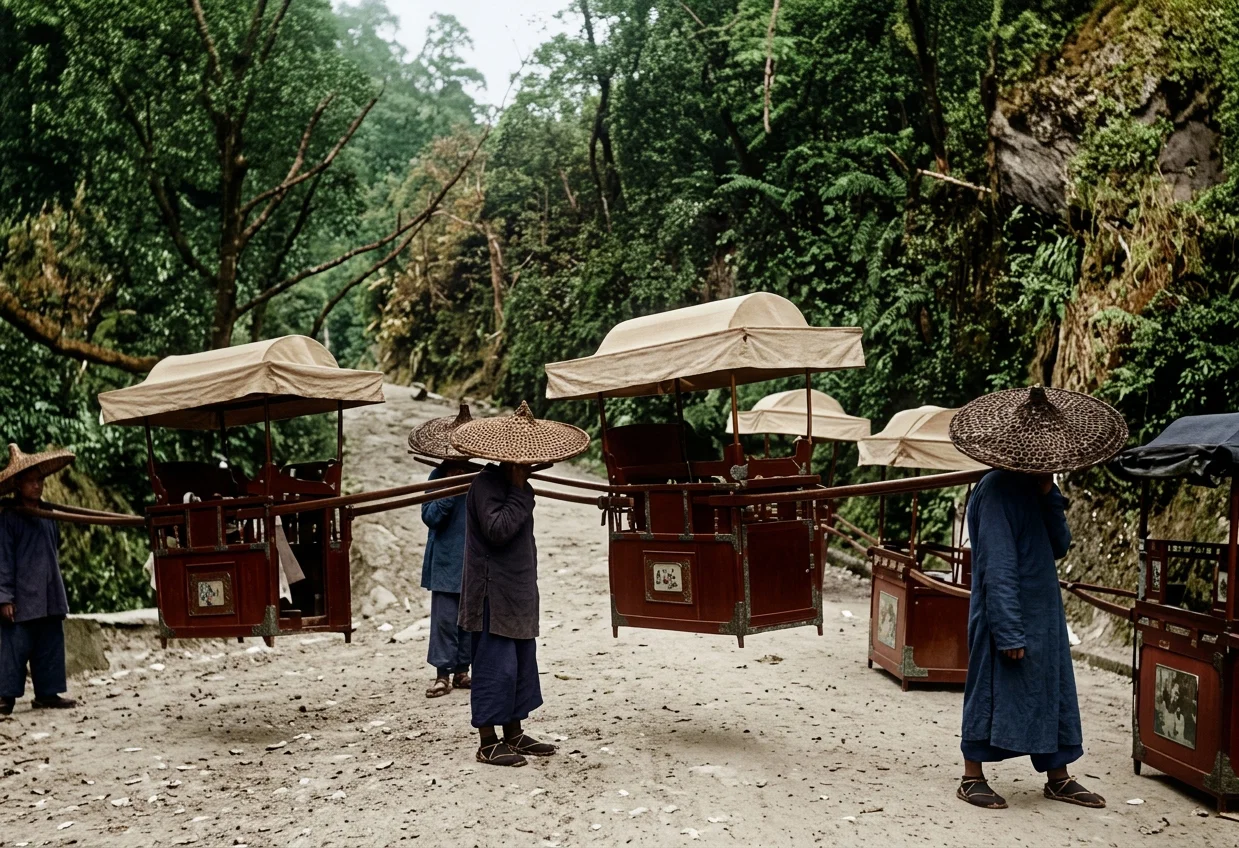
Elder Pilquist rode in his sedan-chair; and a clumsy cart, drawn by a mule and a pony, was to furnish accommodation for Elder Anderson, myself, our bedding, and some dry food we were going to eat with our warm rice and other food which can usually be bought at the inns.
Our paper lanterns furnished us a little light on our path, through the muddy road, until daylight. The cart does not furnish a very safe ride, as the animals—one ahead of the other—are guided by only one line, and can not be easily controlled in crossing the many narrow bridges, or in going by the ditches, but will dodge hither and thither, trying to find better foothold. Elder Anderson rode for about fifteen minutes, and had13all the shaking he wanted, and I rode for about one hour during the day. On we walked through the mud, step by step, the animals having all they could do to pull the almost empty cart. We traveled one hundred and twenty li (three li make a mile) the first day. At noon you should have seen us trying to eat some Chinese soup with chopsticks, laughing at one another on account of the ludicrous effort in trying to get it into our mouths.
At 5:30 P. M. we lighted our paper lanterns, and arrived at that day’s destination at 7 P. M. The name of this city was Cheng Yang Hsien. Having walked for thirteen hours through mud, with little to eat, you can imagine how tired we were, and how well we rested on our hard boards during the night. Next morning it was snowing. And as the Chinese do not want to travel in snow or rain, we were afraid that the snow might detain us for some days; and it being so close to Ko-Nien, we might have to spend many days in that dreary and dismal inn. Hence we thought if we could only reach Roo-Nan-Poo—a distance of fifty-five li—that day, and the next day get to Sin-tsai Hsien—forty-five li distant—we should be thankful.
We consulted our driver, who was willing to go on. But the bearers could not carry Brother Pilquist in the sedan-chair, for it was slippery. Elder Pilquist was promised that he could have a cart the next day. We all agreed that, owing to the approaching New-year, we had better not wait for Elder Pilquist, but go on with our cart, our driver assuring us that he knew the road to Sin-tsai Hsien.
After eating our breakfast, which cost us about four cents, and was the best we could get at that time, we commended one another to God’s loving care, and, separating, started off with but one cart. As soon as we got outside of the city, we discovered that we had the snow and a strong north wind right in our faces. The wind was blowing the snow on our bedding in the cart. So there was no opportunity to ride that day, but we must walk, to keep warm. Everywhere people regarded us as a curiosity, wondering what kind of people we were that would be out traveling in such weather.
After trudging through the snow all day, wet and hungry, not having had anything to eat since 7:30 A. M., we decided, about 4 P. M., to stop in a village overnight. This inn was like a dilapidated barn, with large openings for doors, the cold wind blowing through our compartments, the animals feeding in one part, and we sleeping on some bean-stalks in another part. You can imagine our feelings on entering this place, wet and hungry, a cold wind blowing on us, and about fifty persons crowding into this so-called inn, scanning us from head to foot; and in addition to it all, we discovered, with our meager vocabulary, that our driver had lost his way, so that while in the morning we were only fifty-five li from Roo-Nan-Poo, in the evening, after walking about forty-five li, we were eighty li from the same place, instead of ten li, as we naturally expected.
CHINESE SEDAN-CHAIRS
As soon as we got rid of the crowd, we made our bed, then brought corn-stalks, and made a good fire close to it, which felt very comfortable, although our eyes were running over on account of the dense smoke. After some waiting, our hunger was pacified, and being of good courage, we committed ourselves to God’s loving care, earnestly imploring his protection, as everything around us looked quite suspicious. In the morning we learned that some food had been stolen from the driver. Hence, although it was still blowing and snowing, we were glad to get away from this place, not waiting for any breakfast, as in winter the Chinese stay in bed till eight or nine o’clock, to keep warm.
At about eleven o’clock I felt very hungry, and asked my Father for food. In a few minutes he sent a man—a direct answer to prayer—who had been in town buying some raw carrots and another food article, for his family. He wanted to give us some, when we asked him; but we would not accept his generous offer, but paid him for what we needed, and walked in the strength of that until we had our supper at 5:30 P. M. In the evening, to our great encouragement, we learned that we had come thirty-five li nearer to Roo-Nan-Poo. We enjoyed a good night’s rest.
Next morning the sun shone bright. We bought a wooden shovel to use in the snow-drifts, and, hiring a guide, we started off, and after eight hours’ continuous walk, reached Roo-Nan-Poo. After some pounding, the large inn gate was opened. We were somewhat unwelcome; but the innkeeper, being a very kind man, treated us to a good New-year’s eve dinner at 7 P. M., and we were really surprised that Chinese food could taste so good. We had not eaten anything since eight o’clock that morning.
Knowing that on the next day no inns would be open, and no food—not even boiled water—could be bought, and it would be almost impossible to travel, we bought a supply of mo mo (bread). We learned that our driver was willing to go on, but that he did not know the road; and we thanked God most heartily, who helped us to hire a guide, and this when every Chinaman is supposed to celebrate at least the first four days of Ko-Nien.
After a good night’s rest (although heavy firecrackers were being shot off all night), we were ready to start at five o’clock in the morning. We crossed the river at half-past six, the driver taking his team across it, and we carrying our bedding and other articles across three boats that had been tied together during the night so as to form a bridge. At about nine o’clock we lunched on some dry bread, as we were walking. At noon we came to an inn, but could not get so much as a cup of boiled water. Everywhere the people, attired in their best clothing, hurried to come and stare at us; and the very dogs seemed to think, judging from their angry manner, that we were infringing on the country’s monotonous tranquillity.
We were nearing our destination. From our time and other signs, we knew that the walls of the city would soon appear in the distance. About three o’clock we saw them; and although we knew that it would take us an hour longer to reach the place, the very sight of the city seemed to take away our fatigue and give us new strength, joy, and determination to press onward; soon we would meet and embrace our brethren, who were longing and waiting for our arrival. In the same way, the prophecies and signs tell us plainly that we are nearing the New Jerusalem. And, although the struggle is hard, the very consciousness of the nearness of our dear Saviour’s coming really takes away our tired feeling, and gives us new strength, joy, and determination to press onward to the glorious home in the New Jerusalem.
I know that Elder Anderson will write the particulars about our good meetings, hence I will only say that the old adage proved true even in this case—the more effort required to procure a thing, the greater its value. These meetings were indeed valuable to us. I have attended many meetings and camp-meetings, but have never felt the presence and power of the Holy Spirit more than here. “The ‘loud cry’ will come and pass, and the latter rain will fall, and many of our people know nothing at all about it.” Dear brethren, the end is very near. These foreign fields are ripe for harvest, but where are the laborers? There is a deep longing for something better, and the calls for the gospel are14so many that they can not all be filled. O that the brethren at home would lay their lives and means on the Lord’s altar, and then say, “Here am I; send me”! O that hundreds would come now to this vast field, to study this fascinating language, that in two years they might have such command of it that they could go from place to place and gather in the great harvest that will come from Sinim’s land!
The last meeting of the session was marked by a touching incident. At the beginning of the meeting, Dr. Miller told us, with tears, that he had just learned that one of his helpers, who had gone to visit his home, forty li from Sin-tsai Hsien, was not coming back to go with him to his station. The young man had been intimidated by his father and friends, who told him that if he did not separate from the foreigners, he would be killed with them in the coming revolution. We prayed earnestly for the young man, with hearts and eyes running over. At the end of the meeting Dr. Miller said that he had sent for a guide, as he felt strongly impressed by the Spirit that he must give the young man one more chance. As the doctors had already hired their conveyance, and were to start at two o’clock the next morning, Dr. Miller decided to start in the evening for the young man’s home, and, walking all night, meet the others at some point on the road. So he started on his night trip as we went to bed.
Although the night was dark, and a strong northeast wind was blowing in his face, Dr. Miller went on to find the lost sheep. Brethren, such earnestness is sure to be blessed. Such earnestness would take many Christians away from their easy chairs and Pullman sleepers, and send them to the most remote parts of the earth. Such earnestness, by divine grace, shall take us safely through these sifting times, and land us in the New Jerusalem. None will reach heaven on flowery beds of ease.
At some other time I will write of our experience coming back from the meeting. Dear brethren, pray earnestly for the work in these remote parts of the earth.
Lo Shan, Honan, Via Hankow, China.
Algeria
By Lydia Jesperrson
LYDIA JESPERRSON
Some time ago we learned of a family, about six hundred kilometers distant from Algiers, who had been reading the French Signs of the Times for twelve years. While living in France, a canvasser had taken their subscription, and ever since that time this paper has been their instructor, and has never failed in its mission, as the lady expressed it, and it has been the only religious influence or help they have had.
As I had an opportunity to travel at half rate, we decided that I should pay this family a visit, to see what could be done to help and encourage them in their loneliness. A day’s ride by rail brought me to Oran, where there is connection with Vemours, my destination, by means of small steamers. But as the sea was rough, and there was little hope that the steamer would be able to land at Vemours, I thought best to make the remainder of the distance by rail and carriage, via Elemcen, thus lengthening the journey one day.
On arriving in Elemcen, an Arabic town of about thirty-five thousand inhabitants, I was told that the stagecoach had been taken by robbers recently, the six horses, the coachman, and others having been killed. This did not seem very encouraging, and especially as several persons told me that it was not at all safe for a woman to make that trip. But as I was on the Lord’s errand, and going as his messenger, I took courage, trusting in him who had sent me, and who has said, “Lo, I am with you alway, even unto the end of the world.” The carriage started before daybreak, and took us through mountains and valleys, and over deserts where no man was to be seen, and, thank God, not even a robber. The coachman had to change his six horses five times, so it took thirty horses in all to bring the journey to an end. But I arrived safely a little before sunset, the beginning of the Sabbath, after being three days on the way.
In the carriage was an Arabic chief, who entered into conversation with me, and among other things, he told me that he had long wished to have a Bible, but had not been able to find anything but the Gospel of John. As I had some with me, I handed him a copy, which he accepted with great thankfulness. The evening I arrived, I had one meeting; on Sabbath I had four, on Sunday three, and on Monday, the last day, two. Among the attendants were many distinguished persons, also young people, mostly Catholics, and it was a great pleasure to see them listen so attentively to the Word of God. One exclaimed, “I should like to be here all the time, to hear.” Another said, “Why have they changed? and why do we not keep the seventh day, as Sunday is the first day of the week?”
It was my privilege to make some visits. We went to the hospital to see a French officer, who is a Protestant, but whose relatives are Catholics. As he understood German, I could encourage him to resist the influence of the Catholic priest, without his relatives understanding the conversation. One of the children said that the priest had prayed for her father, and if he was not healed, she would become a Protestant, for that would be a sign that the Catholic religion was no good. On the other hand, if he was healed, she would remain a Catholic.
It is certainly high time that we should do something for these poor souls plunged in superstition and darkness, many of whom are willing to learn, and anxious to know something better. Sacred music and religious meetings seem to be a rare thing in this place, a town of three thousand inhabitants. In one family that I visited there was a harmonium, and as I played and sang some of our gospel hymns, a great crowd assembled on the street. Such places ought to be supplied with gospel workers now, before the field is occupied by other denominations.
As it became known that I was a medical worker, I also had a number of consultations.
After a three-days’ stay, I had to leave these dear souls, my duties calling me back to Algiers. My heart was filled with thankfulness to God for blessings received, but I was sorrowful because there is nobody to further instruct and help them.
Vemours is situated near the frontier of Morocco, and one can hear the shooting going on in that country of dispute and disturbance. Several of the Moroccans had come to Vemours, in order to escape the present danger in their native land. They were very poor and miserable looking, and certainly deserve our pity and sympathy. Morocco is still an unentered field. How long shall it remain so?
We thank the Lord for a beginning in this needy country, and we ask our dear brethren and sisters to remember us in their prayers.
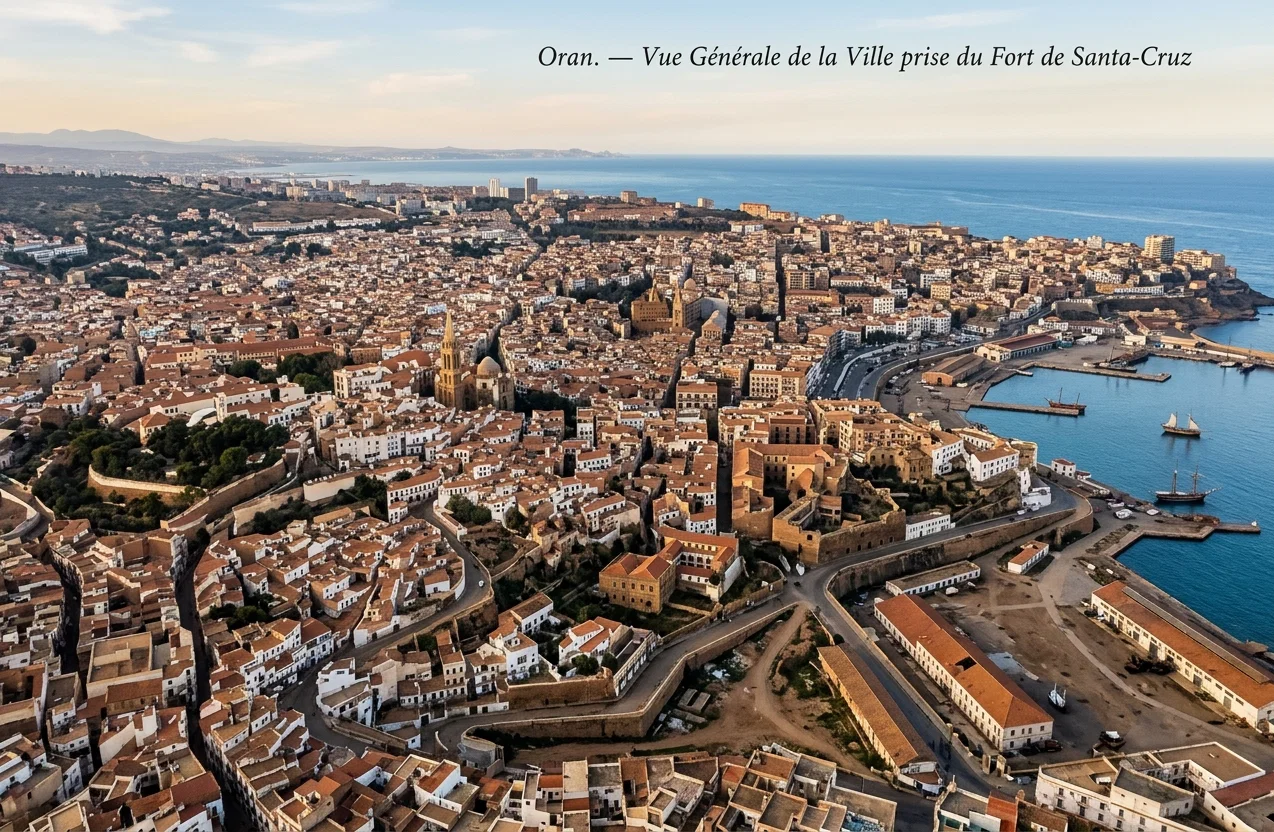
GENERAL VIEW OF ORAN
Ohio
By W. H. Granger
COLUMBUS.—I am glad to be able to report another month of progress in our work in this city. While the enemy has been giving our work serious consideration, yet the Lord is with us, and our work is growing in influence and interest. Several new ones are keeping the Sabbath, and we are planning for another baptism in two weeks. Besides the large class of readers which we visit regularly with The Family Bible Teacher, we are disposing of several thousand copies of the earthquake number of the Signs.
The following is only a partial list of work done during May: Bible readings held, 69; visits made, 125; calls, 4,700; pages of literature distributed, 52,000. We are of good courage, and find joy in working for the Master.
W. H. GRANGER.
1479 N. High St.
South Africa
By J. F. Olmsted; Mrs. J. F. Olmsted
OUDTSHOORN, CAPE COLONY.—On our way from the States to Africa we had the pleasure of visiting many places of historical interest. Reaching Southampton after our boat for South Africa had sailed, we were left in England for a week. This time was profitably spent with friends in London, who showed us every kindness, and made our stay one long to be remembered.
We reached Cape Town on the sixth of March, after a pleasant voyage of twenty-five days from New York to the Cape, neither of us being seasick.
It was decided that we should labor among the Dutch, so we are in Oudtshoorn, a Dutch town of twelve thousand inhabitants. Elder D. H. Groenewald and I have pitched a tent, and are holding a series of meetings with a fair attendance.
Before our tent was pitched, the Dutch Reformed minister gave utterance to some strong language, warning his flock against the “Sabbatarians, who have taken possession of the north side of the town.” The Dutch have great respect for their minister, consequently many believed us heretics of the worst type. He even told his members, who had purchased our books, that hell was their portion if they did not return the books, and he held a special prayer service for their pardon.
Then a few nights ago he came within one square of our tent with a company bearing torches and singing. Between the songs he condemned us, and scattered a pamphlet among our neighbors, denouncing our people in no uncertain language.
But his efforts are working exactly opposite from what he intended. Many see his motive and vindictiveness, and are now attending our services.
Pray for our success that our courage fail not in this difficult field.
J. F. OLMSTED,
MRS. J. F. OLMSTED.
Western Pennsylvania
By W. F. Schwartz
MAY 6 I closed my effort at Spring Meadow, as a result of which nine persons took a stand for the truth, and a Sabbath-school with an average attendance of thirty members was organized, the meetings being held in the same union chapel in which the effort was conducted. The new Sabbath-keepers are all farmers.
May 9-17 I spent with the new company at Six Mile Run, holding meetings every night, also a good quarterly meeting. While there, I baptized two persons, one of these being a case of rebaptism. The church-members are of good courage, and their chapel, which is being built, is under roof at the present time. The donations and tithe of this church to the conference since its organization have amounted to $253.37. This church of forty-two members will be taken into the conference at the coming camp-meeting. Brother J. E. Veach has been doing faithful work with this company since its organization.
May 23 the little company at Clearfield, who have been more than alive since the dedication of their new chapel, sent for me to come and baptize those who were ready. On the following day I baptized five precious souls in a beautiful mountain stream. All hearts were filled with the love of the truth, and on15June 5 I was called again to baptize six others. The church is greatly strengthened by these new additions. Also the new chapel, which has cost them eighteen hundred dollars, has proved a great blessing to them. They are still eight hundred and fifty dollars in debt, but the Lord is helping them in this. We all can thank God for these dear souls that have responded to the truth in these different places. Brother Wiper and his wife, who are working at Clearfield, can also feel amply repaid for all their labors with this company.
In closing, I will also state that there are two persons who have accepted the truth in Altoona, and desire to be baptized. W. F. SCHWARTZ.
Jamaica
By A. N. Durrant
CLARENDON MOUNTAINS.—Leaving May Pen on the fourth of April, I took my family and the tent to Chapelton, nine miles from May Pen. Satan tried to thwart our purpose in coming here to set some of his captives free, but we pitched the tent and started meetings the first week we were here. The attendance was good, and the Lord blessed the preaching of the word, even though it was a rainy season, and many times the meetings had to be deferred. Seven precious souls rejoice with us in the cause we love, and many others give evidence of obeying soon.
Two days ago (May 29) I removed the tent to a neighboring district where there is an interest. While working on the tent there, the resident rector passed by, and called on two of the new Sabbath-keepers, one of whom was formerly a member of his church. He reasoned with them to no purpose, and when they talked the truth to him, he inquired, “Where do you get these things?” They won the battle with the sword of truth.
The work is progressing steadily throughout the island. God is finishing his work; and while able men are denying the faith, and some of the “branches are being broken off,” we know that the “body” will remain till its glorification, and God helping me, I shall stand by the body, firmly believing in the spirit of prophecy till the end of all things. Pray for us and the work in these hills.
A. N. DURRANT.
Missionary Facts and Statistics
A REGION including fifty million people was evangelized through the efforts of seven shoemakers in Hamburg.
MANY Chinese Christians have gone to the Transvaal, to labor as evangelists and catechists, among the forty thousand Chinese coolies there.
NEARLY one third of the missionaries of the American Board in India and Ceylon are the children or grandchildren of missionaries who were sent out by the Board two or three generations ago. In the three Indian missions, including Ceylon, there are now ninety-five American laborers, nineteen of whom were children and eleven grandchildren — thirty in all — of missionaries, most of whom have ended their earthly labors.
Spain
By Walter Bond; Leola Bond
GRACIA, BARCELONA.—Our supply of Spanish literature is very limited. We shall be glad when it is increased.
At present we are holding several meetings each week, with considerable interest. On Sunday night, however, only a very few came. We felt disappointed. The study was a simple one—the importance of obedience. God blessed the reading of his Word, and when the meeting had closed, two souls had decided to obey his commandments. One is a bright boy, seventeen years old, and the other is a man of thirty. We thank God for what he has done and is doing. One of these has already lost his position, and the other expects to lose his next Friday, on account of the decision he has made. They are planning to enter the tract work.
Don Alfonso, a business man whom we met two weeks ago for the first time, has for several years lived up very strictly to the Catholic faith. He had drunk holy water at all times, carrying a bottle of it with him; had gone to mass regularly; and the walls of his house were lined with the images of saints. On New-year's eve he went to mass at midnight, taking with him twelve raisin seeds, which had been blessed by the priest. As the clock struck the midnight hour, he swallowed a raisin seed at each stroke, at the same time offering a prayer to Saint John, for success during the coming twelve months. Yet his confession was, “I have never had peace nor rest of mind.”
After one hour's study of God's Word, the images were all taken down, the use of holy water was discontinued, and Don Alfonso, instead of praying to saints long ago dead, began praying to the living God. We have had two studies with him since the first. Yesterday he said, “I have determined to follow Jesus, and keep his Sabbath, God helping me.” He also said that he had found that peace for which he had been looking. Is not this a brand plucked from the burning?
Of course these have much to learn yet; they are just beginners. But he that hath begun the good work is able to finish it. Pray for these dear souls that are just starting, that they may grow up to the full stature of men in Christ Jesus. And pray for this whole needy field, with its millions in the darkness of Roman idolatry.
WALTER AND LEOLA BOND.
Korea
By W. R. Smith
CHINNAMPO.— We are glad to tell those who are watching the onward march of the third angel’s message of the progress it is making in heathen Korea.
It has been said that the Koreans were without a religion, but that is a mistake; while they are neither Confucians nor Buddhists, yet they are as devoutly attached to the worship of their ancestors, perhaps, as ever a people were to the worship of a false god; and as one travels over the land, temples may be seen where libations are poured out to appease the wrath of the evil spirit. When the winter is breaking up, instead of cleaning out their springs and wells, they put food into them to pacify the dragon that may be lurking there to destroy their lives.
As you know, only a short time ago this message began its work in Chinnampo and its vicinity. Quickly in four different places believers sprang up, and their numbers grew until nearly two hundred had accepted the saving truths of this last message of mercy.
The seventh of February, in company with a native helper, we left our home in Seoul to visit these brethren. The weather was cold, and the means of travel not the best, so we walked most of the time. Everywhere we were given a cordial welcome, and all seemed to be of good courage.
Seoul, which for many reasons is perhaps the most desirable place in Korea for foreigners to live, is two hundred miles from where our brethren are; so the good of the cause seemed to demand that we leave Seoul and go to Chinnampo, where, so far as temporal things are concerned, life is not nearly so pleasant; but we came to Chinnampo to make it our home until it seems advisable for us to move elsewhere.
The circle of believers is very rapidly growing larger. From Ping-Yang, one of the large cities of Korea, about fifty miles distant from Chinnampo, a letter came asking for some one to come and tell them of these things. From Soonan, a place sixteen miles beyond Ping-Yang, word came to us that a company had begun the observance of the Sabbath, and wished to be baptized and join our church. These are only two of several places from which similar calls have already come to us. The seed is being sown by ways that we are hardly aware of; perhaps a Sabbath-keeper will go to make his home in another village, and tell the people what he has learned, or maybe a letter will be sent to a friend, calling his attention to the message; thus the seed is being scattered over Korea, and it is springing up and growing we know not how, but already it is beginning to yield a bountiful harvest. The question is not how to arouse an interest, but how to care for and properly instruct the rapidly increasing number of believers.
With one of our native laborers I went to answer as best we could these appeals for help. After spending a few days with the Christians in Soonan, where twenty-two were buried with their Lord in baptism, we came to Ping-Yang. Here the native worker remained to further instruct the company of fifteen who had begun the observance of the Sabbath, while I returned to Chinnampo to go with another one of our five native laborers to answer a call in Chungwha; after this is done, I will go again to Ping-Yang to baptize and organize the company there, and then go to Homcho, where a company is being raised up through the labors of one of our native brethren.
To be sure, all who have accepted the message and those who are accepting it need much instruction and help along many lines; and we trust that the burden will be so laid upon the brethren of America that many people and much means will be consecrated to the work in Korea; surely the cause requires haste.
They anxiously inquire of us if more of our missionaries from America will come to them soon; if we have many doctors in America, and when one will come here.
We are enjoying our work on the language; and while we still have very much to learn, yet we are glad to be able to make ourselves understood, even though it be in an awkward, roundabout way.
W. R. SMITH.
India
By Della Burroway
KARMATAR.—Our boys and girls are making progress in actual work. The field about Karmatar for village work is broad. There are at least ten small villages within three miles, while in our immediate vicinity, at least twelve wealthy babus live. For several months past, our boys, in company with Elder Little, have gone into the villages on the Sabbath, to talk to the people; while our girls, accompanied by Mrs. Little and myself, have held Bible readings with the women in their homes.
During the week of prayer, as we listened to the stirring articles by our leading brethren, God's Spirit came in, and a longing was created in each heart to do a greater work here in Karmatar than we had yet done. Not having a command of the language as yet, we can not talk to the people, except through an interpreter, so we decided to scatter our literature among the classes who can read, and in that way reach many. Some of the workers meet each train as it stops at our little station, and tracts and papers are handed all who can read. We are much encouraged as the train pulls out, to hear one reading aloud to those about him who can not read. Each Monday we carry tracts with us to Mudhupur, where we do our marketing. Here we find many who can read. Miss Whiteis distributes many tracts while visiting patients.
You will be pleased to hear of our Sabbath-school work, which we have begun since the week of prayer. Our girls and the small children we divide into companies. These we gather about us in prayer, to ask God's blessing on our work, before starting out. We also16go over the lesson with the one who is to teach it. In addition to our Bengali hymn-books, we carry a large picture which represents the lesson we expect to teach. As the first hymn is sung, all gather about us. The picture is placed where all can see it, and is commented upon by men, as well as women and children. As the teacher explains the picture, many questions are asked by the men who crowd closely about it. We not only carry the truth to some in this way, but our students receive the blessing that comes only by working for the Master. We feel that we have God's approval in this work, and we ask your prayers that our Karmatar boys and girls may have a still greater desire to work for those in darkness.
DELLA BURROWAY.
Maine
By S. J. Hersum
LAST Sabbath and Sunday I spent with the church at South Woodstock, Maine. Five were baptized, and four united with the church. Sickness prevented quite a number of our people from attending the meetings. There are so many calls for some of our people to come and hold meetings that we hardly know where to go first. “The harvest truly is great, but the laborers are few.”
S. J. HERSUM.