The Youth’s Instructor, Vol. 53, No. 11.

On the Street
Earlier text: On the Street

The Children's Missionary Society in Rarotonga

My heart is overflowing with the joy of my work. The dear children all came back to school after the vacation, except three. Two new ones came, and I had prayed that these very two would come. We have begun what we call the “Children’s Missionary Society.” Our meetings are held on Sabbath afternoon. Not only the day-school, but the little ones and all of the Sabbath-school come to the meeting, and take part. We have a lesson, reports of work, and a missionary collection. I am president, and a little boy is secretary, and another is his assistant. Last week the secretary took entire charge of the meeting. The children have great joy in this Society. They work for me during the week to earn pennies for the collection.
While in Raiatea I felt impressed that I should open Sunday-schools around the island on my return. Yesterday I began in Mataiva’s house in Avarua. He said we might use his house, and he would tell the children around him. On coming in sight of the house, I saw that the veranda was full of children. There were twenty-seven intelligent children, with a few of the parents. I greatly enjoyed the time spent with them, and they all raised their hands for me to come every week. My little girl from Titikaveka was with me. She prayed, and we sang two English hymns to them. The lesson was on the coming of the Lord. Many of them thought that Christ was never coming again. They were happy to learn these things so new to them.
The children’s gardens are planted with legumes, and we are getting ready to plant cabbages and turnips. I think that if the children can grow, cook, and eat legumes, they need not cling to their fish and other flesh foods. They are planning to tithe the products of their garden. I shall buy the tithe, and place the money where it should go. EVELYN GOODING.

If Knowledge Grew

How nice ’twould be if knowledge grew On bushes as the berries do; Then we could plant our spelling seed, And gather all the words we need. The sums from off our slates we’d wipe, And wait for figures to be ripe, And go into the fields and pick Whole bushels of arithmetic. Or if we wished to learn Chinese, We’d just go out and shake the trees. And grammar then in all the towns, Would grow with proper verbs and nouns; And in the gardens there would be Great bunches of geography; And all the passers-by would stop And marvel at the knowledge crop; And I my pen would cease to push, And pluck my verses from a bush! — Selected.

Harold's Footman

“Bob,” called Harold to his little brother, who was playing on the back door-step, “trot out to the barn and bring me my saw, will you?”
Bobby left his two pet cats, Topsy and Tiger, on the steps, and ran obediently for the tool. Harold was very busy constructing a hen-coop, and he needed a great deal of assistance.
“Thanks,” he said, shortly, as the little boy returned. “Now, where did I put those nails? Oh, they’re on the kitchen table; hand them out.” Bobby produced the nails, and sat down again to watch the work.
“Are you going to finish it to-day, Hal?” he asked.
“No; haven’t time. I am going to the commons in about ten minutes. There’s a lacrosse match on; but I want to drive these nails first. Oh, say Bob, my lacrosse stick is up in my room! You go and bring it down, I am so awfully busy.”
Bobby ran eagerly up the stairs. He always went on errands for his big brother very willingly, but this time he made special haste, for a hope was entering his heart that perhaps Hal would take him to see the match.
“Mother!” he cried, poking his head out to the shady front veranda where his mother and aunt sat sewing, “Hal’s going to the commons; may I go, too?”
His mother looked up from her sewing rather doubtfully.
“Oh, I really don’t know, dearie,” she began. “Oh, let the poor wee man go!” pleaded Aunt Kate, when she saw the look of disappointment on Bobby’s round face. “Hal will take care of him.”
“Well, keep near Hal, Bobby. I don’t like your crossing the railroad track.”
Bobby bounded out to the back yard in high glee, waving the lacrosse stick.
“Mother says I can go, too,” he shouted, jumping down the steps in a manner that made Tiger and Topsy rise up indignantly and move to one side.
“Oh, pshaw!” cried his brother, hammering a nail rather viciously. “What do you always want to follow me round for?”
“Oh, can’t I go?” cried the little fellow, in distress. “Aw, Hal, do let me!”
“I can’t have a kid like you forever tagging after me. Why can’t you play with boys of your own age. You can’t come to-day, that’s all about it!”
“O Hal! you—you might let me! I won’t be a bother!” Bobby’s eyes were beginning to brim over with tears. His face wore a look of despair.
“Oh, cry-baby; of course you must howl! You can stay at home and play with the cats.”
And the big brother, whom Bobby had served so willingly all day, shouldered his lacrosse stick and went off whistling.
Harold met his Aunt Kate in the hall.
“Where’s your little footman?” she asked gaily. “Isn’t he going?”
“Who? Bob? O Aunt Kate, he’s too small to go everywhere with me!”
“Ah!” Aunt Kate looked surprised. “I thought he was quite big enough to be with you when there was work to be done, but I see, a footman is only wanted to run errands and do such things.”
Harold was not very well acquainted with his aunt, and he was never quite sure whether she was in fun or not. The idea of her saying Bob was his footman! He felt quite indignant.
He had just reached the street when he remembered that he had left his ball where he had been working. He half wished Bobby were with him, so he could send him back for it. And then he felt ashamed when he remembered his aunt’s words. Was she right, after all, and did he make use of his little brother, and then thrust him aside when he did not need him?
He did not like the idea of facing Aunt Kate again, so he slipped in through the back gate, and walked quietly around the house. As he approached the house, he heard a voice, and paused a moment, hidden by a lilac bush.
Poor, lonely Bobby was sitting on the steps, one hand on Tiger’s neck while the other stroked Topsy. He was pouring out to his two friends all his troubles.
“He doesn’t like me, Tops, not one little bit. He never wants me round, only to run and get things for him. You don’t be bad to Tops just ’cause she’s littler than you, do you, Tiger? But I guess you like Topsy, and Hal don’t like me. He don’t like me one little teeny bit.” Here a sob choked him, and through the green branches Harold could see a big tear-drop upon Topsy’s velvet coat.
“I wish I had a brother that liked me,” went on the pitiful little voice. “Tom Benson likes Charlie. He likes him an awful lot. And Charlie doesn’t do nearly so many things as I do. I guess I oughtn’t to tell, Tiger, but you and Tops wouldn’t tell tales, so ’tisn’t the same as tellin’ father, or mother, or Auntie Kate; is it, Tige? But I think he might like me a little wee bit, don’t you, Tiger?” And Harold could see the blue blouse-sleeve raised to brush away the hot tears.
Harold drew back quietly and tiptoed down the walk to the street. He had forgotten all about the ball. His eyes were so misty that he did not notice Tom and Charlie Benson, waiting for him at the gate, until Tom called:—
“Hello there! I thought you were never coming. What kept you?”
“Say, is Charlie going?” asked Harold, suddenly.
“You bet I am!” cried the little fellow, cutting a caper on the sidewalk. “Tom said I could. Didn’t you, Tom?”
Tom laughed good-naturedly. “He was bound to come,” he said. “He won’t bother us.”
“Well—I—think Bob wants to come, too,” said Harold, hesitatingly, “and if Charlie is going—”
“Oh, goody!” cried Charlie, who was Bobby’s special chum. “Where is he?”
Harold put his fingers to his lips, and uttered two sharp whistles. Bobby understood the signal, and came round the side of the house. He had carefully wiped away his tears, but his voice was rather shaky.
“What d’ye want?” he called. He felt sure Hal had an errand for him.
“Charlie’s going to the commons with us,” shouted his brother, “so I guess you can come, if you want to!”
Bobby came down the path in leaps and bounds.
“I’m going, mother!” he shouted, waving his cap, and away he and Charlie tore down the street ahead of their brothers.
“Hold on there!” cried Harold, with a laugh. “Don’t get crazy! And mind you two keep near us at the track!”
It was about a week later that Aunt Kate laid her hand on Harold’s shoulder, and said: “I’m afraid I made a mistake the other day, Hal. I believe Bobby’s been promoted from the rank of footman to be a brother.”—The King’s Own.

The Resurrection

1. What proof have we of a resurrection from the dead?
“But if there be no resurrection of the dead, then is Christ not risen.” “But now is Christ risen from the dead, and become the first-fruits of them that slept.” 1 Cor. 15:13, 20.
2. What did Christ say of the dead?
“Marvel not at this: for the hour is coming, in the which all that are in the graves shall hear his voice, and shall come forth; they that have done good, unto the resurrection of life; and they that have done evil, unto the resurrection of damnation.” John 5:28, 29.
3. Which rise first, the righteous or the wicked?
“For the Lord himself shall descend from heaven with a shout, with the voice of the archangel, and with the trump of God: and the dead in Christ shall rise first.” 1 Thess. 4:16.
4. What is said of those who have part in the first resurrection?
“Blessed and holy is he that hath part in the first resurrection: on such the second death hath no power, but they shall be priests of God and of Christ, and shall reign with him a thousand years.” Rev. 20:6.
5. How many years between the two resurrections?
“But the rest of the dead lived not again until the thousand years were finished.” Rev. 20:5.
6. What do the wicked then do? and what happens to them?
“And they went up on the breadth of the earth, and compassed the camp of the saints about, and the beloved city: and fire came down from God out of heaven, and devoured them.” Rev. 20:9. EMMA NEWCOMER

Woman’s Dress in China

THE defects of the modern woman and of her Chinese sisters in the matter of dress have been compared by the people of both nationalities. The comparison, it must be confessed, is rather in favor of the Oriental. While both have sacrificed comfort and good sense to custom and pride, it is the Chinese woman whose vital processes are the least interfered with as a result.
Aside from the long white bandages which have shaped her foot so different from its natural form, restricting the circulation of the extremities, and making her, on foot, awkward and uncomfortable, there are many physiological points in the dress of the Chinese woman which merit attention. And even with their crippled feet, our friends in China are able to get around and do their duties, and to climb up- and down-hill with heavy burdens, in a way which surprises us. These little women have no long skirts to catch the dust and damp from the earth below. Only a few possess skirts, and these are ornamental affairs, which are kept folded away in the clothes chest. The women move about comfortably every day, in what an American would call “bloomers.” But perhaps it is because the American woman does not know how to wear “bloomers” that she so abhors them. At least our Eastern sisters can look as neat as a pin in their simple blue gowns and loose garments. It is quite a shock to the modesty of the Chinese when they first see in the port cities the close-fitted, misshapen form of the modern woman.
In the south of China, and during the summer, the garment worn is more like a divided skirt, being loose at the ankles, and trimmed with a colored border and silk braid. But in the north, all the year round, the bright-colored tape is worn, tying up the plain, neatly folded garment at the ankle, and a little embroidered or figured piece is included in such a way as to adorn the little feet. The gown is loose, with large, flowing sleeves, and usually long enough to reach to or just below the knees. All the garments, under and outer, winter and summer, are made on the same pattern, and there is room enough inside her gown for the mother to carry her infant to protect him from the wind.
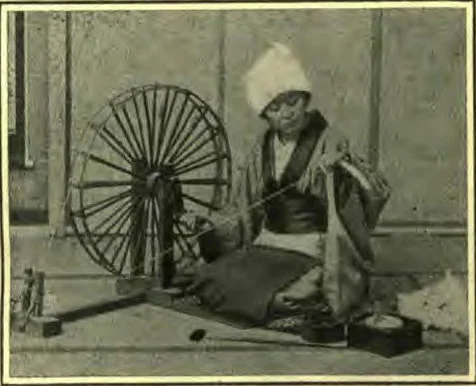
A JAPANESE LADY SPINNING
Were it not for the impoverished diet of many, leading to an over-diet of coarse vegetables, and, consequently, a dilated stomach, the form of the Chinese women would be quite perfect. As it is, she has a control of her muscles, and an ability to work, which few in modern dress could imitate. For once comfort and fashion agree.
A girdle is worn about the waist, but the wide band of the lower garment makes it unnecessary to wear this drawn very tightly. The pervading color of Chinese dress is blue, the nation’s color; other colors are the exception. Coarse homespun goods is worn almost constantly by the common people. The different seasons and weather changes are far better provided for in the Chinese economy than in Western garb. There are three classes of garments—unlined, lined, and cotton-lined, or wadded, garments. Changes are not made on the first day of June, nor at any other stated time. The nights are usually cool, except in the heat of summer, and the Oriental woman rises early, dons her wadded gown, perhaps two of them, and a lined one besides. Later on, as the sun shines brighter, or she is warmed by the day’s duties, she lays off first one, then another, till she has only a light garment remaining. Thus her dress is always in keeping with the temperature and her comfort. The padded garment worn in winter is much warmer than the burden of skirts worn by the Western woman in a vain effort to keep out the cold.
Many Chinese homes have neither fireplace nor heating stove. In the very coldest winter those in central China have only a little open fire of straw or stalks on the floor, to warm their hands and feet. Farther north they have the kang, or heated brick bed, to which they resort when the quilted garments prove insufficient. Here American heated homes would indeed be a luxury.
BERTHA LOVELAND-SELMON, M. D.

Friendly Naps

IN Japan you do not go to bed; the bed comes to you. It does not make much difference in what part of your house you may be, or of a friend’s house, for that matter, if you are drowsy, the bed will come in at a moment’s notice, declares the author of “The Heart of Japan:” —
“If you are visiting, your host will detect your inclination, and beg you to honor his house by taking a nap therein. Clapping his hands, he calls out: ‘Quilts bring!’ In two minutes your hostess will toddle in with a bundle in her arms much larger than herself,—a huge, thickly wadded quilt, the futon, which she rolls out over the tatami, the straw mattresses covered with finely woven bamboos that are upon all floors in Japanese rooms. That is the bed, and if you will condescend to arrange your honorable body on anything so unworthy, your host will be bewildered with the honor.
“You protest that the honor is with you; that it is indescribably rude of you to venture to think of polluting so magnificent a futon. Then, with a low bow, you stretch yourself out upon it. You are covered with another futon. ‘Condescend to enjoy honorable tranquillity,’ lisps your hostess. Mine host says the weather impresses him as being such as to encourage nap-taking also, and soon he is on another futon, lying peacefully beside you.”—Selected.

The Pancake Woman

ONE of the delights of the children in Japan is the pancake woman, who, with her little brazier and its copper frying-pan, offers great attraction to the urchins who gather round her stall.
She is usually found on the corner of the streets nearest the schools, and when the boys and girls clatter out with their wooden clogs and satchels of books, what more welcome sight than the pancake woman waiting on the corner for them? With a bowlful of delicious batter, a ladle, and a cake turner, she is ready for the onslaught.
Her withered smile and wheedling tones, as well as the crisp smell of a sample pancake on the griddle, draw a hungry crowd.
For a small coin, worth one tenth of a cent, a blissful child may fry and turn his own cakes, and eat them fresh from the griddle as he fries them. Happy is he who comes with a stringful of cash in his kimona sleeve, and who can fry and eat to his heart’s content.—Selected.

Shadi's Prayer

A MISSIONARY lady had a little Hindu orphan named Shadi living with her. She had taught him about Jesus, and one night when he was six years old, she said to him: “Now pray a little prayer of your own.”
And Shadi’s prayer was this: “Make me what you were like when you were six years old.”—Child’s Gem.

Forgive and Forget

THERE’S hardly a day goes by, I suppose, But some one or other treads on our toes, Says or does something we think most unkind; But this is the very best plan you will find; Just to go calmly on—not to fume or to fret, And to make up our minds to forgive and forget.
Why dwell upon slights that we meet day by day? Why bother our heads about what people say? So long as the tales which they tell are untrue, The wiser plan far, both for me and for you, Is to go straight ahead—not to grumble or fret, But make up our minds to forgive and forget.
Are we always careful in passing along? Do we never jostle in life’s busy throng? No hasty word speak? No friend ever slight? Do always the thing that is honest and right?— Ah, no! We surely have sad need to fret, Should those we love never forgive and forget.
— Exchange.

Our Way and Theirs

We bake bread; the Chinese people steam it. In rowing a boat, we pull; they push. We keep to the right; they keep to the left. We use a soft pillow; they use a hard one. Our sign of mourning is black; theirs is white. Our windows are made of glass; theirs of paper.
We shake a friend's hand; they shake their own.
Our language is alphabetic; theirs is ideographic.
We eat with knives and forks; they with chopsticks.
We blacken our shoes; they whiten their shoe soles.
We write with a pen or pencil; they write with a brush.
We locate intellect in the brain; they locate it in the stomach.—The Children's Visitor.

XII—Temperance in All Things

(March 25)
MEMORY VERSE: “Whether therefore ye eat, or drink, or whatsoever ye do, do all to the glory of God.” 1 Cor. 10:31.

Questions

1. What is included in the subject of health reform besides the question of food? Note 1.
2. What is the standard set by Paul in all things? 1 Cor. 10:31.
3. What should be our guide in deciding the question of diet? Note 2.
4. What besides the quality of food is embraced in this question? Luke 21:34, first clause; note 3.
5. What principles should be regarded in the matter of drinking? Prov. 23:31; Eph. 5:18; note 4.
6. What is said concerning the dress of the Christian? 1 Peter 3:3, 4; 1 Tim. 2:9; note 5.
7. What besides pride and gluttony is mentioned as one of the sins of the last days? Eze. 16:49.
8. What command was given to Adam after he had sinned? Gen. 3:19.
9. What rule does Paul lay down on this question? 2 Thess. 3:10.
10. What is the duty of each one, in view of these facts? 1 John 1:7.
11. What testimony shows that those who triumph with the third angel’s message have heeded these principles? Rev. 14:5, last clause.
12. What prayer has been offered for every believing saint? 1 Thess. 5:23.
13. How confident may we be that this prayer will be answered in the life of each one of us? 1 John 5:14, 15.

Notes

1. “Temperance in all things of this life is to be taught and practised. Temperance in eating, drinking, sleeping, and dressing is one of the grand principles of the religious life.”—“Testimonies,” Vol. VI, page 375.
2. “Is my diet such as will bring me in a position where I can accomplish the greatest amount of good?”—Mrs. E. G. White, in Review and Herald, 1880, No. 25.
3. “It is possible to eat immoderately even of wholesome food. . . . Masticate slowly, and allow the saliva to mingle with the food.”—Christian Temperance, pages 51, 52.
4. “Many make a mistake in drinking cold water with their meals. Food should not be washed down. . . . Eat fruit with the meals, and the irritation that calls for so much drink will cease to exist. . . . Never take tea, coffee, beer, wine, or any spirituous liquor.”—Id., page 51.
5. “Dress reform proper provided for the protection and development of every part of the body.”—“Testimonies,” Vol. IV, page 635.
“There should be no carelessness in dress. For Christ’s sake, whose witnesses we are, we should seek to make the best of our appearance.”—“Testimonies,” Vol. VI, page 96.

INTERMEDIATE LESSON

XII—Synopsis of Old Testament History—Babylon to Herod

(March 25)
MEMORY VERSE: “For thus saith the Lord, That after seventy years be accomplished at Babylon I will visit you, and perform my good word toward you, in causing you to return to this place.” Jer. 29:10.
Among the Hebrew captives taken to Babylon by Nebuchadnezzar were Daniel and his three companions, who were “of the king’s seed.” These young men were already “skilful in all wisdom;” but when they reached Babylon, the king appointed special teachers for them, that they might become versed in the learning and speech of the Chaldeans. These young men were loyal and true-hearted, and the Lord blessed them, and gave them a great work to do for him.
A few years after Daniel was brought to Babylon, King Nebuchadnezzar had the strange dream recorded in Daniel 2. None of his wise men could tell him the meaning of this dream; but Daniel, after praying for wisdom, was able to tell the king what it meant. Because of this, Nebuchadnezzar made Daniel a ruler and chief governor in Babylon; the three young men with Daniel were also promoted to positions of honor.
Throughout the reign of Nebuchadnezzar, Daniel was one of the king’s trusted counsellors; and when the kingdom passed under the rule of the Medes and Persians, he was still honored. Darius, the first king of Medo-Persia, set Daniel above all the presidents and princes in his realm, because “an excellent spirit was in him.”
In the first year of the reign of this king, Daniel studied the prophecies of Isaiah and Jeremiah concerning the number of years the Jews should be in captivity, and knew that the time was nearly ended. The Lord had even named the man who would give them permission to return to their own land, and restore Jerusalem, and rebuild the temple. This man was Cyrus, the second king of Medo-Persia. In the first year of his reign this king made a decree giving all the Jews in his kingdom permission to go up to Jerusalem to build the house of the Lord. He also sent back the five thousand four hundred gold and silver vessels that Nebuchadnezzar had taken from the temple.
Not all the Jews went up to Jerusalem at this time, but those who did go began the work. The altar was rebuilt, sacrifices were offered, and the foundation of the temple was laid. For a number of years the enemies of the Jews greatly hindered their work. Cyrus died, and Smerdis, the new king of Persia, wrote a letter saying that the building must cease.
But when this king died, the work began again. The new king, Darius, not only gave the Jews permission to build the temple, but he also helped them with gifts of money, and animals, and wheat, and oil, and wine. In the sixth year of this king the temple was finished.
But though the temple was rebuilt, it was not beautified, and the city of Jerusalem was still in ruins. Artaxerxes, a later king of Medo-Persia, granted a decree to Ezra, who was leader of the Jews, giving him power to beautify the temple, rebuild the city, and appoint magistrates and judges. As many of the Jews still living in Medo-Persia as wished might go with Ezra to help in this work. This decree to restore and build was given in 457 B. C.
A few years later Nehemiah, a brave and good Israelite, who was cupbearer to the king of Medo-Persia, went up to Jerusalem with another company of Jews, to help their brethren there build the city. At this time the enemies of the Lord’s people did all in their power to hinder the rebuilding; but the men of Israel worked faithfully, often with their weapons of defense in their hands, till the wall was finished. Nehemiah says: “So the wall was finished. . . . And it came to pass, that when all our enemies heard thereof, and all the heathen that were about us saw these things, they were much cast down in their own eyes: for they perceived that this work was wrought of our God.”
When Medo-Persia was conquered by Alexander the Great, the Jews were still kindly treated. When he died, and his kingdom was divided among four of his generals, the Jews were controlled for several hundred years by the kings of Syria and Egypt, who often treated them very cruelly. At last they passed under the control of the Romans; and at the time when Jesus was born, Herod, a Roman governor, was king of Judea. He was a very wicked and cruel man, who caused even his own wife and children to be killed; but he took pride in building costly temples. The temple rebuilt by the Jews five hundred years before, had fallen into decay, and Herod rebuilt it again, and greatly beautified it.

Questions

1. Who was Daniel? Tell how he and his three companions came to be appointed to positions of honor in Babylon.
2. When the Medes and Persians took Babylon, what became of Daniel? Why was he so greatly honored? What did Daniel study at this time? What did he learn from these writings? See Jer. 29:10; Isa. 44:24-28; 45:1-3.
3. What did King Cyrus do in the first year of his reign? Ezra 1:1-4. What did he send to Jerusalem? What was done by the Jews at this time?
4. Tell how the enemies of the Jews hindered their work, and how the temple was finished.
5. Who was Ezra? See Ezra 7:1-6, 10. What did the decree of Artaxerxes empower Ezra to do? When was it given?
6. How did the work proceed? Neh. 1:1-4. Who went up to Jerusalem at this time to help build the city? Neh. 2:1-6.
7. Under what conditions was the wall built? See Nehemiah 4. What did the enemies of Israel see? Neh. 6:15, 16.
8. By whom was Medo-Persia conquered? Under whose rule did the Jews come? By what nation were they governed when Jesus was born? What Roman governor was king in Judea at this time? What did he rebuild? How long had it stood?

Fire Building

HAROLD stood by the stove, receiving his first lesson in fire building. “Get a few splinters well burning,” said his mother, “then carefully place one stick after another upon the blaze. Do not fill the stove full at the start; you might smother the flame, and make it smoke. Do one thing, keep the fire burning.”
“It is just so in life,” said Aunt Jane, stepping in just then. “Be sure of a good blaze, a proper start, then add one effort to another until your work is complete. Don’t hurry nor crowd. Many failures could have been successes with a little more thought and carefulness.”
Harold was absorbed in thought. He looked up quizzically: “Mother, there is one part of fire building you did not speak of.”
“And what is that, my boy?”
“Lighting it,” and Harold laughed merrily.
But Aunt Jane was serious. “A very necessary part of character building, too,” she said. “Christ is the true light that lighteth every man that cometh into the world. After lighting us, he gives us his Word, the Bible, to keep our lights from going out. David says, ‘Thy Word is a lamp unto my feet.’”
“That reminds me of three verses in the sermon on the mount,” said Harold. “Can you guess which three?”
WILLIAM YARNELL.

Read, Young Men and Women

THE title used above is the same as that found at the head of an article in the INSTRUCTOR dated February 7, which described a plan of reading for our young people for the year 1905. There were not enough copies of the paper by several hundred to fill the orders; so the list of books from which the readers could make a selection is reprinted on page four of this number of the INSTRUCTOR.
It is not necessary to choose from the list. No attempt has been made to name all of the books that are worthy of a careful reading. Any good book, fiction not included, may be among the five. If one selects from the various classes of books named, he will doubtless be better satisfied than if he chose from only one class.
If you wish to join those who have already begun the reading, send a postal card to the editor, stating the fact and giving your address. Almost one hundred persons have responded, and nearly every day brings in word from others. The editor enjoys those cards that say, “I shall also do what I can to interest others in the plan.”
The list of readers is a varied one. It includes nearly all the members of two Young People’s Societies; it also includes ministers, wives of ministers, teachers, canvassers, students, carpenters, and children.
We hope that many more will join us in this interesting and profitable undertaking.
Continue reading: The Winged Foe of Mosquitoes