Your ShelfYour Projects

Review and Herald, Vol. 89, No. 40.

LET US BE KIND
Earlier text: Editorial

At the Latin Union Conference

L. R. CONRADI
THE meeting of the Latin Union and the French-Swiss Conference was held at Lausanne, August 9-14. Brethren W. J. Fitzgerald and Guy Dail and the writer assisted in the meetings. A good camp-ground had been secured close to the city. The weather was pleasant for the first few days, but during the latter part of the meeting we had considerable rain and chilly weather. Still our people remained till the close, and there was a good spirit throughout the meeting. About fourteen were present from Italy, and good representations from France, Portugal, Spain, and French-Switzerland. The reports rendered by the workers showed progress in the entire field. We were also pleased to have Brethren A. Guyot and J. Abella with us from Algeria, and to learn that the work there is onward among the French, Spanish, and Arabs.
Considerable time was spent in studying the needs of all these great fields, and careful plans were laid for the extension of the gospel. The last quarter showed a net gain in the Latin Union membership of seventy-five. As the native workers increase in number, we are assured that the Latin Union will not drag behind the other European unions.
Sabbath was a good day to all in the camp. Fourteen were baptized, and on Wednesday, at the close of the meeting, Brother Paul Meyer, who had been doing successful work in Portugal, was ordained to the gospel ministry.
Much attention was given to the consideration of the publishing and canvassing work. There are now some prospects that good canvassers will be developed for the Italian field. The work is going well in the Spanish field, and every effort is being put forth to find suitable help for the French canvassing field also.
We were indeed pleased to hear good news from a woman who had been at the Gland Sanitarium, to which she had come from the isle of Mauritius, near Madagascar. She had accepted the truth while with us, and on returning home, being a teacher, she at once began to spread the glad tidings. We hope that her urgent call for a French laborer to come to her assistance can be answered in the near future, and that the European Division may be able to take the responsibility of opening up this great French-speaking field.
Our institutions at Gland had a good year. The school, in charge of Elder P. Steiner, is doing good work, and the room for students is being crowded. The sanitarium is more than full, and we are carefully considering the advisability of further enlarging that institution. The brethren appreciated very much the help given them from the $300,000 Fund, to assist them in establishing their publishing work on a better basis.
In considering the needs of this great field for 1913, it seemed that at least $13,000 would be required from the European Division to answer the calls that will be made. But more than anything else, we need more laborers and greater power. Elder L. P. Tieche was again unanimously elected president of the Latin Union.
The French-Swiss Conference, which, since New-year's, includes in its borders the adjoining territory of France, with about two million people, had its sessions conjointly with the union. Elder H. H. Dexter was unanimously reelected president. In order to meet the altered conditions, the name was changed to the Leman Conference (Leman is the French name of Lake Geneva). We made a call for missions, and about 2,100 francs was given in cash and pledges, and we are happy to say that little French-Switzerland is the first conference in Europe to come up to the full ten-cent-a-week quota. Let us remember the Latin Union, with its one hundred million people, in our prayers.

The South India Mission

J. S. JAMES
MORE than seven months have hurried by since my last report to the REVIEW. This tardiness has not been due to indolence or lack of interest, but to ill health and a surplus of taxing work. In October of last year it seemed advisable that I go where I could build up my health, which was then verging on a complete breakdown. Arrangements were made for a temporary stay in Bangalore, a semihill station of south India, where I could get proper food and medical attention. This made it necessary for Elder G. G. Lowry to look after the work of two stations, and in order to do that properly, it was necessary for him to locate in Tinnevelli.
In February of 1912 I was called away to Lucknow, to attend a meeting of the advisory board, remaining there some days to assist with a number of important matters. While there, I received word that Elder Lowry had been compelled to leave Tinnevelli on account of his wife's health, and I hurried home to throw my remaining strength into the gap and help out as best I could. Upon getting careful medical advice, a special season of prayer was held for Mrs. Lowry's recovery, after which it seemed advisable for all of us to spend some time in the hills. The months of April and May (the hottest months of the year) were spent at an altitude of 7,500 feet, in a beautiful range of mountains here in southern India. This stay in the hills was of immense value to me. I gained in strength and weight rapidly, and felt like a new person when I came to leave. It was not then possible for Brother and Sister Lowry to return to their work, so they arranged to remain in the hills until fall.
Returning to the heat of the plains, Mrs. James and I went immediately to the station in Tinnevelli, to supervise some needed repairs on the mission buildings and counsel with our native workers. Developments there in connection with our constituents and the day-school call for some provision to be made for orphan children who have been left to our care, in order to save them for our work. Temporary provision was made, which will be completed later.
In order to carry the responsibilities of two stations, and develop some resources much needed to enlarge our work in the future, it seemed advisable for us to settle in Trichinopoli. This being a chief railway and commercial center of south India, with printing and shipping facilities, it offered us advantages for our literature work that could not be had in an out-of-the-way place. Since coming here, we have begun the publication of a Tamil sixteen-page quarterly journal, printed by a Hindu firm in this city. It is called The Present Truth, and we desire to make it such in fact as well as in name. We hope to be able to have all our printing done here for some time.
While the paper was going through the press, a colporteurs' institute was conducted, which lasted from July 9 to 28. Nine men took a training for that work. Elder Lowry was able to be with us most of the time, and rendered valuable service in the Bible studies. Brother Thomas, our Tamil evangelist from Tinnevelli, was also present and gave timely aid.
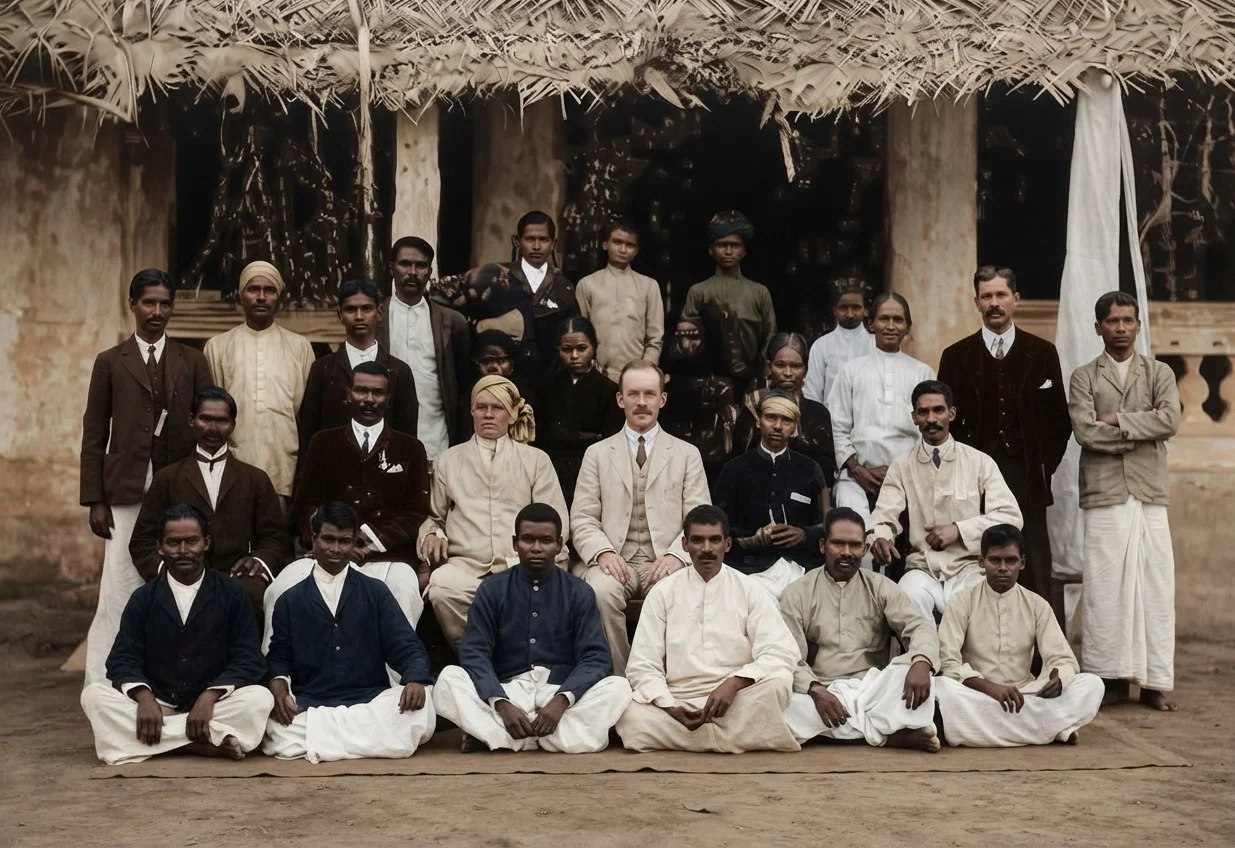
This institute was unlike any that I had ever attended or conducted. Our only material for study consisted of four small tracts and the Bible. Most of the instruction was given through an interpreter. The majority of our men had none of the advantages of an education. Some of them had never seen a railway train in their lives, and with difficulty could correctly add a simple row of figures. But these limitations do not disqualify for work where there is an earnest purpose, consecration, and determination. Toward the close of the institute we were able to get a few finished copies of our Tamil paper for study and drill. The program consisted of a special line of Bible studies for workers in the morning at seven o'clock, practical instruction and drill at 10:30 A. M., and studies in the fundamentals of the message in the evening at 6:30. Some time was spent each day in selling tracts in the city. On the last Sabbath of the institute, five persons went forward in baptism, most of whom were the first-fruits of the work started more than a year before by Elder Lowry and associated workers. On the last day of the institute the printer sent the first instalment of our papers, so our men could take a supply with them to their fields. Before distributing them, we all gathered round the bundles, and on our knees offered earnest prayers for God to bless this beginning made in his name, and go before the men who were to carry the papers to the people. A number of the colporteurs joined audibly in this petition. All the workers went to their appointed fields full of courage and hope, and we believe a good work will be done through their efforts.
WORKERS ATTENDING COLPORTEURS' INSTITUTE AT TRICHINOPOLI, SOUTH INDIA
It is with greater determination and hope that we lay hold of the additional burdens of this new undertaking. We are compelled to labor under many disadvantages, and practically alone, save for the One who has promised to go with us to the end of the world. It is only by his sustaining power in our behalf that we are able to press on. We hear that new workers have been chosen to join us soon. This cheers us, and quickens our pace. We need your continued prayers in behalf of the workers and work of south India. [Since writing this article, Brother and Sister Lowry have been compelled to leave India, and are now on their way home.]
Trichinopoli.

The Korean Meeting

I. H. EVANS
JUNE 4 I left Shanghai for Korea, on a small boat connecting Shanghai with Dairen and the Southern Manchurian Railway. This line makes connection with the Russian Siberian line for Europe. I was happily surprised on reaching Dairen to find a modern city of about sixty thousand population, with electric lights, a well-equipped tramway, public water-works, and other improvements. The city is strictly Russian in type, though since the late war between Japan and Russia it has been under Japanese control.
One hour's ride from Dairen brings the traveler to Port Arthur, famous on account of the decisive battle fought in and about that place during the Russo-Japanese war. Port Arthur is disappointing in many ways to the sightseer, as it has few buildings of any size, and such as it has are widely scattered. Its population, about forty thousand, is made up of Chinese and Japanese, the former largely outnumbering the latter.
To the north of these cities stretches a fertile country inhabited by Chinese who are devoted largely to agriculture. Manchuria has an area of three hundred thousand square miles, with a population estimated at from sixteen millions to twenty millions. The people are among the most prosperous in all China, and other missions have reaped a large harvest of souls as they have preached the gospel to them. We have never done anything for Manchuria. There are nearly as many people in Manchuria as in the United States west of Iowa, yet we have not one Seventh-day Adventist preaching the message to the millions in this great territory.
From Dairen I took a small boat for Chemulpho, and in thirty hours was in Korea, or Chosen, as both the Koreans and the Japanese call the country. An hour's ride on a comfortable train brought me to Seoul, the capital and metropolis of Korea, and the headquarters of our work in that field. During my stay the plans for a new printing plant and three foreign houses were drawn up; and it is hoped that before another year passes, our workers will be in their new quarters.
From Seoul I went to Soonan, where are Dr. Riley Russell and family, Brother Howard Lee and family, and Miss May Scott. Brother Lee has charge of the school for boys, and Miss Scott of the school for girls. Though the school had closed before my arrival, and most of the students had returned to their homes, the farm work was well in hand, and the crops looked promising. The present school building, which cost about four hundred dollars, and which has served as a school building and church for several years, is entirely inadequate to accommodate the school. It can be used, however, as a dormitory for boys, thus doubling our capacity for accommodating boy students. At present, the girls are so crowded that it is impossible to do the best work. In a room eight by twelve feet, from six to eight girls sleep at night, and live in the daytime, eating, studying, and reciting therein. Such congested conditions do not make for health, and are often very unpleasant when a student is ill.
A new school building, with a chapel capacity for one hundred fifty students, and adequate recitation-rooms for both boys and girls, is greatly needed. A suitable dormitory for the girls is also a crying necessity. It is estimated that these buildings will cost about five thousand dollars.
Dr. Russell and his wife still continue the dispensary work in their cramped quarters, without any additional facilities in the way of room, which they so greatly need. On the very place where we had hoped to see a little hospital, the Japanese have built three small houses, in one of which a Japanese doctor lives. About twenty-five hundred patients a year receive treatment in our dispensary, and this number could be easily doubled if Dr. Russell could give more time to this work. We sorely need a small building for a hospital, where suitable treatments could be given. Such a building would cost about two thousand dollars.
Our general meeting for Korea was held midway between Pieng-yang, the old capital, and Chemulpho, the entry port for the central north. On a small hill near several Korean villages our little camp was pitched, the first real camp-meeting ever held in the Far East. One large tent, about twenty-eight by forty-two feet, and nine small family tents, were pitched. In the small tents the foreigners lived, the Koreans securing board and lodging in the village near by. About one hundred fifty of our people were in regular attendance. Many were hindered from coming, as the season was a late one, and it was a busy time for farmers. Hoeing, rice planting, and other farm work were pressing; and many could come only for a short time, and still others could not come at all.
Over three hundred fifty dollars in cash and pledges was secured for the new school buildings. While this amount seems small when compared with what is often given at our large meetings in the States, we must remember that these people are extremely poor, and some of them, in order to give the small amount pledged, will have to deny themselves food and necessary clothes.
All the workers in Korea, both native and foreign, attended this meeting. Elder F. H. DeVinney, of Japan, was present throughout, and took a leading part both in preaching the word and in the council meetings. Brother Fred Lee and wife, of China, were also with us. Brother Lee having come to Korea for his health.
One could hardly tell he was not in the home land when talking to this dear people. They have the same needs, they meet the same temptations, they have the same Saviour, as we. Their prayers are the cries of the human heart for strength to do better, to live purer lives, to be more faithful and true to God. The whole congregation reconsecrated themselves to the service of the Lord, and sought for a new experience in spiritual things. The workers went from the meeting to their respective fields with a determination to press the work into new regions. During the last year over one hundred persons received baptism, several new companies accepted the truth, and one new church was organized. More faithfulness in tithe paying was promised, and we hope to see the church in Korea gain both in numbers and in spirituality during the coming year.
It was my privilege to spend one Sabbath in Korea, at Keizan, about sixty miles north of Fu-shan. Here Brother R. C. Wangerin and family are living. A neat little cottage has been built, and though they have been there only since last fall, we already have a church of about thirty members, with a number of others keeping the Sabbath. Dr. Russell was with me at this place, translating for me. Elder C. L. Butterfield also came down, and we spent Sunday finishing up our committee work and the plans for the buildings. There is a large population in this part of Korea, and the prospects are bright that many souls will find the truth in this region.

Send Them to Bed With a Kiss

O MOTHERS, so weary, discouraged, Worn out with the cares of the day, You often grow cross and impatient, Complain of the noise and the play; For the day brings so many vexations, So many things going amiss; But mothers, whatever may vex you, Send the children to bed with a kiss.
The dear little feet wander often, Perhaps, from the pathway of right; The dear little hands find new mischief To try you from morning till night; But think of the desolate mothers Who'd give all the world for your bliss, And, as thanks for your infinite blessings, Send the children to bed with a kiss.
For some day their noise will not vex you, The silence will hurt you far more; You will long for their sweet, childish voices, For a sweet, childish face at the door; And to press a child's face to your bosom,— You'd give all the world just for this. For comfort 'twill bring you in sorrow, Send the children to bed with a kiss. — New Orleans Picayune.

The Need

Come, Let Us Live With Our Children — No. 1

The Need

FROEBEL's plea, "Come, let us live with our children," was never needed more than to-day. The judicious observer can see that in the world the home is losing its influence. The scramble of the age allows the home no time to work its proper work upon character; and the influences of club, fraternity, institution, press, and public life are almost wholly substituted for the influence of home. If the Christian home is to copy its form or any of its discipline from the character of the worldly home, then woe be to the cause of Christ; for the Christian home is the citadel of the church. Thank God for the Christian homes there are, training their members as soldiers for Christ; but let none of us imagine that the home has yet won in the war, or that it has no need of being better fortified.
Our children, in school and church and home, may be taught the theory of the truth, without ever becoming converted; but if in the daily life they are taught by sympathetic parents and teachers to be honest and pure and self-controlled and unselfish, they are being converted.
"Come, let us live with our children." There are plenty of parents living alongside their children, living over their children in austere authority, living under the burden of their children, but how few there are who are entering into the life of their children, and living with them in spirit and thought and act! And I think that in this infinite and complex problem of child-training, if we come out of the high, thin atmosphere of theory, and seek for solid, practical causes of failure and disappointment, we shall find the basic cause in this,—that in so many cases we have not learned to live with our children. There are fathers and mothers who are vain of their children, or worried over their children, or afraid of their children, and all because their children are unknown to them. I do not know of a greater woe to the conscientious mind than the sense of helplessness before the enigma of the child, nor of any feeling that becomes more quickly and thoroughly the aggravation of the helplessness of which it is the effect. The teacher or the parent who faces the perverseness of the child, and understands at once its causes and its proper remedy, is upheld by the consciousness of mastery; but the teacher or parent who in the presence of evil sinks with the helplessness of ignorance, is tempted to the folly of impatience and abuse.
The one remedy for that ignorance is, through the grace and wisdom of God, to learn to know our children by living with them. To some parents this opportunity may be past, to others it is passing, to none is it yet in the future. It will be well for us, then, to study together some of the essentials—learned both in the school and in the home—of how to live with our children.
The success of God's work, I solemnly believe, depends upon the success of our homes; and that for two reasons: First, our families must every one be enlisted in carrying this message; it can not be completed without them; second, the influence of Christian home life upon the individual worker's character is vital. It can be recollected by every one of long experience that, with few exceptions, those who have been and remain powers in this message have been those who were successful in the training of their families.
The influence of an intelligent Christian family among non-believers is of incalculably greater value than any other power. And, on the other hand, the influence of an untrained, disorderly, but professedly Christian family, is the direst affliction to the cause of God. Therefore the training of homes is the most vital work we have before us. It should be the concern of those who are already parents, so to correct their weaknesses and strengthen their powers as to become wise educators.
The days of the world's probation are fast closing. Our families, our children, ourselves, are needed, every one, to teach the message,—needed, O, so sorely! Let us, fathers and mothers, consecrate ourselves to God, not passively, not spasmodically, but earnestly and with determination, and let him teach us how to live with our children for him now, that we may live with them and with him in the kingdom of God.

The Twelve Apostles to China

MEN who have given over fifty years of their life service to China:—
YEARS
Wm. A. P. Martin, Presbyterian 61
August Wm. Heyde, Moravian 58
Joseph Edkins, London Missionary 57
Rosewell H. Graves, Baptist 55
Bishop J. G. Burdon, Church of Eng. 54
Josiah Cox, English Wesleyan 54
William Muirhead, London Mission 52
Rudolph Lechler, Basel Mission 52
William Ashmore, A. B. M. U. 57
J. Hudson Taylor, China Inland 52
Griffith John, London Mission 53
Bishop E. E. Moule, Church of Eng. 50
---
Aggregate total service 655
— Selected.

Daily Blessings and God’s Good Gifts

“The daily blessings of life ought to be constant reminders of Him from whom cometh down every good gift and every perfect gift.”

The Noon-Hour Prayer

"Evening, and morning, and at noon, will I pray, and cry aloud: and he shall hear my voice." "And the Lord turned the captivity of Job, when he prayed for his friends."
Our Heavenly Father is always ready and willing to answer the sincere prayer of the humblest of his children, but sometimes the answer must be delayed until some work in us is finished, some preparation gained which is needful before the best answer can be received. He waits to bestow upon the suppliant heaven's richest blessing; and if we ask in faith, he will freely give in his own good time.
"Unanswered yet, the prayer your lips have pleaded In agony of heart these many years? Does faith begin to fail? Is hope departing, And think you all in vain those falling tears? Say not the Father hath not heard your prayer; You shall have your desire sometime, somewhere.
"Unanswered yet? Nay, do not say ungranted; Perhaps your part is not yet wholly done; The work began when first your prayer was uttered, And God will finish what he has begun. If you will keep the incense burning there, His glory you will see sometime, somewhere.
"Unanswered yet? Faith can not be unanswered. Her feet are firmly planted on the rock; Amid the wildest storms she stands undaunted, Nor quails before the loudest thunder shock. She knows Omnipotence has heard her prayer, And cries, It shall be done, sometime, somewhere."
Since the last issue of the REVIEW the following requests for prayer have come to us:—
84. A sister in Tennessee desires prayer for her husband, who, because of his wife's faithfulness in observing the Sabbath, refuses to help the family.
85. From California comes a request for prayer from a mother whose daughter, the wife of one of our ministers, is suffering from epilepsy. Let us seek God earnestly for her restoration.
86. A burdened mother writes from Ohio requesting prayer for her son whose mind is unbalanced.
87. A Minnesota mother asks our prayers for the healing of her son who is suffering with epilepsy.
88. From an afflicted family in Illinois comes the earnest request that we pray for the restoration of a son and a daughter who are ill with typhoid fever, and for the mother, that she may have strength to care for them.
89. A sister from the same State (Illinois) asks prayer for the conversion of two sons and their wives and two sons-in-law.
90. A mother writes from Missouri desiring prayer that her son who has left home may return. He once knew the Lord, but has wandered away. Let us pray for his conversion.
91. From Indiana comes this request: "I earnestly desire your prayers in behalf of my son who is in the insane asylum. Pray that God may bless and heal him spiritually, mentally, and physically."
92. A sister writes from Mississippi that she has been stricken with pellagra, and earnestly asks our united prayers that, if it be God's will, she may be restored to health. Her husband is a colporteur, and her five little children need her care.

"Just as I Am"

LORA CLEMENT
DWIGHT L. MOODY said of the song "Just as I Am:" "It has done more good to the greatest number, and has touched more lives helpfully, than any other hymn." The author, Charlotte Elliott, was born in Brighton, England, March 18, 1789. At the age of thirty-two, severe illness left her a helpless invalid. Rev. Dr. Cæsar Malan, a gifted Swiss preacher, was visiting at her home, and one evening they fell into conversation regarding Christian life. The earnest missionary asked her if she thought herself an experimental Christian. She resented his searching question, and told him that she did not wish to discuss the matter. Dr. Malan answered that he would not pursue the subject if it displeased her, but would pray that she might give herself to Christ. Several days later Miss Elliott apologized for her abruptness, and confessed that this question and parting remark had troubled her. "I do want to find Christ," she said; "I want you to help me." Dr. Malan answered, "Come to him just as you are." He little thought that these words would inspire a song that, bringing sweet counsel and comfort to troubled hearts, would lead many to accept the risen Christ as their personal Saviour.
Just when the hymn was written is not known, but in 1836 it was first published anonymously. It found its way into scrap-books, and some years later a philanthropic lady had the words printed in a leaflet, and circulated through the cities and towns of England. Miss Elliott was at Torquay, Devonshire, under the care of an earnest Christian physician. He placed one of these leaflets in her hands. "The surprise and pleasure were mutual when she recognized her own hymn, and he discovered that she was the author."
One Sunday evening in 1895, a young lawyer who had scoffed at religion, was lying ill in his room near the Lenox Road Methodist church in Brooklyn. He was thinking of his wasted life and his godly parents, whose teachings he had ignored. The windows were open, for it was a warm evening, and these words came home to him through the stillness:—
"Just as I am, without one plea But that thy blood was shed for me, And that thou bidst me come to thee, O Lamb of God, I come! "Just as I am, and waiting not To rid my soul of one dark blot, To thee, whose blood can cleanse each spot, O Lamb of God, I come! "Just as I am, though tossed about With many a conflict, many a doubt,— 'Fightings within and fears without,' O Lamb of God, I come! "Just as I am, poor, wretched, blind,— Sight, riches, healing of the mind, Yea, all I need, in thee to find, O Lamb of God, I come! "Just as I am, thou wilt receive, Wilt welcome, pardon, cleanse, relieve; Because thy promise I believe, O Lamb of God, I come! "Just as I am, thy love I own Has broken every barrier down; Now to be thine, yea, thine alone, O Lamb of God, I come!"
And he came. The next morning he sent for the pastor of the church. Holding out his hand to the minister, and, with eyes full of tears and a voice choked with emotion, he said, "I want to tell you that I have found Jesus Christ to be the Saviour of my soul." Then he told of hearing the song, of his sleepless night, of his struggle, and of the surrender.
Many incidents might be given, showing the comfort and help which this hymn has brought to weary hearts. Doubtless Rev. H. V. Elliott, a brother of the author, was warranted in saying, "In the course of a long ministry, I hope I have been permitted to see some fruit of my labors, but I feel that far more has been done by a single hymn of my sister." After Miss Elliott's death, more than one thousand letters were found among her papers, thanking her for writing "Just as I Am."
"A good example before one's neighbors' children is the most potent power for good. It far excels words; and a bad example destroys more than every other agency can build up."

The Victory in California

Its Lessons

CALIFORNIA, the golden State of the West, has been a center of Sunday-law agitation preeminently since her first Sunday law was repealed more than a quarter of a century ago. The campaign of repeal was an education to the State. The Republican party, which stood for the maintenance of the obnoxious law, went down to defeat, and the Democrats, which stood for the repeal, to the surprise of every one, went into power. No other publication contributed more to the repeal of the Sunday law than did the special issues of the Signs of the Times printed at that time, under the able leadership of Elder J. H. Waggoner. Since that period there have been strenuous and persistent attempts to procure a Sunday law through the legislature, and Sunday closing locally throughout the State. Every device and subterfuge has been resorted to, every concession granted, every possible pressure brought to bear, to induce the legislators to pass such a law, and on one occasion a law of that nature was secured, only to be declared unconstitutional later by the courts.
During these efforts petitions have been sent in by the friends of religious liberty against all efforts and attempts to unite church and state, and these have had a part in preventing legislation of this character.
Failing at last, two years ago, the Sunday-law forces decided to make an attempt to secure a Sunday-law amendment to the constitution under the new initiative amendment. According to the initiative amendment it requires but the names of one eighth of the voters in a previous general election to place the Sunday-law amendment upon the ballot for the November election. The Sunday-law forces began quite early their efforts to secure this. All that was asked the petitioner was that he say by his signature, "I am willing that the question of a Sunday-law amendment to the constitution should be submitted to the people." In the meantime the number of voters had been doubled by the woman's suffrage amendment, so that practically all that was required was the signature of one sixteenth of the voters, or in other words, securing the names in round numbers of thirty-two thousand persons. Blank petitions were sent by the Sunday-law forces to fourteen hundred pastors in ten different denominations, requiring an average of less than twenty-five names to each pastor to secure the required number.
What was the result? The following letter from the office of the secretary of state, forwarded to me in the East, gives it concisely. Under date of August 27, Mr. Frank H. Cory, deputy secretary of state, writing for Mr. Frank C. Jordan, the secretary, says:—
"DEAR SIR: Your letter of July 14, inquiring as to the petitions for the proposed Sunday-law amendment received. In reply will state that the Sunday-law petitioners have filed in this office 8,714 signatures up to August 7. The said number of signatures was not enough to entitle it to be placed upon the ballot as a constitutional amendment in November, 1912."
The failure will be more apparent if we contrast it with petitions secured two years before. There were then secured in a short time more than sixty-eight thousand signatures against a Sunday law, but this attempt in which it was thought there would be a united effort of fourteen hundred pastors and their congregations failed to secure more than one seventh of that number of signatures on the simple question of submitting a Sunday-law amendment to the people. In other words, a few people in a short time secured over sixty-eight thousand signatures against a proposed Sunday law, while a much larger number in a longer time secured but 8,714 from double the number of voters.
The reasons for this are found, first, in the education that has been given to the people of California. From the first issue of the special Signs when the law was repealed, in the scattering of tracts, by the American Sentinel and the magazine Liberty, its successor, and by personal work by individuals and on the lecture platform, and otherwise, this work has been carried forward. There has been more or less agitation over the question for at least a score of years. Certainly if these fourteen hundred pastors were, or could have been, interested in a Sunday law, they could easily have secured the number of signatures required; but the simple fact is that many of them evidently do not believe in the union of church and state. They paid no attention to the petitions whatever. They did not even bring the question before their congregations. They evidently saw the principle underlying it. The agitation of the last quarter of a century has educated the people of California so that they can see the true inwardness and the ineffectiveness in a moral sense of Sunday laws.
Second, there have been presented many more earnest petitions to the throne of grace that the great God would himself overrule in respect to all these things, and he always works with his people when they enter into partnership with him.
The real lesson which we should learn from this experience may be expressed in the two words agitate, educate, and both of these to win souls. There are many honest souls in every community, the world over, who want to do just right. Many times when they act in a wrong way, they are doing it conscientiously. This has been demonstrated again and again in Sunday-law campaigns, and also in every true Protestant movement of the centuries in the past. Those who have been on the side of truth earnestly pressed God's claims, and tried in every way to induce men to see what was right and what was wrong, that they might win the honest of heart to the cause of truth. That is the lesson that we should learn. It is our business not only to enlighten men, but to win men; not to antagonize souls, but to save souls from that which will bring destruction not only to them personally, but to the state and church as well.
Those of us who had a part in the struggle in California take no credit to ourselves. We have only followed imperfectly God's plan, and to him we give all the glory. M. C. WILCOX.
Continue reading: The French Work in Canada