INFIDELS declare the Bible to be the great enemy of freedom, progress, and enlightenment. If this charge be true, it seems strange that wherever the book of books is obeyed and loved, there we find prosperity and happiness; and that where it is unknown, we find ignorance, slavery, degradation, and despair. Fifty years ago the inhabitants of the Fiji Islands were cannibals, the vilest of human creatures; while to-day, through the influence of the Bible, they are civilized Christians. Before the advent of our Saviour, slavery was universal outside of the Jewish nation. The word “slave” is mentioned but twice in the Bible. The Israelites had bondmen, but these were not slaves. An apprentice is bound, but he is not a slave.
One of the best short essays on the subject of our article is an article by John H. Mitchell, of London, England, contained in one of the valuable anti-infidel publications of H. L. Hastings, of Boston. The following extract shows what Christianity did for the extinction of slavery, and is a complete refutation of one of the chief contentions of skeptics:—
The early Christian church did its utmost to destroy the distinction between master and slave. Says Lecky, the historian: “Whatever mistakes may have been made, the entire movement I have traced displays an anxiety not only for the life, but also the moral wellbeing of the castaways of society, such as the most humane nations of antiquity had never reached. This minute and scrupulous care for human life and human virtue in the humblest forms,— in the slave, the gladiator, the savage, or the infant,— was indeed wholly foreign to the genius of paganism. . . . It is the distinguishing and transcendent characteristic of every society into which the spirit of Christianity has passed.”—“Morals,” Vol. II, page 36, 1869. “Christianity alone could effect the profound change of character that rendered possible the abolition of slavery.” “The Christians did not preach a revolutionary doctrine; . . . they steadily sapped it [slavery] at its basis by opposing to it the doctrine of universal brotherhood, and by infusing a spirit of humanity into the relations of society.”—“Rationalism,” Vol. II, page 258, 1866.
Paul sent back Onesimus to Philemon, “not now as a servant, but above a servant, a brother beloved.” Tertullian declared the slaves to be “brethren.” Cyprian said: “The slave is as much a man as the freeman.” Cyprian once collected seven hundred eighty-one pounds to buy slaves and set them free. Lactantius taught people to give their gold to redeem captives from slavery. Ambrose sold the ornaments of the church at Milan to rescue captives from servitude, saying, “Men are more precious than metals;” “and this practise speedily became general.”—Lecky, “Morals,” Vol. II, pages 76, 77; Gibbon’s “Decline and Fall,” chap. 15.
God's Riches Supply All Our Needs
By Sunshine
“My God shall supply all your need according to his riches in glory by Christ Jesus.” All my need! What a wonderful promise is this as fitting our temporal as well as our eternal need. But the wonder departs when we see what is the treasury whence God draws all these gifts—the riches of the glory of his grace through Christ Jesus! O there is more than enough for the need of a million worlds.—Sunshine.
PASSING EVENTS AND COMMENTS.
By Editor
The Crisis.— Another week only, happily, remains of the present political campaign. This will be to the country at large and to many thousands individually a time of intense excitement and suspense. We feel no envy toward our fellow men who are thus involved; we feel very thankful to God for the provision made for his people. It is not for us “to fear their fear;” his truth is our shield and buckler. Look as closely as we may, we will not find in any of the many political parties or platforms the saving truth of God for this generation. The questions which they present are those which relate wholly to temporal interests, and many of them are of an essentially selfish character.
To become engrossed in these matters must necessarily be fatal to spirituality. The Spirit of Christ is essentially unselfish. The spirit of political strife is very largely selfish in aim and character. Christ has no concord with Belial. He who follows the course of this world cannot walk in the ways of God. We are thankful that the truth for this time is a standard raised by the Spirit of God against the flood raised by the enemy of all righteousness. Happy is the man who abides close to the standard. The time is near when all the worldly confederacies and associations will be broken to pieces. In that day the Lord himself will be our only hope; his truth will be the only defense.
We shall be glad when this gust of strife is over, and for about three years we shall have quiet on this line. We are glad that no more of our people have become entangled in the snare than have. Let us be sober and watchful unto prayer. Let us hold aloft the banner of saving truth. Let us anew engage in our God-given work.
Relapse of Justice.— About two years ago, perhaps, under the inspiration of Dr. Parkhurst and the vigor of Mr. Goff as prosecutor, a spasm of virtue overtook the New York police force, and there was a grand hustling of delinquent officers of the peace. They were haled to the judge, or at least to the grand jury, and not less than thirty-one were indicted for criminal performances, or for non-performances of duty. This was a brave onset; but of the thirty-one only six were actually tried, though the rest of them were probably pretty thoroughly scared. Of the indicted men, only five were dismissed from their positions; and but one of those who were convicted has paid his full penalty. Probably the most notable case was that of Inspector McLaughlin, who was tried for extortion, and on his second trial received a sentence of imprisonment. The Court of Appeals now decides that his conviction was irregular, and grants him a new trial, with change of venue. This is supposed to be tantamount to acquittal. It restores him to his position as inspector, and gives him his salary. It is said that Dr. Parkhurst is quite disturbed to think that his hopeful case of reforming New York has had such a bad relapse, and the condition of things is likely to be much worse than formerly. The relapse has gone so far that Judge Gaynor, one of the prominent prosecutors of John Y. Mc Kane, of Coney Island, the political boss and public plunderer who was righteously sent to prison for his many crimes, now prays the governor that Mc Kane be released. But what more could be expected? When will ministers of the gospel learn that nothing under the sun but the gospel of Christ will reform sin?
Troubles for Spain.— It has been intimated that the Spanish authorities are becoming weary with the long, fruitless attempt to subdue the rebellion in Cuba. It begins to appear that this weariness is being experienced by the common people. Advantage is being taken of these circumstances by the malcontents to excite sedition at home. The Carlists, who have a rival candidate for the throne, are again coming to the front, and urging their claims. It is openly declared that unless the war in Cuba and the Philippine Islands shall terminate soon, Premier Cánovas and Generals Weyler and Blanco will be called down, and grave events will take place. Spain is sending forty thousand more soldiers to Cuba, but these will hardly turn the scale.
The Recklessness of Crime.— “Desperado,” is a term frequently used to designate the perpetrators of crime, and its use is abundantly justified in the circumstances of crime that are of daily occurrence in our midst. Bank robbers and train robbers take the most desperate risks. Seemingly they have but little more regard for their own lives than for those of their victims. Highway robberies and store robberies take place in broad daylight on our most crowded streets, the audacity of the ruffians being their best protection. From such scenes the mind goes involuntarily to the days of Noah, when the earth was filled with violence. And it is to these days that our Saviour likens the time in which we live. Murder is committed for a very small inducement or provocation. An affront, however small, is likely to be answered by a bullet. Five dollars is a sufficient offset for a human life. No one known to have money is safe anywhere.
Such recklessness only illustrates what the condition of the world will be when the restraint of God’s Spirit is removed as it was in the days that just preceded the deluge. Men bereft of God soon become demoniac.
Because Others Do.— A contemporary religious paper, in “Questions and Answers,” has the following: “Q.—I am convinced that Saturday is the proper Sabbath. Ought I to keep it when all around me are keeping Sunday as the Sabbath? “A.—You should obey your conscience whatever others may do. But as we suppose you have not renounced Christianity for Judaism, we may hope you will not desecrate the day on which all Christendom concurs in celebrating the Lord’s resurrection. That would be to dishonor him. Keep Saturday holy as the Jews do, if you like; and you may keep Friday holy, too, as the Mohammedans do, if you wish; but do not neglect the Sunday, which is the day Christians observe. In short, it will be well if you keep all the days of the week holy, in the sense of refraining from sin.”
It is a common mistake to suppose that to renounce an almost universal practise is to renounce one’s principles, and repudiate all former experiences. Not so. The essential condition to Christian experience is that of advancement, step by step, in truth and knowledge. To cease progress or to refuse to advance, is unchristian. Neither conscience nor custom is a safe guide unless it is in harmony with the Bible. No matter how sincere one may be in his opinions, it does not prevent his being mistaken. No matter how general a practise may become, that does not make it Christian.
HE ATTEMPTED TOO MUCH.
By William Luff
A QUEER story is told of a certain individual who saw for the first time a fireman using the hydrant.
“Mister, where does the water come from?” he asked.
“A man is blowing at the other end,” was the jocular answer. At that moment the water stopped, and the fireman, seeing the credulity of his victim, suggested that the blower was taking breath. Being in want of a job, the astonished man asked if he could undertake the business.
“Certainly,” replied the fireman, “and if you can blow here, and beat the man there, you’re engaged.”
Stripping and taking a long breath, he put the nozzle into his mouth, and commenced; but the water being suddenly turned on, he turned a somersault backward. Rising again, half-drowned, he said, “Mister, I don’t think I’m strong enough.”
There are certain very near relatives of the fireman’s fool, called “higher critics,” who, knowing no stronger power than their own, take God’s word into their mouth, and oppose their breath to the Inspired Breath that has ever been the power of the Book. Not till they are humbled and their mouths washed out, will they acknowledge that they are not strong enough for the job. Those who oppose God must be hard up for employment to attempt such an impossible task. “Thou didst blow with the wind, the sea covered them: they sank as lead in the mighty waters.” Ex. 15:10.—William Luff.
THE ATMOSPHERE OF MARS.
[BROTHER J. A. GREGORY, of Wisconsin, sends us the following, clipped from a recent newspaper, with the following note: “It is in harmony with our views, and illustrates the normal condition of a world where the blight of sin has never been known.”—Ed.]
“Let us now remark that the Martian meteorology is less complicated and more pleasant than that of the earth, says the North American Review. There the weather is almost always fine, especially during summer. Very seldom are there clouds, even in winter. Generally when we are unable to distinguish through the telescope the details of the geographical configuration upon the planet, the fault is in our own atmosphere and not in that of Mars. It is very rarely the case that, when our atmospheric conditions are good, we are unable to see these details. During the last period of observance of Mars in 1894, I, to speak for myself, encountered only fifteen days (from October 10 to 25) when the surface of the planet was veiled by its own atmosphere. Clouds are very rare on the surface of Mars, and perhaps exist at all only as fogs or light cirrus; they are not clouds of rain or storm. These veils are very infrequent there, while they are perpetual upon the earth. Probably there is not a single day in the year when the entire surface of the earth is uncovered so that it could be satisfactorily observed from space. The planets have two meteorological systems that are absolutely antithetical. Furthermore, in the rarified atmosphere of Mars, there can be no powerful winds, like the trade-winds and the predominant atmospheric currents which rule terrestrial climates.”
THE SUMMER IS ENDED.
The words of Bryant are now on the minds if not on the lips of all: —
“The melancholy days have come, the saddest of the year,
Of wailing winds, and naked woods, and meadows brown and sere.”
The approaching Frost King has touched the verdure-clad trees, and the tender leaves, in yielding up their lives, turned “beautiful in death.” The forests were a dream of loveliness. Yellow and golden, crimson and brown, mingling with every shade of green, produced, for a time, scenes of splendor that entranced the mind, and transported it by anticipation to that world of abiding glory where the heart’s longing will be satisfied, of which autumn’s glory seems our best exponent. This period of gorgeous splendor was the appropriate valediction to a life of unassuming usefulness and quiet beauty. The life-work of the beautiful leaves is done. They return no more. Their opportunity to cheer and comfort what without them would be a dreary world, is past. They have no more a portion forever in anything that is done in the light of the sun. Death and oblivion are their portion.
“Heaped in the hollows of the grove, the autumn leaves lie dead;
They rustle to the eddying gust, and to the rabbit’s tread.”
A feeling akin to sadness comes involuntarily over the mind as we see the fragile creatures hurled to the ground, or tread upon their wonderful but lifeless forms. We know another spring will come; it will bring new leaves, while these flitting messengers of life and grace, of shade and solace, are returning to the dust from which they sprang. This tinge of sadness is deepened because of the inevitable reflection that the life of the leaf is an emblem of our own earthly existence. “We all do fade as a leaf; and our iniquities, like the wind, have taken us away.” Had there been no sin, then perishing leaves would have been unknown. Were it not for iniquity, there would be no chilling, driving blasts; there would be no passing summers, and no death.
The one brief summer of human life is our only opportunity. Others will fill the places we now fill. Other hands will do the work we now may do. When the opportunities that are now presented to us pass away, they will never return. How many thousands allow life to flit away unimproved! How many have but to cry at its close, “The harvest is past, the summer is ended, and we are not saved”!
Even the leaves do not live in vain. Each leaf has its mission. During all its brief life, the leaf extends to man and beast and bird, shade and protection, fragrance and beauty, at the same time acting as the medium through which vitality is imparted to its mother tree. So to each of us is entrusted a mission of comfort and blessing. Life is brief, but earnest. To each of us is given the power to be a blessing. Brief as it is, life gives ample opportunity to leave impressions of gladness and comfort upon those who come under our influence. None of us are made to exist only as ornaments in society. The color and forms of the leaves would soon lose their charm should they refuse to impart oxygen to the parent tree, or withhold from man and beast their mission of cheer and comfort. So with human leaves; pride of form, or color, or qualification is folly. Are we filling our mission?
“Is it worth while that we battle to humble
Some poor fellow soldier down into the dust?
God pity us all! Time eft-soon will tumble
All of us together, like leaves in a gust,
Humbled indeed down into the dust.”
BREAD-MAKING
By Lauretta Kress
BY MRS. LAURETTA KRESS, M. D.
(Sanitarium.)*
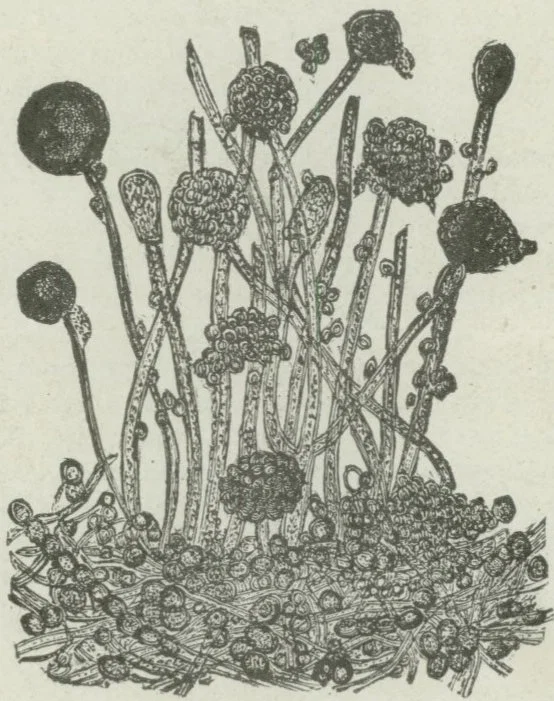
Yeast, or the leaven that is used in the process of making bread, is a plant. It looks like a number of little buds, added one on top of another, somewhat as a cactus grows. This little plant grows just as any other plant grows; it needs moisture, food, and warmth. It will chill the same as any other plant. If our house plants are left out in the cold, they soon shrivel and die; and so in the process of bread-making it is very necessary to keep the plant, or yeast, warm. It must not have alternative chills and fever, because chills and fever are just as debilitating to yeast as they are to other things.
This little plant has a visible growth. If we plant it in flour, and add to it the moisture that it needs, with the right amount of heat, it very soon begins to grow; but it must have food upon which to grow. We give it flour, which it converts into sugar and starch, and it keeps growing on the food which we give it, if it has sufficient moisture and warmth. Its growth is often stunted by its being either in too cold or too hot a place. It is always best to keep bread in a warm place. Housekeepers have various ways of doing this. Some have a bread-box, which is a trough of wood, in which the bread is set and covered over with a blanket. Some raise their bread in the oven; others have devised the plan of putting it over the stove in a crock. Different methods are used by different people.
When the yeast is allowed to stand too long, it becomes sour. That is because the plant is allowed to grow too long, and produces fermentation. Some call bread fermented because it has the growth of this plant inside, but it is not fermented until it gets to that degree that alcohol is made by the development of this plant. If the bread is baked or made up into loaves before this time, there will be very little alcohol in the bread, and it will be sweet and wholesome. It is true that the plant does take much of the substantial qualities of the flour for its food. A portion of the sugar, or sweetness, of the flour is eaten up by the growth of this plant. We do not get the sweetness of the grain in fermented bread that we do in unfermented bread. You perhaps have noticed that bread is not so sweet as gems or rolls. The gluten, which is next to the rind of the wheat, is very frequently all ground out in the process of milling.
The German people even make pies with yeast. After they have made their bread, they take a little of the sponge, and make a light, wholesome crust of the bread dough, rolling it thin, and then putting on apples or other fruit. It makes a very delicious pie crust, and is very light and wholesome. It is much better than a pie crust made with lard.
There is a difficulty in the use of yeast bread, with some who have indigestion. This is usually so much softer than other bread that it may be swallowed with very little mastication. It really requires all the mastication that other bread requires. Other breads cannot be swallowed without thorough mastication, and this is why they are more wholesome. Yeast breads can be made perfectly wholesome, if properly baked. They are very much better if baked in small loaves, because the oven dries the moisture in the loaves much better when they are not so large. The old-fashioned way of baking bread made it much more wholesome. I remember the bake-ovens they used when I was young, where they built a fire in the oven, and allowed it to be heated very hot, removed the fire, and then placed the bread in the oven, and baked it. This method of baking thoroughly dried the moisture in the bread.
Baking-powder and cream of tartar are not the best chemicals to use, because they form lye. This causes irritation of the lining membrane of the stomach. Salt should always be added to yeast bread.
The greatest objection to yeast bread is that people eat it while too new. Bread should be at least a day old before it is eaten. If you put a piece of fresh bread in a glass of water, you will see that it sinks immediately to the bottom; but if you will wait a day or two, and then put a piece of the bread in a glass, you will notice that it will float on the water. Warm bread forms little balls in the stomach, and the gastric juice cannot penetrate it when in that condition.
An acceptable layer cake may be made with yeast, without baking-powder or shortening. To make such a cake, take one cup of sweet cream, and after dissolving one fourth of a cake of compressed yeast in a little water, add it to the cream; then add half a cup of sugar, and one cup of flour. Allow this to rise until it is quite light, then add a little more sugar, and when this has become again very light, add one-fourth cup of flour. The second time it has risen, add a little more flour, so that two cups of flour are used in the process of making. When adding the remainder of the flour, add also the beaten yolks of two eggs. Some use both the whites and the yolks. Let this rise again in the tins for the last time. When it is light, put it in the oven and bake immediately.
This cake, if started in the morning, will be done by noon. I think it takes but little if any more time to bake than any other kind. It does not require much beating, and although it needs more watching, this can be done while doing other work. Do not let it get too hot, or it will spoil. It may be eaten the same day it is made.
WHEN I HAVE TIME.
When I have time, so many things I'll do
To make life happier and more fair
For those whose lives are crowded now with care;
I'll help to lift them from their low despair,
When I have time.
When I have time, the friend I love so well
Shall know no more these weary, toiling days;
I'll lead her feet in pleasant paths always,
And cheer her heart with words of sweetest praise,
When I have time.
When you have time, the friend you hold so dear
May be beyond the reach of your intent,—
May never know that you so kindly meant
To fill her daily life with sweet content,
When you had time.
Now is the time! Ah, friend, no longer wait
To scatter loving smiles and words of cheer
To those around whose lives are now so dear;
They may not need you in the coming year—
Now is the time.
— Selected.
THE DOCTOR AND HIS PATIENTS.
By John Harvey Kellogg
FROM SANITARIUM PARLOR TALKS BY
J. H. KELLOGG, M. D.
(Reported by David Paulson, M. D.)
Question.— Is catarrh of the bowels caused by diet? If so, what diet would you recommend in such cases?
Answer — There are a number of different causes for this ailment. Sometimes it is the result of a cold, sometimes of irregularity of the bowels; but it is most likely to arise from disorders of the stomach, which may be the result of an improper diet or of overeating. A dilated stomach sooner or later is the cause of catarrh of the stomach and of the bowels. I have never met a case of catarrh that was not connected with stomach trouble. So long as the stomach remains healthy, it is able to destroy the germs that enter it, unless they come in too great quantities.
Q.— What proportion of the nitrogenous and carbonaceous elements should be used to constitute a perfect diet?
A.— The old rule established by Letheby was one part of nitrogenous to seven parts of carbonaceous. Some later authorities place the proportion at one part of nitrogenous to five parts of carbonaceous. The latest authority, which I believe to be the nearest correct, because the conclusions are based upon the actual state, not of abnormal men, but of natural, healthy men, puts the proportion at one part of nitrogenous to ten parts of carbonaceous. The later investigators have considered the habits of the native Hindu, the Japanese, Burmese, Chinese, and other people who live in the simpler and more natural ways. These people are remarkable for their vigor and ability to endure fatigue and hardships. A man who had been United States consul for China, and who also had lived in Japan, stated to me that the Japanese, who live almost entirely upon rice and lentils, are the finest people in the world.
Q.— What is the cause of a coated tongue?
A.— The tongue often becomes coated because the person sleeps with the mouth open. The air is thus permitted to pass over the tongue, and the germs which were in the air lodge and grow there; for the tongue has no power to kill germs. The nose, however, has power to destroy germs. A physician planted upon the side of the septum of the nose certain germs that could be distinguished from other germs, and he watched them closely; every fifteen minutes he examined this colony to see if they were alive; at the end of two hours, every germ was dead. The mucous membrane of the nose was capable of killing them; but the tongue does not seem to possess this power. The mouth acts as a sort of incubator for germs. A week or two ago I found a patient sick with fever whose mouth was in a very foul condition, and the breath very bad. I gave directions that the mouth should be carefully disinfected before doing anything with the tongue, and that it should be swabbed out every hour or two with ordinary cinnamon-water—a solution of one per cent. of cinnamon-oil in pure water. The purpose of this was to discourage the growth of germs.
Q.— Would nicotin be effective in killing these germs?
A.— It would not. Smokers have more trouble from germs than from any other cause. A person once told me he smoked for the purpose of fumigating. Some have claimed that smoking would protect people against diphtheria and other throat difficulties. Upon investigation, however, it has been found that smokers are more liable to germ diseases of the throat than are other people; they are quite subject to membranous sore throat, or smoker’s sore throat, which arises from the action of germs.
Q.— What is the best natural tonic in the way of food?
A.— There is no such thing as a tonic food. A tonic is a remedy; it is not a food. It is impossible for an article to be a medicine and a food at the same time.
PLEURISY
Pleurisy is a disease of the pleura, which is the serous lining membrane that surrounds the lung, sack like. One portion of the pleura is attached to the chest wall, the other portion to the lung. It secretes a viscid fluid that lubricates the surface of the pleura, to render it frictionless in the movements of the lungs, which occur in the act of breathing.
Pleurisy is an inflammation of a portion, more or less, of this pleura, the first stages of which dry up the secretion of the pleura and inflame it somewhat, making the surface dry and irritable; consequently every breath causes pain in that region. This primary action of the pleurisy goes on until there is a copious supply of fluid produced, which separates the pleura, and makes the act of breathing less painful. But on account of the inflammatory action, the fluid continues to increase until it fills a portion of this sack, which compresses the lungs, this process going on until a large share of the lung may be so compressed into the apex of either the right or the left thoracic cavity that the lung becomes useless. After the fluid has relieved the pleura of the dryness and irritation, there is, if the individual is in a fair degree of health, an inclination for the inflammation in the pleura to subside, and in most cases, as it subsides, if the compression has not been kept up too long, the lung will expand, and usually become as active and normal as before. However, if the inflammation is slow to reduce, and the fluid produced as fast as it is absorbed, until the lung becomes more or less fixed, it is quite often disabled permanently; for after having been kept compressed for so long a time, with some degree of irritation, the lung becomes fixed, after which no measure will succeed in expanding it. Many people are in this way deprived of the use of the whole or a portion of the lung, which materially lessens their vital force.
Such is the common run of a simple pleurisy. The premonitory symptoms are usually a sharp pain in the side in the right or left lower chest, with more or less chills and fever; or if it is an old, chronic pleurisy, the occasional attacks may come without noticeable chills and fever. The treatment, however, is the same.
These attacks can usually be broken up if the patient be put to bed and have perfect rest, poulticing the diseased portions of the chest until the symptoms subside. If there are any febrile symptoms, correct them with sponge-baths, compresses, etc. The poultice should be made of flaxseed meal, of the consistency to spread, and should be a half inch in thickness, and large enough to cover a good share of the lower pleural surface. It should be put on as hot as can be borne, and changed when cool. The chest should be kept rubbed and oiled thoroughly with coconut-oil. Give a bland diet, and keep the patient at rest until all the symptoms subside. This treatment should break up all cases of pleurisy, and thus avoid the critical conditions that often follow pleurisy that is allowed to take its regular course. The feet should be kept warm and the bowels free. Surround the patient with the necessary conditions for perfect rest of mind and body.—Pacific Health Journal.
AUTUMN
By L. M. Ogden
BY MRS. L. M. OGDEN.
(Ithaca, Mich.)
How lovely a sight on this beautiful morn
Are the leaves all so golden and bright;
The green tints of summer are passing away,
And the autumn glow now greets our sight.
The whippoorwill’s song no longer we hear,
And we miss the bright fire-fly’s spark;
The katydid sank to its rest long ago,
And hushed is the song of the lark.
Still all nature seems gay in its newly donned robes
Of bright crimson and purple and gold;
O who will believe, as he looks o’er the earth,
’ T is because these are all growing old?
What a lesson for us in the autumn of life,
Whose heads have grown silvery gray,
To brighten our lives with kind words and good deeds
As we pass the decline of our day.
May that beauty appear in our every-day life,
Which long since from our faces has fled;
Then the sunshine of hope may brighten some life
When we’re numbered at last with the dead.
THE FIRST-DAY OFFERING.
By V. M.
BY V. M.
On a certain First-day morning at an early hour a goodly number of earnest ones were gathered together. In the strictest sense it was not a family gathering, yet after all, only one family was supposed to be represented,—the household of one common Father.
They listened to the discussion of the needs of the work in foreign fields, as presented by the aged speaker,—the need of men and means,—and as they listened, all hearts were touched with a desire to contribute something to this work, but some had not the ready cash. To meet this deficiency, it was proposed that the name and amount be written on a slip of paper, and that this be placed in the collection. In response to this, many little slips found their way into the basket, bearing sums varying from twenty-five cents to one hundred dollars, while other hearts rejoiced in the ability to share the store already in their possession.
Upon one paper, however, was found a sum that no one could read—no one could even estimate its real value. It might be great, or it might be of small import. The words were these, “I will give myself.”
Others had given money, and had rejoiced to feel that they might thus be privileged to assist in this great work; but this one had offered what to him was vastly more,—a life devoted to the best good of others who had had fewer advantages than himself.
When it is considered that this meant a turning from the scenes of the past, from familiar conflicts, to fight new and strange battles, while the associates and friends of former years were left behind, the simple words take on a new and sacred meaning, and we wonder if the writer fully comprehended the depth of what he wrote.
Since that hour many like opportunities have come and gone. Still there is a call sounded from distant lands and from the isles of the sea, “Come over, . . . and help us.” While not many of us can go in person, we can all bear a part in contributing to the necessities of those who can go, and thus carry a personal interest in the work. When the great day of reckoning comes, we shall find that while others have labored in foreign fields, we have “entered into their labors” by the means and the sympathy we have given; and thus we shall, with them, reap the reward.
A CLOTHES-BAG.
If you want a convenient article, try a clothes-bag made of coarse cotton cloth, and divided into three parts, labeled respectively, “Fine,” “Medium,” “Coarse.” Sort the soiled clothes as they are put into it, and when you see the time and trouble thus saved, you will wonder that any household can do without one.—The Household.