“THE Son of man is come to seek and to save that which was lost.” Luke 19:10.
Our heavenly Father did not create this world to become the abode of his enemies. He formed it to be inhabited, but not by sinful men. “Thus saith the Lord that created the heavens; God himself that formed the earth and made it; he hath established it, he created it not in vain, he formed it to be inhabited.” Isa. 45:18. If, however, the earth is to remain in the possession of fallen, sinful beings during their brief period of existence, and then pass to their sinful posterity, and if this is to continue indefinitely, then surely the creation of our world will result in no good.
It is true that most of the earth is today in the possession of men who have no faith in God or in his inspired Word. Such men, during the working out of the plan of redemption, may hold deeds of their farms and property; but the time is soon coming when the rightful Owner will vindicate his rights. It was not God’s plan that sinful beings should be in possession of the earth, and his plan is to be carried out. He says, through the psalmist David, “Evil-doers shall be cut off. . . . For yet a little while, and the wicked shall not be: yea, thou shalt diligently consider his place, and it shall not be.” Ps. 37:9, 10.
By means of the plan of redemption, wicked men can be made righteous. Repentance, confession of sin, and faith in Christ will transform the character, and of a sinner make a saint. Such will be among the number that our Creator designed should inhabit the earth. It is written, “Those that wait upon the Lord, they shall inherit the earth;” “the righteous shall inherit the land, and dwell therein forever;” and Christ, in his Sermon on the Mount, said, “Blessed are the meek: for they will shall inherit the earth.” Ps. 37:9, 29; Matt. 5:5. It is through God’s great plan of redemption, stretching across the ages, that a people are to be gathered out from among the wicked, and made righteous. Such will eventually come into possession of the earth.
The Creator designed that this world should be an eternally peopled paradise. It was not his purpose that it should be inhabited by a wicked, sickly race, but by happy, sinless beings. It was not God’s will that any of his creatures should suffer in body or mind. He created no faces to be stained with tears, no world to be drenched in blood. He is not the author of sorrow and death. If Adam had been obedient, he would have maintained his primeval happiness,—a legacy which would have been transmitted to his posterity. From his disobedience the world is reaping its harvest of sorrow, misery, and death. The only remedy for sorrowing souls and broken hearts is found in Christ, the second Adam. “If by one man’s offense death reigned by one; much more they which receive abundance of grace and of the gift of righteousness shall reign in life by one, Jesus Christ.” Rom. 5:17.
Adam through obedience to Satan became his servant (Rom. 6:16), and all his property, the first dominion, was placed in the hands of the archrebel. The usurper took possession of the earth. He is declared in Scripture to be the “god of this world,” “the prince of the power of the air,” “the prince of this world.” 2 Cor. 4:3, 4; Eph. 2:2; John 12:30, 31; 14:30. His policy of rulership is to sadden, discourage, and destroy his subjects. Nothing pleases him better than to see men, steeped in crime and blood, end their existence in sin, whether in single combat or by thousands on the battle field. It is his studied plan to stir up strife in the family, in the community, in the church, and among the nations. But his cruel work is to have an end. The curse is to be done away. He and his followers are to be destroyed, and the first dominion is to return to Christ, the Tower of the flock. Micah 4:8.
Christ, the lineal descendant of Abraham, was the only One of his seed who could pass through the grave, then turn upon its brink and call forth all the sleeping dead. He received this life-giving power from his Father. John 5:26-29. After his resurrection from the dead he exclaimed, “All power is given unto me in heaven and in earth.” Matt. 28:18. It is the voice of Christ, the Archangel, that is to raise the dead—those who sleep in Jesus and those who rest in sinners’ graves. The righteous dead are brought forth to inherit the world promised to Abraham. The wicked come forth to receive their punishment, and then perish forever.
It is after the resurrection of the dead that God fulfils his promise to the faithful patriarch. The prophet Ezekiel makes this very clear: “O my people, I will open your graves, and cause you to come up out of your graves, and bring you into the land of Israel. And ye shall know that I am the Lord, when I have opened your graves, O my people, and brought you up out of your graves, and shall put my Spirit in you, and ye shall live, and I shall place you in your own land: then shall ye know that I the Lord have spoken it, and performed it, saith the Lord.” Eze. 37:12-14.
After this great event takes place, are the resurrected saints to be placed in the land as it is today? Are they to live under the curse, amid toil and hardship?—No, never. The promise to Abraham and to all his children through faith in Christ (Gal. 3:7, 29), includes something better than a repetition of former trials and sinful experiences. The earth is to undergo a change. Prior to this change the wicked will be destroyed by the fire that purifies the earth. Mal. 4:1; Rev. 20:7-10; 21:8. Then He who created all things will once more exercise his creative power in renewing the surface of the earth. Says the psalmist, “Thou sendest forth thy Spirit, they are created: and thou renewest the face of the earth.” Ps. 104:29, 30. The Lord through Isaiah has promised a restoration: “Behold, I create new heavens and a new earth.” Peter looked for it: “Nevertheless we, according to his promise, look for new heavens and a new earth;” and John said, “I saw a new heaven and a new earth: for the first heaven and the first earth were passed away.” Isa. 65:17; 2 Peter 3:13; Rev. 21:1.
When the earth is cleansed by fire and rebeautified by all things’ being made new (Rev. 21:5), then will be fulfilled the promise to Abraham. He and all the meek will inherit the new earth. Then the resurrected Adam will reenter Eden, and resume his work of dressing the garden. Then the saints will people the new dominion, plant vineyards and eat the fruit of them, erect houses and inhabit them, and on the Sabbath gather for seasons of worship. Isa. 65:17, 21, 22; 66:22, 23.
These seasons of worship will doubtless be in the city, the New Jerusalem, the metropolis of the restored dominion. At these gatherings no plea will be heard for the unconverted to accept the Saviour. Millions of voices of the redeemed will be heard ascribing praise to Him who, in agony of soul, paid the price of their redemption on Calvary’s8cross. There will not be a silent voice. “Every creature which is in heaven, and on the earth, and under the earth, and such as are in the sea, and all that are in them, heard I saying, Blessing, and honor, and glory, and power, be unto him that sitteth upon the throne, and unto the Lamb forever.” Rev. 5:13.
The throne of God and the Lamb is in the city, which will cover the Mount of Olives, and also Mount Calvary, on which Christ was crucified. It seems that where Satan, through evil men, placed the cross, will stand the throne of universal dominion. What a victory over sin and the powers of darkness! On the very spot where the rabble clamored for Christ’s blood, will be heard every Sabbath day the voices of the redeemed, ascribing glory, in songs of triumph, to the Lamb that was slain on Calvary’s mountain. Isa. 66:22, 23; Zech. 14:4. Happy throng of celestial singers, clothed in the ineffable light of God’s glory!
This beautiful city, the New Jerusalem, the metropolis of the restored dominion, with its gold-paved streets, its walls of jasper, its gates of pearl, its river of life arched over by the tree of life, is to be the final abode of all who are obedient to the mandates of heaven.
St. Paul, Minn.
The Cost of the Kingdom
By J. G. SLATE
J. G. SLATE
THE Bible teaches that the way to the kingdom of God is straight and narrow; a way of self-denial and cross-bearing for the followers of Jesus Christ. Many wonder at the price of faith and sacrifice demanded of the Christian, and question God’s justice in restricting his promise. Why should not all who “strive” for the crown of life obtain the reward?
We prize most that which costs us most. Self is dear to every heart; but as shown by the illustration of the camel’s passing through the needle’s eye, everything of earthly value must be laid aside before we can “enter in through the gates into the city.”
God has made the way straight and narrow and long, that he may have a company “not having spot, or wrinkle, or any such thing,” when he gathers his people home at last.
The young ruler inquired of the Master, “What good thing shall I do, that I may have eternal life?” Jesus referred him to the law, which promises salvation to all who keep its precepts. The young man replied, “All these things have I kept from my youth,” and then the Lord pointed out an unfulfilled condition—that of self-sacrifice: “Sell that, thou hast, . . . and come and follow me.” But alas! the young man went away sorrowful, “for he had great possessions.” Had he been willing to pay the price, he might have become a joint heir with his Lord in glory, and obtained glory, honor, immortality, and eternal life. Mark 10: 17-25; Rom. 2: 7; 8: 17.
Two of Christ’s disciples asked for the privilege of sitting at his side in the kingdom. He inquired, Are you able to drink of my cup of self-denial, sacrifice, ignominy, and shame? Are you able to be baptized into my death—to put away self-will and to suffer the cutting off of every earthly privilege, if such be God’s will for you? Matt. 20: 22; Mark 10: 35-38. They answered that they were ready to endure anything with him. He assured them that if faithful to the end, their reward would be a crown of life.
The same prize is before the disciples of Christ today; the same help is offered us if we follow in the footsteps of the Man of Calvary, who “was tempted in all points like as we are, yet without sin.”
Takoma Park, D. C.
The Spirit of Prophecy in the Remnant Church
By G. I. BUTLER
G. I. BUTLER
“The dragon was wroth with the woman, and went to make war with the remnant of her seed, which keep the commandments of God, and have the testimony of Jesus Christ.” Rev. 12:17. The symbolic woman of the twelfth chapter of Revelation is the true church of Jesus Christ. There can be no doubt of this. Therefore “the remnant of her seed” must be the people of the last great reform movement, those composing the church on earth when Christ comes. This conclusion is demonstrated beyond all question by the characteristics of the true people of God, developed by the third angel’s message of Rev. 14:12: “Here are they that keep the commandments of God, and the faith of Jesus.” This last message brings the people of God to the grandest event the universe will ever see, the second advent of Jesus Christ in the clouds of heaven, with power and great glory, closing up the reign of sin, and bringing salvation to the good and faithful of all ages. Rev. 14:14.
The third angel’s message is the climax of the three angels’ messages of Revelation 14. It has been in process of proclamation since the great disappointment of 1844, that is, for more than seventy years. Beginning in poverty and obscurity, steadily increasing into a loud cry, it is now being proclaimed by more than one hundred thousand persons to the ends of the earth.
This remnant church has the testimony of Jesus Christ. This term is defined by the Word of God itself, yea, by an angel from heaven: “The testimony of Jesus is the spirit of prophecy.” Rev. 19:10. The spirit of prophecy must be that special manifestation of the Holy Spirit which enables chosen agents of heaven to prophesy, that is, to have visions of glory revealing events of the past, of the present, and even of the future, which human beings never could reveal by any natural endowment of the mind. Such were the visions of Enoch, Noah, Abraham, Jacob, Moses, Samuel, Elijah, Elisha, Isaiah, Jeremiah, Ezekiel, Daniel, Paul, and John, yea, and of many others whose names are recorded in the Book of God.
God-given visions and revelations are no mere guesswork. They are divine illuminations of something more than human reasoning. They are special light given from God direct, or through holy angels whom God has commissioned to give that light to men. A good illustration of God’s method is given in Rev. 1:1-3: “The revelation of Jesus Christ, which God gave unto him, to show unto his servants things which must shortly come to pass; and he sent and signified it by his angel unto his servant John: who bare record of the word of God, and of the testimony of Jesus Christ, and of all things that he saw. Blessed is he that readeth, and they that hear the words of this prophecy, and keep those things which are written therein: for the time is at hand.” Here “the testimony of Jesus” is named precisely as it is presented in the words of God to the remnant church. That remnant church has in it “the testimony of Jesus Christ,” which is defined to be “the spirit of prophecy.” In other words, the last church, the remnant church, has the same spirit of prophecy as John had in the grand apostolic church in the closing period of the first century of the Christian dispensation. There is no reasonable way of escaping this conclusion. John had this testimony of Jesus, and John wrote that the remnant church would have the testimony of Jesus.
Has the remnant church had this testimony of Jesus, or did John make a mistake? Can we believe John had the testimony of Jesus Christ when he wrote the revelation which Christ gave to him, or shall we doubt his word? Shall we believe that the remnant church had the same gift? Coming down to the advent experience, at the very time when this remnant church began to be developed, we find a young woman of seventeen, who had had, through great affliction and much sorrow, a most remarkable religious experience, receiving a vision of God’s glory. Indeed, she had many of these wonderful experiences, some of which we shall mention hereafter. These spiritual manifestations were a source of great encouragement to those who had passed through the terrible disappointment of the passing of the time when they confidently looked for the Lord to come. They were as greatly disappointed as were the disciples when Christ was crucified.
This work could never have been successfully founded by a body of inexperienced persons. These greatly disappointed believers who had held on to their faith in the soon-coming Saviour, were believers of experience. They were scattered here and there, but were sought out by the pioneers, and were the first converts. They were people of stamina, and devout Christians; and they became firm believers in the visions of Mrs. E. G. White and in the spirit of prophecy. They were acquainted with the Spirit of God, and recognized these visions as from heaven. Many of the visions were given as important helps in the early days of this cause. Indeed, the work could never have been established without9them. God in mercy gave the visions to instruct and guide his servants in establishing this mighty movement which is to prepare a people for Christ’s coming, in this age of unbelief, infidelity, atheism, rejection of anything and everything supernatural.
The popular churches are constantly giving evidence of having discarded the Holy Scriptures as spiritual authority. The Testimonies of the Spirit in the remnant church ever emphasize the importance of the blessed Bible in all their teachings. Those writings warn our people against fanaticism, Spiritualism, so-called Christian Science, and every satanic counterfeit. The Bible is our great standard of authority. We as a people accept spiritual gifts and the spirit of prophecy because we cannot fully believe the Bible without doing so, for the Bible, as we have seen, positively declares that the spirit of prophecy will be in the last church on earth when Christ comes. Our belief in the Bible compels us to accept this statement as well as other portions of Scripture.
Bowling Green, Fla.
The Agency Involved
By J. O. CORLISS
The Atonement — No. 3
The Agency Involved
J. O. CORLISS
Adam was created a son of God (Luke 3: 38), the highest position to which any being can attain. His completed creation, which included the gift of God’s life (Gen. 2: 7), was the union of the Creator with his created image. The forfeiture of life on Adam’s part (Gen. 2: 17; 3: 22-24) was the severance of the family tie, leaving the human race without hope, and “without God in the world.” But for a member of the divine family to be left in such a plight, without hope, would have been a victory for the original archdisturber of heaven’s peaceful household. Moreover, it would be a challenge to the claim of the Self-existent, whose purpose in creation was of an eternal nature. Eph. 3: 9-11.
So a reconciliation between God and man was necessary. In carrying out this work, the dignity and honor of Jehovah or of his law could not be compromised in any degree. Only one way, therefore, was open to effect the restoration of harmony, and that was again to elevate man to the likeness of his Creator.
To dislodge the enmity from one so “far off” from God’s righteousness as sin had driven man, there was needed a new head of the race, one who would from the beginning master the situation which caused the fall of the first father of the divine-human family. Such a purpose was pursued in a second Adam (1 Cor. 15: 45), in whom all the fulness of God should dwell. Col. 2: 9. To him was committed the mysterious plan of reconciliation, by which things in both heaven and earth could be harmonized as they were before Satan first began his controversy in the celestial courts. To do this there must be such a radical change in man’s present nature as would lift him above his earthly mold, and also give him, before heaven’s throne, an unblamable and unreprovable character. Col. 1: 19-22.
The accomplishment of such a difficult process would not only subject the second Adam to the Adamic nature and the same rigid test as the first Adam met, but he must also take on himself the accumulated sins entailed by the first Adam’s failure, and meet the penalty thereof. Isa. 53: 6. So, inasmuch as death was the result of the original sting of sin (1 Cor. 15: 56), the second Adam must not only succeed in the thing where the first one failed, but in addition he must taste death for every descendant of the first Adam (Heb. 2: 9).
All this was and is required by the law of redemption. But this law also recognized that some one of near kin was the proper person to redeem him who had fallen under adversity. Lev. 25: 25; Ruth 3: 12, 13; Jer. 32: 7. To fulfil this rule of redemptive process, it was quite necessary, therefore, for the appointed messenger of redemption to assume the nature and kinship of those whose redemption would be sought. In other words, he must become the Son of man, while yet holding the title Son of God. This union was necessary from the fact that, the design of the atonement being to relink humanity with Deity, the one who assumes to carry out the atonement plan must in himself be “God manifest in the flesh.” 1 Tim. 3: 16.
Looking forward to such preparation for redemption, the prophet’s eye was directed through the avenue of time until his prophetic gaze viewed the anticipated object, and he wrote: “Unto us a Child is born, unto us a Son is given: . . . and his name shall be called Wonderful, Counselor, The mighty God, The everlasting Father, The Prince of Peace.” Isa. 9: 6. This scripture reveals three important peculiarities necessary to the adaptation of the situation. As the promoter of peace between heaven and earth, he must stand at the head, and be followed without hesitation, as people follow their royal leader. He must be an everlasting Father through whom repentant sinners may enter the new life, being born of his endless life. In other words, he must be able to breathe into men his own life, as was the case in Adam’s creation. Gen. 2: 7. His work in man’s behalf must then indeed be the action of a new creation (2 Cor. 5: 17; Eph. 2: 10), which is the true exhibition of God’s mighty power.
The prophecy concerning his descent to earth in man’s behalf calls his name Immanuel, that is, “God with us.” Isa. 7: 14. So when he was born of the virgin, he was named Jesus, that is, Saviour, in recognition of the fulfilment of the prophecy made regarding his birth. Matt. 1: 21-23.
Since man could not save himself from his awful situation, his salvation must be achieved through a higher power than the merely human. It must also be accomplished by one who had never sinned. This thought needs little comment beyond a statement of the well-understood truism that “the tendency to sin augments itself by its own action, and each transgression adds weakness to the moral nature.” For this reason no moral nature weakened by a single sin could be competent to elevate the sinner above his natural tendencies. The Redeemer of men must therefore be without sin in the least degree. 1 John 3: 5.
Since man lost the divine likeness through his fall, it becomes necessary for the moral attributes of Jehovah himself, the very image and nature of himself, to be revealed through a divine Being. As a true knowledge of God is necessary to salvation (John 17: 3), and as “no man hath seen God at any time” (John 1: 18), none but the incarnated Son of God could reveal to men the divine character. “God was in Christ, reconciling the world unto himself, not imputing their trespasses unto them.” 2 Cor. 5: 19.
Not only does the atonement plan demand that fallen men have a perfect view of divine morals, but it is just as necessary that God’s attitude toward humanity should also be known. To this end the infinite must be seen to dwell in and act through the finite. The two natures, exercised through one person, would thus manifest both God and man. Thus the divine would be seen controlling the human.
In this, Christ was to the world both the true God and the true man. In him God was manifested as he is, and man was revealed as he should be. The race had lost the knowledge of the true man, as certainly as it had lost the knowledge of God. So by faith in Christ as the world’s Redeemer, one believes in the true God and the true man at one and the same time. 2 John 9.
So the human and the divine were both revealed in the life of Christ on earth. With his disciples he ate and drank as a man, yet as God he created food for the multitude. Mark 6: 41. At the tomb of his beloved friend Lazarus he groaned in spirit and wept as a man, then as God his word brought Lazarus to life. John 11: 34-44. At his home in Nazareth he lived and loved as a man (Luke 2: 51), but on Calvary’s cross he loved and died as God. John 19: 26. Thus from his baptism to the cross, the power of love, both human and divine, was manifested through that mysterious and yet comprehensible Being, divinely designated as “God with us.”
Glendale, Cal.
One Little Hour
By Jessie H. Brown
ONE little hour of watching with the Master,
Eternal years to walk with him in white;
One little hour to bravely meet disaster,
Eternal years to reign with him in light.
Then, souls, be brave, and watch until the
morrow.
Awake! arise! your lamps of purpose trim;
Your Saviour speaks across the night of
sorrow;
Can ye not watch one little hour with him?
— Jessie H. Brown.
San Fernando, Trinidad
By M. B. BUTTERFIELD
M. B. BUTTERFIELD
SINCE our last report of the work in Port of Spain, Trinidad, the conference thought best for us to spend some time in carrying on an evangelistic tent effort in San Fernando, Trinidad.
San Fernando is a city of about nine thousand inhabitants, and is beautifully located on the sea coast. Its people are depressed by an environment not altogether of their own making. Satan, the originator of all evil, has certainly done his best to bind them with every debasing sin, until it seems almost impossible for the gospel message to make an impression on them. It is a very common thing to see women and girls smoking and drinking.
There are large Roman Catholic, Anglican, Wesleyan, Presbyterian, and even Mohammedan churches here, and we have encountered strong opposition. The greater part of the people are poverty-stricken, work is scarce, and many are on the point of starvation. Under such conditions it is hard to bring out a people to serve God. But there are diamonds here, though in the rough, and we thank God that through earnest prayer and faithful work some are being led to accept the truth. It would do you good to spend a Sabbath with the San Fernando church, and see the interest its members show in this precious truth. If one were to close his eyes and listen to the songs, prayers, and testimonies, he might think he was in some church at home.
We pitched a new tent from the States in the heart of the city, and made the best of preparation in decorating and seating, installing two hundred chairs and enough benches so that four hundred or more persons might be seated. We continued this effort nine weeks, beginning the middle of February. About forty dollars was spent in advertising. This expense was more than met by the collections, which amounted to $110.33. The interest was excellent, about one thousand people attending the opening service; and for the first five weeks we had five hundred or more in attendance every evening, until the Sabbath question was presented. It seems that the time has surely come for a great work to be done. People are dissatisfied. The terrible war in Europe is troubling their minds, and many are thinking that we are in the last days.
We are now forming a good-sized baptismal class as the result of these meetings. The first woman to accept the truth was a trained nurse of middle age. We feel that the Lord has blessed the effort, and we look for a rich harvest of souls. Several thousand have had the chance to hear at least a portion of the third angel's message.
We are of good courage in the Lord, and trust that the God of the harvest may continue to bless all in his great mission field, and hasten that glad day when our work shall be completed, and we shall be saved in his kingdom.
Chaiju Island, Korea
By C. L. BUTTERFIELD
C. L. BUTTERFIELD
CHAIJU ISLAND, or, as it is sometimes called, Quelpart Island, is the largest island belonging to Korea, and is about 120 miles to the southwest of the peninsula. The first authentic record of the island is in 477 A. D., when the little kingdom of T’am-na, as Chaiju was then called, sent an envoy to the court of Pak-je, one of the three kingdoms existing on the peninsula at that time, with gifts. The people of the island were strong, and their history has been one of war and carnage. No more than sixteen years ago there was an uprising, and all the Catholics, about six hundred in number, were put to death in two days.
The island is about thirty miles wide and fifty long. Hal-la mountain stands in the center, and is the second highest peak in all Korea. The island is covered with lava stone that was at some early date thrown from the crater of this mountain. There is so much of this stone that, although the fields are very small, they all have high stone fences about them, house lots are inclosed with the same, and all roads are kept within bounds by the never-ending lava stone. The population of the island now numbers about 200,000.
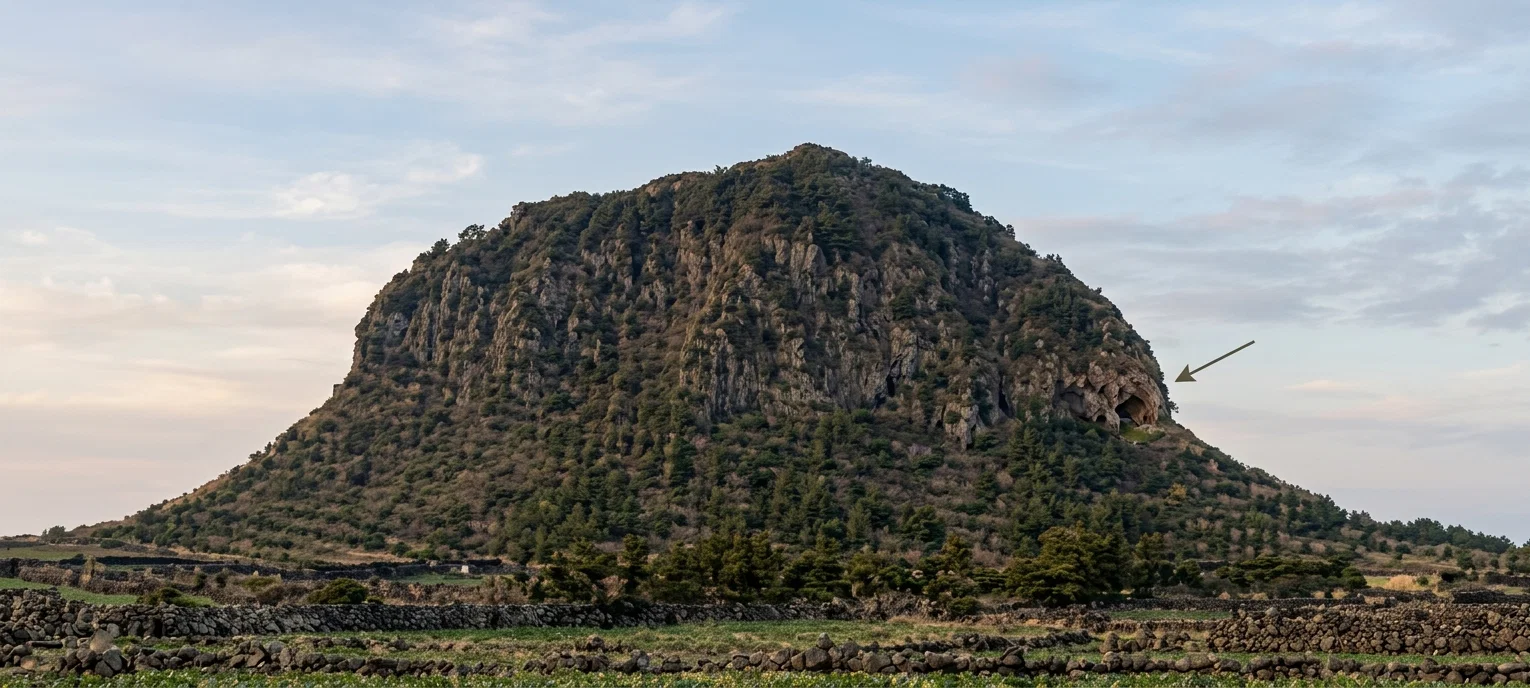
MOUNTAIN WITH CAVE (WHERE ARROW POINTS), WHERE THE PERSECUTED BROTHER KEPT THE SABBATH
Early in the year 1914 a canvasser went to this island, and one day met a man who had been drinking liquor. When the agent saw that the man was intoxicated, he was not anxious to sell to him, but the man wanted to buy; and he did buy a copy of everything the canvasser had,—“Thoughts on Daniel and the Revelation,” “Helps to Bible Study,” and a pamphlet on the “Nature of Man,” and three copies of the magazine. Later this man discovered that while intoxicated he had bought Christian literature, and not desiring to spend his money in vain, decided that, although he knew nothing of Christianity, he would become a Christian and study the literature. To be a Christian he thought it would be necessary to attend church, so he went to the only church in that part of the island, supposing that it was the church that had published the literature he had bought.
For four months this man was faithful in attending church and studying his literature. But one Sunday the pastor notified the congregation that, without doubt, workers of the Sabbath church would soon come to that place, and for them to have nothing to do with the false teachers.
At the close of the meeting the man went to the pastor and said, “Pastor, are we not the Sabbath church? I do not understand your warning.” To this the pastor replied that they were not keeping the seventh-day Sabbath, but were keeping the resurrection day. This was a surprise to our new Christian, and he replied, “Why, Pastor, since I became a Christian I have studied much and have been trying to lead other souls to Christ, telling them that they should keep the seventh-day Sabbath.” This was too much for the pastor. He became angry, told the man that he was a deceiver, an employee of the seventh-day church, coming in there to break up his congregation.
Until this time our new Christian had never heard that there were other churches, and knew nothing of the Seventh-day Adventists. But he was no longer allowed to attend that church, and so it seemed best for him to move to another part of the island. He went to a place called Sa Kae Re, where there are about five hundred houses, but not a Christian inhabitant. He rented a house, and with his wife decided to keep the true Sabbath, worshiping on that day in their rented house. However, the people of the place said that they would not allow a Christian to hold religious services in that village.
About one mile back of the village9there is a rocky mountain, and high up on one side of it is a large cave. Our man now decided that as he was not allowed to worship in what was called a Christian church or hold meetings in the house in which he was living in that heathen village, he would go to this cave and worship God on the day he had blessed and set apart for his worship. Each Sabbath morning for three months he, with his wife, would leave his house before daylight so that people would not see them, and spend the day in this cave, studying the Word of God, praying, and singing. As they were spending one Sabbath in the great cave,—a natural cathedral,—some people from the village came to the cave sight-seeing, and were surprised to find a man and his wife there studying the Bible. They soon became interested in what was told them, and returned the next Sabbath, bringing others with them. Thus an interest was aroused, and by the end of that month a man of influence in the village had also decided to become a Christian, and he said that they should hold meetings in the village from then on, and he would see that they were not molested.
In these native villages there are no large houses suitable for meeting purposes, most of the rooms being eight feet square, and so only a few persons can assemble. The man of influence, Mr. Yun by name, said that as he had spent most of his money for drink, he would now spend what he had left to build a church in which they could worship God. He had a little piece of ground that had been given to him by his father for his house lot, which he said he would use. He planned to build a little church that would seat about thirty persons, but the people of the place strongly objected to having a church building erected there. They were so determined that he should not build that he said he would change his plan and make the new church the largest building in the place, capable of seating at least one hundred people.
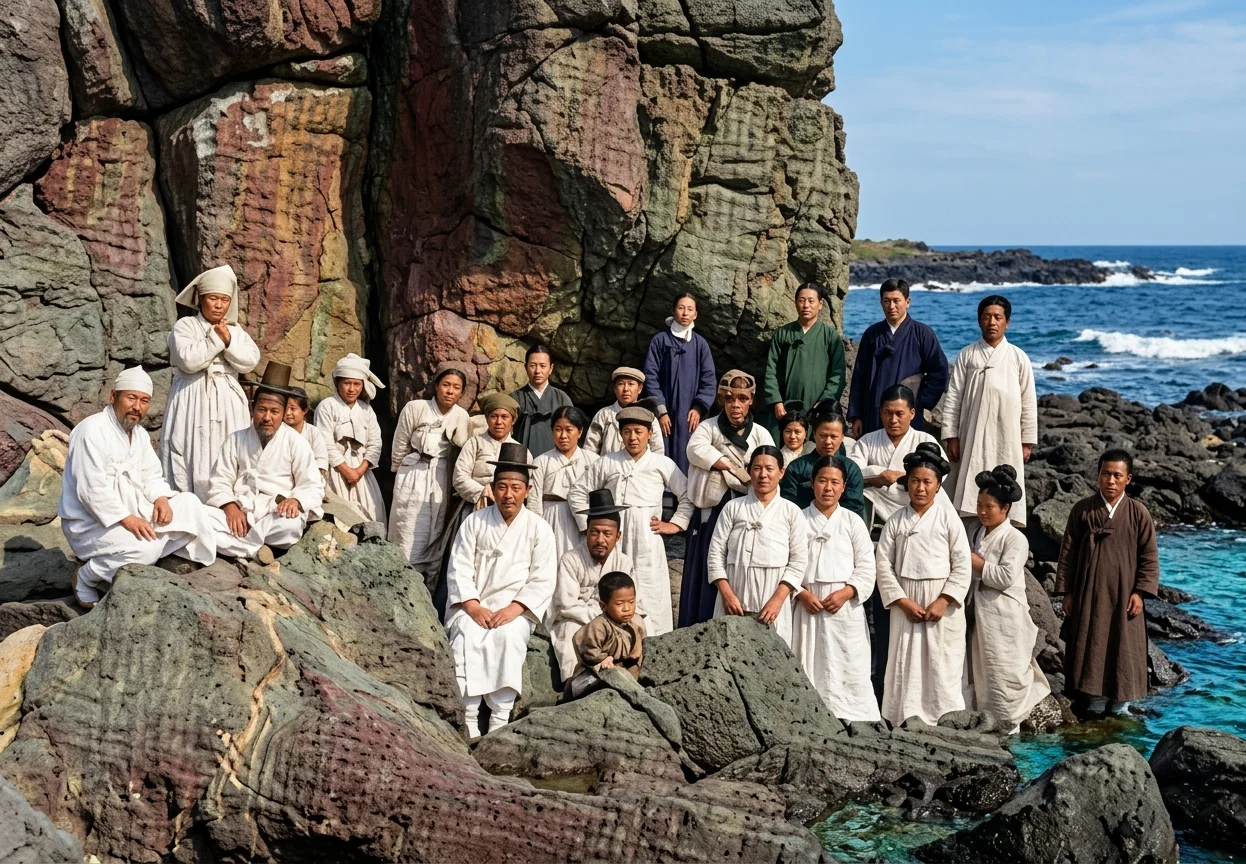
ROCKY CLIFF BY SEASHORE, WITH BAPTISMAL GROUP
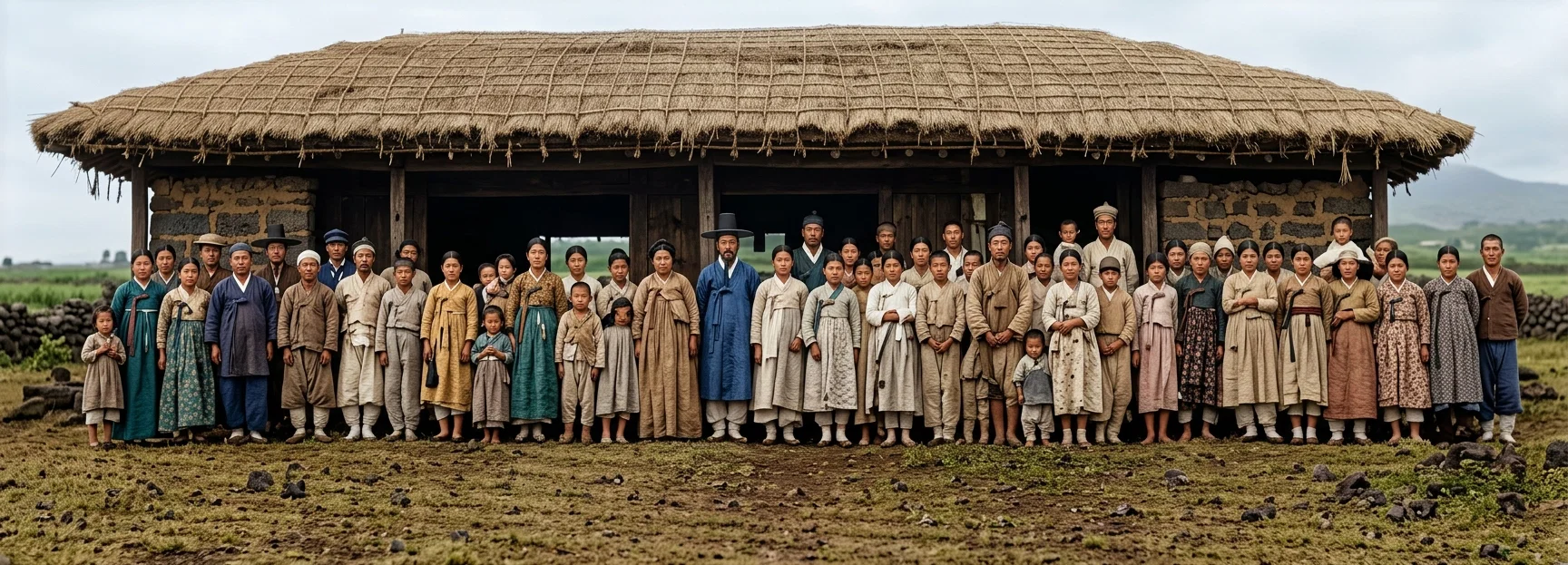
THE SA KAE RE CHURCH BUILDING ON CHAJU ISLAND, KOREA
That building is now about finished, and the expense has been borne mostly by Brother Yun, although it has taken almost all his worldly possessions. The building is well located, and besides the meeting-room there are living-rooms for the native worker who will labor there for a time. Brother Yun, anxious that this building should be used only for the proclamation of the third angel’s message, has given a deed of the land and building to the Korean Mission.
On the last Sabbath in February, in company with Pastor R. C. Wangerin, who is director of the work in that part of Korea, it was the privilege of the writer to visit this place and by a rocky cliff in the ocean baptize eleven candidates, including the above-mentioned two brethren. These have taken a firm stand for the truth. A Sabbath school of nineteen members has been organized, and many others have promised to become Christians. The opposition that was manifested at the first is rapidly giving place to friendliness, and we trust that a strong church will be built up there, and many souls won for Christ.
The people told us that this was the first time that a Westerner had ever visited their village, and from the way they flocked to our room, or gathered in groups by the road as we passed, or peeked through the stone walls at us, we could easily believe that they had never seen our like before.
The journey to the island has to be made on a small boat which runs when the wind is not too strong, which is the case much of the time, as we found out. To one who is not a good seaman the trip at sea is not at all pleasing, and even Pastor Wangerin, who is a good sailor, broke his record this time and experienced the pleasures (?) of seasickness while going to the island.
At the time a steamer was scheduled to leave, we returned to the port, but had to wait just five days in a small room in a Korean inn before the ship came. Our food supply had been exhausted even before we returned to the inn, and all we could get to eat was rice and eggs. Those were days of anxious waiting, yet God’s ways are not our ways, and even those days of “exile” proved to be days of blessing to us. We are glad to have visited the place, and trust that much will be accomplished on the island during the present year. Two native evangelists are now stationed on the island, and many are anxious to know what they must do to be saved. Pray for the work in this part of the vineyard.