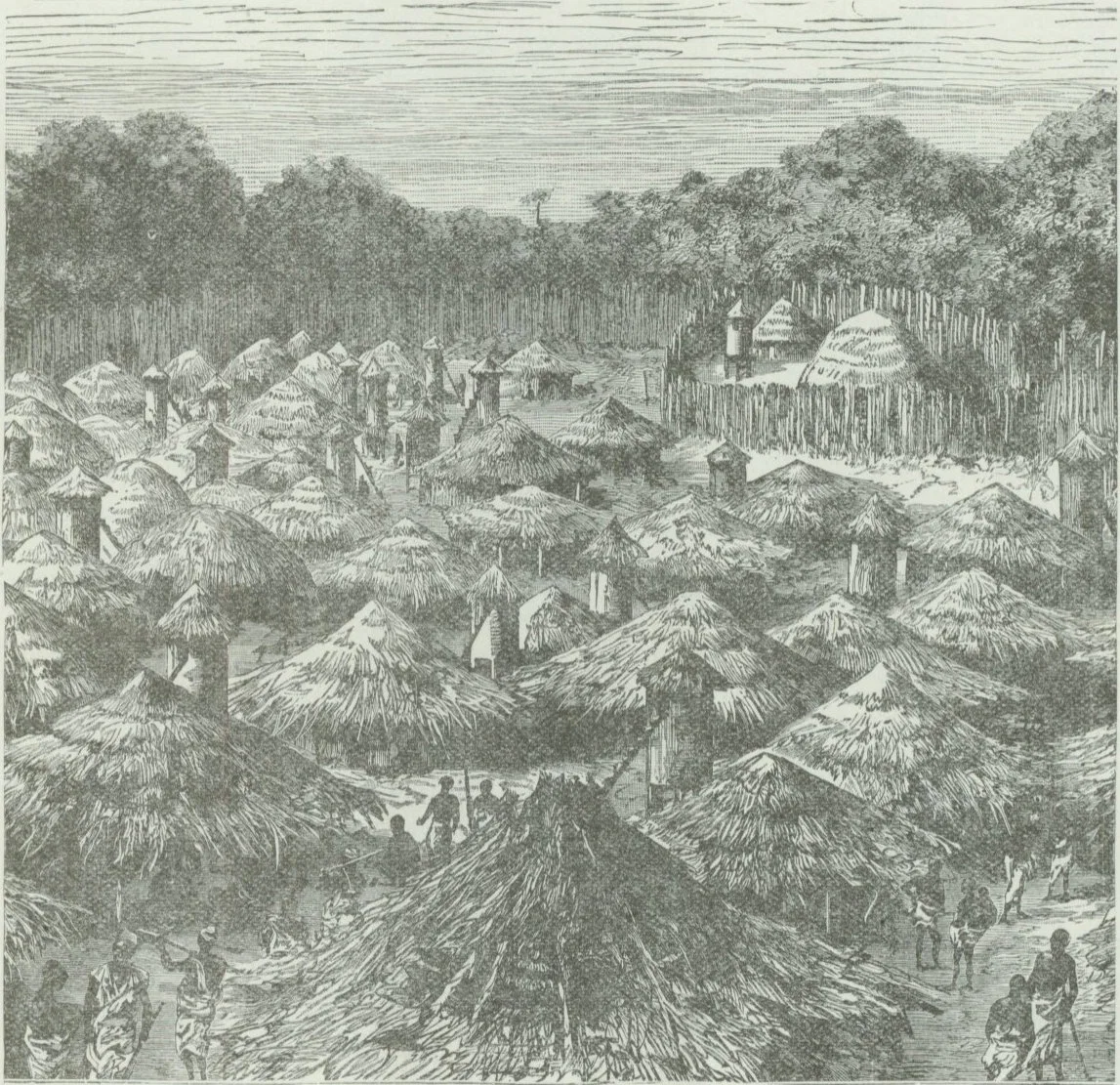
Much has been said, by way of description, both of the physical aspect of this land and of the habits and customs of its people. However, a residence here of only a few months has convinced me that while a pen-picture can give something of an idea of the country, it will come very far short of a true and complete description of the people. This is owing largely, I think, to the everchanging condition surrounding them; a description of last year may not be, in every respect, absolutely true this year. Then there is such a mixture of tribes, each having something peculiar to itself, and this mixture causes a modification of many customs, or a dropping of some cherished one and the formation of something entirely new; but while this is true, there are some customs that are common to all, as far as I know. The practise of polygamy and the use of tobacco in some form, seem to be common to all the native tribes.
AN AFRICAN KRAAL, OR VILLAGE.
Our pioneer mission station is located about thirty five miles west of Buluwayo, and is usually spoken of, in America, as the Zambesia mission. This name is quite misleading, as this territory is quite distinct from Zambesia, and is known as Matabeleland.
While situated in Matabeleland,—in fact, in the very midst of it,—we have to do as yet with but few Matabeles. The natives on the mission farm are, with few exceptions, Macullakas. In many things they differ from the people in the midst of whom they dwell, and whose servants they have been for many years. In physical endurance and mental perception they are said, by some, to be inferior to the Matabeles, but in morality far ahead.
Here, as elsewhere, polygamy is practised. The man is held to be the lord of the situation, and his wives are only so many servants, who are expected to do his bidding without questioning. They are his property, and he treats them accordingly. The girls are usually sold to be wives as soon as they are physically developed,—many of them being mere children,—sometimes to men several times their own age. To us this looks very inhuman, but I have not observed as much evidence of discontent as one would expect under such circumstances. The women seem to accept the situation as their portion, and usually seem contented.
The price paid for these girls, when bought as wives, varies much. Sometimes a girl brings a cow, or an ox, or several cows, or perhaps goats or sheep; then again a few yards of calico or a few shillings’ worth of beads will buy a wife. Two of the boys we have had working for us have bought wives with their wages. In each instance the wife cost ten shillings, about two dollars and fifty cents.
While in the main there is but little outward manifestation on the part of the wives signifying their discontent, there are cases where young girls have been sold to old men, that are touching indeed. Some incidents testify to the fact that there is some true affection, even among those who have been held down for ages by ignorance and superstition. The native commissioner over this district related to me a case that was quite romantic and pathetic. It was the custom of the king, if he saw a girl that impressed him favorably, to make her his queen. This was often done when he did not live with her. A kraal was given her, with cattle and servants, and she was the ruler of that village. One was chosen by the king, in this way, who had formed an attachment for a young man, and her affection was returned. They determined in some way to extricate themselves from the power of the king. Flight was the only means by which this could be accomplished; for to have it known that they were not submissive to the king, would bring upon them his displeasure, and result in their death as rebels against his authority. So taking their blankets and a small amount of provisions, such as could be easily carried, they quietly left their home by night, and made their way southward toward the territory over which the king had no control.
They traveled by night and hid themselves by day, lest they should be detected, and subsisted on the scanty provision taken for their journey, and such game as the young man could secure with his gun without attracting attention that might lead to their discovery. In a short time they reached a place where they felt they would be safe. But fearing he might be considered an enemy or a spy if he retained his gun, the young man determined to give it up to the authorities at Tati station. So he presented himself to the authorities, gave up his gun, and returned to his camp-fire, not knowing the fate that awaited him there. He reached the place, happy to know that they were now beyond the reach of King Lobengula or his warriors. But a danger of a different kind awaited them, and as the fire burned low, a large lion sprang upon them, and before assistance could reach them, only the trampled and blood-stained bushes testified to the valiant fight he had made for himself and the one he loved. I narrate this not for the romance in it, but to show that true affection is not entirely foreign to these people, who are looked upon by many as no higher than the brutes.
Daily we see the evidences that these people have a better nature than they are credited with having, and the spark of true affection still smolders among them; but where, oh, where are the true-hearted workers who will help to fan this smoldering spark into a flame! True, many things which are done for them they do not appreciate; and because of this, many who have come to labor for them have turned from their professed purpose. My heart aches for these people, and I long to be able to impart to them the knowledge of the One who can revive the flagging energies, and make the whole nature glow with the fire of the love of God. There are possibilities before them, and we appeal to you, dear brethren in America, to come to the rescue, and help now to carry the truths of the last message to this people. How marvelously God has opened the way for this field to be entered! Years in the past the field could only be entered by consent of the chief of the tribe; but now the missionary is the master, and stands where he can exercise all the ability at his command, and no native will raise a protest. Why is this?—To enable you and me to carry the precious gospel to the multitudes. Will we do our duty now? God help us to be true.
G. B. TRIPP.
NORWAY
By J. F. Hansen
CHRISTIANIA.— My last report for the REVIEW was written January 27. We have continued our meetings here without a single interruption. The weather, for the season of the year, has been very fine most of the time. We have had a full house at every meeting, and on Sundays we have not been able to give all a seat. I have never seen a better interest in any of our meetings before among the Scandinavians, here or in America. I have given twenty-eight lectures up to date, most of them on the prophecies, and these have created a great stir, and many believe that we are near the end of all things. One of the city papers has made a favorable notice of our work here. We trust that much good has been accomplished by showing the fulfilment of the Holy Scriptures in so many ways.
In the last three discourses, I have spoken upon the law and the Sabbath, which also has created quite a stir among the believers of different parties that have attended these meetings; and some of the leaders, who have shown great interest in listening themselves, as well as in encouraging their friends to hear about the prophecies and the soon-coming of our Lord, now turn the other way, and say: “We can’t see how a man like you will give your time to preaching about the law and the Sabbath. If you would only preach the gospel, you would be the means of converting thousands of people; and we are221sorry to say that we can’t hear you any more, nor will we allow any of our friends to go and hear you, as long as you continue to preach these things.”
It may be expected that these criticisms will have some effect to lessen the number who come to hear us, but it will not keep the upright in heart from being touched by the Spirit of truth, even in their own homes. And just this way it worked the other day upon a Methodist sister. When she opened her Bible, she had her eyes fastened upon these words for the first time: “He that turneth away his ear from hearing the law, even his prayer shall be an abomination.” Many are already in the valley of decision, and others have fully decided. We were made glad last Sabbath to welcome about twelve new converts to the truth of the Lord in our Sabbath meeting. Some of these dear friends then kept their first Sabbath, others their second.
Last night I gave my first regular lecture upon the Sabbath question, to a full house of about four hundred persons, who listened with the deepest interest to all that was said. I expect quite a change will have taken place with many here among the hundreds of hearers who are listening to these solemn truths, by the time this report reaches you through the REVIEW. O may the Lord bring in his converting power, without which nothing really good can be accomplished to his glory! I am of good courage in the Lord and his work, and my health is also good, for which I am very grateful to the giver of all good things. I hope the friends will remember the work here. J. F. HANSEN.
MAINE
By M. G. Huffman
AUGUSTA AND EAST WASHBURN.—The work is still onward here. The Lord is blessing the work, and two more have signified their intention to walk in all the precepts of the Lord. Others are deeply interested, and we have hopes that they will soon obey. Among the interested ones is a First-day Adventist minister and his wife. He is a man of considerable ability, having been a representative in the Maine Legislature, and he is a man of good report. Many of his own people are in the valley of decision, and doubtless his decision will be a great help to the others in deciding for or against the truth. Hence we feel quite anxious in regard to the action of the elder in this matter. Elder Basney and I began a series of meetings in the city hall at Hallowell the evening of February 27, and had expected to continue the meetings several weeks, but we had held but two meetings when a big rain-storm came, breaking up the ice in the Kennebec River, and causing an overflow, which flooded Hallowell, as well as other towns along its banks, to the depth of four to six feet. Millions of dollars' worth of property was destroyed. This, with the severe snow-storms which followed, almost completely broke up our meetings. We held a few meetings, however, between the storms, closing Sunday, March 15, in order to get to the general meeting in Aroostook county. We cannot but believe that much good will result from the meetings held at Hallowell. The last Sunday Elder Basney preached a discourse on the Eastern question, or what the Lord has said in regard to the king of the north coming to his end. The subject was listened to with marked attention. Many seemed deeply impressed with the solemnity of the times in which we live, and the need for a preparation for the great day of the Lord.
The meeting at East Washburn was held according to appointment, March 20–22. The great snow- and rain-storm of the 19th and 20th doubtless kept many away from the meeting, but notwithstanding all this, we had an excellent representation of our brethren and sisters from throughout the country; and the best of it all, the Lord met with us in our first meeting, and blessed by his Spirit in the first service, and continued to bless throughout the entire meeting. Sabbath afternoon an invitation was given to all who desired to give their hearts to the Lord, or who felt like renewing their covenant with God, to come forward. Fifteen or twenty responded to the invitation. Among these were some of the youth, who gave their hearts to the Lord for the first time; others who had wandered from the fold returned to their Father's house. It was a goodly sight, and parents were made to weep for joy, to see these dear souls giving their hearts to God. May the Lord bless and keep them faithful unto the end, for the promise that they shall be saved, is only to such. Sunday afternoon, March 20, a large crowd gathered, at which time the new church building was set apart to the service of the Lord. The dedicatory discourse was preached by Elder Basney. It was listened to with great interest, and a deep impression was made upon the minds and hearts of222the people, as he showed the wonderful contrast between the two temples,—the one Solomon built and the spiritual one which Christ is now building. Notwithstanding the magnificent structure which Solomon had the honor to build, it sinks into insignificance when compared with the spiritual temple which the Master-builder is superintending. He has his workmen in all parts of his vineyard earnestly preparing the material of which this great structure will be composed, and soon, very soon, every stone will have been scored and polished ready for the building, and Jesus will send his angels to gather together his elect. The building will be fitly framed together, and that, too, without the noise of hammers; and the blessedness of it is that each one of us can be, if we will, a lively stone, and fill an important place in the spiritual house.
A few months ago the brethren and sisters at East Washburn were meeting in a little school-house, and scarcely any one, apart from our own faith, would attend any of the meetings held there. When we now see an edifice erected in which to worship God, a place where the people can gather to hear the blessed truths of the third angel's message,— a house which is not only a credit to the community but to the present truth as well,— we cannot but say, Surely the Lord has wrought a wonderful work even in East Washburn. The house was dedicated free of debt, with the exception of a few dollars, but this was all provided for, which makes the house practically clear of debt. The meetings closed Sunday evening with a full house, and the brethren and sisters seemed much encouraged, and returned to their homes to praise the Lord for the blessings received. One brother and his wife walked fifteen miles to attend the meetings, hauling their two children on a sled. He carried his wife over the rough places; and no one enjoyed the meetings more than they did. They said, after the first meeting, that they were doubly paid for all their trouble. Monday morning Brother Basney and I separated, he going to New Sweden, while I left for Augusta. I stopped at South Presque Isle and Blaine, and held one meeting at each place, with a good hearing. The work is onward throughout the state, for which we all praise the Lord. I am of good courage in the Lord, and praise his dear name for the privilege he grants me of laboring in his vineyard.
M. G. HUFFMAN.
New Amsterdam, British Guiana.
By Philip Giddings
For want of a suitable public place for holding meetings, since my last report I have been holding Bible readings with families, and lending or selling tracts and papers. We hired a cottage where we held our church meetings. We have a better place now, for which we pay six dollars a month. This building was formerly the Wesleyan meeting-house. Three others have joined us. Two more attend Sabbath meetings, are fully convinced, and will join us soon.
A tract and missionary society and a Sabbath-school of fourteen have been organized. The week before the week of prayer was spent with Brother Kneeland up the Demerara River with the company he has organized there. The work looks very promising. Our boat for the river district is finished, and Dr. Ferciot and Elder Kneeland are gone on a missionary trip higher up than the first mission. They have, by their personal labor, saved over twenty-five dollars on building the boat.
The week of prayer was spent with the brethren on the Corentyn Coast. We had meeting at eight o’clock in the morning and seven o’clock in the evening. It was a time of spiritual refreshing. One stubborn heart was broken to confession. Few strangers attended the evening meetings. Our Christmas offering was $5.08, which went for the boat fund.
Elder Kneeland and Brother Downer spent a week here with me last month, but as this is the best time of the year to go up the river, they could not stay much longer. Their presence and help were an encouragement to me. We have had to postpone baptism now twice for want of water. A drought is threatened. We might go to the seashore, but other conveniences are lacking. There are now nine waiting baptism. I have just returned from a visit up the Berbice River, to view the situation for future labor. The people there are better provided with churches than at the Demerara River, there being in the Berbice district the Lutheran, Brethren, English, and Missionary churches. I held two meetings, paid several visits, and introduced our literature all the way. I have written to these persons since my return. Two more, have answered. One thinks that I am a false prophet, however. The other is of a different opinion, and writes encouragingly. The rest have not been heard from yet. We are all well, and of good courage in the work.
Philip Giddings.
THE WORK IN BOSTON.
By H. W. Cottrell
As there has been some mention made in several of our periodicals of the remarkable opening for the third angel's message to be presented in the city of Boston, I thought it would be of interest to our people to know how the opening occurred, and also the present outlook. The pastor of the Harvard street Baptist church had lately become a believer in the soon-coming of Christ, and expressed to Dr. Thompson of the city, who had just begun the observance of the Sabbath, a desire to have an Adventist come to his church, and preach upon the subject of the “advent” for one week. The Doctor sent in the request, and we at once supplied the call by recommending Elder G. E. Fifield.
There was considerable prejudice manifested by the people generally,—not against what was said, but against what they seemed to fear would be said. The last day of the meeting there was more of a friendly attitude shown upon the part of all. Later the pastor requested that Elder Fifield labor for them one month. After receiving this request, I went to see him, and told him that we would be glad to grant his request, but although Seventh-day Adventists and Baptists do not believe alike on many points of Bible doctrine, if Elder Fifield were to go, we thought they should grant him untrammeled liberty to preach the Bible just as it is. Otherwise he would be bound, and would please neither the Lord nor them. He replied, “We will grant the fullest liberty on all points.”
The second series of meetings has now been in progress about three weeks, with excellent interest, so far as drinking in the gospel truths they have heard is concerned; but there is no excitement, or anything of that kind. The congregations are not large,—some less than five hundred,—but one very encouraging feature is, the minister throws his entire influence in favor of the truths presented. The Sabbath question has not been discussed yet, but all know of it, and are expecting it.
There is no question in my mind but the hand of Providence opened the way for the truth in this great city, in fulfilment of the testimony of his Spirit as applying to this time. Hence we greatly desire the prayers of all, that the work may be carried on after the mind of God. The pastor now requests that the same help be granted them three months instead of one. The church has done all it could to provide for Elder Fifield's comfort. They are boarding him at the United States Hotel.
The church established a midday meeting to continue throughout the time of the special meetings, and requested Dr. Thompson and his wife, of our people, to take full charge of it, with the request that they call to their aid such help as they chose. Elder Wheeler and Brother Gilbert, who are also laboring here, informed me of three other ministers who request that Bible readings be held with them.
Brother C. E. Palmer is devoting his entire time to Christian Help work in this city, under the employment of the conference. Great is the need of the help thus rendered. The cases of distress and degradation found in this line of work are far beyond human description; and as there is, no doubt, much of a sameness in this respect in all the large cities, I will not mention any case in particular, except that while visiting with Brother Palmer to-day in the destitute district, one woman stated that for a week during the coldest weather of the winter, she had neither coal nor wood for even one fire, hence was compelled to lie in bed to prevent freezing. A family of seven children were in the same condition for one day. Help has been rendered to forty-five families and nearly two hundred persons. Cash donations have been received to the amount of $131.13, besides much provision and clothing.
Brother Palmer has now received personal letters of commendation from several of the leading men of this and other adjoining cities, such as the mayor of Boston and of Everett, the ex-mayor of Everett, an ex-judge of Boston, and several lawyers and doctors, through whom he is now enabled to reach men of means to assist in this great work of imitating the Master in going about doing good. H. W. COTTRELL.
News of the Week.
FOR WEEK ENDING APRIL 4, 1896.
NEWS NOTES.
The uprising in Matabeleland, Africa, appears, by reports received, to be a formidable and serious affair. Quite a large number of white settlers have been murdered, and many others have sought refuge in Buluwayo and Gwelo. Forces are being sent forward to quell the uprising as quickly as possible, and it is anticipated that the trouble will soon subside. There is no information at hand as to our missionaries in that country, but from all we are able to gather, we conclude that there is no cause for uneasiness, since it is the full-blooded Matabeles that are principally concerned in the matter, and our workers are not among these.
A writer in the Monayunk (Pa.) Chronicle and Advertiser says: “Before me lies a small circular which was handed to me a few days since. It announces a lecture to be delivered in one of our churches. The subject, ‘Key to Unlock Hearts,’ is followed by the statement: ‘A rich and rare entertainment,’ while lower down is the following gush: ‘This lecture is humorous and pathetic. The lecturer deals with hearts, and throws out a key to fit every heart. Lovers are greatly aided in their up-hill business. Family infelicities are touched up, and remedies suggested. Some stern but wholesome truths to husbands. It will pay merchants to attend this lecture. Violent politicians rebuked and pacified. Dudes are furnished with keys to fit hearts of flirts.’ And yet it is written: ‘My house shall be called a house of prayer.’ Further comment is unnecessary.”
The attempt to patch up a peace in Winnipeg on the Manitoba school question ended in a complete failure, and the representatives of the Canadian government have returned to Ottawa. A despatch says: “The Dominion commissioners, when the conference assembled, suggested the adoption in Manitoba of the system of schools agreed upon by the Protestants and Roman Catholics of Nova Scotia. The Nova Scotia system is practically the maintenance of Roman Catholic separate schools, so the Manitoba commissioners rejected the proposition. Then the Manitoba delegates offered to give absolutely secular schools. These were declined as objectionable to Roman Catholics, who strenuously opposed what they termed ‘godless’ schools. Then Manitoba offered to allow Roman Catholics to impart religious instruction to the scholars of their faith for half an hour each day, but such concession was not considered sufficient. The gulf between the proposals of the Dominion and those of Manitoba was too wide to be bridged, and so the conference came to nought. The scene of the great struggle is now again transferred to Ottawa. A conflict between the creeds now seems imminent and unavoidable.”
The General Conference of the Methodist Church will convene in Cleveland, O., May 1. For many years the question of lay representation in their conferences agitated the church. That having been practically settled in the affirmative, the more difficult question of admitting women delegates now comes up. It was first broached eight years ago, and received a storm of disapproval. The state conferences have been voting upon it for some time, and the results are nearly all favorable to such admission. Indeed, four women have been chosen as delegates. But some branches of the church are opposed to the innovation, and the debate is likely to prove a very interesting one. The German Methodist ministers of Cincinnati express their opinion223in the following way: “Our German Methodist people look upon this movement as not in harmony with the Scriptures, and as being part of an extraneous current of social and political agitation that has been injected into our church mainly from a source that is pronouncedly antagonistic to Christian faith and doctrine. The ‘new woman’ of the present age is of that unwomanly type that repels the German mind, which has always honored true womanhood, dignified the sacred functions of motherhood, and emphasized the home.”
Ill luck would seem to be on the track of the American Line steamers, so far as getting into difficulty is concerned, although they have encountered no fatal calamities. A few weeks since one of their vessels was in difficulty in Southampton harbor. Since that time the “St. Paul” has lain stuck in the mud outside of Sandy Hook for ten days; the “City of New York” has grounded in New York harbor; and last week the “Paris” ran into the mud while trying to pass up New York harbor during a dense fog. The monster boat was rescued by a lot of tugs, which pulled her out of the difficulty without serious damage. But the question suggests itself, Why don’t some of the other great steamers get stuck in the mud, as well? Is it because they have better captains?
The Spanish government evidently feels disappointed in the career of General Weyler up to the present time. He has not as yet developed all the strength and vigor which they hoped he would. His strict orders not to do anything to bring on provocation with the United States has hampered him in pursuing a vigorous policy against the rebels. He has been engaged lately in trying to induce the Cubans to go through a semblance of an election, but he has been obliged to report his failure to accomplish this. The captain of the American schooner “William Todd,” reports having been fired on by Spanish gunboats on March 16. First a blank cartridge; then three solid shots were fired while the American flag was being hoisted. Two Spanish gunboats were engaged in the affair, and the schooner was searched by armed men. If this affair proves to be as reported, it may result in further difficulties between the two nations.
England’s advance into the Soudan continues to agitate Europe to quite an extent. The powers find themselves in an embarrassing situation, since they are all more or less interested in African plunder, and the defeat of England means trouble for them. The success of England strengthens their claims in one way, but jealousy of England makes it hard for them to see her succeed. France is decidedly opposed not only to the conquest of the Soudan, but to the continued occupancy of Egypt. France is exasperated that the Egyptian reserve fund should be largely drawn on to pay the expense of the expedition up the Nile. England professes not to care particularly what France or other nations think about the affair, and declares that Egypt will not be evacuated, and that the Nile expedition will move on. Thus the attention of the world is being drawn to that part of the world, and expectancy is high as to what will happen.
Mrs. Booth-Tucker, the new commander of the Salvation Army in this country, arrived from Europe much exhausted by her journey, on account of the deep anxiety of mind to which she has been subjected in view of the difficulties which lay before her, and the afflictions which she left behind in the serious illness of her six-weeks-old infant. As said last week, they received the news, after embarkation, of their child’s sickness. “General” Booth, having more confidence in the ability of his daughter than of his son-in-law to manage his interests in this country, is reported to have ordered the husband back to take care of the sick baby, and the mother forward to take charge of the Army. Upon landing the mother was assured by cablegram that her child was improving, but she suffered a nervous relapse. Two or three days later news came that the child was dead, and the poor mother is entitled to the sympathy of all.
It is believed that the real struggle between the two organizations will lie between the two leading women, Mrs. Booth-Tucker, a Booth by birth, and Mrs. Ballington Booth, not a Booth by birth. Prominent ones in the Salvation Army are still entertaining hopes that Ballington will be restored to his place, but while it is possible that this might be done in his case, it would probably be more difficult to reconcile his wife to return to their old position. It is reported that Herbert Booth, head of the Salvation Army in Canada, is to go to Australia to take command.
ITEMS.
—A man named Lipkie was killed in a friendly boxing contest in Laporte, Ind.
—In Uganda, Africa, there have been reported one thousand baptisms during the past year, and two hundred buildings are used for public worship.
—In Germany a merchant was recently fined heavily for using a quotation from the Bible at the head of an advertisement. He would do well to move over to this country.
—The famous and bloody feud that has long existed between the Hatfields and McCoys, of West Virginia, was brought to a termination last week by the killing of the last of the McCoys.
—General Neal Dow, who reached his ninety-second birthday anniversary, Friday, March 20, is reported well and vigorous. “His natural force is not abated.” He still writes and speaks with much of his old-time vigor.
—A recent expert report of the extent of the anthracite coal fields in the United States, places their contents at 11,921,400,000 tons. The annual production averages 45,000,000 tons, at which rate the supply would last some 265 years.
—There is great activity in the oil region of Southeastern Kansas, and much is doing, both in the boring of new wells and in the development of wells already put down to oil. Some two thousand wells will be opened in that region within the next six months.
—A Kansas farmer filled his pipe with tobacco from his pocket, and sat down for a smoke. A sudden explosion startled the family, and it was found that two revolver cartridges had been inserted into the pipe by accident. One bullet pierced the breast and the other the brain of the man, who fell dead.
—James W. McDonough, of Chicago, has perfected a process by which natural colors are photographed. The principal additions to the present outfits are a specially-ruled screen, which is placed directly before the sensitive-plate in the camera, and a specially-ruled paper on which the colored photograph is printed.
—A remarkable invention has lately been produced, whereby five typewriters, at each end of a single wire, can send messages both ways, and have them printed as received, at the astonishing rate of three hundred words a minute. The inventor of this wonderful machine is Mr. Henry A. Rowland, a professor in Johns Hopkins University, at Baltimore, Md.
—Paderewski’s price for playing the piano at a private reception is $500 a minute. A San Francisco woman wrote to Paderewski’s manager some ten days ago, when the pianist was in that city, asking what Paderewski would charge to play for five minutes at an afternoon tea. She got a reply saying that the charge would be $2500. She thought this rather steep, and wrote another note, offering to pay $1000 for five minutes of Paderewski’s music. She didn’t even get an answer to this note.
—The Mobile, Ala., Register says: “Circuit court convened at St. Stephens yesterday, Judge W. S. Anderson presiding. A novelty was sprung on the court, as well as the crowded court-room of citizens, by a motion made by Colonel Samuel B. Browne, that the court be opened each day by reading a chapter from the Bible and by prayer. Judge Anderson granted the motion, stating that he thought it a very appropriate service.” The motion was then carried into effect by Colonel Browne’s reading 1 Peter 1, Solicitor Brooks leading in prayer.
—Professor Wm. H. Eckert, an inventor, in speaking of the recent publications concerning the Roentgen process, says that his researches are resulting in the discovery of a new or first state of matter with a positive mechanical law, governing the actions of seven primary elements of matter, by which nature produces everything in the mineral, vegetable, and animal kingdoms. He figures that it is just as practical to see through a thousand miles of wire as to talk through it. Magnetism, electricity, heat, light, sound, and color are all imponderable phenomena, created by seven elemental energies.
—The papers publish an account of singular distress at sea. The little British schooner “Robin Hood” sailed from St. Johns, Newfoundland, Feb. 18, for Lisbon, and was found drifting at sea with only two children on board. The little schooner left port in charge of her captain and his two children. The captain died when the little craft was in the middle of the ocean, and his two children were left alone eight days on board the little schooner, with their father’s dead body. When found by another vessel, the children were in great distress, and almost famished for food and lack of water.
—Recently the assistant treasurer of the United States at New York City has turned into the post-office department fund the sum of $1,300,000, which has been accumulating in the sub-treasury during the last thirty years from the funds paid to the money-order post-offices for remittances which have never been claimed. Old money-orders are presented at the post-office department almost every day, but the amount of the unpaid money-order fund increases constantly, and there is no likelihood that any part of the $1,300,000 will be claimed by its owners. In fact, every year from $50,000 to $100,000 is added to the fund, which represents carelessness or neglect.
CALIFORNIA
By H. G. Thurston
CALISTOGA.— For several weeks I have been holding meetings at Calistoga, and already some have taken a stand for God’s message for to-day. A Baptist minister and his family, who were much prejudiced, have accepted the truth. Satan has tried in many ways to thwart this good work, but I believe God’s truth has found a permanent place in the hearts of this family. I hope to see the time come when this man, who has formerly been very active, will use his education and ability in helping to warn the world of its impending doom.
A number of others have become deeply interested in the meetings, and of some we have hopes for their conversion to God and his truth. The members of our church have done what they could to make the meetings a success and my stay among them pleasant. May God remember the kind brethren of Calistoga, and add to their number such as shall be saved.
In many respects my work in Napa valley during the winter has been very pleasant, and, I trust, profitable. The Lord has added his blessing, and souls have given themselves to him.
H. G. THURSTON.
INDIANA
By F. M. Roberts
SINCE my last report, I have labored at Marion, Jonesboro, Wolf Lake, and Etna Green. I was with the Marion church during their January quarterly meeting, which was a glorious meeting. The Spirit of the Lord came very near. Four united with the church. I finished up the quarterly work at Jonesboro, and held a few meetings with that church, which were well attended, and a most wonderful manifestation of God’s Spirit was enjoyed by all present, and two united with the church, and others made a new start for the kingdom of God.
From here I went to Etna Green and labored some three weeks, where I had the happy privilege of seeing eleven precious souls take their stand for the truth; and not only this, but there is a good outside interest manifested by many. Closing the work here, February 10, I went to Wolf Lake to hold an institute in the interest of the Sabbath-school, as well as other branches of the work. This meeting was well attended, and all seemed to take a good interest in the work, and expressed themselves as being benefited by the meeting. This being my first visit with this church, I am glad to say that here I met an earnest little church, and all seem willing to do what the Master calls them to do.
I went home from here by the way of Fremont, stopping there overnight. I hope to visit this church again when I can remain longer. At Barber’s Mill we had a most excellent meeting in institute work for one week, which we are sure will be a blessing to the church there. I was made glad to see four persons unite with the church. From this place I returned to Etna Green, where I labored twenty-four days. My work there resulted in six more additions to this new and flourishing church, and arrangements were made for the erection of a good little house of worship, which is to be erected immediately after seeding. A building committee has been appointed, and already almost enough stone and timber have been donated for the rough work, as has been also the work of the masons and carpenters. A good organ has also been given to the church. The church is full of courage, and many people seem to be glad that we are going to build. I wish to say that while I have labored hard, I have enjoyed my labor, and the Lord has greatly blessed me, for which I praise his holy name. Let the church praise the Lord, and the people say Amen. I now go to a new field. F. M. ROBERTS.