Your ShelfYour Projects

Signs of the Times, Vol. 41, No. 1.

Periods of Significant World-Wide Peace

Signs of the Times

Jan 13, 1914

Pacific Press Publishing Association · Mountain View, California · Jan 13, 1914

Periods of Significant World-Wide Peace

The Iron Hand of Pagan Rome — Universal Peace for the Message and Work of the First Advent — International Peace Decreed for the Time of the Second Advent Message — That Message Finished, Then Armageddon
By GEORGE W. REASER
T least in a twofold sense, there was a fulness of time for the manifestation of the Son of God in our world. First, sin must run its course sufficiently long to demonstrate the utter helplessness of the whole human family, without the provision of a Saviour, able "to save them to the uttermost that come unto God by Him." Second, "as the soil must be prepared before the wheat is sown, so before the kingdom of heaven could throw up its shoots, there was needed a kingdom of this world where the nations were neither torn in pieces by violence nor were rushing after false ideals and spurious ambitions. Such a kingdom was the empire of the Cæsars — a kingdom where peaceful men could work, think, and speak as they pleased, and travel freely among provinces ruled for the most part by Gallios, who protected life and property, and forbade fanatics to tear each other in pieces for their religious opinions." "Had Europe and Asia been covered with independent nations, each with a local religion represented in its ruling powers, Christianity must have been stifled in its cradle." (J. A. Froude's "Cæsar — A Sketch.")

SUCCESSFUL ROMAN ARMIES AND WORLD-WIDE PEACE

It will be remembered by every student of history, that Julius Cæsar came into the world in one of the most stormy epochs in all earth's history. The world was almost devastated by wars. The chief object of the deadly strife was to settle the disputed question of the supremacy of the world. The arms of the Romans were finally victorious. Even after they had vanquished all rivals, the question of equal rights of citizenship must needs be settled by resort to arms at the very heart of the empire. Descriptive of this social war, the historian says: "The veteran legions, which had conquered the world, now faced each other on the battle-field. The struggle cost three hundred thousand lives." The final outcome was a reign of universal peace. Tranquillity settled down upon an erstwhile storm-racked world. After the passing of Julius Cæsar, the next of the Cæsars to take the throne of world empire was Augustus. "The Augustan Age (31 B.C. to 14 A.D.) was one of general peace and prosperity." "Wars having so nearly ceased, and interest in politics having diminished, men turned their thoughts more toward literature, art, and religion. The birth of Christ, the central figure of all history, occurred during the wide-spread peace of this reign." (Barnes's "General History.")
Myers's "General History," pages 278, 279, substantiates the same historical fact. He says: "It is preeminently worthy of note that it was in the midst of the happy reign of Augustus, when profound peace prevailed throughout the civilized world, . . . that Christ was born in Bethlehem of Judea." "Never before, perhaps, had the civilized world enjoyed so long a period of general rest from the turmoil of war."

NO SERIOUS WARS DURING CHRIST'S FIRST ADVENT WORK

Even Palestine had been the scene of a disastrous war a short time before the Saviour appeared. Speaking of the prevailing peace in the land of Palestine when "the fulness of the times was come" for His first advent and His work, the Rev. John W. Mears, in his book "From Exile to Overthrow," says:
"For the time being, however, the country was at peace. It is remarkable that during the life of Christ, . . . no serious trouble between the people and their foreign rulers broke out. The quiet which was necessary for His various journeys, His works of healing and beneficence, His discourses and teachings, His selection and training of the apostles and laying carefully the foundations of His church, prevailed. The narrative of the evangelists presents a tranquil scene, a succession of attractive pictures, in striking contrast to the bloody and tumultuous events which crowd each other in the pages of Josephus. It is as if the nation was enjoying a short reprieve, a last golden moment of opportunity, when it might recognize its Messiah and by repentance and humility escape its threatened doom. [See Dan. 9: 24.] . . .
"It is clear that under opposite circumstances no teacher of piety and peace could have accomplished his mission in Judea. In a previous generation, under the jealous and bloody Herod, the career of Jesus would have been immediately cut short. Under a succeeding generation, when the whole land trembled with forebodings of the great civil war, there could have been no peaceful gatherings on the mountainside to listen to the Beatitudes, to the model prayer, and to the sweet parables of the kingdom; no wonderful draft of fishes, and no discourses to the multitudes from the fishermen's boats drawn up on the shore of the sea of Galilee; no quiet feeding of five thousand with a few loaves and fishes when every large gathering meant rebellion and war; no time to let the words and deeds of the great Teacher sink deliberately and diffuse widely through the hearts and minds of the people, like a gentle rain, or for that solemn march of events which gradually led to His death, and gave it the dignity of a great epoch, the grandeur of a divine sacrifice for a fallen race." — Pages 256–258.
We will quote one more extract referring to the prevailing peace when Christ was born:
"Finally, as a central point in the history of all time, in the midst of the brilliancy of the Augustan Age, while Cicero, Sallust, Virgil, and Horace were fresh in the memory of their still living friends, with Seneca in his childhood and Livy in his prime, the empire at its best, and Rome radiant in its growing transformation from brick to marble under the guiding rule of the great Augustus Cæsar, there was born in an obscure Roman province the humble Babe whose name far outshines all these, and from whose nativity are dated all the centuries which have succeeded." — Myers.

WORLD-PEACE TO ALLOW PROCLAMATION OF SECOND ADVENT

If a time of universal peace was necessary for the accomplishment of His mission at the first advent of the Messiah, does it not naturally follow that similar conditions must prevail to give favorable opportunity for the heralds of His second advent to accomplish their Heaven-appointed work? And if Heaven overruled to bring about political conditions in all the world so that Christianity would not be "stifled in its cradle," is it not logical to conclude that "He who ruleth the kingdoms of men" will interpose to restrain the nations for a time from engaging in the battle of Armageddon, and thus produce conditions favorable for the very last proclamation of "the everlasting gospel," before the curtain shall finally drop on human probation?

HOLDING THE WINDS FOR THE SEALING WORK

Happily we are not dependent simply upon logical reasoning to sustain this fact. It is clearly foretold by an inspired writer. Describing conditions to prevail for a time before the gathering of the "kings of the earth and of the whole world" for the last premillennial battle, upon the field of Armageddon, he says: "And after these things I saw four angels standing on the four corners of the earth, holding the four winds of the earth [restraining the elements of warfare and deadly strife]. . . . And I say another angel ascending from the east, having the seal of the living God: and he cried with a loud voice to the four angels, . . . saying, Hurt not the earth, neither the sea, nor the trees, till we have sealed the servants of our God in their foreheads." Rev. 7: 1–3.
The inquiry may be raised, What is indicated by this sealing work? The answer, in brief, is that by the preaching of the gospel, souls are born into the kingdom of heaven, and these are sealed by divine agencies, for eternal life.
We are actually living in the time when heavenly agencies, commissioned to restrain the war spirit of the nations, are holding the winds — delaying the marshaling of the nations for the greatest death struggle in all earth's history, so that the servants of our God may be sealed for eternal life in the kingdom of glory. Then in what work ought every child of God to be engaged? Every Spirit-filled heart will answer, "I must be about my Father's business," — "I must devote every God-given talent to the winning of souls." "Who knoweth," fellow Christian, "whether thou art come to the kingdom for such a time as this?"

Signs of the Times

PACIFIC PRESS PUBLISHING ASSOCIATION MOUNTAIN VIEW, CALIFORNIA

The New Year's Blank Card

What and How Shall I Write in This New Year? By C. P. BOLLMAN
The new year comes from the pregnant East, Where the day line cleaves the seas; And while to the North it brings wild storms, The South hears the hum of bees.
But whether in biting Northern cold, Or in melting Southern air, The new year brings to us every one A blank card, unstained and fair.
And on that card we write, hour by hour, All we do or think or say, And anon we'll meet that record true In the final judgment-day.
What shall I write, then, during this year That the East has sent to me? I can only write my very self, For the eye of my God to see.
For I write as I live day by day, Every act and word and thought; So I must be what I'd have the card When to Judgment I am brought.
Then live Thou in me, my gracious Lord; Write Thy thoughts and words and will Upon the card that Thou givest me, While I trust Thee, and am still.

Peace at the Foot of the Cross

Nowhere can peace be found in all the world but at the foot of the cross and the vision of the Lamb that was slain to take away the sins of the world.—Bishop S. S. Harris.

Peace

OUR heavenly Father is styled “the God of peace.” Heb. 13: 20. His Son is the “Prince of peace.” Isa. 9: 6. Seated on His Father’s throne, “the counsel of peace shall be between Them both.” Zech. 6: 13. We are told, “Acquaint now thyself with Him [God], and be at peace” (Job 22: 21), and, “Let him take hold of My strength, that he may make peace with Me; and he shall make peace with Me.” Isa. 27: 5. Of the wicked it is said: “The wicked are like the troubled sea, when it can not rest, whose waters cast up mire and dirt. There is no peace, saith my God, to the wicked.” Isa. 57: 20, 21.
The apostle Peter admonished, “He that will love life, and see good days, . . . let him eschew evil, and do good; let him seek peace, and ensue it.” 1 Peter 3: 10, 11. Paul informs us that “to be spiritually minded is life and peace.” Rom. 8: 6. Again he says, “As much as lieth in you, live peaceably with all men.” Rom. 12: 18. And in order to accomplish this, he said, “Follow after the things which make for peace, and things wherewith one may edify another.” Rom. 14: 19. And to the Hebrews he said, “Follow peace with all men, and holiness, without which no man shall see the Lord.” Heb. 12: 14. J. N. LOUGHBOROUGH.

Comforting Words Spoken with Authority

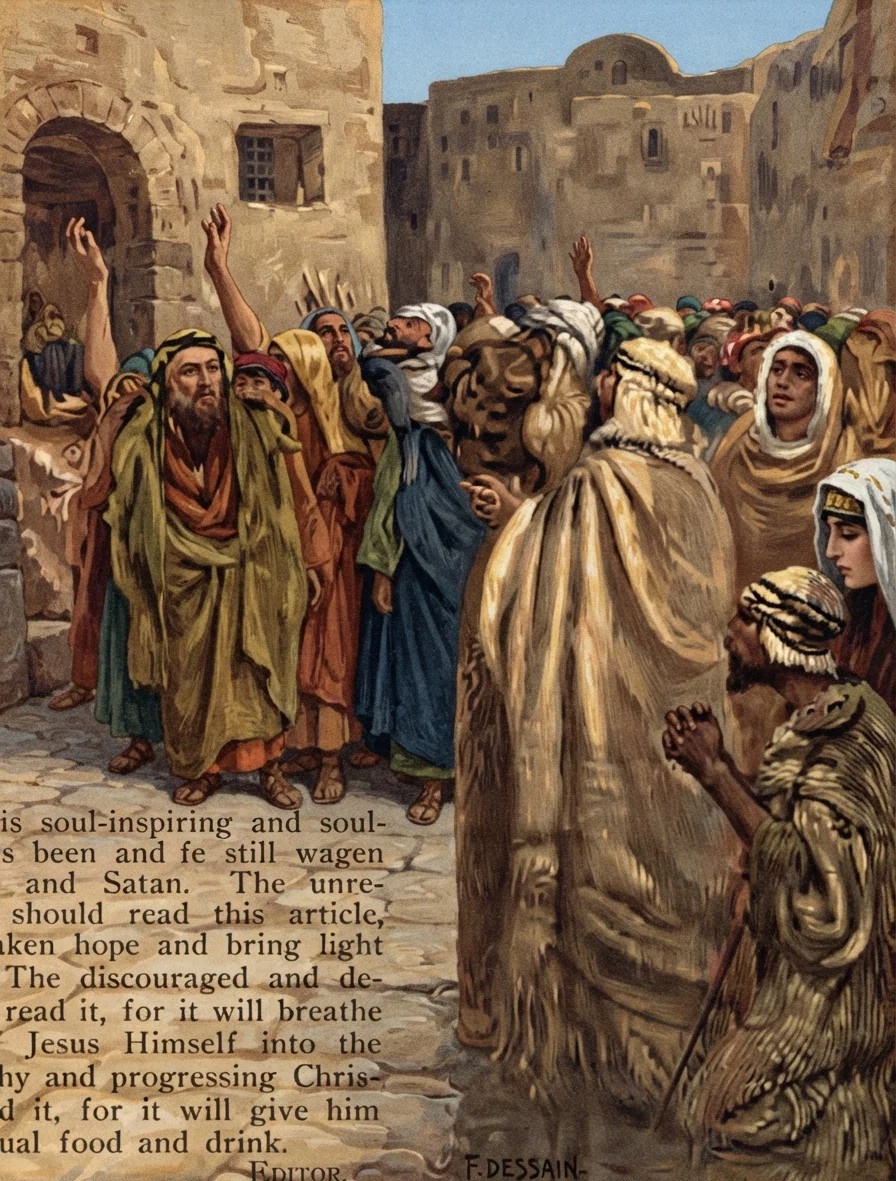
THIS article is soul-inspiring and soul-helpful. It causes the life of Christ to stand out before the mind with a charm that attracts and uplifts. It is a striking setting forth of one of the scenes in the conflict that has been and is still waged between Christ and Satan. The unrepentant sinner should read this article, for it may awaken hope and bring light into his soul. The discouraged and despairing should read it, for it will breathe the heroism of Jesus Himself into the life. The healthy and progressing Christian should read it, for it will give him delightful spiritual food and drink.

Comforting Words Spoken with Authority

The Master's Work Stirred the Demons to Frenzied Activity—His Tenderness and Healing Touch—Hope Created, and Relief Brought to the Lost in Sin—The Power and Activity of the Saviour's Life

By MRS. E. G. WHITE
THE period of Christ's personal ministry among men was the time of greatest activity for the forces of the kingdom of darkness. For ages, Satan with his evil angels had been seeking to control the bodies and the souls of men, to bring upon them sin and suffering. Then he had charged all the misery upon God. Jesus was revealing to men the character of God. He was breaking Satan's power and setting his captives free. New life and love and power from heaven were moving upon the hearts of men, and the prince of evil was aroused to contend for the supremacy of his kingdom. Satan summoned all his forces, and at every step contested the work of Christ.

SIMPLE, YET WITH AUTHORITY

Jesus met the people on their own ground, as one who was acquainted with their perplexities. He made truth beautiful by presenting it in the most direct and simple way. His language was pure, refined, and clear as a running stream. His voice was as music to those who had listened to the monotonous tones of the rabbis. But while His teaching was simple, He spoke as one having authority. This characteristic set His teaching in contrast with that of all others. The rabbis spoke with doubt and hesitancy, as if the Scriptures might be interpreted to mean one thing or exactly the opposite. The hearers were daily involved in greater uncertainty. But Christ taught the Scriptures as of unquestionable authority. Whatever His subject, it was presented with power, as if His words could not be controverted.

DIVINE TRUTH AND LIFE'S DUTIES

Yet He was earnest, rather than vehement. He spoke as one who had a definite purpose to fulfil. He was bringing to view the realities of the eternal world. In every theme God was revealed. Jesus sought to break the spell of infatuation which keeps men absorbed in earthly things. He placed the things of this life in their true relation, as subordinate to those of eternal interests; but He did not ignore their importance. He taught that heaven and earth are linked together, and that a knowledge of divine truth prepares men better to perform the duties of every-day life. He spoke as one familiar with heaven, conscious of His relationship to God, yet recognizing His unity with every member of the human family.
His tender compassion fell with a touch of healing upon weary and troubled hearts. Even amid the turbulence of angry enemies, He was surrounded with an atmosphere of peace. The beauty of His countenance, the loveliness of His character, above all, the love expressed in look and tone, drew to Him all who were not hardened in unbelief. Had it not been for the sweet, sympathetic spirit that shone out in every look and word, He would not have attracted the large congregations that He did. The afflicted ones who came to Him felt that He linked His interests with theirs as a faithful and tender friend, and they desired to know more of the truths He taught. Heaven was brought near. They longed to abide in His presence, that the comfort of His love might be with them continually.

INTERRUPTED BY THE SHRIEK OF A MADMAN

Jesus in the synagogue at Capernaum spoke of the kingdom He had come to establish, and of His mission to set free the captives of Satan. He was interrupted by a shriek of terror. A madman rushed forward from among the people, crying out: "Let us alone; what have we to do with Thee, Thou Jesus of Nazareth? art Thou come to destroy us? I know Thee who Thou art; the Holy One of God."
All was now confusion and alarm. The attention of the people was diverted from Christ, and His words were unheeded. This was Satan's purpose in leading his victim to the synagogue. But Jesus rebuked the demon, saying, "Hold thy peace, and come out of him. And when the devil had thrown him in the midst, he came out of him, and hurt him not."

SET FREE FROM A DEMON'S DEATH GRIP

The mind of this wretched sufferer had been darkened by Satan, but in the Saviour's presence a ray of light had pierced the gloom. He was roused to long for freedom from Satan's control, but the demon resisted the power of Christ. When the man tried to appeal to Jesus for help, the evil spirit put words into his mouth, and he cried out in an agony of fear. The demoniac partially comprehended that he was in the presence of One who could set him free; but when he tried to come within the reach of that mighty hand, another's will held him, another's words found utterance through him. The conflict between the power of Satan and his own desire for freedom was terrible.
He who had conquered Satan in the wilderness of temptation was again brought face to face with His enemy. The demon exerted all his power to retain control of his victim. To lose ground here would be to give Jesus a victory. It seemed that the tortured man must lose his life in the struggle with the foe that had been the ruin of his manhood. But the Saviour spoke with authority, and set the captive free. The man who had been possessed stood before the wondering people, happy in the freedom of self-possession. Even the demon had testified to the divine power of the Saviour.

THE GLARE OF INSANITY CHANGED TO BEAMS OF INTELLIGENCE

The man praised God for his deliverance. The eye that had so lately glared with the fire of insanity, now beamed with intelligence and overflowed with grateful tears. The people were dumb with amazement. As soon as they recovered speech they exclaimed, one to another: "What is this? A new teaching! with authority He commandeth even the unclean spirits, and they obey Him."
The secret cause of the affliction that had made this man a fearful spectacle to his friends and a burden to himself, was his own life. He had been fascinated by the pleasure of sin, and had thought to make life a great carnival. He did not dream of becoming a terror to the world and the reproach of his family. He thought his time could be spent in innocent folly. But once in the downward path, his feet rapidly descended. Intemperance and frivolity perverted the noble attributes of his nature, and Satan took absolute control of him.
Remorse came too late. When he would have sacrificed wealth and pleasure to regain his lost manhood, he had become helpless in the grasp of the evil one. He had placed himself on the enemy's ground, and Satan had taken possession of all his faculties. The tempter had allured him with many charming presentations; but when once the wretched man was in his power, the fiend became relentless in his cruelty, and terrible in his angry visitations. So it will be with all who yield to evil. The fascinating pleasure of their earthly career ends in the darkness of despair or the madness of a ruined soul.

THE DISEASE BEING REBUKED, THE SUFFERER AROSE

While the congregation in the synagogue were still spellbound with awe, Jesus withdrew to the home of Peter for a little rest. But here also a shadow had fallen. The mother of Peter's wife lay sick, stricken with "a great fever." Jesus rebuked the disease, and the sufferer arose, and ministered to the wants of the Master and His disciples.
Tidings of the work of Christ spread rapidly throughout Capernaum. For fear of the rabbis, the people dared not come for healing upon the Sabbath; but no sooner had the sun disappeared below the horizon than there was a great commotion. From the homes, the shops, and the market-places, the inhabitants of the city pressed toward the humble dwelling that sheltered Jesus. The sick were brought upon couches, they came leaning upon staffs, or, supported by friends, they tottered feebly into the Saviour's presence.

VOICES OF TRIUMPH AND SHOUTS OF DELIVERANCE

Hour after hour they came and went, for none could know whether to-morrow would find the Healer still among them. Never before had Capernaum witnessed a day like this. The air was filled with the voice of triumph and shouts of deliverance. The Saviour was joyful in the joy He had awakened. As He witnessed the sufferings of those who had come to Him, His heart was stirred with sympathy, and He rejoiced in His power to restore to health and happiness.
Not until the last sufferer had been relieved, did Jesus cease His work. It was far into the night when the multitude departed, and silence settled down upon the home of Simon. The long, exciting day was past, and Jesus sought rest. But while the city was still wrapped in slumber, the Saviour, "rising up a great while before day," "went out, and departed into a solitary place, and there prayed."

IN THE SANCTUARY OF THE MOUNTAINS HE COMMUNED WITH HIS FATHER

Thus were spent the days in the earthly life of Jesus. He often dismissed His disciples to visit their homes and rest, but He gently resisted their efforts to draw Him away from His labors. All day He toiled, teaching the ignorant, healing the sick, giving sight to the blind, feeding the multitude; and at the eventide or in the early morning, He went to the sanctuary of the mountains for communion with His Father. Often He passed the entire night in prayer and meditation, returning at daybreak to His work among the people.
Early in the morning, Peter and his companions came to Jesus, saying that already the people of Capernaum were seeking Him. The disciples had been bitterly disappointed at the reception which Christ had met hitherto. The authorities at Jerusalem were seeking to murder Him; even His own townsmen had tried to take His life; but at Capernaum He was welcomed with joyful enthusiasm, and the hopes of the disciples kindled anew. It might be that among the liberty-loving Galileans were to be found the supporters of the new kingdom. But with surprise they heard Christ's words, "I must preach the kingdom of God to other cities also: for therefore am I sent."
In the excitement which then pervaded Capernaum, there was danger that the object of His mission would be lost sight of. Jesus was not satisfied to attract attention to Himself merely as a wonder-worker or a healer of physical diseases. He was seeking to draw men to Him as their Saviour. While the people were eager to believe that He had come as a king, to establish an earthly reign, He desired to turn their minds away from the earthly to the spiritual. Mere worldly success would interfere with His work.

NOT SELF-ASSERTIVE

And the wonder of the careless crowd jarred upon His spirit. In His life no self-assertion mingled. The homage which the world gives to position, or wealth, or talent, was foreign to the Son of man. None of the means that men employ to win allegiance or command homage did Jesus use. Centuries before His birth, it had been prophesied of Him: "He shall not cry, nor lift up, nor cause His voice to be heard in the street. A bruised reed shall He not break, and the dimly burning flax shall He not quench: He shall bring forth judgment unto truth. He shall not fail nor be discouraged, till He have set judgment in the earth."
The Sun of Righteousness did not burst upon the world in splendor, to dazzle the senses with His glory. It is written of Christ, "His going forth is prepared as the morning." Quietly and gently the daylight breaks upon the earth, dispelling the shadows of darkness, and waking the world to life. So did the Sun of Righteousness arise, "with healing in His wings."

Jesus in the Humble Dwelling

"The inhabitants of the city pressed toward the humble dwelling that sheltered Jesus."

Where God Has Spoken

OBEDIENCE to the word of God is required until God Himself declares that obedience to the Word has become unnecessary. This is a truth of Holy Writ taught by precept and example.
Hear the following declarations from God Himself: “I am the Lord, I change not.” Mal. 3:6. “My covenant will I not break, nor alter the thing that is gone out of My lips.” Ps. 89:34.

THE CLASH OF THE PROPHETS

In 1 Kings 13:9, the express command of God to a prophet was, “Eat no bread, nor drink water, nor turn again by the same way that thou camest.”
The familiar record tells how another prophet claimed that an angel had spoken to him by the word of the Lord, saying, “Bring him back with thee into thine house, that he may eat bread and drink water”; but the account says, “He lied unto him.” The result was the death of the disobedient prophet.
Even a message from a prophet, if it does not harmonize with the spoken Word, is unsafe to follow. No prophet of God or apostle would be used as a mouthpiece for God if the word of God were to have its meaning altered. God Himself would make the change, as publicly as the proclamation of the original command.
The work of apostle, prophet, minister, or any gospel worker, is not to announce something contrary to or change the word of God, but to “preach the Word” as he finds it. 2 Tim. 4:2.
The testimony of an angel from heaven, if found in opposition to the word of God, is an accursed thing. Gal. 1:8, 9; 1 Peter 1:25.

NONE BUT GOD OR CHRIST COULD DO IT

Dear reader, did it ever occur to you that as God made the Sabbath, sanctifying it, and speaking His blessing into it, if there ever should come a time when He would transfer the Sabbath blessing to some other day, God and Christ were the only ones who would have any authority to make the change? A prophet was well aware that the blessing of God could not be reversed or transferred by man. Num. 23:20.
God has said, “Thou shalt have no other gods before Me.” The same God, in the same law, on the same occasion, also says, “The seventh day is the Sabbath of the Lord thy God: in it thou shalt not do any work.”
Men are trampling on the authority of God by violating precepts made so plain as are both these commandments. His power as Creator places Him above all gods. Hence the Sabbath, the sign of His creative power, is beyond the power of angels, apostles, prophets, or any man, to change.
Now let us see if we find the change of the Sabbath even hinted at in the New Testament. Our Saviour says, “Think not that I am come to destroy the law, or the prophets.” Matt. 5:17. He also says, “I have finished the work which Thou gavest Me to do.” John 17:4. Then if Christ came not to destroy the law, and He also finished His Father’s work, it is plain that His Father’s work and will was to leave the law as He spoke it.
Our Saviour never mentions the first day of the week or a change of the Sabbath.
Matthew did not say, in Matt. 28:1, In the end of the old Jewish Sabbath, as it began to dawn toward the first day, or the Christian Sabbath.
Mark and Luke did not brand themselves as impostors by writing thus of the same occasion.
John did not place himself in the same class by declaring, in John 20:19, for a new first-day Sabbath: but quite the contrary, in 1 John 2:7. Listen to inspiration in harmony with the spoken Word: “Brethren, I write no new commandment unto you, but an old commandment which ye had from the beginning. The old commandment is the Word which ye have heard from the beginning.”
And how glad we ought to be that the beloved Paul did not make God’s word of no effect through his own tradition, but we behold his life of love and faithfulness to God! He says, “I have not shunned to declare unto you all the counsel of God.” Acts 20:27. And as nowhere in the counsel of God do we find a call to depart from the creation Sabbath, we conclude that the progress we see in this direction is the work of “grievous wolves” speaking perverse things. Read the whole admonition in Acts 20:18-35.

THE PRECIOUS AND THE BLESSED DAY

What a precious institution is the Sabbath, full of the blessing of God, and as far beyond the power of man to change as it is for him to make of our God a god of wood or stone!
Let us pray that God will impress upon our minds the importance of His Sabbath, and that we may receive its rich blessings, found on no other day. “For in six days the Lord made heaven and earth, the sea, and all that in them is, and rested the seventh day: wherefore the Lord blessed the Sabbath day, and hallowed it.” Ex. 20:11. GEO. F. BROWN.

Respectability and Morals

MANY people judge the moral quality of an act by its respectability or disrespectability. Burglary, drunkenness, petty thievery, profanity in the presence of ladies, brawling, murder, and the like, they would shun as the plague or as death itself.
But when the test of respectability fails, these people are at a loss for a moral standard. No wonder they find it easy to substitute what they prefer to believe God means for what He says. It is not at all a matter of principle, but a matter of feeling or convenience. No wonder they can persuade themselves that saying "Lord, Lord" is as good as obedience. Does the commandment say the seventh day is the Sabbath, they will have it that "pious" observance of the first day (Sunday) will suit the Lord just as well. The world might be full of dear, respectable people, polished, pious, and refined, who stand not half so good a chance of salvation as do "the publicans and the harlots." J. A. L. DERBY.

Tests of Loyalty

PERSONS who have discerningly observed men, are able to judge largely of one’s capabilities and character by seemingly trivial indications.
Likewise, there are tests which to men in general may seem without import, but which to "the Judge of all the earth" are unmistakable indications of one’s disposition.
Thus when a company of military recruits came to a stream, those who were intent on the purpose of the expedition simply dipped up water in their hands as they passed along, without pausing; while those with whom personal comfort was the first consideration, stopped, stooped, and drank deliberately, and were rejected in consequence. Judges 7:4-7.
Another case in line with this is that in which, in a simple ceremony, a rock was struck a second time when it should have been struck but once. To the offender, whose mind was exercised about personal matters, doubtless the number of strokes appeared an unimportant detail. Yet because of the added stroke, his life, which had been one of extraordinary achievement, closed in disappointment, and the ceremony designed to symbolize the smiting of the Rock of Ages "once for all," failed of its significance. Ex. 17:5, 6; Num. 20:7-12.
A present-day parallel to this incident is presented by those who assert that the definite number in the Sabbath commandment of the Decalogue is immaterial — that is, the ordinal number, "seventh," is declared to be immaterial, and "first" is substituted in its stead. The same assertion is not made relative to the cardinal number, else the commandment might be made to read, "One day shalt thou labor, but on the second day thou shalt not do any work," or, "Two days shalt thou labor," or, "Three days," etc.
A popular American army officer was once obliged to court-martial some of his men for requiring the reason for an order before obeying it. Certainly their disregard of military authority was astounding. Yet often men presume to disregard the orders of the Great General, on the ground that they "don’t see what difference it makes."
Sufficient for us should be a "Thus saith the Lord." It is ours "not to reason why," except as we can do so without delaying obedience. There is surely sufficient cause for believing that all the requirements of the Infinite are right. And we shall eventually understand the need for them, if in the meantime we have fidelity enough to comply with them. ADELAIDE D. WELLMAN.
"THE Saviour’s entire life was characterized by disinterested benevolence and the beauty of holiness. He carried out His teachings in His own life. He showed consistency without obstinacy, benevolence without weakness, tenderness and sympathy without sentimentalism. He was highly social, yet He possessed a reserve that discouraged any familiarity. His temperance never led to bigotry or austerity. He was not conformed to the world, yet He was attentive to the wants of the least among men."

Assurances of Immortality

Jesus Christ the Great Fountain of Eternal Life — All Are Invited to Receive Freely His Priceless Reward

By CHARLES THOMPSON
IT was because man forfeited his life through disobedience, and because Christ was not willing that any should perish, that He left the throne of the Infinite and came to this world. This the Scriptures clearly reveal, “By one man’s disobedience many were made sinners.” Rom. 5:19. “The wages of sin is death.” Rom. 6:23. “That as sin hath reigned unto death, even so might grace reign through righteousness unto eternal life by Jesus Christ our Lord.” Rom. 5:21.
Jesus Himself declares, “I am come that they might have life, and that they might have it more abundantly.” John 10:10. Again, “As the Father hath life in Himself; so hath He given to the Son to have life in Himself.” John 5:26. “He that hath the Son hath life; and he that hath not the Son of God hath not life.” 1 John 5:12.
We are at a loss to know how any who believe that the Scriptures are inspired and that it is impossible for God to lie, can believe that man possesses life as a birthright. When man sinned, he became a dying creature, and could transmit to his posterity the nature only which he possessed by reason of disobedience. Therefore it is truly written, “By one man sin entered into the world, and death by sin; and so death passed upon all men, for that all have sinned.” Rom. 5:12.

THE POSSESSION THAT BRINGS ETERNAL LIFE

How do we come into possession of the Son? is the important question; “for he that hath the Son hath life.” The apostle Paul answers directly, “For ye are all the children of God by faith in Christ Jesus.” Gal. 3:26. Hence life is a result of faith. Paul so affirms when he says: “I am crucified with Christ: nevertheless I live; yet not I, but Christ liveth in me: and the life which I now live in the flesh I live by the faith of the Son of God, who loved me, and gave Himself for me.” Gal. 2:20.
The act of Christ in which we are to exercise faith, that brings the desired result, is also stated in this verse: “And gave Himself for me.” This is what He did that we might live. “Sin, when it is finished, bringeth forth death.” “All have sinned.” Hence judgment came upon all men to condemnation, and there is no way in and of himself for man to escape. “But we see Jesus, who was made a little lower than the angels for the suffering of death, crowned with glory and honor; that He by the grace of God should taste death for every man.” Heb. 2:9. “For when we were yet without strength, in due time Christ died for the ungodly.”

THE RECKONING THAT BRINGS LIFE

Therefore, we have the life which comes by faith, when we accept His death for us by faith. When we account ourselves dead, Christ counts us alive; and so long as we reckon ourselves alive, Christ reckons us dead. Therefore the doctrine of inherent life — of the inherent immortal soul — is the doctrine of death.
Paul says again, in Rom. 6:8, 11: “Now if we be dead with Christ, we believe that we shall also live with Him. . . . Likewise reckon ye also yourselves to be dead indeed unto sin, but alive unto God through Jesus Christ our Lord.”
I am sure that from these few scriptures placed together, we see that life comes only through Christ. May God help us all to accept Him.
Continue reading: God's New Year Message