The Youth’s Instructor, Vol. LI, No. 29

NOON-TIME TOILERS

The Youth’s Instructor

July 23, 1903

Review and Herald Publishing Company · Battle Creek, Michigan · July 23, 1903

NOON-TIME TOILERS

By Frank Walcott Hutt.
Just a minute or two ago, Over hilltop and dusky dell, Came the sound that the farm-boys know, Welcome sound of the dinner-bell;
Just in time for the tired arms In the hayfield since early dawn; Up the roadway and through the farms Everybody from work has gone.
Everybody? - Of course, Why not? Who, pray tell us, would care to be Toiling here in the sun so hot? Wait a minute, and you shall see;
Or, at least, you shall hear them, then--- Happy creatures of field and air, Tiny workers in vale and glen, Toilers numberless, everywhere.
All the marshes, the wood and brake, Like the robins, are now in tune; All the meadows are wide awake, Wide awake, and at work---at noon,
Twelve o'clock, but there's much to do; Ring the dinner-bell, if you may; Farmers tiny and builders, too. Work from dawn until close of day.
Up the orchard and down the hill, Everybody from work has gone; But the grasshoppers labor, still, And the bees and the birds toil on.

The Origin of English Names

THE study of names in the English language should interest every student, for the historical facts to be gleaned from some of them. Coming across an old book a few days ago, I passed a pleasant hour looking over its recorded names, and their probable origin. That which follows in this article was called out by that opportunity, and is now presented to INSTRUCTOR readers who are interested in such matters:—
A few miles north of Leicester, and near a small body of water, is situated the village of Loughborough. Wondering why so peculiar a name should attach to a small town, we had only to give the word its natural division to find that lough means lake, and borough means town, and the full significance is seen in “lake-town;” that is, a town by a lake. This word, however, appears in old English literature under different forms, such as Lettidur and Lactoduro, but having the same significance in all its forms, because of the use of the affix dur, which signifies water.
In many old English towns, some of the streets are called gates. The retention of this appellation is one evidence of early Roman occupation, since all Roman roads were called either strata (streets) or porta (gates). The word castra, meaning camps, or garrisons, is still preserved in the names of English towns, in three forms,—Lancaster, Manchester, Leicester, etc. It is thought by some etymologists that the name Leicester is derived from legionis castra, from the inscription, “L. VIII” on a tile found near the town, which is supposed to have been left where the Eighth Legion of the Roman army was stationed.
While the Romans left behind them in England no word which signifies home, the Teutons, who followed them, gave the language several words of this import. Prominent among these was ton. As an affix it signified a place surrounded by a stockade, or hedge. In Wyclif’s time the word took the form of toon, as may be seen from his translation of Matt. 22:5, which he renders: “Thei dispiseden, and wenten foorth oon to his toon, another to hys maurchandise.” The word still carries this form in Ireland and in some parts of Scotland. Bar was used to indicate a bush, thicket, or different roots; so that the word Barton, now the name of a town, originally meant a “hedged enclosure for the bear;” that is, the bearing crops. The words worth and garth meant smaller, protected enclosures than those called ton. From garth comes yard, which also includes the idea of garden. Stoke, or stock, was a stockaded enclosure, while fold meant an enclosure surrounded by felled trees.
Leys were open pastures for cattle, while dens, or denes, were woodland vales, where hogs might find needed food in beech-nuts, acorns, etc. On large estates the “hog-warden,” who superintended the hogs, was an important officer of the household. Such names as Hayward and Howard are derived from this early English title.
The particle ing was to the Saxon language what Mac, O’, and Ap were to different branches of the Celtic tongue; that is, “son of.” In time, however, it came to represent clans, or tribes. It had also a local significance; as, Kentings, or “men of Kent.” In other cases, as a prefix, it means a meadow.
Wal, or gwal, meant a walled town, or estate, belonging to Danish or Norse settlements, by which they guarded themselves from the inroads of their perpetual enemies, the Saxons and Anglians. This foreign sense of the word was more apparent, however, when applied to foreign things, as walnuts, Cornwall, and Wales. The dwellers in the parts of the country thus designated were distinctively aliens from the Teutonic possessors of other parts of the land, hence the word wall in their names designated them as foreigners.
The word well, now used to denote a water supply, formerly had a far different significance. It often took the form of will, much like the German weiler, and meant a single house. From this use of the word came Eastwell, Holwell, etc.
Many English family names are derived from the occupation of some ancestor. For example, the name De Spenser came from Dispensator, the distributor of the royal property. Le Gros Veneur, master of the hunting, or chase, became Grosvenor.
Considering the orthography and forms of tenses of English words, we find many curious things, and begin to realize some of the difficulties met by those of other nationalities who try to express themselves in correct English. To illustrate: The writer once heard a gentleman tell how strangely he felt upon hearing a will read, which was made by a Frenchman, when he found that in it he himself had been appointed “executioner” for the testator.
Referring to the arbitrary change of form taken on by some English words, a writer in the Commonwealth gives the following curious medley:—
“We’ll begin with box, and the plural is boxes, But the plural of ox should be oxen, not oxes. One fowl is a goose, but two are called geese, Yet the plural of mouse should never be meese. You may find a lone mouse, or a whole nest of mice, But the plural of house is houses, not nice. If the plural of man is always called men, Why shouldn’t the plural of pan be called pen? The cow in the plural may be cows or kine, But a bow if repeated is never called bine, And the plural of vow is vows, never vine. If I speak of a foot, and you show me your feet, And I give you a boot, would a pair be called beet? If one is a tooth, and a whole set are teeth, Why shouldn’t the plural of booth be called beeth? If the singlar’s this, and the plural is these, Should the plural of kiss ever be nicknamed keese? Then one may be that, and three would be those, Yet hat in the plural would never be hose, And the plural of cat is cats, not cose. We speak of a brother, and also of brethren, But though we may say mother, we never say mothern. Then the masculine pronouns are he, his, and him, But imagine the feminine she, shis, and shim. So the English, I think, as you all will agree, Is the strangest language you ever did see.”
J. O. CORLISS.
Leicester, England.

BENJAMIN B. KEECH

Work

KEEP busy at work; there is much you can do; Life's vineyard is wide, and the toilers are few, And those who work willingly, sometime shall know The rich recompense that the future may show.
Keep busily working; content yourself not With deeds half completed. Whatever your lot, There is much you can do. Will you start it to-day? Or will you indifferently turn it away?
Oh, be not discouraged! Whatever your task, Hard work may be pleasant if only you ask To complete, with perfection, the things you begin. Resolve to be worthy of winning—then win.
Away to the field! Though the hot sun doth beat Relentlessly down, and your hurrying feet Seek shady repose from the toil of to-day,— Remember your duties, remember the pay.

BENJAMIN B. KEECH

God's Quiet Strength

A VERY beautiful illustration of how quietly God's most mighty physical and spiritual forces work, is given by James I. Vance. He says:—
In a certain city a bridge was to be built across the river. To secure a solid foundation, piles were driven in the bed of the river. One day they could make no headway, and, on examination, found that they had struck an old, forgotten, unused water-main left in the river-bed. But one thing was to be done. The main must come out. Encircling the main with immense cables, they harnessed them to a locomotive on an improvised track. The engineer opened the throttle, and the engine started forward, only to be thrown back on the track by the cables. More steam was turned on, the mighty locomotive rushed forward with tremendous power, only to rebound again. It was useless, the engineer said; another effort would derail the engine. Tugboats were brought, and the cables were harnessed to them. Then the tugs did their best. They pulled and plunged and churned the river into foam, but the main was unmoved.
“We shall have to give it up,” said the workmen.
“The location of the bridge will have to be changed,” said the city authorities.
But a quiet man came thither one day, and, after looking on a while, said, “I can lift it out.” At once the contract was his. He brought two old mud-scows, and let them rest just above the stubborn main. The cables were tightly lashed to huge beams laid from one scow to the other. “What are you going to do?” they asked him. “I have finished,” was the quiet reply.
He then climbed upon the bank, and, folding his arms, waited for the tide to come in. The scows rocked and tossed, they tugged and stormed, while the man cried: “Come up! come on! You must come!”
Then there was a mighty upheaval, that shook the river from bank to bank, and the tide had the victory.
God’s strength flows into human life as the tide. There is no noise, it is scarcely perceptible, but it is sovereign.

A Boy's Essay on the Stomach

THE stomach is the most important organ in the body, because it's the place where all our brains are made. Some brains are not very good, and that's because they are not manufactured according to the best methods. It does not require much book learning, not even a course in college, to make good brains. But in order to make the best compound of any kind, one must use the best materials. If the stomach is not provided with proper food, the brain power, as well as the power in every other part of the human machine, will be lacking. For as a man's stomach is, so is he. If his stomach is kept loaded with a conglomeration of obnoxious things, his brain will be filled with a multitude of good-for-nothing thoughts. And as the food in the stomach ferments, the thoughts in the brain effervesce in expressions of discouragement, utterly devoid of health-giving cheer.
There is such a thing as letting the stomach become so sour that it will eat itself up; and there is such a thing as allowing it to become so sluggish that the whole machinery will stop. When this happens, you may be sure the stomach needs a bath.
A stomach bath is a good thing sometimes. It sort of makes a hero of an individual, and gives him new courage to take up the duties of life. The stomach rebels sometimes, just because it needs a hot-water bottle on it. A hot-water bottle is a good thing. It's so much easier to “take” than medicine, and then it really does some good, while medicine is apt to make matters worse. I know a lady who is sick all the time just from taking medicine to get well.
One should cultivate respect for his stomach; it's a great deal like a boy in its disposition: it won't overwork without offering serious objections. Some people want the stomach to do a whole lot more work than it's booked for. I know of a man who went to a big celebration; and when his stomach refused in rather a heroic way to celebrate all he wanted it to, he would not admit that the disagreement was caused by overwork in caring for bread and butter and salads and pickles and meats and jellies and jams and preserves and cakes and pies and cookies, which were allowed to descend in such an avalanche as completely to overwhelm his poor stomach.
Some doctors seem to think the stomach is not necessary, and that a person could get along all right if he didn't have any. But if it were not for the stomach, what would the doctors do in trying to locate the seat of all the diseases? Then, too, what would some people have to talk about, if they hadn't any stomach? It is such an inexhaustible topic, and with some it never seems to grow old. When you see two persons in conversation, one gazing vacantly at the earth, and the other staring off into space, and both looking as if their last hope had taken its flight, there is cause to suspect that they are gossiping about their stomachs.
Now it's a law of nature that nobody likes to be talked about, and it's an established fact that gossip never did anybody any good. It's a shame on Christian people that they should stoop to gossip about their downtrodden stomachs. If the stomach absolutely refuses to attend to business, and you are utterly unable to persuade it to resume, it is all right to confide your troubles to some good physician, and then quietly follow his advice. But if you want your stomach to reform, stop talking about it, and stop craving sympathy for it by telling everybody all about its little failures in business. There are plenty of other things to talk about without talking about the stomach.
Mrs. M. A. Loper.

The Hour of the Morning

I KNEEL in the calm of the morning, The hour consecrated to prayer; For I know, ere I touch the day's duties, That Jesus will meet with me there, And I ask that the hand of the Master The heaviest burdens will bear.
The hour of the morning is sacred, For angels are hovering round, And, reverent, I lay off my sandals, For 'tis holy, 'tis God's hallowed ground,— The calm, precious hour of the morning, Where Christ, my Redeemer, is found.
And I ask him that strength may be given For each task that shall come through the day; And that every sin and temptation May be banished and put far away; That life may be filled with such blessings As the Spirit of Christ shall convey.
O, that calm, holy hour of the morning, Ere the duties of day are begun, My heart with my voice is uplifted, To commune with the Infinite One; And with rapture I think, “I shall see him When the toils of the journey are done.”
L. D. SANTEE.

Present Training and Future Conduct

CHARACTER is a growth, not a creation. Every thought has its effect toward beautifying character, and strengthening it in the right, or toward making it the opposite of all that is lovely and good. Therefore take jealous care of your thoughts, guard carefully the intents of your heart, consider candidly the motives of your life. Resist the wrong for the sake of the strength—the self-control—you will gain thereby. When a temptation comes to do some little act of dishonesty, or even of carelessness, resist it. Gain the victory in the minutest details of your life; you will thus be stronger for its other and larger duties.
Take care of your personal appearance, of your manners, of your actions, as carefully when no one is present to see as when you are surrounded by those whose respect you wish to gain. Carelessness in little things, at times when nobody sees, begets the same fault in larger matters, and when people do see.
Many an old man owes his childishness, his carelessness about his personal appearance, his uncouth conduct, to years of training in the moments when he thought it didn’t matter. Many another owes a sudden downfall from respectability to the secret thoughts of his heart, cherished through a long course of years.
Therefore weigh every thought, word, and action of your life, and make each conform to principle. The Bible says that the sinner “shall be holden with the cords of his sins.” ’Tis so; the little cords of our daily life, easily broken one by one, are woven together in our later years, and make a rope that binds us fast.
E. B. MELENDY.

Faithfulness in Lowly Places

It is only the few who are called to fill the positions of great honor. Most of us are forced by circumstances to take lowly places. In every house there are vessels of honor and vessels of dishonor, and it is probable that the house could get along more conveniently without the former than without the latter. There is comfort in that thought for those who have to do the drudgery of life. There is a satisfaction also in remembering that we are not responsible for the size of our field, but only for our faithfulness in caring for our charge. He that is faithful in that which is least will be dealt with just as generously as if he had had the whole world for his field, and had been faithful in discharging his obligations toward it.—United Presbyterian.

A Visit to a Chemical Analyst

“GOOD MORNING, young people; come right in,” said Professor Leiter, kindly, opening the laboratory door.
Heartily thankful for such a cordial welcome, we entered a splendidly fitted room, and looked around in some surprise at the array of apparatus and gleaming instruments, while one of our number explained to the professor that we were very anxious to see him at his work.
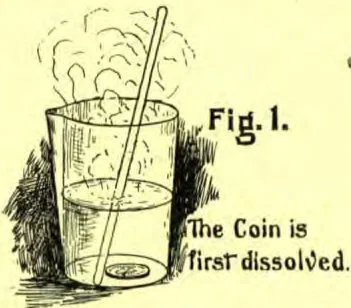
Fig. 1. The Coin is first dissolved.
“Ah,” he exclaimed, “that is well; and I am really fortunate this morning in having something simple to do.”
“Here,” he continued, leading the way to his work-table, and opening a drawer therein, “I have an old Mexican coin to analyze. The man who left it wants to know just how much silver, copper, and lead have entered into its composition. Do you suppose we can find out?”
What a question? Did we suppose he could find out! No; we didn’t suppose—we knew he could do whatever he undertook.
Fig. 2.
Fig. 2.
“Well, young people, the very first thing the analyst has to do is to dissolve the substance he wants to analyze. Sometimes it is rock, sometimes glass, sometimes rubber; but whatever it is, it has to be dissolved. See, I drop this coin into this hot nitric acid,—”
Fig. 3. A few drops of Hydro Chloric Acid
“Whew! We saw, indeed, and smelled the sharp, pungent vapors that rose, cloud-like, from the acid. We rushed to the open window.
“O children! children! it’s all right now,” said the chemist, presently. “You will at least remember about the ‘dissolving of the substance,’ won’t you?”
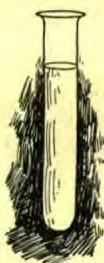
“Isn’t it lovely!” exclaimed a girl, as the professor poured the bright-blue liquid into a clean test-tube.
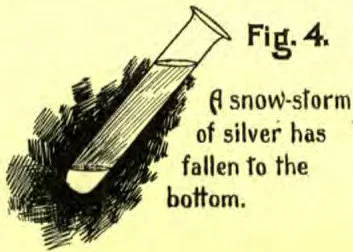
Fig. 4. A snow-storm of silver has fallen to the bottom.
Getting the copper and lead
“No, Alice, it’s copper,” said the professor.
“That blue color fairly shouts ‘copper’ at the chemist. He can’t mistake it. When that appears in the solution, he knows that that money had copper in it.”
“But look—I am pouring some hydrochloric acid into the solution. Before I do this, however, I want some bright boy or girl to tell me what the nitric acid made of the silver, copper, and so on—quick!”
“Nitrate of silver, copper, and so on!” said one of the boys, with a grin.
“Right!” assented the teacher, pouring in the hydrochloric acid. “Now watch the silver snow-storm!”
The blue liquid lost its color in an instant, and became white as milk, or as air filled with snow, and these white particles slowly (“Don’t jar the table, young people”) floated downward till they rested in a white drift on the bottom, leaving the liquid as blue as the blue sky again.
“Listen, boys, girls! Hydrochloric acid makes chlorides out of nitrates. It made chloride of silver that would not dissolve or float in water out of the nitrate of silver that would dissolve and would float.”
“But why didn’t the copper sink, too?” I asked.
“A fair question deserves a fair answer,” he responded. “This last acid did make copper chloride and lead chloride, but both of them will dissolve and float in hot water. So of course they remained in the solution after the snow-storm.”
Professor Leiter now quickly poured off the copper and lead solution from the silver, dried the latter, and weighed it on the most delicate scales we had ever seen. “You have heard,” he said, “of balances so delicate that a name written in lead-pencil can be exactly weighed. These scales are of that kind; the bearings are of agate and ruby, like the jewels of a watch. An analyst, especially a quantitative analyst, must have such an instrument, and it will cost him hundreds of dollars.”
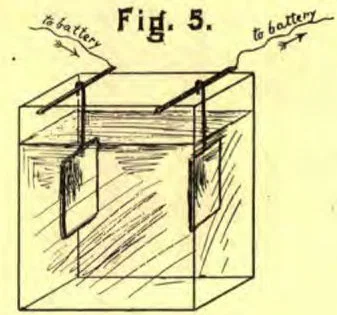
Having ascertained the weight of the silver, and written it on the analysis blank, our instructor turned his attention to the blue liquid again. “These two little sheets of platinum,” he said, “that I put in here [the liquid] are connected with a strong electric battery. O, don’t be afraid to look close: this kind of battery doesn’t shoot!”
Pretty soon one of the platinum electrodes—for that is what he called them—began to get yellow and bright, the other dull and scaly. “The electricity is depositing copper on one terminal,” he explained, “and lead on the other. By and by, when all the metal has been deposited, I will weigh them, subtract the weight of the platinum, and, of course, know exactly how much copper there is, and how much lead.”
“Now, you see,” he exclaimed, laughing, “the wonders of chemical analysis are not so difficult to understand, after all. Of course you haven’t seen it all. The delicate tests for arsenic and strychnine, the wonderful detection of really scarce substances, the analysis of organic products,—all these things you do not understand yet; but you have the working principle just the same, for them all. Has any one of you a question he would like to ask?”
“Yes, I have one,” said a girl; “can chemists tell what people and animals and plants are made of?”
“Certainly they can,” responded the professor. “They can take the plants and animals apart just as readily as we took the coin apart. You ask them how much carbon there is in an eye, and they can tell you; or how much oxygen in a brain, how much phosphorus,—how much iron in the blood. Ah, but should you ask how much life is there in the eye, the brain, the heart, the blood, he could not answer. No, he says, I can’t tell you that. That life is God, and we can’t find out God, no matter how deep we search. We only know he is. The chemist sees him at every turn; but the mystery of his life in the world is just as much a mystery to me as it is to you.”
EDISON DRIVER.

Healing Light-Rays

About forty years ago there was born in the cold, dark island of Iceland a boy who was named Niels Finsen. For twenty-one years his home was in that dreary land where he longed for light, and, whenever the sun shone through, hailed it with joy.
When he had attained his majority, he went to Denmark, and for eight years studied medicine at Copenhagen. But when in 1890 he was graduated, his health was so poor, his heart, liver, and digestive organs all being seriously affected, that he knew he could never practise his profession. Fortunately the position of professor of anatomy in the university was offered him. For the next three years he taught in the Danish city.
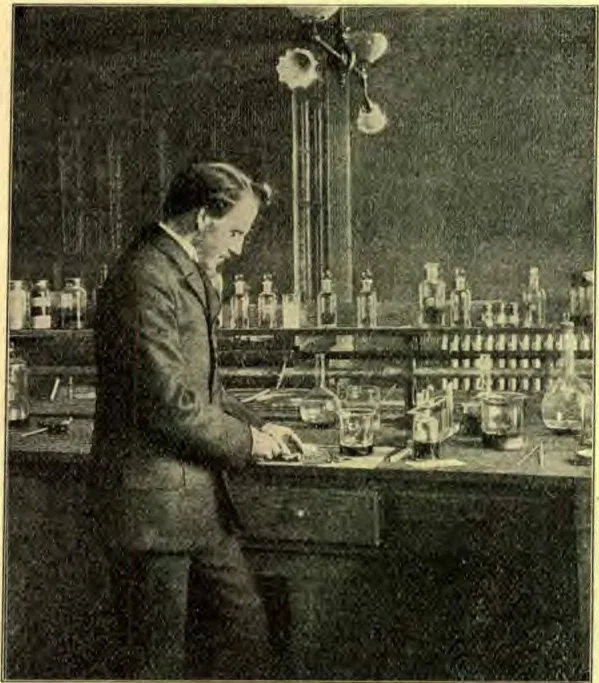
THE CHEMIST AT WORK
THE CHEMIST AT WORK
But in the meantime he was conducting some experiments on his own account. As he had always loved and longed for light, he started with that, wondering about its special effects upon the human body. The first answer to his question came to him from earthworms, which we have not credited with much intelligence. Dr. Finsen placed some of these crawling creatures in an oblong box, one half of which was covered with red glass, the other half with blue glass. As a result, the worms always crawled away from the blue glass, where they seemed restless, and sought shelter under the red glass, where they would lie quite content.
In the case of the chameleon, too, the half of his body under the blue glass would turn almost black, while the half under the red light was almost white. All of which, Dr. Finsen thinks, goes to prove that it is only the blue or chemical rays of sunshine which can affect animal life, and that it is they that produce sunburn, which really is not a burn, since travelers have suffered from it in countries where the thermometer was below zero.
When he had gone thus far in his studies, he one day found a pamphlet published in 1832 by a physician of New Orleans. In this the fact was mentioned that during a smallpox epidemic in that city, some soldiers confined in a dark dungeon had been ill with the disease, but recovered without scarring. The author of the pamphlet made no attempt to explain this fact; but Dr. Finsen immediately believed that the reason why these men escaped scars was because the darkness protected them from the irritating effects of the blue rays of the sun, which, being able to irritate a healthy skin, could do far more harm on one inflamed by smallpox.
Then he further reasoned, Why would not smallpox patients always escape scarring if confined in a dark room,—or, which would be more comfortable, in a room lighted only by red light, which would have the same effect as darkness? Finsen had then never seen a case of smallpox; but he was so confident of the truth of his theory that he soon gave it to the world, declaring with assurance that patients afflicted with this dreadful disease would recover without scar or pock-mark if cared for in rooms into which only red light was admitted.
It happened that summer that there was much smallpox in Bergen, Norway. So it was determined to make a trial of the red-light treatment.
Eight severe cases, four of them children who had never been vaccinated, were chosen for the experiment. The result proved that Dr. Finsen had made no mistake. In Sweden also this preventive was successfully tried.
So the experimenter had accomplished something, and in 1894 gave up his classes that he might go still further. He wondered, again, why, since the blue or chemical rays are injurious to the body, they might not also be made beneficial.
So with powerful lenses he experimented by throwing blue light on certain kinds of bacteria. The rays proved so effectual that the germs were almost instantly killed. And Finsen was then ready to make attempts to cure some skin diseases.
There is a form of tuberculosis which affects, instead of the lungs, the surface of the body, particularly the face. This disease, called lupus, is not very common in our country; but in Europe there are many cases of it, fifteen hundred in Denmark alone. It has always been thought incurable. But Finsen’s first patient was cured within six months, by means of powerful lenses whose light passed through blue water.
The new remedy was gratefully received, and within a month after this cure the Finsen Light Institute was opened in Copenhagen. As the good news that healing had been found spread abroad, patients came from many lands.
Even royalty became interested. Queen Alexandra of England, and the former empress of Russia, while in Copenhagen visiting their father, King Christian, heard what light could do, and visited the new institute. As a result St. Petersburg now has a Finsen Institute. Queen Alexandra gave one of Finsen’s lamps to the London Hospital, and soon a light department was established there. As lupus sufferers heard of it, they flocked to London in large numbers, only to be told, alas! that so many patients were already entered that they could not be treated under two years.
The light cure has also been adopted in Paris. There a lamp is used which the physicians claim is a great improvement upon Finsen’s. In our own country, doctors have been slow to take up this new cure, though there are a few medical men who use it, and claim that in connection with X-rays the Finsen lamp will cure malignant cancer.
The discoverer of all this, who is indeed a public benefactor, has not profited financially by his knowledge, but lives on a modest salary of twelve hundred dollars a year; and it is sad to think that, though he has done so much to help others, he can do nothing to ease his own suffering or to make his health better.—Christian Endeavor World.
Continue reading: Juniata Young People's Society Organizes for Christian Work