Juniata Young People's Society Organizes for Christian Work
By Nellie A. Honeywell
From Juniata, Alabama
Thinking that a report from this place might be of interest, I inclose a short account of our Young People's Society.
In accordance with the instruction given by the Lord that the young people should organize themselves into companies to work for him, we met together to lay plans for work the last Sunday in February. As we had not seen the membership cards, we drew up a pledge that we thought might be a help to our young people in keeping before their minds their duties as Christians. The pledge is as follows:—
“We, the young people of the Juniata church of Seventh-day Adventists, do hereby associate ourselves together as a band of Christian workers, that, laboring in a specified manner in harmony with, and under the direction of, the church, we may better advance the cause of God. To this end we agree, by the help of the Lord, to read one or more chapters of the Bible daily; to seek the Lord in secret prayer three times each day; and to attend all regularly appointed meetings of the church and Society unless hindered from so doing by some justifiable cause. That we further agree to form no social or business alliances with the world, and to endeavor to bring at least one soul to Christ during the year.”
The membership is not restricted as to age, and several of the older members of the church have joined the Society. Eight signed the pledge at first, and five more have since joined. These are all members of the church.
For the benefit of the youth and children who wished to join, a juvenile society was formed with the following pledge:—
“We, the children of the Great King, desire to enter his service. We agree to follow his directions, to pray three times each day, and to learn at least one verse from the Bible each week. By the help of the Lord we will speak the truth, and use no liquor or tobacco.”
In regard to these pledges, all who join say that they find them a great help. The Society has had a marked influence upon the children. They are learning to pray, and to take part in the meetings of the church. Two of the older children were converted, and united with the church.
The meetings of both Societies were held Sunday afternoon at four o'clock until the last week or two, when we changed to Sabbath afternoon just before the close of the Sabbath, so as to leave Sunday open all day for missionary work.
One result of the work of the Society is the planting of a missionary acre on the school farm, which is being worked by the church.
The following is a partial report of the work done since the Society was organized:—
Quite a number of hours have been spent in Christian Help work, visiting and caring for the sick, sending flowers and food, etc. The Lord has greatly blessed us in this work, and we believe he will make us a blessing.
We have been making use of the lessons given in the INSTRUCTOR, and find them very interesting and instructive, especially as we study them every day at our noonday worship.
MRS. NELLIE A. HONEYWELL.
THE WEEKLY STUDY
By W. A. S.
Growth and Extension
(July 26 to August 1)
OUR study of the development of this work has brought us to the time when a general organization of the forces had been effected, and the little body of believers began to plan a definite campaign into all the world. Let us divide the study for this week into three parts.
1. Let some one be appointed to give, in very brief outline, the facts presented in “Rise and Progress,” chapter XXI, showing the light shed upon the great struggle of the Civil War by the spirit of prophecy. A few scriptures may also be cited to show that a little way in the future we shall have to meet times of strife and war that will try men’s souls. Note also that angels are restraining the elements of strife now. For what purpose alone?
2. Let a member go through Chapters XXV, XXVI, XXVII, and XXVIII, and be prepared to note the growth of the work in the home field, as indicated by the establishment of institutions, — publishing, educational, and medical. This can be done in a ten-minute survey. Do not try to give particulars, which could not be remembered, but simply note in what order, and possibly under what circumstances, the institutions began to multiply among us.
3. Taking the same chapters, let another by the aid of the map, trace the march of the truth into foreign lands, beginning with the vote to open a mission in Central Europe in 1874. Again, do not try to give details, but only to follow the line of advance into the regions beyond. Some details of special interest may, of course, be given to illustrate the circumstances and conditions of the advance; but the survey must necessarily be brief if made interesting.
The study this week deals rather largely with facts; but we should know something of the process of growth during the period sketched. This brings us to a comparatively recent time, and with one more study we may close this series.
W. A. S.
The Cedar Lake Young People’s Society
By Irving R. Hall
OUR Young People’s Society now consists of nineteen resident members and twenty-two non-resident members; these latter are mostly academy students who do not remain through the long summer vacation. Several who held membership with us have transferred their membership to the Society where they now reside.
Sabbath afternoon has been the time of holding the meetings. The program has been varied. The chief subject of study during the winter has been the book of Daniel.
Some of the young people have been doing active missionary work in the surrounding country, giving Bible readings, and distributing tracts and papers. The young men have been holding meetings on Sunday evenings at several of the schoolhouses. A real interest has been aroused by these efforts, and we have had the pleasure of seeing a number accept the truth as a result of them. We read from the word that “this gospel of the kingdom shall be preached in all the world for a witness unto all nations; and then shall the end come.” This is the work our Society is trying to do,—preach the gospel by scattering printed pages; by going to the homes of the people, and talking with them; and above all, trying to perfect in our lives such characters as will stand in the great and final examination which the righteous Judge shall give.
IRVING R. HALL.
Two Old Brooms
By Aunt Betty
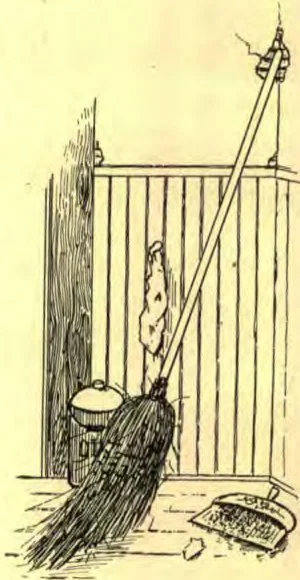
As I passed, two worn-out brooms lying in the alley, I thought I heard one of them talking. Wondering, I stood still to listen, and this is what I heard:—
“Well, well, old friend! So we’ve met again! I remember we stood side by side in the grocery on the corner.”
“So we did. But I would not have recognized you, your appearance is so changed. Where have you been, anyway?”
“O, just over in that little white house on the east side of the alley, with a little girl named Dolly.”
“Well, I lived in that little white house on the west side of the alley, with a little girl named Polly.”
“I don’t see why we should look so different now, when we looked as much alike as two peas to begin with, and lived in houses so much alike, with little girls whose names are so much alike.”
“Maybe they are only alike in name. How did Dolly use you?”
“Why, she used me to sweep with, of course.”
“O, I know that, but—well, I’ll tell you how I was used. I belonged just in Polly’s room —”
“And I in Dolly’s.”
“Don’t interrupt, please. After Polly had made up her bed in the morning, she rolled it out from the wall, and she and I went behind it, and swept the place where it had stood. Then it was pushed back in place, and the rest of the floor was gently and carefully swept, especially the corners.”
“Corners! Dear me, I never bothered the corners! And as for under the bed,—well, I guess we wouldn’t meddle with that, either, if Dolly’s mama didn’t look after us. But we had a lively time in the middle of the floor every day, and made the dust fly. But that didn’t matter; for Dolly brushed around with a feather duster —”
“Feather duster! Oh, dear! Polly never used such a thing; she always wiped the dust carefully from the bedstead, table, and chairs with a soft cloth, which she shook out-of-doors every minute or two. But that isn’t about me. When she had finished sweeping, she hung me in her closet by this string you see in the end of my handle.”
“Well, I wondered what that string was for. That must be the reason you are worn so square off. Look at me! My brush leans all to one side. When Dolly was done with me, she just stood me against the wall, with my brush well out, and the top of my handle leaned up in the corner. But what is the reason you are so bright and yellow, and I am so dirty-looking?”
“Once every week Polly dipped me in hot water, and hung me on the south side of the shed in the sun to dry; this kept me soft as well as bright and clean.”
“Dear me! What a difference there is in brooms,—and the little girls who use them!” AUNT BETTY.
Little Wanderers in Armenia
IN the mountains south of the Black Sea coast, and within sight of that sea, lived two little children, Nishan and Aroosiak. Their home was on a lonely hillside, far from any other house. It was a poor shanty of one room, without a single window, and with only a hole in the roof to let out the smoke of the fire; with a mud floor, and for furniture a mattress,—spread on the floor at night and rolled up to make room in the daytime,—and a small, round table about a foot high, around which they sat to eat, and on which was placed the one dish, out of which they all ate with wooden spoons.
Their food consisted chiefly of corn meal in various forms. When asked once whether they had any other food, they said, “Why, yes; we have salt.”
The father of these children was a Christian man, though very ignorant, and when he heard that orphanages for children had been opened in Marsovan, he asked, “Won’t they take our children, that they may have a good Christian training?” When told that as their parents were living, they could not be accepted, he said, “Oh, that one of us might die, that our children might have the advantage!”
By and by the father did die. Later the mother married again; and when the stepfather refused to care for the children, Aroosiak was sent to the Girls’ Orphanage at Marsovan, while Nishan, with an older brother, was left alone in the mountain cabin. Sometimes the Turks would come and rob them of cattle and crops. Often the little boy of eight would be left all day alone on the mountain, sometimes crying the whole day long because of fear and loneliness.
Although there seemed to be little room in our Boys’ Orphanage here, we could not resist the plea for this lonely boy, and he has lately been brought to us.
What a change now in the lives of these children! They have clean, warm clothing, good food, and, better than all else, loving care and Christian teaching.
Nishan will not only learn to read, but to make shoes or weave gingham, to do tailoring or carpentering, while Aroosiak will learn to weave and knit, sew and mend, cook and clean.
She also will have lessons part of the day. You should see how happy these children are with their companions! It is a delight to see their bright faces at the service in the college chapel Sunday morning, or in their own meetings, or at play in their garden just under our windows.
As Aroosiak has been here two years, we can judge of her development better than in the case of the boy, who has just come. When the little girl first came, she seemed to have little idea of right or wrong; but she seems very eager to learn, and to do the right thing when she understands.
Not long ago, led by a mischievous little girl somewhat older than herself, she got into the bundles of the older girls when the teachers were away, and took out some of their things to play with. When she was told that those things were not hers, and that it was wrong to take them, it seemed an entirely new idea to her, and when again the same companion tried to tempt her to do mischief, she said: “No, I will not do so. I am going to be a little Christian girl now, one that God will love.”
Another time, when she was angry, she was seen to be writing around the edges of one of her school-books. When Mrs. C. told her it was not right to do so, and looked to see what she was writing, there were the words: “What would Jesus do? What would Jesus do?”
I write these things to show you how quickly even the little ones learn what is right, and know that first of all we want them to follow Jesus.
Many of these children were taken out of the streets. They were dirty, ragged, starving, but now are as attractive and well-behaved children as you would see anywhere.
Besides these little ones we have nearly four hundred young people in college and girls’ school who are preparing to be useful men and women in this country.—Mission Dayspring.
A Dreadful Fifteen Minutes
MAIDIE sat on the steps, her little chin in her chubby hands, and a frown between her brown eyes. At the next house Bluebell sat on the steps, with her little chin in her chubby hands, and a frown between her blue eyes. And neither of them would speak first! Never! They had6both declared that. And they had sat there for as much as five minutes, looking straight ahead without the least glance at each other.
But, O dear! Maidie had just remembered that they were both going out to grandma’s with Uncle Frank, for the afternoon, and have supper, and the good times they had planned would all be spoiled; for where was the fun of little chickens, and pigs with curly tails, and calves, and frisky lambs, if you could not talk about them and laugh over them with your little cousin and playmate?
But neither of them could speak first, that was settled, and no use thinking about it! She sighed dolefully, and cast a wee glance from the corner of her eyes at the other small figure, and caught her glancing across uneasily. Bluebell had remembered, too, Maidie suspected, but that did not help the matter any; it only made two sorry little girls instead of one; but to speak first was out of the question.
If they only could! Then Maidie thought of something, and giving Bluebell a bright and unexpected smile, she ran into the house. Bluebell came to the middle line between the lawns, and waited hopefully. She had confidence in Maidie’s ingenuity, and was sure she had some plan to break the dreadful silence without breaking the word of either.
By and by Maidie skipped out of the house and over the grass to Bluebell, and held up her big slate, which had a straggly line of printing running down into one corner. It said, “Les Both sPeAk To Onct WHen I StomP.”
Bluebell read it and nodded. Maidie laid down the slate. The brown eyes looked into the blue ones an instant, then Maidie “stomped,” and they cried in one breath:—
“Maidie!”
“Bluebell!”
And they fell upon each other and kissed as if they had been away and had not met for weeks.
They talked and talked all the way to grandma’s, and all the time there, and at the supper-table Uncle Frank laughingly asked them if they were ever silent two seconds.
Then they looked at each other soberly, and thought of that dreadful fifteen minutes when they could not talk.—Selected.
Three Sticks of Would
If some little playmates
Came to play with me,
I would ask, politely,
What each game should be.
I would not be selfish,
Wishing every time
To have them play only
Favorites of mine.
I would be so careful
That every single one
Should go home declaring
He’d had lots of fun!
— Selected.
Different Points of View
“THE Fourth of July is a glorious day,”
Says Robbie, the boy, as he runs out to play.
“Crackers and cannon before it is morn,
Fireworks and music and blowing of horn.”
But Fido, the dog, crouches under the stair,
The wretchedest tangle of howls and hair.
“The Fourth of July is a horrible day,”
In dread and in torment the dog would say.
And grandmother smiles as she naps in her chair;
She does not look up for the cannon’s blare.
“The Fourth of July is my thanksgiving day,
When I’m glad that I’m deaf—that’s what I say.”
— Selected.
CLIFTON L. TAYLOR
By Clifton L. Taylor
Youth
YOUTH is the morn when life is in bloom,
The days that are happy and free;
Youth is the day when all must decide
What use in the world they will be.
As a tree falleth, thus shall it lie;
The path that we start, we pursue,
Highlands of progress or lowlands of ease—
Friend, what is the choice made by you?
CLIFTON L. TAYLOR
How the Music Was Heard
THEY were a little group, sitting around the study table, where lay some smooth sea-shells. Ned was holding first one and then another to his ear, and listening to the sweet, far-away murmur that came from it.
“What makes it, Alice?” he asked, at last.
“It’s the echo of the ocean’s roar, that it heard when it was the home of a live little animal, ever so long ago when it lived in the deep sea.” Alice answered, pleasantly.
“And the sound lasted all this long, long time!” Ned said, slowly, with a little drawn breath of wonder.
Uncle Ray looked up from his book, across the table, and smiled a little at Ned’s tone.
“There are some things that last longer than that, my boy,” he said. “Many a little word spoken for good or evil, has lasted more years than we could count. There are a great many things in this every-day life of ours that are eternal. But that pretty fancy of Alice’s is hardly believed now. Those that know, say it is not the sad song of the great sea, but the sound of our own throbbing heart-blood in the tips of our fingers, that we hear. If you lay the shell on the table, and put your ear to it, there is no music. It only sings its song when you hold it close to you.”
“Like baby does when mama holds her close to her,” Ned said, sagely. “She always sings a little song—mama calls it cooing, but I believe she is trying to sing.”
“Holding close is a great help to hearing music of many kinds,” Uncle Ray said, quietly. “There’s many a lonely, desolate heart would sing, if only some one held it close. So many lives—uninteresting, ‘empty shells,’ they often seem—that only need to be held a little closer to some kindly soul, and they, too, will give out sweet heart-music.”
“Well, that’s just what she always seems to me”—Alice spoke quickly—“an empty shell.” And then the pretty color came in her cheeks as Uncle Ray looked at her.
“That especially unpleasant girl I told you about who is my desk-mate for the month,” she explained, with a half-laugh. “You know the rule of our class is that you shall be comrades with your desk-mate for the month. Miss Kate says that it breaks up the ‘sets’ that girls form among themselves, and prevents there being any outsiders and lonely girls. And while you are in school at least, you walk and talk and generally ‘chum’ with your desk-mate. The girl that sits with me can’t talk about anything, and is dull and uninteresting as can be,—an empty shell,—and I don’t know what to do with her.”
“Try Ned’s plan, puss,” Uncle Ray said, brightly, “and hold her a little closer, with a kinder, more sympathetic manner, for a while. And let me hear of the result, won’t you, please? Somehow I can never forget my own childhood. I was one of your ‘outsiders.’ I don’t know why it was. I was bright enough in my studies, but I didn’t know how to be a boy among boys. No one ill-treated me, and I don’t think any one meant to be unkind to me, only I was never chosen when sides were taken for a game, never asked to join in any of the boy-sport. I was simply let alone—a lonely little lad.”
A far-away look came into his pleasant eyes, and Alice looked her real astonishment. Her bright, genial Uncle Ray as a boy “outsider”—it seemed impossible!
“I had passed several years of this sort of life at school, when there came a new scholar one term. Handsome, bright, lovable, he soon took his rightful place as leader in all our boyish games and plans. I worshiped him from the safe distance of my great timidity, never dreaming he would ever care to speak to me, and I shall never forget the day he walked over to where I was watching an exciting game of ball, that I would have given anything to be in, and said, ‘Ray, why don’t you play too? I believe those legs of yours can run. Come join our side.’ I don’t think I made any answer. I felt my face burning with confusion, but I followed him, and from that day on was his devoted slave, and he, noble-hearted fellow that he was, repaid this worship by a championship of my rights, a comradeship with myself that made another boy of me. He held me close enough to his heart,” Uncle Ray said, with a smile, “to hear the music that even I was capable of making. There is many a child that has had the same bitter experience of being odd, uninteresting, misunderstood, with no pleasant ending, as I had, of a friend to hold him close enough to find out the hidden song.”
He turned to his open book and went on with his reading. It was Uncle Ray’s way to let his sermons make their own application. He rarely troubled to do it himself. And Alice knew where it suited her, without his telling her.
“I’ll try it,” she said slowly, as she picked up one of Ned’s shells, and held it to her ear. “I know she is not pretty nor very bright, and she is poor and has no pleasant home like this, and maybe she does feel far off from us all. I’ll try it for a month, and see what I’ll hear.”
“Music,” Uncle Ray answered with a twinkle in his eyes. “I know it’s there, and you will hear it if you really get close enough to listen.” — Selected.
In Green Pastures
By Mabel Earle
So many ask thy help in anguished prayer,
Through pain and trial clinging close to thee;
I need thee also; come and help me bear
The test of gladness thou hast laid on me.
Lest I be tempted so, and turn aside,
Come with thy gift, to keep it pure and sweet.
Cover mine eyes from vanity and pride,
And let me lay this crown before thy feet.
Be thou beside me, Lord, when dawn shall lift
My heart to hail the gladness of this grace,
And ere my eyes look up to greet thy gift,
Let them behold the blessing of thy face.
Put forth thy hand and hold me all the day,
While task and care the golden hours employ.
Men wander oft in grief from out thy way;
Good Shepherd, let me wander not in joy!
But let me, when the evening shadows fold,
Lay down my heart to rest upon thy will.
Fearless to face the morrow’s page untold,
Of joy or grief, since thou art with me still.
— Mabel Earle.
Joseph's Keeper
By H. E. Sawyer Hopkins
In his youthful days Joseph listened to his father's instructions, and it was a pleasure to him to obey the Lord. When he was a captive, and felt the loss of his father's tender care, he was thus led to turn to his father's God. At this time, when he needed help, angels of God would lead, guide, instruct, and protect him; and he then and there gave himself fully to the Master's use. Thus the God of Israel was Joseph's keeper while in the land of exile.
When he was sold to Potiphar, and during the years of service, when exposed to temptation in the midst of royalty and idol-worship, Joseph stood firm to principle; and we know how the Lord was with him, and prospered him in all that he did. Because Joseph was loyal, truthful, and honest wherever he was placed, the Lord favored and blessed him; he had trials, grievous ones, too; but his confidence was unshaken in the God in whom he trusted.
The Lord gives us opportunities, and success depends upon the use we make of them. It pays to be upright, firm, and true to principle. Such a character is worth far more than any worldly fame or honor that might be conferred upon us.
H. E. SAWYER HOPKINS.
Gently Speak
By B. F. M. Sours
Gently speak! there are spirits a’weary,
Needing the accents of love from you;
Let not the quick, sharp word be spoken,
Always be gentle and loyal and true.
Gently speak, for the world is o’erburdened
With the fierce, faultfinding word, and its sting.
Be to the meek like the zephyrs of heaven,
Like the wee birds that so cheerily sing.
Let the glad accents of love and affection
Fall like the fragrance exhaled by the flowers:
Brighten by gentle words, soothing and tender;
Freshen, like joy of the glad summer showers.
Over the world there are spirits a’weary;
Maybe there’s one who is living with you:
Dear one, speak gently; love whispers, “Speak gently,”
So to your mission be loyal and true.
MEMORY VERSE: “Thou shalt love the Lord thy God with all thy heart, and with all thy soul, and with all thy strength, and with all thy mind.” Luke 10: 27.
Before Joshua died, he gathered the tribes together at Shechem, the city given to him for an inheritance. The chief men of all the tribes were especially called for—the elders, heads, judges, and officers.
Very plainly Joshua set before them the two ways, one of which they must choose. He showed them the way of prosperity and life—to “cleave unto the Lord,” and serve him only; to cast out utterly the heathen nations, and have nothing to do with their false gods.
Then Joshua showed them the other way, and what would come upon them if they took it. If they should “cleave unto the remnant of these nations,” and mingle with them and serve their gods, then these should become as “snares and traps unto you, and scourges in your sides, and thorns in your eyes, until ye perish from off this good land which the Lord your God hath given you.”
And so it is with us in our warfare against sin and Satan. There is no middle ground; we must either have the victory over all sin, or it will have the victory over us and destroy us. Satan tries hard to get us to cherish some sin, some little sin, and to cleave to it. But the smallest sin that is not put away will be enough to cause our death.
Let us ask Jesus to cast out of his kingdom within us “all things that offend,” so that he may lead us on to complete victory over all the hosts of Satan. Then God will fight for us, and no enemy will be able to overcome us.
Read carefully this little review lesson in Joshua 24: 2-13. Beginning with the call of Abraham, Joshua brings Israel down to their own time, when the Lord had brought them in, and given them “a land for which they had not labored; cities which they built not,” and vineyards and olive-yards which others had planted.
After reminding them of all this, Joshua urged them to make their choice, saying: “Choose you this day whom ye will serve”—whether the true God, the gods that Abraham left when God called him, or the gods of the Amorites into whose land they had come. Joshua did not hesitate a moment for himself. He said, “As for me and my house, we will serve the Lord.”
This is the choice set before us to-day: “Choose you this day whom ye will serve.” Shall it be God or self, Christ or Satan? To-day, every day, we must make our choice—Christ or Satan. May we all have the grace to answer, in the words of Joshua, “We will serve the Lord.”
But when the Israelites said this, Joshua told them they could not do it, because he is a holy and jealous God. How was this? The words of Joshua in verse 23 show us. It was because they had strange gods among them, and were not wholly given to the Lord. God must have the whole heart of those who serve him. He is a holy God, and those who serve him must be holy. The word “holy” means “whole.” So this means that if we would be the servants of God, we must give him the whole heart.
When the people still declared that they meant to serve the true God, Joshua set up a great stone to be a witness—a reminder to them of their promise. This was to keep them from denying God and turning to idols.
Joshua lived to the age of one hundred and ten years. He was forty-five years old when Moses sent him to spy out the land. Because of the unbelief of the Israelites, he was obliged to stay forty years in the wilderness when he was ready to go into Canaan. He was eighty-five years old when Moses died, and the children of Israel crossed the Jordan, and at last entered the land of promise. For twenty-five years after this he ruled and led and encouraged them, “and Israel served the Lord all the days of Joshua.”
Questions
What did Joshua do just before his death? Who were especially called to the meeting at Shechem? Why did Joshua send for them?
What choice did Joshua set before the people? What two ways did he show them? Is there any other way? Then if we are not serving God in the way of life, where are we, and whom are we serving?
What story did Joshua tell to Israel? Why did he remind them of all this? What does God want us always to keep in mind? Ps. 105: 5; 78: 7.
How had the Israelites got into the land of Canaan? How had the heathen been cast out before them? Had they themselves done anything toward it? What about the cities and vineyards which they now had?
What other gods did Joshua speak to the people about? Had these been able to deliver those who trusted in them?
What did Joshua tell the people to choose? In what words did he tell them his own choice? Have you yet made your choice? Can you answer in the words of Joshua? How often must our choice be made?
Whom did the Israelites say that they had chosen to be their God? Why could they not serve the Lord as they then were? What did Joshua tell them to do, and why? What does God want from all his servants? Memory Verse.
What age was Joshua when he died? How old was he when he first saw the land of Canaan? How long did he lead Israel? What is said about Israel in the days of Joshua?