THE true object of the sanctuary, with its entire sacrificial service, was to teach men more perfectly the way of life; to reveal to them God's plan for the forgiveness of sin, and for the final disposition of evil and of its author. "Thy way, O God, is in the sanctuary." It is there that His goodness, His mercy, and His love, as well as His power and His glory, may be seen. There God's name was placed, His law reposed, and His Shekinah glory was manifest. In the sanctuary, "mercy and truth are met together; righteousness and peace have kissed each other." Ps. 77:13; 63:2; 85:10. The psalmist said: "I was envious at the foolish, when I saw the prosperity of the wicked, . . . until I went into the sanctuary of God; then understood I their end." "The wicked shall perish, and the enemies of the Lord shall be as the fat of lambs: they shall consume; into smoke shall they consume away." Ps. 73:3, 17; 37:20. The burning of the fat of the sacrifices upon the altar revealed the end of sin and sinners as well as of the originator of evil. Rev. 20:10; Eze. 28:18. We will therefore study the various steps taken in the disposition of sin, as disclosed in the services of the sanctuary.
The Sinner and His Offering
The sinner was instructed to bring an offering such as the law prescribed, to the door of the tabernacle of the congregation. The transgressor then laid his hands upon the head of the victim, and confessed over it his sin. This was a very solemn rite, and was of great significance. The imposition of the offerer's hands upon the head of the offering meant the transference of the guilt to the substituted victim. That this is the true meaning of this rite, is clearly stated in the scripture: "Aaron shall lay both his hands upon the head of the live goat, and confess over him all the iniquities of the children of Israel, and all their transgressions in all their sins, putting them upon the head of the goat, . . . and the goat shall bear upon him all their iniquities." Lev. 16:21, 22. Having confessed his sin upon the head of his victim, the penitent transgressor then with his own hand took its life. It was because of imputed sin that the offering was slain; and in the act of taking its life, the sinner thereby acknowledged that he was worthy of death. The priest then took the blood, and approaching as near to the ark containing the law that had been violated as it was possible for him in the daily ministration to do with impunity, the priest dipped his finger in some of the blood, and sprinkled it "seven times before the Lord, even before the veil." Lev. 4:17. The blood, which is the life (Lev. 17:11), having been borne into the sanctuary and sprinkled before the veil, the sin, through that medium, was transferred in figure from the transgressor to the sanctuary, where it rested till the great day of atonement. A substitute had been accepted in the sinner's stead, and his sin was forgiven him. But tho he was free for the time being, full atonement had not been made for his sin, for "in those sacrifices there is a remembrance again made of sins every year." Heb. 10:3. The offering had, however, provided a means whereby his sin had been transferred to the sanctuary.
The Sin Borne into the Sanctuary
The blood of the offering was not always taken into the sanctuary; in certain instances the flesh was eaten in the holy place by the priest, and in such cases he bore in his own person the iniquity of the transgressor. Lev. 10:12-18. Whatever the specific form of service that may have been employed in the relief of the individual or the congregation from guilt, in every instance the sin was borne into the sanctuary, where it was deposited awaiting the great day of atonement, when, in figure, final disposition would be made of it.
In this manner, sin was constantly accumulating in the sanctuary. Day after day, week after week, and month after month, through the entire year, this continual round of services was carried forward; the innocent substitutes in unbroken line were led to the slaughter, the solemn note of confession was ceaselessly sounding, the crimson stream that cleansed the sinner from his sin was ever flowing, while the priests with grave and serious mien incessantly sprinkled the token of forfeited life before the broken law. Through this perpetual round of service, sins were continually transferred from the people to the substitutionary offerings, and through them to the sanctuary.
The tenth day of the seventh month; the most memorable day of the Jewish year, the day of all days, when expiatory sacrifice was to be made for the sins of the whole people, when the sanctuary was to be cleansed from its accumulated sins, and these were removed into a land of separation—such was the great day of atonement, the one fast-day of all the Jewish calendar. This day had to do with all the people, for all the people were commanded to afflict their souls on that day; and if a single individual refused, he was to be cut off from among his people. Lev. 23:27, 29. On this day the sins of the entire year were brought to remembrance and final atonement was made for them. Heb. 10:3; Lev.616:30. In the daily ministration, sins were borne into the sanctuary; while on this day the process was reversed, and it provided a means by which they were borne out.
Yearly Service of the High Priest
On the great day of atonement, the high priest was the central figure, and the holy of holies was the place of special interest. Into this apartment "went the high priest alone once every year." Heb. 9:7. Having bathed his person, and robed himself in the holy white linen garments peculiar to the service of the day, the high priest brought a young bullock for a sin-offering, and made an atonement for himself and for his house. Having killed the bullock, with a censer full of burning coals of fire from off the golden altar, and his hands full of sweet incense, he entered into the most holy place. He then threw the incense upon the burning coals, and enveloped the mercy-seat with a cloud of smoke, which veiled the glory of the Shekinah from his person, "that he die not." Then, dipping his finger into the blood, he sprinkled it "upon the mercy-seat . . . seven times." Leviticus 16. Having performed this service for himself and for his family, the high priest, being cleansed from every stain of sin, was then prepared to perform the most solemn service of the year,—to enter into the presence of the great God, and to make an atonement for the whole people.
Casting Lots upon the Two Goats
The two goats that had been brought, and upon which lots had been cast, one lot for the Lord and one for the scapegoat, or Azazel, were then taken. The goat upon which the Lord's lot had fallen was killed, and his blood was taken within the veil and sprinkled upon the mercy-seat and before the mercy-seat, as was the blood of the bullock. With the blood of the Lord's goat, which was slain as a sin-offering for all the people, the high priest made "an atonement for the holy place, because of the uncleanness of the children of Israel, and because of their transgressions in all their sins; and so shall he do for the tabernacle of the congregation, that remaineth among them in the midst of their uncleanness." Thus was the sanctuary cleansed and hallowed "from the uncleanness of the children of Israel." He then brought the live goat, and laying both his hands upon its head, confessed over it "all the iniquities of the children of Israel, and all their transgressions in all their sins, putting them upon the head of the goat," and sent him away "by the hand of a fit man into the wilderness." And the goat bore "upon him all their iniquities into a land not inhabited ['of separation,' margin]."
The high priest with the blood of the Lord's goat, passed into the holy of holies, and sprinkled the blood upon the mercy-seat, directly over the broken law, to make satisfaction for its claims. The sins of all the people had been transferred to the sanctuary previous to the death of the Lord's goat, hence no sins were confessed upon its head; therefore when the high priest carried its blood into the sanctuary, he did not bear sin into that sacred enclosure. When its blood was sprinkled upon the mercy-seat, it represented a sinless life. This being all that the law required, its claims were satisfied, and the people were free.
The high priest now as it were gathers up the sins of all the people for the past year, and bears them out of the sanctuary. He then places them, by confession, on the head of the scapegoat. The goat then bears them away, and with it they perish.
This round of service was repeated year after year in the earthly sanctuary, and in the temple which later took its place, till the shadow was displaced by the substance in the ministration of our great High Priest in the "greater and more perfect tabernacle, not made with hands." It was a beautiful figure of the real service in heaven which actually takes away sin, and it foreshadowed the end of the awful conflict with sin. In future articles we will speak of the substance which cast the shadow.
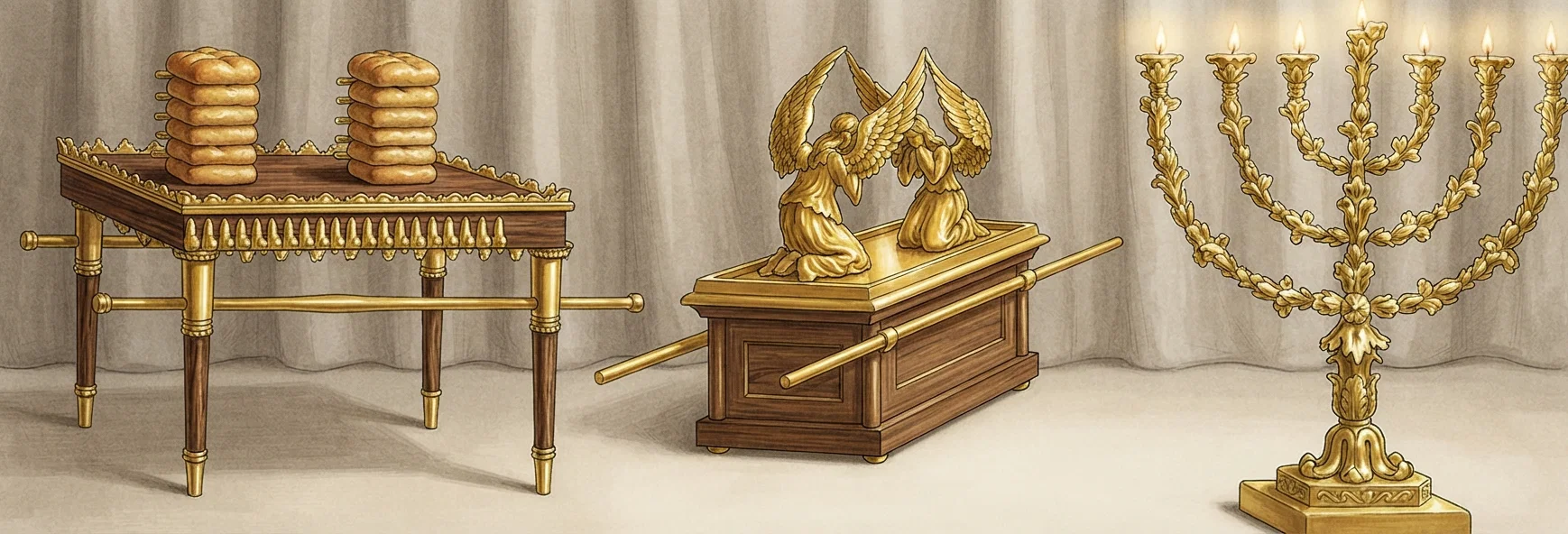
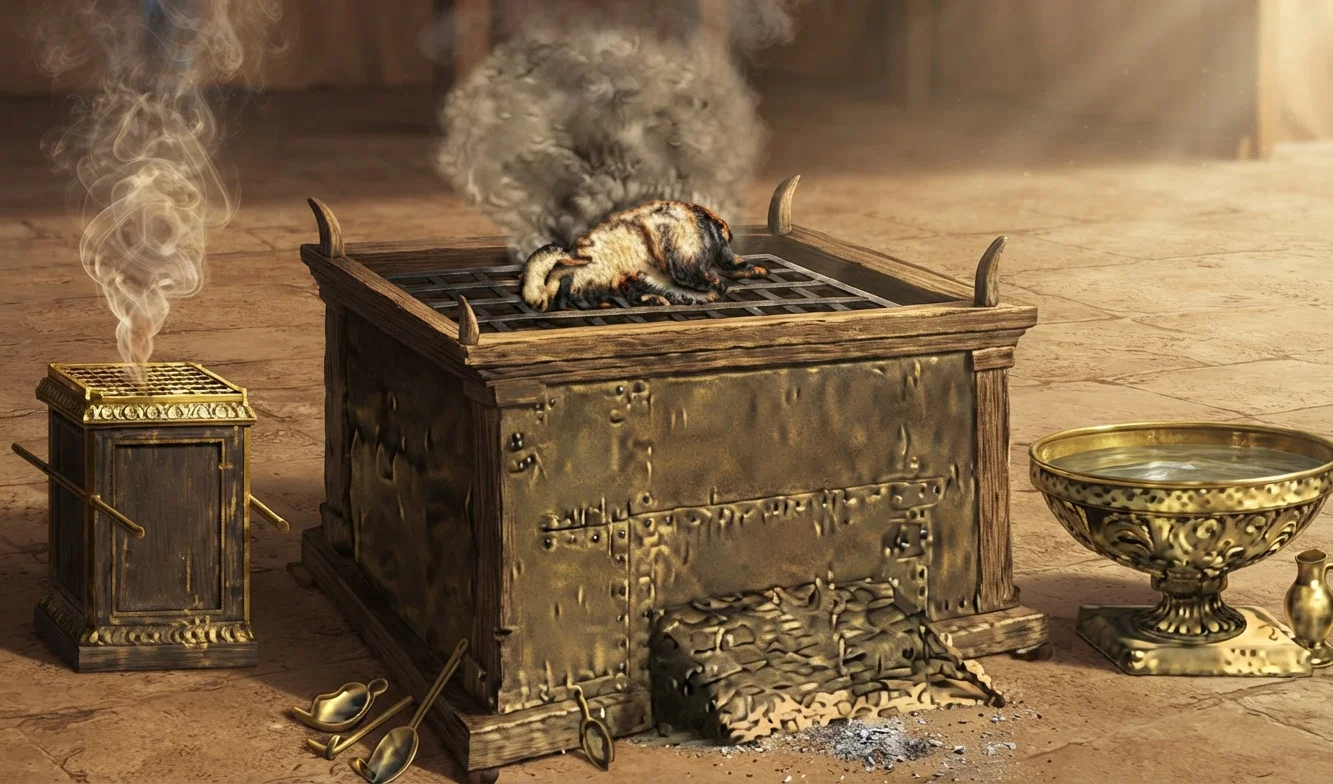
The furniture of the sanctuary. Upper row, from left to right, the table of showbread; the ark containing the law, over which was the mercy-seat; and the golden candlestick. Lower row, from left to right, the altar of incense, the altar of burnt offering, and the laver.
A Prayer for Self-Knowledge
—— **——
"Show me myself. Show me Thyself."
Are the Dead Really Dead?
By Arthur L. Manous
"I praised the dead which are already dead more than the living which are yet alive."Eccl. 4:2.
IN spite of the teachings of popular theology that the dead are more alive than dead after the breath leaves the body, there are a number of passages or cases recorded in the "Scriptures of truth," which bear double testimony, so to speak, to the fact that "the dead which are already dead," are truly dead, or dead in fact. Of these we may note the following:
1 Abel's Death
The record of Abel's death at the hand of his wicked brother, is given in the Old Testament in the following terms:
"And Cain talked with Abel his brother: and it came to pass, when they were in the field, that Cain rose up against Abel his brother, and slew him. And the Lord said unto Cain, Where is Abel thy brother? And he said, I know not: am I my brother's keeper? And He said, What hast thou done? the voice of thy brother's blood crieth unto Me from the ground." Gen. 4:8-10.
Still Dead
And some four thousand years after his murder, the New Testament bears testimony to the fact that Abel is still dead, and not more alive than when breath was in his body. Note the record:
"By faith Abel offered unto God a more excellent sacrifice than Cain, by which he obtained witness that he was righteous, God testifying of his gifts; and by it he being dead yet speaketh." Heb. 11:4.
Others render the latter part of this verse as follows:
(a) "And through it [faith] he yet speaks, altho dead." (Fenton's Translation.)
(b) "And through this faith, altho dead, he still speaketh." (Weekes's Translation.)
(c) "And through it, he being dead, doth yet speak." (Young's Translation.)
(d) "And through it, tho he is dead, he still speaks." (Weymouth's Translation.)
These two inspired records from the "Scriptures of truth," one from the Old Testament, and the other from the New Testament, are absolute proof that Abel, the first man to lose his life, and that early in this world's history, was still dead in the apostolic days, some four thousand years after his murder, and not in heaven, where men may be said to be more alive, if possible, than when living on earth. "In the mouth of two or three witnesses shall every word be established." 2 Cor. 13:1.7
2. Abraham's Death
Concerning the death of the good old "patriarch Abraham," "the friend of God," we have the following record:
"And these are the days of the years of Abraham's life which he lived, an hundred threescore and fifteen years. Then Abraham gave up the ghost, and died in a good old age, an old man, and full of years; and was gathered to his people. And his sons Isaac and Ishmael buried him in the cave of Machpelah, in the field of Ephron the son of Zohar the Hittite, which is before Mamre; the field which Abraham purchased of the sons of Heth: there was Abraham buried, and Sarah his wife." Gen. 25:7-10.
Abraham Still Dead
And when we come down to the New Testament times, we find the Jews acknowledging that the prophets, and their "father Abraham" according to the flesh, are still dead. Note the words of Jesus:
"Verily, verily, I say unto you, If a man keep My saying, he shall never see death. Then said the Jews unto Him, Now we know that Thou hast a devil. Abraham is dead, and the prophets; and Thou sayest, If a man keep My saying, he shall never taste of death. Art Thou greater than our father Abraham, which is dead! and the prophets are dead; whom makest Thou Thyself?" John 8:51-53.
Another text of interest in connection with the case of Abraham is the words of Christ:
"Now that the dead are raised, even Moses showed at the bush, when he calleth the Lord the God of Abraham, and the God of Isaac, and the God of Jacob. For He is not a God of the dead, but of the living: for all live unto Him." Luke 20:37, 38.
God is here speaking prospectively of the resurrection, when Abraham, Isaac, and Jacob shall be "raised," even as "Moses showed at the bush." For God "calleth those things which be not as tho they were." Rom. 4:17.
Mr. Rotherham translates this passage thus:
"But, that the dead are to be raised, even Moses disclosed at the bush, when he calls [the] Lord . . . the God of Abraham, and God of Isaac, and God of Jacob. Now He is not God of [the] dead, but of [the] living; for all to Him are to live."
Mr. Rotherham has the following interesting note on this passage:
"It seems fair and safe to give this verb the same prospective turn as that which the verb 'raise' clearly has in the previous verse. 'To be raised' and 'to live' are plainly correlative." (Note on Luke 20:38.)
Another writer remarks on this point as follows:
"Christ declared to His hearers that if there were no resurrection of the dead, the Scriptures which they professed to believe, would be of no avail. He said, 'But as touching the resurrection of the dead, have ye not read that which was spoken unto you by God, saying, I am the God of Abraham, and the God of Isaac, and the God of Jacob? God is not the God of the dead, but of the living.' God counts the things that are not, as tho they were. He sees the end from the beginning, and beholds the result of His work as tho it were now accomplished. The precious dead, from Adam down to the last saint who dies, will hear the voice of the Son of God, and will come forth from the grave to immortal life. God will be their God, and they shall be His people. There will be a close and tender relationship between God and the risen saints. This condition, which is anticipated in His purpose, He beholds as if it were already existing. The dead live unto Him." ("The Desire of Ages," by Mrs. E. G. White, chap. 66, par. 19, p. 606, trade edition, 1898.)
3. David's Death
The record of King David's death is briefly stated thus:
"So David slept with his fathers, and was buried in the city of David." "For David, after he had served his own generation by the will of God, fell on sleep, and was laid unto his fathers, and saw corruption." 1 Kings 2:10; Acts 13:36.
David Still Dead
The New Testament bears testimony to the fact that good old patriarch David was, in the apostolic times, still dead, even tho many centuries had passed since he fell asleep. Briefly we read:
"Men and brethren, let me freely speak unto you of the patriarch David, that he is both dead and buried, and his sepulcher is with us unto this day." Acts 2:29.
Altho David was a man after God's own heart (1 Sam. 13:14); and altho he turned not aside from following the Lord all the days of his life, save only in one point (1 Kings 15:5), the record further says:
"For David is not ascended into the heavens: but he saith himself, The Lord said unto my Lord, Sit Thou on My right hand, until I make Thy foes Thy footstool." Acts 2:34, 35.
Altho the "sweet psalmist of Israel" (2 Sam. 23:1) is still sleeping in the grave, it is the firm conviction of the writer that the time "is near, even at the doors" (Matt. 24:33), when he, with all the saints who are sleeping in their graves, shall hear the Saviour's "voice, and shall come forth" (John 5:28, 29) "out of their sleep" (Job 14:12) to "be caught up together," "to meet the Lord in the air: and so shall we ever be with the Lord." 1 Thess. 4:17.
Life
By Maggie A. Pulver
By Maggie A. Pulver
"In the midst of life we are in death."
How fleeting is this mortal breath!
And those who smile and weep to-day,
To-morrow may be laid away
Within death's silent walls to rest,
Where foes or fears can not molest.
Tho tide may roll and tempest rave,
There is no knowledge in the grave,
And time unmeasured flies away
Till dawns the resurrection day,
When the great trump of God shall sound,
And wake the dwellers in the ground.
Then shall the righteous live again,
And with their King forever reign.
Then teach us, Lord, to know Thy will,
That we Thy purpose may fulfil,
And wear, in that grand, glorious day,
A crown that fadeth not away,
And robe of immortality
Purchased for us on Calvary,
And with the host triumphant sing,
"O grave, O death, where is thy sting?"
How sweet 'twill be to meet once more
Upon that sinless, painless shore!
O blessed hope! O matchless grace!
The glory of my Saviour's face
Will then suffice for every tear
And all the woes we've suffered here.
Stoddard, Wisconsin.
OUR BIBLE READING
The True Lord's Day
1. Which days of the week has the Lord given to man?
"Six days shalt thou labor, and do all thy work." Ex. 20: 9.
2. Which day has the Lord reserved to Himself?
"But the seventh day is the Sabbath of the Lord thy God." Ex. 20: 10.
3. Through the prophet Isaiah, which day does the Lord claim as His?
"If thou turn away thy foot from the Sabbath, from doing thy pleasure on My holy day; and call the Sabbath a delight, the holy of the Lord, honorable; and shalt honor Him, not doing thine own ways, nor finding thine own pleasure, nor speaking thine own words: then shalt thou delight thyself in the Lord; and I will cause thee to ride upon the high places of the earth, and feed thee with the heritage of Jacob thy father: for the mouth of the Lord hath spoken it." Isa. 58: 13, 14.
4. Of what day does Christ specifically say He is the Lord?
"And He said unto them, The Sabbath was made for man, and not man for the Sabbath: therefore the Son of Man is Lord also of the Sabbath." Mark 2: 27, 28.
5. On what day did John say he was in the Spirit?
"I was in the Spirit on the Lord's day, and heard behind me a great voice, as of a trumpet." Rev. 1: 10.
NOTE.— The Lord says, "The seventh day is the Sabbath of the Lord thy God." If we say that the house is the property of John Smith, any one would understand that the house belonged to Smith — that he claimed it as his own. In like manner we may easily understand that when God says, "The seventh day is the Sabbath of the Lord thy God," He is claiming it as His. It is "the Lord's day." In the text from Isaiah, the Lord distinctly says that the Sabbath is "My holy day." This is another testimony that the Sabbath is "the Lord's day." Then as a climax to the evidence, the Master specifically says, in the text quoted from Mark, that "the Son of Man is Lord also of the Sabbath." Then when John says he was in the Spirit on the Lord's day, it is equivalent to saying that he was in the Spirit on the Sabbath day. This is a part of the evidence which shows that the seventh-day Sabbath is the Lord's day. There is no evidence whatever to show that Sunday was ever claimed by the Lord as His day, and we have no right to call it such. We are not warranted in calling any day the Lord's day aside from the one that He has said is "the Sabbath of the Lord thy God," that He has called "My holy day," and the day of which He says He is Lord.
Joy in Heaven
By Delwin Rees Buckner
Delwin Rees Buckner
There's joy among the heavenly hosts to-day
In New Jerusalem's straight streets of gold,
For, lo, a sinner lost has sought the fold,
One who had wandered countless leagues astray
O'er jagged crags, hid by a cloak of gray,
Where winter winds howl ever, chill and cold,
And hungry beasts of prey prowl, bad and bold,
And thorny thistles strew the weary way.
Harp music echoes 'mid the city spires,
While glad hosannas herald the new birth
To truth and light of him, nigh dead in doubt
And night, meanwhile each angel guide inquires
Who will be hastened down to distant earth
To lead the weak, bruised, bleeding one about.
The Forward Look
By Worthie Harris Holden
By Worthie Harris Holden
Through all the fevered, anxious night
Ye wait to greet the morning light;
No balm for grief, no rest from toil,
No gain where moth and rust despoil,
Save in His peace and quietness
That soothe the watchers' soul-distress.
But lo, the blush of dawn appears
With roseate hues dispelling fears!
Your hopes renew as faith espies
The heralds mount the eastern skies;
For soon the waiting ones shall see
The Day that brings eternity.
O, look not back, lest lurking foe
Beguile to throes of awful wo!
Nor unto left nor right attend
To cavilings or threats of men,
Lest 'mid diverted thoughts the Day
Unseen will break, to your dismay.
The Gentle Word
By Amos E. Flint
By Amos E. Flint
A gentle word—a little thing,
But great the joy that it can bring
When spoken to the careworn heart,
Oft pierced and torn by sorrow's dart.
A gentle word can leave no scar
The sweetest song or smile to mar.
'Tis love that rules its sowing here,
And crowns with joy each passing year.
Speak gently to the erring one
Who now the path of right may shun.
Perchance harsh words, so careless sown
In moistened soil, to seed have grown.
A gentle word, alas, may win
The erring one from paths of sin.
'Tis better far to rule by love,
As does the One who dwells above.
Kind, gentle words shine full and bright
As distant worlds on darkest night.
Like heaven's calm on storm-tossed spume,
They bear away life's sighs and gloom.
A gentle word—what charm it brings,
Like soothing strains on joyful strings!
Each care and pang of mortal birth
Finds buoyant sphere—a heaven on earth.
Then speak kind words—'tis not in vain;
The harvest brings eternal gain.
'Tis ours to sow the kindly seed
Of every word and act and deed.
Christ Our Brother and Saviour
By F. W. Robertson
But if there has been on this earth no real, perfect human life, no love that never cooled, no faith that never failed, which may shine as a lodestar across the darkness of our experience, a light to light amidst all convictions of our own meanness and all suspicions of others' littleness, why, we may have a religion, but we have not a Christianity. For if we lose Him as a Brother, we can not feel Him as a Saviour.—F. W. Robertson.
Do Not Be a Stumbling-Block
By Mary E. Watson
THERE is a story of a man who was walking down a dark street and met another man with a staff and a lantern. The striking thing, as the stranger noticed it, was that the man was feeling his way with his staff and apparently making no use of the light. When asked if he were not blind, the man replied that he was, but he knew the street well, and had no difficulty in making his way with his staff. "But," asked the stranger, "why do you carry a lantern?" "To keep other people without lanterns from stumbling over me," was the blind man's answer. To be able only to tell others where not to go is a small gift, but it is something. Not every one can be a brilliant beacon in the world, but the humblest person can keep himself from being a stumbling-block.—Mary E. Watson.
Garbled Statements of Facts
A CORRESPONDENT sends us a copy of the Louisville Christian Observer of February 12, containing an article on the Seventh-day Adventists. It aims to set forth the views of Seventh-day Adventists, not from their own published statements so much, but statements from a disappointed, ambitious man who felt that his ability was not sufficiently recognized, and who apostatized.
The only power that he possessed as a preacher was when he was among Seventh-day Adventists. After twenty-eight years among them, in which he was free to go and come at any time, he left them, declaring that they were the most devoted Christians on earth, but that he saw larger things, and would labor to convert souls to Christ. After working a while for the Baptists with no record of souls converted, or large evangelical work done, he concluded that he could better pose in destructive work than constructive work, and would make himself more popular by fighting the church to which he once belonged. After confessing that it took him twenty-eight years to learn that he was in error, he claims to set forth the belief of Seventh-day Adventists, in a book which he publishes. The simple fact is that in all this time this man never really knew the truth as taught by Seventh-day Adventists and as it is in Jesus. He learned facts and theories, but not truth. He learned doctrines, separate and distinct articles of faith, but never the doctrine, the teaching of the Bible, the center of which is Christ Jesus. He perhaps tells us truly what he believed once, but he does not rightly represent the denomination. For instance, he declares that among the chief doctrinal points of Seventh-day Adventists are "rejection of the doctrine of the Trinity; materiality of all things; that the Bible must be interpreted to harmonize with the writings of Mrs. White; that when Christ comes only 144,000 out of all then living will be saved, and all those will be Seventh-day Adventists." Now in the sense in which these are set forth they are not true. This man may not know it, but our correspondent evidently thinks so, who says that he is a member of the Presbyterian Church, and a reader of the SIGNS OF THE TIMES, and remarks that "I do not think this article quite fair." And it is not fair, nor is it true.
The best way to understand just what Seventh-day Adventists believe is to read just what they have to say. All of the great fundamental Scriptural views of the denomination are given each year in the SIGNS OF THE TIMES, and these are taught as the editors understand the Bible to teach them.
Very much more might be said regarding the article in the Christian Observer, but there are very few, indeed, of the Christian Observer readers who would see the SIGNS OF THE TIMES, and the readers of the SIGNS OF THE TIMES are constantly finding sufficient to meet all that is said in the Christian Observer. Take, for instance, the criticisms which the Observer offers regarding the destiny of the wicked, in which the Observer contends that everlasting death, or the anguish of the lost, is a conscious state, when there is abundance of proof in the Bible that "the wages of sin is death." All that Seventh-day Adventists ask at all is that fair examination shall be given of their teachings.