The Youth’s Instructor, Vol. 48, No. 5.

AND IT WAS WINTER
Earlier text: AND IT WAS WINTER

OUTDOOR OBJECTS IN PERSPECTIVE

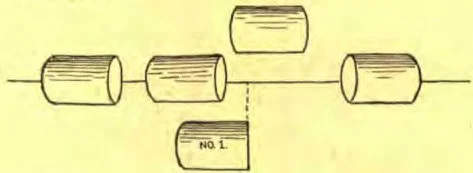
WHEN the cylinder is placed horizontally, the same principles are observed in drawing it that are observed when it is vertical, except that the curves become straight when they come in line with the eye, as shown in cylinder No. 1 below.
Notice that the more the cylinders are moved to the right or left, the more of the end closest to the point of vision is visible. This end becomes more circular, while the opposite end line becomes more curving, the farther away from the point of vision it is moved. This rule is the same when the cylinder is lowered or raised, when horizontal.
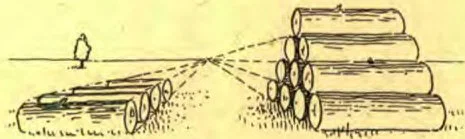
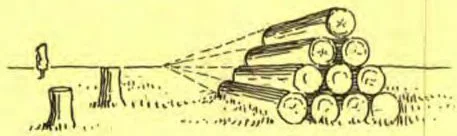
The accompanying drawing shows the way several cylinder-shaped objects should be drawn when horizontal. If the observer is standing so that the ends of the logs are facing him, they would look thus:—
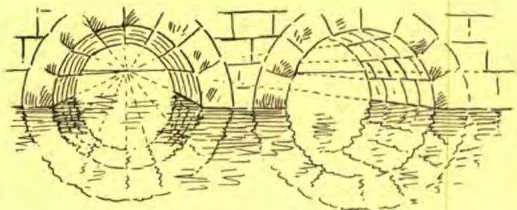
In drawing a stone bridge, be sure to have the perspective of the stones correct. Below, you will see what is meant. The lines formed by the stones in the reflection should recede toward the horizon as well as those formed by the stones in the bridge.
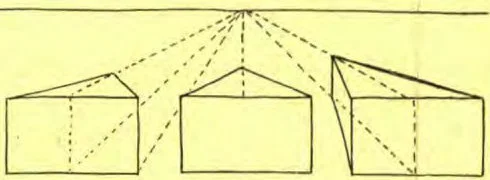
The prism is somewhat more difficult to draw in perspective than either the cube or the cylinder. By a little study, with the aid of the drawing here given, you will see how a vertical prism should be drawn.
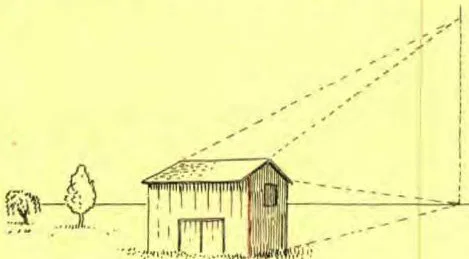
The lines formed by the roof of a house meet at a point, but not on the horizon line. As has been said, only lines at right angles with the observer meet at the point of vision on the horizon line. For instance, all the lines on the house shown below are at right angles with the observer (except the roof lines), and so meet at the point of vision.
A vertical line should be drawn up from the point of vision; and according to the slant of the roof, so should the point to which the roof-lines converge be placed on this line. If the roof slants much, the point should be placed high; if the slant is gradual, the point should be placed low. This is illustrated in the drawing herewith given. PEDRO LEMOS.

THE SIKHS OF INDIA

THE Sikhs of India are among the most interesting of all the races found in that interesting country. Their founder was Nanck, who was succeeded by nine pontiffs, each of whom, like himself, was popularly denominated guru, or teacher. His object was to unite Hindus and Mohammedans on the basis of a pure monotheism and human brotherhood.
Arjún, compiler of the sacred doctrines in a volume called “Adigranth,” and founder of Amritsar, the holy city of the Sikhs, rendered himself conspicuous as a partisan of the rebellious prince Khúsru, son of Jahangir. He was imprisoned by the Mussulman government, tortured, and put to death in 1606. His son, Har Govind, led the Sikhs against the Mohammedans, but was driven from Lahore to the northern mountains.
Under Guru Govind, the tenth “teacher,” the Sikhs were first formed into a separate state. He combated the Mohammedan power and religion; and Hinduism, with its castes, fictions, and irrational idolatry, fell under his ban. He also wrote the second volume of the Sikh scriptures, in which are taught the worship of one God, strict morality, and, equally, living by the sword. He was assassinated while in the imperial service in 1708, on the banks of the Godavari. After his death, persecution from time to time greatly reduced the strength of the tribe. But their religious fanaticism, nourished by the sacred writings which successive leaders had prepared, lent vigor to their warlike energies.
In 1764 they convened a general assembly; formally assumed the character of a nation; and issued coin, from which the name of the emperor was omitted. Their commonwealth was designated Khalsa; its twelve component states were called misals, and were governed by sirdars, or petty chiefs, of whom Maha Singh was the most powerful. In 1838 his son, Runjít Singh, consolidated the misals into a unity subject to his own sway. The following year he died, aged fifty-nine years, leaving a kingdom called Lahore, which included all the principal Sikh states except those east of the Sutlej. In 1846 the Sikhs were conquered by the English, and ceased to be a nation.
New complications arising, war between the Sikhs and the English was renewed in 1848, but concluded unfavorably for the Sikhs, in February, 1849. The portion of the Sikh territory remaining independent was comprised in the nine small states of Sirhind.
The Sikhs were faithful to the English during the sepoy rebellion in 1857, and aided materially in its suppression.
They still maintain their national characteristics, being tall, thin, dark, active, frank, sociable, and pleasure-loving. Their number in British India was officially given in 1868 as 1,129,319. This should undoubtedly be increased, to allow for growth in population during the last thirty years. When in native garb, the Sikhs are strictly Oriental, their dress resembling the usual costumes of the natives of India. The turban worn by them is one of the most graceful and becoming forms of headgear of which I have any knowledge.
As soldiers, the Sikhs have distinguished themselves for bravery, and their stanch devotion to the British crown causes them to be held in high esteem by the English nation. So much does the queen appreciate these men and the services they have rendered the government, that some of them are found in her household. Wherever the British have gone in the East, the Sikhs have followed, usually in the capacity of soldiers. In the native states the English depend almost entirely upon them for their military strength.
An incident that occurred in the Indian mutiny will throw some light on the Sikh character. The English forces were sorely pressed, and short of provisions. Rice was one of the principal articles of diet, and even this began to fail. The noble spirit of their comrades, the Sikhs, was shown in their voluntarily relinquishing their ration of rice to the British soldiers, on condition that they be permitted to cook it, and drink the water in which it was boiled. They kept the rice-water, and gave the rice to the Englishmen, and in this way both were tided over a time of considerable peril. The incident furnishes one of the finest illustrations of the generous spirit and physical hardihood of vegetarian races.
These people have received but little attention at the hands of missionary societies, and next to nothing has been done in evangelizing them. It is to be fervently hoped that the Christians of the West will not continue to neglect the Punjab. I do not mean to be understood as saying that nothing has been done: some missionary work is being carried on; but compared with what has been done for some other parts of India, it amounts to but little.
I would call the attention of my young readers to the interesting fact that the Sikhs belong to the same branch of the human family—the Caucasian—that we belong to. I have often surprised Americans and Europeans by asserting that the people of India are our blood-brothers, notwithstanding the color of their skin; such is indeed the case, and for that reason, if for no other, we ought to feel an unusually deep interest in them.
R. W. MUNSON.

Casting Our Burdens upon the Lord

GETTING rid of our load is getting rid of our burdensome selves. “Cast thy burden upon the Lord, and he shall sustain thee: he shall never suffer the righteous to be moved.” No wonder the psalmist promptly responded: “I will trust in thee.” And why should we not trust him, seeing he has promised to take and bear both ourselves and our burden? He never does anything by halves, but rather by doubles and multiples. It never takes long to cast anything off from ourselves upon another. Away with thy burden, then, this instant! Away with thy weary, burdened, disheartened, disconsolate, groaning, sinking self! And when thy burden and thyself consciously go over to God, be sure to leave both henceforth with him. A great, strong Father can easily, and will gladly, lift his little child and all his bundles. Our Heavenly Father’s arm is already lifting us.—E. I. D. Pepper.

WHAT RAY SAW

The moment little Ray was born, his good father, Old King Sol, dispatched him on an errand of mercy; no short trip it was, either, such as you might be sent on, to the post-office, or the corner grocery, but a journey measured, not by miles, nor by thousands of miles, but by millions of miles,—more than ninety-two millions of miles!
But the bright little fellow never made one objection, nor grumbled because he could not stop to play. Turning his face straight toward the earth, he shot out into space at the remarkable speed of twelve million miles a minute! Just think of that!
He caught a fleeting glimpse of Mercury as he flew past him; if he had not been going straight toward the earth, Mercury would have caught him; but, as it was, Ray dashed past him,—on, on, on! He saw Venus, too, but did not turn aside for her.
Then he saw the round, yellow face of the moon, and he thought, “How glad the earth must be of her light at night.” But as he hurried past, he glanced back over his shoulder at her, and was surprised to see that her face toward the earth was nearly dark: only a pale light shone from it, and this, he decided must be reflected earth-shine.
Just then he shot into the earth’s atmosphere, and was quite frightened to find it full of clouds; for it was raining. As he reached the clouds, they parted, and he slipped through the opening, dashing right in among the falling drops. “Just right for a looking-glass,” said he; and going straight up to one, he looked in. A most beautiful sight met his astonished gaze,—a great curved band of shining colors,—violet, indigo, blue, green, yellow, orange, and red. A moment later he had expired, after a brief life of seven and one-half minutes.
AUNT BETTY.
[How many of the children can tell what this pretty story means? What was little Ray? What is called Old King Sol? What is it that travels nearly twelve million miles a minute? What are Mercury and Venus? What was the beautiful sight Ray saw in the raindrop? The best set of answers to these questions will be printed.—Ed.]

A NEW WAY OF QUARRELING

WE are accustomed to think of the Japanese as being far behind us in all that goes to make up civilization. But there are a few things that we can learn even from them. They are said to be the most polite people in the world. When they meet, they bow very low two or three times, in a most graceful manner. Street fights and brawls are uncommon; and when two persons do condescend to quarrel, they do it with the greatest propriety. A traveler in that country tells of seeing the rare sight of two little boys of five or six years old, who were having an “unpleasantness,” which had reached the point of pretty vigorous squeezing and pulling, when one of them, who was evidently getting enough of it, called out, “Please excuse me! Please excuse me!” whereupon the other child immediately stopped, and peace was made. It strikes us that some American children might take a hint from these “heathen.” Suppose at the beginning of a quarrel a boy should say, “Excuse me for being angry!” “I beg your pardon for calling you names!” “Please be so good as to tell me why you did that!” how long do you think the quarrel would last? Suppose we try this Japanese way the next time there is occasion.
— Words of Cheer.

“Dickey Downy.”

_By_ _Virginia Sharpe Patterson._
This little volume is charmingly written, its object being to teach the children to love and protect the birds. That it is interesting, the following selected chapter-headings will abundantly show:—
The Orchard.
Dickey Downy’s Meditations.
Dickey’s Cousins.
A Winter in the South.
The Prison.
The Hunters.
Polly’s Farewell.
The book is bound in cloth, and contains 192 pages, with four beautiful colored plates. Price, post-paid, 60 cents.
We offer this book, post-paid, or three new yearly subscriptions to the YOUTH’S INSTRUCTOR, at 75 cents each, or with the INSTRUCTOR one year for only $1.15.

Self-Pronouncing S. S. Teachers’ Reference Bible.
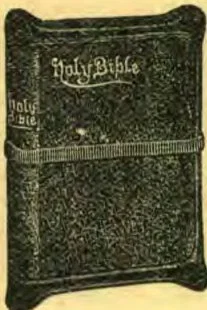
CONTAINS the celebrated Teachers’ Helps, comprising nearly 400 pages. Also a complete series of fifteen new maps.
Description. — Imperial Seal Binding, Tuck Edges, known as “Divinity Circuit,” Rounded Corners, Full Red under Gilt Edges.
We offer this Bible, post-paid, for only SIX NEW YEARLY SUBSCRIPTIONS at 75 cents; or TWELVE NEW SIX MONTHS’ SUBSCRIPTIONS at 40 cents.
We will also send it, post-paid, with the INSTRUCTOR one year for $2.25. For 20 cents extra we will stamp your name in gold upon the cover.

IN A MINUTE

SHE'S such a sunny little girl We can not help but love her,— More bright the flowers about her feet, More blue the skies above her,— As frolicsome as kittens are, As joyous as a linnet; And yet— she has one grievous fault,— She will say, "In a minute."
When, not too early in the morn, Mama comes stepping lightly, She finds that little girl asleep, With blue eyes closed up tightly; And though she calls, "Jump out of bed, 'Tis too late to be in it," That little lassie only yawns, "Yes—mama—in—a—minute."
When mama brings her book and slate, With cheery look inviting (She loves to teach her little girl In reading and in writing), And says, "Here, daughter, is your task; 'Tis time you should begin it," That lazy little maiden cries, "Yes, mama,—in a minute."
And mama says, when bed-time comes: "'Tis time you were undressing: A long and healthy life, my dear, Is this earth's greatest blessing, And you must early be in bed, If you would ever win it,"— She nods her sleepy head, and says, "Yes—mama—in—a—minute."
But if her mama says: "My dear, Here is a stick of candy;" Or, "Let us go and take a ride After the new horse Dandy;" Or, "Here's a package from Aunt Jane, Let's see what may be in it,"— I never, never hear her say, "Yes—mama—in—a—minute."
ELIZABETH ROSSER.

A RICH BOY

“Oh, dear,” said Ben, “I wish I was rich, and could have things like some of the boys that go to our school.”
“I say, Ben,” said his father, turning round quickly, “how much will you take for your legs?”
“For my legs!” said Ben, in surprise.
“Yes. What do you use them for?”
“Why, I run and jump and play ball, and, oh, everything.”
“That is so,” said the father. “You wouldn’t take five thousand dollars for them, would you?”
“No, indeed,” answered Ben, smiling.
“And your arms, you wouldn’t take five thousand dollars for them, would you?”
“No, father.”
“And your voice. They tell me you sing quite well, and I know you talk a little bit. You wouldn’t part with that for another five thousand dollars, would you?”
“No.”
“Nor your good health?”
“No.”
“Your hearing and your sense of taste are better than two thousand dollars apiece, at the very least, don’t you think so?”
“Yes, indeed.”
“Your eyes now. How would you like to have ten thousand dollars, and be blind the rest of your life?”
“I wouldn’t like it at all.”
“Think a moment, Ben; ten thousand dollars is a lot of money. Are you sure you would not sell them for that sum?”
“Yes, father.”
“Then they are worth that much, at least. Let’s see, now,” his father went on, figuring on a sheet of paper: “legs, five thousand; arms, five thousand; voice, five thousand; hearing, two thousand; taste, two thousand; good health, five thousand; and eyes, ten thousand—that makes thirty-four thousand dollars. You are worth that much, at the very lowest figure, my boy. Now run and play, jump, throw your ball; laugh, and hear your playmates laugh; look with those ten-thousand-dollar eyes of yours at the beautiful things about you; and think now and then how rich you really are.”
It was a lesson that Ben never forgot; and whenever, since that day, he has seen a cripple or a blind man, he has thought how many things he has to be thankful for. And it has helped to make him contented.—Selected.

Leave It With Him: A Poem on Prayer

“Yes, leave it with Him; 'T is more dear to his heart, you will know, Than the lilies that bloom, Or the flowers that start 'neath the snow. Whatever you need, if you ask it in prayer, You can leave it with him, for you are his care— You, you know.”

In the Garden

Sabbath-School Lesson—No. 6

In the Garden

(February 10, 1900)
Memory Verses.—Isa. 53:4, 6.
Time: A. D. 31. Place: Mount of Olives.
Persons: Jesus, disciples.

Questions

1. Having ended his instruction, what did Jesus then do? John 18:1. By what name was this garden known? Mark 14:32. Where was it situated? Luke 22:39.
2. At the entrance to the garden, what request did Jesus make of the disciples? Mark 14:32. Whom did he take with him into the garden? V. 33. With what feelings was he burdened as he went forward with the chosen three? Matt. 26:37.
3. What was his condition of mind at this time? What request did he make? V. 38. What admonition did he give Peter, James, and John? Luke 22:40.
4. Bidding them pray, what did he himself do? What was the burden of his prayer? Matt. 26:39; When he returned, seeking for comfort and sympathy, what did he find? What tender, but reproachful question did he ask? V. 40; What did he again urge the disciples to do? How did he seek to excuse their failure? V. 41.
5. Returning to his place of prayer, from whom did Jesus receive help? Luke 22:43. How terrible did the conflict now become? V. 44; What was his prayer the second time? Matt. 26:42.
6. As he came again to his disciples, in what condition did he find them? Luke 22:46. How many times did Jesus agonize in prayer to God for strength to drink the bitter cup? Matt. 26:44.
7. When he came the last time, and found his disciples sleeping, what did he say to them? V. 45; What did he immediately add? V. 46. As he spoke, who appeared upon the scene? V. 47.

Notes

1. It is impossible for man to understand the depth of woe, or to fathom the experience, through which Jesus passed during this night in Gethsemane. Not the sins of one man or of one generation, but the sins of a world, weighed him down. Satan pressed in every thorn of sin to its fullest extent, and endeavored by every means within the range of his supernatural possibilities to overthrow Christ. The suffering undergone by Jesus was, therefore, not simply human, but divine. It was both as the Son of man and as the Son of God, that he suffered in this conflict; and so terrible was the struggle that he feared his frail being could not endure. He had taken the sinner’s place, and as a man he was called to sense God’s hatred against sin. So terrible is the temptation to step aside, and let an ungrateful world bear its own guilt, that three times he uttered, in agony of mind and body, “Father, if it be possible, let this cup pass from me.” But this was not all the prayer. Had it closed here, man would have been instantly cut off from heaven. No! Jesus added, “Nevertheless not my will, but thine, be done.” His faith finally grasped the power to submit to all that the justice of God’s law would impose upon the world because of sin, and he was triumphant. Every question was now settled, and Jesus went out from the garden to drink the cup of suffering. The struggle in Gethsemane was for power to submit to the full will of God. Human nature finds it easier to believe than to submit; but in Gethsemane it was demonstrated that humanity may, by faith, be perfect in its surrender to the will of God. The weakness of the flesh is no excuse for sin, or for holding back from duty of any kind.
2. The disciples had all boldly affirmed that they were ready to go with Jesus to prison and to death; and Peter had further declared that though all the rest might forsake Jesus, he never would. As Jesus came from prayer, and found them asleep, he reminded them, by his question, of their promise, which had so soon been broken. And because Peter had been so self-confident, to him the reproachful question was asked, “What, could ye not watch with me one hour?”
3. In times of great suspense and distress, beads of perspiration force their way to the foreheads of men, an indication of the intense strain under which the system is placed. This is as far as man has gone. But Jesus sweat “great drops of blood.” This is beyond our understanding. And yet there will come a time to those who pass through the closing scenes of earth’s history, when they will “drink of the cup” of which he drank, and be baptized with the baptism of suffering. But they will be victorious, even as Jesus was. Like him, they will be given a place at the right of the throne; and, because they know his sufferings, they will “follow the Lamb whithersoever he goeth.”
4. The last hours that Jesus spent with his disciples, and the experiences of those hours, are types of the times in which we live, and of the events that fill our days. As with the disciples during those closing hours, this is the watching time. “Watch and pray, that ye enter not into temptation,” is the admonition now given to God’s people. But many, though they are confident that they will stand in the hour of trouble, are now sleeping. They are indifferent to the present call. Time after time the Spirit has appealed to them to awake, but they again fall back into the slumber of sinful indifference. Erelong, Jesus will come to them, but only to say, “Sleep on.” To the disciples there was still hope; but when the word shall be spoken in this time, it will mean an eternal sleep: the angel of mercy will have taken her flight, never to return. The people of God should now take earnest heed to the admonition, “Watch and pray, that ye enter not into temptation.”

Dr. Worst's New Scientific CATARRH INHALER ON TRIAL FREE!
DR. E. J. WORST, ASHLAND, OHIO.
It cures Catarrh, Colds, Pains and Roaring in the Head, Bronchitis, Sore Throat, Headache, Partial Deafness, and all diseases of the Air Passages.

CURES BY INHALATION.

Air is the only agent fine enough to carry any medicinal influence into the small air cells and homes of the living germs, that will effectually destroy the causes of these diseases. It was the agent that carried the disease there, and it must be the one to successfully remove it.

SPECIAL OFFER.

For a short time I will mail to any reader, naming this paper, one of my new Scientific Catarrh Inhalers, with medicine for one year, on three days' trial, free.
If it gives satisfaction, send me $1.00; if not, return it after three days' trial. If you are willing to comply with such reasonable terms (agents wanted), address—
DR. E. J. WORST, 402 Main St., Ashland, O.
ON TRIAL FREE!

KEEP THE MIND EMPLOYED

A PURPOSE is always a companion, and an earnest purpose is the closest of companions. To fulfill duties is more than to enjoy pleasures. Keeping the mind constantly employed leaves no time for useless forebodings or vain regrets. Much of the bitterest loneliness in the world arises from an exorbitant and morbid self-regard.—Selected.

To Reach BATTLE CREEK

FROM
CHICAGO, BUFFALO, DETROIT, OR TOLEDO,
Purchase Tickets Reading over the MICHIGAN CENTRAL
“The Niagara Falls Route.”
A First-class Line for First-class Travel between Chicago and New York and Boston. Elegantly equipped through trains pass Battle Creek in each direction daily.
R. N. R. WHEELER, Ticket Agent, Battle Creek.
O. W. RUGGLES, Gen'l P. and T. Agt., Chicago, Ill.

TAKE THE Canadian Pacific Railway

for . . . CHATHAM, OTTAWA, MONTREAL, LONDON, GALT, QUEBEC, WOODSTOCK, TORONTO, BOSTON, PORTLAND, and All points in New England, the Maritime Provinces, Great Britain, and the Continent.
Illustrated literature, time-tables, and full particulars, upon application to—
J. FRANCIS LEE, GEN. AGENT,
Passenger Dep't. 228 SOUTH CLARK ST., CHICAGO
Branch Offices: 76 Ottawa St., Grand Rapids, Mich. Room D, Chamber of Commerce, Cincinnati, Ohio. 315 Chestnut St., St. Louis, Mo.

Cincinnati Northern Railroad Co.

TIME TABLE NO. 3.

IN EFFECT SEPT. 24, 1899.
Trains Pass Battle Creek, as follows:
WEST-BOUND.
No. 21, Mail and Express — 6.58 P. M.
No. 23, Accommodation — 2.07 P. M.
No. 27, Local Freight — 8.25 A. M.
EAST-BOUND.
No. 22, Mail and Express — 8.25 A. M.
No. 24, Accommodation — 1.45 P. M.
No. 28, Local Freight — 5.30 P. M.
Direct connections are made at Toledo with all roads diverging. Close connections for Detroit and Cincinnati.
J. L. BEARD, Ticket Agt., Battle Creek.
E. R. SMITH, City Pass. Agt., 6 West Main St.
Continue reading: GRAND TRUNK RAILWAY SYSTEM