The Youth’s Instructor, Vol. 48, No. 5.

AND IT WAS WINTER

The Youth’s Instructor

Feb 1, 1900

Review and Herald Publishing Company · Battle Creek, Mich. · Feb 1, 1900

AND IT WAS WINTER

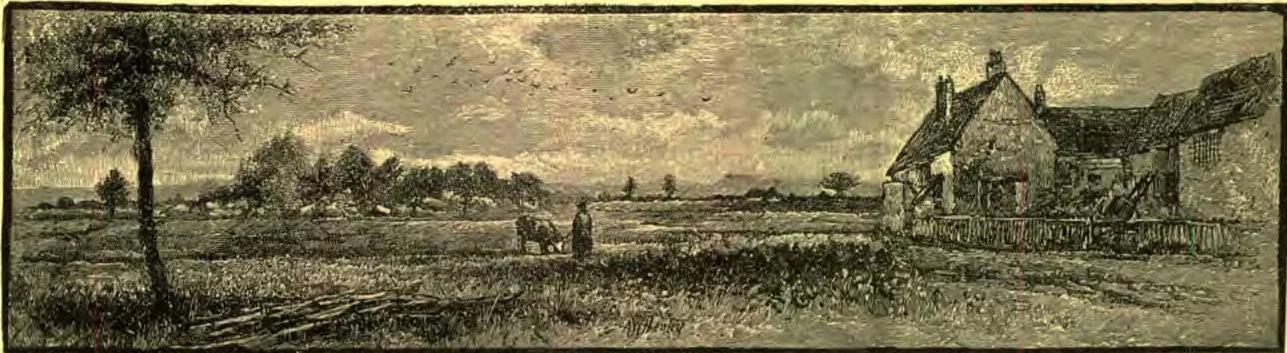
OH! it is winter now, and quiet lies The landscape, in a gray and cheerless light,— Dark outlines, traced upon a ground of snow,— A perfect study, done in black and white.
“And it was winter” in Jerusalem, A Jewish feast-day in the long ago, When, as the pilgrims journeyed cityward, Their sandaled feet made footprints in the snow.
A Pilgrim walked within the temple porch, Viewing the hundreds crowding out and in; To him the jostling multitude appeared Like sheep without a shepherd, wandering.
“My sheep all know my voice and follow me,” He said, in voice like music, wondrous sweet; Then, slowly, down the steps, toward Jordan went, Treading the snow, in footprints, ’neath his feet.
‘And it was winter’ when he paused to rest; And so his sheep, who follow him, do go, Following his steps and murmuring not, although Their weary feet make footprints in the snow.
MINNIE ROSILLA STEVENS.

CHRIST BEFORE PILATE

“WHEN the morning was come, all the chief priests and elders of the people took counsel against Jesus to put him to death: and when they had bound him, they led him away, and delivered him to Pontius Pilate the governor.”
The priests and rulers were prepared to place themselves in a false position in order to sustain their charges against Christ. The Jews were bitter opponents of the Roman power, they hated Cæsar’s rule and supremacy; but to gain their end, they professed to be his loyal subjects. They had no conscience, no pure principles. When it was safe for them to be so, they were most tyrannical in their church requirements: when they aimed to bring about some purpose of cruelty, they exalted the power of Cæsar. The world was gone after Christ, they declared, and all men would believe in him if he was permitted to live.
“They began to accuse him, saying, We found this fellow perverting the nation, and forbidding to give tribute to Cæsar, saying that he himself is Christ a King.”
These charges were wholly at variance with the appearance of Christ, and Pilate did not believe them. “He knew that for envy they had delivered him.” To all their accusations Christ had answered nothing.
“Then said Pilate unto him, Hearest thou not how many things they witness against thee? And he answered him to never a word, insomuch that the governor marveled greatly.”
The eloquent silence, the patience and serenity maintained by Jesus throughout the condemnation, had a different effect on the several actors. The same meekness and patience that spoke conviction to Pilate, excited satanic hatred in the hearts of the Jews.
“Art thou the king of the Jews?” Pilate asked. “Jesus answered him, Sayest thou this thing of thyself, or did others tell it thee of me? Pilate answered, Am I a Jew? Thine own nation and the chief priests have delivered thee unto me: what hast thou done? Jesus answered, My kingdom is not of this world; if my kingdom were of this world, then would my servants fight, that I should not be delivered to the Jews: but now is my kingdom not from hence. Pilate therefore said unto him, Art thou a king then? Jesus answered, Thou sayest that I am a king. To this end was I born, and for this cause came I into the world, that I should bear witness unto the truth. Every one that is of the truth heareth my voice. Pilate saith unto him, What is truth? And when he had said this, he went out again unto the Jews, and said unto them, I find in him no fault at all. But ye have a custom, that I should release unto you one at the Passover: will ye therefore that I release unto you the King of the Jews? Then cried they all again, saying, Not this man, but Barabbas. Now Barabbas was a robber.
“Then Pilate therefore took Jesus, and scourged him. And the soldiers platted a crown of thorns, and put it on his head, and they put on him a purple robe, and said, Hail, King of the Jews! and they smote him with their hands. Pilate therefore went forth again, and saith unto them, Behold, I bring him forth to you, that ye may know that I find no fault in him. Then came Jesus forth, wearing the crown of thorns, and the purple robe. And Pilate saith unto them, Behold the man! When the chief priests therefore and officers saw him, they cried out, saying, Crucify him, crucify him. Pilate saith unto them, Take ye him, and crucify him: for I find no fault in him. The Jews answered him, We have a law, and by our law he ought to die, because he made himself the Son of God.”
“When Pilate therefore heard that saying, he was the more afraid.” He went again into the judgment hall, and said to Jesus, “Whence art thou?” Jesus gave him no answer. “Then saith Pilate unto him, Speakest thou not unto me? knowest thou not that I have power to crucify thee, and have power to release thee? Jesus answered, Thou couldest have no power at all against me, except it were given thee from above: therefore he that delivered me unto thee hath the greater sin. And from thenceforth Pilate sought to release him.”
“He that delivered me unto thee hath the greater sin.” Christ here referred to Caiaphas, who, as high priest, represented the Jewish nation. Caiaphas knew the principles that controlled the Roman authorities. He had had light in the prophecies and in the written word, which testified of Christ; and according to his light, he would be judged.
The words of Christ filled Pilate with awe. He feared the results of his course of action. He had boasted of his power to crucify Christ or to release him, according to his view of the matter. But when he considered that this man was connected with the highest authority the world ever knew, he was afraid. He thought that he could on his own authority let Christ go forth uncondemned. But the Jews cried out, saying, “If thou let this man go, thou art not Cæsar’s friend: whosoever maketh himself a king speaketh against Cæsar.”
This threat increased the guilt of the Jewish nation before God. They were determined to accomplish their purpose. To gratify their envy, and get rid of Jesus, they placed themselves in a false position, professing loyalty to a ruler whom they hated. To have complaint of him go from the priests and rulers to Cæsar was more than Pilate dared risk. To have them impeach his course of action might forfeit for him his place and authority. Therefore Pilate yielded up to the will of his enemies the One whom he had pronounced without fault. Christ was again scourged.
Again Pilate took his place on the judgment-seat. He had made his decision. In mockery he presented Jesus to them, saying, “Behold your King.” But the mad cry was raised, “Crucify him, crucify him.” In a voice that was heard far and near, Pilate asked, “Shall I crucify your King?” But the loud, ringing, awful cry came from profane, blasphemous lips, “We have no king but Cæsar.”
Though Pilate had given Christ over to the will of the infuriated mob, he was not willing to take upon himself the responsibility of his act. In an imposing manner he took water, and washed his hands before the people, saying, “I am innocent of the blood of this just person.” Priests, scribes, and rulers answered, “His blood be on us and on our children.”
What was Christ’s grief to see the Jews fixing their own destiny beyond redemption! He alone could comprehend the significance of their rejection, betrayal, and condemnation of the Son of God. His last hope for the Jewish nation was gone. Nothing could avert her doom. By the representatives of the nation God was denied as their ruler. By worlds unfallen, by the whole heavenly universe, the blasphemous utterance was heard, “We have no king but Cæsar.” The God of heaven heard their choice. He had given them opportunity to repent, and they would not. Forty years afterward Jerusalem was destroyed, and the Roman power ruled over the people. Then they had no deliverer. They had no king but Cæsar. Henceforth the Jewish nation, as a nation, was as a branch severed from the vine,—a dead, fruitless branch, to be gathered up and burned,—from land to land throughout the world, from century to century, dead,—dead in trespasses and sins,—without a Saviour!
MRS. E. G. WHITE.

BEREAN LIBRARY STUDY

Dan. 8:1–14; “Thoughts on Daniel,” pages 145–159

NOTES ON LESSON 10

(February 4–10)
1. Elam, Shushan, Ulai.—The ancient province of Elam corresponds in point of location to a large portion of what is now Persia. The city of Shushan, or Susa, was its metropolis. About twenty miles north of Shushan the River Ulai, meaning “pure water,” divided: one stream, flowing down on the east side of Shushan, emptied into another river, and thus finally reached the Persian Gulf; the other, passing the city on the west side, flowed southwest into the Tigris River. The bed of the Ulai, about nine hundred feet wide, is now entirely dry.
2. No Symbol of Babylon.—Why is this? The prophecy was given in B. C. 538,—the year in which Babylon was overthrown. The history of that empire was then almost wholly in the past; hence, in the view of the future then given to Daniel, it was not represented.
3. Dan. 8:5–7.—The contest for the mastery between Persia and Grecia is one of the most celebrated in history. Dan. 8:5–7 portrays it most vividly. Previously to the decisive battle of Arbela, the armies of Darius Codomanus, the Persian, and Alexander, the Grecian, had met in two fierce combats, resulting in a loss of over one hundred thousand men to the Persian army, and in the capture of the king’s mother, wife, and sister by Alexander. Darius then proposed a compromise, offering ten thousand talents (over $11,000,000) for the restitution of the royal captives, the surrender of all the countries west of the Euphrates River, a recognition of the Grecian power as an ally, and the hand of his daughter in marriage. To this proposal of peace, the haughty Alexander answered, contemptuously: The countries were his already. When he desired the money, he would take it. If he wished to marry the daughter of Darius, he would do so as soon as he pleased.
4. “The Most High Ruleth in the Kingdom of Men.”—Before again meeting Darius in battle, Alexander went to Jerusalem with the determination to destroy the city. The Jews were greatly troubled, but God was caring for his people, and revealed to the high priest that he should take courage, and meet the king in his priestly garments. When Alexander entered the city, and saw the priests in their garments of fine linen, and the high priest in purple and scarlet, having on his head the miter displaying the engraved words, “Holiness to the Lord,” Alexander went forward alone, saluted the high priest, and rendered homage to God. The generals of the army were so surprised at this that they thought the king must have lost his mind. But in reply to the question why he should adore the Jewish high priest, Alexander said: “I did not adore him, but that God who hath honored him with his high-priesthood. For I saw this very person in a dream, in this very habit, when I was at Dios, in Macedonia, who, when I was considering with myself how I might obtain the dominion of Asia, exhorted me to make no delay, but boldly to pass over the sea thither, for that he would conduct my army, and would give me the dominion over the Persians; whence it is that having seen no other in that habit, and now seeing this person in it, and remembering the vision, and the exhortation which I had in my dream, I believe that I bring this army under the divine conduct, and shall therewith conquer Darius, and destroy the power of the Persians, and that all things will succeed according to what is in my mind.” Alexander then went up into the temple, and under the priest’s direction, offered sacrifice to God. The book of Daniel was shown to him, and the prophecy we are now studying pointed out; he expressed the belief that he was the Greek who was to destroy the Persian Empire.
5. And So It Was.—The whole Persian Empire was made to contribute to the final conflict. More than a million men, it is said, were gathered under the Persian banners. A plain about thirty miles west of Arbela was deliberately selected by Darius as the place of conflict. This was improved to afford every advantage to the Persians and every disadvantage to the Grecians. That portion of the plain that would be traversed by the enemy in making the charge, was sown with spiked irons, to cripple their horses. Alexander also prepared for the battle with extreme care. His forces numbered fewer than fifty thousand men. Deserters told him of the arrangement of the Persian troops; and when the time came for an attack, he hurled his army forward like an avalanche. Alexander fought his way to the place where Darius was stationed, and himself threw a lance that brought down the king’s charioteer. The rumor spread that Darius was slain, and at once the Persian lines broke, and the banner of the empire fell, never to rise again. Darius escaped, but later was assassinated, and discovered by Alexander, dying by the roadside. The victory of the Grecians “was overwhelming, astounding, the very crack of doom to that great power which had so long overshadowed western Asia.”

FEBRUARY STUDY OF THE FIELD

PART I: GEOGRAPHY OF CHINA
(February 4-10)
1. Basis of Study.—For Part I of the February study read “Geography of China,” in the February number of the Missionary Magazine. This is the first of a series of four or five articles on the Chinese Empire, and the study begun this month will be carried on for several months. We would urge all our young people to make a close study of this field, as it is one of those not yet entered by the third angel’s message. The notes on this series will be simply additional information on the points brought out in the articles.
2. The Great Wall of China was built by the first universal monarch of the empire, about two hundred years before the beginning of the Christian era. It bounds the whole north of China. The body of the wall consists of an earthen mound, retained on each side by walls of masonry and brick, and terraced by a platform of square bricks. The thickness of the wall at the base is twenty-five feet, diminishing to fifteen feet at the platform. The total height, including a parapet of five feet, is twenty feet from a base of stone, which projects two feet under the brickwork, and varies in height from two feet to more, according to the level of the ground. The towers are forty feet square at the base, diminishing to thirty at the top, and about thirty-seven feet in total height. At particular spots, however, the tower has been of two stories, and forty-eight feet high. The bricks are of a bluish color, about fifteen inches long, seven and one-half inches wide, and nearly four inches thick. The blue color of the bricks led to a doubt that they had been burned; but some ancient kilns have been observed near the wall, and it has been found, by actual experiment, that the brick clay of the Chinese, which is red at first, burns blue.
3. The Waterways of China are the natural lines of communication throughout this great empire. There are few places of importance that can not be reached by water transport. The country is irrigated by some of the most splendid rivers in the world, and intersected by a system of canals more than a thousand years old.
4. The Grand Canal.—Most of the ancient nations had canals. The Grand Canal of China, one of the finest pieces of engineering in the world, was constructed partly in the seventh, and partly in the ninth, century A. D. It is about eight hundred and twenty-five miles long,—the longest artificial waterway ever made.
5. The Yang-tse-Kiang.—This magnificent river is the principal river of China, and is one of the longest in the world. Its broad stream, from three to three thousand five hundred miles in length, taps the heart of the Chinese Empire, and passes through its richest provinces, its basin extending over an area of nearly seven hundred and fifty thousand square miles.
6. The Yellow River is so called from the deposits of yellow mud which it brings down, and which give the sea a yellow tinge many miles from the mouth of the river. In its course the river carries many millions of tons of yellow mud yearly; and this mud causes the bed to rise, till in some parts it is sixty feet above the level of the surrounding country. The Chinese keep building up the banks of the river; but sooner or later it bursts its bounds, and after flooding the land through which it flows, cuts out a fresh channel, sometimes hundreds of miles from its old bed. In a few years the same process is repeated.
7. Agricultural Implements.—The Chinese are rather gardeners than farmers, if regard be had to the small size of their grounds. They make up for the disadvantage of poor implements by hard work. Their agricultural tools are few and simple, and are probably now made much like those used centuries ago. The broad hoe is more used in soft land than any other tool; the weight of its large wooden blade, which is edged with iron, adds impetus to the blow. Spades, rakes, and mattocks are employed in kitchen gardening, and the plow and harrow in rice cultivation. The plow is made of wood, except the iron-edged share, which lies flat, and penetrates the soil about five inches. The whole implement is so simple and rude that one might think the inventor was a laborer who, tired of the toil of spading, called the ox to his aid, and, tying the shovel to a rail, fastened the animal to it at one end, and guided the other. He was so pleased with the relief thus afforded that he never thought of improving the tool, further than to sharpen the spade to a colter, and bend the rail to a beam and handle. The harrow is usually a heavy stick, armed with a single row of stout wooden teeth, and furnished with a framework to guide it; sometimes a triangular machine, with rows of iron teeth, is used. The latter is so arranged that the driver can ride upon it, his weight aiding in sinking the teeth into the ooze. The buffalo is used in rice cultivation, and the ox and ass in dry plowing; horses, mules, cows, and goats likewise render service to the farmer in various ways.
8. Rice Cultivation.—An early rain is necessary to the preparation of rice fields, except where water can be turned on them. The grain is first soaked; and when it begins to swell, is sown thickly in a small plat containing liquid manure. When about six inches high, the shoots are transplanted, and in a few days the fields, which were unsightly marshes, are clothed with living green. Holding the seedlings in one hand, the laborer wades through the mud, at every step sticking into it five or six sprouts, which take root without further care. Six men can transplant two acres a day, one or two of them being engaged in supplying the others with shoots. About two and one-half bushels of grain will plant an English acre, and the yield is, on an average, tenfold. The ripe grain is cut with “vill-hooks” and sickles, or pulled up by the roots. Scythes, mowing-machines, and cradles are not taken into account where human arms are so plenty.

A LITTLE CHILD

THERE is no wonder half so great As is a little child; Of such as he God's kingdom is, So sweet and undefiled; He has an angel's ministry; And none can serve the world as he.
The wonder of a little child! He smiles, and none knows why. Perhaps he hears the angels speak, And whispers his reply; Perhaps his clear, heaven-lifted eyes See through the gates of paradise.
The wonder of a little child! He stirs the founts of love; Hard hearts grow kind at sight of him, He bears men's thoughts above. There is no trouble in the bliss That lingers in a baby's kiss.
Christ called to him a little child, And held him to his breast, And set him in the midst of men, To teach them of life's best.
Who are the great? they asked. Christ smiled, And pointed to the little child.
— Marianne Farningham.

REQUISITES FOR WORKERS

II

In the former study we learned that we must first of all be alive, as we can be made alive only through the regeneration, before God can use us in his work. It is also true that this Life by which we are made alive must rise in us, as water rises in a reservoir, to the point of POWER.
We must have power, not outside of us, but in us, if we are going to be of use. There is power enough somewhere to do everything that God wants done. It is situated in the great motor of his Spirit, but it must somehow be communicated from that motor to the mechanism of the human being who aspires to be a “laborer together with God;” and until it is communicated in sufficient measure to make power in us, we are still “as good as dead,” although we may have a name to live.
“Are ye able?” Jesus asked one day of two of his disciples (Matt. 20:22); and this is a question that has been asked as often as any other by old and young ever since the struggle for life began. “Can you?” is the way we say it; but “Can you?” means, simply, “Are you able?”
It is interesting to notice how, in one form or another, this question runs through Biblical story. “If thou be able,” “One can not be able,” “Thou art not able,” “Moses was not able,” “The Lord was not able,” “I am not able,” “Who is able?” “Thou shalt be able,” “We are able,” “The Lord is able,” are some of the changes that have been rung by the bell-buoy, as, with a constantly rising and falling cadence, it swings and rings as it is moved by the tides of faith and unbelief.
The measure of success in every effort is according to the measure of power; the measure of power is according to the measure of life; the measure of life is according to the measure of the Spirit; and that is according to the faith with which we take every word of God as absolutely true and sure.
In every engine there is a power gauge. This gauge marks the pressure which is on, and the pressure determines the ability of the engine to go.
Your faith is the gauge of power in you; and obedience is the valve which lets it on, or shuts it off. You will never be able to believe God beyond your willingness to obey him.
This principle of obedience lies down deep in the very core of the heart, like a spring of water, fed from the fountain which is in Christ, and which flows continually out, carrying life and vigor wherever it goes.
This spring can not be suppressed: as long as it is there, it will flow. It can be dried up by cutting it off from Christ, its fountain head, but in no other way. Its existence is a secret between every soul and God; and according to this will every one be judged at last.
God holds us each responsible for keeping this spring alive within us. He does not hold any one responsible for doing what he has told some one else to do, nor for seeing as truth anything that he has revealed to any one else; but when he has made anything clear to us, we must have in us the willingness gladly and quickly to obey; and this will be the case if the principle is in us. But if we should yield to any temptation to disobey, and keep on without repentance and confession, we should begin at once to lose power; the spring within us, no matter how much it might have overflowed in beautiful life, would begin to shrink and go down to a more and more scanty measure, until it would have all dried up, and we should be left as dead as we were before we were made alive, and at last perish just as miserably as if we had never had the sweet spring of power within us.
“Ye shall receive power after that the Holy Ghost is come upon you” (Acts 1:8); “Let every soul be subject unto the higher powers” (Rom. 13:1). These words come as a promise and an admonition to us. To be subject means simply to be obedient. Obey every word of God as the engine obeys the lever, and you shall have power to be used as a witness for the truth in Jerusalem (at home), in all Judea (in the circle of your friends), and in Samaria (your immediate neighborhood), and unto the uttermost parts of the earth.
The practical question for each of us, then, is, Have I life? Have I that power according to which He hath given unto us “all things that pertain unto life and godliness”?
MRS. S. M. I. HENRY.

God Measures Us by Our Possibilities

“God measures us by our possibilities.”

THREE BEAUTIFUL LIVES

A FRIEND had often pictured to me the beautiful home-life of three nephews of hers, and had told me how, to their widowed mother, they were like “three lovers.” Consequently I could, to some extent, sympathize with this friend when she came one morning to bring the sad news that only one of the three remained, telling me that the oldest and the youngest of the brothers had been laid low by diphtheria.
“My sister is heart-broken,” said the one who so deeply feels for her; “but, after all, she is rich in comparison to many, for she is left with only pleasant memories of the dear boys, on whose new-made graves the autumn leaves are falling.
“I lived neighbor to Mary and the boys,” continued my friend, “during the larger portion of their lives, and consequently shared their every joy, and with the mother planned for the future of ‘our boys.’ Having given our hearts to Christ in early girlhood, my sister and myself prayed earnestly that our dear ones, while their hearts were still tender, might consecrate themselves to the Saviour, who had so graciously led us. But the older brother, though thoughtful beyond his years, as well as faithful to church and Sabbath-school, gave no evidence of feeling his need of Christ as friend and helper. This was the situation until one winter, during special services, when Robbie, the second son, yielded his heart to Christ, and came out loyally upon his side.
“Ah, I shall never forget how the dear boy, who was then fourteen, drew my arm within his, at the close of the services of that eventful night, and said: ‘I’m afraid you will think me a coward when I tell you that there is something I shrink from more than going forward for prayers.’ Then he hesitatingly confided to me the fact that to kneel before his brothers in the privacy of their room that night would be a heavier cross than the public profession he had made. ‘For,’ said he, ‘you know we all three sleep in one large room with separate beds. Generally a pillow fight is the last thing indulged in. Then, too, Harry is older, and he’ll think it so queer. When we were little fellows, mama taught us to say, “Now I lay me;” but since we have grown older and slept in a room by ourselves, we have discontinued prayer.’
“I could only tell him that I was sure the Christ he loved would help him to be brave.
“He made no reply; but as he kissed me at parting, he whispered: ‘Pray, auntie, pray that I may be brave to-night, and always.’
“The following morning, as soon as I was astir, Robbie bounded in with an unwonted light in his eyes, and exclaimed: ‘O auntie! I did, and they did, too!’
“Then, half crying and half laughing, he said: ‘You know I thought it would be hard to pray before the boys. And it was. But when I knelt down, Fred—dear little fellow!—knelt beside me, and putting his arm about me, burst out crying; then, at once, Harry dropped on his knees, saying, ‘I can’t hold out any longer!’
“Well, from that day,” continued my friend, “the brothers were seldom separated; and being consecrated Christians, they were a power for good in the town where they were born. Ah, it breaks my heart to think of Robbie, at twenty, brotherless. But still, there is a bright side to the picture, and I try to bring it to view by thinking of the beautiful lives the two boys lived, and the sweet memories they have left. I have just received a letter from Robbie; and among other things he referred to that memorable night when they all yielded themselves to God, and added: ‘O auntie! I am so glad that courage was given me to kneel in prayer that night; for had I done otherwise, Harry and Fred might not have left such beautiful records.’”
After my friend had left, I thought, If only all young men filled their lives with loving deeds for the Master, what a different world would this be! Am I not right, dear young reader?—Young People’s Weekly.

SOWING AND REAPING

The eating of proper food and a recognition of the laws of health in other ways is not health itself, but only the gateway to it. The observance of physical law is the entrance to the land of health. Those who try to get in by any other means are, in a certain sense, “thieves and robbers.” Only in this case they do not secure any plunder. In proportion as we do what we can, God will increase our vital resistance, and disease will not be able to reach us, even with a high stepladder. When we stand in the right position on the various health questions, we are simply taking advance steps in harmony with the Spirit of God. To attempt to secure health without obedience is like trying to get piano music without a piano. The Spirit of God has to produce the music of health by playing on the laws of health. We shall reap in due season, if we faint not. Gal. 6:7, 8. Does not this suggest to us that many people will be doing right, and not receiving any apparent benefit? God first says, “Be not deceived,” and then, “Be not weary in well-doing.”
Many accept the right system of living for a few weeks, and are much disappointed because they do not receive all the benefits they had expected. Perhaps they even feel worse. Such should remember that one always feels the worst when coming out from under the influence of chloroform, but that would not be a rational reason for being put to sleep again by it. The devil’s chloroform consists of bad habits of living; so we need not be surprised if there is some groaning as we part with our old acquaintances, though they have in reality been “miserable comforters” to us. But many will not persevere long enough to see the blessed results of right sowing, but continue the violation of the laws of health, and thus sow for an awful reaping by and by.
DAVID PAULSON, M. D.

THE BRIDLE

“Don’t go without a bridle,” children, was my grandfather’s favorite bit of advice. Did he suppose we were all teamsters or horse-jockeys?—No such thing. If we hear a person cursing, swearing, or indulging in much vain or foolish talk, we can easily tell that he has lost his bridle.
Without a bridle, the tongue, though a small member of the body, will make great trouble. It is “an unruly evil, full of deadly poison.” Put a bridle on it, and it is one of the best of servants. “I will keep my mouth with a bridle,” said King David.
Who can do better than follow his example? When you see a man drinking or carousing, a boy spending all his money for cakes and sweets, you say, “Poor fellow, he’s lost his bridle.” The appetite needs the curbing rein. Let it loose, let it have its own way, and it will bear you on to gluttony, drunkenness, and all sorts of disorder.
Be sure to keep a bridle on your appetite; do not let it gain the mastery, even if you have to starve it to govern it; and while you are doing this, do not forget to control your passions. Keep the check-rein tight; hold it steady; never go without your bridle. Self-government is the most important government in the world. Let us master self, not allow self to master us.
C. R. LABIER.

A HERO

A HERO is one who is ready for his opportunity, and will do his duty regardless of the consequences to himself. The Christian Advocate tells of such a man in the employ of the Canadian Pacific railway in British Columbia:—
“Not long ago a bridge on his section of road caught fire, and tumbled into the raging mountain river. It was midnight, and the watchman was alone in the mountains. Coming toward that yawning gap was the limited express from the East, while from the West an excursion train, containing four hundred American journalists, also drew near.
“The excursion train was due first, and it was coming from the side opposite that on which the watchman stood.
“The man did not hesitate. He plunged into the swollen stream, reached the other shore, ran to the flag-station, and signaled the excursion train. Then he disappeared in the darkness.
“Back to the river he ran without a moment’s pause, cast himself in, and crossed again. Another rapid run to the flag-station on that side, and the exhausted watchman, ready to sink with fatigue, stood by the Pacific flier, which had been brought to a stop at the flag-station east of the bridge. He had saved two trains, and perhaps a thousand lives.
“His own comment on the occurrence was that he had done his duty.”

The World Within Shapes the World Without

“AFTER all,” says James Russell Lowell, “the kind of world one carries about in one’s self is the important thing; and the world outside takes all its grace, color, and value from that.”

The Name of Jesus

Weary and spent and fainting, For bitter had been the day, And rough the road I had traveled, At the foot of the cross I lay. No prayer could my spirit utter, No word my white lips frame; With only a breath there fluttered From my famished heart the Name.
The sweet, dear name of Jesus, I whispered that, no more; But straight there thrilled an answer Deep to my being’s core. Soul of my soul was lifted By the wondrous strength that came, In an instant, swift from heaven, At the mention of the Name.
The tears that from my weakness Fell slowly, one by one, Were dried by the gentle touch of him, The Father’s equal Son. ’T was God who stooped to help me, Whose help I dared to claim, When out of the depths I whispered The mighty, conquering Name.
From the foot of the cross, then onward, I took my way at length; Not now in pain and feebleness, But on from strength to strength. For Love had given me courage, No foe my face could shame. By faith my soul had spoken, In its hour of need, the Name.
— Margaret E. Sangster.
Continue reading: OUTDOOR OBJECTS IN PERSPECTIVE