That there is and has been for some years a great increase of crime is evident to the most ordinary observer. During the last four years murders have increased from 3,000 to 10,000 in this country alone. Bank robberies, train hold-ups, and petty, dastardly crimes without number are more numerous. Merchants and tradesmen are not trusted as they once were. Very many who purchase expect to be cheated. There is wide-spread distrust and suspicion. Such a state of things is most distressing, especially in a country and nation the great majority of the inhabitants of which are professedly Christian. Even the Supreme Court of the United States has declared that “this is a Christian nation.” Well, here are some of its fruits; and the Author of Christianity declares, “By their fruits ye shall know them.” Judged by this rule this nation, or, for the matter of that, any other nation on the broad earth, is not Christian. Christian life, Christian spirit, Christian deed, manifest continually and steadfastly, are the exceptions not the rule. The increase of crime shows the tendency to be downward rather than upward.
Not only do we see this increase of crime in what may be called low life, but among the leaders and molders of the national life, many or most of whom are church members. Their individual names are in evidence when some university or college is to be endowed or cathedral or church is to be built, but in the high and colossal crimes committed they hide behind the bulwarks of some great trust, combine or syndicate. As an instance of crimes of this sort take the following:—
In February, 1896, eleven companies controlling the mines and railways of the anthracite coal region combined, or organized, a trust. The avowed purpose of this trust—so it is stated—was to restrict production and increase the price of coal. Previous to the formation of the trust—one year ago—the price of anthracite coal was in New York $3.25 per ton. It was produced then at a fair profit.
“When the trust went into business [we quote from the Thrice-a-Week World], the price of stove coal was $3.50 a ton. In March the trust raised the price to $3.75, in May to $4.00, in July to $4.25, this month to $4.50. Now the trust announces to the dealers that next month the price will go to $4.75.
“Last fall the price of stove coal was $3.25. This fall it will be $4.75. This trust therefore proposes to take and will take from your pocket this fall $1.50 more than you paid last fall for every ton of coal you burn in your kitchen stove or in your furnace or base-burner. It proposes to levy an enormous tax upon every industry that derives power from coal, thus adding to the depression which has already caused many mills to close, and many others to go upon half time. These lawless conspirators place an additional burden upon business which impairs wages and then levy an additional tribute upon wages themselves.”
This very work is denounced as criminal by the laws of the United States and the laws of New York, but before such gigantic greed and capital the law is powerless. One can fortify his house against the ordinary thief, he can in most cases by watchfulness and prudence escape the highwayman and the footpad, but from this robbery there is no escape except to possibly worse conditions. You are compelled to suffer. The worst of it is, such deeds are not considered criminal except by few, nor are they denounced as sinful by the churches, the members of which many of the men who compose these trusts are.
But a just God sees it all and notes it. He has pointed out this age when “evil men and seducers shall wax worse and worse,” when sin and wickedness shall sit enthroned in high places. But against no class in social life has the Most High uttered stronger condemnation than against those who oppress the poor.
“Woe unto them that join house to house, that lay field to field, till there be no place, that they may be placed alone in the midst of the earth! In mine ears said the Lord of hosts, Of a truth many houses shall be desolate, even great and fair, without inhabitant.” Isa. 5:8, 9.
“Hear this, O ye that swallow up the needy, even to make the poor of the land to fail. . . . The Lord hath sworn by the excellency of Jacob, Surely I will never forget any of their works. Shall not the land tremble for this, and every one mourn that dwelleth therein? and it shall rise up wholly as a flood; and it shall be cast out and drowned, as by the flood of Egypt.” Amos 8:4-9.
“Woe to him that coveteth an evil covetousness to his house, that he may set his nest on high, that he may be delivered from the power of evil! Woe to him that buildeth a town with blood, and establisheth a city by iniquity! Behold, is it not of the Lord of hosts that the people shall labor in the very fire, and the people shall weary themselves for very vanity?” Hab. 2:9-13.
“Go to now, ye rich men, weep and howl for your miseries that shall come upon you. Your riches are corrupted, and your garments are moth-eaten. Your gold and silver is cankered; and the rust of them shall be a witness against you, and shall eat your flesh as it were fire. Ye have heaped treasure together for the last days. Behold, the hire of the laborers who have reaped down your fields, which is of you kept back by fraud, crieth; and the cries of them which have reaped are entered into the ears of the Lord of sabaoth. Ye have lived in pleasure on the earth, and been wanton; ye have nourished your hearts, as in a day of slaughter. Ye have condemned and killed the just; and he doth not resist you. Be patient therefore, brethren, unto the coming of the Lord.” James 5:1-7.
God sees and knows all this wickedness. At heaven’s shrine great gifts and munificent bequests will not buy absolution from oppression of the poor, from greed of gain that stopped at no cost, from the withholding of the hard-earned hire. Wicked men may pervert the most righteous laws here, but God’s law and judgment can not be perverted or turned aside. Thus God has predicted and thus it is now:—
“In transgressing and lying against the Lord, and departing away from our God, speaking oppression and revolt, conceiving and uttering from the heart words of falsehood. And judgment is turned away backward, and justice standeth afar off; for truth is fallen in the street, and equity can not enter. Yea, truth faileth; and he that departeth from evil maketh himself a prey.” Isa. 59:13-15.
And thus is declared what God will do:—
“And the Lord saw it, and it displeased him that there was no judgment; . . . therefore his arm brought salvation unto him; and his righteousness, it sustained him. For he put on righteousness as a breastplate, and an helmet of salvation upon his head; and he put on the garments of vengeance for clothing, and was clad with zeal as a cloke. According to their deeds, accordingly he will repay, fury to his adversaries, recompence to his enemies.” Verses 15-18.
Christ is our Advocate. It is safe to trust our case in his hand. He is coming and coming soon. “Be patient therefore, brethren, unto the coming of the Lord.”
UNIVERSITY SOCIETY.
By Editor
The social influences of the universities and larger colleges of this “enlightened age” are becoming more and more degrading. In testimony whereof we submit the following press despatch from California’s leading institution:—
“BERKELEY, September 8.—The Freshmen and Sophomores at the State University held an exciting rush yesterday afternoon, which resulted in another victory for the Freshmen. The fight lasted an hour and a half and was a thrilling one from beginning to end.
“The co-eds [lady students] played a leading part in the rush in cutting the cords of the bound and in caring for the injured. A number of serious accidents occurred during the skirmish. James Ely, the big Sophomore half-back, was kicked on the right temple and stunned. Wolf, ’00 had his back badly injured, and Kuster, ’00, was kicked in the stomach.
“The fight was precipitated by the Freshmen, who painted a huge ‘00’ on the back-stop in red and green paint, and dared the Sophomores to deface it.
“At the end of the rush thirty-six Sophomores9were found tied and piled up near the back-stop. The work was done by about fifty Freshmen.
“The Faculty witnessed the rush, but deemed it best not to interfere with it.”
It is not to be inferred from the foregoing that Berkeley is worse than other great “institutions of learning.” Such scenes as is here described are simply the result of a desire to be “up to date” in popular college doings.
A BLESSED CONTRAST.
At the beginning of this century the cheapest Bible cost $1.00 and a New Testament 80 cents, while throughout the greater portion of the world the Book was unknown. Now the British and Foreign Bible Society provides a whole English Bible for 12 cents, a New Testament for 2 cents, any one of the four Gospels for 1 cent, while it gives every year thousands of copies, without money and without price, to all who can not pay.
GOOD MANNERS.
A FAMOUS old Englishman, William of Wykeham, the founder of the great Winchester School, used to say, “Manners maketh the man.” We would like to add to this famous saying, and make it read thus: “Manners maketh the man, and children to be beloved.”
Good manners are at once the cheapest thing in the world and the most valuable. That is to say, they cost less than nothing, and yet may not be bought for all the wealth of the Indies. Still it is too sadly true that good manners are scarce. Ill manners spring from selfishness; good manners from unselfishness.
A want of consideration for the feelings of others lies at the root of all those sad outbursts of ill manners that we often see, alas! both in children and those who are older. If all the readers of this paper were to form themselves into an army to fight against ill manners, their day would soon end, and the dawn of a brighter one begin.
Many years ago, early in the reign of the present queen of England, the famous Lord John Russell was the minister in attendance upon her majesty at her Scottish home. One evening, late, there came a messenger—a little old man, buried in a great coat—to the Aboyne telegraph office, and delivered to the clerk a message from Lord John Russell to one of the officials of the government in London. The message did not bear a signature. On seeing this the ill-mannered clerk flung it back to the old man and said:—
“Put your name to it; it’s a pity your master doesn’t know how to send a telegram.”
The name was added and the message handed back.
“Why, you can’t write either,” cried the enraged clerk, after vainly trying to make out the signature. “Here, let me do it for you. What’s your name?”
“My name,” said the little old man deliberately, “is John Russell.”
It was Lord John Russell himself, and the unhappy clerk was removed from his office for his ill manners.
When the still more famous Duke of Wellington was dying, he exhibited in a very marked way that good breeding and kindly consideration for others which were characteristic of him all through his eventful life. A faithful servant attended him all through his last illness. A few moments before he breathed his last, his attendant came near to him and asked him if he would like a glass of water. The great man turned a look of gratitude towards him, and said in the gentlest of tones: “If you please.” In two minutes he had passed away forever.
Christ was the truest gentleman that ever lived. His followers should imitate him in this regard, as in all others. True gentility is not the monopoly of the rich and the educated alone; indeed, they are very often totally destitute of it. It belongs to the very poorest and the most ignorant. And it has often been our experience to find the best manners among the poor.
Good manners can not be taught by etiquette. The royal road to good manners is that trodden by the Christ himself—the road of unselfishness.—Zion’s Watchman.
A ROYAL WEDDING IN FIJI.
By Mrs. J. E. Fulton
BY MRS. J. E. FULTON.
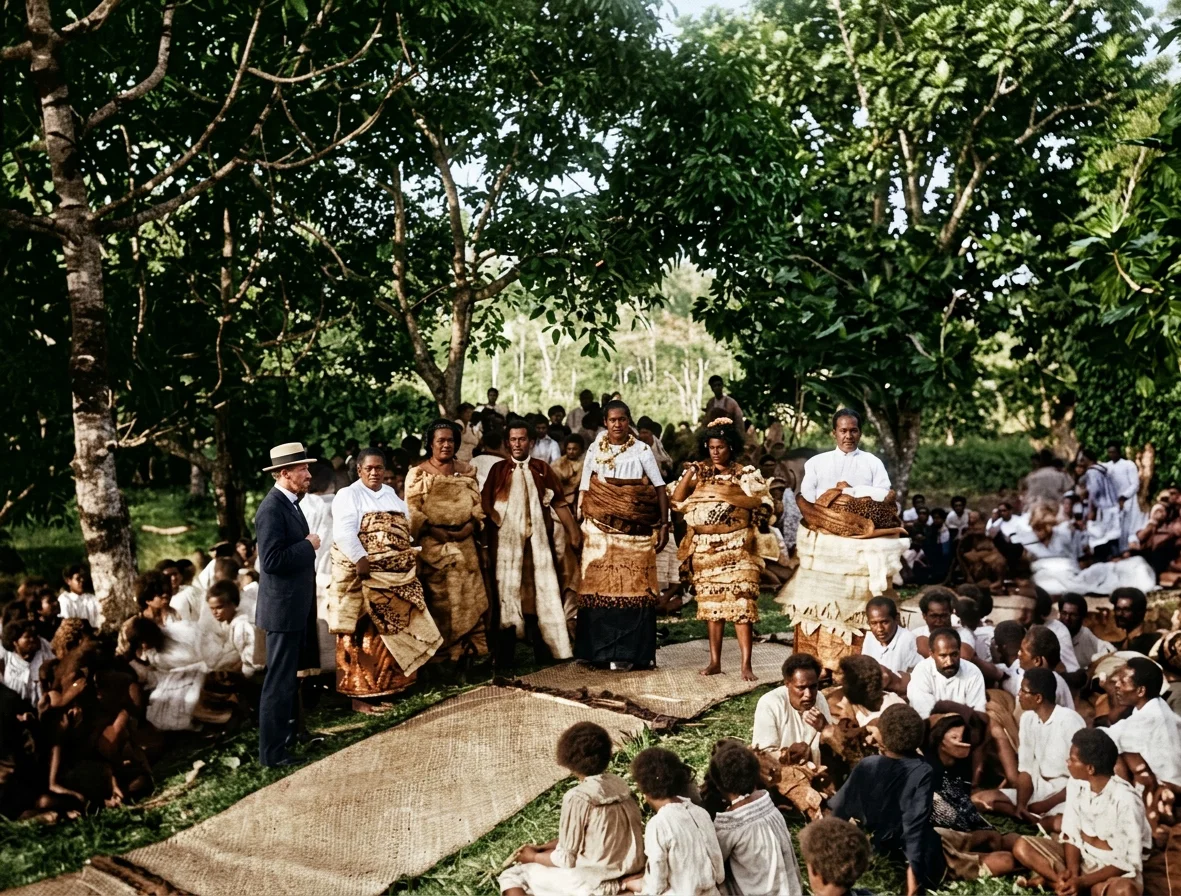
Among the many great royal weddings of modern times not the least by far, if not the most magnificent, was that of Princess Adi-vuikaba, the daughter of Ratu Timcoe, king of Fiji, and granddaughter of the once famous King Cakambou (pronounced Thakambough), who for many years was the great enemy of Christianity during the work of the early missionaries in Fiji.
The marriage took place at Rewa, the largest native town in the Fiji group, and about ten miles distant from Suva, the capital. The bridegroom is Tui Sawau, Roko Tui Rewa. Roko Tui is an official title meaning high sheriff, which is the position next to the king in authority. The actual power of a person possessing that title depends much upon his own ability. If he is a simpleton, all the disagreeable work will be given him to do, and but little of the honor and profits of his office. If he be active and prudent, his power and honor will be equal to the king himself. Tui Sawau was educated in Sydney, Australia, is a fluent speaker in English, and has great influence among his own people.
The bride has very little, if any, knowledge of English; but she is bright and amiable, and has an excellent voice for singing.
Since the beginning of this year the preparations for the wedding have been in progress. As the process for making native cloth is such a slow and tedious one, and such immense quantities were needed for the wedding, it was necessary that the preparations should be thus early begun.
The wedding was to be on Wednesday, July 29, and the invited guests began to arrive the week before, there being representatives present from nearly all parts of the group. The day previous to the wedding five thousand had arrived, which number increased to fully six thousand by the next day. More than fifty native yachts lay at anchor in the river Rewa, upon whose banks the town is built.
The people of Rewa were expected to make provision for the reception of visitors, and in order to do this they constructed a large native house about two hundred feet long, by thirty feet wide, without any partitions. Other smaller houses were used for the same purpose, and they too were filled to overflowing.
As would be supposed, the wants of such a vast multitude would require no small attention; accordingly a monster feast was prepared.10Among the flesh meats provided were some six hundred pigs and three hundred turtles. There were yams and taro innumerable, while all other Fijian delicacies were served in abundance. Yagona, a choice drink of the natives, was served ad lib. It is made from the root of the kava tree, and is prepared in the following manner:—
A group of native young men or young women sit on the ground in a circle, with a large wooden bowl in the center, and a plentiful supply of kava root at hand, which they each chew vigorously until it is reduced to a soft pulp, when they spit it into the bowl. When a sufficient quantity is chewed, they mix it thoroughly with water, and strain out the pulp by passing through it a sieve-like leaf. Some one of the chewers then fills a cup with the beverage and offers it to the visitors. If one does not take a drink, they feel highly insulted, after they have taken the pains to prepare it. The drinking of this yagona produces a peculiar effect upon a person. Unlike alcohol, it affects the legs instead of the head, rendering the limbs useless for a time.
The enormous quantity of food consumed at this feast can scarcely be estimated. To give a slight idea, it may be mentioned that for one evening meal a trench was dug 200 feet long, 2 feet wide and 4 feet deep, and this was filled to the brim with taro (a vegetable that resembles the potato), while along the top were laid, cross-wise, roasted pigs. Most of the people were present four or five days, and meals larger than this were served in the morning and at noon, so the amount of food consumed and wasted must have been immense.
The mekes, or native dances, commenced the day before the wedding. The parties from the various towns performed in turn on the rara, which is a large open space in the center of a native town. Some of the performances were considered very good. The dancing and feasting were continued until morning, when fresh relays arrived.
On the morning of the wedding day the presents began to pour in. There were native mats by the hundreds, and thousands of yards of tappa (a kind of cloth made by the natives from the bark of the malo tree, and painted in different designs with ink). The natives of Vatu Lele presented some 2,000 bunches of bananas, the bunches varying in weight from 20 to 40 pounds. To make their present as imposing as possible they raised a scaffold 60 feet high in the air, which they decorated with gay tappa streamers, and covered it with bananas, making a very pretty show.
During the day, the uncle of the bride, Ratu Epeli, the greatest living chieftain of the Fijians, held a grand reception, at which he presented each visitor with a fan.
As it was impossible for the marriage ceremony to be held in the church (Wesleyan), as so few would be able to witness it, a framework was quickly erected outside and covered over with mats, forming a very pretty edifice. Seats were provided for the European visitors, of whom there were a large number present, while six of them used cameras at pleasure. The rara was crowded by the different tribes, all sitting on the ground. The floor of the structure was covered with mats and some beautiful tappa, while mats were laid on the ground from it to the residences of the bride and bridegroom, respectively.
About 4:30 P.M. Ratu Epeli left his house, followed by the bride and bridegroom, who were accompanied by a retinue of attendants of both sexes, fanning them and making themselves otherwise useful. Ratu Epeli and the bridegroom wore immense sulas of tappa. (A sulu is the native dress, and extends from the waist to the knees.) The sulu of the bride was made of very beautiful mats, very finely woven, over which was worn a silk pinafore. Both parties seemed quite nervous, especially the bride.
The wedding ceremony was conducted by three Wesleyan clergymen, missionaries to Fiji. The students from the Wesleyan school were present, who rendered some excellent singing for the occasion. The ceremony being over, the newly-married couple proceeded to the house of Ratu Epeli. They then returned to the scene of the marriage, and from there they left for their future residence at the other end of the village.
The dancing was then resumed, and continued without abatement until the evening of the next day, when the guests began to take their departure.
The white people were highly pleased to have the privilege of being present on such an important occasion, as it may be years before another wedding of such magnitude occurs.
Does Rom. 7:15-25 apply to the condition of Paul previous to his conversion or after it? O. A. V.
Let the reader include the fourteenth verse: “For we know that the law is spiritual; but I am carnal, sold under sin.” This, it seems to us, ought to settle the question. The whole passage shows that the apostle was describing himself, as a convicted, not a converted, sinner, one who wished to do right, but found no strength in himself. The twenty-fifth verse shows how he was made free from his bonds. It is through such an experience, to a greater or less extent, that every adult passes on his way from the bondage of sin to the service of Christ. The converted man is described in Romans 8.
No. 420. The Zeal of Thine House.
PLEASE explain the seventeenth verse of the second chapter of St. John. O. A. V.
“The zeal of thine house hath eaten me up,” means, to put it in other words, that the zeal and earnestness of Christ for the holiness and honor of God’s house and people was all-absorbing and consuming. The American Revised Version reads: “Zeal for thine house shall eat me up.” It is a quotation from Ps. 69:9.
Our correspondent asks too much for this department. Only the briefest explanation can be here given, and for a long passage like the first ten verses of Hebrews 4 much might be said, and yet the point desired explained not touched upon. In brief, however, we will say that the subject is the rest which Christ gives all believers in him. Those who do God’s works may know God’s rest—rest from sin, and rest in any condition in which he permits us to be, save that of sin. Faith works the works of God, and faith enters into his rest. Unbelief does not know God’s works, hence unbelief will not enter into God’s rest, even as the unbelieving Hebrews did not. The rest which God gives to the soul in Christ is a pledge of the eternal rest of his glorious kingdom. But to know that rest, of which the Sabbath is a pledge, we must know the spiritual rest of soul in Christ Jesus. Man might have entered this rest at the beginning; for it was all completed from the foundation of the world, and of this the Sabbath was a pledge. But Adam would not work God’s works, hence did not enter God’s rest. The Lord has offered the same rest to his people all the way through the world’s history. But they would not believe, and of this unbelief the Hebrews of old are a typical illustration. But God’s rich mercy did not cease to be offered because Israel would not believe. Their unbelief could not make of none effect the promises of God. See Rom. 3:3. And now God calls, “To-day if ye will hear his voice, harden not your hearts.” Those of unbelief have passed away, but the rest remains to the faithful, to those who have ceased from their own works and by faith accepted of God’s works. He who thus labors faithfully to the end in God’s works will know his blessed rest here and enjoy the eternal rest to come. See the first article in Signs of September 10.
SYMPATHY
By Grace Duffield Goodwin
If we should be so quick of heart,
So keen of sight,
That we could feel each shadow's gloom,
Each blossom's blight,
The fairest of earth's blue-gold days
Would turn to night.
If we should grow so swift to feel
Each human pain
That for each aching human heart
Ours ached again,
Life were all weariness, and joy
Grown poor and vain.
Some sounds are lost in silence, though
We reverent hark;
Some sights are shot from anxious eyes
By pitying dark;
The limit of the soul's out-gift
Has finite mark.
—Grace Duffield Goodwin.
MASON AND DIXON'S LINE.
MASON AND DIXON'S LINE is a name given to the southern boundary line of the state of Pennsylvania, which separates it from the states of Maryland and Virginia. It was run, except about twenty-two miles, by Charles Mason and Jeremiah Dixon, two English mathematicians and surveyors, between Nov. 15, 1763, and Dec. 26, 1767. During the exciting debate in Congress in 1820 on the question of excluding slavery from Missouri, the eccentric John Randolph, of Roanoke, made great use of this phrase, which was caught up and re-echoed by every newspaper in the celebrity which it still maintains.—Selected.
The Sabbath-Day Strawberries
A LITTLE girl in Aberdeen brought a basket of strawberries to the minister very early on Monday morning. “Thank you, my little girl,” he said. “They are very beautiful. But I hope you didn’t gather them yesterday, which was the Sabbath day.” “No sir,” replied the child, “I pulled them this morning; but they was growin’ all yesterday.”—Quaint Sayings of Children by the Rev. David Macrae.
In the Top Drawer
A LITTLE four-year-old occupied an upper berth in the sleeping-car. Awakening once in the middle of the night, his mother asked him if he knew where he was. “Tourst I do,” he replied, “I'm in the top drawer.”
ABORIGINES OF JAPAN.
By Henry Hartshorne
BY HENRY HARTSHORNE, M.D., LL.D.
Hokkaido, Japan.
WHEN the Yamato people, as the Japanese once called themselves, came, as Rein expresses it, like Norman vikings, crossing from Asia to invade what is now known as Nippon, or Nihon, Japan, they found, according to tradition, sustained by other evidence, a numerous people in possession,—the Emisi, more barbarous, but less warlike, than their invaders.
Whether these so-called aborigines succeeded a yet inferior race can not now be made certain. Stories abound of pigmies, Koropokoru, pit-dwellers, tiny men, like those seen by Stanley and DuChaillu in parts of Africa. Skeletons of such have not been found, and it is most probable that they belong in the region of folk-lore fancy, like the gnomes, kobolds, sprites, and fairies of many lands. Remains have been discovered by Professor Morse, and others, of implements unlike those in use by Japanese since their history began. But, altho they differ also from those now made and used by the Ainu, such differences may easily have come about with time in the same races, as there is little or no doubt that the mound-builders of North America were of the same blood as the Indian tribes still wandering, until displaced within a century, over the region in which they made constructions such as no Indians now make or have in memory or tradition.
Ainu is the name by which those formerly called Emisi by the Japanese now designate themselves. They are almost entirely confined to the large northern island, Yezzo, recently called the Hokkaido. A few are still left in the Kurile Islands, and possibly some in Saghalien. But when, many years ago, the latter island was ceded to Russia, in exchange for the Kuriles, most of the Ainu there were deported to Yezzo. Like the Acadians, whose unwilling exile is celebrated in Longfellow’s “Evangeline,” they are said to have changed their abiding-place with sadness, and their chief took his life soon after reaching Japan.
Hunting and fishing have always been the occupations of the Ainu. A few families in the Hokkaido have lately taken to farming, under the inducement of a “land in severalty” arrangement of the Japanese Government, offering to each family twelve and a half acres of land for settlement without cost to them. They are brave hunters, especially of the bears, which are still found, and once abounded in their country. Bears’ cubs are often caught and reared by them, to be killed, after a time, with ceremony and festivity, a sort of sacredness as well as food value attaching to them.
The Ainu are certainly an entirely different race from the Japanese. They are the most hairy people in the world. The Japanese have, like them, long, straight, dark hair on their heads, but are mostly beardless, and have very little hair on their breasts or limbs. The Ainu have very thick and abundant beard all over their faces, hairy breasts, arms and legs, and sometimes hair upon their backs. Ainu eyes are large and straight, their eyebrows low, straight, and bushy. Their figure is but little taller than that of the Japanese, but they are stronger and more broad-shouldered. The men are often handsome. Miss Bird (now Mrs. Bishop) says that one whom she met had the most beautiful face she had ever seen. Their women might, perhaps, be handsome, if they did not tattoo their upper lips and foreheads in the most unbecoming fashion.
Dirt is conspicuous about the houses and persons of the Ainu; cleanliness is a universal national or race trait with the Japanese. Batchelor says that the Ainu are not naturally stupid, but their subjugated condition has made them abject. They have been left in ignorance, until lately an “Ainu Improvement Society” has been started in Sapporo, the capital of the Hokkaido. Saké, Japanese beer or wine, has been the cause of their almost final ruin. Both the government and the better class of people in Japan, under Christian influence, are now, like our American people, after our “century of dishonor” towards the Indians, beginning to try to do something to humanize the long-trampled Ainu.
No doubt needs to exist that these, the oldest known inhabitants of Japan, now numbering less than twenty thousand in all, are of far northern extraction, akin to the Kamtschatkans, the Siberians, Eskimos, and Alaskans. Their own traditions point towards the north for their emigration. Their religion (very vague, but without idolatry) makes the place of punishment after death to be a very cold region. Their kindest wish for a parting friend is, “May you be kept warm.”
Thus, by exclusion, we are left to seek for the probable origin of the Japanese race farther south. Certainly they are not Chinese or Koreans, altho the latter approach them in some particulars. Intermixture with them may have taken place to some extent when, after the conquest of Korea by the Japanese empress Jingu Kogo, early in the third century A.D., a number of its inhabitants were transported to Japan. Much intermixture with either the Chinese or the Ainu is not made probable by any proven facts. It is just possible that its exceptional occurrence may account for what authors speak of as a diversity of types in the Japanese population. For example, a more than usually marked obliquity of the eyes is said to exist among members of some of the older families of the nobility, and may point towards an ancestral Chinese strain of descent. The depressed, thick nose and large mouth, with straight brows and eyes, of the Eta class, may indicate a mingling, long ago, of the Yamato conquerors with the subjected Ainu race.
We have still left for consideration material for conjectures, with a measure of probability in their favor, concerning the actual origin and affinities of the Japanese, remarkable as have become their peculiarities in the course of many centuries of insular and for a long time secluded life.—S. S. Times.
NEED OF THE GOSPEL IN SPAIN.
Does the “word of the Lord have free course” in Spain of to-day? A few facts taken from a multitude that might be cited will give us the answer to that question.
The archbishop of the see of Santiago de Compostela, the capital of Galicia, one of the most important dioceses of all Spain, on one occasion promised to give to a Protestant of that parish a Roman Catholic Bible in exchange for his Protestant Bible; but after spending a long time in looking for one, he had to confess that he could not find one in the episcopal palace—that he would “have to send for it to Barcelona,” all across the peninsula!
In the city of Zaragoza, on one occasion, one of the canons of the cathedral of La Virgen del Pilar, now and for many years one of the most popular shrines in Spain, took upon himself the mission of winning back to the Church of Rome a class of bright young men, members of our Evangelical Church. All testified to his trained skill as a controversialist, and to his gentle ways and winning manners both in conversation and in debate. Once and again some of these young men—after he had met them in their own hall—accepted the invitation to visit him in his private apartments, where they still further discussed, among others, the questions of justification by faith, Christ as our only mediator, and prayer—our young men ever appealing to the Bibles that they carried in their pockets. This rather piqued our good canon, and it forced him, much against his will, to refer to his Bible, which they insisted he should do. And here was his weak point. He knew that he did not know even his own Roman Catholic Bible. Once he confusedly sought a familiar New Testament passage in the Old Testament, among the books of which he floundered painfully until the Protestant boys came to his rescue. That was the end of his mission. But not long after this episode he was elevated to a bishopric, and it was no secret that it was in reward for his active efforts to reclaim the Protestants that infest that district.
If the bishops show such ignorance of the word of God, it is not to be wondered at that the parish or village priest should be found at a still lower level. A missionary was talking with one of these when the question of the worship of images came up. Allusion was made to the second commandment; and when he quoted the words, “Thou shalt not make unto thee any graven image, or any likeness of anything that is in the heaven above, or that is in the earth beneath, or that is in the water under the earth; thou shalt not bow down thyself to them, . . .” the12honest priest, instead of arguing, as an astuter man would have done, that Roman Catholics do not worship images, nor bow down to them, but only to the being or the spirit that they represent or that they suggest, he frankly admitted that they do worship them, and that their worship was permitted if not taught by the church; and he declared that he could not believe that the words quoted by my friend were to be found in the Bible, and much less in the Roman Catholic Bible. So a copy of the Bible sanctioned by his church was produced. He read and reread the fatal words, and could hardly believe his own eyes. At last, with hands clenched and teeth set, he turned on his heel, and with intensest feeling, exclaimed: “God made a mistake when he put that in the Bible!” Poor man! he could not believe that his church could be guilty of deliberately suppressing that part of the Decalogue from its liturgies and from its catechisms; he could more easily believe that God had blundered! “And if the blind lead the blind, both shall fall into the ditch.”—Missionary Review of the World.
UNDER THE DAISIES.
It is strange what a deal of trouble we take,
What a sacrifice most of us willingly make,
How the lips will smile tho the heart may ache,
And we bend to the ways of the world for the sake
Of its poor and scanty praises.
And time runs on with such pitiless flow
That our lives are wasted before we know
What work to finish before we go
To our long rest under the daisies.
And too often we fall in a useless fight,
For wrong is so much in the place of right,
And the end is so far beyond our sight,
'Tis as when one starts on a chase by night,
An unknown shade pursuing.
Even so do we see, when our race is run,
That of all we have striven for little is won,
And of all the work our strength has done,
How little was worth the doing!
So most of us travel with very poor speed,
Failing in thought where we conquer in deed,
Least brave in the hour of greatest need,
And making a riddle that few may read
Of our life's intricate mazes.
Such a labyrinth of right and wrong,
Is it strange that a heart once brave and strong
Should falter at last, and most earnestly long
For a calm sleep under the daisies?
But if one poor troubled heart can say,
"His kindness softened my life's rough way,"
And the tears fall over the lifeless clay,
We shall stand up in heaven in brighter array
Than if all earth rang with our praises.
For the good we have done shall never fade,
Tho the work be wrought and wages paid,
And the wearied frame of the laborer laid
All peacefully under the daisies.