"Come, Eddie, go get some wood. The box is empty," said his mother one day.
"O dear!" said Eddie, who was playing with his top, "I have to work all the while, and you just sit in the chair and take it easy."
"That isn't a very pretty way for boys to talk to mothers," she quietly replied.
"I don't care; it's the truth," he persisted.
His mother concluded to fight it out on that line with such weapons as the boy could appreciate, so she said, "Who gets Eddie's dinner?"
"That's nothing, after I've brought in the wood and kindlings, and everything is in the pantry ready to cook," was the reply.
"Then it won't be anything if my little boy starts the fire for me while I am mending his jacket—everything is so handy."
"Now, mother, I'd rather wear my jacket without mending."
"But, Eddie, I cannot allow that; it is my place to keep your clothes looking as well as possible. You cannot mend, but you can build a fire."
"Oh, dear! I know I can't make it burn, and I hope it won't. It is too bad to make a little boy like me build a fire!" And he whined, and slammed, and scolded, but the fire burned.
"Now, Eddie," said his mother, "I shall find more things for you to do till you can do what I tell you to cheerfully. You may fill the tea-kettle next."
"It will spill over on the stove and floor—there, I told you so!"
"It will soon dry on the stove, and you can get a cloth and wipe it from the floor, then try again."
"There's nothing else you can make me do anyway!" said Eddie at last.
"You can wash the potatoes," replied the mother, knowing well that her work would grow harder for everything of the kind that the boy would do, but feeling that he needed the discipline.
"Now, mother!" he began; but, bethinking himself of his mother's unfailing resources, he hesitated, rolled up his sleeves, and did the best he could; then he offered to set the table for dinner, and finally received his furlough, to the great relief of his mother as well as himself.
I cannot say that Eddie was always cheerful after this, when required to leave his play for some light task; but the plan of having him do something more, whenever he grumbled at being called upon, worked well in his case, and finally broke up the foolish habit.
Two years later, we find him telling his mother that the "Smith boys don't amount to anything, anyway. Now there's Harry—his mother tells him she wants a pail of water, and he says, 'Let Joe get it.' Joe says, 'I don't want to. You told Harry.' So she waits awhile, and then gets it herself. I've seen her go after wood, too, and split it, and the boys loafing around. I'm glad you didn't bring me up so."
Eddie isn't quite "brought up" yet, but he has had a good start.—A. L. H., in the Boston Watchman.
A WONDERFUL DISCOVERY.
By W. E. L.
LONG, long while ago, over four thousand years ago, there lived on the other side of the world a woman whom I am sure we should remember gratefully. I do not suppose she was very handsome, with her straight, black hair, and little almond-shaped eyes. Her name was as odd as she was herself, for she was called Se-ling-chi. Now you will know she was a Chinese woman.
Her husband's name was Shin-nung. But I suppose he could get along very well with his name, since he was emperor and could rule over such a vast country, and be called the “father of the people.” He was truly a father to his subjects, and tried to make the country better.
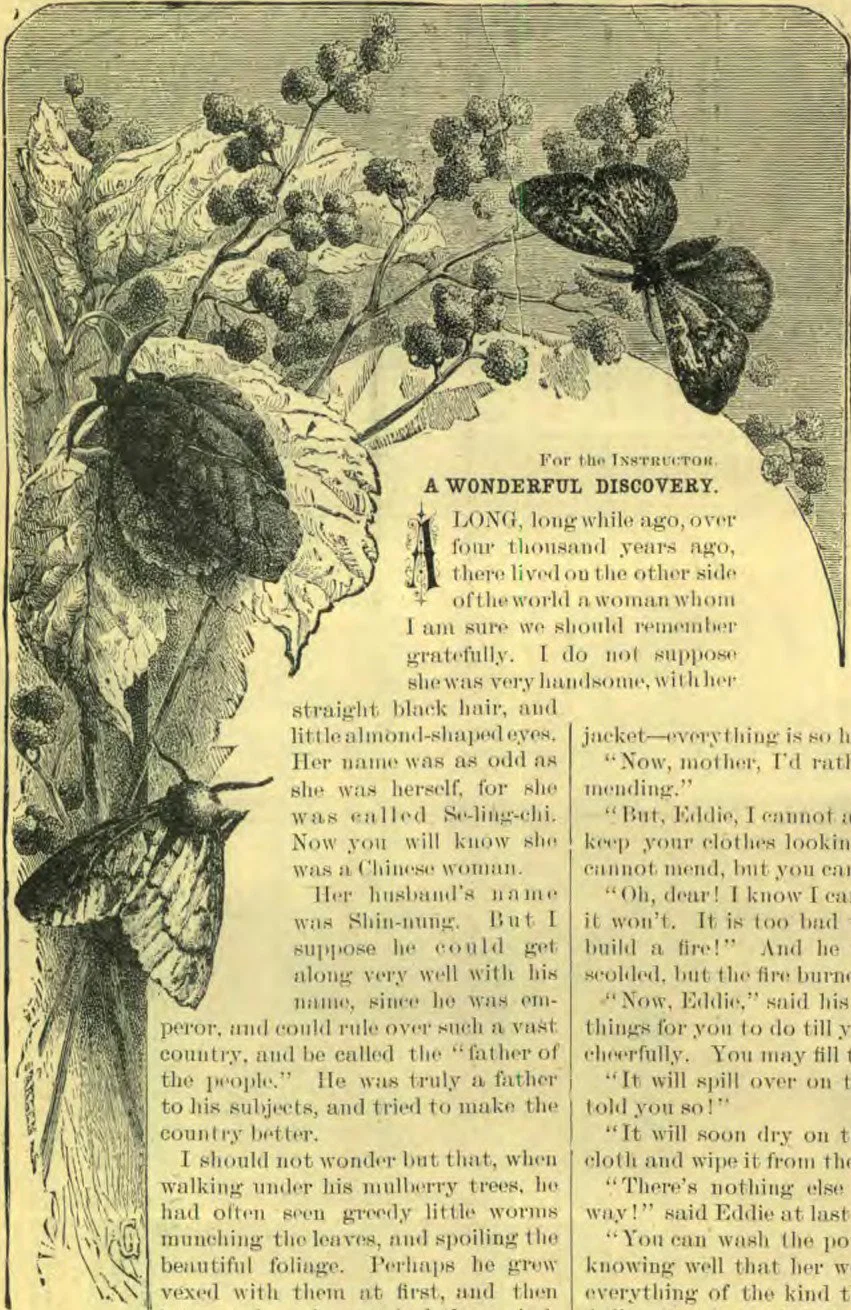
I should not wonder but that, when walking under his mulberry trees, he had often seen greedy little worms munching the leaves, and spoiling the beautiful foliage. Perhaps he grew vexed with them at first, and then interested, as he watched them winding themselves up into little oblong rolls of rich, creamy threads, oh, so soft and fine!
“Ah! I must speak to my dear Se-ling-chi about these wonderful threads,” he no doubt thought. “The women are really wonderfully handy about some things, and perhaps she will know of a use to which these threads can be put.” So Se-ling-chi was shown the worms.
Then she caused her maids and the princesses to gather large quantities of the worms, and carry them to a place made on purpose for them, where she fed them every day with fresh mulberry leaves, and watched them so carefully, from the time when they hatched out of the tiny eggs till they turned to butterflies.
The little worms were very greedy, and munched and munched so many leaves, that at last they grew too fat to eat any more. Then they began to move about; they had been too hungry to think of that before. Se-ling-chi saw them, after they had found a convenient corner, throw off threads of silk, and fastening themselves securely, begin to wind the delicate threads around their body until they were completely hidden.
Now Se-ling-chi set her wits to work to learn how to unravel this long thread of silk. It would be interesting to know how many times she failed—for I have no doubt it was more than once—and just what way she found successful at last; but that, I suppose, we will never find out. That she did succeed at last, we know, not only finding a way to wind off the silk, but weaving the most beautiful fabrics.
Shin-nung guarded his secret well, and so did the emperors who ruled after he died; so that it was many, many years before any one outside of the Empire found out how to make silk, or could get the worms that spun such fine threads. But at last two cunning priests succeeded in carrying away a few silk worm's eggs in a hollow cane, and then the Chinese secret was a secret no longer. And that is how it came about that everywhere silk is made. But nobody, not even the Chinese, can now make such beautiful silks as came from the royal hands of Se-ling-chi. W. E. L.
GOLDEN KEYS.
A BUNCH of golden keys is mine
To make each day with gladness shine.
“Good morning!” that’s the golden key
That unlocks every day for me.
When evening comes, “Good-night!” I say,
And close the door of each glad day.
When at the table, “If you please”
I take from off my bunch of keys.
When friends give anything to me,
I’ll use the little “Thank you!” key.
“Excuse me,” “I beg your pardon,” too,
When by mistake some harm I do.
Or if unkindly harm I’ve given,
With the “Forgive me” key I’ll be forgiven.
On a golden ring these keys I’ll bind,
This is its motto: “Be ye kind.”
I’ll often use each golden key,
And then a polite child I’ll be.
—Selected.
Letter Budget.
Alice Harrington sends a letter from Sussex Co., Del. She writes: “I like the letters in the Budget so much that I thought I would write one. My brother and I are keeping the Sabbath. Our parents, as yet, have not embraced the truth, but we are hoping for them. We were baptized by Eld. Victor Thompson last April, and are now in the canvassing work. I took twenty-five orders the first week for ‘Sunshine at Home.’ I am making excellent deliveries. Not one person has failed. We are living in Mr. Babcock’s family. I am trying to keep all the commandments so that I may be found among the faithful ones when Jesus comes.”
Wesley Bristow, aged thirteen years, writes a letter from Macon Co., Mo. He says: “I have a little brother and two little sisters younger than myself. I attend Sabbath-school with my parents, and study in Book No. 3. I can repeat the second book as a story. I go to day school, and have a good teacher. She opens her school with prayer, after reading a chapter in the Bible. I have been going to writing school. I love to read the INSTRUCTOR, and what the little folks write for it. I hope to meet them all in the new earth.”
Nettie Warren, of Cowlitz Co., W. T., is a little girl ten years old. She writes: “I have been keeping the Sabbath with my parents all my life. All of our family have been baptized but one brother and myself. I want to be baptized at the next camp-meeting. We have a Sabbath-school with twenty-seven members. Mamma gave me four hens for missionary purposes. I put fifty cents into the foreign mission fund, and hope it may do good. I love to do this kind of work.”
Horace S. Fenton, of Lenawee Co., Mich., writes: “I go to school every day, and, until two weeks ago, never missed a day in my life. It was because I had the diphtheria that I could not go. I am better now. I enjoy reading the Budget very much. At Sabbath-school I am just going to begin Book No. 2. We have no church building; the meetings are mostly held at our house. My pa takes the Gospel Sickle for me this year. I am trying to be a good boy.”
We have three letters from Multnomah Co., Oregon, written by Lizzie Sorenson, Luella Reed, and Edith Brooks. Lillie is thirteen years old, the others are each twelve years of age. They attend their denominational school at that place, and like their teacher. Lizzie and Luella study Book No. 4, and Edith, Book No. 5. Luella says: “My papa is away most of the time, working in the cause. Mamma was away with the tent last summer.”
We have a letter from a little girl in Wapello Co., Iowa. She writes: “My name is Bessie Jones. I am twelve years old. I live four miles from Sabbath-school, but I go when the walking is good. My mother teaches me to keep the commandments, but my father has but little regard for the Sabbath. I read the INSTRUCTOR, and find many valuable lessons in it. I send my love to the INSTRUCTOR family.”
Emerson Lewis writes from Clinton Co., Mich. He says: “I am twelve years old. I am staying at my uncle’s at present. I attend day school, and keep the Sabbath. I learn my lessons in the INSTRUCTOR. I think the lessons about the angels are very nice. I hope I shall be one of the happy ones who will see the angels in the kingdom.”
Minnie B. and Carrie E. Martin write from Harlan Co., Neb. Minnie is twelve years old. She says: “I have two sisters and one brother. My little brother, four years old, and my little baby sister were very sick, but we treated them as directed in Dr. Kellogg’s ‘Home Hand Book,’ and now they are getting better.”
Carrie is eleven years old. She writes: “I keep the Sabbath with my parents. We have no Sabbath-school. I go to day school. My cousin visits us every summer. We have two horses, a colt, and eight head of cattle. I have a hen named Bird, and we have a puppy named Curley.”