The death of Saul did not occur on the morrow after his visit to the woman of Endor. Notice first, the phrase “to-morrow” signifies the day following the night during which it is spoken. See 1 Sam. 19:10, 11: “And Saul sought to smite David even to the wall with a javelin; but he slipped away out of Saul’s presence, and he smote the javelin into the wall; and David fled and escaped that night. Saul also sent messengers unto David’s house, to watch him, and to slay him in the morning: and Michal, David’s wife, told him, saying, If thou save not thy life to-night, to-morrow thou shalt be slain.” And Acts 23:31, 32: “Then the soldiers, as it was commanded them, took Paul, and brought him by night to Antipatris. On the morrow they left the horsemen to go with him, and returned to the castle.” Also Acts 20:7–11: “And upon the first day of the week, when the disciples came together to break bread, Paul preached unto them, ready to depart on the morrow; and continued his speech until midnight.” Then Eutychus fell out of the window and was killed, and Paul brought him to life again, etc. “When he therefore was come up again, and had broken bread, and eaten, and talked a long while, even till break of day, so he departed.” This text says that he preached till midnight, ready to depart on the morrow, and that he departed at break of day.
So it is plain from these scriptures that the term “to-morrow” means the day, or light part of the time following the night, or dark part, and that it begins in the morning, or even at “break of day.” Therefore, when the spirit told Saul, through the woman, “to-morrow thou and thy sons shall be with me,” that is, that they should be dead, he meant by the word “to-morrow” the daylight division of time following that night.
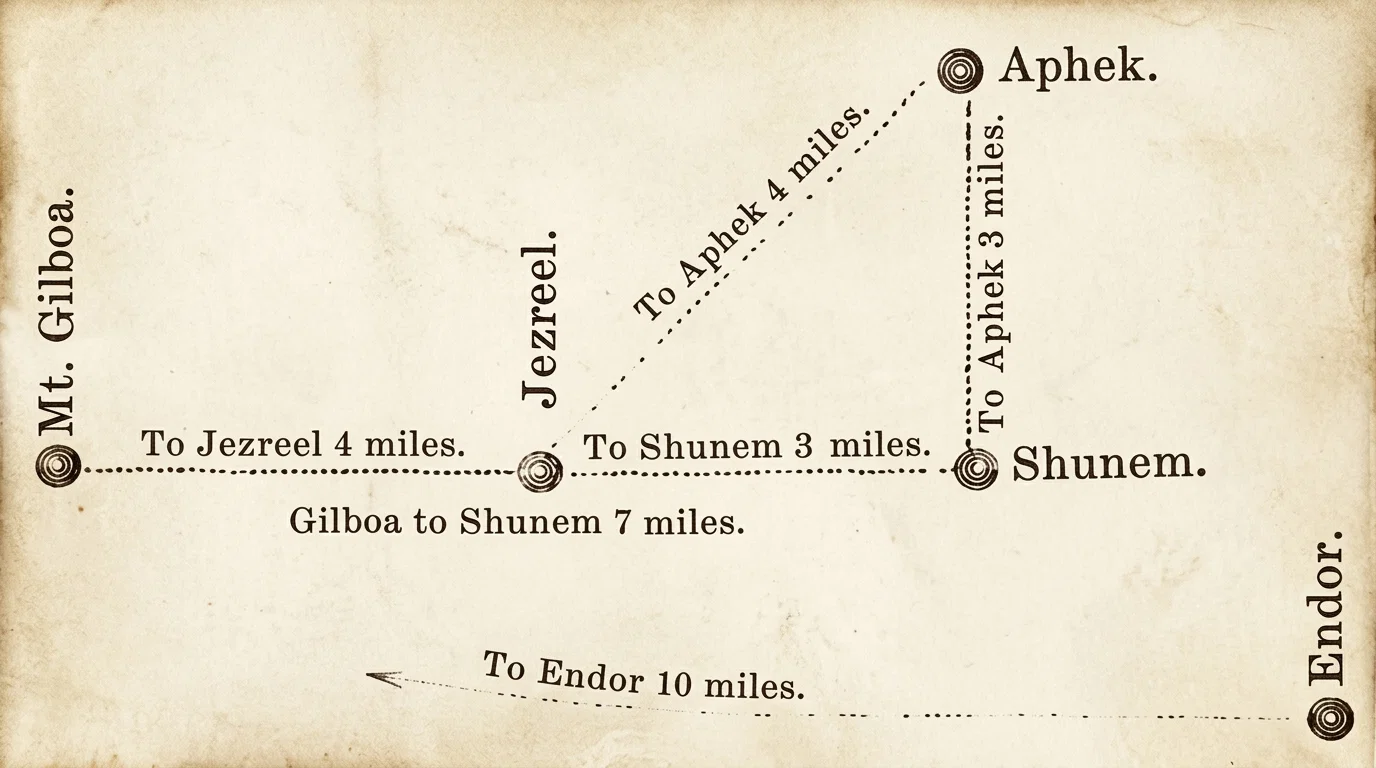
In the second place, we want to understand the position of the two armies at that time, and their movements afterward; and to assist the reader in understanding this, I give a plan here of the places named, their relative positions and distances. There are five places named in the narrative; viz., Shunem, Gilboa, Endor, Aphek, and Jezreel; and they lay as indicated in this diagram.
Now, 1 Sam. 28:4 says: “And the Philistines gathered themselves together, and came and pitched in Shunem; and Saul gathered all Israel together, and they pitched in Gilboa.” Thus the first day Israel is in Gilboa and the Philistines in Shunem, seven miles apart. That night Saul went to Endor, ten miles, and inquired of the spirit; the spirit told him that he and his sons should be with him “to-morrow.” Verse 19. Then Saul and his servants “rose up, and went away that night” (verse 25), back to Gilboa, making in all twenty miles that Saul traveled that night.
Second day (the to-morrow of verse 19). Chap. 29:1: “Now the Philistines gathered together all their armies to Aphek [three miles from Shunem]; and the Israelites pitched by a fountain which is in Jezreel” (four miles from Gilboa). Now they are about four miles apart, for Aphek is about that distance from Jezreel. But while the Philistines were moving from Shunem to Aphek, passing “on by hundreds, and by thousands,” their princes saw David and his men in the rearward with Achish, and objected to their going to the battle with them. Chap. 29:2–5. Then Achish ordered David and his men to return to their homes; but it was too late in the day for them to start that day, so Achish said to David: “Now rise up early in the morning with thy master’s servants that are come with thee; and as soon as ye be up early in the morning, and have light, depart.” Verse 11.
Now the second day, the to-morrow of the spirit, is past, the battle has not yet been fought, and cannot be; for the two armies are four miles apart, and Saul and his sons are yet alive upon the earth.
Third day. Verse 11: “So David and his men rose up early to depart in the morning, to return into the land of the Philistines. And the Philistines went up to Jezreel.”
At Jezreel was where Saul and the Israelites were, and there was where the battle was fought, and the Israelites “fled from before the Philistines, and fell down slain in Mount Gilboa.” Chap. 31:1. And it was not on the morrow after Saul inquired of the familiar spirit, as the spirit said it would be, so the “thing did not follow, nor come to pass,” as it had said. Therefore the Lord did not speak by that spirit, and we are not afraid of him. Deut. 18:22.
If you want to see a prophecy spoken by the Spirit of the Lord concerning “to-morrow,” and fulfilled to the very letter, read 2 Kings 7.
So we find that on that point, as well as on every other, the Scripture proves to an absolute certainty that it was an evil, lying spirit, even one of the “spirits of devils,” (Rev. 16:14), that appeared to the woman of Endor and communicated with Saul.
ALONZO T. JONES.
Our Basket.
“A little balm, and a little honey, spices, and myrrh, nuts and almonds.” Gen. 43:11.
—God’s mills grind slow but sure.
—God is always opening his hands to us.
—CHEER up, man; God is still where he was.
—God is at the end, when we think he is farthest off.
—THEN does the good man lay himself down to sleep with sweet composure in the midst of waves and storms, when he has lulled all the cares and sorrows of his heart to sleep, by pouring out his prayer to God.
—Many afflictions will not cloud and obstruct the peace of mind so much as one sin; therefore, if ye would wait cheerfully, be more careful to walk holily. All the winds about the earth make no earthquake, but only that within.
—THE man who, whether in his habits or his actions, in great things or in small, separates himself from his friends, seems to set every evil and envious feeling of our nature in array against him. Distinction is purchased at the expense of sympathy.
—A pious cottager residing in the midst of a long and dreary heath, being asked by a visitor, “Are you not sometimes afraid in your lonely situation, especially in the winter?” replied: “Oh, no; for Faith shuts the door at night, and Mercy opens it in the morning.”
SUFFERING AND JOY.
“For I reckon that the sufferings of this present time are not worthy to be compared with the glory which shall be revealed in us.” Rom. 8:18.
What though we suffer while we stay,
’Tis but the anguish of a day;
At most, our life is but a span;
A “hand’s-breadth are the days of man.”
What if those days we “sow in tears,”
And our hearts heave with rocking fears,
Despairing thought and cank’ring care
Their impress on our spirit bear;
We’ll hope, and faint not in the race,
But pray for all-sufficing grace
To help us trust, from hour to hour,
The Saviour’s love and watchful-power.
Ere long, our earth-life being done,
The battle fought, the victory won,
With joy we’ll lay our armor down,
And at his feet receive the crown.
UPWARD
By Eliza H. Morton
Every true life seeks higher levels. The lowest forms of animal existence mount upward, and man, the noblest specimen of God's workmanship, has heavenly aspirations implanted in his soul. The Christian life should be progressive. The careless worldling may dream and doubt and throw his life away chasing shadows, but the child of God should not suffer his barque to “lie becalmed on the sea of life.” Pull up the stream, O mariner! Pull with all your God-given powers!
The past, however dark, is gone forever. It is useless to sigh over lost opportunities; for with the sigh other opportunities slip away, and the great loss becomes greater. The blood of Christ applied to the heart will wash sin-black stains into oblivion. The love of God shed abroad in the soul will dispel the shadow and the cloud. Fellow-mortal, the ladder of light is planted at your feet. Its top-most round rests on the threshold of a sun-bright home, a home called Beauty-land, a city called the Golden.
Pilgrim in a stranger land, angels beckon you upward. The gates of the city cry, “Onward.” The King himself says, “Come.” Every round in that shining ladder is a glorious truth. Plant your feet firmly, and keep your eye fixed on the sky-blue dome above.
The trees of autumn shake down their leaves and toss their bare branches, while earthly homes are made desolate by chilly winds wafted from tombs.
Where we are going, the flowers never fade, and the home-circle is never broken. Up yonder is durability, the source and spring of all joy.
The little trials of life, if borne patiently, will prove strong levers pushing us upward. Faithful labor with voice or pen, if consecrated to God, will propel us onward. It is growth we want! It is progress we need! Oh, for a deeper heart-work! Oh, for a closer soul-communion with God! Fearless workmen are wanted in this needy age. Strong hands and loving hearts are called for in these last moments of time.
The soft splendor of a brighter day will soon shed its radiance o’er the earth, and the thinker and the thought, the doer and the deed, the dreamer and the dream, will be brought face to face. The far-off joy will draw divinely near, and the height be reached from which all glory radiates and all beauty shines. Let us press upward, ever upward, until all purity becomes ours forever.
ELIZA H. MORTON.
PRO AND CON.
By R. A. Underwood
The following extracts from an essay on the ten commandments, written by Pardee Butler, and published by the Christian Standard of Nov. 15, 1879, I present in contrast with the words of the Lord. He says:—
“The capital objection to the ten commandments is, that they were written in the wrong place. They were written on stone—cold, hard, and insensible stone—instead of having been written on the hearts of the Jewish people.”
“Shall not the Judge of all the earth do right?” Gen. 18:25. “Far be it from God that he should do wickedness, . . . Will thou condemn him that is most just? Is it fit to say to a king, Thou art wicked? . . . How much less to Him that accepteth not the persons of princes, nor regardeth the rich more than the poor? for they all are the work of his hands.” Job 34:10, 17–19.
“Growing out of the men on whom the Jewish laws were imposed, its exactions must, of necessity, have been narrow and mean.”
“Thy commandment is exceeding broad.” “Open thou mine eyes, that I may behold wondrous things out of thy law.” “Thou through thy commandments hast made me wiser than mine enemies.” Ps. 119:96, 18, 98.
“To have given them a law more ample and complete, would have been to cast pearls before swine. Hence the ten commandments do not forbid slavery, divorce, or polygamy. They enjoin neither love to one's neighbor, nor forgiveness of enemies. They contain no injunction as touching deeds of mercy and humanity.”
“The vile person will speak villainy, and his heart will work iniquity, to practice hypocrisy, and to utter error against the Lord.” Isa. 32:6. “I know that whatsoever God doeth, it shall be forever; nothing can be put to it, nor anything taken from it; and God doeth it, that men should fear before him.” Eccl. 3:14. “The law of the Lord is perfect.” Ps. 19:7; read also James 2:12; Matt. 22:36–40.
“There were, in the observance of the Sabbath, as commanded by the law, no prayers, no devout meditation, no assembling of the people together to worship God and read his law. And now Second Adventists mock themselves, and try to mock other men, by stealing the prayers, preaching, praises, devotional songs, the fellowship and the breaking of bread, that constitute the worship of the Christian institution, and seek to make them a part of the observance of the Sabbath as commanded by the law.”
“Six days shall work be done: but the seventh day is the Sabbath of rest, an holy convocation.” Lev. 23:3. “Paul, as his manner was, went in unto them, and three Sabbath days reasoned with them out of the Scriptures.” He “reasoned in the synagogue every Sabbath, and persuaded the Jews and the Greeks.” Acts 17:2; 18:4; also Mal. 3:16, 17.
Again he says: “If we are amazed at the madness and blindness of Second Adventists in going back to the weak and beggarly elements of such a law, how much more amazed must we be at the greater madness of the denominations that call themselves evangelical, who make the Christian institution and the Jewish institution identical; who make the membership of the one identical with the membership of the other; and who sprinkle water on the face of a babe in the name of the Lord, though it has neither faith nor a single spiritual idea? Shall we wonder that Adventism flourishes in such soil?” In the same essay, trying to defend the Sunday institution, he says: “Grant that our observance of the first day of the week is purely voluntary, this is in exact harmony with the genius of the Christian religion.”
If this be true, why condemn those who voluntarily (without command) sprinkle water upon the unconscious child; for “it is in exact harmony with the genius of the Christian religion.” Such reasoning reminds one of the following stanza:—
“A man who thought himself quite wise,
Climbed up a tree toward the skies,
And as he meant the tree to trim,
Just placed himself upon a limb,
And trimmed away with progress good,
But cut the limb on which he stood;
When to his great surprise he found
Himself soon sprawling on the ground.”
R. A. UNDERWOOD.
A DAY’S RECORD.
[The following lines, although somewhat old, may be read with profit by many who are on the road to the great city. J. R. CALKINS.]
The latest gleam of purple light
Upon the hills has died away,
And with the fading glow has gone
The record of a day.
How often through this day has He
Whose pen records good actions done,
Borne tidings of some pious deed
Up to the great white throne.
And in that other book just closed
As daylight darkens into gloom,
What countless sins are written down
To wait the day of doom!
What misspent time, what idle words,
What want of charity is there!
How oft the heart has wandered while
The lips breathed words of prayer!
The firm resolve so soon forgot,
The broken vow recalled with shame,
Just when we thought ourselves most strong,
Temptation overcame.
How careless words have grieved the heart
We would have died to shield from pain,
How sins that easily beset
Have triumphed once again.
Oh! who unfalteringly may read
The fearful record of a day,
Where no repenting tears have washed
A single line away?
—Selected.
THE GOLDEN RULE ON PETS.
SPEAKING of the almost universal tendency of men in the direction of pets, the Golden Rule observes that the class of pets which are the most dangerous to the church are pet virtues. Men have some particular gift of grace which by nature it is easy for them to exercise, and they make the most of that virtue. It is very easy for one man to be patient, and he throws all the power of his religion into patience, while perhaps the thing he most needs is benevolence, or activity, or faith. Another man is by nature generous, and he turns all the power of his grace in the direction of his pet virtue, neglecting prudence and patience.
Now, the value of grace is not in that it makes us strong on the side of our natural virtues, but that it makes us balanced on the side of our natural defects. The value of our religion is not seen in that it makes our sweetness sweeter, but that it turns our sourness into sweetness; not that it makes an honest man more honest, but that it makes a dishonest man honest; not that it makes a temperate man abstemious, but that it makes an intemperate man temperate; not that it makes a pure man clean, but that it makes an impure man pure; not that it makes a generous man liberal, but a selfish man generous; not that it makes a kind man gentle, but that it makes an unkind man amiable; not so much that it helps us be what we are, as that it helps us to become what we are not; so that men, looking at us, will say we are other and better men than we used to be. He used to be intemperate, now he is temperate; or he used to be selfish, now he is generous; fault-finding, and now he is charitable; obstinate, and now he is gentle; irritable, and now he is patient; desponding, and now he is hopeful; inactive and now he is earnest. The new birth does not consist in mounting your pet virtue as a hobby.—Sunday Herald.
THE POWER OF THE PRESS.
By James White
The men of this world understand the great power of the printing-press. The politician seizes this lever to lift himself into office. Political campaigns are run principally through the press. Advertisements of this, that, and the other, posted and scattered everywhere, are evidences that the man of business understands the influence of the press.
This is a reading age. Active minds must be employed. The people will read. The masses prefer fiction to fact. The writers, publishers, and sellers of fictitious works fully comprehend the situation, and for gain flood the world with light literature. Thus the devil seizes the press to turn the minds of the people from the real facts and duties of this life, and a preparation for the life to come. The minds of the young are fevered with fiction to that degree that they lose relish for solid reading. They are so completely filled with trash that there is but little room in their minds and hearts for that which is substantial and real.
“Ye are the light of the world,” said Christ in his memorable sermon on the mount. “A city that is set on an hill cannot be hid. Neither do men light a candle, and put it under a bushel, but on a candlestick; and it giveth light unto all that are in the house. Let your light so shine before men, that they may see your good works, and glorify your Father which is in Heaven.” Matt. 5: 14–16.
Christians should be as wise in their generation as the men of this world. They should seize upon every means, and every opportunity, to let their light shine. They should let it shine from the hill-top. The press, which in the hands of the children of darkness is a power for evil, may, in the hands of the children of light, be a mighty power for good. All our preachers in the lecturing field should not only act as pastors in visiting and praying with the people, but as colporters to circulate our publications wherever they go. The reasons why, follow.
1. It has been said upon good authority that our ministers add nine-tenths to their usefulness in the active circulation of our publications in connection with their public labors as speakers, and experience proves it. Time is short, and is very precious to the true servant of Jesus Christ, in whose heart the love of souls has been planted by the Holy Spirit. He keenly feels the importance of laboring to the best advantage, and if he is wise, he will seize upon the plan by which one man can do the work of ten.
2. The changes of his three-fold work, as preacher, pastor, and colporter, will be conducive to physical and spiritual health. This course will equalize the labor and wear, and strengthen the physical, mental, and spiritual. It will give the preacher time for reading and that study necessary for the preparation of his subjects, and will also give him opportunities for physical exercise, and the cultivation of those qualifications for pastoral labors which are as important for his success as are his labors in the speaker’s stand. While thus laboring in public and from house to house, his opportunities for circulating our publications will be neither few nor small.
3. Some of our preachers are rusting from inaction, and can never rise from second or third rate preachers and become men of usefulness unless they adopt more active habits of life. There is no better exercise than walking from house to house, with a light satchel well filled with publications. Exercise increases the circulation of the blood and stimulates thought. Coming in contact with different minds under these circumstances conduces to mental growth.
4. Others of our preachers of more studious habits read many volumes hastily, think, reason, and write carelessly and loosely, under the mistaken idea that they are accomplishing much for the Lord. These are making great mistakes. In their haste to cover so much literary ground, they cannot find time to act the pastor in visiting the people, and to cultivate those social qualities so necessary for a minister and true laborer in the Lord’s vineyard. Neither can they find time to act the colporter, and thus add nine-tenths to their usefulness. And besides these evils, they read more than they can properly digest and incorporate into their labors and work. They become literary dyspeptics. Men of this stamp are wearing out too fast in accomplishing but little real good.
As writers, their productions are wordy and lean, and their reasoning loose, to the annoyance of the editor and the weariness of the reader. If these brethren would read less, exercise more in visiting and in urging our publications upon the people, think more, reason more closely, and write less, they would do ten men’s work where they now poorly do that of only one. We already have too many books, tons of which are lying idle on the shelves at our offices. Before more are written and published, let these be put into the field.
God has given us in the tract and missionary societies the best system for the circulation of reading matter known to the Christian world. This may be made more efficient and receive a new impetus by the hearty co-operation of all our ministers. They should set an example to the tract and missionary workers. This system makes all the members efficient laborers in the cause of God. A good, earnest, devoted lay-worker in this field can accomplish more than two preachers who shut themselves up to the work of preaching.
Our preachers should and can have a good support, without feeling that they must depend in part upon the profits of the publications they sell. And it is in their power to bring about the state of things which will give them better support than they now have. If the farmer would have his farm give him better support, he improves it. And if the miller desires more water upon his wheel, instead of closing the main channel, he opens new ones. The place for our ministers to take hold in working up a better state of things is at the great lever of the press, in the wider and more thorough circulation of our periodicals and publications.
Our offices of publication are theirs. All our ministers should work to the point to free them from embarrassment, and to build them up. In the products of our presses is light for the people. The tract and missionary societies, with the active support of all our preachers, can bring numbers and financial support to our cause, and thus replenish our empty treasuries. The action, or inaction, of our preachers, in withholding their support from our publishing houses would be cutting off the main channel that moves the machinery. The REVIEW, Signs, Good Health, Instructor, and periodicals in other languages, should have the active support of all our preachers.
The REVIEW now has a circulation of only 5,365. Our ministers, by personal effort, and by influencing others to work, can increase its circulation to 10,000.
Good Health, the ablest and best journal of its kind in the world, has a circulation of only 3,748. This must be raised to 10,000. The prosperity of the Sanitarium, and the health reformation among our people, depends very much upon Good Health being in every respect what it should be, and having a very wide circulation. Mrs. White and the writer are taking hold of this work in earnest. We design to give articles in the twelve numbers for 1880.
The weekly Instructor has a circulation of only 8,335. This can be raised to 15,000 during the next three months by the active co-operation of all its friends, fully sustained by our ministers.
The Danish and Swedish periodicals are owing the REVIEW Office the sum of $7,000. The Tidende has a circulation of only 1,431. This should be raised to 2,000 full paying subscribers. The Harold has a circulation of only 623. The Danish and Swedish brethren must not let the REVIEW Office suffer at this rate. These papers can be made self-sustaining by proper efforts by our Scandinavian brethren. The circulation of the German paper can be increased greatly.
But the financial benefit of a united effort to circulate our reading matter, led off by the ministry, is of small consequence compared with the great good such action would accomplish in the salvation of souls. Here is the principal ground of our appeal. The people are perishing for lack of knowledge. We do the work God has given us to do in educating people in the truth of God, and not by flashy revivals. Our preachers are few in number, and cannot do a tithe of this work in preaching only. In the accomplishment of this last great work, in the brief time left for it, we must seize the great lever, the press, and avail ourselves of all its advantages.
J. W.
GOOD WORDS.
By James White
It is with pleasure that we read the good and kind words from Bro. Ethan Lanphear, in the Sabbath Recorder for the eleventh inst. He gives reasons why S. D. Baptists and S. D. Adventists should continue friendly relations, as follows:—
“1. Because they [S. D. Adventists] propose to be friendly with us [S. D. Baptists], and work together, so far as we do agree, as Christian brethren.
“2. Because they believe with us in the commandments of God, and that it is the duty of all mankind to observe them, the fourth, the Sabbath commandment, as well as the rest.
“3. Because they accept Christ as the Son of God, agreeing with us that in him, and through him, man can be saved from the penalty of sin.
“4. Because they agree with us as to the gospel mode of baptism, and the Lord’s supper.
“5. Because they believe with us that repentance, and faith in our Lord and Saviour Jesus Christ, is necessary in order to be saved.
“6. Because they profess to take the Bible for their faith and practice.
“7. Because both denominations desire to know the truth and the whole counsel of God, and need all the light that can be obtained from each other.
“8. Because the law of God is trampled under foot, not only by the world, but by most of the professed Christian church in the world; and a union of effort to hold up God’s word is needed of all Sabbath observers.
“9. Because in our differences of opinion, we do not break the commandments of God.
“10. Because, by so mingling together, we shall come to know each other better, love each other more, and thus be more likely to come to ‘see eye to eye’ as to the things of God and the revelations of Jesus Christ in his gospel.
“11. Because we are not yet a perfect people, and by intimacy with them may learn their modes of operation, wherein they have succeeded so well in spreading truth and bringing men to observe the commandments of God; and possibly may learn lessons of profit to ourselves and the cause we love, from their zeal, self-sacrifice, systematic benevolence, and their reforms as to the fashions and customs of the church and the world.
“12. Because there is an attempt to incorporate Sunday into our National Constitution, and a spirit of persecution against those who keep the commandments of God and the faith of Jesus, which seems to demand that those loving God’s law should stand together for its defense.
“13. Because of Eld. White’s meeting with us in our Conference, as a delegate from that body, and his kind spirit manifested toward us, and the God-speed he gave us in the progressive work of our denomination, and the kind invitation to continue to appoint delegates to their body.
“In view of the foregoing causes, and the best interests of the cause of God, was it wise to refuse a delegate to that body, thus indicating that we desired no further fellowship with them? I believe it a great mistake and wrong, and not in accordance with the feelings of the Seventh-day Baptists generally.”
“ETHAN LANPHEAR.
“Plainfield, N. J., Nov. 25th, 1879.”
We know the true feelings of the body of S. D. Baptists toward S. D. Adventists. Some of our injudicious ministers have committed provoking errors in their labors on S. D. Baptist ground, which our best men deeply feel. The best men in the S. D. Baptist ministry comprehend the situation, and feel kindly toward our people. As a body, they are a generous, kind and forgiving people.
We regret the apparent necessity of introducing so much into the REVIEW on this disagreeable subject. A low insinuation and a sneer are the two hardest things for us to review and bear. Lord, give more patience and grace. Kind words in private letters addressed to us by leading S. D. Baptist ministers are drawing our hearts nearer to theirs in confidence and love.
J. W.
MISSIONARY WORK.
In the Review Supplement last week was given a “Summary of Tract and Missionary Labor” for the year. The figures show a very encouraging amount of labor performed, and some encouraging results. Prominent among these we notice, thirty-three thousand two hundred and twenty-seven families visited, twenty-nine thousand seven hundred and twenty-nine letters written, seven thousand nine hundred and forty-four new subscribers obtained for our different periodicals, and five hundred and eight thousand three hundred and eighty-three periodicals distributed, which, with the millions of pages of other reading matter distributed, makes a total amount of reading matter equivalent to over twenty-six millions of tract pages.
So far encouraging. But we notice that the T. and M. society shows an enrollment of only six thousand seven hundred and sixty-five members, out of a church membership of over fourteen thousand reported by our Conferences; and the Annual Report of the T. and M. society shows that only about thirty-seven per cent of its members reported any labor performed, leaving us to presume that the remaining sixty-three per cent performed no labor.
In the presence of these facts, it is not difficult to see what is wanting: First, a greater proportion of workers among those already members of the society, so that the reports shall show one hundred per cent of the members workers instead of thirty-seven per cent; and secondly, a great increase of membership, so that the number of members of the society and the number of members in our churches shall be more nearly equal.
The great argument in favor of the T. and M. organization is that it provides avenues through which all can work, and gives a place in the field, not for the preachers only, but for every man, woman, and child in the rank and file. But we see how small a proportion are yet engaged in the work. This great lack is not all in any one place; but it is distributed throughout the entire field, a little here and a little there. Each society, each church, knows where some of it is. Will there be an effort made by all these to remedy it?
We speak of what has been done, that the197reader may enter for himself into a calculation something on this wise: If so much has been done by the comparatively few who have been engaged in the work, how much would be done if all were engaged in it? Do we want to see this larger work accomplished? Do we believe that the views we are trying to make known are the solemn, testing truth for this time? Do we believe there is any responsibility resting upon us in reference to these things? Have we faith in God? Do we believe that time is short, and that the opportunities we have to labor for our fellow-men will soon be past? Do we believe that the day is at hand when our own account must be rendered up to the Lord of the harvest concerning the work which he has given us to do?
Every S. D. Adventist in the land is every day recording an answer to these solemn questions, not in words,—they alone are nothing,—but in deeds which are to decide our final destiny; for every man shall be rewarded as his work shall be. What response, then, are we making to these questions, and what foundation are we laying up against the time to come? The next yearly report will be something of an index to the answer. We trust it will be one which shall cheer the soul.
CLOSE OF THE VOLUME.
By Editor
It was the aim, when this volume commenced, to give, besides the continual flow of good reports from the great harvest field, a large variety of doctrinal articles, on all the prominent points of our faith; practical articles to stir up to holiness of heart and godly living; warnings, to guard against spiritual dangers; admonitions, to prompt to the discharge of imperative duties; exhortations to watchfulness of the signs of the times; notes of the more important secular and political events transpiring in the world; and items calling attention to significant movements, religious or otherwise, that the reader might have a general idea of passing events, the progress of our cause, the signs of the times, and the foundations of our faith, and so be edified, or built up, in the service of Christ.
How well this aim has been met, the twenty-five numbers of this volume are, of course, the only competent witnesses. But the testimony is now all in, and the reader can make up his verdict. While we are conscious of many imperfections and failures, we trust the verdict will at least concede an evident intention and effort to reach the high aim cherished from the beginning.
This aim we shall still cherish, and the efforts we shall try to increase in efficiency and multiply in number; and with whatever power may come from increased experience, with the continued co-operation of our friends and patrons, and with the Holy Spirit, without which we can do nothing, given the place of chief factor in the accomplishment of the work, the paper can and will be made still better than it ever has been.
EDITORIAL NOTES.
By Editor
No paper next week. According to our present arrangement to commence the two yearly volumes, of 25 numbers each, at the beginning and middle of the year, number 1 of the new volume will be dated Jan. 1, 1880, when we will extend to our increasing family of subscribers a happy New Year's greeting.
There have been five Supplements to the REVIEW, including the present one, issued during the past volume. This gives the reader more than 26 numbers to the volume, though he is charged for only 25. The Supplements this week and last are equivalent to the paper which is to be omitted next week.
Many thanks to friends who have sent us by letter or marked papers notices of interesting movements and items of news that we might not otherwise have obtained. A number of good articles are still on hand, some in type, which have waited long, and put the patience of their authors, no doubt, to a severe test. We thank all for their forbearance, and solicit a continuance of their kind endeavors to aid in the work. We will do the best we can for them with the present limited size of the paper.
One of our young preachers who lately went out from the College into the great harvest field, and who, having met with some opposition, has found from practical experience how well adapted the truth is to withstand it all, writes: “I praise God for the truth. ‘The pure testimony will cut its way through.’” Thus have we all reason to feel.
The Detroit Evening News says: “In these days of storms and general atmospheric disgruntlement, if a man is in a hurry about getting a dispatch to Sault St. Marie, the surest and best thing he can do is to take it there himself, afoot.”
It is no small evidence of the fearfully disturbed condition of the atmospheric and other elements, that it has led to the invention of such a word as “disgruntlement.”
We are happy to acknowledge the receipt of the first number of a new Journal entitled America, to be devoted, as its name implies, to a record of the material progress of America, and a discussion of all the great questions, scientific, religious, and political, which affect its prosperity. We give from its columns the article in this number entitled “America; its Material Progress,” in which our readers will find much statistical information which will be of special interest to them; though we do not, of course, from our views of prophecy, go with the writer in his anticipations for the future. Terms $2.00 per year. Published by Price & Co., 13 West Broadway, New York.
A voter in Syracuse, N. Y., says the Baltimore American, put into the box at the last election a ticket inscribed, “For governor—the Devil.” And the American adds: “Isn't there enough hot pitch and sulphur in politics already?” This is altogether too limited a view of the matter. What use is there in voting for a being as governor who is and has been, not only the governor, but the god, not of New York-only, but of the whole world, for the past six thousand years. If the voter referred to thinks the personage for whom he cast his ballot has been spending his time as a private individual without taking any part, and without having a wonderful influence, in politics, he is a marvel of simplicity and innocence.