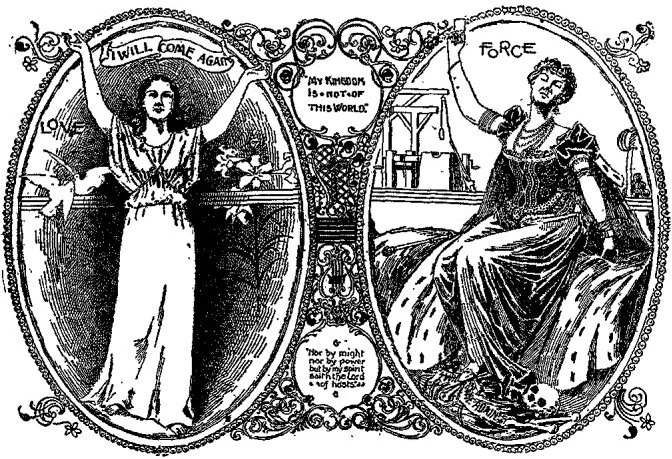
To write the history of the harlot woman, the apostate church, is but to reverse every statement in the history of the bride of Christ, the true church. Of the scarlet woman it is said, she “is fallen.” From what did she fall? Why did she fall? The true church began with the “power from on high.” The other church began with “false brethren,” without power from on high, who followed Paul with false teaching, and who were rebuked by the Holy Ghost. Acts 15:12, 28. Two statements of Scripture will clearly contrast the true and the false:—
“He [Barnabas] was a good man and full of the Holy Ghost and faith: and much people was added unto the Lord.” Acts 11:24.
“Take heed therefore unto yourselves, and to all the flock over the which the Holy Ghost hath made you overseers to feed the church of God which he has purchased with his own blood. For I know that after my departure shall grievous wolves enter in among you, not sparing the flock. Also of your own selves shall men arise, speaking perverse things to draw away disciples after them.”
From the above it is clear that the power of the true church is the Holy Ghost which labors to lead men to the Lord. The apostate church, on the other hand, was to be led by men whom the Holy Spirit had not made shepherds, and who therefore were filled wholly with self; and who would consequently draw away disciples after themselves.
Of this falling away from the Lord and His Spirit to men and human power, Paul speaks more definitely. After warning the Thessalonian church against the error that “the day of the Lord is now present” (R. V.) he writes: “That day shall not come except there come a falling away first and that man of sin be revealed, the son of perdition; who opposeth and exalteth himself above all that is called God, or that is worshiped, so that he as god sitteth in the temple of God, showing himself that he is God.” After describing the result of this falling away, in the utter ruin of all who fall with it, he says: “But we are bound to give thanks always to God for you, brethren, beloved of the Lord; because God hath from the beginning chosen you to salvation through the sanctification of the Spirit and belief of the truth.” 2 Thess. 2:1–13.
This truth that the Holy Spirit is to sit in the temple of God, instead of the man of sin, is more clearly stated thus:—
“In whom all the building fitly framed together groweth unto an holy temple in the Lord; in whom also ye are builded together for an habitation of God through the Spirit.” Eph. 2:21, 22.
From these scriptures it is clear that the Holy Spirit, God’s representative on earth, sits in the temple of God, the church, for the purpose of exalting God. “He shall not speak of himself . . . he shall glorify me.” John 16:13, 14. The falling away, therefore, as above described, was the seating of man in the seat of the Holy Ghost, and the exaltation of a sinful man in the place of the Saviour of men.
There is in the true church a “holy see,” or holy seat, which the Holy Ghost occupies as the vicegerent of Christ; but how changed all this in the church of the “falling away.” There we have the “holy see” occupied by a man who claims to be himself the “vicegerent of the Son of God.”
It is sincerely hoped that the reader will not get his gaze so riveted on the “mother of harlots” that he will fail to see the mother’s characteristics in the daughters. It is also hoped that the reader will not select certain churches and declare that they compose the falling daughters. The falling away begins with the individual; and to just the extent that the Holy Ghost is unseated in the hearts of the members of your church and my church, just to that extent has there come a falling away; and then just to that extent are they a part of the great Babylonian family.
It is the province of the Holy Spirit, from its seat in the temple of God, the church, to dispense power and wisdom, to teach and govern, to plan and execute. In all things it is the privilege and place of the believer to be managed by the Spirit and not to manage either the Spirit or his brethren. “There is no man or set of men that can manage men. All ye are brethren: the Holy Spirit of God alone can do this.”
The Spirit not only furnishes power but pleasure as well. “The kingdom of God . . . is joy in the Holy Ghost.” Any Christian or Christian church which harbors any joy not furnished by the Holy Spirit is guilty of enthroning the world in the temple of God, and by that means becomes a member of the family of the scarlet woman. “Lovers of pleasure more than lovers of God” is the inspired description of the religious world in the “perilous times” of “the last days.”
How many there are who look with scorn on the scarlet woman, yet who, because of their own friendship with the world, which is spiritual adultery (James 4:4), are themselves really members of the harlot family. “Come out of her, my people, that ye be not partakers of her sins, and that ye receive not of her plagues.” Be not drunk with the wine of Babylon, “but be filled with the Spirit.” A. F. B.
News, Notes, and Comment.
IN a certain Southern city, there is just now a rather abnormal zeal manifested in the matter of running down wicked violators of the “Sunday law.” Certain Hebrews are among the chief sufferers from this spasm of virtue on the part of the municipal authorities. It is a well-known custom among the tailors of that race to take their work home and do it in their private apartments. Inasmuch as they are naturally clannish in their habits, the houses—nay, the entire neighborhoods, in many instances—wherein they elect to abide, are generally filled with them alone, so that nobody is likely to be disturbed by their pursuing their own national and traditional manner of living and acting.
IT is a part of the religious life of these people to refrain from “worldly” or secular labor on the seventh day of the week. This they do in pursuance of a “commandment” which thousands of those “who profess and call themselves Christians” have read out to them in their churches on the first day of every week, without otherwise paying any attention to it whatsoever. That they may keep pace with competitors, these conscientious Hebrews must work on this first day, if they are to “observe” the seventh. The municipality in question has a “Revised Version” of its own. Therein, a certain famous text reads as follows: “One man esteemeth one day above another; another man esteemeth every day alike; let this be prevented by the police.” The authorities have—in spasms—the courage of their convictions.
WHEREFORE, the blue coated missionaries of the gospel according to Puritanism are now amusing themselves in that town, and endeavoring to divert the public mind from their alleged intrigues with the gambling fraternity, by entering (with force and violence, where necessary), without the shadow of justification in law, without even the formality of “warrants” previously obtained, the dwellings of the unfortunate Hebrew tailors, dragging them forth, men, women and children, and carrying them off by scores to the station houses, all in the interest of true religion—and costs.
OF course, these “domiciliary visits” of the police, and their tyrannical behavior belong to the Russian system of civil administration, and have no place or excuse in free America. Equally of course, any policeman who might undertake thus to trespass vi et armis on the habitation of a wealthy citizen, or one of “high” social standing, would expose himself to the dangers of shotgun and revolver, which, under the circumstances, would be legally as available against him as against any private person who might venture to indulge in similarly outrageous conduct. But the average Hebrew tailor is poor, and as to his social standing, it is as the things that are not.
IN free America, every citizen is, by virtue of his citizenship, a conservator of the peace. Whatever judges may say, we must ever maintain as a political principle that no man in our country should have in this regard, rights, privileges or duties in any wise different from the rights, privileges and duties of every other man. What, then, is a policeman? He is simply a man who is paid a salary for devoting his attention exclusively to the duty of preserving the peace, etc., which duty all other freemen are expected to discharge without pay whenever occasion demands. Neither in the detection of crime, nor in the arrest of criminals, may an officer arrogate to himself other powers than those of citizenship. He may not break in a door, where the public interest would not justify another in so doing; he may not arrest without a warrant where by the general law a warrant is required; for false and malicious and causeless interference with the liberty of the citizen, he is as responsible as those are who unfortunately live without his blue cloth and brass buttons.
THE average policeman understands all this perfectly well; and he is careful not to exceed the legal limits of his authority where by so doing, he would subject himself to trouble at the hands of those who have money at their disposal, or possess that mysterious yet powerful attribute known to the initiated as “influence.” When he wants to do what he knows he has no right to do, he visits the “down town” districts, and tramps about among the humble and lowly, and bullies and harries and “badgers” them to his full, and when he has the “Sunday law” as a lever, so to speak, his violations of the fundamental law of American jurisprudence and of the express language of State constitutions are hailed with delight and vociferously applauded by some excellent persons.
MANY of the Hebrews of whom I am speaking are peculiarly fitted to be the subjects of police usurpation and outrage. They come from Poland and from Russia. In their own country, violence is all they know of law. For centuries they have been ground down by the iron heel of military despotism. To them a uniform is the badge of irresponsible and often of malicious power. The notion that any one of them possesses a political “right” which a uniformed officer of the law is under any obligation to respect is a new one to them, and my observation of them leads me to believe that it can never be thoroughly comprehended or appreciated by the older immigrants, though the first generation born here, and those who arrive young enough to get the benefits of the public schools, take to freedom naturally enough.490
BUT this is the inherent vice of all sumptuary laws, “which vex the citizen and interfere with individual liberty”—that they are not, and never, from their very nature can be, used for the vexation of any but the poorer classes in the community. If a rich man wants to work on Sunday, he goes to his store or office and gratifies his desire, and the policeman will never be born who will dream of objecting to the proceeding. It is only the day laborer, the toiling artisan who lives “from hand to mouth,” whose scanty wage for hardest drudgery barely suffices to keep body and soul together—he alone it is whose liberty is curtailed under cover of the “Sunday law.” Surely this inexorable fact alone is an all-sufficient reason why the representative body of a free government should “reform it altogether.”
VIRTUE of the municipal sort is certainly spasmodic. But it is radical enough while the fit is on, in avowed purpose, if not in execution. And so, while Sunday tailoring is to be stopped in the town unmentioned, “Sunday club drinking” is also loudly doomed to go. The startling statement is printed that there are nearly three hundred “clubs” within the city limits, and that people drink liquor in them on the first day of the week. This the “grand jury” justly regard as calculated to bring down the wrath of Providence on the wicked burg, and they propose to put a stop to it in time.
THERE are, say, three hundred clubs. About six of these are what is called “fashionable.” It is not denied that the members of all six get strong liquors at their respective clubs on Sundays, and pay for the same then and there (sometimes). Now, after all the flurry and flare and fuss and feathers of the proposed “crusade” are over, what will we find? If it be true that history repeats itself, and that human nature is pretty much the same at all times, we will find this—that a few “clubs,” whose members are “workingmen”—that is to say, hand-workers, of one kind or another—and who are too poor to hire more than one room for their club meetings, have been broken up; and that not the slightest attempt has been made to break up one fashionable organization, whose members are “brain-workers” of one kind or another, or else absolute idlers, but are rich enough to own or to rent an entire house to meet in.
WHEN a mechanic’s club has been “raided” on a Sunday and the members walk “up town” in a body and see at the great windows of palatial mansions rich men, attended by liveried waiters, engaged in precisely the same acts for which they have just been arrested and turned out into the street, their respect for American law and American justice, for American liberty and American equality, is not likely to be much enhanced. But this is the nature, again, of all sumptuary laws. And because of this, their nature, their existence is an evil and a menace; their administration a scandal and a reproach; and they ought to be reformed out of the statute book.
I HAVE no animosity toward wealth. I have no desire to excite the poor against the rich. I do not advise the raided tailors, nor the members of a raided club, to set in motion a raid against a luckier body. Two wrongs do not make a right; and this sumptuary Sunday law would be just as objectionable if it were enforced against every body as it is now, when it is only enforced against poor people. It is the principle of the thing that offends justice.
I GO with anybody who happens to be going my way. And I know that there are many who will not listen to argument about principles, but will take sides with great ardor if you can point them to an undeniable evil of practice. All poor people—all toilers—all they of severe and narrow living—ought to band together against the Sunday law, if for no other reason, than that they alone suffer from its application. Its enforcement makes of them a distinct and branded class in the community. It surrounds them with police conditions on fifty-two days in the year from which the men of money are altogether exempt. It insults their intelligence and their manhood by proclaiming that they are not fit for the liberty accorded to others. It robs them of innocent pleasures. It puts a strait jacket on their bodies. It curtails the freedom of their souls by denying them the freedom of choice in their conduct that is part of American citizenship.
Sunday Enforcement in Muncie, Ind.
A PRESS telegram from Muncie, Ind., under date of July 18, gives the following with reference to the new crusade for Sunday enforcement in that place:—
“Muncie has not experienced such exciting times on Sunday for many years as to day, when the steps were taken to close every business house in the city in strict accordance with an old law. The Young Men’s Christian band issued a manifesto last week notifying all who engaged in their regular vocation on Sunday that affidavits for their arrest would be filed by the members of the band. For three days the threat has been the chief topic of conversation, and it was supposed that the city would be closed up as tight as a clam to-day, and that possibly the street cars would not venture out. On the contrary, all the meat shops with a single exception, cigar stores, drug stores, ice cream parlors, and delivery wagons, bakeries, candy stores, bicycle stores, soda fountains and some groceries did business as usual, and the usual regard was paid to the saloon law. The street cars not only491ran, but the company carried out its programme at West Side Park with a band concert, balloon ascension, and baseball game, unmolested by the sheriff.”
“The churches were largely attended. At High Street M. E. Church, Rev. Mr. Naftzger, the pastor, was not present, but the discussion of the threat was so warm pro and con that it was decided to take a vote as to how the members of the church stood on the Blue Law enforcement, and when those favoring the action were asked to stand, the number was, it is said, very small, and there was loud hand clapping from those who refused to arise. In the church, W. A. Thompson, one of the leading lawyers in the State, denounced the stringent action proposed, while strong arguments were heard on the other side. During the day members of the “band” were collecting evidence for affidavits to cause arrests Monday.”
Sunday Enforcement in Chattanooga.
By C. P. Bollman
BY C. P. BOLLMAN.
CHATTANOOGA has “turned over a new leaf” in the matter of Sunday observance, and is likely ere long to turn over another. The so-called reform was on this wise:—
A new head was recently selected for the Police Board, and immediately orders were issued to close all saloons on Sunday, in harmony with the city ordinance to that effect. The saloon men—
“Grumbled and said ’twas no use;
’Twas horrid injustice and horrid abuse.”
The authorities were however firm, and the saloons closed as per their order. But in all other respects the city pursued the even tenor of its way. Groceries, fruit stands, confectionaries, news stands, soda fountains, ice-cream saloons, livery stables, street-car companies, etc., continue to do business as before, and each week the saloon men grow more desperate. They demand that the law shall be enforced impartially upon all, if enforced at all, and threaten to stop even the running of the street cars unless the order closing the saloons shall be revoked.
The Police Board has replied that so far as the city is concerned there is no discrimination. The city ordinance prohibits only Sunday liquor selling and Sunday barbering and either says nothing about other lines of business or else permits them; and that while it is true that the law of the State prohibits all business alike, it is no more their place to enforce the State law than it is the business of the saloon-keepers; and that if they (the saloon-keepers) wish the law enforced it is their privilege to swear out warrants against all violators of the statute. This the saloon men threaten to do. The matter may also be brought before the grand jury, though that seems unlikely.
THE B. Y. P. U. CONVENTION.
July 15–18 the seventh annual international convention of the Baptist Young People’s Union of America was in session in Chattanooga. About 7,000 delegates and visitors were present representing every section of the United States and the Dominion of Canada. Among the addresses of welcome was one by the mayor of the city, Hon. George W. Ochs. Among other things the mayor said:—
“There is something so peculiarly American in the Baptist church that it appeals with especial force to the patriot. The church typifies liberty in its purest sense; liberty of soul, liberty of thought, liberty of action, liberty of conscience, the total separation of Church and State, the absolute independence of each separate church organization. It unites the jealous guardianship of sacred teachings of Scripture, with an equally vigilant watchfulness of the priceless jewels of liberty. In the formation of our national Constitution it was the Baptist church that stood inflexibly for full religious freedom, never receding from that position until victory was won.”
“It was a Baptist pioneer, who in the dawn of our nation’s history, first lighted the torch of religious liberty; he held it aloft, proclaiming that civil magistrates had no right to coerce the consciences of men, that the ritualism and formalism of a State church were obnoxious to soul liberty, that man’s responsibility in religious matters was to God alone; and in spite of persecution, contumely and indignities he persevered and the sparks which showered from that blaze kindled by Roger Williams, lighted the fires which chastened our fundamental laws and perpetuated the principles which underlie the whole superstructure of our free institutions.”
“By such teachings your church produces men and women who live in perfect fulfillment of our highest ideals, and thus it best serves society’s needs; for the true source of a happy, a prosperous and a contented State, is a broad, liberal and independent church. These truths taught by your exalted society make your progress a resistless march of triumph and explain the marvelous strides you have made.”
Nothing that the writer heard was so loudly applauded as was this tribute to the religious liberty principles of the Baptist church. But deserved as it was so far as the remote history of Baptists is concerned, it is greatly to be feared that many who bear the Baptist name to-day do not know the real meaning of the term, religious liberty. However, the official utterance of the convention concerning Sunday observance was very mild indeed. It does not necessarily include any but perfectly legitimate means. Resolution 6 reads:—
“That we pledge ourselves to renewed efforts to secure a more general and fitting religious observance of the Lord’s day, and to use all rightful and available means to check the growing tendency to secularize the day and give it over to worldly business and amusements.”
All this might be done without any appeal to civil law, and is what consistency demands from every believer in Sunday sacredness; but unfortunately the speeches made in support of the resolution revealed the fact that in the minds of many Baptists, among the “rightful and available means to check the growing tendency to secularize the day and give it over to worldly business and amusements,” Sunday laws occupy a prominent place. One of the speakers, a Baptist pastor from Knoxville,492in his words of welcome to those from other States, referred to the statute-intrenched Sunday of Tennessee, in these words: “We are proud to have you see among us, what others say is the truest Americanism in our fair land—an American sabbath; and we are trying to preserve it.” This gentleman possibly did not know all that has been done in Tennessee to “preserve” this “American sabbath;” he possibly did not know how “soul liberty” for which Baptists of past generations contended and for which not a few of them laid down their lives, has in this closing decade of the nineteenth century been outraged in the State of Tennessee in the interests of the so-called “Americanism” which he is proud to exhibit to visitors from other States. Oh, that Baptists would be true to their history; true to the noble men and women who counted not their lives dear unto them that they might have conscience void of offense toward God; and above all, true to the principles of the glorious gospel of our Lord and Saviour Jesus Christ.
Recent Changes in Sunday Laws.
The report of the “New York Sabbath Committee” for 1894–1896, gives the following summary of recent changes in the Sunday laws of the various States:—
“Vermont, in the revised Sunday law of 1894, omits the old-time prohibition of traveling and visiting, except for necessity or charity, and of being present at any public assembly except for worship and instruction.
“In Rhode Island, the General Law of 1896 provides for the exemption of those who keep another day than Sunday as the Sabbath.
“In New Jersey, by the Amendatory Act of April 28, 1893, it is made ‘not unlawful’ to publish or sell newspapers, to sell milk, to ride or hire horses and carriages for recreation on Sunday; subject to the power of the local authorities to regulate or prohibit by ordinances the acts thus made lawful, in their several municipalities.
“In Georgia, a law passed in 1895 permits the running on Sunday of special fruit and vegetable trains, under careful restrictions.
“Public ball games and other sports on Sunday, forbidden in most of the States by the general statutes, have become in some places so serious an evil by reason of the large and noisy crowds assembled and the temptation to mischief, that special ordinances have been found necessary to suppress them.
“The work of barbers, which in some States has been held to come under the general prohibition of labor on Sunday, has been forbidden by special statutes, on demand of the barbers themselves, in Missouri, Ohio, Kentucky, Illinois, Colorado and Montana, as well as in New York as mentioned above.
“California, which had been for a number of years without any Sunday law—except that, as in the other States, by the common law Sunday is a holiday, dies non juridicus—in 1895 passed ‘An Act to provide a day of rest from labor;’ it declares that ‘every person employed in any occupation of labor is entitled to one day’s rest therefrom in seven,’ and makes it unlawful for an employer of labor to cause an employé to work more than six days in seven, except in cases of emergency. The position of California in this respect is unique, no such law being found in any other State. An unsuccessful attempt in 1895 to enact a suitable Sunday law has aroused public sentiment, and led to renewed efforts for reform.
“Oklahoma, the latest received into the sisterhood of States, has enacted Sunday laws mainly copied from those of New York.
“Idaho is the only State in the Union where as yet no statutory provision is made for the protection of the weekly rest-day.
“In the District of Columbia, the Sunday laws which were in force at the time the district was ceded to the United States, are still nominally in force. A bill is now before Congress, and is understood to have the approval of the District Commissioners, to provide more effectually for the prevention of labor and traffic on Sunday.”
This summary is given as showing the trend of public sentiment in the matter of Sunday legislation. At first glance, however, it is liable to be misleading. There seems to be a trend of public sentiment in the direction of greater Sunday liberty; but this is true only of the present sentiment as compared with the sentiment prevailing at the time the old laws were enacted. It must be remembered that most of the Sunday statutes of the States had their birth before the modern era of religious liberty. As compared with more recent times, the present sentiment respecting Sunday legislation shows a marked increase in the desire for Sunday enforcement.
“Faith or Fact.”
This is the title of a book of 331 pages, which comes to us for review from the firm of Peter Eckler, of this city. The author is Mr. Henry M. Taber, and his endeavor is to show that faith and fact are antagonistic to each other. To this end he cites a numerous array of facts bearing upon quite a wide range of topics, which seem designed to include every prominent manifestation of human thought and action to which religion has given rise.
The purpose of the author does not appear to have demanded any great effort at substantiating his “facts” by proof. For example, on page 99, he states that “Three Baptists (who religiously observe the seventh day of the week) have been for months languishing in a prison in Tennessee for the crime(!) of attending to their gardens or performing some ordinary farm duties on Sunday.” But no Baptists were ever imprisoned in Tennessee for Sunday labor. Mr. Taber might easily have learned the truth on this point if he had been anxious to state the matter correctly.
As a presentation of the superstition, credulity, hypocrisy, errors, inconsistencies, follies, fanaticism, injustice, and crimes of which men have been guilty in the name of Christianity, Mr. Taber’s book would be well worth perusing, provided it were a profitable occupation to peruse such records,—which it is not.493
As regards its intended impeachment of faith, it is sufficient to say of Mr. Taber’s book that it is based upon a false assumption and is therefore a failure from the start, as every work of the kind must be. It assumes that Christianity is responsible for all the crime and folly that have been perpetrated in her name. As well might it be assumed that Liberty is responsible for all the crimes that have been committed in her name. “Freethinkers” believe in liberty, while condemning lawlessness and anarchy. Why can they not be as fair towards Christianity?
Christianity is no more responsible for the frauds which have used her fair name to mask their baseness, than is the United States mint responsible for the counterfeit coins which rogues have put into circulation. The very fact that there have been and are spurious Christians, is proof of the value of genuine Christianity.
A United States coin is counterfeited because, for the rogue’s purpose, it is worth counterfeiting. For the same reason there are counterfeit Christians. But who ever heard of a counterfeit “Freethinker”?
Faith is not superstition; it is not credulity. It is the assent of the mind and heart to the Word of God, as a revelation of truths which lie beyond the range of finite vision. It is a means of knowing all-important facts which could not otherwise be ascertained.
Gratifying Results from Our Special Offer.
By Editor
NOTHING could give the publishers of the AMERICAN SENTINEL more genuine satisfaction than the remarkable manner in which its friends have responded to our “special offer,” the announcement of which appeared first in our issue of the 22nd ult. A week, at least, should elapse before returns could in reason be hoped for, yet as we close the forms of this week’s paper, we are gratified to state that over one thousand new subscribers under the offer have been received, and these only from less than one half the States where the SENTINEL circulates. Over fifty have sent in clubs of from five to twenty subscriptions each; long lists have come through the State tract societies and individual subscriptions are numbered by the scores. This is something quite remarkable in newspaper circulation, and especially at this time of year. It demonstrates beyond a question of doubt that the SENTINEL has a very warm place in the hearts of its constituency, for it is the love of the principles for which the paper stands in defense, and the desire that they shall be known among all men, that have led to this unselfish activity in its behalf.
We are profoundly grateful for this evidence of appreciation, and it stimulates us, as nothing else could, to redouble our efforts in giving the SENTINEL’s message in no uncertain tone. So let us together, editors and readers, unite hand in hand in “pressing the battle to the gates,” so that all the people in all the land may know, and know in the light of God’s word, what the dangers are that threaten us, and the way of escape.
Toleration in Russia.
THE Berlin correspondent of the London Standard telegraphs that while celebrating Christmas eve in the German manner the Czarina was asked by her husband to express a wish. She whispered:
“Please permit a little more religious toleration.”
The Czar answered, smilingly: “That will come by and by.”
The Czar has remembered his promise, and has recently issued a ukase cancelling that of his father, which ordered that every non-orthodox person in Russia who married an orthodox person should sign a document declaring that he would baptize and educate his children in the orthodox faith. The ukase of Emperor Nicholas permits children of mixed marriages to be educated in the religion of their parents—sons in that of their father’s and daughters in that of their mother’s.
Card.
To all interested in carrying the gospel of Jesus Christ to the inhabitants of other lands and who desire to assist in supporting missionaries already placed and others who may engage in the work, the opportunity is given to make an offering to the Foreign Mission Board of the Seventh-day Adventist denomination.
Such donations should be sent to W. H. Edwards, the Treasurer of the Board, 1730 North Fifteenth Street, Philadelphia, Penn.
TO OUR PATRONS:
By Editor
Write names plainly.
Remit by P. O. Money Order, or Express Order, or by Bank Draft on New York. Personal checks are not desired.
Make all Orders and Drafts payable to Pacific Press Publishing Co., not to the editor or any other individual.
We will receive Postage Stamps in small quantities and any kind of good money. Defaced coins will not be taken. If paper money or coin is sent, register the letter.
FIGHTING AGAINST GOD
Is the Title of a sixteen-page tract just issued as No. 41 of the Religious Liberty Library,
In which PICTURE, POETRY, and PROSE unite in teaching Christian principles of freedom of conscience.
7 Fine Half-Tone Illustrations 7
Printed on highly-finished paper.
Its attractiveness will insure perusal by the most prejudiced or indifferent reader.
PRICE—3 Cents each.
Usual discounts in quantities.
PACIFIC PRESS PUBLISHING CO., 39 Bond Street, New York City.
AGENTS' OUTFIT FREE. No Capital NEEDED.
Weekly sales pay big money. We make a high grade BICYCLE as low as $24.00. Fully guaranteed. Shipped anywhere on approval. Direct from our factory. ALPINE CYCLE CO., Dept. 68. Cincinnati, O.
The Gospel Primer.
A Book for the Children.
Contains 160 pages of matter, which will interest the old as well as the young. There are thirty-three full-page illustrations, which, in themselves, teach many gospel truths.
PRICE - - - - .25
Address this Office.
A Greek-English Lexicon TO The New Testament.
Revised and Enlarged by
THOMAS SHELDON GREEN, M. A.
WITH A PREFACE BY
H. L. HASTINGS,
Editor of the Christian, Boston, Mass.
AND A SUPPLEMENT BY
J. H. THAYER, D. D., LITT. D.
Professor of New-Testament Criticism and Interpretation in the Divinity School of—Harvard University.—
Containing additional Words and Forms to be found in one or another of the Greek Texts in current use, especially those of Lachmann, Tischendorf, Tregelles, Westcott, and Hort, and the Revisers of 1881.
“The best thing of the kind for the money.”
PAPER BINDING, Postpaid, 35c.
Address,
Pacific Press Publishing Co.,
39 Bond Street, New York City.
THE WHIRL of the CYCLONE CONTINUES.
The people are looking for a perfect washing machine. It is found only in the Cyclone, and it is so easy to demonstrate the fact to intending purchasers that agents for it are reaping a rich harvest. Write for terms and territory to Coon Bros., 18-20 Hanover St., Battle Creek, Mich.
Contains ninety-six pages, with twenty full-page illustrations. The work takes up Christ's great prophecy of his own second coming, and the signs of the times are clearly pointed out in relation to that greatest of all events.
JUST THE BOOK FOR THE TIMES.
Interesting, Timely, and Instructive.
Price, attractive board cover, .25
PACIFIC PRESS PUBLISHING CO., 39 Bond st., New York City.