Pacific Press Publishing Company · New York · May 27, 1897
Abraham Called Out of His Country
WHEN God said to Abraham, “Get thee out of thy country, and from thy kindred, and from thy father’s house, into a land which I will show thee,” Abraham “went out, not knowing whither he went.”
God had not yet showed him the land or country into which he was to go, and which was to be his. So far, the Lord had only promised to show it to him.
There were three things, however, which Abraham must do, before he could fairly expect God to show him the country which he had promised, and which was to be his.
First, he was to get out of his country; secondly, from his kindred; thirdly, from his father’s house.
He left his country; but when he did so his father and his kindred went with him to Haran, and dwelt there. There his father died; and now, separated from his father’s house, he went on to the land of Canaan.
But there accompanied him yet one of his kindred—Lot, his brother’s son. While Lot was with him, and he was thus not yet separated from his kindred, though separated from his country and his father’s house, the time could not come for God to show him the land, nor the country which he would give him.
But there came a day when Lot should be separated from him. Lot chose all the plain of the Jordon, and journeyed east, and “They separated thus, one from the other.”
And just then it was that God showed Abraham the land which he had promised to show him, the country which should be his.
“And the Lord said unto Abraham, after that Lot was separated from him, Lift up now thine eyes from the place where thou art, northward, and southward, and eastward, and westward, for all the land which thou seest, to thee will I give it, and to thy seed forever.”
And the country which the Lord then showed to Abraham, and which he there promised him should be his for an everlasting possession—that country embraced the world—for “The promise that he should be heir of the world was not to Abraham or to his seed through the law, but through the righteousness of faith.”
Therefore, when at the word of the Lord Abraham lifted up his eyes to see what the Lord would show him, he saw “the world to come,” which is to be the everlasting possession of Abraham and of his seed—the everlasting possession of all them which be of faith. “For if ye be Christ’s then are ye Abraham’s seed, and heirs according to the promise.”
And from that day forward Abraham “sojourned in the land of promise as in a strange country;” looking for “a better country, that is, an heavenly;” and looking “for a city which hath foundations, whose builder and maker is God.” For though God promised that He would give to Abraham that land, and to his seed after him, yet as long as he was in this world God really “gave him none inheritance in it, no, not so much as to set his foot on.”
Now note: God had called Abraham out of his original country, and thus had separated him from that. Then he gave him not even so much as to set his foot on in any other country in this world.
Abraham at that time represented the religion of God. The Lord in His dealing thus with Abraham and in recording it, has shown for all time and to all people that it is his will that there should be an absolute separation of his religion from any State.
Abraham, representing at that time the Church of Christ, being thus totally separated by the Lord from every State and country on the earth, there is thus shown to all people, as an original truth of the gospel of Christ, that there should be total separation of Church and State; and that the church of Christ can never have any country in the world.322
So also dwelt Isaac and Jacob, heirs with Abraham of the same promise, accepting with Abraham separation from every earthly State and country, confessing that they were strangers and pilgrims on the earth, looking for the country which God had prepared for them, and the city which hath foundations, whose builder and maker is God.
And that they accepted this freely of their own choice, by faith in God, is shown by the fact as recorded, that, “Truly if they had been mindful of that country from which they came out, they might have had opportunity to have returned. But now they desire a better country, that is, an heavenly, wherefore God is not ashamed to be called their God, for he hath prepared for them a city.”
This dealing of God with Abraham, and the record of it, were for the instruction of all the people who would believe God, from that time to the world’s end. For Abraham was the called, the chosen, the friend of God; the father of all them that believe. And all they which be of faith are blest with faithful Abraham. And not the least element of instruction in this account of God’s dealings with Abraham, is the great lesson it teaches that the religion of God means separation of religion and the State.
Further, “Now to Abraham and his seed were the promises made. He saith not unto seeds, as of many, but as of one, and to thy seed, which is Christ.” Therefore the promises recorded and referred to in the scripture, “To Abraham and his seed,” are always to Abraham and Christ, and to Abraham in Christ. And therefore, “If ye be Christ’s, then are ye Abraham’s seed, and heirs according to the promise.”
And when Christ, that promised seed, came into the world a man amongst men, then in him, as formerly in Abraham, there was represented the religion of God and the church of Christ. And as such he ever maintained the same principle of separation of religion and the State which he himself had set before the world in the life and record of Abraham.
He refused to recognize even by a sign, the wish of the people to make him king. He refused, when requested, to act the part of judge or divider over men as to the rights of property. He refused to recognize the national lines of distinction, the wall of partition, which Israel in their exclusiveness had built up between themselves and other nations. He refused to judge or allow any others to judge any one for not believing on him. He distinctly declared that though he is a king, yet his kingdom is not of this world, and that it is not in any way connected with this world. He distinctly declared the separation of his religion from the State: “Render unto Cæsar the things that are Cæsar’s, and unto God the things that are God’s.” And when he sent forth his disciples with his heavenly commission to preach the gospel of his kingdom, he sent them not to one particular nation, but to “Teach all nations, baptizing them in the name of the Father and the Son and the Holy Ghost.” He sent them to preach the gospel; not to one particular, favored exclusive people, but “to every creature.”
Thus it is seen again that in every phase of the fundamental principle of the religion of God and the church of Christ, from the beginning to the end of the world, there is required the absolute separation of religion and the State: the total disconnection of his church from every State and country in the world, and from the world itself.
"Christian" Atrocities.
By M. E. Kellogg
BY M. E. KELLOGG.
THE above heading may strike our readers as a misnomer, and in one sense it is. No real Christian can do an atrocious act, and hence such a thing as a Christian atrocity cannot be. But we have used the term “Christian” here in the accommodated sense, the same as it is used in the expression “Christian nation.”
Christians do not fight; Christian nations do; Christians do not take property from other Christians by violence; Christian nations do; Christians with lowliness of mind esteem others better than themselves; a Christian nation looks with a high disdain upon other Christian nations and thinks itself and its institutions and ways the best.
So there is a very great difference between the spirit of a Christian and the spirit of a Christian nation—so much so that we shall have to conclude, either that a Christian is not a Christian, or that a Christian nation has no right to such a high-sounding profession.
If we apply the rule laid down by an inspired apostle, “He that doeth righteousness is righteous, even as he [Christ] is righteous,” and “He that committeth sin is of the devil,” to men and to nations, we shall be forced to the conclusion that Christians who have attained to a righteous and peaceful life by faith in Christ are righteous, are Christians, and may properly be called so; but that nations which have not so attained but which practise selfishness, fraud, robbery, and even murder—miscalled war—are not Christian at all. And that they are not Christians, though often called so, we refer again to the idea of Christian atrocities.
Adopting the spirit and nomenclature of the times we note that the Moslems and Christians are fighting in Thessaly and in the island of Crete. The war broke out in Crete by a rebellion of the Christians against the Moslems.323The great Christian nations of Europe think that they have attained to the high ideal of fighting in a thoroughly Christian manner because they do not kill their prisoners nor the women and children of the opposing party. But the Cretan Christians who are now receiving so much sympathy have not yet attained that exalted state of Christianity where they kill only men! The sea-port towns of Crete are filled with Moslem women and children who bear in their bodies the marks of the Christian, but they are not like the marks of the Lord Jesus that Paul bore. No. Women with their breasts cut off, children mutilated in every manner, may be seen in the hospitals. Such atrocious actions might be expected of the wild Kurds of the Armenian mountains who profess the religion of Mohammed; but what about the Greek Christian, boasting of his civilization, of his religion, and posing before Europe as a hero, doing such things!
Christian atrocities! Let the world ponder it and learn that as true as the saying that “All is not gold that glitters,” so all is not Christian which passes under that name; and in nothing is the name Christian so abused and disgraced as in the very common expression, “Christian nation.”
Trusts Remain in Possession After Each Legislative Defeat
The New York World sums up the situation of the governmental contest against the monopolies, by the remark that “in the campaign carried on by our patriotic legislators and Attorney-General against the Trust we have observed that although the Trusts are completely defeated in every engagement they are invariably found in possession of the battle-ground the next morning.”
What We Need to Bring Prosperity.
The United States Government began with the setting up of the principle that “all men are created equal.” Its founders asserted to the world the doctrine that all are “endowed by their Creator with certain unalienable rights, among which are life, liberty, and the pursuit of happiness; that to preserve these rights, governments are instituted among men, deriving their just rights from the consent of the governed.” Upon this doctrine they essayed to establish a government which should afford to all persons under it the perpetual blessings of civil and religious liberty.
It is perfectly evident to-day that this ideal of our forefathers has not been realized. We do not have to search for this evidence; one cannot look in any direction without seeing it. Instead of the peaceful country filled with inhabitants in the undisturbed enjoyment of “life, liberty, and the pursuit of happiness” which loomed into the perspective of our forefathers, there is seen a nation whose people are arrayed against each other in a bitter struggle for the mastery. And to the vast majority of those engaged in this contest, the struggle is one for the realization of those very conditions of life and liberty which are supposed to be guaranteed by the fundamental law of the land.
We see around us the Trust, and all the various combinations of capital and labor, operating against the enjoyment of individual freedom. We see the strike, with its attendant misery to the families of the poor, only greater than the perpetual misery from which they seek by that hard means to escape. We see the power of wealth to create unjust conditions for its own advantage in political and social life. And from the enslaved and dissatisfied masses we hear the mutterings of threatened revolution.
And if anything were lacking to show the insufficiency of a theory of government in itself to secure the blessings of good government to a people, it is supplied by the fact that both plutocrats and populists invoke the name of Liberty and appeal to the same principles of free government in support of their diametrically antagonistic positions.
“Liberty, equality and fraternity” are good words, but in the mouth of the plutocrat they do not mean what they do in the mouth of the socialist. Whose meaning of the words, whose theories for the realization of these blessings, are to prevail?
There are many explanations put forward defining and locating the trouble with the workings of our governmental system. One explanation asserts that the trouble is with the Constitution; that this was long ago outgrown, and has since been only an incumbrance to good government and a protection to rascality. Another says that wrong political principles have been put in force; another says that the Government ought to be religious instead of secular; another affirms that republican government is a failure, and that a return must be had to some form of monarchy. The tendency in the last-named direction is already very marked.
But the real trouble is not with the Constitution, or with republican principles of government. As Abraham Lincoln said, there are men who would overthrow the Constitution, and pervert right principles of government. A “government of the people, by the people, and for the people,” depends upon the people, and not upon principles and constitutions. Right principles in the Constitution are indeed essential, but these count for little when there are wrong principles in the hearts of the people. When the commercial spirit has cast out the spirit of independence, when the love of gain is greater than the love of liberty, the people will certainly lose their liberty, in spite of the best constitution and the soundest governmental theories.
In other words, when the people lose the ability to properly govern themselves individually, they can no longer hope successfully to govern themselves collectively. In such a case it will avail nothing to shift back and forth between two or more political theories.
WHAT SAITH THE SCRIPTURE?
The position of the Christian, and that of the SENTINEL, is that “liberty, equality, and fraternity” are qualities which have their origin in God, and have descended to man from him. Or rather, they are in the hearts of men in proportion as God is in their hearts, being inseparable from Him. And they can be properly understood324and appreciated only in the light of the knowledge of God. Of what use is it to the country that men of all classes from plutocrats to populists prate and dispute about these things, without ever arriving at an agreement? Of what use is it that politicians declaim about the virtues of political theories and promise prosperity that does not come?
How long will it take to usher in prosperity upon the nation by way of money “trusts” and labor “trusts?” How long will prosperity be in emerging from the clash of contending “combines,” all embodying the spirit of selfishness and hatred? A long time, we venture to say.
In the literature of Scripture, “liberty, equality and fraternity” mean something. They are there used in no selfish sense. To his followers Jesus said, “Ye know that the princes of the Gentiles exercise dominion over them, and they that are great exercise authority upon them. But it shall not be so among you; but whosoever will be great among you, let him be your minister; and whosoever will be chief among you, let him be your servant.” It is the theory of government in the United States that those in the chief positions are the servants of the people; but their practical attitude as well as the attitude of the people toward them, is more suggestive of the position of “honored ruler” than of that of servant. The actual exemplification of the theory is not found in any department of the Government. It never was seen in the Government. It never existed anywhere outside of the Christian church.
Again, Jesus said: “Be not ye called Rabbi; for one is your Master, even Christ, and all ye are brethren.” And to the same end the Apostle Paul wrote to the church at Corinth: “For who maketh thee to differ from another? and what hast thou that thou didst not receive? now if thou didst receive it, why dost thou glory as if thou hadst not received it?” Here is the doctrine of the equality of all men; and when this doctrine was enunciated in the Declaration of Independence and embodied in the national Constitution, it was not a product of the human intellect, but a principle of divine government, as old as Christianity itself.
This divine principle of government cannot be worked out on a selfish basis, but only on the basis of Christianity. This is the trouble with its application to human governments. Men are willing enough to adopt the theory that all men are created equal and are endowed by their Creator with unalienable rights; but for the most part they do this from a selfish motive. When this principle was appealed to and adopted by the people of this nation, they were seeking to defend themselves from the tyranny of an English king. They sought liberty, not for an oppressed people in Europe or Asia, but for themselves, and in proportion as the nation grew strong and ceased to feel the need of defense against an opposing power, the people relaxed their hold upon their liberties, and the change which Thomas Jefferson foresaw became a reality. Having liberty for themselves, securely, as they supposed, the people became absorbed in the occupations of gain, and their guardianship of liberty was relaxed. They held the precious boon in selfishness, and by selfishness they have well-nigh lost it. But how can it be held in any other way? The question can be answered only by the gospel of God.
“What things soever ye would that men should do to you, do ye even so to them.” “Let this mind be in you, which was also in Christ Jesus, who being in the form of God, . . . made himself of no reputation, and took upon him the form of a servant, and was made in the likeness of men.” “Look not every man on his own things, but every man also on the things of others.” Phil. 2:4-7. “Let no man seek his own, but every man another’s wealth.” 1 Cor. 10:24. This is God’s method, and this is the example set by Him who was equal with God. And in proportion as God is in men, they will adhere to this rule; they will hold the principle that all men are created equal and are endowed with equal rights,—not for their own benefit, but for the benefit of their fellows.
The trouble is that God is not to any great extent in the hearts of men to-day. They will not let Him into their hearts; they have driven Him almost out of their hearts. And when He is out there is only selfishness left, and selfishness means bad men, and bad men means bad government. A government cannot long rise above the level of the people by whom it is administered.
If there is to be a better government in the United States,—if we are to have prosperity in place of the hard times,—there must be an improvement in the people themselves. The Government cannot improve itself; the Government cannot improve the people. But the people can improve themselves by allowing the divine principle of unselfishness to come into their hearts and rule their lives. The great question is, Will they do it? And this means, for each individually, Will I do it?
Individual Character as the Hope of a Republic
THE only hope of a republic lies in individual assertions of a character founded and maintained on correct principles.—New York Observer.
Sunday Baseball in Iowa.
By Editor
It is reported that the Iowa legislature has undertaken to suppress Sunday baseball in that State, by a bill which prohibits all persons from engaging in that game on Sunday, with the exception of observers of the seventh day.
We do not think the latter will be likely to take any advantage of this exemption, for they are not noted as players of baseball, either on Sundays or other days. But the fact that the exemption is made on religious grounds,—that is, the observance of another day as the Sabbath—gives the law itself a religious stamp.
It would certainly be most inconsistent to allow a game of baseball on Sunday by observers of the seventh day, and at the same time prohibit the like exhibition on the part of other classes of people. As an exchange remarks, “A Seventh-day Baptist ‘inshoot,’ or an Adventist ‘home run,’ must be just as disturbing to the peace325as any other kind. There is no denomination in baseball.” It would certainly be hard to give an explanation that would satisfy an average community to the contrary.
That legislators should feel bound to make such a discrimination, in order to escape restricting freedom of conscience, shows that something must be wrong with the Sunday law itself. It is so manifestly unjust to prohibit those who conscientiously observe another day from doing work on Sunday that almost every State in the Union exempts them from the penalties for such work; and on the other hand it is manifestly absurd to say that there is any difference between plowing, carpentering, or baseball playing on Sunday by persons of one denomination, and the same by individuals of any other denomination. There is nothing denominational about work or recreation.
Hence we are driven by both reason and justice back to the starting point of all Sunday legislation, and find that we become involved in wrong the moment such legislation is undertaken.
Who Should Run the Government.
By Editor
The country ought to be governed by the best men in it, and the best men are to be found in the Christian Church. Therefore, for the good of the Government and the people under it, the civil offices should be filled by Christians. So reason our friends, the Christian Endeavorers, and they have undertaken, no doubt in all honesty and sincerity, to put the theory into practice.
Or, what is a slightly different theory, but amounts to the same thing in the end, they believe that they themselves are best fitted to run the Government, by controlling the elections to public office, because they are Christians.
This reasoning is fallacious. The best men in the country are certainly Christians, but Christianity does not claim to qualify any person for public office. Christianity is designed to save people from their sins; and because a man is very pious and very good, it does not follow at all that he is better fitted than other people to hold office or to nominate men for office.
Christianity acquaints men with the governments of God; but the government of God and all human governments are totally dissimilar. The one is a government of love; the others are governments of force. The one brings to view the power of God unto salvation from sin; the others bring to view the power of man for the regulation of outward acts. The one is based upon a spiritual, divine law; the others upon the laws of man. The purpose of one is to maintain a perfect individual character; that of the others is to establish a prosperous State.
The very fact that a person is led to espouse the principles of the government of God, must have a tendency to unfit him for service in a government of a totally different character. The governments of earth know nothing of love; the theory is that the offender, if caught, must be punished. If he escapes it is not from any governmental recognition of the principle of pardon upon confession and repentance. No earthly government can recognize such a principle. It could not proceed a day if it should do so.
That country will be most prosperous in which there is the least need of government; and there will be the least need of government where the people are best fitted to govern themselves, as individuals, in harmony with the principle of respect for the rights of their neighbors. Christianity enables a person to do this; and the more real Christians there are in a community, the less need will there be there for the services of the sheriff, the fewer jails and poor houses will be needed, the less taxation will be required, and the less occasion will there be for enacting laws for their benefit. In this way, and this only, is Christianity a help to good government.
The qualifications for being a Christian are totally different from those required for statesmanship. Any person can be a Christian, because every person has the power and wisdom of God pledged to make him one, through faith in Christ. But not every person can be a statesman. Not every person can successfully fill a public office. Nor has God pledged his power or wisdom to qualify any person in this respect. The qualifications for eminence in public life are in the individual at his natural birth. The “new birth” has nothing to do with them.
And when a religious organization, such as that of the Christian Endeavorers, sets out to control the Government for any purpose, it is inevitable that their views will have a religious coloring, and their actions be influenced by a religious bias. Their very nature being religious, and the object of their existence being the furtherance of religion, it can but follow that their exercise of civil power in their organized capacity will be guided by religious reasons. Their endeavors will be as distinctively “Christian” in the matter of running the Government, as in anything else.
As we have often said, the principle of the total separation of religion and the State is a Christian principle; but the endeavor to keep religion and the State separate is not Christian endeavor in the view of the Endeavorers. Their aim is in quite another direction.
The result will be that when the control of elections falls into their hands, men will be nominated and chosen to office on account of their religion, and religion will be connected with their administration of office. Thus religion will work its way into the Government, and with it will go the church; for where religion is there is also some church or church combination. Thus religion in the Government means the Church in the Government, which means a union of Church and State, which means an image of the papacy.
The religious people of this day who want to control the Government need not fancy that they alone of all religious people who in former times have grasped the civil326power, are upright and honest. The plan has always brought evil upon mankind in the past, this must be admitted. But we must give the religious people of past times credit for being honest, the same as we do those of to-day. They meant well, just as the Christian Endeavorers mean well to-day. But the history of the papacy in Europe, and of the Puritans in America, testifies of the harm that resulted. It was so because it could not be otherwise. Christianity will not coalesce with a government of force; and it matters not how good and honest are the people who attempt to unite them, or how innocent and plausible is the appearance of things at the start. The only result that can possibly follow is that which has followed in the past—the establishment of a religious despotism.
As before stated, Christianity does not qualify any person for the administration of civil office. On the contrary, it separates a person from the world, and from that which is of the world. It gives him citizenship in a different country. It enrolls him under another government, while it teaches him to live peaceably with all men here, and to be in subjection to the powers that be. The governments of earth are not the product of the wisdom and power of God, but of man; and God rules in them by overruling. The fit symbols of the divine government are the dove and the lamb; of human governments, the eagle and the lion. In the screaming and tearing of the eagle, and the roaring and rending of the lion, God has not called His people to participate.
“Reading the Fourth Commandment in a Drop of Blood by the Aid of the Microscope.”
By J. F. Ballenger
BY ELD. J. F. BALLENGER.
The sixth of the educational series of lectures under the auspices of the local plebiscit campaign committee was delivered in the Dundas Street Methodist Church recently by Dr. Wilbur F. Crafts, of Washington, D. C. His subject was “The Big Four and Forty More” (reforms). Prominent among the “Big Four” was the sabbath reform. In speaking upon this the doctor said:—
“As in the case of temperance, so in that of the sabbath, we believe the need of the hour is to reinforce conscience with science to show in this case that it is not a Christian doctrine only but a certainty of science that the best health and the longest life cannot be attained without sabbath rest.”
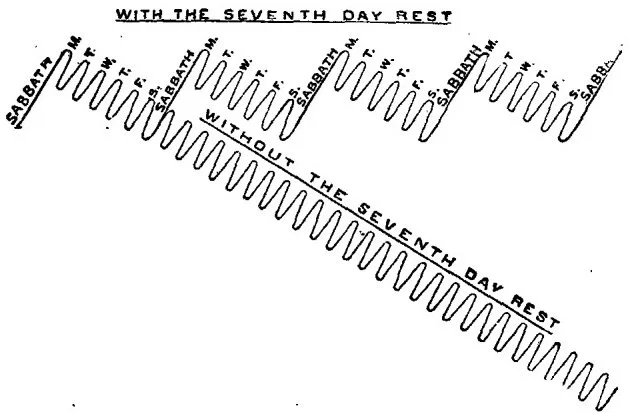
After making the above statements the speaker produced a chart drawn up by Dr. Heagler, with the accompanying diagram,— in which the author claims to have made a new discovery showing the “need of the hour,” that is, how “conscience can be reinforced with science” by the devoting of one day out of the seven to rest.
The speaker said it was hoped that the chart would soon be inserted in the text books of scientific temperance, which are one by one being revised, as they ought to be as familiar and fundamental in every child’s education as the “rule of three,” since this rule of seven is more radically essential to wise living.
Each downward stroke (in the accompanying diagram) represents a day’s work which is not quite equaled by the upward restorative stroke of the night’s rest; so that one is a little weaker every day as the week’s work goes on.
It was further claimed that the laborer in a normal327day’s work, overdraws his oxygen one ounce, and that the normal night’s rest restores only five sixths of it. Losing one sixth of an ounce per day, he is six sixths of an ounce short on Sabbath morning,—a whole ounce short,—a whole day behind—in the same condition physically on Sabbath morning and in the same need of rest as on Monday night. He is therefore called to a whole day’s rest to balance his account with Nature. If he habitually disobeys this divine law of weekly rest, he runs down more and more until he is far from what he ought to be, as is shown by the chart, about which, the speaker said, doctors do not disagree.
Further, that one breathes less oxygen and uses more during ordinary work than when at rest, absorption of mind checking the respiration to the extent of 12,960 cubic inches in eight hours. Oxygen being but another name for vital force, the bearing of the foregoing facts on health and strength is apparent. So that if this reparation is not supplemented by an occasional longer period of rest, the system is subjected to a gradual falling in pitch. So that one may “read the fourth commandment in a drop of blood by the aid of the microscope.”
The reader of the above needs no aid to see the underlying object of this pretended science, or as the Scriptures put it, “science falsely so called.” We are sometimes met with the objection that we cannot keep the same day all around the world, therefore a seventh part of time is all that is required; but the above reasoning makes it impossible to keep a seventh or any other equal portion of time.
Every person in the least acquainted with the chemical properties of the atmosphere knows that the vitalizing property of oxygen is found in different degrees in different localities. In the pine regions of the North, ozone or oxygen gas is found in greater abundance than in the lower and more malarial regions of the South. In fact there is scarcely two degrees of latitude where the air is charged with the same proportion of oxygen. So that a law compelling people to stop work a sufficient length of time to take on the wasted oxygen from a certain number of normal days’ labor would vary according to the amount of oxygen gas found in the different latitudes. In some localities it would be necessary, according to the above diagram, to have a “Civil Sanitary Sabbath” about every third day, while in more healthy regions these periods of rest might be two or three weeks apart.
In China, the people have kept no sabbath for centuries and yet they have not “run down” or run out either; and facts show that they live to as great age as do those who keep Sunday regularly.
Again, there is a large element in society that live sedentary lives. They need no civil Sunday law to compel them to be idle that they may take in a sufficient amount of gas to keep them from “running down.” It would be far better for this class of people if they could get out every Sunday and exercise their muscles by honest toil or innocent amusement.
We quote the following from “Home Hand Book of Domestic Hygiene,” page 239:—
“During forced respiration, when a larger quantity of air is inhaled, the quantity of oxygen lost in the lungs, and the amount of carbonic acid gained are of course greater [italics ours], which is also true of the other changes mentioned. It should be remarked that the amount of carbonic acid gained is a little less than that of the oxygen lost.”
According to the above, the amount of oxygen lost depends upon the degree of respiration, and this depends upon the amount of exercise taken. Hence, a civil Sunday law should specify just how much each one should respire during the week. Or if this could not be done, then the law should gauge the time of rest to suit each individual case. So that those who work in the furnace in hot weather and respire very rapidly might have their sabbaths come at shorter intervals; and the man whose employment is less violent and in a cool place, and hence respires much less, should have a longer interval between his periods of rest.
Once more: A person with weak lungs who is compelled to labor beyond his strength to get a living for himself and his family would certainly require a longer time to recuperate his wasted energies than a robust healthy person whose occupation required but little physical exercise. Surely a law requiring stated periods of rest could not fall in equal proportions upon all classes. Then how foolish and absurd to think of basing a “Civil Sunday Law” upon the amount of oxygen gas required to recuperate our wasted energies. No one but a drowning man would ever catch at such floating straws.
Those who are acquainted with the history of the papal church need no microscope to read in the blood of the saints and martyrs of Jesus Christ the outcome of the first Sunday law enacted by Constantine in A. D. 321, in speaking of which Dr. Neander says: “In this way the church received help from the State for the furtherance of her ends.” And the same results are seen in the Sunday laws of the present time.
Nor does human vision need artificial aid to see in this whole scheme of civil Sunday legislation the dragonic spirit which was to make war upon the remnant of the church, who keep the commandments of God and have the testimony of Jesus Christ. Rev. 12:17.
Let the reader beware. God is not mocked with any such pretended reforms as are proposed by these men who make void the law of God by forcing upon the people the traditions of Rome. Again we say, Beware!
Judicial Usurpation.
“Twentieth Century,” May 1.
The three cent car fare law which was put into operation in Indianapolis, two weeks ago has been declared null and void by a federal judge from Chicago. The judge says it is a piece of special legislation, but whatever it may be there is no evading the fact that the Constitution of the United States never contemplated any such interference with the rights of a sovereign State as this decision forms. It is a most flagrant usurpation. Judge Showalter, who rendered the judgment in this highly important case, denied that the Supreme Court of Indiana has any right to pass upon the matter in controversy. It is a great disappointment to find that the three cent car fare can be abrogated in defiance of the will of the people.
The corporation magnates are naturally highly delighted at the victory they have won. A curious feature is the wholesale series of injunctions issued by Judge Showalter. In the first place, he enjoins the State prosecutor from enforcing the law. He enjoins the governor of the State from executing it. He enjoins the city officials in Indianapolis from recognizing the law, and he enjoins the street railway company from receiving a three-cent car fare. It seems very strange that a Chicago official can thus govern the whole State of Indiana. Government by injunction is evidently capable of infinite expansion and application.
We should not now hear any more nonsense about the will of the people being the supreme law.
Crafts on the Saturdarians' Waterloo
THE Rev. W. F. Crafts writes in the May Christian Endeavorer of “The Saturdarians’ Waterloo,” which he says has been occasioned by Mr. Gamble’s “great discovery” about the Sabbath. But the cause of the seventh-day Sabbath has met a good many “Waterloos” of this kind and is still moving on without any mark of having ever been defeated.