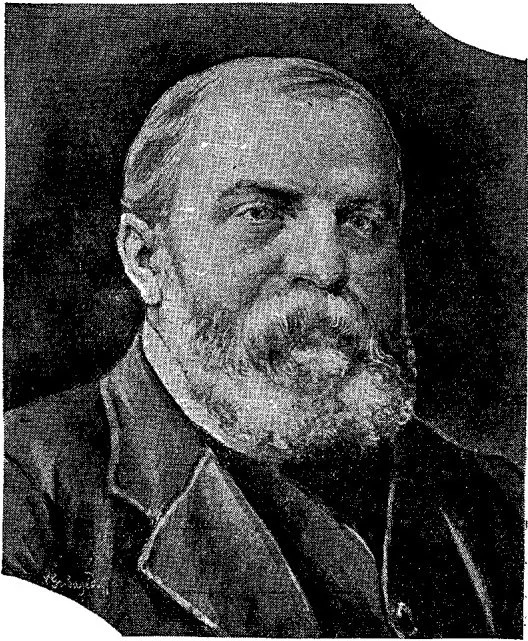
Whoever neglects this has only a mutilated Gospel, for the Bible teaches us not only of the death and sufferings of Christ, but also of his return to reign in honor and glory. His second coming is mentioned and referred to over three hundred times, yet I was in the Church fifteen or sixteen years before I ever heard a sermon on it. There is hardly any church that does not make a great deal of baptism, but in all of Paul’s epistles I believe baptism is spoken of only thirteen times, while he speaks about the return of our Lord fifty times; and yet the Church has had very little to say about it. Now, I can see a reason for this;
THE DEVIL DOES NOT WANT US TO SEE THIS TRUTH, for nothing would wake up the Church so much. The moment a man realizes that Jesus Christ is coming back again to receive his followers to himself, this world loses its hold upon him. Gas stocks and water stocks and stocks in banks and railroads are of very much less consequence to him than. His heart is free, and he looks for the blessed appearing of his Lord, who, at his coming, will take him into his blessed kingdom. . . .
In certain churches, where they have the form of godliness, but deny the power thereof—just the state of things which Paul declares shall be in the last days—this doctrine is not preached or believed. They do not want sinners to cry out in their meetings, “What must I do to be saved?” They want intellectual preachers who will cultivate their taste, brilliant preachers who will rouse their imagination, but they don’t want the preaching that has in it the power of the Holy Ghost. We live in the day of
SHAMS IN RELIGION.
The Church is cold and formal; may God wake us up! And I know of no better way to do it than to get the Church to look for the return of our Lord.
Some people say, “Oh, you will discourage the young converts if you preach that doctrine.”
Well, my friends, that hasn’t been my experience. I have felt like working three times as hard ever since I came to understand that my Lord was coming back again.
I look on this world as a wrecked vessel. God has given me a life-boat, and said to me, “Moody, save all you can.” God will come in judgment to this world, but the children of God don’t belong to this world; they are in it, but not of it, like a ship in the water; and their greatest danger is not the opposition of the world, but their own conformity to the world. This world is getting darker and darker; its ruin is coming nearer and nearer; if you have any friends on this wreck unsaved, you had better lose no time in getting them off.
But some one will say, “Do you then make the grace of God a failure?”
No; grace is not a failure, but man is. The antediluvian world was a failure. The Jewish world was a failure. Man has been a failure everywhere when he has had his own way and been left to himself. When the Son of God left heaven, and came to this sin-cursed earth to open up a new and living way whereby we might return to God, the earth would give him no better quarters than a manger for his birthplace, no place to lay his head during the years of his ministry, and only the cruel cross in his death.
Nowhere in the scriptures is it claimed that the whole world shall be brought to the feet of Christ in this dispensation. In the fifteenth chapter of Acts, James says: “Simeon hath declared how God at the first did visit the Gentiles, to take out of them a people for his name.” That is one reason for our Lord’s delay. He is waiting329until the elect are all gathered out, until his Gentile bride is complete.
The Power of His Coming.
By A. F. B.
If men believed the scriptural truth that in the last days “wicked men and seducers shall wax worse and worse” until the Son of man returns to destroy sin and sinners, it would revolutionize church methods. Men would cease trying to save a ship-wrecked world and redouble their efforts to save sinners out of the world. They would drop all National Reform and Christian citizenship schemes of saving the State and go to saving sinners. Knowing this to be true, we print below two articles from prominent evangelists on the subject of the second coming of Christ. A. F. B.
The Blessed Hope.
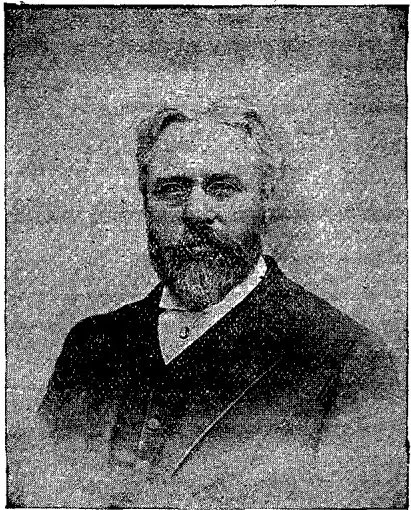
By Geo. C. Needham
By Rev. Geo. C. Needham.
“LOOKING for the blessed hope and appearing of the glory of our great God and Saviour Jesus Christ.”
A blessed hope means a happy one. The word refers to inward enjoyment apart from external environment. The expectations implied in such a hope make all present circumstances of trial or depression “not worthy to be compared with the glory which shall be revealed to usward. For the earnest expectation of the creation waiteth for the manifestation of the sons of God.”
IT IS A PURIFYING HOPE.
“And every man that hath this hope in him purifieth himself, even as he is pure.”
As linen bleaches under the sun, the light of this hope cleanses the life from world stains. It loosens the grasp from the things of earth.
The man who has a magnificent mansion in some beautiful locality, and is only tarrying in a city hotel for a few days till he can journey home, will not care to spend his time and money in elaborately decorating his temporary lodging in the strange city. If he purchases bric-a-brac or pictures, the thought in his mind is, “I will take them home.” So the Christian, who reckons himself a “pilgrim and a stranger” here, will have little heart to spend his energies on things pertaining merely to the earthly. His city and his home lie beyond. His great concern will be to “lay up treasures in heaven.”
IT IS A PACIFYING HOPE.
“Therefore judge nothing before the time, until the Lord come, who will both bring to light the hidden things of darkness, and will make manifest the counsels of the hearts; and then shall every man have praise of God.” “Be patient, therefore, brethren, unto the coming of the Lord. Behold, the husbandman waiteth for the precious fruit of the earth, and hath long patience for it, until he receive the early and the latter rain. Be ye also patient; stablish your hearts; for the coming of the Lord draweth nigh.”
In the power of this hope all questions of provocation can be patiently laid aside for the Lord to settle on his arrival. The child of God who is pervaded with this hope will be willing to waive all rights of self-vindication, knowing that his “labor of love and patience of hope” will not go unrewarded.
IT IS A COMFORTING HOPE.
“But I would not have you to be ignorant, brethren, concerning them which are asleep, that ye sorrow not even as others which have no hope.”
The lustre of this hope shines most conspicuously in the consolation it brings to those who are called to part with their loved ones by death. The unbelieving bury their dead without any certain or definite expectation of re-union. For in no human scheme of philosophy is the truth of a resurrection even hinted at. But the Scriptures definitely promise this. “For if we believe that Jesus died and rose again, even them also which sleep in Jesus will God bring with him.” The Apostle Paul, after explaining all this to the Thessalonian Christians, and showing them the immense advantage they had over the heathen who knew nothing about the advent in majesty of Jesus Christ, or of the resurrection, adds finally, “Wherefore comfort one another with these words.”
IT IS A GLORIOUS HOPE.
“For our citizenship is in heaven; from whence also we wait for a Saviour, the Lord Jesus Christ; who shall fashion anew the body of our humiliation that it may be conformed to the body of his glory, according to the working whereby he is able even to subject all things unto himself.” “By faith Abraham, when he was tried, offered up Isaac; and he that received the promises offered up his only begotten son, of whom it was said, that in Isaac shall thy seed be called; accounting that God was able to raise him up, even from the dead; from whence also he received him in a figure. . . . Women received their dead raised to life again; and others were tortured, not accepting deliverance; that they might obtain a better resurrection.”
This hope would be meaningless apart from the locality and the circumstances where it anchors itself. It leaps over time and space to the period when Jesus Christ shall himself be glorified as King of kings according to the eternal purpose of the Father.
PROMISES.
This blessed hope embraces several promised glories:
1. We shall be with Christ. Not as in death, when we are said to be “unclothed” and “waiting to be clothed upon with our house from heaven.” In an actual sense we shall “see Him as He is,” and be ourselves like him, personally and morally.330
2. We shall be beyond sinning. Now we groan for deliverance. Pain and the curse encompass us. The consummation of that hope will bring full redemption to the body.
3. We shall know as we are known. “Now we see through a glass darkly; but then face to face; now I know in part; but then shall I know even as also I am known.”
News, Notes, and Comment.
THE theory of divine right in government is treasonable in the United States as well as blasphemous among Christians. It is really nothing but the European conception of the divine right of emperors and kings. It does not matter whether you call a man Czar or President, if he owes his position to “the grace of God,” and is responsible to Him alone for his actions. It does not matter how you choose your Congress or your legislature, if, after you have gotten either, you propose to consider its proceedings in the light of a revelation, and make it practically an ecclesiastical council. For my own part, I prefer a single tyrant to several hundred. And, if a set of men is to prescribe rules of conduct for me, which I am to accept as “founded on the law of God,” I would prefer them to be as few as possible. A smaller despotism is more easily “tempered by assassination,” for one thing, than the despotism of the many-headed.
“DIVINE right” no more exists in the people than in emperor or king. The sovereign people of America are trifled with, and insulted as well, by the puerile maxim “vox populi, vox dei.” They know that, try as hard as they may, they often fail to secure the services of public men who are wise and honorable. They know that many wicked laws are passed with wicked purposes, and under the pressure of wicked motives. They know that monstrous blunders are repeatedly made in legislation, and gross wrongs perpetrated in the course of public administration. They do not make the mistake of laying these things at the door of heaven. Sooner or later, they “turn the rascals out.”
AND the people know, too, that they are no more capable of infallibility in the making of a fundamental constitution than they are capable of it in the selection of those who are to act for them under its provisions. Of course, if an American constitution were really “based on the law of God,” once promulgated, it would be perfect and unchangeable by any human agency whatsoever. But American constitutions expressly declare that the people may amend them at any time, and at their own sweet will—so that they have a check on their rulers in general and in particular—the first of which may be applied by simply abolishing the whole frame of government, and substituting another; and the second, by the operation of the great principle that elections should be “frequent and free.”
AMERICAN democracy, then, is really applied Christianity, albeit there is no room for “divine right” anywhere in its creed. It applies Christianity to practical politics by removing religion altogether from the business of State-craft. It follows the Master by disclaiming the power and the inclination to soil Christianity with the mire and the dust of civil contention. Not only does it refrain in practice from infringing on individual rights of conscience, but it expressly admits and declares that it has no power to infringe. Every implication otherwise, every suggestion of a connection between civil obligations and duties, and the obligations and duties of the religious life, is rank treason to true Americanism.
NOR is this offence lessened by that wretched juggling with words which some have lately attempted by declaring that they do not want Church and State, but they do want religion and State. The two are synonymous terms for the purposes of this argument. A State church, like all other churches, has two distinct functions—she is a master of ceremonies and a director of souls. In her first capacity she is less objectionable than in her last. There is no political reason why the State should not set the details of a gorgeous ritual before the people, except the one of expense—which, to be sure, is conclusive. The principle of religious freedom and religious equality, which is what Americanism stands for, and is the constant object of assault—this is violated whenever and howsoever a religious dogma is incorporated in a statute, and wherever a practice is found, in the course of civil administration, which originated in a religious conception, and derives its sanction therefrom. An instance of the first violation is the “Sunday law”; an instance of the second sort is the swearing of witnesses, and the “swearing in” of Presidents, etc.
ALL “Christian Citizenship” leagues are thus under the ban of the Master’s displeasure. Christianity has nothing in the world to do with citizenship. A good Christian—which means simply a real Christian—cannot but be a good citizen. So a real Christian is of necessity a good father, husband, son, as the case may be. But one may be a good citizen without being or even pretending to be a Christian. Jews make excellent citizens, for example. Any man that behaves himself with outward decency is a good citizen. It does not matter whether he does this because he is afraid of the penitentiary, or because he dreads the social ostracism which would follow a different course. He is all right as a citizen, so long as he is all right on the outside.331
BUT Christianity has no concern with the outside, except as an indicator of the condition of affairs within. Whether the man does right or not is no matter from her standpoint, unless he does right from one single motive. This test is severe, but there is no other. It is made the more serious by the fact that one is often confused as to his own motives. But the analysis must be made at some time, according to the Master’s very explicit announcement. Let us, then, “Render unto Cæsar the things which are Cæsar’s,” and—the rest we all know.
That West Point Chapel Again.
By Editor
It appears that the Catholics are not, after all, to get their Government chapel at West Point. Attorney-General McKenna has delivered an opinion in the matter, denying the power of Secretary Alger to grant a lease of Government ground at West Point for a longer term than five years, and this limited concession will not answer the purpose which the Catholic authorities have in view.
The facts which led up to the present situation are these: Secretary Lamont, during the administration of Mr. Cleveland, granted “Father” O’Keefe, the Catholic priest at West Point, the privilege of erecting a chapel on ground designated by the commandant, the license for which was to be revoked by the Secretary of War on sixty days’ notice. Secretary Alger extended the time of notice to six months. “Father” O’Keefe then proposed that he would erect a stone chapel, costing $20,000, which, on completion, he would present to the United States on condition that it should be used in perpetuity for the celebration of Catholic religious services. The matter came before the Attorney-General, and in his decision he says:—
“This case came before me, and after carefully reviewing all the statutes I decided that the Secretary of War had no color of law to accept a gift such as Father O’Keefe contemplated. I reviewed every statute covering any phase of the matter as to the Secretary’s right to grant such a license as was given by both Secretaries Lamont and Alger. On these I decided that it would be impossible to grant such a license without further legislation, and remitted the proposition to Congress.
“There is one statute giving the Secretary of War the power to lease any Government property in his care, not in use, for a period of five years. I could not satisfy myself that the erection of a stone church of the cost and dimensions determined came within the provisions of the law. The fact that the United States reserved to itself the right to revoke the lease or license did not cover the ground, because the mere fact of the erection of such a building contemplated a perpetuity. Such an expense would not be incurred unless the parties tacitly understood that the United States would refrain from exercising its rights.
“This would confront the Government with enduring a perpetuity not contemplated by law, or at some time or in some emergency exercising a right in a manner that might seem invidious. Therefore, because of the absence of sufficient statutes and also on the ground of good public policy, I decided that the Secretary had not power to grant the license sought by Father O’Keefe. My decision is very full and covers all the points. Religious sentiments did not enter into it.”
We must not omit to notice the fact that Attorney-General McKenna is a Roman Catholic. It might be thought that he would have decided the matter in a different way, but he says that “religious sentiments did not enter into it,” and we are glad to give him the credit of acting in an unbiased, honorable manner. All honor to upright men, whether Roman Catholics or otherwise. The SENTINEL has nothing against Roman Catholics. It has nothing against men of any shade or unbelief. It opposes only what it believes to be evil principles.
Toronto Votes to Allow Sunday Street Cars
THE vote taken in Toronto, May 15, on the question of running street cars on Sunday, resulted in a victory for those demanding Sunday cars, by a small majority. Toronto can now no longer be spoken of as the model “Sabbath-keeping” city. It is doubtless a great disappointment to the defeated side not to be able longer to compel people to walk on Sunday who would prefer riding, but they can console themselves with the reflection that they and all others are just as free to walk as they were before.
Dr. White's Book on Science and Theology
Dr. Andrew D. White, ex-president of Cornell University, has published a book on the “Warfare of Science with Theology.” That such a warfare exists is undoubtedly a fact; but it should be borne in mind that there is no necessary connection between theology and Christianity.
Children's Ideas of Satan and the Angel of Light
In a Sunday-school quarterly of recent date Dr. Earl Barnes strikes at a popular religious fallacy by mentioning that “many children have formed their ideas of Satan from the picture on the cans of deviled ham.” This is unfortunate enough, certainly; but it might have been still worse if their conceptions on this point had been derived from some pictorial representations of an approved orthodox type. The only authority on the subject is Scripture, and that speaks of Satan as appearing in the form of “an angel of light.” 2 Cor. 11:14. The people generally have been so fooled by what theology and tradition have taught them on this point, that they have been prepared to see the devil only in that which to most minds is shocking and repulsive, and not in that also which is beautiful, “respectable,” and even “pious;” and as a consequence they have been easily duped by the arch-deceiver. The devil knows enough not to appear with cloven hoofs, horns and tail when he wants to catch people whom anything outwardly repulsive would repel.
The Strength of a Nation.
“New York Observer,” May 13.
THE true strength of a nation, or of a society, is never determinable by rough mass measurements, or long insurable against lapse and loss if, after the manner of Asiatic despotisms, the few are allowed to treat the many as though they were their natural born or accidentally subjugated serfs. Power in the last analysis is personal rather than popular. That nation alone can survive in history where the individual factor stands out sharp and clear. . . . Virtue in bulk, and piety by proxy, will not do. Not any number of serfs, howsoever many they be, make nations, make fames, make histories, but only intelligent, self-assertive freemen. We cannot calculate from any amount of corraled cattle. The real unit is the man, not the mass. Historic totals are footed up beginning with the lowest-written integers, and if any ciphers are admitted to Time’s enduring columns, it is not the ciphers which take precedence of, but those which follow after the human units. The man is the measure of mankind.
Keeping God’s Commandments.
By C. H. Keslake
BY C. H. KESLAKE.
To know God and Jesus Christ is to keep the commandments. That this is true will be evident by reading John 17:3: “And this is life eternal that they might know thee, the only true God, and Jesus Christ whom thou hast sent;” and Matt. 19:16, 17: “And, behold, one came and said unto him, Good Master, what good thing shall I do that I may have eternal life? And he said unto him . . . If thou wilt enter into life, keep the commandments.”
Not only is this true, but the keeping of the commandments is evidence that one knows God. Proof. 1 John 2:3: “And hereby we do know that we know him, if we keep his commandments.” Not that one knows God as the result of keeping the commandments, but that he keep the commandments as the result of knowing God.
It is the bounden duty, apart from the idea of its being a blessed privilege, of every man to “fear God, and keep his commandments.” It is because of failure to do this that sin and iniquity abound on every hand and in every conceivable form.
Jesus Christ came into this world with the boundless love of God in his heart, to so reveal the Father that He might bring people to recognize Him and render a willing obedience to His will.
Every word and act on the part of Jesus was with this supreme end in view. In doing this he went forth relying wholly upon God, and trusting in the arm of the Infinite.
In the hearts of all who should yield themselves to Christ there would be implanted that which would not only enable them to love God with all their heart, but also love their neighbors as themselves. This would not only make them good Christians, but would also make them good citizens, rendering honor to whom honor is due, tribute to whom tribute, always remembering that the “powers that be are ordained of God.”
Christ worked always and only in harmony with principles, the recognition of which would contribute to the stability of any government—even the principles of the government of God.
It is because these principles are not recognized that the governments of earth are not enduring,—or rather, had these principles alway been recognized, there never would have been but one government—that of God, extending throughout all creation.
As the principles taught and preached by Jesus Christ are not recognized by the governments of earth, and only through these can the stability of any government be333maintained, it follows that the time will inevitably come when earthly governments will cease to be, to give place however to the everlasting kingdom of Christ.
When our Lord left this earth he gave to his disciples the great commission of preaching the gospel to every creature, equipping them for that work by endowing them with power from on high—by giving them the gift of the Holy Spirit. They were to be as he was, and just as the Father had sent him into the world, even so sent he them—armed with the same mind.
But it is evident that some of the professed followers of Christ have sought to improve upon his methods. The chief thing that Christ kept in view has—if not altogether ignored—been made secondary, while they have set about reforming the State, making that their chief business. To accomplish this they have sought to secure legislation compelling the observance of God’s law. This the Saviour never did, for the simple reason that he knew that that method would not, because it could not, accomplish the desired result.
The great evil, so they think, at which they aim in their work of reform(?) is that of Sunday desecration. This, they say, is a violation of the law of God, supposing Sunday to be the Sabbath. Just what connection Sunday sustains to the Sabbath of the Decalogue has never been shown. Even a cursory glance at the fourth commandment will reveal the fact that Sunday is not the Sabbath, for that reads “the seventh day is the Sabbath of the Lord thy God,” while every body knows that Sunday is not the seventh day, but the first.
As a matter of fact the first day, as such, is not mentioned in the commandment, and only has a place there by virtue of its being one of the six days in which God made the heavens and the earth, and because of which He says to His creatures, Six days shalt thou labor, and do all thy work. According to the commandment, therefore, Sunday is only a common working day.
Not only does the fourth commandment show that Sunday is not the Sabbath, but the whole Bible will show the same thing.
This being so, it will be seen that even though their methods of securing obedience to the law of God were correct, all their efforts must end in complete failure, for they are expended in behalf of the wrong day.
This will explain why it is they are seeking human help, instead of relying upon God’s power, for Sunday as a Sabbath is only a human institution. But on the other hand, if Sunday were the right day, their methods are wrong.
The violation of the Sabbath, like that of all the other commandments, has its source in the heart. Make the heart right, therefore, and there will be no trouble on the score of Sabbath desecration, or any other evil.
No human law ever enacted could do more than bring about a pretended observance of the day, while it would be adding another to the victim’s long list of sins—the sin of hypocrisy.
No human law ever enacted, or that shall ever be enacted, or all of them put together, can ever make a man know the Lord. And as no man can ever really obey any one of God’s commandments without his knowing God it follows that the only way in which this work can be done is to simply do as Jesus did—preach the gospel of the grace of God, relying upon the arm of the Infinite One for success.
Breaking the “Sabbath” to Stop “Sabbath Breaking.”
New York “World,” May 18.
JOSEPH FINK, of Nanuet, was on his way to church last Sunday, when he saw Farmer Farrell ploughing in his field.
“Why, Brother Farrell,” he said, “working on the sabbath?”
“Yes,” said the worker, “been delayed by the pesky rains, and got to get things under ground, you know.”
Brother Fink forgot about church, and ran off to Justice Haerle’s to get a warrant. Justice Haerle issued it and Constable Snyder served it, all on the sabbath.
Brother Farrell was fined $5 for breaking Section 263 of the Penal Code, and Brother Fink felt as good as if he had heard a bushel of sermons.
Seventh Part of Time: A Sabbath Anecdote
Miss B., a bright young lady of —ville, had become convinced that Scripture requires the observance of the seventh day of the week, instead of the first day, as the Sabbath; but the Rev. Mr. C., pastor of the Church of the Venerable Tradition, very lucidly showed her that not any specific day, but only a seventh part of time,—any one day in seven—was all the commandment requires to be observed. Meeting her one day shortly after, he said:—
“Good morning, Mary; I hear you are married now.”
“Yes; I married one of Mr. Brown’s sons,” was the reply.
“Mr. Brown has a fine family of sons—seven of them, I believe. Which one did you marry?”
“Oh, no one in particular; I just married one seventh of them,” said Mary, while her eyes twinkled.
“Oh—ah—yes—I see, I see,” gasped the discomfited pastor, as he resumed his walk.—Gospel Sickle.
Our Next Issue.
By Editor
Our issue of May 3 will not be a “special,” but it will be of special interest to all our readers. Inasmuch as it is issued near the time when the thoughts of the people are directed to the fruits of war,—when they decorate the graves of those who fell in the late struggle, the SENTINEL will devote considerable space to militarism. Excellent cuts will illustrate the preparations for war. Extra copies can be had at the usual price.
Mass Meetings Urge Stricter Sunday Law in Rhode Island
Mass meetings were held recently in Pawtucket, Providence and East Providence, in the interests of a more stringent Sunday law in that State, and “strong resolutions” on the subject were passed on each of these occasions.
TO OUR PATRONS:
By Editor
Write names plainly.
Remit by P. O. Money Order, or Express Order, or by Bank Draft on New York. Personal checks are not desired.
Make all Orders and Drafts payable to Pacific Press Publishing Co., not to the editor or any other individual.
We will receive Postage Stamp in small quantities and any kind of good money. Defaced coins will not be taken. If paper money or coin is sent, register the letter.
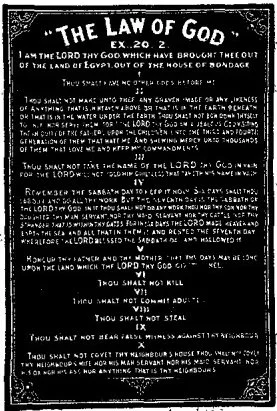
SOMETHING NEW, NEAT, NICE,
And necessary, if you would know, and have others know the COMPLETE DECALOGUE as God spake it from Sinai’s flaming summit.
A CHART 12 X 18 INCHES
On thick paper mounted at top and bottom with metal and ready to hang on the wall.
Postpaid 25 cents.
Postage stamps acceptable.
Address, PACIFIC PRESS PUB. CO., 39 Bond Street, New York.
AMERICAN STATE PAPERS
A MOST valuable work on the subject of religious legislation in the United States, from the foundation of the Government to the present time.
It includes the various prominent acts, both State and national, relating to subjects of religion, such as Bills of Rights, Amendments, Treaties, Sunday Observance, etc. In it are found various Memorials, Petitions, and Remonstrances; House and Senate Reports on Sunday Mails; documents on “The Sphere of Civil Government,” “The Rights of the Jew,” “Religion in the Public Schools,” “Civil Laws Against Blasphemy,” “Christianity and the Common Law,” “Sunday Legislation,” etc., etc.; Judicial Decisions on Sunday Laws and the Bible in the Public Schools. It also contains in an appendix the provisions in the Bills of Rights of all the States, relating to the rights of conscience, and
The Sunday Laws, Complete,
OF ALL THE STATES AND TERRITORIES.
There are also running footnotes all through the book, containing the comments and statements of eminent men.
368 pages. Price, best binding, $2.00, Cheap edition, $1.25.
PACIFIC PRESS PUBLISHING CO.,
39 BOND STREET, NEW YORK.
Kansas City, Mo.
Oakland, Cal.
Invaluable to Bible and History Students
By Alonzo T. Jones
THE EMPIRES OF THE BIBLE
FROM THE TIME OF THE FLOOD TO THE BABYLONIAN CAPTIVITY.
By ALONZO T. JONES.
Recent research in Babylon and Egypt has brought to light many valuable historical records that were inscribed in stone by the very men living in those ancient times. These records and the Bible history of the same time are woven together in one connected story. Another important feature of the book is the tracing in a series of twenty-one maps, the course of those empires. The design of the book is unique, and every student either of Bible or history will find it invaluable.