Home Bible Study Series. Outline of Subjects—Continued
By Editor
XI. FROM SIN TO RIGHTEOUSNESS.
1. Conviction of Sin—Repentance. What It Is.
2. Conversion from Sin. How Wrought.
3. Born Again. How Much Is Involved?
4. Baptism. The Mode, the Meaning.
XII. MAN'S SIN AND SAVIOUR.
1. Man's Creation and Fall, and What Was Lost by the Fall.
2. Object Lessons of God's Mercy to Man in Misery.
3. Our Great High Priest.
XIII. THE SANCTUARY AND ITS CLEANSING.
1. The 2300 Days of Dan. 8:14. Why the Bible Student Can Not Set Time for the End of the Age.
2. The Sanctuary and Its Cleansing. The Work of Christ as Mediator and Priest.
3. The Judgment and Its Proclamation. God's Effort to Render Men Worthy of Acquittal at the Bar of Deity.
XIV. THE RULE OF THE JUDGMENT.
1. The Immutable, Eternal Law of Jehovah.
2. The Law and the Gospel; and Their Interrelation.
3. Christ and the Law—Writing the Law in the Heart.
XV. THE GREAT MESSAGE FOR TO-DAY.
1. Present Conditions in the Religious World—Disunion, Confusion, Apostasy.
2. The Healing Message of the Most High. Rev. 14: 6, 7.
3. What Its Rejection Means to the Individual; to the Church.
XVI. THE GREAT MESSAGE FOR TO-DAY (Continued).
1. The Law—the Standard of Life and Character.
2. The Sabbath. Is It Temporal or Eternal?
3. The First Day of the Week. Its Claims upon Us.
XVII. THE GREAT MESSAGE FOR TO-DAY (Continued).
1. The Third Angel of Revelation 14—Result of Two Former Messages.
2. The Beast and His Image. What Is the Meaning of the Beast?
3. The Two-Horned Beast; It Is Not the Catholic Church. Of What Is It a Symbol?
XVIII. THE GREAT MESSAGE FOR TO-DAY (Continued).
1. Attitude of Beast Power Toward God's Law.
2. The Attempted Change in the Law of God.
3. The Mark of the Beast. What It Is. Who Possess It.
XIX. THE GREAT MESSAGE FOR TO-DAY (Continued).
1. What the Two-Horned Beast Symbolizes.
2. Change from Principles of Liberty to Principles of Tyranny.
3. Progress of Apostasy; the Center of Church-and-State Apostasy.
XX. RELIGIOUS LIBERTY.
1. Man Created a Free Moral Agent, Equal in Opportunity and Inalienable Rights.
2. Teachings of the Bible—Christ's Words.
3. Embodied in Primitive Americanism.
4. How to Secure Man's Rights.
XXI. THE CHURCH OF GOD. WHERE SHALL WE FIND HER?
1. A Called-Out Body.
2. A Converted Body.
3. Scattered in Babylon.
4. Centering Always in the Remnant.
XXII. THE SPIRIT OF GOD.
1. Creative Power and Energy.
2. The Spirit and the Word.
3. The Spirit in Conviction and Conversion.
XXIII. SPIRITUAL GIFTS.
1. The Gift of the Spirit—Righteousness.
2. The Gifts of the Spirit for Service.
3. All the Gifts Restored in the Remnant Church.
XXIV. THE SEAL OF GOD.
1. The Remnant Church—The Last Remnant.
2. All Error of the Time Met by Abundant Truth.
3. The Seal of God—Loyalty to the Creator.
XXV. REVIEW OF SOME OF THE GREAT TOPICS COVERED.
BIBLE READINGS
With each number a Bible-reading upon the topic concerned, correlating some of the plainest scriptures upon the subject considered, pertaining to religion, the Bible, history, and godly living.
QUESTIONS
All questions accompanied by postage, name, and address, will receive reply through the paper if at all consistent; if not, by mail. The Question Corner is one of the great features of the SIGNS OF THE TIMES, and meets the needs of a constantly growing band of inquirers.
OUR BIBLE BAND
The SIGNS OF THE TIMES has a Bible Band composed of earnest souls who, with its editors, read the Bible through every year. A new plan, reading the Bible chronologically will be followed the year to come. Great help and blessing have come through this department to those taking part in the readings.
THE OUTLOOK
Never were conditions more interesting and ominous in the political and religious worlds. The forces of good and evil, never so intensely active as now, are engaged in a life-and-death struggle which affects the world. The seer of God in prophetic vision nearly three thousand years ago, looking down the long vistas of time and seeing present world-conditions, exclaimed, “MULTITUDES, MULTITUDES IN THE VALLEY OF DECISION.” The days are days of doubting and indecision.
The editors and writers of the SIGNS OF THE TIMES, as they must meet these things in the judgment of God, will endeavor to lead uncertain souls in the right way.
Our Outlook and Editorial Departments will deal with world-conditions and soul-needs week by week in the light of the word.
MISSIONS
The true Christian must be a missionary, and hence will be interested in mission fields. But the great events which are occurring in the great mission lands of the earth are also of general interest to the student of politics and history. The SIGNS OF THE TIMES has experienced and reliable correspondents in all the great mission fields of earth.
THE HOME
One of the mightiest agencies for the upbuilding and saving of the church and society is the Home, and the SIGNS OF THE TIMES recognizes this. In right physical living, in true temperance, in all that makes for true fathers and mothers, true sons and daughters, true, attractive homes, the SIGNS will seek to help its readers.
POETRY
It will not forget its readers who love poetry—and who is there whose heart has been renewed by God's Holy Spirit that does not love it? Much of God's word consists of poetry. The poetic as well as the prophetic gift was demanded in the conveying of great truth.
ILLUSTRATIONS
The SIGNS OF THE TIMES has an editor who is also an artist. It has connection with the art and photography of all lands. It will use illustrations wherever the topic treated can be helped by their use.
SUBSCRIPTION PRICE
The series of 25 numbers to one name and address — $0.75
Five or more copies of this series of 25 numbers mailed direct from the office of publication to names and addresses furnished, each — .60
Five or more copies of the series of 25 numbers to one name and address, each — .50
In clubs of 5 or more to one name and address, cost as follows:
5 copies 25 weeks, full series — 2.50
10 copies 25 weeks, full series — 5.00
15 copies 25 weeks, full series — $7.50
20 copies 25 weeks, full series — 10.00
25 copies 25 weeks, full series — 12.50
50 copies 25 weeks, full series — 25.00
All over 50 copies same rate as above.
Cash must accompany all orders not sent through tract societies.
Send your subscription at once in order not to miss any of these special numbers.
Yearly Subscription, 50 numbers, $1.50.
Address your Tract Society, or SIGNS OF THE TIMES, Mountain View, Cal.
Calvin’s Four Hundredth Anniversary
By Jean Vuilleumier
Calvin Street II. At the left, the house where Calvin lived
John Calvin
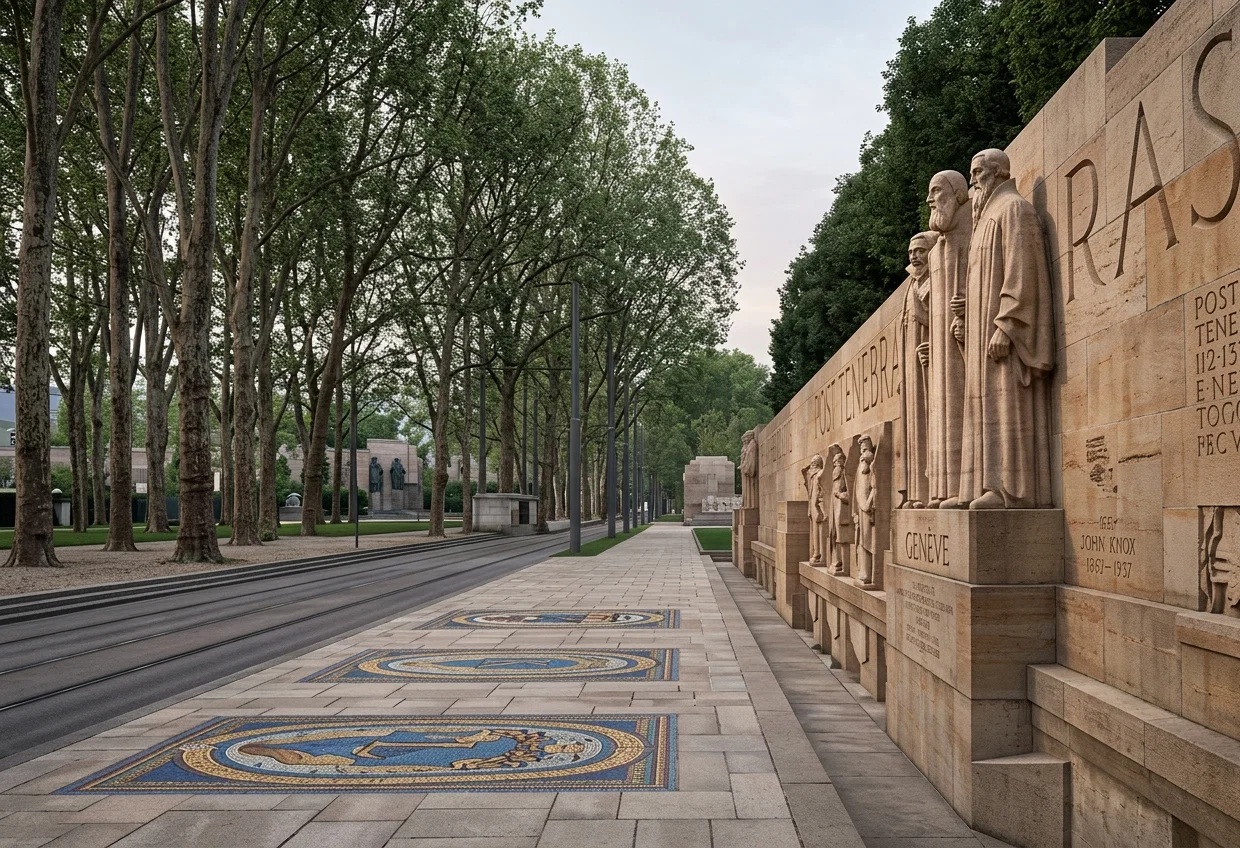
The Monument of the Reformation as it will be when finished
A Great Jubilee
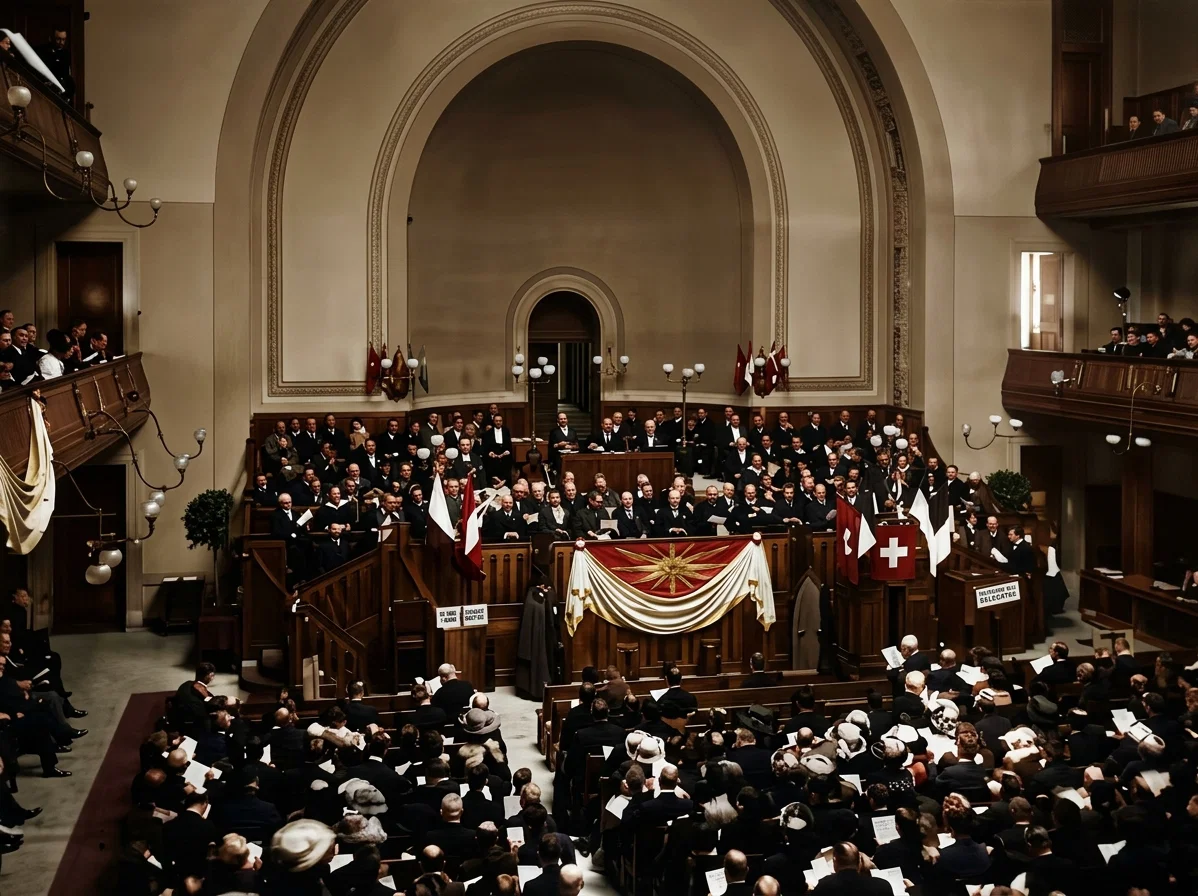
During the first week of July, the city of Geneva, splendidly decorated, was the happy host of hundreds of distinguished visitors, who had come to attend the festivities of a great jubilee. It was just four hundred years, on July 10, since the birth of John Calvin. When it is remembered that to this man, under God, this city owes everything it has of worth, it is not surprising that Geneva should make an effort, after four centuries, to honor his memory. The university and the church celebrated their jubilee together. June 5, it was exactly 350 years since Calvin formally opened, at the Saint Pierre Cathedral, the academy of Geneva, of which the present university is the outgrowth.
Things were done generously and sumptuously, rather after the manner of the world and not at all after the manner of Calvin and the early Geneva customs which now seem too austere. Fine banquets were offered, and many of them; grand meetings were held, in which many eloquent tributes were paid to the Reformers and their work; a cantata, “Post Tenebras Lux” (After Darkness Light), the city’s motto, specially written for the occasion, was sung at the cathedral by a special choir; the first stone for a grand monument of the Reformation was laid; the guests were taken in steamers around the Geneva Lake, stopping at the historic Castle of Chillon, where a noted tragedy, “Abraham Sacrificing Isaac,” was played by university students; and last, but not least, the University offered the title of Doctor, honoris causa, to 150 of her learned guests.
So much about the jubilee festivities. Let us now take a look at the hero and the meaning of this jubilee.
The hero was graphically described at the opening meeting held in the cathedral, in which Calvin used to preach, by Prof. E. Doumergue, dean of the Montauban (France) Protestant Theological School. Professor Doumergue is the author of a monumental work on Calvin, and was well chosen to speak on “Calvin, the Preacher of Geneva.” He described him at his home near the cathedral, now Calvin Street II; among his friends; at the state house, conferring with the city councilors; at the Auditoire, teaching the Bible to his students; at the cathedral preaching to the people at six in the morning or at three in the afternoon.
The preacher was middle-sized, his complexion sallow, his face small and sickly, but beaming with intelligence and decision, his delivery slow but energetic; his style was simple and familiar, abounding in colloquial terms and comparisons from daily life; alternately rude with the thunders of the law, and graciously sweet with the love of God.
All phases of life, all realms of thought, were dealt with by the pastor of Geneva: the home, the church, the state, social economy, industry, commerce, legislation, hygiene, fashion, marriage, recreation, education. And where did he find the wealth and variety of his teaching? Where did he take the authority which accompanied his words?—In the Bible, of which he was but the humble servant and expounder. The Bible was the leaven with which he kneaded the Huguenot dough of the sixteenth century. The Bible faithfully preached for twenty years, preached daily and, if need be, twice a day, the Bible as the only rule of faith and life, the Bible, whose writers are as “the sworn notaries of the Holy Spirit,” the Bible fearlessly, perseveringly and intelligently studied and preached,—herein lies the power and success of Calvin.
So far as he had the light, Calvin preached the pure Gospel, in its simplicity and logic, in its austerity and mercy. Not all law or all love, but a commingling of the two at the cross of Christ, the law as our schoolmaster to bring us to Christ, and Christ bringing us back to a law fulfilled in Him. The Cross of Calvary and the Ten Commandments stood out as the two great pillars of his theological temple, as the two light-houses set out by God on the shores of life, albeit he did not see the claims of the fourth precept. On this point I take pleasure in quoting Prof. Williston Walker, from Yale, one of the delegates at the jubilee, in his “Life of Calvin”: “Calvin introduced so much clearness and order into Christian theology, that he is par excellence the theologian of the Reformation, and one of the three or four greatest interpreters of religious truth to be found in the history of Christianity. This portion of his work is found in his commentaries and especially in his great work, ‘The Institution.’ These commentaries are the best that the Reformation produced. Such as Calvin expounded it, the theology of the Reformation arose to a clearness, a dignity, and a logical precision in the definitions which were never surpassed.”
This teaching, coupled with a faithful catechizing of the growing generation by Calvin’s collaborers, could not but produce fruits of a high character. Indeed, to John Knox, who was one of Calvin’s students, the Reformer’s system appeared “as the most perfect school of Christ which ever existed on earth since the time of the apostles.” And the well-known French historian, Michelet, writes thus of the marvelous transformation which took place among the turbulent Genevians: “The laughing, sarcastic, changing city, where so many fine intellects were drowned in the superstitions of the Middle Ages, where so many noble hearts were polluted in the defilements of dissipation, became an astonishing city, where every thing was ardor and prayer, reading, labor and austerity, the great school of faith and martyrs.”
In order to deserve such eulogistic testimonies as these, it would seem that Christians to-day might feel like giving up some of the luxuries and fashions forbidden in Geneva during the sixteenth and seventh centuries. Let us read some regulations published twenty years after Calvin:
“To artisans and mechanics, their wives, their children and servants, it is forbidden to wear costly and glaring cloth, precious furs, or braids of silk; neither shall said women and girls wear bonnets costing more than an écu.”
“Servants and room maids shall not wear high-priced goods, but shall be content with cheaper ones, as heretofore, and shall not wear bonnets costing more than eighteen sols, neither any fashionable collars.”
“It is also forbidden to tailors to make henceforth any new fashions of clothes without permission from our said lords.”
Other regulations, dated 1639, recommend to women to dress in all modesty, without powder, paint, precious stones, not to curl their hair or uncover their chest. Other regulations were addressed to men with the same import. Still other rules served to check the appetite, forbidding the use of too many dishes at one meal.
The Geneva of to-day differs widely from the Geneva of the past. In greeting the delegates to the church jubilee at the Reformation Hall, Pastor Guillot said: “We have ceased to be a city of the Spirit, a school of faith and martyrs; Geneva has taken the aspect of a worldly and cosmopolitan city, a city of pleasure. And yet pious hands pass to each other the sacred torch: may you perceive it?”11
During the jubilee, a Geneva writer and professor, Philip Monnier, wrote in the Journal de Genève: “We are no more the austere city molded by Calvin after his own image. We are no longer the united, studious, and cultivated city of a hundred years ago. The walls have crumbled which encircled us so tightly. The principles have fallen which gave our public life such a fragrance of virtue. Other interests lead us, and other cares solicit us. A cosmopolitan crowd has invaded the open place. All opinions are being ventilated, all winds are blowing. We are ourselves divided, discordant, and contradictory.”
Such a marked and sad change is not without a cause. What is it? Can it be discerned? Can it be pointed out without error or injustice? Might it not be that the very principles upon which the Reformers built, and which, from common consent, produced such a beautiful edifice, have been abandoned? The writer just quoted confesses it: “The principles have fallen which gave our public life such a fragrance of virtue.” But where have the principles fallen? We are forced to answer: At the very sources of life, private and public, in the very religious teaching it self. Geneva theologians have not kept the sacred trust handed down to them. The inheritance of the Reformers has been exchanged for scientific discovery so-called; the Bible has been laid aside, or rather, torn and dissected by higher criticism, to such an extent that nothing of it is left, neither historical records nor doctrinal teaching. And of course the belief about God the Father, Christ the Son, the majesty of the law, the character of sin, the atoning value of the sacrifice on the cross, eternal life, the glorious return of our Lord,—all these pillars which the Reformers had placed under the dome of the edifice they built, have been undermined and laid waste. What else could be expected than the sad results which have been portrayed?
To prove the above statement, let me just quote a few words which crept out from the carefully written discourses made at the jubilee. In the very pulpit in which Calvin used to preach, the dean of theological professors at Geneva defined religion as follows: “A feeling of dependence toward an unknown power above us, which religious souls call divinity, and others force, ideal, and duty.”
Speaking of the Son of God, the same teacher called Him the “Jesus deified by tradition,” “the Christ who is no more.”
Another pastor, speaking officially in the jubilee, referred to “the error into which the Reformers had fallen in opposing an intangible Catholicism, an intangible Bible,” and he added: “In a general way, we can no longer admit their conception of the Bible nor their theological method.”
Need we go any further in search of the cause for the ravelling out of the noble work of the Reformers? Is it not even a little surprising and extremely illogical, that with such convictions regarding the principles of the Reformers, Protestants of to-day should have given themselves all the trouble of organizing the grand jubilee just witnessed in the city of Lake Léman?
Whatever plausible explanation may be given for this, may I be allowed, in closing, to draw from this whole matter a conclusion which I do not think any one will contradict? The teaching of the Reformers brought out beautiful results, religious, social, and political. The world is hungering for just such a state of society as those principles created. Let us, then, return to the principles of the Reformation, which are the same which Christ gave to His apostles to preach, and which made the apostolic church.
JEAN VUILLEUMIER.
Books and Battle-ships
The delegates at the opening meeting in Reformation Hall
More than seventy per cent of all the people in Russia over nine years of age can neither read nor write. Russia spends about six cents per capita for education and about one dollar per capita for battle-ships and naval equipment. If Russia should disband her army and educate her citizenship, she would be much stronger. Japan, by sinking the Russian fleet, has shown to Russia and to the world that it is possible for a nation to get along for a while at least without a navy. The report is that Russia is about to open 143,000 primary schools.—California Christian Advocate.
The Decline of Nations
By Editor
The London “Times,” of July 6, in an editorial on “National Nervousness” declares that “we know next to nothing as yet of the laws that govern the growth and decline of nations. We can study history for those laws, but no one has yet found them. Many different reasons have been given for the decline of the Roman Empire, but most of them merely amount to a statement that the Roman Empire did decline.” We can tell The Times, and all others, where they may find the reasons, and that source of information is God’s word. In that word is found all the reasons why individuals and nations decline. It will show also that notwithstanding all that men may do, if they transgress the laws of their existence, if their usefulness for God comes to an end, they are bound to decline, and no power can save them.
Spiritualism and Demonism.
UNDER this caption the “Independent” of April 1, 1909, has a few words to say which show that occasionally, at least, some one thinks of the true explanation of spiritualistic phenomena. While the Society for Psychical Research is working on the hypothesis that the phenomena are due to some mental influence emanating from the medium or other source, possibly a disembodied spirit, the phenomena themselves often more clearly indicate that they are originated by beings of devilish caprice. A portion of the article reads as follows:
“While the Society for Psychical Research is seeking evidence that the spirits of the dead may communicate with the living, and while some of our most competent students of physics accept it as a fact that they do, we are forced to the conclusion that such an existence after death as these spirits show us through Mrs. Piper and other mediums, is not worth the having. The platitudinous inanities which these spirits repeat, excite no wish for such an existence as theirs.
“We would commend to the study of the Society for Psychical Research another side of the question, that of demoniacal possession. Every one believed in it two centuries ago. Most of the attacks on Luther’s character are based on his violent and vulgar treatment of devils. Our missionaries have much to say about demonism in China, and Dr. Happer has written a very interesting book on the subject, while other missionaries have declared that Korea is peculiarly infested with devils.”
Our dead friends and acquaintances do not visit us. Such appearances are the “spirits of devils, working miracles.” Rev. 16: 14. “The dead know not anything.” Eccl. 9: 5. Their thoughts cease, their emotions perish. They have nothing more to do with anything under the sun. Eccl. 9: 6, 10.
Cuba’s Deficit and Political Patronage
Cuba’s financial deficit this year is due in no slight degree to the salary list of the government, which has been swollen all out of proportion to the real needs of administration by the clamorous demands of the politicians for office. The government of Gomez is said virtually to admit this condition of affairs, but, at the same time, it points out that the situation can not be remedied, inasmuch as satisfying the pressure for office was the price of peace in the island. In other words, it is so easy to start a revolution in Cuba by burning a plantation or two that any politician of importance can force a multiplication of places at the public crib. Allowing for exaggerations, there must be some truth in these explanations, if one may draw inferences from the appetite for office so highly developed in our own country.
Divorce in San Francisco
Six days in the week there are an average of eight divorces granted in San Francisco. Sometimes the number runs up to fifteen or twenty. But taking the average of eight, there are 2,496 divorces in a year. Considering the average life of those concerned as 30 years of maturity, and not forgetting that there are two in every divorce, 150,000 people in San Francisco have been divorced. That is something more than half the number of those who have been or are married. There seems to be something the matter with the institution of marriage, or is it the human race? — News Letter.
A Deed of Merit
By Elisabeth Gowdy
By Mrs. Elisabeth Gowdy
THROUGH the narrow, congested streets of Foochow a gaily decorated sedan-chair was borne with great pomp. In it sat a Chinese woman in gorgeous clothing, with the curtains of her sedan rolled up so that she appeared in full view, smiling and bowing to people as she passed by. This publicity alone would have attracted attention, even if it had not been for the red banners borne in front of the chair, announcing that on a certain day this same smiling little widow would hang herself in memory of her late husband. An act of such merit so cheerfully contemplated was heralded far and wide, and each day added numbers to the throng which followed the widow as she thus advertised her self-sacrifice.
Rumors of the coming event had reached even my foreign ears, but lately accustomed to Chinese tones. Thinking that I must have misunderstood, I sought an explanation from that fountain of knowledge, my Chinese personal teacher, who only confirmed the rumor.
“But why should she wish to do a thing like that?” I inquired.
“It shows that she loves her husband so much that she wishes to go to him at once,” he replied. “Now she thinks of him constantly and grieves for him, but she fears that if she lives she may forget him,” he added, with delightful naiveté.
Then he went on to tell me that in earlier times a widow who performed so great an act of merit as this would have been accorded the highest honors; her spirit would have been worshiped by the officials and the people. Now, however, since the coming of missionaries, the practise was gradually passing into disfavor.
Chinese Sedan-Chair
On this occasion there was, indeed, a great deal of feeling aroused not only among the missionaries, but also on the part of all the foreign residents. But what could be done? No one had any authority to interfere, and it seemed as tho the widow’s plans were about to reach their consummation. The appointed day came, and the scaffold was erected in the center of a large open space near one of the foreign business houses. Hundreds of Chinese and a number of foreigners had gathered to witness the ghastly spectacle. The widow ascended the scaffold, and the halter of red cord was slipped over her head. According to custom, it was the duty of her nearest male relative to take from under her the stool on which her feet rested, thus leaving her to hang; but if this final act should be performed by any other person the deed would lose some of its virtue as an act of merit.
All were now waiting breathlessly for this next of kin to appear. Just as he was about to draw away the stool, however, a Chinese official stepped forward and forbade his going any further, thus putting a stop to the entire ceremony. The American consul had been using his influence with the officials, and had told them how disgraceful the whole affair appeared to the eyes of Westerners.
The widow was released, and was taken charge of by a lady of the English mission, who has been trying ever since to lead the poor, benighted creature into a knowledge of Christ. A number of these would-be suicides have become happy Christians, and have lived noble, useful lives.
With such “deeds of merit” as these held before the Chinese people, is there any one who will still cling to the time-worn argument that the old religious beliefs of China are “good enough” for the Chinese?—World-Wide Missions.
A New Alignment in India
A Call to Christians
REV. J. H. WYCKOFF, D.D., of the Arcot Mission of the Reformed Church in America, reports from Vellore, India, to the American Tract Society a new alignment of forces on the field, and asks that the Christian line of defense and attack be doubled in the supplies of literature. He writes:
Foochow, China
“Never was there a time when the printed word had such a mission in India as to-day. Education has spread so rapidly that newspapers and periodicals in both English and the vernacular are numbered by the hundreds. Madras has three daily newspapers in English and one in Tamil, all edited by Hindus; while a new weekly or monthly organ is so common as not to excite attention. Children of the lowest class are studying English, and native presses are sending forth a perfect flood of literature of every kind and description.
“Christian missions must be alert if the great tide of anti-Christian teaching is to be met and stemmed. The old-line tract with its exposure of folly and idolatry, superstition and caste, is no longer sufficient. The conflict now centers round the fundamental principles that separate Christianity from Hinduism. The nature of God, the doctrine of sin, the way of redemption, the future of the soul—these and other basal13truths must be presented from the Christian standpoint, and it must be shown where they antagonize Hinduism.
“Theosophy, which is a sort of refined paganism, is exerting no little influence on the educated mind. It makes much of the Hindu belief in reincarnation, and with its doctrine of karma proclaims a salvation by works well-pleasing to the carnal mind. Not a few Indians, in their escape from Western materialism, have become infatuated with theosophy, the humbling doctrine of the Cross being an offense to them. Its subtle errors must be exposed, and this can only be done through the Christian press.
“There is also a revival of Mohammedanism, and the priests of Islam are especially active in the propagation of their faith. Tracts and books attacking the Christian religion, and supporting the claims of Mohammed, are being disseminated in various vernaculars. The erection of a mosque in London, and the pampering of Islam by interested Europeans, have done much to flatter the pride of Mohammedans and quicken their zeal for a time.
“God is thus shaking the nations, and the way for the establishment of His kingdom is being prepared. Can you not double the amount of your remittance this year? We have a good printing-press in connection with our Industrial School, and if we had the funds we could do something in the way of publication.”
Easily Given
“A SMILE, a word, a touch,—
(And each is easily given)
Yet either may win
A soul from sin
Or smooth the way to heaven.
A smile may lighten the failing heart,
A word may soften pain’s keenest dart,
A touch may lead us from sin apart,—
How easily each is given!”