NINE months have passed since we left Shanghai to enter upon our work here in Manchuria. They have been busy months. We were still unfamiliar with the language and the people who came to investigate the truth, but we had to go ahead and do the best we could. As we look back over our work, our hearts are made glad because the Lord has been with us and blessed us, and our efforts have not been in vain. During the winter months we held three meetings a week, besides giving Bible readings to those who came for further instruction. For some time some of the inquirers have been looking forward to the time when they could follow their Master in baptism. Desiring to lay a good foundation for the beginning of our work here in this field, we held them back until they became more fully established in the truth. Finally, we decided to baptize five who we thought were ready, and let the others wait and continue studying a little longer.
On the twelfth of July we gathered with these candidates on the banks of the Hun-ho only a few miles from the city of Mukden. Though it is the rainy season, and we have rain almost every day, heaven seemed to favor us on this day. It was a little cloudy on the way out, but just at the time of the baptism the sun came forth, and it did not rain until the service was over and we had reached home. Brother Grundset spoke to the bystanders concerning the meaning of the ordinance, after which the writer buried the candidates in the watery grave. Their faces beamed with joy and gladness as they rose to walk in newness of life. Two days after, we organized our first church in Manchuria, of eleven members, and the following Sabbath celebrated the ordinances of the Lord's house. We pray that this church may grow and be the means of winning many precious souls to the truth.
Manchuria seems to be ripe for the message. Many calls are coming to us from different places, to come and instruct the people. A little over two weeks ago I left Mukden for a larger city farther south. A call has been coming to us from Liao-yang for some time. One of our canvassers went there some time ago to sell magazines, and as a result some became interested. An elderly man has begun to keep the Sabbath. He has a store, which he now closes every Sabbath day. Many others are very much interested, and desire to have us come and instruct them. One morning recently our Chinese teacher read a letter to me which he had just received from one of his friends living about one hundred and thirty miles west of Mukden. While we were attending the general meeting in Shanghai, this man came to Mukden, and hearing about us, sought us out. Our Chinese helper gave him some literature, which he took home with him. Since then our Chinese teacher has been sending other books to him, and now he and others in his town are anxious for us to come and instruct them. Today another letter came from the north, where for more than a year people have been anxiously waiting to hear the message; but we have not been able to answer the call. We are now planning to send them a Chinese evangelist who can instruct them in the truth.
Thus the work is continually going forward. But we feel our great need of more workers to answer the calls that come to us. There is a great work to be done here in this large field, and we rejoice when we see how the Spirit of God is working upon the hearts of the people, preparing them to receive the message. We are all of good courage, and are doing what we can to hasten the finishing of the work.
Pernambuco, Brazil
By F. W. SPIES
F. W. SPIES
AFTER finishing our work in Maceio, as described in my last report, I started with Brother Wilfart, on the fourth of June, for Pernambuco, his field of labor. We had sent an appointment on ahead, and I was much pleased to find the following day, Sabbath, fifty-two adults gathered at Musahiba, all of whom, with the exception of four or five, were members of our church, living in and near the capital of the state.
The following Monday, June 7, we embarked for Caruaru, a city in the interior, some eighty-five miles distant. We were glad to find our people there of good courage, and feeling that the Lord had been especially good to them, having preserved them from the dangers of the bubonic plague and an epidemic of smallpox that had shortly before passed through that section. I enjoyed much the privilege of making a visit for the first time to Vasco, a place about five miles from Caruaru, where shortly before ten persons had been baptized; and I also had the pleasure of spending a day at Condessas, about five miles distant from Caruaru in another direction, where seven others were preparing for baptism. On Sabbath, June 12, we had a general meeting at Vasco of all the brethren in and about Caruaru, at which sixty-two adults were present. The ordinances were celebrated, and it was a day of rich blessing.
The following day we started for Santa Maria, going as far as Guarita, where we spent a day with our brethren. Here we began to see the effects of the drought. There had been practically no rain in this section for more than ten months. The planters had planted as usual, but the seed that sprouted and came up was withered by the scorching rays of the tropical sun. The supply of drinking water was also about gone, and all nature looked parched and dreary. Ten leagues farther on toward Santa Maria, conditions improved somewhat, and during our stay of nearly a week it rained a little almost every day, so that we had fresh water from the clouds to drink. After much effort we finally found a place where there was water enough so we could have baptism.
We organized a company of twenty-six, the third company organized on this trip, the three companies having a membership of seventy-one. The Sabbath spent at Santa Maria was also a blessed season, the celebration of the Lord's Supper closing the day's services.
As we were returning from Santa Maria to Caruaru, Elder Wilfart was taken with a severe fever. Time and again he was compelled to dismount and rest in the shade, though we traveled leagues without being able to get the cool, refreshing drink that he craved, the only water available being strongly saline and having a nauseous taste.
From Caruaru we returned to Recife, spending a Sabbath at Paulista, where we had a good meeting. I then returned home, having been absent nine weeks, instead of two, as I had planned when I started. I was thankful to find the work everywhere prosperous, but I realized more than ever the need of more well-trained workers. We are taking steps to start a school for educating such workers, and we believe this need can be to a great extent supplied in the near future, and then the work will make greater progress.
Calcutta, India
By W. S. MEAD
W. S. MEAD
SOMETIMES when we read of the success of efforts elsewhere, and the baptism of scores, we are tempted to feel that we are not accomplishing much out here. Yet we do not allow that to discourage us, but rather to spur us on, knowing that the whole work is the Lord’s, and that fields differ.
Last fall I came from the work in Simla—where we had seen the church built up and some new converts baptized—to help Brother Comer in his work with the people of Calcutta. The work is among the English people in both places.
Photo by W. S. Mead
In October, in one of the best theaters in Calcutta, we began a short series of Sunday evening lectures on the subject of the signs of the times, the coming of the Lord, and so on.
We planned for only four lectures in the theater, but the public supported us so well by their attendance and offerings that we continued into January. Our average attendance was nearly four hundred.
Photo by W. S. Mead
As Brother Daniells was with us for the conference in December, he spoke three Sunday evenings, twice on the European situation, and once on the advent movement in all the world.
All the lectures were well received, and many persons expressed regret that we had chosen their church hour, which prevented them from hearing the lectures. In fact, considerable influence was brought to bear to have us change our hour.
After a permanent interest was established, we closed the theater meetings and continued in our own church hall.
As is usually the case, when people began to see that accepting the truths of God would mean a severing from the world, the attendance diminished. But we have seen ten worthy persons baptized, largely as the result of this effort; and others are now waiting for baptism.
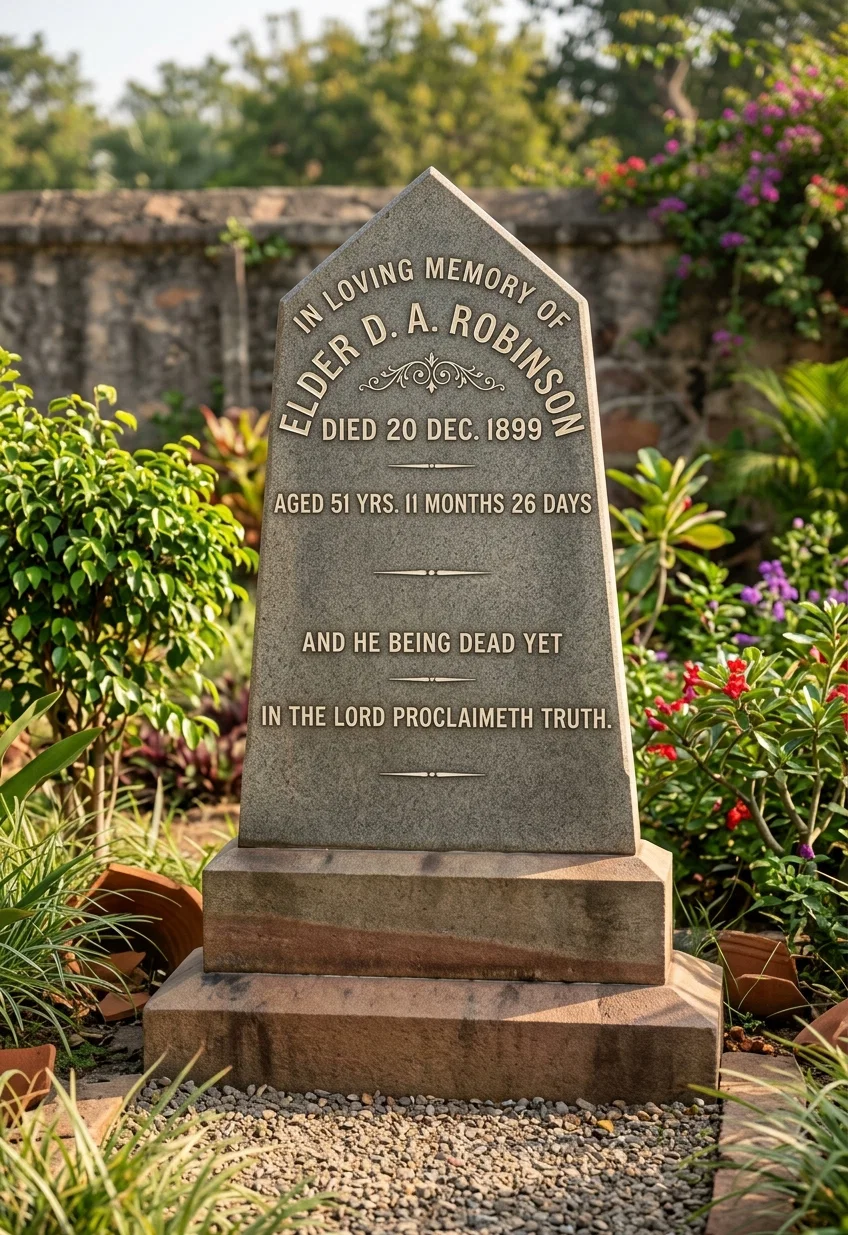
We have realized in this effort the certainty that the works of those who die in the Lord do follow them. The seed faithfully sown years ago by Brother D. A. Robinson and his helper not only bore fruit then, but it has been germinating all these years in the hearts of some, and now by our watering is springing into life. So we enter into their labors and see the fruit gathered in; but we cannot boast, for the harvest is the Lord’s.
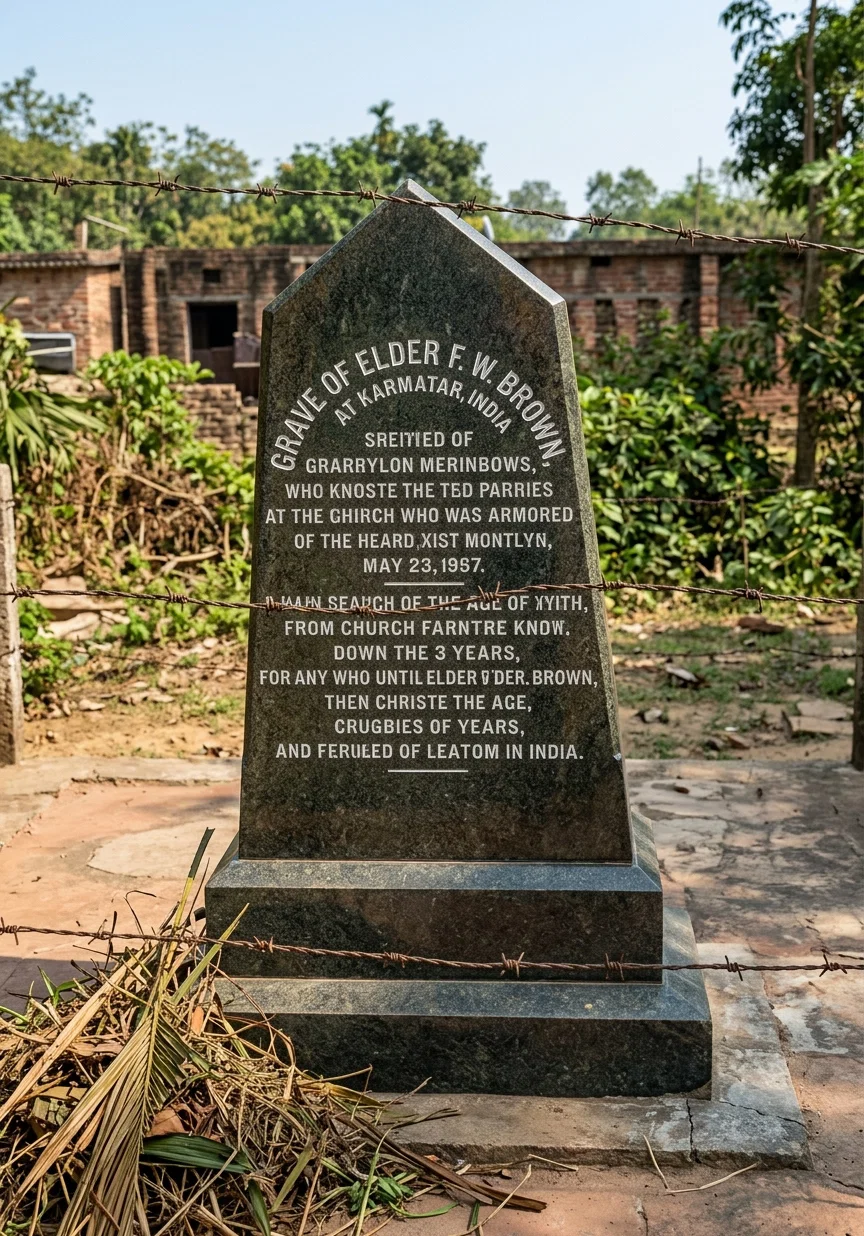
Recently, while on a visit to our Karmatar mission station, which is 168 miles by railway northwest of Calcutta, I went to visit the graves of Brethren Robinson and Brown and others who lie buried there. It is a small private burial ground not far from the house which was our rented mission home before we built our own place farther out from the town. Knowing that many would appreciate a view of this resting place of some of our faithful pioneers in India, I endeavored to get pictures of the stones which mark the graves. The stones are plain and substantial, solid and erect; similar, I thought, to the men they commemorate, and the truths those men stood for.
At present we are in the midst of a summer effort in Darjeeling, the hill town nearest Calcutta.
Shan-Tung, China
By C. P. LILLIE
C. P. LILLIE
SHAN-TUNG Province is one of those great divisions of the Chinese Empire which, as regards extent, resources, and population, are almost empires in themselves. One of the most healthful provinces in all China, populated with a sober, intelligent, industrious people, Shan-tung is naturally an attractive field to the foreign missionary.
Since early in the sixties, when Protestant missionaries commenced labor in the province, a splendid work has been done here for God. Noble-hearted men and women have been working tirelessly and unselfishly for the uplifting of the Shan-tungese. Some sleep in martyrs’ graves. The writer recently had the pleasure of meeting one of the pioneer missionaries of Shan-tung, Mr. Hunter Corbett, of the American Presbyterian Mission, for over fifty years a missionary in Chifu. At present, although nearly eighty years of age, he is still quite actively engaged in street preaching and itinerating.
All these years the gospel seed has been freely sown. As a result, twenty thousand persons have been gathered into church membership. But better than this, from the standpoint of the speedy finishing of the work, prejudice against Christianity has been broken down, and now millions are not unfriendly to the gospel. As one evidence of this we can say that of the many subscribers to the Chinese monthly Signs which we are now securing in Chifu, practically all are heathen, who know that the Signs is a church paper.
In May we were asked by the Asiatic Division to commence work in this great field, and so we have located temporarily in Chifu, a treaty port.
As a result of the visit of Brother F. E. Stafford to Shan-tung two years ago, and the work of some student colporteurs here last summer, an interest has been aroused in two centers, Tsi-nan, the capital, and Chifu. Shan-tung is now ready for the message, “white already to harvest.”
Do not the eternal interests of Shan-tung’s forty million precious souls appeal to you? When you are planning your offerings from now on, will you not remember the needs of this field? And who will volunteer for service? Will not some loyal young hearts quickly respond, “Here am I; send me”?
“Judge Not”
By Gertrude Flather
“Judge not;” thou knowest not all
things. Stay
Thy hasty, bitter word;
Err rather, by indulgence; leave
All judgment to thy Lord.
“Judge not,” the lowly Saviour said.
Wouldst thou his word obey?
Then have no eyes for others’ faults;
Look well to thine own way.
“Judge not;” thou knowest not all
things, nor
Canst ever read the heart,
Nor fathom secret anguish deep
With which some soul may smart.
“Judge not;” thou knowest not what the
load
Thy brother’s life may bear;
Wouldst try to help him lift it right?
Remember him in prayer.
“Judge not;” thou knowest not all;
sometimes
The brightest smile conceals
A heart the while with anguish torn,
Sore pressed beneath life's ills.
— Gertrude Flather.
Home Life Department
By Mrs. I. H. Evans; Miss Lora E. Clement
Conducted by Mrs. I. H. Evans, Takoma Park, Washington D. C.
Assisted by Miss Lora E. Clement
Through the columns of this department, hints will be given on all matters pertaining to the home life. Short articles and letters are solicited from home makers, telling of their everyday experiences,—their joys and sorrows, their failures and successes.
“Mentally Deaf” Children
By Mrs. I. H. E.
Most of us have felt a throb of sympathy for the little lad who, when asked his name, replied that it was “Tommy Don’t.” As long as he could remember, “Tommy Don’t” had been the form of address most often used to gain his attention.
“Tommy Don’t,” “Rebecca Don’t,” “Harold Don’t,”—they’re a large family, the “Don’ts,” and we know them well. Sorry little figures in the realm of childhood are the junior Don’ts—wayward and willful, inattentive, and often apparently openly disobedient. Judging superficially, we feel justified in saying that they need reproof quite as often as they receive it. But should we not avoid superficial judgment? More careful observation will often show that the great mass of admonition and correction falling constantly on the child’s ears, instead of leading him to do better, has had the result of causing him to assume the unconscious defense of mental deafness. By the simple device of not hearing, unless some special note in the words spoken warns him that this time mother is in earnest, he continues carrying out his little plans, with just enough pause to satisfy the letter of the law. It does not take long to reach the place where he really does not hear.
We are quite familiar with this principle. The great mass of New York City dwellers endure without a protest the roar of the “L,” and the thousand and one other sounds that bewilder and terrify the unaccustomed. Those who live near railway tracks seldom notice the passing trains. In the Navy Yard in Washington the workmen are apparently oblivious to the tumult that deafens the visitor.
In American Motherhood for September, Carolyn Sherwin Bailey relates the following incident to show how one who loves and understands children set about the task of changing a small lad afflicted with the malady referred to, into a “hearing,” obedient child:—
“A little boy came to one of the beautiful children’s houses in New York City, unable to obey even the most simple directions put to him by the director. He was an alert, perfectly normal, physically sound little chap; and when he had finished looking over and naming a box of brightly colored pictures of fruits and flowers, the director said: ‘Put the box away in the cupboard, John.’
“The boy looked at her, smiling, his big hazel eyes wide open as they met hers. He seemed to understand, and he started across the room from his low, white table to the white shelves of the material cupboard, where other little ones were busily putting away their pictures and color spools and blocks. John stopped halfway, however, set down his box, and began talking to one of the other children. The director softly but firmly repeated: ‘Put the box away in the cupboard, John.’
“John started, smiled his assent, picked up the box of pictures, and again started. A few steps on, though, he set down the box, and looked out of the window. The director repeated her request patiently, persistently, seven times. The seventh attempt of the little boy to follow a consecutive line of thought was successful. He reached the shelves with his pictures, put them in their place, and fairly leaped into the arms of the director, so deep was his joy at this conquest of himself.
“‘Is John a naughty boy?’ asked an interested observer of the director.
“‘No, indeed,’ she smiled back.
“‘Is he weak-willed?’ queried another.
“‘John has a splendid will,’ was her reply.
“‘Then, why—’
“‘The director answered with a sympathetic understanding: ‘John is mentally deaf. From the time he was old enough to walk, his mother has confused him with such a discord of “don’ts” and “do’s” that the child’s mind has not grasped them. She seldom insisted upon his minding, and gradually John developed this mental deafness. He heard with his “outward ears” what I told him to do, but his brain did not respond in action.’
“‘How will you overcome this condition?’ was the next question.
“‘As I did just now,’ the director explained. ‘I shall lay but few commands upon the little boy, only those that affect his own moral welfare and conduct, and the good of the other children. Then I shall repeat the directions until John learns to hear, and learns, also, to follow his recognition of the command with obedience. In a few weeks John will be a changed boy.’”
“Few commands, and those few obeyed,” is a golden rule for mothers. If you have forgotten how hard rules are to keep, try keeping this one. Not many mothers but will be honestly surprised at the number and minuteness of the directions they lay down each day for the children to follow, and by which they are often adjudged “good” or “bad.”
Little wonder the little folks acquire mental deafness, which is only the first step in the path that may lead them later to throw off all parental control at some crucial moment. Such is often the fruit of too frequent and severe restraint in trifles that really do not matter, so far as the development of the child’s character is concerned.
MRS. I. H. E.
An Experience in Child Training
By MRS. T. E. MOORE
MRS. T. E. MOORE
THIRTEEN years ago I took a little girl almost three years old into my home. While she was quite a cheery-dispositioned child and a most busy one, yet she, like most others, had some faults. The most undesirable and the hardest of all to get rid of was her habit of starting a fuss of some sort at every meal-time. It seemed to make no difference what came, the fuss was never wanting. Everything we had ever heard of or learned from experience, we tried, but the fussing went on just the same, until the case became really unbearable, and I decided that something unusual must be done.
As the time for the next meal approached, she came to ask if it was time to get ready for dinner. I told her that I had decided to have her eat in the kitchen henceforth; that I would fix her a place on the kitchen table, and she could quarrel to her heart's content, as we were going to close the dining room door and could not hear her; that I was sorry such a course had to be taken, but it seemed the only way in which we could have peace at mealtime; and that while we should all miss her, it could not be helped.
At first she seemed to think it quite a joke to eat by herself, and apparently enjoyed her dinner; but when supper time came, and she was left alone, she lost her temper and threw her spoon across the room. As she was preparing to send her supper after the spoon, I opened the dining room door, and quietly remarked that if she wasted her supper, she would get no more to eat until morning.15After a few moments she got her spoon, wiped it, and ate in silence.
When breakfast time came, she asked if she could eat with us, saying that she did not like to eat alone at all. I said, “Certainly, if you will be good, and not quarrel and fuss.” She behaved nicely for six months or more; then we had to send her to the kitchen to eat one more meal alone. Since that time we all wear smiling faces at the table, unless something has happened to bring real sorrow to our hearts.
Prairie, Colo.
Weary Mothers
By Mary K. Buck
O MOTHERS, like me, who are weary,
And often too hastily chide,
Keep not your fond word for the sleepers,
Nor wait for the darkness to hide
The love welling up from the heart
spring
When kneeling your darlings beside.
Let us give of our best in the daytime;
Let mother love brighten and bless
The pathway the dear ones must travel:
Too soon will life's burdens oppress;
Let theirs be the joy to remember
Mother's smile and her tender caress.
— Mary K. Buck.
Mother
MOTHER was a little woman, and never very strong. She had many severe illnesses, and was often at death's door, but she recovered and lived on. She had sorrows, but she survived them. She saw her friends depart, and she mourned them; but she dried her tears, sought out some comforting word in the Book, took up her duty, and continued to live.
Mother became a grandmother, and then a great-grandmother; she even lived to be a great-great-grandmother. She died at the age of ninety-six, and she had seen the blessing of God on her children's children and on their children.
She spent her years as mothers do, caring for her home and loving her children, and teaching them to pray, and day and night lifting up her own prayer to God to help her to be a good mother.
In her old age she lived in the home of her son-in-law. He was in business, but his joy in life was the cultivation of flowers. She sat in the window and watched the flowers he planted; and she saw the world go by her window, and smiled serenely as it passed. Her son came out from the city to see her every week. He was employed by a great railway, and he rose step by step to be its president.
Mother did not know how to run a railway, but she had a few simple maxims that directed her own life, and constantly guided the judgment of others who had more conspicuous places to fill. “Remember this, my son,” she would say, in her calm, even voice, “nothing really counts but character,” and, “Remember that duty never calls us to be in more than one place at one time.”
At last she passed away, with a verse of Scripture on her lips. Hers was a quiet funeral. The minister read from her own Bible, and paid a simple tribute to her memory. It was dignified, old-fashioned, and very beautiful. And although there was no publicity, the house overflowed with friends who came to pay their tribute to the memory of mother.
Mother was little and frail; at her death she weighed only eighty pounds; but two special trains were needed to carry her and those who loved her to the cemetery, and the traffic of a great railway system kept out of their way.
In his private car the railway president sat with the minister, and said, “I have tried to carry into my business the ideals I learned of my mother. I hope I have not failed to do so.”—Youth’s Companion.
Taking It Easier
By MARTHA E. WARNER
Front Porch Visits — No. 4
Taking It Easier
MARTHA E. WARNER
“This has been such a hard day,” remarked Mrs. Bowen one evening, “and, like Laurence, I’ve prayed and prayed, but it doesn’t seem to do a bit of good. The children have acted like wild Indians all day—and I’m so tired. At dinner time my husband said, ‘My dear, you look tired. I wish you would take it easier.’ That’s just like a man—‘Take it easier!’ I wish he had to take my place for a week. He would be ready for the insane asylum. Just as if I got tired purposely!”
“Now, my friend,” said I, “you lie down in the hammock and rest while we talk this matter over. You must excuse me if I say I think your husband is right—you ought to ‘take it easier.’”
“‘Take it easier!’” exclaimed Mrs. Bowen; “I never want to hear those words again. I do the best I can.”
“Dear Mrs. Bowen,” I replied, “I am going to talk very plainly to you. Do you think you are doing yourself and your children justice in allowing them to play all day, while you work? Why not let them help you?”
“Help me! It is ten times easier to do the work myself than to be bothered by them.”16
“That is just the trouble,” I answered; “you do not want to be bothered, but what kind of housekeeper will Helen make when she grows up? Is it not your duty to teach her now? She is old enough to take full charge of the dishes, the dining room, and her own room. Harold ought to keep you supplied with wood, coal, and kindlings, sweep the porches, and be your man-of-all-work. Assign to each child a part of the work for each day. Write out a program for each, so there will be no occasion for forgetting. Even little Fern could help with the dusting.”
“Plan your work so as to work with the children. When their playtime comes, join with them as much as possible. You will have time to get outdoors more if you will gradually change the children’s wardrobe so that white dresses, skirts, shoes, and stockings are used only for Sabbath and very special occasions. Dress the girls in something they can play in and be comfortable. Fold up your sheets, and put them away without touching an iron to them; the underclothing likewise. Cut out the rich pies, cakes, and puddings, and serve plenty of milk and fresh fruit, instead, with some special treat for Sabbath. Don’t let your mending get ahead of you. Stop waiting upon the children, and let them wait upon you. Have a place for their toys and clothes, and insist upon their keeping these things in their places. Plan to have your evenings free for your husband. Then—well, I think I have said enough for one evening.”
“I think you have,” remarked Mrs. Bowen, rising to go. “I came over expecting to receive sympathy, and instead you have given me a lecture. I do not know whether I can digest it all, but I do see some things in which I have failed.”
Clintonville, Conn.
“Folks”
By MRS. M. E. BODWELL
MRS. M. E. BODWELL
“It’s extremely wearisome to me,” declared one, “to hear people continually talking about their ancestors.”
“And to me,” thought another, who heard, “it’s more commendable to praise the dead than to criticize those who dare think or act differently than yourself.”
As a matter of fact, it may not be wise to speak too often or in too glowing language of our “ancestors,” and it surely is not kind to criticize those who do. But there is one relative of whom we may speak with propriety at any time or in any place. His record is one of which any family may be proud. He is our Elder Brother, Immanuel, God with us. To speak of his goodness and his wonderful works is ever the Christian’s happy privilege. Like David, he may say, “I will bless the Lord at all times: his praise shall continually be in my mouth.”
Boulder, Colo.
A Wily Scheme
By Mrs. D. A. Fitch
MRS. D. A. FITCH
SEVERAL years ago as three of us were sight-seeing in Mexico City, we entered the large cathedral. We climbed the many stairs until we reached the tower, being amply repaid for all the toil by being able to see so much beautiful country at a glance.
Some time was spent, but finally down, down the stairs we went. When a portion of the descent had been made, we found ourselves locked in. There was no way to get down and out without each paying twenty-five centavos—not admittance, but exmittance. Such a course of action may be profitable, but it is not Christian. By this incident we are reminded of the schemes of Satan. He will induce us to undertake things that promise great pleasure, and let us well alone while we find enjoyment in them; but when we awake to the fact that it is best to return to that which is better, the door is found locked, and we must pay well in tears, repentance, confession, and perhaps restitution, ere he will permit us to leave his service. It does no good to plead with him to let us go free, for he will never do it. The desire must be presented to Jesus, and he will overcome Satan.
Santurce, Porto Rico.
“The Bread That Comes From Heaven Needs Finest Breaking”
By Julia H. Johnson
“THE bread that comes from heaven needs finest breaking.”
Remember this,
All ye who offer for the children's taking,
Nor give amiss.
The desert manna, like to coriander,
With honey taste,
Was gathered at the word of the Commander,
With cautious haste.
“A small, round thing,” and not in loaves for eating,
The manna fell,
Each day the wondrous miracle repeating,
As records tell.
So make it small, the bread of God, life-giving;
The child is small,
Unskilled in all the strange, great art of living,
That baffles all.
Be mindful of the little ones, and feed them
With living bread;
But break it for them as you gently lead them
To Christ, the Head.
With skill and pains and loving forethought tender,
Provide the fare;
Remember that their powers at best are slender
For whom you care.
Young, pliable souls claim your constant tending;
To these be true;
Be sure to give the bread from heaven descending—
Naught else will do.
Mix not with earthly things that cause distraction,
The bread divine.
The Word itself has infinite attraction,
Yet break it fine;
Nor let them lose, for any selfish reason,
The measure due;
Remember, for their portion in due season,
They look to you.
—Julia H. Johnson.
Broadview Swedish Seminary
By H. O. OLSON
THE Broadview Swedish Seminary opened its sixth year September 15. Strenuous efforts have been put forth during the summer months in order to fill all the rooms and all the seats in our seminary this fall. It is impossible, however, for our teachers to come in personal touch with all our Swedish young people throughout the United States and Canada; even our Swedish laborers in the ministry are unable to do this. In this eleventh hour we therefore again invite the cooperation of all our workers, yes, of all our people.
During the summer vacation about three fourths of our last year's students have occupied all or nearly all their time in missionary work, either in tent efforts or in the canvassing field. The stick-to-itiveness evinced by these student canvassers has been viewed with a great degree of satisfaction by our faculty and others especially interested. Their untiring efforts have also been crowned with success, and present indications are that they will almost without an exception return with their scholarships earned. Some have made two scholarships, and as a result will bring a brother or a sister along to school.
The seminary carries fourteen grades of work, and, although special attention is given to the training of ministerial workers, it also aims to give a thorough course of instruction in music and commercial work. H. O. OLSON.
Nebraska Camp Meeting
By C. S. Longacre
THE Nebraska State camp meeting was held August 19-29, at Hastings, on the Chautauqua grounds, a beautiful grove about a mile and a half from town. There was no street car service in the town, and the roads were so very muddy on account of the heavy rains that it was very difficult to operate the jitneys, so the meetings were poorly attended by the people from the city. About five hundred of our own people encamped on the grounds.
The Sabbath meetings were marked by the mighty movings of the Holy Spirit. Backsliders were reclaimed, souls converted, and consecrations renewed. Forty-three were baptized on the last day of the camp meeting. Over $10,000 was contributed in cash and pledges to foreign missions. About one half of this amount was pledged in land that will have to be sold. The offerings in the Sabbath school were the largest ever known in the conference, the first Sabbath a little over $202 being given, and the last Sabbath a little over $405, a total of more than $600 for both Sabbath days. More than $1,200 worth of literature was sold during the camp meeting.
Elders R. A. Underwood and J. W. Christian, Professors Morrison and Ruble, and Brother McEachern, representing the Central Union Conference, were present and took part in the meetings from the first. Dr. P. T. Magan, Elders Nord and Brodersen, Brethren Simon and Gay, and the writer, were also present. Meetings were held daily among the Germans, the Danish-Norwegians, and the Swedes.
Elder D. U. Hale was reelected president of the conference for the ensuing year. A few changes were made on the executive committee and in the department heads. Our own people were very expressive of their appreciation of the good spiritual meetings and the help they were receiving. They returned to their homes with their hearts full of hope and courage, resolved to live better before one another and the world and to push17the work with greater zeal than ever before. We all felt refreshed and strengthened to fight manfully the battles of the Lord for another year.
C. S. LONGACRE.
The Drink Demon
By Arthur M. Growden
WHAT noble intellects have been destroyed by this demon! Alexander the Great fell before it. He conquered others, but lost the great moral battle.
Byron, the gifted poet, came to his end at thirty-seven. Drink destroyed his powers, and cast his body, dishonored, into the grave.
Edgar Allan Poe, likewise, was vanquished; and William Pitt, the younger, lost his powers through alcohol. Charles Lamb, also, and William Brinsley Sheridan, and Edmund Kean, and Coleridge, son of the poet and friend of Wordsworth, were claimed likewise.
It has been truly said by Gladstone, "Drunkenness expels reason, drowns memory, distempers the body, defaces beauty, diminishes strength, inflames the blood." In the battle of life let no young man dream of success who indulges this evil taste. He cannot win. Every great corporation and railroad has ruled it out; the individual must do the same. Destroy the demon lest he destroy you.—Arthur M. Growden.
Eternal Love
By MARY HENRY ROSSITER
MARY HENRY ROSSITER
WHEN I was a babe, I dozed and dreamed
That God, from beyond the clouds, with me
Had come to dwell in my mother’s arms,
And feed me with love, eternally.
When I was a child, I played, and dreamed
That far in the fairy mystery
Of Oberon’s realm the Queen of Love
Her bower would keep eternally.
When I was a maid, I mused, and dreamed
That life her intent had told to me;
To love was enough for one to do,
To love and be loved eternally.
When I was a bride, I sang, and dreamed
That life had no more a minor key;
My heart was filled with the sweet refrain;
This love will endure eternally.
When I was a mother, once more I dreamed
That out of the depths had come to me
The marvelous pearl of love I sought,
The love that would stay eternally.
But now I am old; my dreams have fled.
From the sunset land a star I see,
The star of a pure and changeless love,
The love that abides eternally.
’Tis not on earth that a perfect love
Can dwell in a human heart for me;
’Tis not on earth that my heart can feel
The love that is true eternally.
Only the infinite love of God
In that perfect heart that is to be,
In that perfect heart of thine and mine,
Can, immortal, dwell eternally.
My star in the west grows brighter, dear,
And oft I think that it beckons me.
How sweet with thee, in that other world,
To love with His love eternally!