[IN a recent number of The Christian Advocate there was an interesting article by J. B. Cranfill describing the writer’s experience at a meeting of Baptists who observed the Scriptural ordinance of feet-washing. The following is a portion of the article beginning with a reference to the sermon.—ED.]
It was based on the incident related in the thirteenth chapter of John, where Jesus washed the disciples’ feet. Never shall I forget the dramatic interest with which this unlettered preacher invested this simple incident. After having enforced his view of the narrative as earnestly as an honest, simple-hearted man could do, he read these words from the chapter mentioned:—
“He riseth from supper, and laid aside his garments; and took a towel, and girded himself. After that he poureth water into a basin, and began to wash the disciples’ feet, and to wipe them with the towel wherewith he was girded. . . . If I then, your Lord and Master, have washed your feet; ye also ought to wash one another’s feet. For I have given you an example, that ye should do as I have done to you. Verily, verily, I say unto you, The servant is not greater than his lord; neither he that is sent greater than he that sent him.”
These exercises concluded, he led in the administration of the Lord’s supper. Then, in imitation of his Lord, he laid aside his garments, and girded himself with a towel. Meantime the membership of the church has been ranged in companies—the brethren on one side, with seats facing each other, and the sisters on the other side, arranged in like manner. When the venerable preacher had thus girded himself, he made his way to Deacon Jack Bellamy, and kneeling, he looked up into the face of that brother, and said, “Brother Bellamy, may I wash your feet?” Tears were streaming from the eyes of both. Deacon Bellamy took off his shoes, and there, kneeling before him, the warm-hearted preacher washed the deacon’s feet, and wiped them with the towel wherewith he was girded. While this scene was being enacted, a venerable dame, whose head was crowned with silvery locks, and from whose kindly beaming countenance there glowed the light of a true Christian’s faith, had knelt at another aged sister’s feet, and was washing them in like manner, and wiping them with the towel wherewith she was girded.
While these simple incidents were taking place, a brother led in singing George Keith’s immortal song:—
“How firm a foundation, ye saints of the Lord, Is laid for your faith in his excellent Word.”
In a little while other brethren and sisters were engaged in the solemn exercise, and all hearts were swept with the keen spiritual interest and fervor that is witnessed on each similar occasion. When almost all the members had participated, a hand-shaking began. Now and then warm-hearted brethren embraced each other, and the spirit of brotherly love and fellowship was regnant in every heart.
On the outskirts of the congregation there were some who had never before been present on a feet-washing occasion. Some of these had come through curiosity, and others, who had a smile of scorn upon their lips when the solemn scene began, were subdued and quiet now, overcome by the intense spiritual interest of the occasion. It was true on that day, as on many another such day, that “those who came to scoff remained to pray.”
Daily Bible Study
By William Covert
WILLIAM COVERT
It is said that the Christians at Berea searched the Scriptures daily that they might more fully understand the things which the apostles preached to them. They are highly commended for doing this. Their understanding of the Scriptures and their faithfulness in the Christian life were traceable to their Bible study. It is impossible for any one to grow in grace and in the knowledge of our Lord and Saviour Jesus Christ, who neglects to study the Word of God. Not one person in the wide world can be a strong and capable Christian who neglects to study God's Word.
It is Bible study and prayer which make the child of God strong to work for Jesus and to bear burdens in his cause. It is the earnest Bible student who becomes the strongest evangelist. Drinking from the living fountain is accomplished by Bible study and prayer. He that reads God's Word and meditates upon it most is best prepared to lead the sinner to Jesus. It is the one who is filled with the Word of the Lord who becomes strong in bearing burdens for the Master. O for more faith in God! but this faith will come into the soul of him who feeds most constantly upon the living Word.
The Living Christ Working Today
“What a joyful sense of companionship it brings to the solitary, what calmness of vision in contemplating the complications and calamities of the world's history, if we grasp firmly the assurance that the living Christ is actually working by the present forth-putting of his power in the world to-day!”
A Thankful Heart
By Edith M. Thomas
Thou art not rich, thou art not poor,
Thy fortune keeps the middle way;
No ills thy strength cannot endure,
Apportioned to the passing day.
Thou art not young, thou art not old,
Yet, calm, thou seest thy years depart;
And joys are thine—a thousandfold—
Because thou hast a Thankful Heart.
A Thankful Heart for life alone—
For beauty in the earth and skies,
And for such share as thou dost own
By happy gift of seeing eyes—
For human love's endearing bond
Where stanchly thou dost bear thy part,
For solace here, and hope beyond—
For all, thou hast the Thankful Heart.
—Edith M. Thomas.
A. Training in Mother's Work
By Mrs. E. H. Whitney
MRS. E. H. WHITNEY
In an article in the last issue of the Haskell Home Appeal was a reference to a course of training at the Home in mother's work, which has raised a question in the minds of some, judging from letters received. “What is the course? and for whom is it intended?”
Early in the history of the Home we learned that love for children, though essential to the work, did not of itself make successful mothers, so we began classes with those employed in the Home, in which we attempted the study of the individual child, the influences which had made him what he was, and the influences needed to correct wrong tendencies and develop right ones. We called these first classes Mothers' Meetings.
Of course we were led out on many lines,—the physical, the mental, the moral, and the spiritual condition of the child, his heredity, his employments and recreation, and many other things affecting the development of character. Out of these studies grew a course which we have found it necessary to ask every one to take who assumes any considerable responsibility in the care and training of the children. Physicians from the Sanitarium, teachers and others who have given the subjects years of study, have assisted in the instruction; and the course, as a whole, opens avenues of thought and experience which the worker in any mission field, home or foreign, will find of invaluable help.
The instruction in nursing is practical and valuable; and while it is not intended as a full nurse's course, it is calculated to prepare the student to do home nursing whenever circumstances may require, and is an advantage if she wishes to enter a nurses' training school later.
So also the work in Christian education, kindergarten, domestic science, sewing, sloyd, and physical culture is intended to open the door for the student into wider fields, in which, if she chooses, she may pursue to further proficiency any one of these to which she finds herself especially adapted.
Who can take up this work to advantage?—Those who are to be connected with the Home as caretakers, as we have already said, and young people who wish to make work with children and youth a specialty. Such will find the instruction and the experiences in the Home helpful, whether they are preparing for kindergarten work or for the supervision of some department in an industrial school.
The Lord says, through the prophet Malachi, that before the coming of Christ he will “turn the heart of the fathers to the children, and the heart of the children to their fathers.” See Mal. 4: 5, 6. This is being fulfilled on every side. Not alone among those who profess to be looking for the coming of the Lord, but everywhere thinking people are studying the problems of childhood and its development. Many principles of education and training that have long been overlooked are attracting attention, principles which the Christian parent or educator finds in the pages of his Bible, and to which God's Spirit has been trying to call our attention as a people for thirty years or more. Those who go “to the Word and to the Testimony” find these principles in their purity. Those who depend on the reflected light of science find more or less of truth, but mingled with it is a vast amount that is useless, if not actually misleading. The enemy of our souls and of our children's cares little how much people search for light if he can divert them from the true source, and lead them by false lights.
There are parents everywhere among our people, and among others as well, who are asking seriously concerning their duty to their children. Like Manoah, they inquire, “How shall we order the child, and how shall we do unto him?” See Judges 13: 12. Letters often come to us from those who are not objects of charity, but who feel that their burden is too great to carry alone, asking us to take children, or mother and children, for a few months' training or experience. It is not the mission of the Home to relieve parents of responsibility, but we would gladly aid such in any way possible. Many of these parents would welcome to their homes those who could give them practical, helpful suggestions, who could set them on the right track of studying for themselves. Some of our more experienced workers have been highly appreciated at general meetings, especially where children were in attendance. From various places where they have gone, we have had most appreciative words concerning their work. More such might go out every year, besides those who could fill important places in the Home itself, if more earnest Christian women would give themselves to the work.
One thing which seems to us to lie at the basis of child training is the relation of the child to the Bible and its study. Let a young child learn to love the Bible, and he will always find it a safeguard,—a lamp to his feet, and a light to his pathway. The Bible is therefore made the basis of our kindergarten work, and is given a leading place in all the educational work of the Home. The result, especially in the development of the little ones, has been such as to strengthen our convictions as to the wisdom of the plan.
We may be asked, What have you to show for your work with the children?—To this we would answer, Character is not formed in a day nor in a year.
Only eternity will furnish the full test; but whenever a conscientious worker who has grasped the idea of spiritual and practical training, has remained at her post, the results upon the children have been most encouraging. The failures, so far as evident, have come largely from the lack of such help in the Home, and the consequent necessity of untrained caretakers and frequent changes. The straightest sapling may be bent out of its course if subjected to pressure before it is hardened, and any child, however well he may seem to be developing under right influences, if these influences are for any reason interrupted, is likely for the time, at least, to degenerate, though the seed sown in prayer and watching may not utterly fail. During the past year we have refused many children whom we would gladly have taken, because we had not sufficient help, and were unwilling to take greater risks in this direction.
The course for the coming year begins in November. We shall be glad to answer by personal correspondence any questions concerning the details of the work. Address Haskell Home, Battle Creek, Mich.
The Mission of Cookery
By Mrs. E. E. Kellogg
MRS. E. E. KELLOGG
The true purpose of cooking should be such a preparation of food materials as will so change their constituent elements as to make them more digestible than they would be in a raw state. Indeed, good cookery is a partial preliminary digestion of the food elements; at the same time it breaks up the food by dissolving the soluble portions so that it is the more readily acted upon by the digestive fluids.
Cookery is one of the oldest of household arts. In primitive days it is probable that the processes by which food was prepared were very simple, but with the later ages of luxurious tendencies and voluptuous living, such a multitude of the cook’s devices was called into requisition to provide new and pleasing dishes,12that the primal purpose of the art was largely overlooked, and the whole aim centered upon producing something to cater to the sense of taste. There was much rivalry among cooks, and even those of different nations vied with one another in efforts to concoct marvelous and unheard-of dainties.
With such a gastronomic heredity, it is not difficult to understand why so many of the recipes in common use at the present day are simply a mixture of ingredients to please the palate without regard to dietetic value.
When taste alone is made the criterion, it is so easy to disguise the results of careless and improper preparation of food by the use of flavors and condiments, that poor cookery has come to be quite as frequently the rule as the exception. The resulting evils are almost innumerable. No one thing over which we have control exerts so marked an influence upon physical prosperity as the food we eat. Improperly prepared food makes poor blood, poor brains, poor muscles, and vitiates the integrity of the entire system. Much of the disease, many of the sins and misdeeds, and much of the unhappiness of the world may be rightfully attributed to poor food and bad cookery.
Phillips Brooks used to say that “health is salvation,” and Bishop Foster declares that “to care for men’s souls most effectively, we must care for their bodies also.” To care for their bodies necessitates a first care for the building material from which these bodies are made, in the provision of proper food and its healthful preparation. The proper preparation of food for digestion is not merely a matter of having at “one’s fingers’ ends” the composition of numberless dishes.
The following of recipes and the mechanical mixture of ingredients have largely constituted the cook’s art in times past, but in these days of progress it is becoming evident that success in cookery, as in other arts, depends upon attention to the scientific principles involved, and that a knowledge of the composition of foods, their digestibility, their nutritive values, their adaptation to individual use under varying conditions, the results of certain combinations, the action of heat upon different materials, the why and the wherefore of each operation employed in cooking, is indispensable for the successful production of wholesome articles of food.
Snares for Little Feet
Not long ago there were found on one street in Chicago twenty kindergarten saloons. These places were fitted up with small furniture, toys, hobby horses, and picture books, and the children were enticed to come in and play. They were at first given sweetened wine to cultivate a taste for liquor, and were induced by the proprietors to coax other children into the trap.
How many other such snares for little feet are running in Chicago is only a matter of conjecture; how many others are running in other parts of the world cannot be known. But it is certain that this is the carrying out of a concerted scheme of the great liquor interests to debauch the children of the rising generation, and make them its slaves practically from the cradle to the grave.
Some time ago a warning was thrown out at a great convention of the liquor interests that unless something was done to create an appetite, a taste, for strong drink in the boys and girls that are now coming up to young manhood and young womanhood, the trade would lose heavily; it was pointed out that in schools and in the home many of the children were educated away from liquor, and something must be done to overcome this.
Sprinkling refuse liquors on the sidewalks in front of saloons is an old device to fire the appetite of those who had already learned to drink.
But that did not particularly reach the children.
This new device of Satan is for the undoing of the children in particular.
Thus for the sole purpose of increasing business, little girls and boys are lured into these antechambers of ruin. It is a cold-blooded and deliberate design to carry the contamination of the liquor evil down to the unsuspecting babe, so that the first pennies he earns may flow into the saloon keeper's till, gradually increasing in volume as his ability to earn becomes greater.
It is hard to conceive of a more dreadful conspiracy against babyhood than the discovery of the kindergarten saloon has brought to light. This alone condemns the whole liquor business, from the vats in which the liquor is brewed to the bar and the dive where it is retailed to the victims of that slavery.
Parents should make note of this new conspiracy against the bodies and souls of their children.—Signs of the Times.
Medicine and the Healing Art
In a recent number of The Literary Digest we find the following quotations from The Hospital, taken from “an editorial in which it uses words about the medical profession that read strangely in the pages of a medical magazine:” —
“A science, if it be a science, springing in the far past from mystery and witchcraft, tainted with the methods of the sorcerer, and even now dominated by that overmastering faith in drugs and nostrums which is the direct and disastrous heritage handed down to us by our immediate ancestors, the apothecaries. It has been an ignoble spectacle. No one taking a broad view. Each man limited by his education, and trudging along in the rut of his old habits—physicians pouring in drugs, surgeons scraping out bits of diseased tissue, while even now, in the full light of bacteriological science, we find men attempting to cure consumption by soaking the patient’s tissues with antiseptics; and all this in defiance of the teachings of pathology, which go to show how frequently the disease gets well if the patient’s vitality, the vis medicatrix naturae, is but given a fair chance. Yet, how near we were to the truth if we would but have listened, if we would but have cut ourselves adrift from the prejudices ingrained in us by our education, and, in the words of one great man, have thrown ‘physic to the dogs,’ and, in those of another, have investigated all things by ‘observation and experiment.’ Once a year we have met together to do honor to the immortal Harvey, and then we have returned to this miserable drug giving as if Harvey had never existed.”
The occasion for all this is the award of the first prize of twenty-five hundred dollars for the best essay on the proposed King’s Sanatorium for tuberculosis. The successful competitor, Dr. Arthur Latham, does not believe in treating consumption with drugs, and advocates the fresh-air method, whose introducers, half a century ago, were tabooed by their medical brethren. Says the writer in The Hospital again:—
“It is one of our amiable weaknesses to hold patent medicines in ridicule and contempt, but what could be more ridiculous, considering the teachings of the dead-house, than the current treatment of consumption so aptly described by Dr. Latham—a mere pouring in of drugs without any attempt to touch the root of the disease. Yet in the midst of all this drugging, which has been going on for longer than we can remember, there have been men who saw the truth. So far back as 1840, George Bodington insisted on the importance of a generous diet and a constant supply of pure air, and propounded the terrible heresy that ‘cold is never too intense for a consumptive patient.’ In 1855 Dr. Henry MacCormac, the father of the late Sir William MacCormac, published a book on somewhat similar lines, and in 1861 read a paper before the Royal Medical and Chirurgical Society in which he advocated what are now established principles. Yet what was the treatment which these pioneers received at the hands of their professional colleagues? Bodington’s book, says Latham, ‘met with much bitter and fierce opposition, and eventually the disapproval of his methods became so universal that patients were driven from his sanatorium,’ while ‘the members of the Royal Medical and Chirurgical Society refused to pass the usual vote of thanks to Dr. MacCormac, because they thought that the paper was written by a monomaniac.’ . . . Meanwhile, notwithstanding our ostracism of new ideas, the teaching of Bodington, of MacCormac, and of the modern host of sanatorium owners has prevailed; and now, at last, in the full sunshine of royal patronage, we admit how simple is the truth, expressed as it is by the motto of Dr. Latham’s essay: ‘Give him air; he’ll straight be well.’ What sycophants we all are!”
Prayer
PRAYER is the key of the day and the lock of the night. We should every day begin and end, bid ourselves good morning and good night, with prayer. This will make our labor prosperous and our rest sweet.—Berkeley.
MRS. J. N. ANDERSON
By Mrs. J. N. Anderson
A Trip to Canton—No. 1
MRS. J. N. ANDERSON
Starting at six in the evening, the little steamer “Kong Nam,” with her burden of freight and passengers, wound her way through the narrow channel, between the many small islands, toward Canton. “You do not carry many passengers,” some one remarked, noting that the boat was supplied with only two passenger cabins. “O, yes; sometimes four or five hundred! We have several hundred on board to-night,” the mate replied.
CHINESE GARDENS
“Where?” I mentally queried; but later in the evening, on passing from the upper deck across the lower to the cabin, the answer came, “Anywhere;” for every inch of available space on the deck was occupied by a sleeping Celestial. Some had thoughtfully brought their pillows, consisting of hollow oblong cubes of chinaware softened by ornamental figures in national colors according to personal preference; others a bit of rush matting or an extra garment for a bed; while others slept with only a short lower garment; but each was apparently as free of care and as satisfied as when swinging through dreamland in a sling on his mother’s back.
About one hour out from Hongkong we left the salty waters of the Pacific, and entered the broadest and most northern estuary of the Canton River, on whose northern bank, about ninety miles inland, the city lies. Floods of light in red and gold, mellowed by the soft gray of coming night, streamed from the tropical sun, bathing all the landscape, while the glad sea breeze brushed briskly past.
Slowly but steadily the boat glided on,—for there was not a ripple before her bow,—past odd, barren islands rising abruptly out of the deep waters, a few miles inland, where the larger islands, low and level, are luxuriant with vegetation. The rice fields were still inundated, but the spears of coming grain could be clearly traced in drills across the flats. Groves of bananas and plantain, backed with the darker green of orange and litchi, betokened promises for days to come.
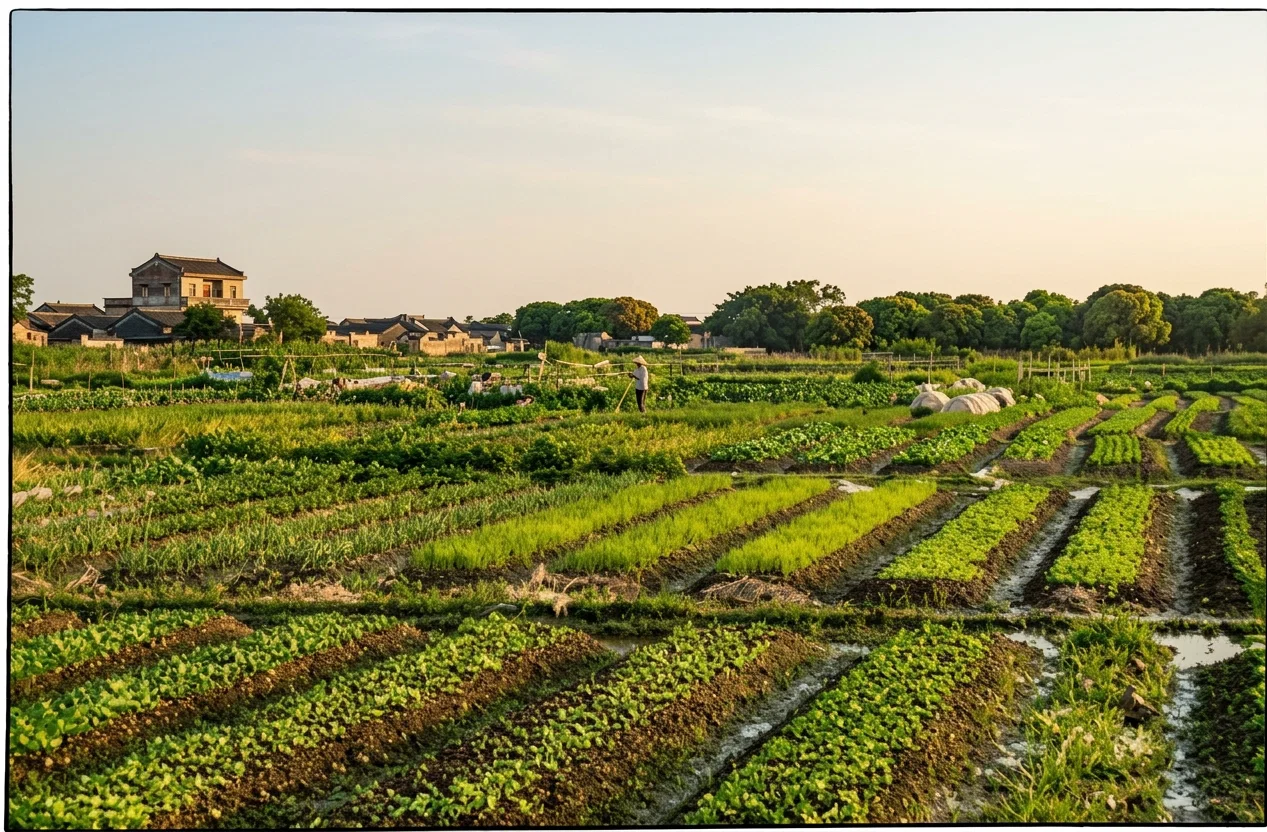
The utmost care is bestowed upon gardening in China, but nothing like farming as it is known in the Middle and Western States of the United States is thought of. The work is done by hand, with possibly the aid of a water buffalo and a very primitive plow. The farms are mere garden patches surrounding the clan villages, in which the people congregate from generation to generation. In some dense sections village touches village, separated only by their walls or a running stream. Nevertheless, each is a distinct village with its own traditional customs and shade of dialect. In other sections the villages are miles apart, with wide, unoccupied acres between them, which, to all appearances, might be just as fruitful as those now under cultivation. But tradition has bound the people to village life, and so the little dark houses are packed together, tile touching tile on the roof, till there is neither air nor sunshine to bring comfort and health to the little ones who are driven into the streets.
Night came on, and with it forgetfulness, till, early in the morning, we were awakened by a din of voices, low and guttural, high and shrill,—men, women, and children calling, scolding, chattering,—while the racket of wooden shoes and the shuffle of bare feet on the deck led us to suspect that something extraordinary had happened. Hastening preparations, we were soon on deck, relieved to find that the boat had anchored before the city of Canton, and that the confusion was occasioned by the sampan people in their competition to secure patronage of freight or passengers. Trade is much less active at Canton, and therefore the conflict for bread among its floating population is correspondingly sharper, than in former years.
“I wonder why passengers are not called early in the morning to see the native boats come out to meet the steamer. It is one of the most picturesque and interesting sights to be seen,” remarked a gentleman who has traveled extensively. And so it is. A population numbering tens of thousands, but just how many no one knows, spend their lives in these small house-boats, or sampans, and in the larger crafts and junks. Each floating home, in turn, becomes the inheritance of some child of the family. If a boy, when he is married—probably to one of his own station—here he brings his bride, who will take her post at the large oar in the rear of the boat till the day her first-born comes, bringing the first real joy into her life. A few days later, with the precious little burden on her back, she will take her place at the oar again, and pull with new vigor because of this new inspiration. If this life seems hard, remember that it is exempt from much of the drudgery and care of what is called a more perfect civilization. Generations come and go, generations that never know a settled home on solid earth.
Before us lay the shameen, or foreign settlement, occupying what was once a mud flat in the great sheet of water known as the Bak Kong, or North River, the northern fork of the mouth of the Pearl River; but which is now a verdant island, with substantial residences, constructed after European plans; and beautiful, paved streets lined with shade trees. The European population who live here must make this their world, and, therefore, no pains has been spared to make the place attractive.
Across the canal northward lies the ancient and modern city of Canton. The old city is inclosed within a wall about twenty feet thick, from twenty-five to forty feet high, and six miles in circumference; but outside this wall a city of equal size has grown up on the low plain, extending with its suburbs a distance of ten miles up and down the river. Our first view of this well-known, and yet certainly unknown, city lying before us in mysterious and ominous silence, brought to mind the words of Jesus, “Thou that killest the prophets, and stonest them that are sent unto thee.” Wretched, and poor, and blind, and naked, she wraps her tattered robes of ancient tradition and national pride about her, and declares herself in need of nothing. The metropolis of the two Kwang Provinces and residence of the viceroy, Canton has a certain governmental importance second only to Peking, and a conservatism perhaps fully equal to that of the national capital.
But of greater importance to us is the place this city has occupied in the14history of missions.
Hither in 1807 came Dr. Morrison, then a young man. A burning zeal for Christ had led him to long for China, as yet untouched by Protestant missionaries. In order to reside in the city while studying the language, he was obliged to accept employment in a factory under English management. The study of the language was of itself a crime against the government, and the teaching of it was treason, liable to cost his tutor his life. Here silently and perseveringly he wrought, and finally produced a grammar and a lexicon of the language, besides a translation of the entire Bible, thus laying the foundation for all succeeding missionary work in the Chinese world.
Here, too, occurred the conflict over the opium question, and the war which followed, by which the name “Christian” was brought into reproach in all China, and an additional curse was heaped upon an already enslaved people. The opposition manifested is not so much hostility to Christianity as to the fan gwi (foreign devils) themselves; but it is as deep seated and abiding as the national life of China itself.
Always a storm center, Canton is today in a state of ferment; and even as I write, the city is being placarded with matter inciting to riot against the foreigners, and no one can forecast what may be the outcome. Still the angels are holding the winds that she may hear the gospel and be saved. O that she might know in this her day the things that belong to her peace!
OTTO LUNDELL
By Otto Lundell
A SCENE IN FINLAND
Finland
OTTO LUNDELL
Coming in contact with the people of Finland, it is evident that they are better educated than one would at first believe. I do not know that I ever found a place where the people could not read and write, if they were not too old and feeble to do so. Those who can, give their children a higher education, sending them to the university after they have gone through the preparatory schools, and are proud to have their children, whom they have worked so hard to support, bear the title of pastor, professor, etc.
Finland is a country where education is rapidly advancing. In the year 1890 the total population was 2,380,000, and it is no fewer than 540,412 attended school. Of the entire population, about twenty-three out of every one hundred are actually at school. There are 2,608 university students, including women. At the lycée there are 4,723. The primary schools have an enrollment of 419,867. With such a foundation, one is no longer surprised to read the long list of learned societies which flourish here—philological, juridical, medical, scientific, and literary. One of these, the Society of Finnish Literature, is laying the world under obligations by the wealth of folk songs it has discovered and preserved.
The university of the country is to be found in Helsingfors, which is the capital of Finland. The university building is named after Alexander I, whose bust occupies the place of honor in the vestibule.
The most interesting buildings in Helsingfors, or “Helsinki,” as it is called in the Finnish language, are the Senate House, with a magnificent place of assembly, where the emperor, when present, opens the Diet; and Standerhuset, the Estates House, with its three halls where the representatives of the clergy, the bourgeoisie, and peasants sit during the rare meetings of the Diet. In the architecture of these buildings there is nothing remarkable. They are dignified, simple, and modern.
Forty years ago there were only about twenty thousand inhabitants in Helsingfors, but to-day there are more than four times as many. There is no capital city in the world that surpasses it in cleanliness, convenience, and all the externals of modern civilization. Small electric cars, models of their kind, run through the streets, and furnish rapid and comfortable transport to all parts. And from the capital a person can now get telephone connections with almost any part of the country. All these things are preparing the way for the last message.
River Plate Conference
By N. Z. Town
N. Z. TOWN
My next trip was with Brother Hillmann, who is canvassing in the Province of Santa Fé. This brother began canvassing about three years ago, and has worked faithfully summer and winter, but not until my recent visit had he received any instructions or help as to the best way of conducting the work. We labored together several days among Italian colonists, he canvassing one house and I the next, and between the houses we conducted a canvassers' institute. The Lord blessed us with success while together, and this brother has been doing much better since my visit.
From there I crossed over to our mission school in Entre Rios. The school has been prospered in a special manner this year. The home is full to overflowing, and quite a number attend from outside. The total attendance has reached fifty. Among the students are six heads of families, the eldest being forty-nine years old.
The students have added a three-room brick building to the school during work hours this year. Commendable efforts have also been made to improve the school farm with fruit trees, shade trees, plants, etc., but as we have been having a severe drought again, it has been difficult work.
Although the medical work is comparatively new to the brethren in this field, they show a deep interest in it. To make a start in raising funds with which to begin a building where the sick can be cared for, we presented to the brethren the missionary-acre plan. Many of them were pleased with the idea, and over one hundred and sixty acres of wheat and flax are already promised. If the Lord gives a harvest, this will make a good start toward the medical building fund. One aged sister gave a fat ox, a servant girl gave a month's wages, and one brother gave a good piano and three fine large paintings.
Some months ago we presented to the Buenos Ayres church the importance of doing more in circulating our Spanish paper El Faro in the city. As a result, several of the church members began selling the paper from house to house. Among them was an Italian sister who can neither read nor write. In her work she came to the house of an Austrian lady. As our sister talked to her of the coming of the Lord, and of the end of the world, she became interested, and arrangements were made for Sister Oppegard to give her Bible readings. Last month we had the joy of seeing this lady baptized and received into the church. She, in turn, has interested others, whom we hope to see fully accept the truth. Brother Ernst and I have recently begun taking subscriptions for El Faro in the town where we live. We have met with encouraging results. At our general meeting, we hope to arrange for one or more to give their whole time to canvassing for this paper.
Until quite recently, Brother Snyder has worked principally among the foreign15population in Paraguay. As papers can be posted free in that republic, Brother and Sister Snyder have given special attention to sending our papers into the different colonies. Some of this seed has fallen on good ground, and already fruit is beginning to appear. Of late, Brethren Snyder and Mangold have begun canvassing for our books among the Spanish-speaking people of Paraguay. A large per cent of the natives are unable to read, but among those who can read these laborers have met with a good degree of success. Brethren, pray for the work in these dark lands of South America.
Character Alone Enters Eternity
THERE is only one thing you can carry into eternity—your character. See that it is what it should be, and the jasper gates will gladly swing open to give you a welcome.—Great Thoughts.