Review and Herald Publishing Assn. · Washington, D. C. · October 10, 1905
Not Lighter Burdens but Greater Strength
By Vida V. Young
I WOULD not ask thee, Lord, for lighter burdens:
For greater strength to bear them would I plead,
E'en for the strength of thy right arm so holy,
That arm which bare thou madest for my need.
I would not ask thee, Lord, for smoother pathways,
Though in rough, thorny ways be cast my lot;
If thou wilt in thy paths hold up my goings
So that my fal'ring footsteps shall slip not.
And though the way be sometimes sad and dreary,
The “well done” I shall gladly hear at length;
For still my cry shall be, though faint and weary,
Not lighter burdens, Lord, but added strength.
VIDA V. YOUNG.
In Sunny Southern Seas
By Adelaide D. Wellman
To a missionary the people among whom he labors are not a strange, alien race; they are “our people.” And as we become more acquainted with the inhabitants of foreign lands, they cease to be to us objects of curiosity; they seem more really human. It is well therefore for us to study various countries and their people, though not after the manner of novelty seekers, but to gain an insight into their real lives.
If you should cross our country from its north-eastern extremity to its southwestern, and then continue for an equal distance in a somewhat more southerly direction, you would then be in the outskirts of the South Sea Islands; and you might then repeat the distance, without passing beyond the bounds of those mid-ocean habitations.
These islands number many thousands. In size they vary from that of some of our larger States to that of a small farm. Some are closely grouped; others stand solitary, hundreds of miles from the nearest neighbor.
In general appearance also the islands differ greatly. Some are mere rugged mountains projecting abruptly from the sea; while others are low plats of coral sand, which have been reared by their tiny builders upon a foundation of submerged rock. Islands of the latter class are in some instances almost devoid of vegetation; but many are covered with a dense growth, which contributes to the fare of the population numerous tropical fruits and vegetables.
I used to think of the South Sea Islands as being almost as foreign to the rest of the world as is the moon. I expected that I should sometime visit Europe, and probably Egypt and Syria, and perhaps also Japan, and other countries less frequented by travelers; but never did I imagine myself in the reef-encompassed islands of the Pacific.
However, I have never yet seen Japan, Syria, Egypt, nor even Europe; but the South Sea Islands are now more familiar to me than are some of the States of our own fair country.
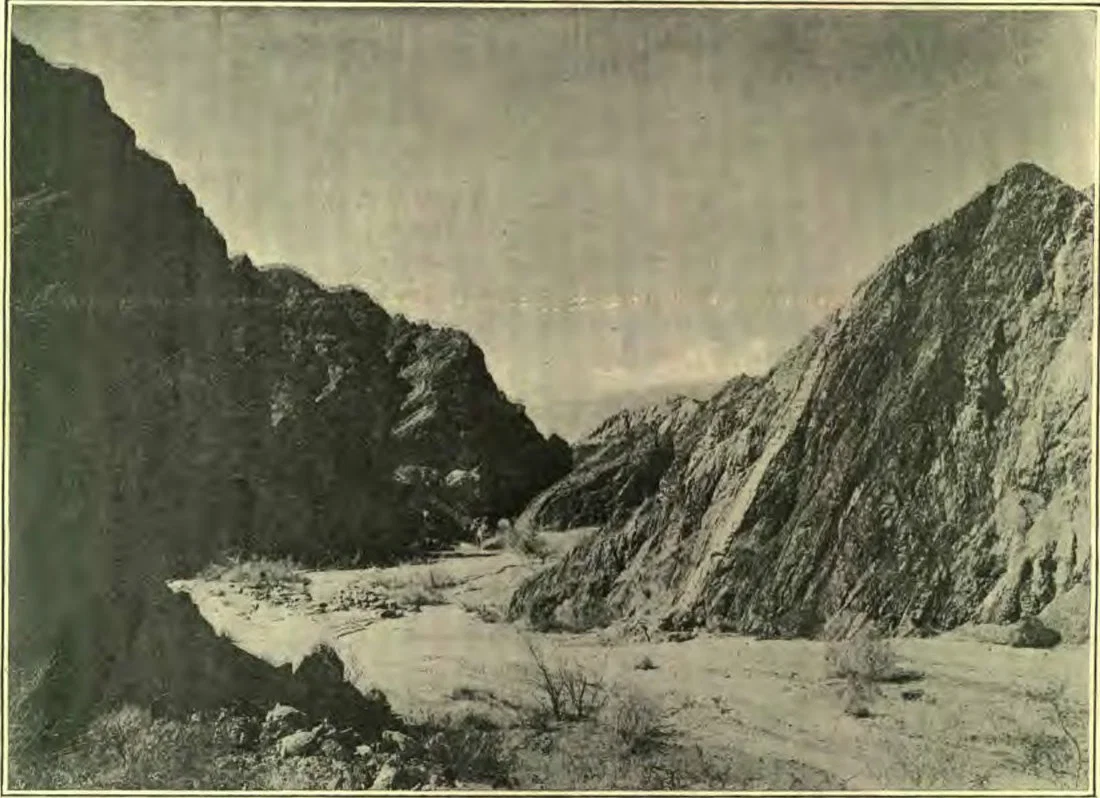
A SCENE IN THE DESERT CANYON
The world apparently is growing smaller. Steam navigation seems to bring remote places closer together; linguists have made incomprehensible jargons intelligible; and civilization has lessened the danger of venturing into frontier regions.
A century ago the existence of islands in mid-Pacific had but recently become known to the world; and many of those islands were yet undiscovered. The inhabitants were all savages. In fact, the natives of some of those islands are still savages, but a large proportion are at least semi-civilized. During my sojourn in the Cook Islands a few years ago, one of my nearest neighbors was the son of a former cannibal chief, and an amiable neighbor he was, too.
In the islands of the Pacific, two races are represented,—the brown skinned of the eastern islands—Polynesia proper—and the darker race of the more westerly islands. Generally, each group of islands, and in some cases a single island, or even a portion of one, has a distinct dialect. Many of these dialects have been put into printed form by enterprising missionaries; and the islanders to a great extent have now been taught to read the Bible in their own language. Little else has been printed therein.
The translation of the Scriptures into these languages is a stupendous undertaking. The vocabularies are very meager, and pertain chiefly to the most common matters. Some contain no terms of thanks or apology, and no words signifying gratitude, virtue, or many other of the graces of civilized life. The aboriginal inhabitants of those regions doubtless have not much conception of such things; but under the influence of Christianity, characters have been developed there which bear little trace of the hole of the pit whence they were digged.
The natives of the South Sea Islands in general are of good physique; and they are also of higher intelligence than are most uncivilized peoples. But morally they are very debased. The religion of the aborigines, like that of all pagans, is a religion of fear. Their deities are largely malevolent spirits, who must be pacified by heinous offerings and superstitious rites. There still remain many of the old-times pagan altars—mere rude walls of stone—even on islands where heathen forms of worship have been abandoned. I brought from one such gruesome pile a bone of a human sacrifice.
MRS. ADELAIDE D. WELLMAN.
On the Desert
By Jocie Wallace
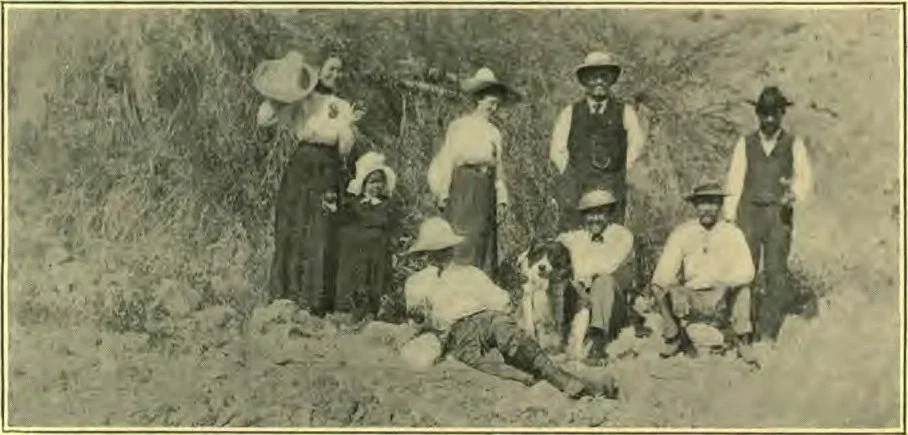
ONE Sunday last April, a party of friends, numbering nine, drove out to a beautiful California canyon. It was an enjoyable day, spent in studying from God’s own book of nature. We also enjoyed a little mountain climb, from two hundred feet below sea-level to three hundred feet above the beach line. The picture shows the party just after our climb. We are by a pala verde tree. Words can not picture the grandeur of the view from the summit, as we looked out over the valley with its fresh spring robe, and silvery lake nestling in the midst of the green, with a few small boats gently rocking on the waves of the lake. As the sunlight on the water gave the appearance of fire, it reminded me of the “sea of glass mingled with fire” that the apostle John saw. May we all stand some day on that sea.
The beautiful, large fan-leaf palm is a native of this desert; the cottonwood and desert willow2are found near all springs; the pipe-stem reeds and tulips also grow in moist places. The pala verde (meaning green tree) is a beautiful tree with the bark of its trunk and limbs as green as the leaves. The foliage, is so fine that it gives a feathery appearance to the tree, which causes it to be admired by all nature lovers. To add to its beauty, it comes out in March with a bright new golden dress on; the flowers are so thickly clustered that the entire tree has the appearance at a distance of a great heap of gold. After a few weeks it spreads its bright yellow robe around the foot of the tree for a carpet of soft golden yellow, which is inviting to the passer-by. It then puts forth a full crop of pretty pods of beans which are protected from beasts by the needle-like thorns all through the foliage. The mesquit, which also grows here, is more of a bushy tree, with heavier and darker colored leaves, through which are many sharp thorns. The mesquit puts forth a soft cream-colored tassel that turns into an odd-shaped cluster of screw-looking beans, which are highly relished by the Indians.
The desert cedar is next in beauty to the pala verde. It has a more graceful shape and feathery appearance than the common cedar; it has a silvery color, with just a delicate shade of green, which seems to show through the thin silvery-white robe. The arrow-weed sends up a number of straight stalks from one root, and all of its foliage points upward, making it an easy weed to handle. As it does not shed its leaves when cut, it is valuable for making structures for shade. It has a pretty purple bloom, shaped like a thistle flower.
The smaller blooming plants seen were the California golden poppies, the white and golden daisies, sweet perfumed verbenas, the lilies, blue-bells, yellow and white primroses, baby-breath, with now and then a cactus in bloom. The flowers all seemed to whisper, “God is love,” and it seemed a pity to drive over them; but the ground was so completely carpeted that their destruction could not be avoided, and the air was made sweet from their perfume. On our return we all enjoyed filling our flower baskets. Many tokens of God’s love are seen all around us; these should ever draw our minds to our Saviour.
I have been here in the desert since the first of February, and have not seen one of like faith; and the nearest white neighbor lives six miles away; but I am thankful for the opportunity of holding up the banner of truth in this out-of-the-way place where the seeds of truth have never been sown. Let us strive continually to see the good, pure, and lovely things around us, and especially look for the good and pure in our fellow beings. There is no place in God’s world without tokens of his power and love.
MRS. JOCIE WALLACE.
Aluminum Paper Supplants Tin-foil
ALUMINUM paper is now manufactured in Germany, and recommended as a substitute for tin-foil. It is not the so-called leaf aluminum, but real paper coated with powdered aluminum, and is said to possess very favorable qualities for preserving articles of food, for which it is used as a covering.
THE MOUNTAIN CLIMBERS
The paper used is a sort of artificial parchment, obtained through the action of sulphuric acid upon ordinary paper. The sheets are spread out and covered upon one side with a thin coating of a solution of resin in alcohol or ether. Evaporation is precipitated through a current of air, and the paper is then warmed until the resin has again become soft. Then powdered aluminum is sprinkled upon it, and the paper subjected to strong pressure to fasten the powder thereon. The metallic covering so obtained is affected neither by the air nor by fatty substances. Aluminum paper is much cheaper than tin-foil.—Search-Light.
Why Does the Bird Molt?
“We get a new suit — some of us — because our old one wears out. That is the most apparent cause for the new annual suit of the birds, says a writer in The Country Calendar. Yet with them, as with some of the favored of us humans, the feathers go out of fashion. But the annual molt is, first of all, nature’s wise provision for the safety and life of the bird. Feathers are not only covering, but also means of locomotion, and hence the bird’s only means of life. A year of use leaves many of them worn and broken, some, through accident, entirely lost.
“Here in my woods is a crow with three of the large quills in his right wing gone. I can see the gap as he flies over. He has been shot at, and nature must replace those feathers if that crow is destined to survive. The feathers of this crow and of all birds might last for two years or longer, but to keep the race at its best, nature provides a new plumage once a year.
“But there are other reasons, at least there are advantages taken of the molt for other ends; such as the adaptation of the feathers to the varying temperatures of the seasons,—heavier in winter and lighter in summer,—also the adaptation of the color of the plumage to the changing colors of the environment, as the change from the dark summer color of the ptarmigan to its snow-white winter plumage to match the snows of its far northern home; then the adorning of the bird for the mating season.” — Search-Light.
A Convincing Illustration
THE magic lantern has been used ingeniously in the campaign against the yellow-fever mosquito carried on during the epidemic in New Orleans. In order to convince the skeptical that pouring oil on standing water would kill the larvæ in it, Dr. Kohnke, head of the board of health, prepared an illustrated lecture, which he delivered to crowded houses all over the city. A vessel of water filled with the “wiggletails” was projected upon the screen after the larva had been studied in detail. The wiggletails were seen rising to the top to breathe. A film of oil was then poured over the water, and the wiggletails could be seen struggling vainly to thrust their breathing apparatus through it. Balked there, they darted frantically about in all directions, to sink at last to the bottom and die of suffocation. It was a convincing illustration.—Youth’s Companion.
Indian Summer
By Mrs. P. Alderman
Soft breezes from the summer time
Come back my heart to cheer;
They whisper of a kindlier clime
Where beauty fills the year.
In hazy garb the hills are dressed,
Of purple, gold, and green,
Not like our earth, nor yet like heaven,
But something fair between.
I gaze with wonder on the scene,
And ask what will earth be
When cleansed from all impurity,
As, Lord, it came from thee?
Stay, lovely Indian summer, stay!
Make not thy visit brief;
For thou dost cheer midst earth’s decay,
And paint each falling leaf.
Mrs. P. Alderman.
Heroic Hearts Come From Hard Places
“Heroic hearts come from hard places.”
Sakhalin: Japan's Bleak Island Past and Present
Sakhalin
Do you know where and what Sakhalin is? If not, find out before reading what the Youth’s Companion says about this unique place:—
When, after the Russian fleet had been swept from the sea, Japan turned her attention to the island of Sakhalin and took possession of it, the mikado was only taking back what had once belonged to him.
Sakhalin is a rocky island of about twenty-nine thousand square miles in area, lying north of Japan in the same chain of islands, and commanding the mouth of the Amur River. It is one of the bleakest, least attractive spots in the world, yet it is the enforced home of thousands of Russians who have broken the laws or offended their rulers.
For a long time the island was thought to be part of the mainland of Asia. When the Straits of Tartary had been discovered, it was the Japanese who sailed round the island, and gave the world some knowledge of its littoral. The Japanese, too, were the first to exploit it, although they found it inhabited by Ainos and other primitive people; and they found also kitchen-middens and other mounds which indicated that it had been the home of man since the stone age. They discovered it to be an island heavily timbered with fir and larch, with maple, oak, and other trees in the southern portion. There were rich deposits of mineral, most of which remained unknown to them then.
The weather was abominable. It was generally cloudy or rainy. At Dui the mean annual temperature was but one degree above freezing—three above zero in January, and sixty in July.
They found two principal rivers leading into the interior, the Tym and the Poronia. The Tym, which is the larger, is navigable for rafts and light boats for fifty miles from the sea, but the rest of the way is too shallow and swift. Falls and rapids, with excellent power, are abundant.
What interested the Japanese most was the abundant fishery round the coast, and the great quantities of edible seaweeds to be obtained there. A large trade in these has been established in recent years, and as the Japanese live mostly on sea-food, these supplies are important to the mikado’s people.
Russia first went to Sakhalin with a permanent colony about 1857, and in 1875 persuaded Japan to relinquish claim to the island. Since then it has been made a convict settlement. In 1902 there were living there more than five thousand hard-labor convicts, nearly ten thousand released convicts and exiles, and enough exiled peasants, wives, husbands, and children of convicts or exiles, to make a total of more than thirty-seven thousand, exclusive of the natives, who number about five thousand. Less than eight thousand acres were under crops. Almost the whole Russian population was engaged in lumbering or in the coal-mines.
True Beauty in Service
By Mary Martin Morse
’Twas a summer morn, and a small bird sat
In a tree that grew in a garden fair,
And, having o’erheard, repeated to me
The talk of two roses ’twere growing there.
A beautiful bud from a rare young plant
Showed a streak of crimson adown its side,
And anon a leaf unrolled to the sun,
As with look of hateur and tone of pride,
She said, “Why that bush with its thousand buds
Ready to burst in such common bloom
Should be placed near me I never can tell,
While for myself there is only room.
“Who will want to wear such a scentless rose?
Not even the humblest servant, I ween;
But my rare perfume and delicate tint
Are fitting indeed for even a queen.
“Perchance the young girl by the window there
Will wear me to the party where she will go;
I, seen to be fairest of all the fair,
Shall enjoy my triumph in the gaslight’s glow.”
“Ah, well,” said the rose with a thousand buds,
“If I can not be fine enough for the queen,
That I am content with what God bestows,
Some one may be happier for having seen.
“I’ll make the most of his gifts to me,
For how kind he is to allow me room.”
Next morn when the young girl passed that way,
The bush was covered with half-opened bloom.
So she filled her hands with the common things,
To take to the children’s hospital ward,
Nor thought of the party, or queenly rose,
Enrapt with spirit and work of her Lord.
The little wan faces brightened up
As the slender fingers closed o’er the flowers,
And the childish hearts reached out for God,
From those beds of pain through the long June
hours.
A worm at the root of the rare rose plant,
Had silently sapped its young life away,
And the gard’ner saw by the light of the moon,
That its shapeless buds in the pathway lay.
And the birth-night guests in their youthful glee,
Did not see the one who had hopes so high;
While the children dreamed of heaven-to-be,
Where they and the flowers would not fade or
die. MARY MARTIN MORSE.
Muriel's Bright Idea
By Pansy
My friend Muriel is the youngest daughter in a large family of busy people. They are in moderate circumstances, and the original breadwinner has been long gone; so in order to enjoy many of the comforts and a few of the luxuries of life the young people have to be wage-earners. I am not sure that they would enjoy life any better than they do now if such were not the case, though there are doubtless times when they would like to be less busy. Still, even this condition has its compensations.
“Other people don’t know how lovely vacations are,” was the way Esther expressed it as she sat one day on the side porch, hands folded lightly in her lap, and an air of delicious idleness about her entire person. It was her week of absolute leisure, which she had earned by a season of hard work. She is a public-school teacher, belonging to a section and grade where they work their teachers fourteen hours of the twenty-four. Alice is a music teacher, and goes all day from house to house in town, and from school to school, with her music-roll in hand. Ben, a young brother, is studying medicine in a doctor’s office, also in town, and serving the doctor between times to pay for his opportunities. There are two others, an older brother just started in business for himself, and a sister in a training-school for nurses.
So it was that this large family scattered each morning to their duties in the city ten miles away, and gathered at night, like chickens, to the home nest, which was mothered by the dearest little woman, who gave much of her time and strength to the preparation of favorite dishes with which to greet the wage-earners as they gathered at night around the home table. It is a very happy family, but it was not about any of them that I set out to tell you. In truth, it was Muriel’s apron that I wanted to talk about; but it seemed necessary to describe the family in order to the full appreciation of the apron.
Muriel, I should tell you, is still a high-school girl, hoping to graduate next year, though at times a little anxious lest she may not “pass,” and with ambitions to enter college as soon as possible.
The entire family have ambitions for Muriel, and I believe that she will get to college in another year. But about her apron. I saw it first one morning when I crossed the street to my neighbor’s side door that opens directly into the large living-room, and met Muriel in the doorway, as pretty a picture as a fair-haired, bright-eyed girl of seventeen can make. She was in what she called her “uniform,” a short dress made of dark print, cut lower in the neck than a street dress, because Muriel felt “choked” when she tried to work in a high-necked dress. It had elbow sleeves, and a bit of white braid stitched on their bands and around the square neck set off the little costume charmingly.
Her apron was of strong dark-green denim, wide enough to cover her dress completely; it had a bib waist held in place by shoulder straps; and the garment fastened behind with a single button, making it adjustable in a second. But its distinctive feature was a row of pockets—or rather several rows of them—extending across the front breadth; they were of varying sizes, and all bulged out as if well filled.
“What in the world!” I began, and stared at the pockets. Muriel’s merry laugh rang out.
“Haven’t you seen my pockets before?” she asked. “They astonish you, of course; everybody laughs at them; but I am proud of them; they are my own invention. You see, we are such a busy family all day long, and so tired when we get home at night, that we have a bad habit of dropping things just where they happen to land, and leaving them. By the last of the week this big living-room is a sight to behold. It used to take half my morning to pick up the thousand and one things that didn’t belong here, and carry them to their places. You don’t know how many journeys I had to make, because I was always overlooking something. So I invented this apron with a pocket in it for every member of the family, and it works like a charm.”
“Look at this big one with a ‘B’ on it; that is for Ben, of course, and it is always full; Ben is a great boy to leave his pencils, and his handkerchiefs, and everything else about; last night he even discarded this necktie because it felt ‘choky’!”
“This pocket is Esther’s. She leaves her letters and her discarded handkerchiefs, as well as her gloves; and Kate sheds hair ribbons and hat pins wherever she goes. Just think how lovely it is to have a pocket for each, and drop things in as fast as I find them; when I am all through dusting, I have simply to travel once around the house and unpack my load. I can’t tell you how much time and trouble and temper my invention has saved me.”
“It is a bright idea,” I said, “and I mean to pass it on. There are other living-rooms and busy girls. Whose is that largest pocket marked ‘M’?”
“Why, I made it for mother; but do you know I have found out just in this very way that mothers don’t leave things lying round? It is queer, isn’t it, when they have so many cares? It seems to be natural for mothers to think about other people. So I made the ‘M’ stand for ‘miscellaneous,’ and I put into that pocket articles which won’t classify, and that belong to all of us. There are hosts of things for which no particular one seems to be responsible. Isn’t it a pity that I didn’t think of pockets last winter, when we all had special cares and were so dreadfully busy? It is such a simple idea you would have supposed that any person would have thought of it, but it took me two years! I just had to do it this spring, because there simply wasn’t time to run up and down stairs so much.”
“You have proved once more the truth of the old proverb, ‘Necessity is the mother of invention,’ I said. ‘And, besides, you have given me a new idea; I am going home to work it out; when it is finished, I’ll show it to you.’ Then I went home, and made rows and rows of strong pockets to sew on a folding screen I was making for my workroom.”—Pansy, in Christian Endeavor World.
A Lesson
By Nina M. Reynolds
My task not long ago was to pick the peas. A short distance lay between me and the garden, so I started for the spot, wondering what lesson I might learn from my work. I found the two rows nearly hidden among the tall weeds, which prevented me from seeing their length.
Soon I was busily engaged, for the vines hung full. Some were young and tender and easily severed; but it was difficult to pull the ripe pods without injuring the vines. I resolved to pick them every one, so that if the owner of the garden inspected my work, he would find it thoroughly done. As I worked on, the number of peas seemed to increase. One pod perhaps hung barely visible behind the large green leaves, and on endeavoring to secure it, many more would be uncovered. I thought, “These peas are like my faults.” Then my determination to find them all, grew strong indeed.
The day was hot, the rows were long and tedious; but at last the end was reached. As everything in nature gradually attains a state of perfection, and as, by steadily keeping at it, I had at last gathered all the peas, so by gradual growth and constant care our characters may finally stand the test of the Great Owner, with whom “all things are possible,” and who gave us the command, “Be ye therefore perfect, even as your Father which is in heaven is perfect.” The possibility of meeting this command seemed more real after my experience with the peas. I know the promises are sure: “My grace is sufficient;” and “I will never leave thee, nor forsake thee.”
REFERENCE STUDY: “Sketches from the Life of Paul,” pages 310-318.
TOPICS FOR STUDY:—
Charge.
Ready to be offered.
A crown for the faithful.
Exhorted Timothy to come to him.
Apostasy of Demas.
Mark profitable.
Cloak and parchments.
Alexander the coppersmith.
Forsaken by all.
Delivered by the Lord.
Notes
“Paul before Nero—how striking the contrast! The very height of earthly power, authority, and wealth, as well as the lowest depths of crime and iniquity, had been reached by the haughty monarch before whom the man of God answered for his faith. In his power and greatness, Nero stood unrivaled, unapproached. There were none to question his authority, none to resist his will. The kings of earth laid their crowns at his feet. The most powerful armies marched at his command. The ensigns of his navies upon the seas betokened victory. His statue was set up in the halls of justice, and the decrees of senators and the decisions of judges were but the echo of his will. Millions of subjects bowed in obedience to his mandates. The name of Nero made the world tremble. To incur his displeasure was to lose property, liberty, and life. His frown was more to be dreaded than the pestilence. Yet while surrounded by all the outward semblance of earthly pomp and greatness, adored and reverenced as a god in human form, he possessed the heart of a demon.”
“The vast hall which was the place of trial was thronged by an eager, restless crowd that surged and pressed to the front to see and hear all that should take place. Among those gathered there were the high and the low, the rich and the poor, the learned and the ignorant, the proud and the humble. Yet all alike were destitute of the true knowledge of the way of life and salvation.”
“Again the Jews urge against the prisoner the old charges of sedition and heresy, while both Jews and Romans accuse him of instigating the burning of the city. While his enemies were vehemently urging their accusations, Paul preserved a quiet dignity; no shade of fear or anger disturbed the peaceful serenity that rested upon his countenance. The people, and even the judges, beheld him with surprise.”
“As Paul gazed upon the throng before him,—Jews, Greeks, Romans, with strangers from many lands,—his soul was stirred with an intense desire for their salvation. He lost sight of the occasion, of the perils which surrounded him, of the terrible fate which seemed so near. He looked above all this, to Jesus, the divine Intercessor, the Advocate pleading before the throne of God in behalf of sinful men. Earnestly he pointed his hearers to the great sacrifice made in behalf of the fallen race, and presented before them man in his true dignity and value.
“His countenance glows with the light of heaven, as though reflecting the rays of the sun. Many who looked upon him in that hall of judgment ‘saw his face as it had been the face of an angel.’ Tears dimmed many eyes that had never before been seen to weep. The gospel message found its way to the minds and hearts of many who would never have listened to it but for the imprisonment of Paul.” G. B. T.
A Report from Ohio
By J. E. Shultz
SEVERAL years ago there lived with the servant of God a humble servant girl. Hers were the menial tasks which so many despise, yet she loved the Lord, and while her hands were busily engaged, her soul held communion with its Maker. She prayed that as she passed through this sin-cursed earth, she might be the means of lightening some burden, of cheering some disheartened one, of directing some alien to a Friend who sticketh closer than a brother. Presently it was her privilege to enjoy the happiness anticipated.
She visited a sick woman who was the mother of several children, and after she had nursed her back to health, she organized the family into a Sabbath-school; others joined until their school numbered twenty-five. Then a minister was called and organized them into a Seventh-day Adventist church. It was this experience that caused the statement to be written, “Let the youth be organized and trained as a well-disciplined army, for service. Young men and young women, can you not organize upon some plan and order of action? Can you not form companies that you may work for the salvation of your fellow youth?” Also “let those who really love Jesus organize for service.”
Acting upon this testimony, we have moved out. A mighty work has been begun. Even the dark and heathen Korea is awakening to the results of our efforts. Two hundred fifty souls witness for the truth. The Young People’s Society is supporting one worker in Korea for one year. Two workers are being supported in Africa. A church was bought for the believers in Chenampo, Korea. India has received her share of assistance, while the great needy South has not been overlooked.
Financial help has been given the following countries with the amounts as follows:—
The South ........................................ $ 85 00
Africa ................................................ 86 99
Korea ................................................. 131 59
India .................................................. 171 46
Total ................................................ $475 04
Besides this much has been done in the home field. One Society equipped one bed for the ministers’ tent, another Society equipped part of another. Thousands of pages of literature have been scattered, and Bible readings have been held.
We have fifteen Societies at the present time, the highest number of any conference in the Lake Union, yet be it far from us to boast. Our work is simply begun; but we are organizing for service. Why?—Because our youth are leaving us at an alarming rate. Statistics show that in the East Michigan Conference only five per cent of their membership is below the age of thirty-five years. More youth are leaving us than converts are being brought in by the united efforts of our ministry. Does not this great need plead most eloquently in behalf of this work. God’s prospering hand has been upon it. All the laborers have been paid up to date, yet we must still broaden. We must annex new territory. While Japan and Russia are warring over territorial lines in Korea, we have entered the country, and have begun to conquer it for Prince Immanuel.
A shout of victory is heard throughout our borders as we see new recruits come marching on the field. Ah! watch that enthusiastic throng advance. They have been trained and disciplined as a well-organized army, and nothing can resist their advance as Prince Immanuel is at their head. As we listen, we hear them say, “There shall be delay no longer.”
“Yes, on they come, that mighty throng,
And evil hosts, despairing, wail.
On every lip the victor’s song,
Through Christ our leader we prevail.
“Yes, on they come, and shall we join,
And with them wage the battle fierce?
O men arise! Gird up thy loins,
That light each darkened land may pierce.
“Till victory crowns Jehovah’s arm,
And we at rest with him shall see
The souls we saved by the alarm
That sounded loud o’er land and sea.”
—J. E. Shultz, in The Welcome Visitor.
Young People at Work
By Mrs. L. Flora Plummer
(Concluded)
An excellent report of the Young People’s work is sent from the Upper Columbia Conference. There are only five organized Societies, with a total membership of one hundred forty-seven. It is a difficult matter to form Societies there, as the brethren and sisters are so scattered. The most encouraging feature is the fact that the secretary has been working for these isolated young people, and now has a list of over two hundred names of youth with whom she has been in correspondence, and one hundred fifty-eight of these are enrolled as Home Department members of the Young People’s Society.
The work for the quarter is summarized as follows:—
Missionary letters written .............. 38
Missionary letters received .............. 22
Missionary visits ........................ 61
Bible readings held ...................... 47
Subscriptions for papers ................. 27
Papers sold .............................. 80
Papers given away ........................ 569
Books sold ................................ 9
Books loaned .............................. 8
Pages of tracts distributed ............... 9,660
Contributions ............................. $9.42
The first Society organized in North Carolina is at Archdale, and is composed of sixteen members. They meet each Sabbath afternoon for Bible study. The missionary work done by the members is summarized as follows: One hundred forty-five papers sold, six books sold, twenty-five missionary visits made, two Bible readings held. The report closes with the sentence, “General interest quite good.”
Word comes from Mississippi of a little band of six colored children who are responding to the call to our youth as best they can. In that State there is also an isolated white young man who desires to be enrolled as a Home Department member. These seven report six missionary letters written and four received; fourteen missionary visits, and seven Bible readings; three subscriptions for papers, fifteen papers sold, and thirty-two given away; three books loaned; thirty-five cents given to foreign missions.
The quarterly summary of the Societies in the Western Pennsylvania Conference is encouraging. There are seven Societies with an aggregate membership of seventy-eight, and ten isolated members. The children in some places are carrying flowers to the hospitals; in others, they are supplying railway station reading-racks. In one Society the members are rejoicing over the conversion of two youth for whom they have been praying. Considerable paper work has been done—six thousand four hundred papers having been sold in three months. Thirty-seven books have also been sold, and over thirteen thousand pages of tracts distributed. The offerings for home missionary work amount to $44.48.