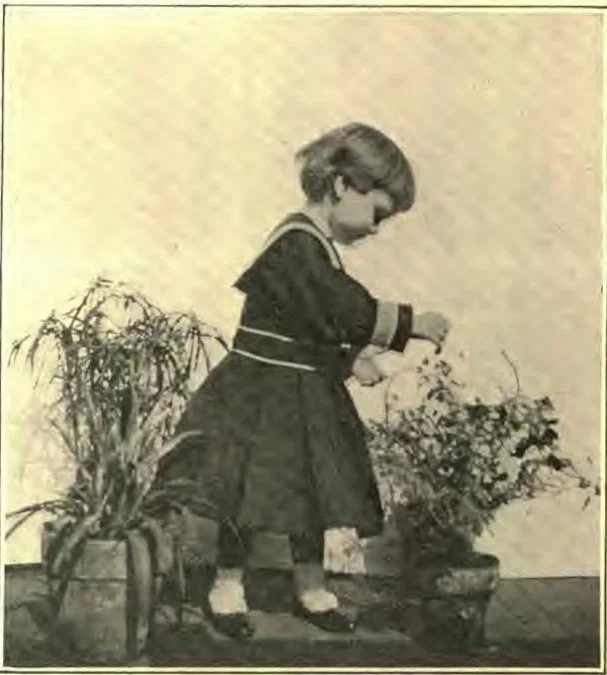
WHEN I see him go by each day to his school,
This dear little Laddie in Brown,
I ask as I look at the sweet little face,
Can there be such another in town?
O, tell me, dear Laddie, where, where, did you get
Those soft and appealing brown eyes?
That dear little mouth and bright, ruddy cheeks,
Did they come to you straight from the skies?
Don't grow up too quickly, O wee little man!
It makes mother lonely and sad
To see the dear baby slip out from her arms,
And grow to the strong, sturdy lad.
God bless you, dear baby! and keep your heart
pure;
I'm sure that the angels look down
And smile, as they tenderly guide the wee feet
Of this dear little Laddie in Brown.
—Lou Royce Hayden, in American Motherhood.
Mrs. G's “Best Story” Class
By Mrs. H. C. Goodrich
Carl and Oliver were two little boys living in Central America. Carl was of an even temper, and easily influenced in the right direction, while Oliver had a determined will, and loved his own way. These little boys were cousins, of about the same age, and nearly always together.
In their class at school were Sissy Walters and Sammy Gains, who were both dark, with woolly hair, while Carl and Oliver were white. The teacher had just promoted Sissy Walters to this class in the “Best Story,” and she had not yet purchased a book. Poor Sissy was not so favored as the rest, with a father and mother to buy books for her; in fact, her own mother had thrown her away when a tiny babe, and her grandma had taken her in her arms and kindly cared for her, but the grandmother hardly thought it worth while to send the child to school, because she did not think Sissy could learn anything. But Sissy, to her grandma's surprise, made such rapid advancement that she was now entering the “Best Story” class.
On this particular day, as the teacher tapped the bell for the class to rise, Sissy rose with them at the teacher's request, and slowly made her way to the recitation seat, and as it happened sat between Carl and Oliver, while Sammy Gains sat on the other side of Oliver. As the teacher looked up, she was surprised to see four clouded little faces before her, and began to inquire of each one to learn the cause; finally Carl said he thought Sissy Walters might look over with Sammy Gains, for he was black, and she was black; and himself and Oliver did not want her to look over with them, and she would not sit over beside Sammy. The teacher thoughtfully looked at them for a moment, then told them how sorry she was that they had let Satan come into the schoolroom and cloud their faces, and put such a wrong feeling in their hearts toward one another.
Then they examined Sissy's and Sammy's hands, and learned that the color was between the outer and true skin, so it was not even skin deep; then they learned from the Word of God that our Heavenly Father is no respecter of persons, that he loves all with the same great love, and that Sammy and Sissy were just as anxious to be saved in the kingdom of heaven as Carl and Oliver were, and that God had sent their teacher away across the sea to teach Sissy and Sammy as well as Carl and Oliver.
Their teacher then asked if they were now all willing to drive Satan out, and put on bright, happy faces, and love one another as God wants them to do. Carl was the first to say that he would do so, and Oliver was the last to respond, but we know that they all felt more kindly, for each little face wore a smile, and there was no happier class that day in school than the “Best Story” class. MRS. H. C. GOODRICH.
A Vacation for Mother
By Susie Bouchelle Wight
(Concluded)
“I THINK you would better go right on and get Jane,” said her mother. “I left quite a lot of unfinished work in the kitchen.”
“Hopie,” said Mr. Abbott, “can you take care of mother while I am gone, or would you rather I should call Robert back to stay with you?”
The little doubting of her resourcefulness turned the scale, which had been trembling between a real desire to be helpful and a disinclination to take upon herself the responsibility it would involve.
“Father,” she said, quietly, “do not go for Jane at all. Surely I can do for a little while what mother does all the time, and if you will let me, I will show you what my lessons in domestic science have been worth to me.”
“Will you, Hopie?” he exclaimed.
“Oh, but, John, the dear child’s vacation!” demurred the mother, and her white face was very anxious; but vacation’s not everything.
“Now, mother,” said Hope, gently, “I have been taught that a change of occupation is the best rest; you must let me try it. I really want to,” she concluded, earnestly.
She had her way at last, and as she left the room to take up that unfinished work in the kitchen, her mother’s eyes followed her dubiously, but Mr. Abbott’s face fairly beamed, as he said in a low voice: “I tell you, mother, I don’t believe that Hopie is spoiled after all.”
“So you have risen to the occasion, have you?” Dr. Mallory stood in the kitchen door, looking on as the busy little figure moved briskly about.
“I had to rise to something after those knock-down hints of yours,” Hope retorted, merrily, turning bright eyes to him, in which lurked no spoiling shadow of discontent.
“Did I say anything? Did I tell you to cook?”
“No, but you looked unutterable things.”
“You would not have understood if your own conscience had not already prompted you!”
“Well, maybe not; but now sit down,” she said, “and let me give you some commissions to do for me. You know mother is supposed to be away on a vacation. Well, while she is away, I am going to refit the kitchen for her, and then you may load up your buggy with all these old things.” She waved her hand toward the row of ugly, heavy pots and griddles, and held up some bent and worn kitchen forks and spoons.
“I am going to let father into the secret to-morrow, but this must be my part, and he might object if he knew beforehand.” She gave her uncle a written list and a crisp greenback.
“Now get the prettiest white enamel ware you can find, Uncle Rob, and show your sense in the selection of the forks and spoons. Don’t you be beguiled into taking any other kind of egg-beater than the one I have on the list. Think of it, mother has never owned an egg-beater!”
Dr. Mallory looked over the list and fingered the bill. “See here, little lady, I do not like to be inquisitive, but these things don’t grow on trees, and I hope you will excuse me if, out of the depths of my interest, I delicately inquire”—he paused and lifted his eyes in grave assumption of solicitude.
“Why, certainly you may inquire. That bill has lain in the tray of my trunk since last Christmas—you probably remember who sent it to me—and I had intended to spend it for a beautiful silk waist to enhance the splendor of my personal appearance at the Chautauqua; but,” and here Hope grew suddenly very much interested in looking after something in the oven, “I scarcely think I shall need another waist.”
“And what part am I to have in all this celebration?” Dr. Mallory had stowed bill and list away serenely in his vest pocket.6
“You? Oh!” said Hope, with a mischievous twinkle, “you can forbid her trying that foot until all my plans are finished.”
He caught her by the shoulders and turned the flushed, laughing face up to his. “Now, miss, your looks, more than your words, insinuate something!”
“Yes? Well, you and I have learned to read glances nicely, haven’t we? But, really, mother does not half believe that her foot is as serious as you pretend, and you will have to be pretty firm with her, or you can not keep her disabled long enough to finish your experiment with me.”
Mrs. Abbott, after a few days, began to threaten to walk, for she said her ankle looked and felt all right; but her brother was so positive, and her daughter and husband were so solicitous, she had to yield as gracefully as she could, and agree to make the most of her enforced vacation. She was a little set in her ways, but to please Hope she allowed herself to be dressed up in her daughter’s prettiest dressing sacques, and although the extra effort did seem a little superfluous to her at first, she soon came to thoroughly enjoy the exquisite daintiness of the trays brought to her at meal-times. It made her very happy to see Hope’s unfeigned enthusiasm over her work, and she watched with great interest numerous small changes which the girl made in the arrangement of the simple rooms: a flowering plant in bloom in a corner or by a window, a picture hung in a different light, a cushion for a chair, and all the vases in the house filled in a graceful fashion, one kind of flower at a time.
“Why, daughter,” she said one morning, when Hope had rolled her lounge into the sitting-room to await the arrival of some neighbors who were to come in and chat with her awhile, “I feel as if I were away at the springs!” She looked with appreciation at the little table close to her hand, with a few books on it, and her work-basket convenient. Hope had just brought in a tray, and showed her some nice little refreshments she had prepared to hand to the neighbors before they should go away. “To think of the old friends coming in to chat, and me sitting here with never a care on my mind, all the time! Why, it is wonderful!”
“You are taking the rest-cure,” said Hope; “but it does seem a pity that you could never get a chance to rest until you had hurt yourself so badly.”
All the restlessness was gone now, and Hope found her little troubles vanish like magic, as she threw herself thoroughly into her undertaking; for work, that sovereign sweetener, left her little time for bitterness. The new ways she had learned at school enabled her to turn off her work very expeditiously, and it scarcely wearied her at all; but something almost choked her as she came to realize the deadly monotony of her mother’s life, in the long years in that dingy little kitchen, day in and day out. In that spontaneous outrush of love and sympathy, her father had met her more than half-way, and was so eager in helping to further her plans that Hope forgot to notice the little things in him which had so irritated her; and even “Hopie” came to sound to her, as he had always meant it, a sweet and loving name. After her work was done, she would play The Battle of Manassas and The Maiden’s Prayer with such spirit that her father leaned back with eyes half closed in gratified delight, and graciously asked for some of her new pieces. Then she would fight shy of ultra-classics, but the same slender fingers which had cooked the dinner and made the house dainty would weave out the exquisite melody of the spring and flower songs, or trip through bright little staccato movements so charmingly that husband and wife would seek each other’s eyes and tell in a smile their pride and satisfaction in this dear daughter.
The two weeks slipped by happily and rapidly, and at the end of the time, Dr. Mallory gravely pronounced the injured ankle fit to be used.
“But very cautiously at first, my dear Mary. You must still let Hope spare you the most of the running about. By the way, Hope,” he continued, turning to his niece, “the work has done you as much good as the rest has your mother. You people did not know that Hope was not quite herself when she came home, did you? Only the day before Mary sprained her ankle, the child had told me, and asked me to prescribe for her.”
“Why, dearie,” exclaimed the mother, “why did you not tell me?”
After a bit, Hope, sweetly flushed and smiling, led her mother to the metamorphosed kitchen, and seated her in a new rocker near a window, where a shelf full of plants had been added. Then she proudly showed her all the new vessels and utensils which were to make the work a pleasure to her, and remind her every day of the loving thought of her daughter and husband; the newly painted walls, and the splendid blue-flame stove which was Uncle Rob’s gift.
“Now, mother,” she said, “I have wished so much that I could keep you from having to work at all, but I can’t do that just yet, so we have tried to make this room, where you spend so much of your time, as nice for you as possible, and not even the model kitchen at the seminary is much more convenient than this is now.”
“It is lovely,” Mrs. Abbott said, “and Hope, darling, it is so good to have some one planning for me. If it had been the sitting-room or the hall, it might have seemed as if it was as much for you as for me, but this—where no one will ever see but me—the thought was so sweet in you and father.”
“And now, mother, there is one more thing to tell you. Uncle Rob and I have talked the matter over, and we think it would be better for me to stay right here with you and father until school-time than to go to the Chautauqua, and be under a strain trying to stuff my mind all the while. May I stay? Will you let me, and feel all right about it?”
“Let you, my dear? Let you?” and Mrs. Abbott broke into a happy little sob, and Hope’s soft arms were about her neck.—Susie Bouchelle Wight, in The Wellspring.
Help for the Millions of India
By Mrs. S. N. Haskell
THERE are more than eighty million of the Hindustani-speaking people in India; and not one laborer among them to tell them the Lord is soon coming. You could better appreciate the situation if you should think of the eighty million people in the United States without one laborer to proclaim the message. It makes one long to help them; but we could not give them the message if we could be suddenly carried into India; for they speak a strange language.
A way has been devised by which every one can help to carry the light to these eighty million persons who sit in darkness. Brother and Sister Burgess, who have labored many years in India, have learned the Hindustani language, and are anxious to labor among these people; but the foreign mission funds are low, and there is no money to open a new mission. We have printed a special number of the Bible Training School, called “Help for India” Special; and Brother and Sister Burgess have taken twenty thousand of these to sell to secure money to open a mission among the Hindustani-speaking people of India. They are working as hard as they can, but twenty thousand papers are a great many to sell one by one, and it will take them a long time to do it alone. Many are helping them by taking from ten to one hundred papers, and selling them, and returning the full price to Brother and Sister Burgess.
How many of the young people would like to have a part in this good work? The price of the “Help for India” Special is ten cents a copy.
Many of the young people are helping, and we believe many more will be glad to help when they know of it. Send all orders to the Bible Training School, South Lancaster, Massachusetts, and they will be promptly filled.
What is done must be done quickly, as Brother and Sister Burgess hope to start for India in October. Who will help?
MRS. S. N. HASKELL.
Japanese Girl Notes Change in Christian Home
A JAPANESE girl said to a missionary (Christian church) at Tokyo: “My brother-in-law used to scold me if I overslept in the morning; now he is patient, and teaches me how to be careful and prompt.” Why is he patient?—Because he is a Christian now. And the girl added, “Our home is so much nicer now we are all Christians.”
A Missionary's Day in the Transvaal
A MISSIONARY in the Transvaal describes the program of one of his days. First came the Young People’s League, containing Germans, Dutch, Australians, English, Irish, Scotch; then, at eleven o’clock, the English service. Following this was lunch, and then a drive of eight miles to an out-station, where was held a service for natives. Here the singing was by those who could see over each other’s shoulders, for there was only one hymn-book, but there was a good congregation, and all sang lustily. After the sermon there were four adults and three children to be baptized; and there were testimonies to be borne, and the sacrament to be administered. Then there came a sharp drive home, where we arrived just ten minutes before the evening English service. The steward came to say that “one of the lamps in the church won’t burn;” but there was no time to wrestle with a lamp before service, so we went on without it. The very variety of occupations among blacks and whites shows how far times have changed since Zulu heathen used to decide to tolerate missionaries or not, as the whim might take them.
ESTELLA HOUSER
By Estella Houser
A LITTLE thirteen-year-old girl who was baptized at the time of the council meeting last year in Raiatea, Society Islands, writes as follows to Brother Cady, who is in charge of the work there:—
We are all well. Peter has come to school. He says he wants to be a good boy forever, and wants to be baptized and trust in Jesus. I have made a missionary garden, and I am going to plant some beans, and tomatoes, and pineapples, and when they have some fruit on them, I will pick it, and sell it to Miss Nelson or to Eliza, and will give the money to the Lord. I try very hard to trust in Jesus, but Satan is trying to tempt me. Sometimes he tries Jacintha and Johnny and Nio, but we all try very hard to trust in Jesus. Jacintha and Johnny and Nio have made a missionary garden, too. Jacintha planted some beans, and sold them to Miss Nelson, for which she got $1.40.
WE have only thirteen Sabbath-keepers in Tonga, but their annual offering (week of prayer) amounted to thirty-eight pounds—almost three pounds a member. Isn’t that good? Even the children had the spirit of sacrifice, and sold some of their most cherished playthings.
ESTELLA HOUSER
Four Japanese Who Read a Gospel
By Dr. Timothy Richards
ON one occasion in Peking the son of the Japanese minister and three secretaries of the Japanese legation came to my house, and asked me if I could spare them an hour every day to teach them English. I said I was too much occupied with other work, and I could not spare it. Then they asked if my wife could spare the time. She said that she would be glad to do so, and they studied English for a few weeks.
Then Sheoda, the son of the Japanese minister, said: “We find frequent references to Christianity in the English books that we read, and we are at a loss to understand them. What is the best way to understand Christianity?” My wife said: “Read the New Testament, and you are at the fountainhead at once.”
They were glad of the suggestion, and they began with the Gospel of St. John.
You who have been in the habit of reading the New Testament from childhood have no idea of the effect of those truths on thinking men when they hear them for the first time. What happened to these Japanese? Within a fortnight those four men were as if leaven had gone into their blood. A great fever was working through them. They could not read anything else. They wanted to know more about this religion, and then they came to me, and asked me if I would explain some of the passages. I did so, and within a month they were anxious to join the Christian church. I visited the father of Sheoda, and told him that his son desired to enter the Christian church. I said, “Have you any objection to this?” He replied, “I was sent by my government to Europe to study Western civilization. For eight years I studied various matters, and among other things I studied religion, and I came to the conclusion that the best people I saw in Europe were the Christian people. I myself am a Buddhist, and my family for generations have been Buddhists; but if my son desires to be a true and good Christian, I have no objection.” The four men were baptized in Peking.—Dr. Timothy Richards.
MEMORY VERSE: “Strive to enter in at the strait gate.” Verse 24.
“There were present at that season some that told him of the Galileans, whose blood Pilate had mingled with their sacrifices. And Jesus answering said unto them, Suppose ye that these Galileans were sinners above all the Galileans, because they suffered such things? I tell you, Nay: but, except ye repent, ye shall all likewise perish. . . .”
“He spake also this parable; A certain man had a fig-tree planted in his vineyard; and he came and sought fruit thereon, and found none. Then said he unto the dresser of his vineyard, Behold, these three years I come seeking fruit on this fig-tree, and find none: cut it down; why cumbereth it the ground? And he answering said unto him, Lord, let it alone this year also, till I shall dig about it, and dung it: and if it bear fruit, well: and if not, then after that thou shalt cut it down.”
“And he was teaching in one of the synagogues on the Sabbath. And, behold, there was a woman which had a spirit of infirmity eighteen years, and was bowed together, and could in no wise lift up herself. And when Jesus saw her, he called her to him, and said unto her, Woman, thou art loosed from thine infirmity. And he laid his hands on her: and immediately she was made straight, and glorified God. And the ruler of the synagogue answered with indignation, because that Jesus had healed on the Sabbath day, and said unto the people, There are six days in which men ought to work: in them therefore come and be healed, and not on the Sabbath day. The Lord then answered him, and said, Thou hypocrite, doth not each one of you on the Sabbath loose his ox or his ass from the stall, and lead him away to watering? and ought not this woman, being a daughter of Abraham, whom Satan hath bound, lo, these eighteen years, be loosed from this bond on the Sabbath day?”
“And when he had said these things, all his adversaries were ashamed: and all the people rejoiced for all the glorious things that were done by him. . . .”
“And he went through the cities and villages, teaching, and journeying toward Jerusalem. Then said one unto him, Lord, are there few that be saved? And he said unto them, Strive to enter in at the strait gate: for many, I say unto you, will seek to enter in, and shall not be able.”
Questions
1. Of what had Jesus been teaching the people? Luke 12:40. What warning had he given them? Verses 45-47.
2. What was now told Jesus by some of those present? Luke 13:1. What does this show?—That the Jews who heard Jesus’ words did not take his warnings and reproofs to themselves, but looked upon these unfortunate Galileans as great sinners.
3. In answering their unspoken thoughts, what question did Jesus ask his hearers? Luke 13:2. What solemn warning did he give them?
4. Repeat the parable that Jesus now spoke to the people. Where was this fig-tree planted? What is the Lord’s vineyard? Read Isa. 5:7.
5. What had the One who had planted the tree a right to expect? How often did he come seeking fruit? What command did he finally give to the dresser of the vineyard?
6. What favor did the gardener ask? What did he offer to do? How long did he plead that the tree might stand? If it should still fail to bear fruit, what would be done with it? What lesson may we learn from this parable?
7. Who was present one Sabbath when Jesus was teaching in a synagogue? What was her condition? What did Jesus do when he saw her? Whom did she glorify?
8. What did the ruler of the synagogue say? How did Jesus rebuke this wicked man? What was the result of the Saviour’s words?
9. As Jesus journeyed toward Jerusalem, what question was asked him? Repeat his answer. Memory verse. What does it mean to “strive”? —“To make earnest effort.” What, then, will be done by all who hope some day to have a home in heaven? What will be seen in their daily lives? Read carefully Gal. 5:22, 23.
Vegetable Cure for Consumption
IN a circular sent last week to all the prominent physicians of New York, under seal of professional secrecy, the announcement is made by the New York Post-Graduate Hospital, Manhattan, of the discovery of a vegetable fluid which has been accepted as a positive cure for consumption.
Results covering many months of exhaustive and costly experiment show complete cures in every instance. Eleven patients who on beginning the treatment were sufferers from the disease have been discharged as fit subjects for a life insurance risk, and fifty others, still under observation in the hospital, are on the high road to recovery.
The discovery is this: that a compound of raw vegetable juices is the long-sought-for element of diet needed to cure obstinate cases, where the lesions in the lungs persisted after the ravages of the disease had been apparently checked and the general health of the body restored, as testified by an increase in weight. The use of the new compound has overcome this difficulty to the complete satisfaction of a disinterested board of doctors, who investigated the claims made.—Search-Light.
Sentence Sermons
HE who shields little sins will soon be the slave of large ones.
Some men never make a mistake because they never make a move.
No man ever lost any time in the heavenly race by stopping to help another.
Sometimes the church that is praying for showers of blessing only needs a thaw.
He is dead already whose only thought in life is how to make a living.
It takes more than credit with the grocer to keep the heart from starving.
Opportunity’s doors are only holes that we must knock in the walls of difficulties.— Henry F. Cope.
III—The History of Haman’s Family
(October 21) *
MEMORY VERSE: “There is a way that seemeth right unto a man, but the end thereof are the ways of death.” Prov. 16:25.
Questions
1. What man did King Ahasuerus promote in his kingdom? To what family did Haman belong? Esther 3:1.
3. What was the character of the Amalekites, as shown in their treatment of Israel? Deut. 25:17, 18.
4. What punishment did the Lord pronounce against Amalek? Ex. 17:14.
5. When were they to receive this punishment? Deut. 25:19.
6. Who was commissioned to carry out the words of the Lord? 1 Sam. 15:2. How long was this after the sentence had been pronounced? Note.
7. How complete was to be their destruction? 1 Sam. 15:3.
8. After Saul had come up to the city, what message did he send to the Kenites? Why? Verse 6.
9. Describe the battle. How faithfully did Saul obey the word of the Lord? Whom did he take alive? Verses 7, 8.
10. What besides the king did they save? Verse 9. How did the Lord regard the course of Saul? Verse 11.
11. How was Saul punished for this disobedience? Verse 23.
12. How strong were the Amalekites twenty-three years after this time? 1 Sam. 30:1.
13. Had Saul carried out the Lord’s instructions, would the Jews ever have been troubled by Haman?
14. How does the experience of Saul verify the words of our memory verse?
Note
The Lord was long-suffering, and gave the Amalekites over four hundred years to reform, before he commanded Saul to destroy them; but they clung to the same nature. They were ever ready to raise their hand against the poor and weak. Haman inherited all the evil tendencies of his race, and developed the most diabolical scheme of which we have any record. If God himself had not interfered in behalf of his people, every child of God would have been destroyed in one fatal day. Esther 3:13.
Mrs. Burgess Speaks on Missionary Work in India
Mrs. G. A. Burgess, who for nine years labored in India as a missionary, spoke to the Young People's Societies of Washington and Takoma Park recently. Mrs. Burgess and her husband expect to sail for India in October. It is easy to see that the heart of this faithful missionary is given to India's helpless, suffering, unappreciated women and children. As one listens to the story of suffering and abuse of the millions of our India sisters, and of their entire ignorance of the story of the gospel, and of the readiness with which their hearts respond to the good news, and of their pathetic pleading for missionary help, it does seem a wonder that all Christendom does not arise as one man and send them thousands of workers; so that the good news of salvation through Christ might quickly spread throughout every part of darkened India, and all the fetters that bind helpless women and children be broken in a day.
One hundred fifty million women in India, and not one Seventh-day Adventist lady missionary among them!
If India's sons and daughters should pass by us in procession at the rate of one each second, ten years would be required for the review. Fifty thousand of these each week are sinking into Christless graves from the Bubonic plague alone, and yet we eat, drink, and make merry as though all was well with the whole world.
Our work for India has been confined almost wholly to the northeastern province of Bengal. Brother and Sister Burgess expect to open a mission station in the northwestern part, where there are eighty millions of Hindustani-speaking people, with not one of our workers among them. They are depending upon the sale of the special number of the Bible Training School for means to assist them in this work. Will not our young people lend a helping hand?
The long “closed” doors of India are now wide open. Soon they will swing to, nevermore to open.
The Opening of Union College
By C. C. Lewis
THE enrolment was two hundred twelve before the close of the first week, and students will be coming for several weeks. The total enrolment is only a little larger than last year; but there is a marked increase in the number of students in the Home. Last year at this time we had only ten or eleven tables. Now we have sixteen. Our enrolment at the Home is one hundred eleven.
A more earnest class of students I think I have never seen together. One marked feature of the opening is the small number of seventh-grade pupils. Last year the grammar and arithmetic classes in this grade were large, and had to be divided at the beginning of the second term. This year we have seventh-grade classes only in grammar and arithmetic, and there are only five or six pupils in these. I believe by another year we can, in our announcement, eliminate the seventh grade entirely. The organization of the school was effected easily and quickly, a day's time being gained over last year.
One hundred twenty-six persons have enrolled in the different Bible classes. Most of the remainder of the students have either completed the Bible work, or else have some excellent reason for not taking that study this year. No special effort was made to induce them to choose Bible studies, but nearly all seemed glad to do so. The enrolment in industrial studies and trades is also encouraging. Sixty-six is the number at present. The industrial studies come at three o'clock in the afternoon, and many of our students desire to work in the afternoon to help meet their expenses. If it were not for this fact, there would be many more in the industrial classes, but we feel gratified that the number is so large.
An excellent spirit pervades the school. This is especially noticeable in the Home. Although circumstances beyond our control had made it impossible to have the Home in perfect readiness for the students, yet there has been heard no murmuring or complaining. At the social meeting in the Home parlor at the beginning of the Sabbath, it was evident that the Spirit of the Lord was present in a marked degree. A large number of cheerful testimonies were borne in quick succession, and it seemed as if the work was beginning where it left off last year. The same was true in the social meeting in the chapel Sabbath afternoon. We are encouraged to believe that the blessing of the Lord will rest upon the work at the college in a larger measure even than it did last year, and the teachers and students enter upon the work with hearts full of courage and good cheer. C. C. LEWIS.
Spanish Rivers Silting Up and Famine Follows
THE rivers of some parts of Spain have been gradually filling with sand, preventing navigation and hindering commerce. The population of the country through which these rivers flow are dependent on their crops for a living, and now through the failure of the crops, the country is famine stricken.
Earthquake-Resistant Houses in the Indian Quake Region
The people of India, in the region of the great earthquake of April 4, are living in buildings constructed of a low brick wall about three feet high, surmounted by a mud wall four feet high, with a wooden roof covered with corrugated iron sheets. These huts are thought to be earthquake proof, though they make an alarming noise when a shock occurs.
Corrections to the Reading Circle Membership List
By Editor
IN the list giving the names of the Reading Circle members, the name of Mrs. Della M. Wiltse was omitted by mistake. Instead of the name David Austin, there should have been the names of David L. Wiltse and Austin T. Wiltse. If there were other omissions or errors, the editor would be glad to be so informed. The list is still below the two-hundred mark, so we hope for additions, even though the year is nearly past.
Rescuing the Perishing: A Call to Soul-Saving
There is but one thing worth while now, and that is to rescue the perishing. It is time for every Christian to be actively in earnest. The Life Boat workers are seeking to rescue persons almost buried in the mire of sin. Angels of God rejoice over every such soul reclaimed. How beautiful are the feet of those who carry the gospel to lost souls,—of those who through the grace of Christ open the prison doors that bind both body and soul, and lead one from the darkness of sin into the full light and love of the last gospel message to the world. May the time soon come when all who have any love for this message will be united heart and hand in the work of soul-saving.
How to Know the Birds
Many of our young people are interested in nature study, and would be glad, doubtless, of some help in learning the names of the various birds they see. Of course certain birds are familiar, but as they pursue their study in field and forest, they are sure to come across some whose names they do not know.
Dr. L. A. Reed has just written a most interesting book of true stories about various birds and animals, which for the most part inhabited the author's garden. Its title is “My Garden Neighbors,” and its stories of nature's children are very interesting, and while giving an insight into nature, impress, at the same time, useful lessons. In the latter part of the book is an introduction to the birds, showing how to learn their names, and some excellent suggestions for those who desire to take up this delightful study.
“My Garden Neighbors” is now ready for delivery. It contains two hundred fifty-six pages, and is well illustrated with colored plates, full-page half-tones, and pen sketches in the text. Price, $1.
Every young person, yes, and the older ones, too, will enjoy reading this charming book. Orders may be sent to any of our agencies, or to Review and Herald Publishing Association, Washington, D. C.
The Letter Box
Coopersville, Mich., R. F. D. No. 2.
Dear Editor: The INSTRUCTOR is a visitor at our house every week, and I enjoy reading it very much. I go to Sabbath-school every Sabbath. I live on a farm. I am fourteen years old, and have one brother older than myself. I hope to meet the INSTRUCTOR readers in the new earth.
Gracie DeVore.
Healdsburg, Cal., July 23, 1905.
Dear Editor: I enjoy reading the YOUTH'S INSTRUCTOR very much. My mother took it when she was a little girl.
Church-school closed here last May. I finished the sixth grade, and was promoted to the seventh.
I have one brother and three sisters. I was baptized the twenty-seventh of last May. I want to meet all the readers of the YOUTH'S INSTRUCTOR in the earth made new. Zella V. Pine.
Elkwood, Ala., July 17, 1905.
Dear Editor: I enjoy the letters in our paper so much that I thought I would write one. We came from Wisconsin to Alabama three years ago, and we like it here very well. I go to public school because there is no church-school. My teacher's name is Miss Lida Spence. We have a small church and Sabbath-school here.
I have one brother twenty-two years old, and one sister four years old. I am thirteen. I want to do all that I can to help the cause of God, for the time is short.
I hope my letter will be printed, but not take up any one else's space. Amy May.