PERHAPS but a comparatively few people realize what a great trust is reposed in the single individual who may be placed in charge of the United States treasury. He is the custodian of more than $1,300,000,000 in cash, and is responsible for financial transactions11amounting to $3,500,000,000 a year. But Frank A. Vanderlip, former assistant secretary of the treasury, writing in Scribner's Magazine, says that the control of finances is not the only important task imposed upon the secretary. Mr. Vanderlip says that the secretary is the head of the navy of revenue cutters, lighthouse tenders, and the coast survey steamers. He is the arbiter of the admission of from half to three quarters of a million immigrants a year. He is the head of the national public health system, of a great detective service, of a life-saving service with 272 crews patrolling 10,000 miles of coast, of a coast survey, a lighthouse system illuminating the shores of this continent from Maine to Alaska, and of an architect's office that has built and cares for 400 public buildings. He is the commander in all these activities of an army of 26,000 men—as many as were serving in the regular army of the United States before the Spanish war. There are some things even the secretary would like to reform, but can not. There is one collector of customs who receives a salary of $1,800, who, in one recent year, collected 20 cents. There are twelve customs districts officered at a total cost of $15,578.14 whose total of collections in one year was $275.26.
TRUE AND FALSE LOVE.
By Francis Kemble Butler
I know the very difference that lies
'Twixt hallowed love and base, unholy lust;
I know the one is a golden spur,
Urging the spirit to all noblest aims;
The other but a foul and miry pit,
O'erthrowing it in midst of its career;
I know the one is a living spring
Of virtuous thoughts, true dealings, and brave deeds—
Nobler than glory, and more sweet than pleasure—
Richer than wealth, begetter of more excellence
Than aught that from this earth corrupt takes birth,
Second alone in the fair fruit it bears
To the unmixed ore of true devotion;
I know that lust is of all this, spelt backwards,
Fouler than shame, and bitterer than sorrow,
More loathly than most abject penury—
Nor hath it fruit or bearing to requite it,
Save sick satiety and good men's scorn.
—Francis Kemble Butler.
“SHE NEVER GAVE ME A CHANCE.”
By C. H. Spurgeon
ONE Sunday night I was urging Christian parents to let there be no delay in speaking to their children about their souls. I said: Do it to-night, if you have not done it already. You mothers may say, “My children will be in bed and asleep when I get home.” Never mind, go up stairs and wake them, and talk to them about their souls.
A mother—this I know to be true—went home, and her little girl was in bed and asleep. She woke her, and said, “Jane, I have not spoken to you about your soul. The pastor has been exhorting to-night, and saying that if you were asleep you should be awakened.”
Then said Jane, “Mother, I have often thought that you did not speak to me about Christ, but I have known Him these two years.”
The mother stood convicted. She brought her daughter around on Monday, and said, “Let this dear girl be baptized and join the church.”
I said to her, “Why did you not tell your mother?” “Well,” said she, “You know mother never seemed to come to the subject; she never gave me a chance.”
Then the mother said, “Quite right; I have never been to my children what I ought to have been, but, please God, there shall never be another child of mine that shall steal a march on her mother, and find out Christ without her knowing it.” God graciously rebuked that mother.—C. H. Spurgeon.
Can You Tell?
By Carolyn Wells
Uncle Harry came into the nursery, where his four nieces and nephews were playing, and held up a big, round, rosy, red apple.
“Children,” he said, “I am going to give this apple to whichever one of you can answer a question that I shall ask about it. Stand in front of me in a row, and listen.”
So Fred and Josie and Dick and Totty came and stood in a row, with their eyes fixed upon the beautiful apple.
“What is in this apple?” said Uncle Harry.
“A core,” said Fred; “that’s easy.”
“Yes, my boy; but what is in the core?”
“Seeds,” said Dick.
“Certainly; that’s right. But those are, neither one of them, the test question. Here it is. There are several seeds in this apple. Now which way are they pointing, upward or downward, in toward the core or out toward the skin? Who can answer?” The children looked puzzled. They had seen the core of an apple hundreds of times, but they couldn’t seem to remember the position of the seeds.
However, as there were four directions to guess, Fred proposed that each guess one, and then, as one of them must be right, whoever won the apple was to give a quarter of it to the other three. They agreed to this, and Fred guessed that the seeds pointed down. Then Josie guessed that they pointed up. Dick said he guessed that they all pointed inward toward the core; and, as there was only one guess left, of course Totty guessed that they pointed outward.
“You are right,” said Uncle Harry, handing the apple to the one who had guessed correctly; “and I am glad you are going to share it with the others. But I must say you are a stupid lot of children; for if you had known which way the seeds pointed, and had all told me correctly, I would have given you each an apple. As it is, I shall keep the other three myself.”—Carolyn Wells.
SEND ORDER TO-DAY
Ladies!
Read the following testimonial from a lady agent for E-Z WASHING TABLETS, and then send in 10 cents for samples and terms and try it yourself. Don’t delay.
“Enclosed find P. O. Order for another 3 gross of Tablets. I never saw anything like it. People who use them can’t keep still about them, and we keep having calls to supply new customers through the recommendations of the old ones. “We sold over $5.00 worth in a few hours one afternoon.”
SEND ORDER TO-DAY
ADDRESS, ALFRED MALLETT, NYACK, NEW YORK
OLDEST MAN IN THE WORLD.
Prince Wolkonski, writing to the Svet (Vienna), quotes a most remarkable case of longevity in the village of Marewka, in the government of Smolensk. Sinip is the son of a serf and was born in May, 1775. He is therefore one hundred and twenty-eight years old. Sight and hearing have not failed him, and he is sufficiently active to be able to walk two versts to the village church, to do odd jobs in the farmyard, to weave sandals, and knit stockings. The old man, whose mother reached the respectable age of one hundred and twenty, can remember quite distinctly the days of the Empress Catherine II and the Napoleonic war.
PRIZES OF THE BRITISH BAR.
The Lord High Chancellor of Great Britain is second only in position to the Archbishop of Canterbury, and he enjoys an income of £10,000 a year. The Lord Chief Justice of England has a salary of £8,000 a year. The Master of Rolls has a salary of £6,000 a year, and the Lords of Appeal in Ordinary have the same. The lord justices of the Court of Appeal and the judges of the High Court earn £5,000 a year each. The masters of the High Court are chosen either from barristers or from solicitors, but all the other office-holders to whom we have alluded must have come from the bar.
The Attorney General makes much more money than any of these dignitaries. His salary is only £7,000, but he has fees as well, sometimes to a very large amount. The Solicitor General has £6,000 a year besides his fees. Of course the double work, legal and parliamentary, which these officers have to undertake, is most arduous, requiring an iron constitution and a mind that requires but little time for rest. The private practitioners in some few cases make larger incomes than any of the official persons at the bar. It is not, indeed, many who make salaries of five figures, but there may be always one or two leaders who are achieving this. The leaders who are chiefly before the public in ordinary cases do not often make more than from £5,000 to £6,000 a year. Larger fortunes are frequently made by men who specialize in patent cases, who are engaged in rating appeals and compensation work, or who practise their profession at the parliamentary bar.—The Cornhill Magazine.
THE TENDER SHEPHERD.
By Maidie E. Barnitz
LITTLE one, the way is hard and very weary,
Filled with many a ragged rock and cruel thorn,
And the tender feet that strove to pass amidst them
Are already by their presence bruised and torn.
I will take you in my arms and bear you safely
Over rocky waste and guard until the last,
Through the unforeseen, but ever present perils,
Till the last, long, cruel distances are past.
Little one, the days are long and very dreary,
Fraught with dangers which you scarcely now can see.
I will take your heart and bear it safely through them,
Pure and spotless, if you trust it now to Me.
Over unapparent, ever-present, perils,
And the region of their consequences vast,
Through the darkness and the dread until together
We have come unto the Father's home at last.
Berkeley, Cal. MAIDIE E. BARNITZ.
MINES OF WAX.
In several parts of the world a resinous substance called ozocerite, and bearing considerable resemblance to beeswax, is found, usually in connection with rock salt and coal. There are deposits in Austria, Russia, Rumania, Egypt, Algeria, Canada and Mexico, but ozocerite has, so far, not been discovered in sufficient quantities to pay for mining anywhere except in the district of Boryslav, in Austrian Galicia, and on an island on the west coast of the Caspian Sea.
In mining this mineral wax, shafts are sunk until a bed or “nest” of ozocerite is struck. Then connecting galleries are driven. There is considerable danger, and many lives have been lost in consequence of the sudden forcing up of the soft wax into the shafts by the enormous pressure to which it is subjected. It is used largely for manufacturing ceresin, which is employed, together with beeswax, for making wax candles, as well as in the manufacture of phonographic cylinders, and for many similar purposes.
Cholera in China
THE London Express states that recently at the city of Chinanfu, China, where the cholera was raging a distinctly Chinese remedy was employed for combatting the disease. It is of course well known that cholera ceases during cold weather, and the Chinese thought to stop the ravages of the disease by making the demons of the disease believe winter had arrived. They accordingly went through all the religious ceremonies of New-year’s day; but the ravages of the disease continued. At another place two English missionaries were accused of poisoning the water and thus causing the cholera epidemic. The populace were made to believe the charge, and actually killed the missionaries.
COLONIST RATES TO CALIFORNIA VIA SOUTHERN PACIFIC
Every Day February 15 to June 15
NEW YORK ····················· $50.00
PITTSBURGH ····················· 42.00
BUFFALO ························ 42.50
CINCINNATI ····················· 39.00
LOUISVILLE ······················ 38.00
CHICAGO ························· 33.00
PEORIA ·························· 31.00
ST. LOUIS ······················· 30.00
MEMPHIS ························· 30.00
NEW ORLEANS ····················· 30.00
SIOUX CITY ······················ 25.00
OMAHA ··························· 25.00
KANSAS CITY ····················· 25.00
MINEOLA ························· 25.00
HOUSTON ························· 25.00
The cost of a ticket can be deposited at once with any Southern Pacific Agent in California, and the ticket will be furnished to the passenger in the East, while these low rates are in effect.
Illustrated California Literature Mailed Free to Any Address
E. O. McCORMICK T. H. GOODMAN
PASSENGER TRAFFIC MGR. GEN. PASSENGER AGENT
SAN FRANCISCO, CAL.
G. T. FORSYTH, DIV. FREIGHT AND PASSENGER AGENT
468 TENTH ST., OAKLAND, CAL.
CHICAGO IN LESS THAN 3 DAYS
From San Francisco at 10 a. m.
CHICAGO UNION PACIFIC & NORTHWESTERN LINE
Pullman fourteen-section Drawing-Room and Private Compartment Observation Sleeping Cars, with Telephone. Electric-reading Lamps in every Berth, Compartment and Drawing-Room. Buffet, Smoking and Library Cars, with Barber and Bath, Dining Cars—meals a la carte. Electric-lighted throughout.
Daily Tourist Car Service at 6 p. m. and Personally Conducted Excursions every Wednesday and Friday at 8 a. m. from San Francisco. The best of everything.
R. R. RITCHIE
617 MARKET STREET (PALACE HOTEL)
GEN. AGENT PACIFIC COAST
SAN FRANCISCO
A GLIMPSE INTO PARANA, BRAZIL.
By Paul Kramer
Since the work was opened in Brazil five years ago in the State of Santa Catarina, the small company of persons who decided to keep the commandments of God and the faith of Jesus has increased to over 700. It is not my object to report for the different churches in Brazil, but to give a brief report of the development of our church and school in Curityba.
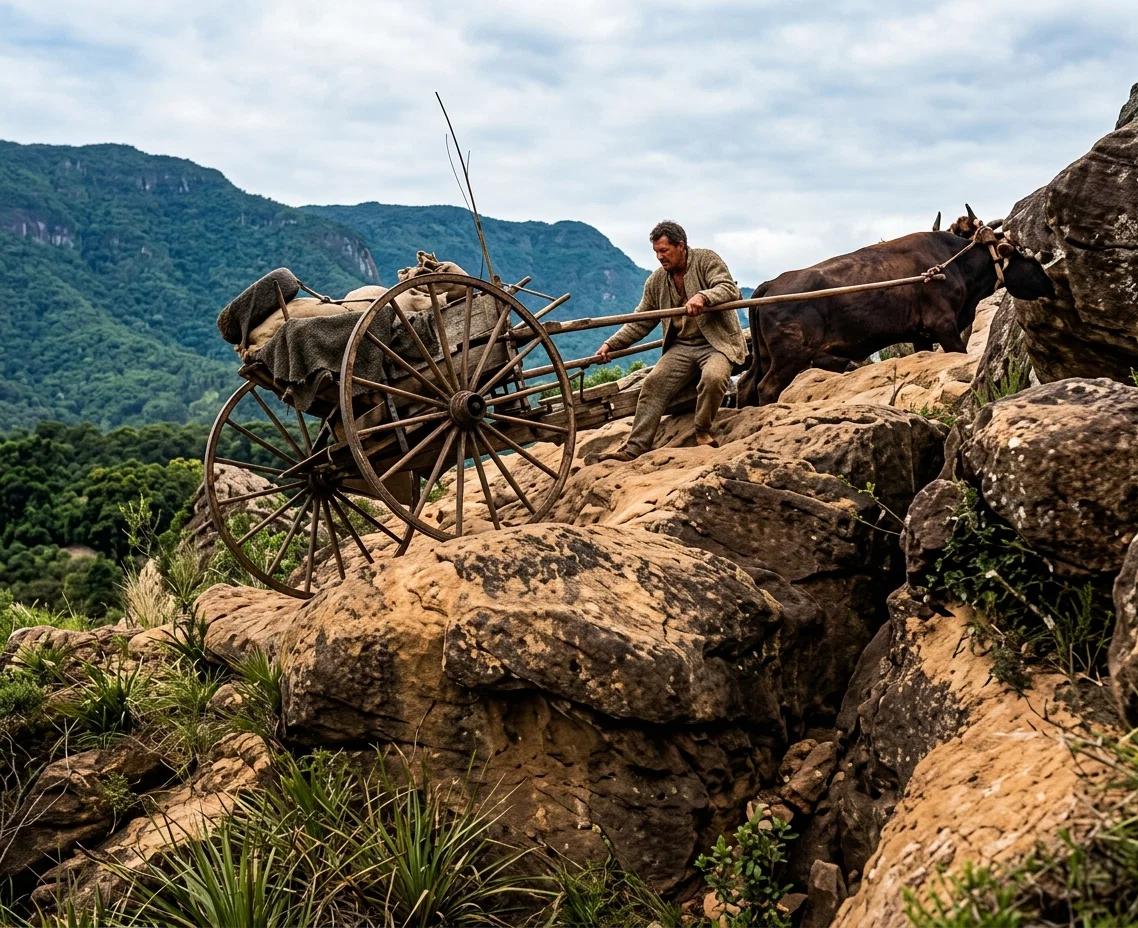
No. 3. Difficult Piece of Brazilian Highway.
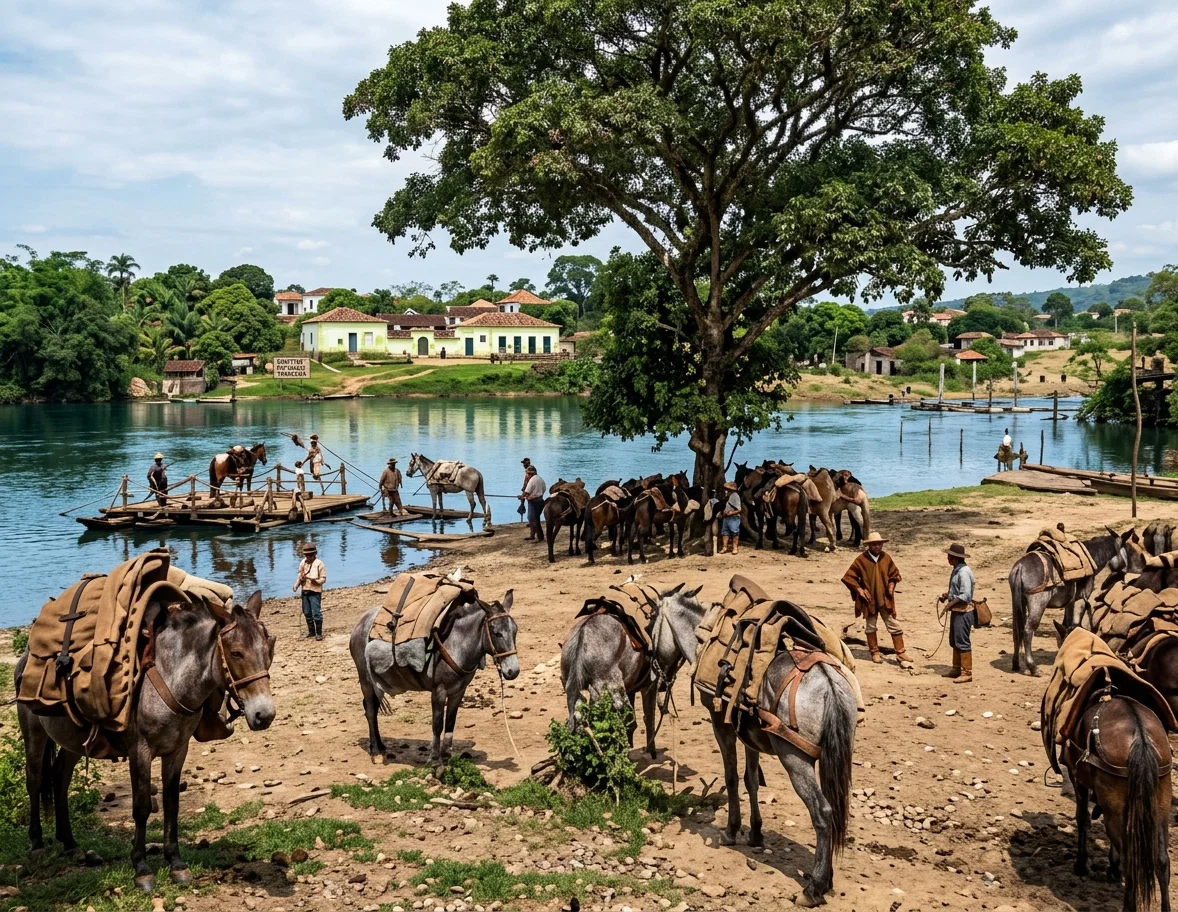
No. 5. At a Brazilian Ferry.
No. 1. Where the Railway Runs in Brazilian Mountains.
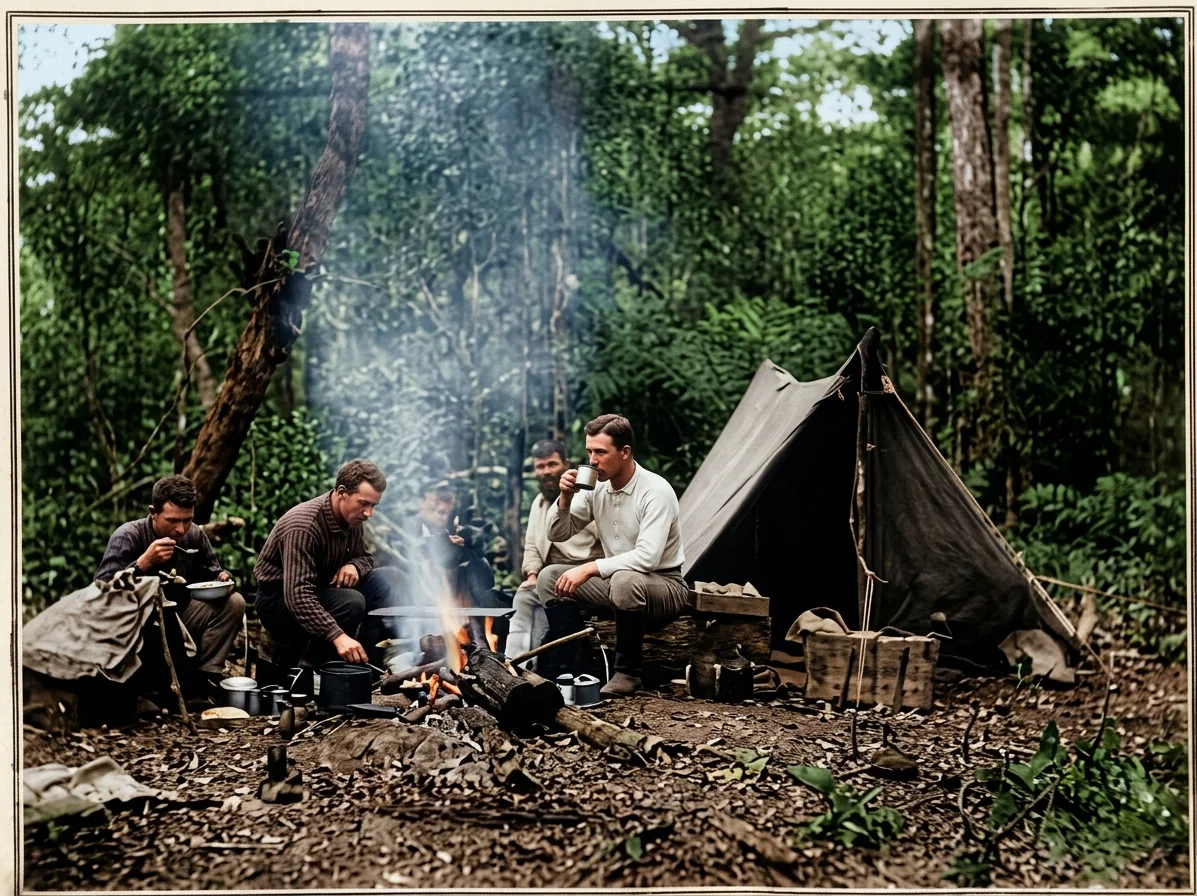
No. 6. Midday Meal in Brazilian Forest.
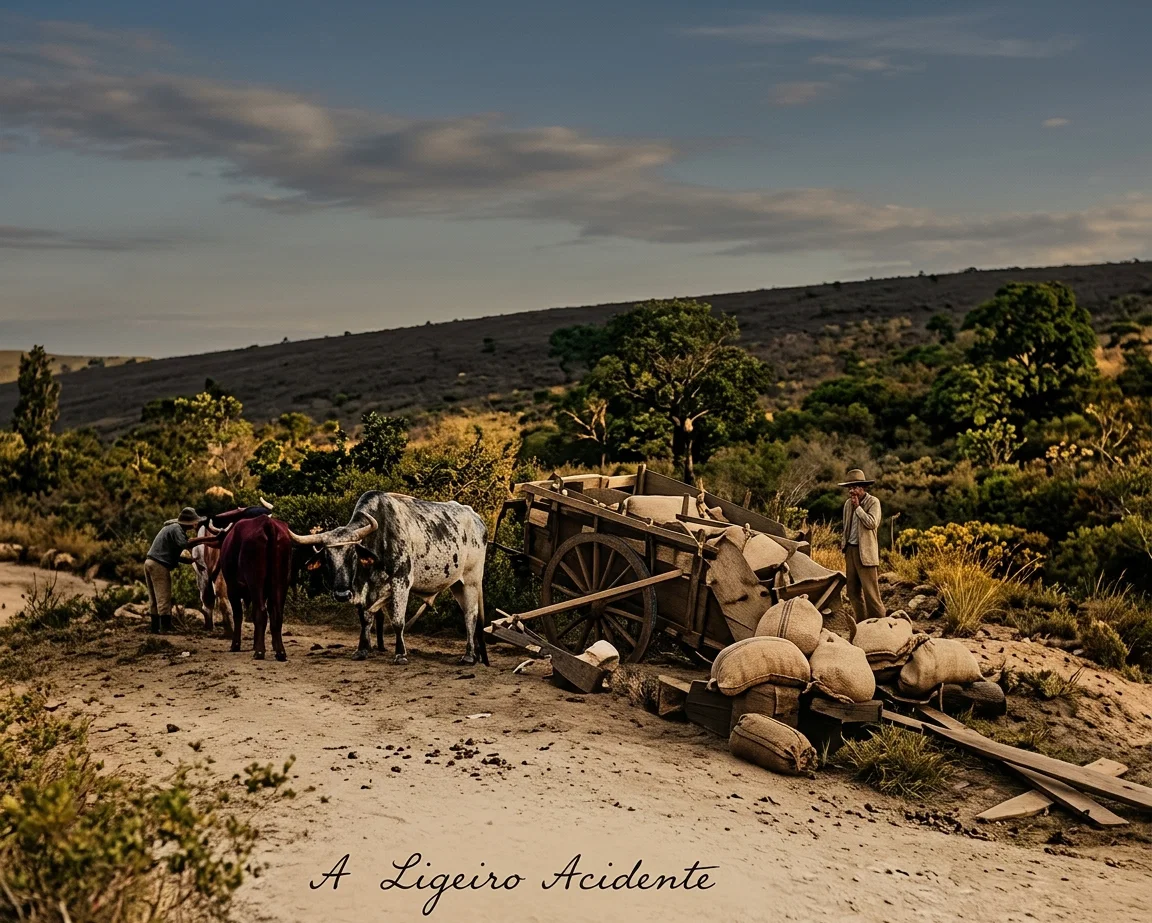
No. 4. A Slight Accident.
In order better to comprehend what is to follow, I will make a brief statement in regard to the customs of the people in the State of Parana.
When forming a Republic in 1888, Brazil followed the example of North America, and at that time organized itself into twenty federal States. Parana, with Curityba as its capital, belongs to the three southern States of this country, and is renowned for its healthful high altitude and climatic advantages above all other States in Brazil. In the lowlands along the coast which covers only a small area, the heat of the tropical sun is almost unbearable. In order to reach Curityba from the coast one must ascend through a wild, mountainous country; the highest point reaching about 6,360 feet above the sea. (See Picture No. 1.) A truly picturesque trail leads around this mountain; and with the high peaks on one side and the deep ravines on the other, one has an enchanting view of the mighty, creative works of God. (See Picture No. 2.) A constant change of this beautiful scenery rolls before our eyes as one grand, continuous panorama.
On Picture No. 1, A, B, C, represents some of the tunnels of which there are 17 to pass through in a short time. The somewhat irregular line marks the tracks of the railroad. D represents an immense curve, after which the train disappears in a long tunnel, as marked by C. It would not be just, however, to conclude that Brazil, as a country, is well supplied with transportation facilities. In proportion to the area which it covers, there are very few railroads, and the methods used for transportation make it very difficult to travel through the country.
Picture No. 3 represents some of the difficulties which a traveler in Brazil must meet, and it often occurs that a driver is forced to draw his vehicle over the rocks and stony hills himself. The horses have to be unharnessed and led over the dangerous places. Four-wheeled vehicles have to be taken apart and carried in pieces over these impassable portions of Brazilian highways. From this one can form a vague idea of the difficulties which the traveler in Brazil often encounters.
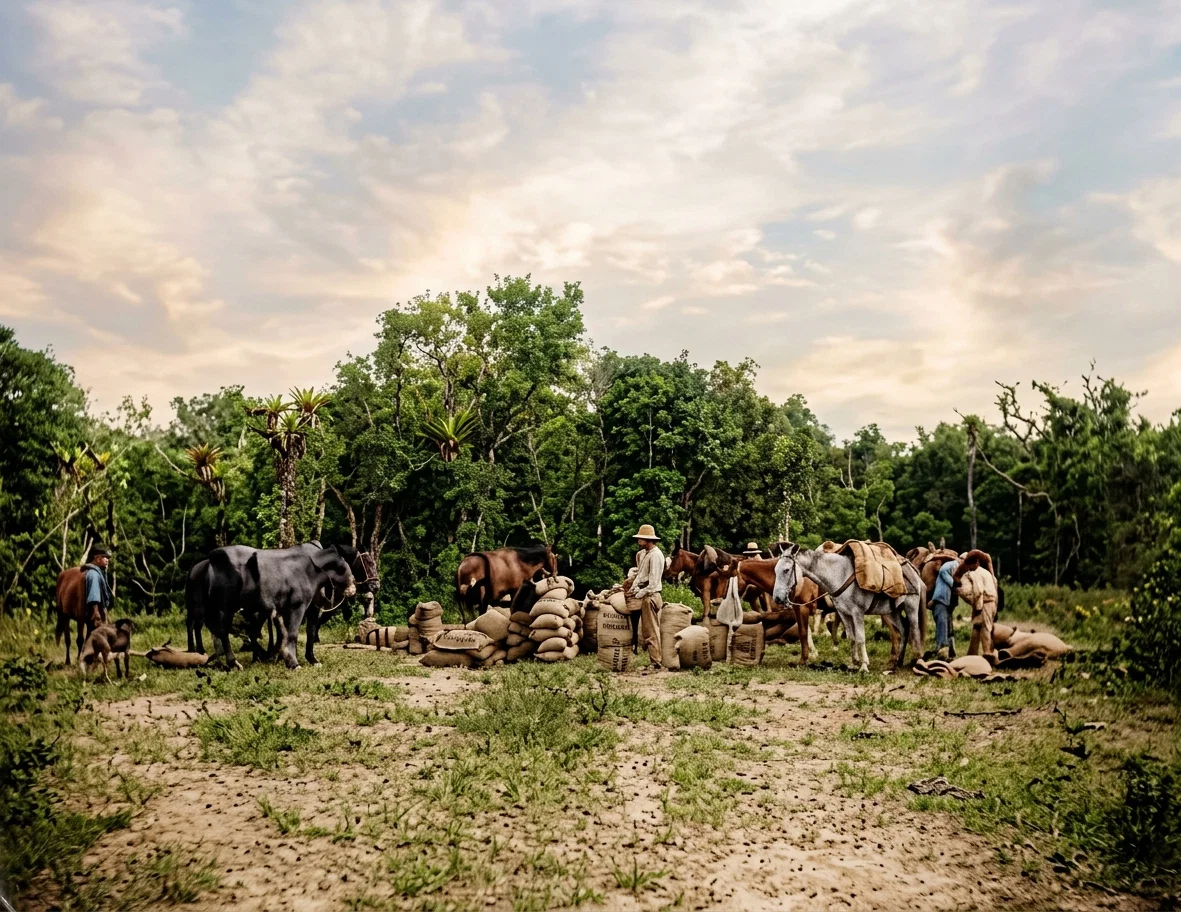
After reaching the summit one finds himself on a wide level stretch of country, 2,900 feet above sea level. This plateau forms the prairie of Parana, and its pastures make it well adapted to the raising of cattle. (See Picture No. 4.) Thousands of horses and cattle live on these prairies. Large and small clusters of trees artistically arranged by nature, greet the traveler’s eye and welcome him to rest. (See Pictures Nos. 5 and 6.) Even these endless prairies preach the wisdom of God and bear witness to His watch-care everywhere over the works of His creation.
The roads compare favorably with the conveyances used. Large two-wheeled carts drawn by from four to sixteen oxen, according to the size of the cart, move along at small pace with loud squeaking wheels that can be heard a mile away. The driver accompanies his team alongside on horseback and is armed with long bamboo sticks which he applies from time to time to remind the oxen that it is not yet time to go to sleep.
One does not lose his paciencia (which means the Brazilian stolid patience) when through little or greater interruptions the journey is considerably prolonged through some such cause as shown in Picture No. 4, or when one spends hours with the mules (which take the place in Brazil of the camel in the deserts of Asia and Africa) when crossing a river or stream, which intercepts the path of the traveler. (See Picture No. 5.)
The climate in the higher altitude is raw and cold when compared with that of the lowlands and is therefore more agreeable to the European emigrant. In the winter months, June and July, the thermometer sometimes drops to 21° Fahrenheit. At such times one willingly dons warm, woolen clothing and the stove is much appreciated.
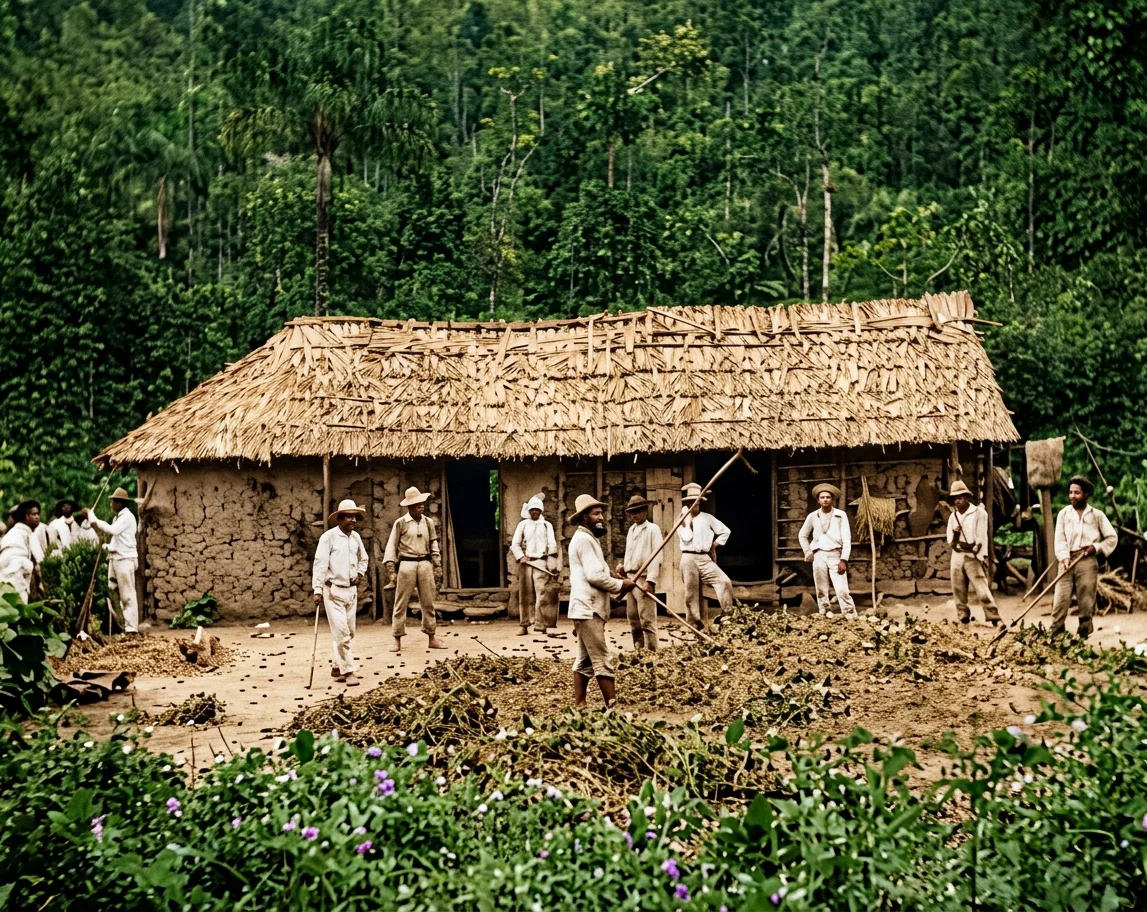
The most primitive methods are used in farming, and the chief products are corn, rye, potatoes and black beans. The latter are prepared with flour made from the roots of manioc and this is called the national dish of Brazil.
So far wheat-growing has not been a success, as there are many birds here and they often destroy the entire crop.
On the mountains in Parana grows the tall maté tree, from which the Paraguay tea is obtained. The dark, shiny leaves together with the smaller branches are dried in the woods before an open fire, which gives it the smoky flavor, after which it is ground up and the dry powder put in colored bottles. When wanted for drink, hot water is poured over it and it is sipped through a silver tube, which has a fine strainer at the bottom. The bottle is then passed from mouth to mouth, as the Brazilians seem to be devoid of any sense of propriety in this respect. This tea is the most popular drink in all South America.
They use a great deal of tobacco, especially among the lower classes, where men, women, and children are addicted to the habit.
Of the fruits, peaches and grapes are the most abundant. Oranges do not thrive well in the highlands and are quite sour.
The city of Curityba has a population of between 30,000 and 50,000. It is impossible to obtain a correct census with the deficient methods used. All possible nationalities are represented. There are between five and six thousand Germans.
In the year 1896, Brother Graf began to preach the truths of the Bible, but only a few accepted the message. The desire to become rich, and the pleasures of this world made many indifferent to the Word of God. It was purely a work of faith when Brother Graf in June 1896, by request of the pastor of the Evangelical State Church, opened the International School with eight children. Brother W. Stein was the only teacher for a time, tho the attendance had increased by December to forty-five. At the beginning of the new school year, this number was doubled. It is only by the help of the Almighty that our school has developed until it is considered the best school in the city. Altho we may appear as only a nutshell on the stormy sea of life, He is with us, and the winds and the waves obey His voice.
In the year 1897, by request of Brother Graf, I took the supervision of the school, with my wife as assistant. In August 1898, Brother Waldermire Ehlen from Hamburg came to our assistance, and our son, aged twenty years, is also one of the assistant teachers. An instructor in the Portuguese language has also been added to our corps of teachers.13
The constant growth of our work, and the public sentiment in our favor, aroused the jealousy of the pastor of the Evangelical Church, the successor to the one who encouraged the enterprise in the beginning. He received no encouragement or sympathy in his opposition, and many scorned him. In order to accomplish his plans, he organized an Evangelical school. His church, however, opposed this; but as he insisted on carrying out his purpose, he was finally released as pastor of the church, and had to leave Curityba. We see in the outcome of this the overruling hand of God. We do not always understand why the Lord uses such means to advance His work; but His deeds are wonderful and His name is glorious. To Him be all the praise.
No. 7. Resting at the Edge of a Forest.
An interesting incident occurred last year, when Brother Graf visited Curityba and through the pupils invited the parents to attend our meetings. A large number attended, and as a result, six parents of our students were baptized.
Brother Graf has spent some time in Curityba and has put forth a renewed effort in the State of Parana. In a short time four decided to follow the Lord. Our church numbers at the present time fifty members, and there are a number who are interested, and the prospects for a good work are encouraging.
At the Bible classes conducted for the children on Sabbath morning from 9:00 until 10:30 the average attendance has been about seventy. May the seed sown spring up to the honor and glory of God, and may we be ready when the Lord comes to enter with Him into His glorious kingdom.
Curityba, Brazil.
PAUL KRAMER.
WHY HE BECAME A CHRISTIAN.
SELDOM have the teachings of the false and the true been more strikingly yet simply illustrated to the heathen mind than in the following statement by a Chinaman of his conversion and his acceptance of Christianity.
No. 8. Hut and Threshing Floor of Brazilian Farmer. Threshing Beans.
“I was in a deep pit,” he said “sinking in the mire, and helpless to deliver myself. Looking up, I saw a shadow at the top, and soon a venerable face looked over the brink and said: ‘My son, I am Confucius, the father of your country. If you had obeyed my teachings you would never have been here.’ And then he passed on, with a significant movement of his finger and a cheerless farewell, adding, ‘If ever you get out of this, remember to obey my teachings.’ But, alas, that did not save me!
“Then Buddha came along, and, looking over the edge of the pit, he cried, ‘My son, just count it all as nothing. Enter into rest. Fold your arms and retire within yourself, and you will find Nirvana, the public peace to which we all are tending.’ I cried: ‘Father Buddha, if you will only help me to get out, I will be glad to do so. I could follow your instructions easily if I were where you are, but how can I rest in this awful place?’ Buddha passed on and left me to my despair.
“Then another face appeared. It was the face of a man beaming with kindness and bearing marks of sorrow. He did not linger a moment, but leaped down to my side, threw His arms around me, lifted me out of the mire, brought me to the solid ground above, then did not even bid me farewell, but took off my filthy garments, put new robes upon me, and bid me follow Him, saying, ‘I will never leave thee nor forsake thee.’ That is why I became a Christian. It was because Jesus Christ did not come to me with theories and speculations, but with practical help in my time of need.”—Christian Leader.
WILL YOU GO?
By Carrie Butcher
“Whom shall I send, and who will go for us.” Isa. 6:8.
THERE'S a message going forth;
It must quickly gird the earth;
There's a call for willing workers for the Lord;
There are living truths to teach;
Darkened lives that we may reach;
Who will volunteer to carry them the Word?
No. 2. Viewing the Valley from the Mountain Railway.
Chorus.—
Lo, the bugle call is sounding,
But the ranks are forming slow;
Tell, O tell me, Brother, Sister!
“Are you ready?” “Will you go?”
Let us labor with our might;
Haste, O, haste! ere comes the night;
Let us pray, and watch, and work, in sweet accord.
There is room for one and all,
Who will heed the ringing call?
O, there's joy in willing service for the Lord!
From the highway, from the slum,
From the haunts of sin they'll come,
From the mansion and the palace hear the cry!
Lives all marred by sin and strife,
Starving for the “Bread of Life,”
We may win them for the Master if we try.
Chorus.—
Who is ready, who is willing?
Who will answer, “Here am I?”
Haste, O, haste! while God is calling;
Ere His Spirit pass you by.
'Tis not ours to mourn and weep,
When some hero falls asleep;
Drop a tear, then close the ranks, nor heed the pain.
They are falling one by one,
Still with courage we press on!
Christ is coming! and we'll greet them, soon, again.
CARRIE BUTCHER.
Red Oak, Texas.
OUR WORK AND WORKERS.
THE new sanitarium at Madison, Wis., was dedicated on the 3d inst.
FIVE converts to the faith are reported in connection with the labors of Brethren R. C. Horton and R. E. Harter, at Kalamazoo, Mich.
AS THIS paper goes to press the Ohio State meeting is being held at Toledo. Brother D. E. Lindsey is pastor of the church in that city.
AT Milwaukee, Wis., five members were added to the church on the last quarterly-meeting occasion, and seven were baptized on the 26th ult.
MAY 6, brother Alexander Ritchie and wife sailed from New York for Scotland, to engage in missionary labor. May God bless them in their new field.
THE brethren at Eau Claire, Wis., have purchased, on favorable terms, a brick-veneered building 27x52 feet, which they are remodeling for a house of worship.
THE Welcome Visitor notes the baptism of four candidates at Springfield, Ohio, by Brother Wood. Still other candidates were announced for a future occasion.
A NEW church building at Big Springs, S. D., was dedicated on the 10th inst. Brethren N. W. Allee, L. Johnson, N. M. Jorgensen, and Professor Wallenkamp assisted in the services.
A LATE report in the Review from Brother L. O. Corwin, of Utilla, Bay Islands, says that six of the larger students in their school had been baptized. One is the wife of a wealthy merchant.
THE new sanitarium in Belfast, Ireland, which was started early the present year, is said to be making gratifying progress. Dr. J. J. Bell, a qualified physician and surgeon, is the superintendent.
THE Central Advance has information that Brother F. H. Westphal, of College View, Neb., has been asked to go to the proposed new conference comprising Manitoba and Alberta, and act as president.
FROM the West Michigan Herald we learn that two of our sisters—Drs. Patience Bourdeau and Carolyn Geisel, of Battle Creek—were on the program for addresses at the Fifth District Annual Convention of the W. C. T. U. recently held in Grand Rapids. This was good for the convention.
THE first annual meeting of Scotch believers in the message we are giving to the world was convened in Glasgow, April 1. Brother W. A. Westworth was chosen chairman of the mission board, with W. B. Scott as secretary and E. Aplin as treasurer. Ministerial licenses were granted to D. P. Miller, E. Aplin, R. M. Lamie, J. Netherey, and Miss Mary Lamie. The mission has also ten canvassers in the field circulating our literature.
A NOTE in the South African Missionary says: “The Cape Town office has just received an order from a native up-country for sixty copies of ‘Steps to Christ’ in Kaffir, and the same number in Sesuto, and sixty copies of ‘Coming of the Lord’ in both Kaffir and Sesuto. He has used our literature before, and knows what it is. A number of educated natives from the location at Maitland have recently called at our office to enquire about our literature and views.”
WE have received a neat circular showing the Arizona Sanitarium, at Phoenix. It was opened last February, and is doing a general treatment business. The circular says this is “the only place in Arizona where hydrotherapy in its modern and scientific methods is practised in connection with medical and surgical care.” It is controlled by the Pacific Union Medical Missionary and Benevolent Association, under the superintendence of Dr. E. C. Bond. Address 525 Central Avenue, Phoenix, A. T.