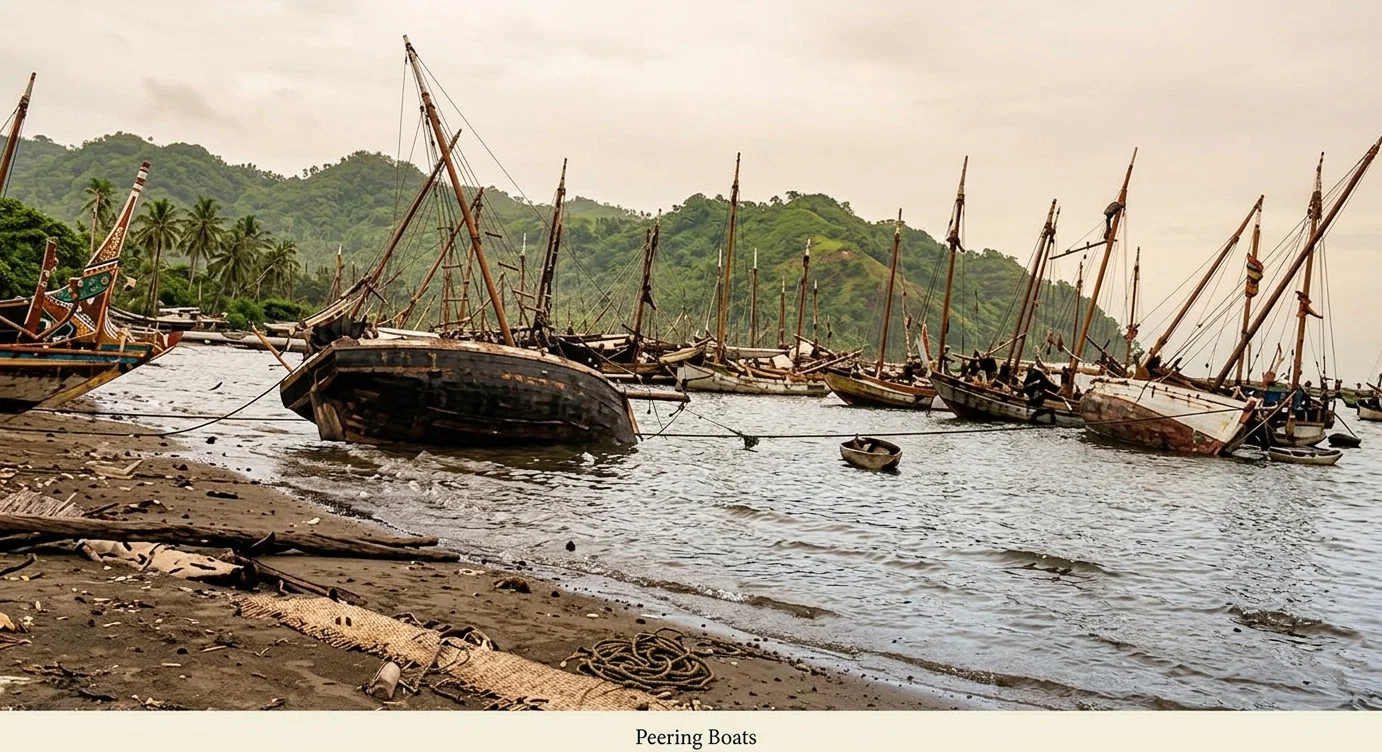
While in Java we made a very interesting trip into the interior. Some one has styled Java the “Garden of the East,” and from what I have seen I think the term very appropriate indeed. Everywhere we traveled it is one magnificent garden of luxuriance. We went through thousands of rice-fields in every stage of development, some lovely green and others golden. I never saw such intense cultivation anywhere; neither have I seen such a picturesque and satisfactory bit of tropical scenery anywhere before.
Speaking of the rice-fields, we saw the natives plowing with the clumsy water-buffaloes and the antiquated wooden plow. I saw many of the natives on their way to the rice-fields with their buffaloes, driving them before them and carrying both the plow and the yoke on the shoulder. The plows seem to me to be about as good as crooked sticks. The rice-fields are divided off into small, diked-in paddocks, inside of which the water can be turned off or on at pleasure. The rice grows in the water much of the time. I noticed that, as a rule, the plowing is done while the land is under water, the buffaloes wallowing along through mud and water dragging the harmless plow and the lazy driver. Both animals and driver seem to enjoy the “mud-pie” business equally well. The deeper the water the better satisfied the buffaloes were.
We visited Miss Jansz’ mission some distance from Soerabaya. We were all day and part of another on a steam tram, and finished our journey by a ride in a cart and a horseback ride up a mountain. It was all very interesting, and the scenery was too beautiful for any description that I can give. I thought of some of the Bible statements about the land of Canaan, “a land of hills and valleys, and drinketh water of the rain of heaven.” “A land wherein thou shalt eat thy bread without scarceness, thou shalt not lack anything in it.”
We had a right welcome from Miss Jansz, and we were glad to see her and her work. She has been keeping the Sabbath now for over fifteen years, and for over six years she has been doing mission work here; has a little colony of 200, all of them resting on the Sabbath, and a number of them converted. Sister Jansz has not identified herself with us, but she is an earnest Christian and believes in the soon coming of the Lord and other points of the message. She now desires to turn the whole work over to us and work under us. I was much interested in what I saw there. We have arranged for Miss Tunheim to go there till we can get some one from Australia. Miss Jansz will take a rest and then do some translating for us.
While in the interior of Java, we visited the old Hindu temples, among the greatest and most interesting ruins of the world. Here the admirer of noble workmanship, both in architecture and ancient art, will have much to interest him. There are a number of these temples in Java, but the ones at Boro Budoer are the largest. We visited these and two smaller ones. There are hundreds of life-size images of Buddha, many of them in an excellent state of preservation, altho the temples have been in ruins for hundreds of years,—how long we can scarcely say, from the time no doubt that Hinduism sank under the tide of Mohammedanism.
These temples are supposed to have been erected over a millennium ago. The workmanship is truly wonderfully executed; every face is a study, none are expressionless. There are not only statues of Buddha, but also of sacred bulls, and carvings of monkeys, beasts of various kinds, and birds and trees. There are carvings of soldiers with spears, and others in battle array; pictures of ships under sail, tables of offerings to their god, of kings upon their thrones. It is wonderful how these have stood the ravages of time. Earthquakes have disjointed the walls in many places, rain and rank vegetation have disintegrated the foundation works, and no doubt zealous haters of idolatry have effaced much that no longer appears, but a great part still stands, wonderful monuments of human skill and industry. In Boro Budoer alone I am told there are three miles of walls, if each were placed one after another, all studded with wonderful carvings.
J. E. FULTON.
Beginnings and Progress in China
By J. N. Anderson
Extracts from Quadrennial Report
IT is now seven years since the General Conference of Seventh-day Adventists formally opened work in this empire in pursuance of action taken by that body at its biennial session, held in Battle Creek, Mich., 1901. Beginning with a small nucleus of three workers sent out by that conference with instructions to go to Hongkong, our force of workers has been augmented until to-day we number thirty-three adults and thirteen children. From our first entrance into the island of Hongkong, which, by the way, is not China, nor even a part of China, we have steadily advanced until at the present we are in five of the eighteen provinces of China proper, distributed in eight central stations, with which are connected nine outstations.
As foreign workers we are supported by some thirty-five native evangelists, teachers, colporteurs, and other assistants. Including the Swatow dialect, which to the present is spoken by only one of our native preachers, we have entered upon six of the various languages of China, the most widely spoken, and the most representative, including probably not less than nine tenths of China's population. These languages are the Mandarin, the Shanghai, the Amoy, the Swatow, the Hakka, and the Canton. In all the five languages (barring the Shanghai, where our workers have been located but a short time), we now have foreign workers who have a good working knowledge of their language, and what is equally important,13there are native evangelists and teachers instructed in the truth, and of considerable training, prepared and ready to second our every effort in the endeavor to teach the people the message.
When it is remembered that it takes from two to four years to acquire a good working knowledge of the Chinese language, it is very patent that this measure of success in the acquisition of the languages of this field, is no mean attainment, in view of the time we have been here. It will readily be seen that it is the key to the whole situation. Potentially, it gives us a possession of the entire field, in that it throws wide open the channel that is to carry a volume of trained workers to the masses of this race.
We have at present six organized churches, with a membership of about seventy-five, exclusive of foreigners. Our Sabbath-schools number five, with an attendance of about one hundred fifty. We are operating three girls' schools, with an attendance of about one hundred. One of these is in part a boarding-school, and carries on work in the line of training teachers and Bible women. Three boys' schools are in operation, having an aggregate attendance of fifty or sixty. Four dispensaries are maintained from which healing and the word of truth are ministered. An increasing volume of literature is steadily being sent forth into the various parts of the field. New openings adjoining our central and outstations urge us forward beyond our ability to fill them. Commendable progress has been made in the few months since we installed the printing-press at Shanghai, and we are in a fair way to do effective work along this line.
J. N. Anderson.
Go and Tell It
By Max Hill
If the message of the kingdom
In its power and purity
Has within your heart found welcome,
Go and tell it, joyfully.
Tell it to your own dear brother,
He may long its power to know;
Tell it to him if you love him—
Go and tell it, quickly go.
Tell it to your nearest neighbor,
Maybe he knows not the way
That will lead to life eternal—
Go and tell it, go to-day.
Tell it to the distant heathen
Bowing still to wood and stone;
'Tis the Master bids you tell it—
Go and tell it, make it known.
Go and tell it; go and tell it!
Thousands yet have never heard;
Thousands perish in the darkness—
Go and tell it, preach the word.
MAX HILL
Union College Summer School
A SUMMER school will be held at Union College from July 7 to August 17, under the auspices of the Central and Northern Union Conferences. Special review work for teachers, manual training, and primary methods are made prominent. Regular credits will be given for preparatory, academic, and college work. For information address C. C. Lewis, College View, Neb.
Matthew Twenty-four Second Coming of Christ
An exposition, verse by verse, of one of the most striking chapters in the New Testament; covering
Matthew Twenty-four Second Coming of Christ
our Lord’s great discourse on the destruction of Jerusalem, the end of the world, and the special signs of His second coming to reward His children. The facts of fulfilment given make this pamphlet worth many times its price. 94 pages, price 10c.
PACIFIC PRESS
Mountain View, Cal.
Our Work and Workers
At Iola, Kan., Brother B. W. Brown recently baptized six. These, with six others, united with the church.
THE company at Newport News, Va., has been blessed with the addition of fourteen members, and the church is generally prosperous. So Brother L. Munce reports.
THE brethren at Los Gatos, Cal., have just purchased and paid for a lot upon which they will erect a church building.
A CHURCH of twenty-two members was organized at Plainview, Texas, April 10, by Brethren S. Swinson and E. S. Taylor.
MR. and Mrs. M. B. Butterfield closed a series of meetings at Scottsville, Mich., April 2. Six accepted the truth for this time through their labors.
BROTHER Q. V. SHAW has been holding meetings among the colored people of Corsicana, Texas. Seven were baptized and united with the church early in April.
BROTHER JOHN LIPKE, who has spent several years laboring in Brazil, reports advancement in that field. On a six-weeks’ tour he baptized a dozen or more and organized a new church.
A SCANDINAVIAN church was organized at Council Bluffs, Iowa, April 3. Ten of the fifteen members came in through the labors of Brother L. H. Christian, who has been ably assisted by Bible workers.
BROTHER and Sister G. W. Pettit, in company with Brethren J. M. Cole and Daniel Nettleton, have conducted services at Dallas, Ore. At the close of the series of meetings fifteen signed the covenant to obey God’s commandments.
BROTHER F. H. WESTPHAL, who has labored for many years in South America, writes that on a recent journey in Chile he baptized five converts to the truth. While the message goes slowly in those sin-darkened lands, there is steady progress, and those who accept of the truth are generally faithful.
BROTHER J. N. LOUGHBOROUGH, writing of a camp-meeting held in New Zealand, states that twelve were baptized. This was their midsummer meeting, January 1 to 11. Elder Loughborough is seventy-seven years old, but in his long journeys in many lands he is well and strong, being able to speak every day, often more than once.
Why People Will want the May Signs of the Times Monthly
By Editor
Now Ready
The cover is beautiful, a photo of a California wild poppy field with children gathering poppies. Printed in colors.
One of the features of the world-wide tour of the Chapman-Alexander Missionary Company “will be to leave a trail of Testaments more than 25,000 miles long.”
This great movement, with photographs of members of party, is described in an interesting way in this number.
Almost every one is familiar to some extent with the “Emmanuel Movement.” “It was in the fall of 1906 that the Emmanuel movement had its birth. Altho for years the Emmanuel Church was apparently one of the most prosperous churches in Boston, Drs. Worcester and McComb saw that she, like so many churches, was becoming more and more powerless to attract and hold the people.” Prof. Geo. W. Rine, in his article on the subject in this number, tells of the methods adopted by these leaders to “reinvest their church with the genuine faith and power of the Christian religion.” He goes into the whole subject thoroly, explaining the system of teaching so clearly that all may understand it.
“IS THE WORLD FACING A RELIGIOUS DESPOTISM?” is the heading of the article in the new Religious Liberty Department, in which incidents from state after state are presented showing exactly how religious legislation is regarded.
The Departments on TEMPERANCE and the HOME are filled with helpful, health-producing, educational articles.
If you do not receive the SIGNS MONTHLY, send $1.00 for yearly subscription You will not be disappointed. Combination price with Signs Weekly, $2.00
If you are interested in getting the truth it contains before others, order a quantity to sell. You will be given every help and encouragement possible.
Retail price 10 cents. Twenty-five to five hundred copies, 4 cents each.
Order of your Tract Society, and ask for a copy of the “Signs Worker,” a little paper containing helpful thoughts for workers.
Orders in Central and Northern Union Conferences now filled very promptly from stock at Pacific Press, 1109 E. 12th St., Kansas City, Missouri.
Signs of the Times, Mountain View, California
Wanted for Missionary Work
LATE copies of Life and Health, Instructor, and SIGNS. Belle Waterman-Findlay, Albany, Ore.
CLEAN copies of any of our denominational papers for free reading-rack at Vallejo navy-yard. A. V. Dyberg, 220 Main St., North Vallejo, Cal.
Japan and Christianity
THIS is the title of a twenty-eight-page booklet written by Yoshio Tanimoto, a Japanese student at the Foreign Mission Seminary, Washington, D. C. It is a “brief sketch of the geography, history, and progress of Christian missions, and the decline of religions in Japan, etc.,” illustrated. The price is ten cents, postage three cents additional. Address the author at Takoma Park, Washington, D. C. The sale of this pamphlet will assist the author in securing an education, as well as instruct the readers concerning Japan.
Bedtime Talks with the Children
By Mrs. L. D. Avery-Stuttle
By Mrs. L. D. Avery-Stuttle
The other day as I walked down the street, my way led me across a new cement sidewalk. It was very nice and smooth, and I thought, What an addition to the city are these nice walks! But as I looked, I noticed several large, unsightly footprints deeply sunken into the great cement slabs, which were now as hard as stone. Ah, said I, some one has been stepping on the walk while it was still soft and plastic, and now it is too late to smooth out the footprints; they must remain as long as the walk endures,—a standing monument to somebody’s heedlessness. Why?—Because the cement has hardened now, and the mischief can not be repaired by never so skilful a workman.
Then I said, There is a lesson in all this, which it would be wise for parents and teachers and any one else who has anything to do with the molding of the minds of young children to remember. The minds of the little folks are like the cement blocks before they have hardened. When once they receive impressions, they are there to stay. Ah, how many times the careless, thoughtless mother or teacher leaves unlovely impressions upon the plastic minds of the little ones.
The bedtime hour ought to be the sweetest, happiest hour of the whole day to the children. Instead of this, it is to many of them a time to be dreaded and postponed as long as childish ingenuity can accomplish it. Many timid and nervous little ones are afraid of darkness and shadows. The morbidly imaginative and sensitive child is to be pitied; and the parent or guardian of such an one needs heavenly wisdom and divine patience. To such a child, every shadow is peopled with horrible shapes and dreadful goblins, and every dark nook and corner becomes in his imagination the lurking-places of “bogy men” who only await an opportunity to destroy him. It can not be the wise mother who insists upon putting such little ones into a lonely, dark bedroom, with the parting admonition to “go right to sleep,” while she closes the door upon the sobbing child and leaves him alone to the horrors of his childish imagination.
The loving mother—the truly wise one—is never cruel. She will reserve the sweetest stories, the most loving kisses, and the most dreamy lullabies for the twilight hour. Then, with these upon her lips, she will soothe the weary, restless, nervous little body into the quiet slumbers of dreamland.
Put the little ones to bed with dimples upon their soft cheeks instead of tears. Tell them some sweet story of your own childhood, or, better still, go to that inexhaustible storehouse, the Bible. This is a story-book that never grows old. Where is the little child who ever tired of listening to the “sweet story of old,” of the wonderful Babe whose birthplace was a manger; of the beautiful star of Bethlehem; of the wise men who brought the rich treasures of the far away East, and poured them at the feet of the sinless Child? What little one ever wearied of hearing the story of young Samuel, or of Ruth, the beautiful gleaner, or of Esther, or of Sampson, or of young David and the giant, or of Noah and his wonderful ark?
With such a rich and varied storehouse as this from which to draw, it is an astonishment to me that foolish mothers can think of nothing more profitable for mental or for spiritual food for their children than some silly nursery rhyme about the “cat and the fiddle,” and “hi-diddle diddle, the cow jumped over the moon.”
Pitiful, isn’t it? Especially does this apply to those of us who ought to know better,—to those whose own minds ought to be so filled and impregnated with the all-glorious truths of the Gospel, that they want nothing else for their children. Not that they are to be taught nothing but the Bible; but O there is plenty of good, sound, sensible literature, without dabbling in folly.
A child who is fed on cake and candy and pastry and sweetmeats, soon learns to relish nothing else; but he grows to be a weakling—an unhappy and miserable dyspeptic. In like manner, children who are taught nothing but folly and silly, senseless jingles from earliest infancy are apt to become spiritual and mental dyspeptics. Of what conceivable benefit will it ever be to your little girl or boy to be able to repeat page after page from “Mother Goose,” or “Mother Hubbard” or “Simple Simon”? Will such bedtime stories as these add one whit to their knowledge? Will it brighten their intellects or add to their intelligence to be able to tell how many “black-birds” were baked in the pie that the king was said to have eaten? And more serious than all, is this the kind of foundation upon which to build well-rounded, symmetrical characters, such as we desire our children to possess?
“But,” protests some anxious mother, “I think it is a good thing to develop the imagination of our children. Don’t you think these old-fashioned nursery rhymes help to do that?”
Yes, if it is desirable to train the imagination to dwell upon things which never existed nor ever can exist. But O how much better to allow the imagination to revel in the unseen glories and dazzling beauties of those mansions which “eye hath not seen,” and before whose indescribable splendors, even the pen of inspiration hesitates and stands still!
Do you think it possible for human language fully to describe the wonderful journey which the redeemed will soon take? Are you able perfectly to describe the shining convoy of angels which will escort the saved of earth—parents and children—even to the everlasting gates of the city of our God? Can you describe the meeting of loved ones long separated by death? Is your tongue able to recount the wonders which will pass before them while on their upward flight,—the whirling suns and planets and worlds and systems which will be passed by the mighty excursion train on its way to the glory land?
If you feel unable to describe these things perfectly, then assuredly there is plenty of room for the play of the most vivid imagination.
Then, do you not think that, if the last waking moments of our little ones are trained to dwell upon such themes, their sleep will be calm and sweet, and their dreams be of the beautiful angels whose holy presence is continually invited?
I Have Put the Children to Bed, Father
By Mrs. L. D. Avery-Stuttle
By Mrs. L. D. Avery-Stuttle
I HAVE put the children to bed, Father,
William and Jennie and Paul,—
Three little beds and three curly heads
And three little forms so small;
I have kissed their baby lips, Father,
And smoothed out the pillows white,
But it seemeth now I have never known
The love that I feel to-night.
I think of the years to come, Father,
And think of the snares of sin,
Of the perilous days and the devious ways,
Of the paths they must journey in.
I told them to-night of the Magi wise,
Of the Bethlehem Babe so sweet,
Of the glorious star that led them far,
Till they knelt at His blessed feet.
And the children smiled in my face to-night,
As the beautiful tale I told;
"Please, tell us the story again, mama,
It will never be—never be old!"
O I tell them the story again and again,
As close to my heart I hold
The dear little forms that I love so well,—
The story that never grows old.
A Too Easy Task
I WAS watching the plumbers, says Craig S. Thoms, as they worked on the new home. One with a simple little cold-chisel had, by dint of numerous brisk taps in a circle around it, cut in two a large iron pipe. Another was busy with a similar chisel cutting in halves a large piece of lead.
“Easy work,” I said, as I watched the latter drive the chisel into the soft material.
“Yes,” he replied, “but this work spoils the chisel.”
“Lead is not hard enough to spoil a chisel,” I insisted.
“No,” the workman replied, “but it takes all the temper out of it, so that it is good for nothing else. To cut much lead will spoil the finest cold-chisel.”
Soft seats, easy tasks, and pathways strewn with roses, take the temper out of character, and produce good-for-nothing lives. Difficulties impart their own splendid fiber to those who master them.—Young People’s Weekly.
The Vegetarian Cook Book
By E. G. Fulton
By E. G. FULTON
The author has had years of experience in vegetarian cookery and in the management of vegetarian cafes, and cafeterias. With its aid the chef, cook, or housewife is able to prepare appetizing, healthful meals without the use of any flesh food.
This book contains 226 pages, including a handy and well-arranged index of all the recipes given.
Tastily bound in cloth, price,post-paid, 75 cents
Pacific Press Publishing Assn.
Mountain View, California
Portland, Ore. Regina, Sask., Can. Kansas City, Mo.
PLAN YOUR VACATION NOW AT OUR EXPENSE
A Choice of Four
Free Trips
Is Offered You
Seattle, during Alaska-Yukon Exposition
Yellowstone National Park
Yosemite Valley
Lake Tahoe
All Your Expenses Paid
If you have friends in the East who want to visit the Pacific Coast, we can arrange it
THIS IS YOUR OPPORTUNITY
For complete information address
SUNSET TRAVEL CLUB
ROOM 16, FLOOD BLDG., San Francisco
The Well-Bred Girl
THE girl who is well bred never finds it necessary to announce the fact to the world. Good breeding is as natural to her as breathing, and as necessary, too.
She never gossips nor listens to tales about her friends. This sort of conversation is not pleasing to her.
The well-bred girl seldom apologizes. It is not necessary for her to do so, because she is always careful of other people’s feelings, and she never talks of her private affairs.
The well-bred girl never makes herself conspicuous in public places and does not permit herself to be drawn into any arguments in conversation which might involve others.
She is gracious and hospitable, giving of what she has with a good will, and never attempts to entertain in a way she can not afford. Indeed, she is just a simple, wholesome girl, careful of other people’s feelings and always has a ready fund of sympathy for those in trouble.—Farm and Fireside.
Chinese Lily Bulbs
MANY who start bulbs of the Chinese lily in water are disappointed that they do not bloom. This is probably because the bulbs have already bloomed once in water. The Chinese tell us that if they are planted in the ground the first time, they will always bloom yearly. If they are planted in the ground after blooming once in water, they will come up every year, but will not bloom until the end of the fifth year, but after that they will bloom every year. It is wise, therefore, in buying bulbs of the Chinese lily, to ascertain the date of the last blooming and whether it was in water or in soil.
Our Little Friend
An Illustrated Paper for the Smaller Men and Women, for the Children and Little Ones
Instructive and entertaining, clean, wholesome, sensible. It is a character builder, a helper to father and mother. Our Little Friend would plant seed in the joyous life of the children in the Present, that it may bear blessed fruitage in the Harvest of the Future. Respect your child's individuality. Take the paper for him or her. Only 50 cents a year.
Address, OUR LITTLE FRIEND, Mountain View, Cal.
Thoughts from the Mount of Blessing.—
An exposition of Christ’s Sermon on the Mount. It has 218 pages and six chapters: On the Mountainside, The Beatitudes, The Spirituality of the Law, The True Motive in Service, The Lord’s Prayer, Not Judging but Doing. A new edition just printed on fine enameled paper, new type, and reillustrated with 27 beautiful half-tone engravings specially prepared for the book by eminent New York artists. It will be found full of comfort and blessing by all fortunate enough to obtain and read it. A beautiful gift book. In paper covers, 35 cents. Address this office.
Helps to Bible Study
Helps to Bible Study. A series of Bible-readings, simple and easy, designed as an aid to the personal study of the Scriptures, and adapted to the use of individuals or families; also a valuable assistant for Bible workers. 125 pages. Paper covers, 25 cents; cloth, net, 50 cents. Address this office.
A SEVENTH-DAY ADVENTIST,
Widower, who has four sons, desires to correspond with owner of small farm, mine, or business, for rent or sale on a small advance. Adventist preferred. Address, William C. Corus, Box 361, Turlock, Cal.
CHRIST OUR ADVOCATE
A clear, tho brief, setting forth of the Bible types and symbols, the services in connection with the earthly sanctuary, the effectual sacrifice and priesthood of our Lord, to which all these types pointed, and the great prophetic period of Dan. 8:14. Contains 112 pages and is illustrated. Price ten cents.
PACIFIC PRESS
Mountain View, Cal.
The Martyrs’ Monument in Smithfield
It may be of interest to our readers to know that when the photograph of the martyrs' monument in Smithfield Square, London, found in another column, was taken, one of the surprising things was to find so few who were acquainted with the locality. Unless one knows just where it is, it is not an easy thing to find. Perhaps a half dozen were inquired of who knew nothing about it, and the only one that had heard of it could give only general information. On the other hand some very ordinary places, marked by the most trivial incidents in the lives of such men as Dickens, Thackery, and others, were well known and easily found. So the world estimates true greatness. John Philpot and his companions died for principles that were eternal. Some of the well-known names lived merely to amuse, yet the former are forgotten by the mass while the latter are remembered. It is good to know that God does not forget.
Turkey
By Editor
Turkey.— In our last issue we noted the fact that there was a recoil from the action taken by the Sultan, that his effort to overrun the Young Turks resulted in a revolution, that the Sultan was a prisoner in his own palace, and that the Sultan was begging for his throne. The news of the last week shows that his brother who has been kept a prisoner for thirty-six years is made Sultan under the name of Mehemmed V. He seems to be of an altogether different character than the one who has ruled. His whole course thus far is one of democratic simplicity. He moves among the people and is cheered wherever he goes. The Sultan himself has been taken to Salonica and there imprisoned. The last news is that a special council of war will be held over his case and he may after all be beheaded. His wealth, estimated all the way from $25,000,000 to $200,000,000 has been confiscated and all his harem taken away except four wives. These are imprisoned with him. The United States was the first government officially to recognize Mehemmed V. In this President Taft offered his imperial majesty his congratulations. Favorable impression has been made upon other powers, of the new Sultan. When Abdul Hamid left, he passed between troops of soldiers who did not even salute; there was none to do him honor; not a single cheer was raised. The women who were to share his exile went timidly and yet curiously, riding on a train for the first time in their lives.
The Young Turks seem to be, at least at the present time, able to cope with the situation, nor do they wish interference from the outside until it is clearly seen that they are themselves unable to control the people and manage the government. The new Sultan promises to keep the sacred law and is enthusiastically acclaimed by the people of Constantinople. As a result of the reaction on the part of Abdul Hamid, fanatical Moslems have slaughtered hundreds and hundreds of professed Christians. Among them are two American missionaries at Adana, the Rev. Daniel Weiner Rogers and the Rev. Mr. Maurer. How much has been done in this way we will not know for weeks. Disturbances have taken place in the interior and it is not easy to get at the news. Many perhaps who are reported slain have fled to places of safety outside. We still believe that God will overrule so that His message can go throughout all Mohammedan countries and we welcome the restoration of the New Turks to power. It seems as tho every devout soul throughout Christendom and every lover of humanity will also rejoice.
An Epidemic of Tornadoes.
Years ago our tornado season came in the latter part of summer. Almost all times of year seem to be propitious these days. The last of April was marked by what the newspapers call an epidemic of tornadoes. Cyclones, blizzards, and hurricanes swept the whole East from the Rockies to the Alleghanies, and from the Great Lakes to the Gulf. One paper gives the record of death at 140; another at 178. Three towns were wiped out in Tennessee, six villages in ruins in Arkansas, two towns wrecked in Alabama, two in Missouri, tidal wave on Lake Michigan doing great damage, fearful hailstorms sweeping through Illinois ruining crops, fruit crops of Colorado ruined, tornado in Ohio that swept three counties. Throughout the South we are told that there are hundreds of mangled bodies and a general devastation of property worth many millions, and in the section around Memphis there are at least one hundred dead. It will take days before anything like a correct estimate can be made. Definite news seems to indicate that in Centerville, Tenn., 20 are killed, 20 in Chicago, 11 in Golden, Mo., 12 in Hornlake, Tenn., 20 in Pulaski, Tenn. Dead are recorded in 19 different places. These increasing calamities are among the many indications of the aging earth.