Your ShelfYour Projects

Signs of the Times, Vol. 29, No. 52.

THE PATH OF LIFE

Signs of the Times

Dec 30, 1903

Pacific Press Publishing Company · Oakland, California · Dec 30, 1903

THE PATH OF LIFE.
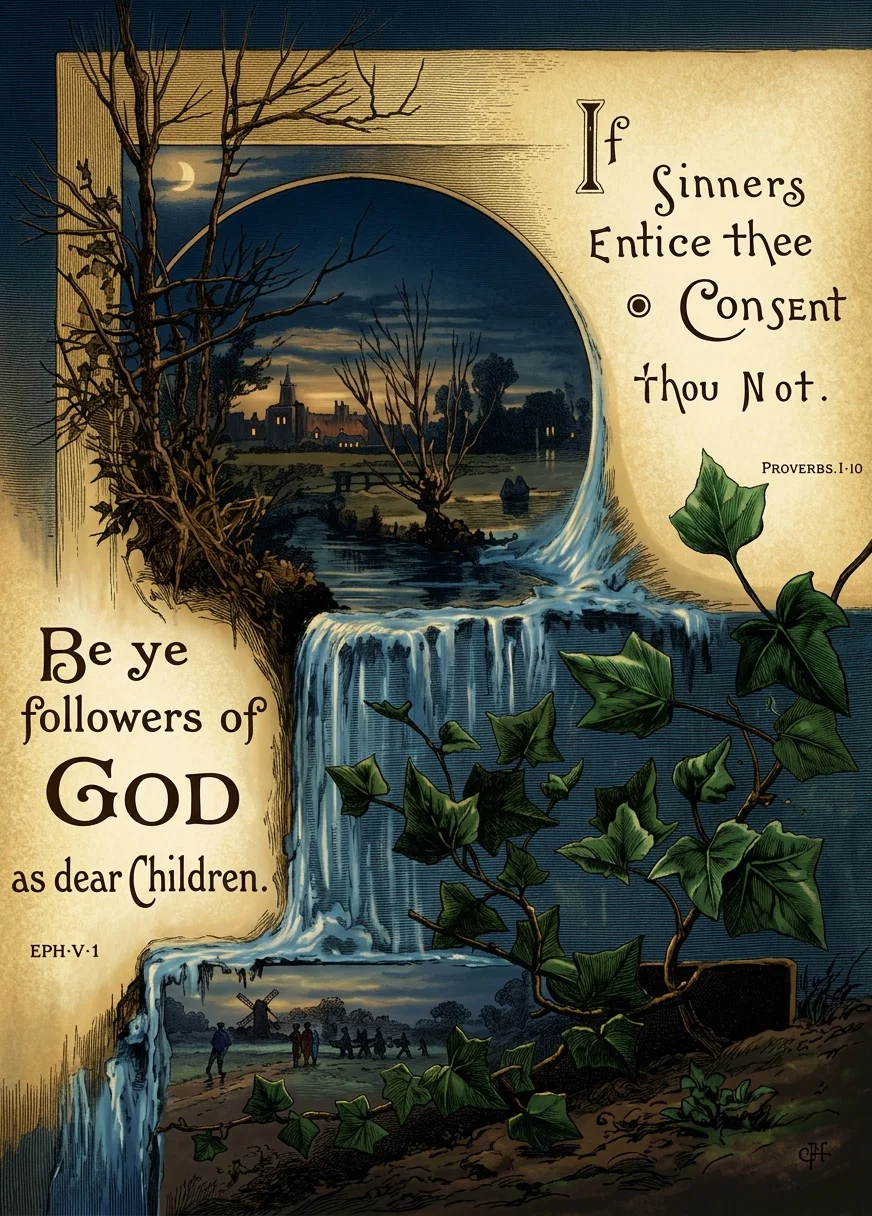
Our illustration presents two splendid thoughts for the coming year, one positive and the other negative, one a blessed thing to do, the other an important admonition not to do. Let us study them a little.
EVERY soul will follow some path in the year to come, not physically, particularly, but morally. The trial path of every soul ends at the judgment bar of God. The path we have chosen, the way we have walked, will determine thenceforward the eternal future. How important it is that we choose the right path!
SHALL we choose the path of sensuous pleasure—the path which will please the physical man? Or shall we choose the path of right? Sometimes we long that the path of pleasure might be the path of right. The next step is easy; we persuade ourselves that our senses are a law of right, and that pleasure is the highest motive. But it is well to remember that “there is a way which seemeth right unto a man, but the end thereof are the ways of death.” For it is eternally true that “he that soweth to his flesh shall of the flesh reap corruption;” and “if ye live after the flesh, ye shall die.”
SELF-CENTERING is the direction of death. This is taught in the very law of your physical being. The man is healthy only so long as the circulation of the blood is from the great centers to the extremities. Gorge the centers with life-fluid, with no outward flow, and congestion, inflammation, enlargement, lesion of blood-vessels, or collapse, occurs. It is so in the body politic; let the life-blood of the nation—its circulating medium—become congested in the great financial centers, and the extremities suffer, and disease and disturbance and panic and hard times follow. Center the affections on self, and we die. Follow self-interests, and it may seem to pay for awhile, but the heart-soil is filling in the meantime with growths of selfishness, and the end of all merely worldly prosperity is death and disappointment.
WHAT shall we do? What path shall we follow? The psalmist, believing God’s promises, assures himself, “Thou wilt show me the path of life.” Ps. 16:11. His next utterance tells us that it is in the presence of God, or, as elsewhere indicated, the path of God’s commandments. Ps. 119:35. Our text expresses the same thought, “Be ye therefore followers of God, as dear children.” The Revised Versions have it more literally, “Be ye therefore imitators of God, as beloved children.” Do as God does in all things; not merely follow a certain path, but as the little child loves his father, seeks to do as father does, unconscious of acting any part, but moved only by love, so follow—imitate—God.
WHAT is His way? How may we know it? He has given us two-fold direction, in both the abstract and concrete, in precept and example. Precept: “If thou wouldest enter into life, keep the commandments.” “This is the love of God, that we keep His commandments.” “In the way of righteousness is life; and in the pathway thereof there is no death.” Example: “I am the Way, the Truth, and the Life.” “No one knoweth the Son save the Father; neither doth any know the Father, save the Son, and he to whomsoever the Son willeth to reveal Him.” “No man hath seen God at any time; the only-begotten Son, who is in the bosom of the Father, He hath declared Him.” The rule of life is God’s great law expanded into ten thousand precepts in His Word. The perfect working out of that rule in humanity is manifest in Jesus Christ. He was Immanuel—“God with us;”—He was God “manifest in the flesh.” Follow Him: In His humiliation and self-denial and crucifixion of sin, in giving up all for His sake. “If any man will come after Me, let him deny himself, and take up his cross, and follow Me.” In simple faith in the all-sufficient promises of God, follow Him, whether in ministering to the poor and needy, on the mountain top of transfiguration, in the dark Garden of Gethsemane, in the unjust judgment hall, in bearing the cross with faltering pain-filled steps up Calvary, in unmurmuringly and unresistingly, with prayer-filled heart for your murderers, being nailed upon the cruel tree, or burned at the stake, follow Him. “Be ye imitators of God, as beloved children.” At all times, in all ways, in all places, glorious opportunity is given you to witness for God.
“If sinners entice thee, consent thou not.” There will be ifs all the way, offered with all the deceptions of devilish suggestion, to turn thee from the rugged, holy road. Thou shalt meet continually strong, persuasive temptations to turn thee from the path of life. Thus also did the Master of life. Voices on every side as sweet as angel song and of Circean power will lure the soul to lust of flesh and lust of eye and pride of life, to selfish ease and pleasure, to paths flower-bedecked to hide the poisoned vines, to paths flower-strewn to cover the bottomless bogs of sin and death and hopeless despair. “If sinners entice thee”—it matters not tho they are life of thy life and name of thy name—“consent thou not.” Thine only hope is Christ Jesus. Keep thine eyes upon Him. Open thy heart and soul and mind to all His glorious love and beauty and wisdom and glory, and follow on and up in greater, truer joy and nobler victories than earth can win. In forgetting self, tho all forsake thee, thou shalt win Christ, and in Him win all. In blessing others, tho all the maledictions of evil be cast upon thee, the curse causeless shall not come and thou shalt be blessed with all the benisons of Heaven forevermore. Therefore, “Be ye imitators of God, as beloved children;” “if sinners entice thee, consent thou not.”

HELP IN EVERY TIME OF NEED.

BY MRS. E. G. WHITE.
It is for our present happiness and future good that God subjects us to trial. The greatest blessing that His wayward children have is the correction that He sends them. When called to pass through trials, we may know that thus God is striving to lead us to know Him and to place our trust in Him.
Your way may seem very dark. Your friends may seem to have forsaken you, and circumstances may seem to be against you. Hereditary tendencies to wrong strive for the mastery, and you are ready to sink down in discouragement. But you are not forsaken. The Lord God of Israel is looking upon you with compassion and sympathy. His thoughts toward you are thoughts of good, and not of evil. He sees the forces arrayed against you, and He sends you the message, “Let him take hold of My strength, that he may make peace with Me; and he shall make peace with Me.”
Do not depend on human help. Why turn from the One who is all-powerful, to ask help of finite, human beings? Why not make God your counselor, saying, “Lord, to whom shall we go? Thou hast the words of eternal life.” Have we not acted discourteously toward the One to whom we owe all that we have? Let us no longer turn from the light that lighteth every man to the uncertain wisdom of those who have no power save that which they receive from God.
Our Saviour is not lying in Joseph’s new tomb. Over the rent sepulcher He has proclaimed, “I am the resurrection and the life.” He has withdrawn from human sight into the immediate presence of God. There He is making intercession for those who by faith come to God. He presents them to the Father, saying, “By the marks of the nails in My hands, I claim pardon for them. I have made an atonement for them.”
Then do not take your sorrows and difficulties to man. When you need help, go to Him to whom has been given “all power in heaven and in earth.” In your weakness and unworthiness come to Christ, saying, “Lord, save, or I perish.” From Him you can learn the manifold wisdom of God, wisdom more precious than words can tell. You may gather strength from Jesus; for in Him all fulness dwells.
God sees and tenderly sympathizes with those who are tempted. He hears the voice of supplication and distress. Not a groan, not a sigh, not a tear, escapes His notice. Did not Christ come to this world to work out the plan of redemption in man’s behalf, to show him how to overcome the temptations of the enemy? Will God, then, withhold from His children anything that will perfect their characters? If He did not love us, this great sacrifice would not have been made.
In the darkest hour, let faith pierce the cloud surrounding you; for Christ is behind, and He does all things well. We have a covenant-keeping God, who knows all our necessities, a God who unites with His majesty the gentleness and tenderness of the shepherd. He has pledged Himself to supply all our need. Have faith in Him; for His honor is at stake. He will not alter the thing that has gone out of His mouth. He will fulfil His promise. Absolute power is His, and no obstacle can stand before Him. His understanding is infinite. He can not err. He is never in perplexity in regard to the means that He will employ. He says, “Fear thou not; for I am with thee. I the Lord thy God will hold thy right hand, saying unto thee, Fear not; I will help thee.”
Bring rejoicing into your experience. When you are depressed, sing to the praise of God. Rejoice in the hope set before you,—the hope of eternal life. Talk faith, even tho you seem to be surrounded with darkness. He would have you pluck and eat the leaves of the tree of life.
The Lord Jesus has chosen those who believe in Him to be heirs of God and joint-heirs with Him to an inheritance incorruptible and undefiled, and that fadeth not away. Let us believe the messages of cheer that He sends us. Let us live lives of hope and trust. Christ has given us the key that unlocks heaven’s treasure-house of blessing. He declares, “Whatsoever ye shall ask in My name, that will I do, that the Father may be glorified in the Son.” Christ promises not only to present our petitions to the Father, and to intercede in our behalf, but to bestow the blessings sought.
“Seeing then that we have a great high priest, that is passed into the heavens, Jesus the Son of God, let us hold fast our profession. For we have not an high priest which can not be touched with the feeling of our infirmities; but was in all points tempted like as we are, yet without sin. Let us therefore come boldly to the throne of grace, that we may obtain mercy, and find grace to help in time of need.” “Let us draw near with a true heart in full assurance of faith.”
The gift of Christ is our pledge of help in trouble and of victory in conflict. In Christ is the strength of His people; for to Him all power has been given. “He giveth power to the faint; and to them that have no might He increaseth strength. Even the youths shall faint and be weary, and the young men shall utterly fall; but they that wait upon the Lord shall renew their strength; they shall mount up with wings as eagles; they shall run, and not be weary; they shall walk, and not faint.”

THE BITTER END OF THE BROAD WAY.

THOSE who enter into the ways of sin seldom think of the end. They do not look ahead. They are content to know that the present is according to their desire. “Whatsoever a man soweth, that shall he also reap,” is a law never considered by the wicked. They do not believe it. They hope to do evil and reap good. They flatter themselves that they can wrong others and benefit themselves. Had the prodigal known when he left his father’s house that the way he had chosen would end in a far country where he would be forsaken by his companions and surrounded by swine and tormented by hunger, would he have yielded to the temptation? If the young man taking his first glass of strong drink believed that the path in which he is planting his erring feet will surely end in the wreck of his body, mind, and life, would he not dash the sparkling beverage from his lips and say to the tempter, “Get thee behind me”? “Wine is a mocker, strong drink is raging; and whosoever is deceived thereby is not wise.” “I die like a fool,” said a great statesman who lay dying of a wound received in a duel. The broad way always ends in shame. It may not be the end of the drunkard or the duelist, but it is bitter, nevertheless. There is no peace, no hope, no joy, no comfort in the end of this way. “Blessed is the man that walketh not in the counsel of the ungodly, nor standeth in the way of sinners, nor sitteth in the seat of the scornful.”—Examiner.

SPIRIT OF GOD.

I NEED Thy sweet spirit, my Saviour, For my life is a-weary with care. And the sorrows that chasten my spirit Are oftentimes heavy to bear. Before Thee I humbly am kneeling, And for strength in my weakness I pray. O, come with the touch that brings healing, And drive all the shadows away.
I need Thy sweet spirit, my Saviour, To give me the graces I need; The peace that flows deep as a river; The meadows of love where I'd feed; The patience that knoweth not sorrow; The trust that is stayed but on Thee; The hope that sees joys on the morrow; The Day-star o'er life's troubled sea.
I need Thy sweet spirit, my Saviour, To guide through the day and the dark. When the tempests of earth break in fury, I would flee as the dove to the ark. I would rest in the arms everlasting, And sweet shall my confidence be; For the hand that I love has been casting My sins in the depths of the sea.
I need Thy sweet spirit, my Saviour, When bereaved, I stand close by the tomb. 'Tis then I would know that the loved one Shall awake and arise from the gloom; That free from the country of shadows They shall enter the kingdom of God, Rest in peace in the evergreen meadows, Where the footsteps of sin never trod.
I need Thy sweet spirit, my Saviour, Till I pass from Time's desolate shore To the city of love and of gladness, Where sorrow can come nevermore. Where is joy for the brows that are weary, Where is rest for the hands that hang down. Where no life is e'er loveless or dreary, But peace weaves her shadowless crown.
Elgin, Ill. L. D. SANTEE.

XVIII. ASSUMPTIONS OF CHRISTIAN SCIENCE.

People who jump to conclusions are likely to fall on uncertainties. Christian Science verifies this bit of wisdom from the almanac. We have already shown that its “first fundamental proposition” so far from being a teaching of Holy Writ is thereby proved to be false. The fact may here be added that it is likewise a pure assumption. No attempt is made to defend it or support it with Scripture. Its author’s ipse dixit must be accepted as the end of controversy. “The Bible implies it,” ’tis said. Another conclusion jumped at. We challenge the statement and request the text.
“But God created man. God is spirit. Like produces like. Therefore, man is spirit.” This is the whole tenor of Science. Another assumption in the same breath with a diametric contradiction of Scripture. The assumption here is, that God can not create any substance different in nature from its own. This is certainly an unwarranted limitation of Omnipotence. The contradiction lies in the statement that man is spiritual. (See almost any page of “Science and Health,” as pp. 230, 334, 473, 509). What saith the Word? “There is a natural body.” 1 Cor. 14:44. Did Adam, as he came from the hand of His Creator, have this body? “And so it is written, The first man Adam was made a living soul.” Verse 45. This “living soul” was therefore a “natural body.”
But was not this a spiritual body? “Howbeit that was not first which was spiritual.” Verse 46. In other words, that which was first was not spiritual. It appears to us that the “Key to the Scriptures” contained in the back part of “Science and Health,” gets into a very bad dilemma on this point. For this precious key is at emphatic pains to show (pp. 508–514) that the first record of the first creation is the correct one, and that this record, Gen. 1:26–2:5, is proof that the first man was spiritual. We fear, in view of the texts we have above quoted, that this vaunted “Key” is not the “key of David.” Rev. 3:7.

Christian Science and Mysticism.

The history of these “keys” to Scripture shows them invariably to have been fashioned in the minds of mystics. Here is one, geographically near enough to the birthplace of Christian Science to be its grandparent. “By Samuel Gorton, Gent., and at the time of penning hereof, in the place of Judicature (upon Aquethneck, alias Rhode Island) or Providence Plantations in the Nanhyganset Bay, New England. Printed in the Yeere 1647.”
But let us see what this “professor of the mysteries of Christ,” as he styled himself, offered as a model for future New England keysmiths. Here is the delectable treasure: “An Incorruptible Key, composed of the CX Psalme, wherewith you may open the Rest of the Holy Scriptures; Turning itself only according to the Composure and Art of that Lock, of the Closure and Secrecie of that great Mystery of God manifest in the Flesh, but justified only by the Spirit, which it evidently openeth and revealeth, out of Fall and Resurrection, Sin and Righteousness, Ascension and Descension, Height and Depth, First and Last, Beginning and Ending, Flesh and Spirit, Wisdom and Foolishness, Strength and Weakness, Mortality and Immortality, Jew and Gentile, Light and Darkness, Unity and Multiplication, Fruitfulness and Barrenness, Curse and Blessing, Man and Woman, Kingdom and Priesthood, Heaven and Earth, All-sufficiency and Deficiency, God and Man. And out of every Unity made up of twaine, it openeth that great two-leafed Gate, which is the sole Entrie into the City of God, of New Jerusalem, into which none but the King of Glory can enter; and as that Porter openeth the Doore of the Sheepfold, by which whosoever entereth is the Shepherd of the Sheep,” etc., etc., etc. Just as this ancestor of American mysticism used an explication of the hundred and tenth psalm, as an illustration of his “incorruptible key,” so the more recent mysticism of Christian Science follows its pattern and uses the first three or four chapters of Genesis and part of Revelation; as, says the key-maker, “Genesis and the Apocalypse seem more obscure than other portions of the Scripture, because they can not possibly be interpreted from a material standpoint. To the discoverer of Christian Science [Mrs. Eddy], they are transparent, for they contain the deep divinity of the Bible.”
The “deep divinity” of the simple, intelligible account in Genesis is made transparent in the following manner:—
Gen. 1:—“In the beginning God created the heaven and the earth.”
The Infinite hath no beginning. The word beginning is employed to signify the first, that is, the eternal verity and unity of God and man, including the universe. The creative Principle—Life, Truth, and Love—is God. The universe reflects Him. There is but one Creator and one creation. This creation consists of the unfolding of Spiritual ideas and their identities, which are embraced in the infinite Mind and forever reflected. These ideas range from the infinitesimal to immensity, and the highest ideas are the sons and daughters of God.
Genesis 1:2—“And the earth was without form, and void; and darkness was upon the face of the deep. And the spirit of God moved upon the face of the waters.”
The divine Principle and idea constitute spiritual harmony,—heaven and eternity. In this universe of truth, matter is unknown. No supposition of error enters there. Christian Science, the Word of God, saith to darkness upon the face of error, “God is All in All;” and light appears in proportion as this is understood. It reveals the eternal wonder,—that infinite space is peopled with God’s ideas, reflecting Him in countless spiritual forms.
These are but brief samples. Now if you desire to test the exceeding transparency of this elucidation, you can easily do it as follows: The first time the unfolding curiosity of your child, or of your Sunday-school class, prompts a question as to the origin of this world and its contents, just erase these quotations from Scripture and read them the remainder of this wonderfully perspicuous improvement on the sacred oracles.
The historian says of Gorton, “Lucidity, indeed, was not one of his strong points as a writer, and the drift of his argument is not always easy to decipher.” “It is not likely that he had any distinct comprehension of his own views, for distinctness was just what they lacked.” A reading of “Science and Health” will be sufficient to convince ordinary people that Samuel Gorton was not the only sufferer from the malady of obscurity. A disciple of Gorton’s, in answering one who questioned Gorton’s inspiration, declared: “Gorton wrote in heaven, and none can understand his books except those who live in heaven while on earth.” And this is the tack taken by “Scientists” in replying to critics of their theories. “You lack the spiritual mind. Spiritual things are spiritually discerned.” But just what constitutes spirituality according to the Christian Science view, seems to be something quite inappreciable, not to say incomprehensible, by any except those who by some exalted “demonstration” of Science have got higher than Paul when he went to the third heaven.
The present writer, while laying no claim to extraordinary intellect, never had much trouble in understanding what the apostle means when he speaks of the spiritual mind. Indeed, we know of numberless instances where people of the most mediocre capacity have grasped his meaning without difficulty.
We know what Theosophists mean by spirituality; it is an unfolding of the “sixth” or inner sense, which to them is the capacity to do the clairvoyant act. But the spirituality of Christian Science floors us. As near as we can get at it, we would say (humbly acknowledging our lack of inspiration) that it means the failure to accept—not the Bible—but the dogmatic idealism contained in “Science and Health.” We say, “not the Bible,” for we have had opportunity to put the thing to a practical test. Curious to know whether downright gospel piety meets the Scientists’ concept of spirituality, we put a concrete illustration to a prominent Scientist; we asked him whether his people would consider such men as John Wesley, Moody, and Spurgeon, spiritually-minded men. It is certain that the world regards these holy men as fulfilling the Biblical requirement. No one endued with the evangelical Gospel of the New Testament doubts that. But this gentleman preferred to profess ignorance of these renowned men of God rather than admit that they met the Scientists’ notion of spirituality. We mention this experience for the benefit of any that may wish to ascertain whether it is a very great disgrace not to have the ability to understand the mysticism of Christian Science.
J. A. L. DERBY.

MOUTHPIECE FOR GOOD AND EVIL.

JAMES 3:10 says, “Out of the same mouth proceedeth blessing and cursing,” When a boy, in memorizing this scripture I thought it simply meant that some persons both pray and curse. But now I perceive that it means far more; that many who pray, return thanks, or ask the blessing, and say kind, helpful words, are also given to vain jesting, frivolous talking, and using unkind words, even if not to direct profanity or cursing. Our every act and word either gathers with Christ and is therefore a blessing, or scatters from Him and is a curse.
God is the originator of every truth; but Satan is the father of lies. John 8:44. If we use God’s words in a right manner, we are assisting in His work; but in making a wrong use of them, even unintentionally, we cast a wrong influence. We may not make a lie, but if we repeat one we are surely guilty of telling a lie, as a man may not make counterfeit money yet may pass it.
No fountain can yield both salt water and fresh, neither can a man serve two masters. Even that which would seem good of itself loses its effect upon the hearer when evil is heard from the same speaker. Wicked people themselves despise a “two-faced” individual. “A double-minded man is unstable in all his ways.” James 1:8.
The Lord does not want us to learn both good and evil, and act or teach the same; but only the good. It was the knowledge of evil with the good that brought the human race into sin and degradation. To the words first quoted in this article, the apostle adds, “My brethren, these things ought not so to be.”
So let our motto be: “Whatsoever things are true, whatsoever things are honest, whatsoever things are just, whatsoever things are pure, whatsoever things are lovely, whatsoever things are of good report; if there be any virtue, and if there be any praise, think on these things.” Phil. 4:8. “For as a man thinketh in his heart, so is he.” Prov. 23:7.
S. H. CARNAHAN.

The Church Has Lost Its Grip

A WOMAN came to Mr. Carr at the close of one of his Bible-readings, and said: “You told the truth to-day. My husband is an infidel, but he did respect Christianity a little, until one night I took a character in a drama played in our church. That night I lost my grip on my husband. I am afraid I shall never get it again.” The church that resorts to broom drills and dramas, and mum socials and fairs and festivals to raise money, is without the faith that takes hold on God. A genuine Holy Ghost revival is a thing unknown. Fathers have lost their grip on wayward sons, mothers have lost their grip on unconverted daughters, the church has lost her grip on God. Down on her knees in sackcloth and ashes before Him who drove the buyers and sellers out of the temple, let such a church plead with God for mercy, promise to forego all worldly measures of money-making, and regain the lost grip.—The Illustrator.

Live Well by Remembering Death

IF a man would live well, let him fetch his last day to him, and make it always his company-keeper.—John Bunyan.

THE BUILDERS.

There was a certain King, [God] who ruled over an extensive domain. He had a son noble and true, whom He had exalted (John 1:1-3) to a place of equality with Himself. In fact they reigned conjointly, sitting upon the same throne. This King had an enemy [Satan] who had once been a loyal subject, holding a high position in the kingdom, but who had rebelled (Isa. 14:12; Eze. 28:14, 15) against the authority of the King and had incited to rebellion a number of the King's subjects (Rev. 12:3, 9).
There was a portion of the territory of this kingdom over which the King had placed a certain one [Adam] to reign as a prince. Gen. 1:26-28. This one sold himself, his territory, and all his subjects to that enemy who immediately took possession, and thus brought this piece of territory into open rebellion. Luke 4:5, 6. John 14:30.
This King was greatly grieved, not at the loss of territory, for by His power He could easily recover that, but, being of a kind and loving disposition, He could not bear the thought of destroying His former subjects, who had been deceived into accepting the authority of the seducer.
A plan [plan of Salvation] was proposed whereby these rebels might be forgiven and reinstated; but to insure against the possibility of a future revolt, certain things were required of those to whom this new citizenship should be given.
A proclamation [the Gospel] was prepared and announced throughout the rebellious land to the effect that the King proposed to recover that territory and to make of it a special kingdom where His Son, noble and true, should reign most gloriously, having for His subjects (Matt. 5:5) all who would accept of pardon at His hands, and who would build a house [character] in the rebellious land.
The subjects generally were greatly pleased at the prospect, for they had already become dissatisfied with the dominion of the usurper, who had proven to be a dreadful tyrant, and had filled the land with wo.
Many, therefore, were glad of this chance, and wished to undertake the work at once. They were then informed that each building must be a perfect one; and to insure this result the King proposed to furnish a book of plans and specifications [the Bible] to be carefully followed by each one. When the book was given, and they began to read, they soon found that the building was to be made entirely of gold, silver, and precious stones [traits of character]. This they could not furnish, as these substances were very rare in the rebellious territory, and could only be purchased at a price which it was not possible for them to pay. The messenger [Holy Spirit] then told them that the King expected to furnish all the material, His Son, their future King, paying the price for them.
With this information they were greatly pleased, and since they had, as they supposed, a little of the right material on hand [their own righteousness] they began at once to lay the foundations for their houses.
The messenger then cried out, Hold! Hold! The material you are using [Isa. 64:6] is not genuine. None must be used save that furnished by the King; and, besides, you are not laying your foundation aright. The specifications call for the removal of all sand [self] until a certain bedrock is reached, and all foundation walls must rest throughout their length and breadth upon this rock [Jesus, 1 Cor. 3:11], because there is a terrible storm coming which will try every building, and in that storm [Judgment, 1 Cor. 3:13] every building not resting upon this rock, and not perfectly built will fall, and great will be the fall of it. Matt. 7:24-27.
Then began the builders, with some chagrin and disappointment, to tear down the walls already laid, and to cast aside the material [their righteousness], which some, however, laid away in a heap near by, thinking that it might yet be useful to them.
This done, all began to dig for the foundation stone; but this proved to be no light task, for the sand was loose and shifting, so that after digging down a few feet it began to roll in upon them. And in some cases the material of the old walls which they had torn down, but which they had left too near by, also tumbled into the trenches and had to be lifted out again and again. Some soon said, “We never can reach the rock.” Others began to doubt its existence beneath such a mass of sand, while others concluded their trenches were deep enough, since no one could ever see that their foundations were not settled upon the stone; and besides they did not believe that a storm ever could come violent enough to wash away the earth to such a depth.
As the King had supplied abundant material, these began at once to construct their walls. The work went rapidly forward. The walls arose above the surface. The sand and loose material was shoveled in and leveled up, and then all looked neat and indeed quite substantial. Others now began to think it useless to dig deeper for the true foundation, and they followed the example of their neighbors. Thus many were led away from the guide book.
At length some of the faithful ones discovered the rock. But they found it only in places, for the depth of the sand varied. There were deep cuts and holes here and there, and of course these were filled with the sand. Here also was discovered more fully the nature of the sand, for, while in a general way there was a common resemblance, yet each hole and cut contained a kind peculiar to itself. For illustration, in one which was very deep, were the sands of self, to wit, self esteem, self reliance, selfishness, etc. In another was the sand of pride; in another, of worldly ambition; in another, of the love of money, etc.
Just here is where many failed, for, having found the stone in places, they did not persist in removing all the sand from these depressions. In fact there were few, very few indeed, who removed every grain of the sands of self. But some did, and when their walls began to rise they were resting throughout their entire length and breadth upon the true foundation.
Having once departed from the plans, those doing so felt free to introduce various other changes from time to time so that soon there was seen a great variety of architecture. At length those whose ideas most nearly coincided associated themselves together, and in this way a number of bands [churches] were formed. It was not long before each of these associations drew up a book of plans and specifications for themselves [creeds]; and while it was expected that all would follow in a general way the book of the great king; yet each one was required to follow quite closely the book furnished by his association.
RODERICK S. OWEN.
(To be continued.)

EVERY DAY ALIKE.

More than a score of years ago, when Dakota was opening up to the world its agricultural resources, especially in the line of wheat production, the writer fell in company with a gentleman who was returning over the Grand Trunk railway from this wonderful territory to his home near the northern shore of Lake Ontario. He was eager to tell of the astonishing things he had seen in that vast prairie land of the West, but, said he: “I could not be hired to live there, the people are so wicked.”
“In what respect” inquired I, “are they so wicked? Do they lie, steal, murder, etc.?”
“No, I do not know that I heard of anything of that kind,” said he, “but I will tell you. I went out one Sunday morning and counted eleven threshing machines running. I asked one of the men who was at work if he ever brushed the dust from his Bible, and he said he presumed he did not read it as much as he ought.”
“Supposing he had read the Bible,” said I, “would he have found anything in it about working on Sunday?”
“Yes, indeed he would,” was the reply.
“What would he have found?”
“He would have found that it said: ‘Remember the Sabbath day, to keep it holy.’”
“Yes,” said I, “and I believe that same commandment tells which day is the Sabbath, ‘the seventh day is the Sabbath of the Lord thy God.’”
“Well, if you want to keep that old Jewish Sabbath you may, but I keep the first day of the week, the Christian Sabbath.”
“But where in the Bible is the first day called the Sabbath, or any command given for its observance?”
“Good men have settled that question long ago.”
“What authority have good men, or any other men, for substituting human tradition for the commandment of God?”
“The laws of the land require us to keep the first day of the week, and we should be law-abiding citizens.”
“But when it comes to a conflict between the law of God and the requirements of men, we are told, ‘We ought to obey God rather than men.’” Acts 5:29.
“Well, one-seventh of the time is all that is required, it makes no difference which day we keep, only so that we keep one day in seven.”
“The commandment says we shall rest the same day that God rested, and that day was the seventh. Can you change your birthday from the day on which you were born to any other day in the year, and say it makes no difference, that one day is just as much your birthday as any other day?”
“We can’t keep the seventh day anyhow, the world is round, and it is impossible to observe it at the north pole.”
“But you say you keep the first day regularly, and if the first day can be observed anywhere without difficulty, why may not the seventh day be just as easily observed?”
“The apostle Paul said, ‘One man esteemeth one day above another; another esteemeth every day alike. Let every man be fully persuaded in his own mind.’ That’s my doctrine; I stick to that; that’s good enough for me; I’m satisfied with that.”
“My friend,” said I, “is not that exactly what those people in Dakota were doing? Did they not esteem every day alike? Did they not thresh on Sunday, and did they not thresh on Monday, and thresh on Tuesday, and Wednesday, and on every day of the week, and thus regard every day alike? And was it not for this very reason that they did consider all days alike that you thought they were so wicked that you could not live among them? Is that your idea of Sabbath observance?”
Our friend’s argument having thus devoured itself, and the last position in his theory being so directly contradictory to his first, he turned himself about in his seat and had no more to say.
How much more satisfactory to take the plain command of the Lord on this question, and simply obey Him, and thus avoid all the inconsistent and contradictory positions, into which the sophistry of disobedience unavoidably leads its advocate. F. D. STARR.

A BAG WITH HOLES.

It is recorded of that poor rich man, Cornelius Vanderbilt, that before he died he said to a friend: “I don't see what good it does me—all this money that you say is mine. I can't eat it, I can't spend it, in fact, I never saw it, and never had it in my hands for a moment. I dress no better than my private secretary, and can not eat as much as my coachman. I live in a big servant's boarding-house, am bothered to death by beggars, have dyspepsia, can not drink champagne, and most of my money is in the hands of others, who use it mainly for their own benefit.” This is the testimony of one who put his treasure in “a bag with holes.”—Exchange.
Continue reading: SHOULD CHRISTIANS KEEP THE TEN COMMANDMENTS?