It was a sorrowful morning,
And bitter words were said;
From the face of wife and husband
The sunshine of love had fled.
Their hearts were hot with anger,
As the husband went his way
With no kiss, and no kind word spoken
To think about all that day.
And the heart of his wife was heavy,
Lonesome and sad through the day,
“I was wrong,” she said over and over,
As anger died slowly away.
“Had I spoken one kind word to him—
Had I given a smile for a frown—
It would all have been right between us,
Had I kept the hard words down.
“When he comes from his work at evening
I will meet him with a kiss,
And say, ‘I was wrong—forgive me
For all that has gone amiss,
For all the pain I have given,
Forgive me this time, I pray,
And never again, God willing,
Shall we part as we did to-day.’”
That sad day neared its ending,
The sun went down to rest,
And day’s departing glories
Crimsoned the distant west.
The wife looked out and listened
For that step by the garden gate,
And wondered, over and over,
Why her husband was so late.
A step on the path—a stranger’s;
A sudden and nameless fear
Came over the woman waiting
For the step she would no more hear.
‘My husband!’ she cried—‘O tell me!’
And then in his face she read
The tidings he came to bring her
Before a word was said.
Dead! and they parted in anger;
Dead! and he could not know
How bitterly she had repented
The words that had vexed him so.
That moment a heart was broken—
Alas for the love-links riven!
Alas for the word unspoken,
And the kiss that was never given!
—Selected.
GREATEST HOARD OF GOLD IN THE WORLD.
By Frank Fayant
[By Frank Fayant, in Success for June.]
Nearly one thousand three hundred tons of gold lie to-day in the vaults of the treasury of the United States,—the greatest hoard of the yellow metal ever gathered in the history of the world. Four hundred tons of this gold are piled, like bags of salt, within the four walls of the sub-treasury in Wall Street, New York. Outside the treasury hoard, there is in circulation through the country a nearly equal amount of gold coin, making more than two thousand, five hundred tons of gold in the United States, bearing the imprint of the eagle. The value of this coin is more than one billion, two hundred and sixty million dollars.
One of the remarkable things about this gold is that, despite the fact of its forming one-half of the country's circulating money, it is rarely seen in the course of ordinary business. What becomes of all our American gold? The mines of Colorado, California, Alaska, and other gold-producing regions of the West add eighty million dollars a year to our hoard of gold, and three-fourths of this output goes to the mints. The yearly coinage of gold actually approaches in value the entire circulation of silver dollars.
The treasury holds in trust, against outstanding gold certificates, four hundred million dollars in gold coin. These gold certificates range from twenty dollars to ten thousand dollars. They are issued from the treasury in exchange for gold coin or bullion, and are just as good as gold. The Englishman wears his pockets out carrying gold coin around with him; the American prefers to have his money in the form of representative paper that can be folded compactly in his waistcoat pocket. In the sub-treasury at New York, recently, I picked up a handful of gold certificates of the value of three million six hundred thousand dollars; the bundle could be stowed away in one's hip pocket, but it represented seven tons of gold. Stored in the vaults of the building at the time was a hoard of gold coin of the value of two hundred million dollars. In one vault, no larger than the bedroom of a New York flat, was an aggregate of seventy-eight million dollars in gold. This was stored in little white bags stowed away in scores of steel boxes, covering the four walls of the vault from floor to ceiling. Every box was sealed, and some of the seals were dated several years back. The first thought, at sight of this gold hoard, is that it is idle money, but it should be recalled that all of it is in circulation by proxy in the form of gold certificates.
LITERARY NOTICES.
“The Standard Dictionary and Condensed Cyclopedia with Atlas of the World,” Latest Edition. (Sold only by Subscription.) Funk & Wagnalls, 30 Lafayette Street, New York; 44 Fleet Street, London.
We noticed this prodigious and magnificent work when it was first projected and when it was first published. It met all the promises of its publishers, and more, when it first appeared. We then said it was the best all-round dictionary of the English language, and after years of using and comparing with the four others of America’s best we have no reason to change our opinion. We are fully persuaded that those who do not like it are those who will not take the time to become acquainted with it. It makes use of new principles in lexicography, which have demanded new methods of treatment, and it is worth while to learn the principles and get acquainted with the methods and plans; they are not at all difficult.
The first edition contains over 2,300 pages, 5,000 illustrations made expressly for this work; and 304,000 vocabulary terms, nearly 80,000 more than in any other dictionary of the language. Nearly 250 editors and over 500 readers for quotations were engaged upon this great work. The Appendix contained a Language Key, Principles and Explanations of the Scientific Alphabet (by the use of which pronunciation is more exactly indicated than by the old diacritical marks). A list of Proper Names in Bibliography, Bibliology, Biography, Fiction, Geography, History, and Mythology, etc., etc., Glossary of Foreign Words and Phrases in English Literature, Disputed Spellings and Pronunciations, etc., etc., etc.
The new edition is a thorough revision of the old, a new list of 17,000 new vocabulary terms and additional meanings; a Pronouncing Vocabulary of Bible Proper Names, according to the best authorities; Formation of the Plural of Nouns, with rules and an exhaustive list over which questions might arise. It contains 37 full page Plates and Illustrations, some of them of marvelous beauty. Eight of these are portraits of many of the great educators of the world. One plate is a beautiful lithograph in natural colors, of 93 butterflies and moths; two others of the uniforms in color of the armies of Europe and of the Army of the United States respectively; one of typical woods; another gems and precious stones; and many others equally beautiful and valuable.
The Atlas of the World contains 88 up-to-date full-page maps with a Standard Cyclopedia of closely-packed information of the world.
The above is the subscription edition, substantially and splendidly bound in red Russia leather, with Denison’s patent index. It is a complete library in itself.
“The Living Temple.” By J. H. Kellogg. 568 pages, 21 chapters, over 50 illustrations. Good Health Publishing Company, Battle Creek, Mich.
The author tells us in his preface that it is his object “to present in a simple but comprehensive way, those facts which are of great interest and importance in relation to the structure, the functions, and the proper care and training of the body;” and that “it has been no part of the author’s purpose to write a theological treatise, but simply to study man from a physiological standpoint; hence in the use of the word ‘temple’ as it appears upon the title-page and in numerous places in the work, the physiological, or literal, sense is to be understood.”
We heartily wish the author had held to his purpose. The book, to our mind, would have been an invaluable treatise; for very few indeed are better qualified than he to properly present the subject from that standpoint. But in less than two pages even in the preface—which seems after all a postprandial defense of the literary menu which follows—the author is pleading his cause wholly from a religious view-point.
The chief objection which presents itself to our mind—a view we do not wish to believe is held by the author—is the essentially pantheistic view that is again and again thrust in. Whether consciously so to the author or not it is decidedly un-Biblical in its teaching and trend. We are told “that man [in general] . . . is a son of God, the image and representative of his Creator,” and that the “divine Spirit” is “within him,” “maintains him,” “shares his griefs and sorrows and all his earthly experiences,” etc. And while this is true of the man connected with God by faith in Christ Jesus, it is not true of the man who knows not God or His Gospel. Much stress is laid on “the brotherhood of being,” “the one common life;” “that animal and vegetable are not merely kindred lives, but are really one and the same;” but we are not told that another equally important truth is that the element of law as well as life enters into every individual in every scale of being from distinctive mineral to man; and that man, the primal prince of earth, transgressing the law of his own life, perverted every law of being in every plane of existence below himself, from mammal to mineral; and that in consequence the life from the great Fountain of Life enters every individual in every scale of being through the channel of perverted law and is therefore perverted life. Perverted law issues in destruction. Perverted life issues in death. Sin breaks all normal connection with God’s life, and only the renunciation of sin and the yielding of God’s highest law can truly bring God’s life into the soul. Therefore, the apostle Paul truly says of the wicked that they are “separate from Christ, alienated from the commonwealth of Israel, strangers from the covenants of promise, having no hope, and without God in the world,” “alienated from the life of God.” Eph. 2:12; 4:18. The condition and character of the individual’s life is dependent on the degree of harmony or inharmony of the law of his being with the law of God’s life, the great and only moral law of the universe. It is abhorrent to us to say that the Spirit of God shares the experiences of the drunkard and rake. The “vain life” of the sinner God prolongs in mercy that the sinner may yield to God and by faith “lay hold on eternal life.” But he who does not so yield we are expressly told, “shall not see life;” that is, God’s life, eternal life. If every man now have that life, if earth’s sentient and insentient beings now possess it, then Christ died in vain, and faith is nothing more than a recognition of the fact that we have in ourselves what cost Heaven so much to bring to us!
Divine intelligence and guidance is argued from the marvelous displays of animal “intelligence,” as in “the skill of the bee,” and the “intelligence” of plants. But if it is God in the bee that enables it to construct with such precision its cell, it would seem that the same “intelligence” would know when a cell was full or empty of honey, and would not be content in making just so many deposits of honey, and then capping the cell, when the cell was still empty, as has been demonstrated. It would also seem that the same “intelligence” would enable the bee to liberate itself from a tube held against a light window with the other end open toward the dark, instead of beating out its life against the glass. Yet the common house-fly can get out all right. It would seem that the carnivorous-eating plants, if guided by God, would not seize upon cheese as readily as they do flesh, although it is fatal to them.
In all these things they are following their originally God-implanted instincts, more or less perverted by sin, affected by environment, more or less taught by experience, and sometimes guided by God’s angels.
But to say that God is in insect and tree and flower is to justify all of Egypt’s idolatry.
God is a personal God, a heavenly Father, having central throne and habitation, not because such a conception is essential to man’s religion, but to the very unity of the universe. But God forbid that we should even seek to measure Him or describe His glorious person dwelling in unapproachable light, or on the other hand to belittle Him or change His glory into birds or beasts or insects or vegetation.
The physiological and hygienic teaching of the book is excellent, but its theological instruction is unscriptural and pantheistic. Our hope is that the author does not believe it.
“More Money for Public Schools.” By Charles W. Eliot. Price, net, $1.00. Doubleday, Page & Co. New York.
This little volume is composed of addresses by President Eliot, of Harvard University, and at the time these addresses were delivered (1902), of the American Educational Association. In them, in a comprehensive way, the author sums up the results of public education, its benefits and its shortcomings, its defects and its needs. He clearly shows what the public schools have not done. He hopes more from public education morally than they will ever meet in fruition. Morality must be the work of religion. But the addresses are instructive, and the facts presented are just what every educator ought to know.
“My Old Maid’s Corner.” By Lillie Hamilton French, author of “Homes and Their Decorations,” etc. 16 mo., 227 pages, with headbands by Granville Smith, printed in color. Price $1.00 net. Postage 6 cents. The Century Co., New York.
A bright little book, and the “corner” we are told actually exists in the midst of busy, bustling New York. The “old maid” found the secret of happiness when she learned that a corner was to look out of and not into, and that while old maids could not do much for the world (the author’s own thought), “we can keep an atmosphere about us in which the best of young hearts can grow.” A few stories down was the noisy, bustling street filled with its noisy traffic, but to the dweller in that corner, that which received the shine of the sun by day and of the stars by night, “the sky in its beauty,” seemed “nearer than the street.” It is a cheery, human, helpful little book.
“Manhood’s Morning. A Book to Young Men between Fourteen and Twenty-eight Years of Age.” By Joseph Alfred Conwell. 308 pages. $1.00 net. New Revised Edition. The Vir Publishing Co., Philadelphia, Pa.; London, England; Toronto, Canada.
It is a book designed to point out the dangers which beset young men, and to help them to form right characters. It contains many striking facts and old truths in new settings.
“The Best American Orations of To-day.” Compiled by Harriet Blackstone. 292 pages. $1.25. Hinds & Noble, New York.
The leading thought of the book is in its title. The men mostly quoted are those still in the field of action, and most of the selections are made by the authors themselves. It presents selections from over threescore and ten men on as many different subjects, some of which are of vast importance.
“Just for To-day” is another song which has come to our table. Rather, it is Canon Wilberforce’s poem set to new music by Asa Smith and M. T. Garland. It is simple and sweet. Copies may be obtained for 20 cents a dozen, post-paid of Asa Smith, 12th and Castro Streets, Oakland, Cal.
THE RELIGIOUS SITUATION IN ITALY.
By Chas. T. Everson
In a previous article I called attention to the fact that the Italian people are losing confidence in Catholicism, and that many of them are drifting into skepticism. This transition is quite natural, for when a person has been brought up in a religion that he comes to see has been deceiving him for many years, he loses confidence in all religion. Especially to the mind of a Catholic, religion and Catholicism are synonymous terms. And therefore the problem in Italy is almost as serious in dealing with skepticism as in refuting Catholicism. And it is a skepticism that very often takes a peculiar form, because, while many will rail against Catholicism and show their utter disregard for it, yet, after all, they will in a sense defend it as compared with other religions, as their business and social relations depend so much upon the influences that are held within the grasp of the Roman Church.
Here, in Rome, for example, are brought together many thousands of Catholic priests, monks, nuns, and students for the priesthood, who, in procuring the necessities of life, naturally must buy great quantities of goods of various kinds. They try to so regulate these purchases that they will hold the greatest possible number of shopkeepers under obligation to them, by giving to them their patronage. A man may be an infidel, having no faith in religion at all, yet when his living comes from a certain source he will not speak evil of the religion that helps him in his business. Therefore to help this situation it will take a religion in which a man has confidence to believe that there is a reality, and such a religion will not only convert him from his skepticism but from his Catholicism also. In order for a person to sacrifice friends and business, he must catch a glimpse of something eternal.
Now have we not in the Third Angel's Message that reality and that enduring substance before which these earthly considerations become as empty dross? I believe that we have in this message just that which the world, including Italy, needs to save them from skepticism, Catholicism, and the thousands of other "isms," new and old, that are raging in these last days.
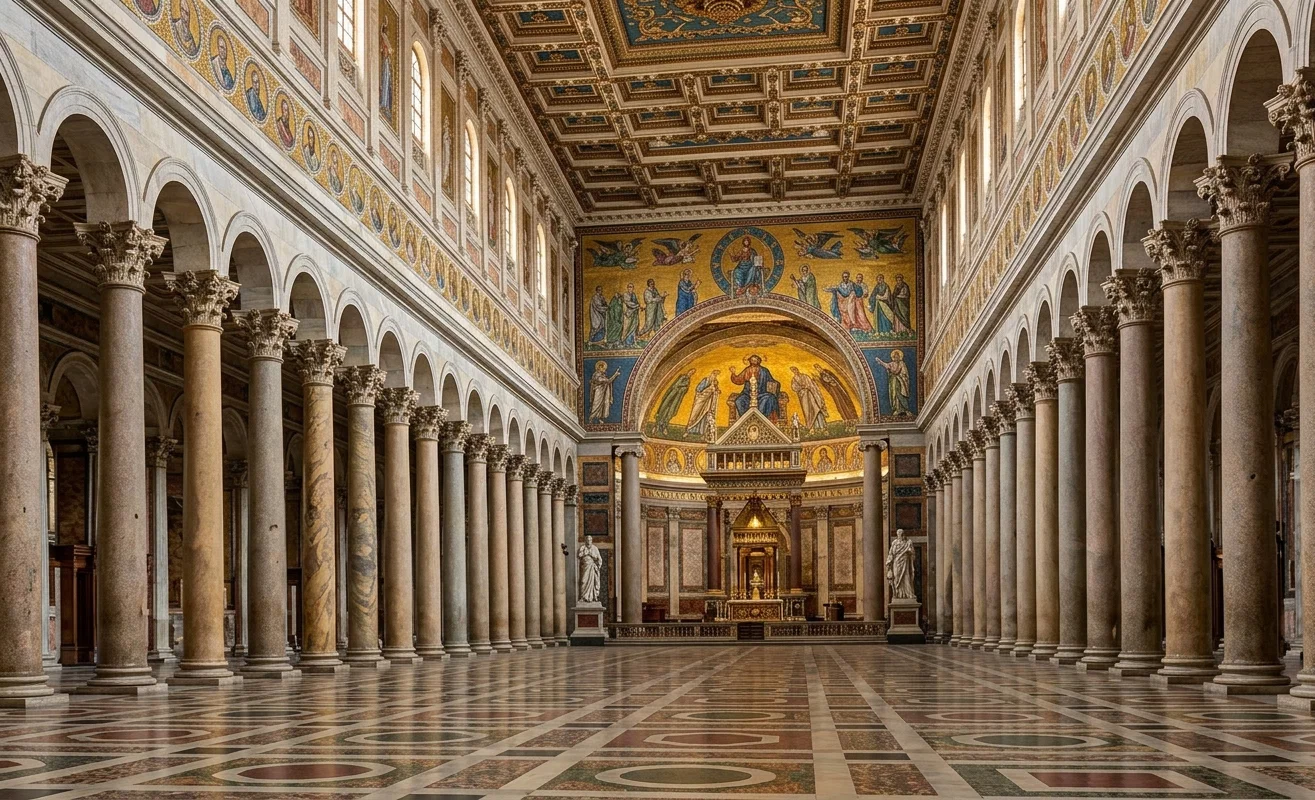
Interior View of St. Paul's Church, Rome.
To illustrate this last statement, let me call attention to a circumstance that occurred here a short time ago. One afternoon, at our regular Sabbath meeting, a Baptist minister was present who has worked here for several years. I was giving a series of readings on the points of the message, and, on that particular Sabbath, was explaining the prophecy of the twenty-three hundred days. When I had finished, the minister said, enthusiastically, that such preaching is just what is needed in Rome, for it shows up so plainly the inspiration of the Bible. And he went on to say further that he was giving some talks to young men at the Young Men's Christian Association, but he experienced so much difficulty with the young men because they were so full of skepticism. He felt sure, however, that such lectures as the one he had heard would do great good. He said that I ought not to delay, but should procure an interpreter and start meetings immediately, and he believed that it would not be long before we could do a successful work. He emphasized his words by hunting about and procuring an interpreter for me, but as yet we have not been in a position to open meetings in a hall.
I only speak of this instance to show how some others are struck by this message, and see immediately its adaptability to the present day conditions. If others are impressed in this manner, surely we that know this message should have greater confidence in what the truth is able to do.
The Protestant work in Rome is comparatively new, as no Protestant churches were allowed within its walls previous to Sept. 20, 1870, at which date the Papacy lost control of the temporal power in Rome. Previous to this date no Protestants were allowed to meet in Rome, only one or two small embassies, and under the flags of their countries. All other work along religious lines was strictly forbidden. And many times since 1870 the pope has lamented the fact that the Protestants are allowed to evangelize in Rome, and longed for the opportunity to drive them out. Therefore, it is only a little over thirty years that the Protestant work has been carried on here, and, altho mightily opposed, it has made some progress. The Methodists have here a very fine church building, where they have two meeting halls, one for the English-speaking and one for the Italian congregation. The hall for the Italians is quite commodious, and generally very well filled at their services. This Italian church has a membership of about three hundred. Besides this church building, the Methodists have a fine school building, and are doing a splendid work along educational lines. Then there are the Wesleyan Methodists, who have also a good church building, and a membership of something over 250. The pastor of this church is an Englishman, and he can preach very acceptably in the Italian language.
The Baptists, taking them all together, have three good church buildings here and operate several mission halls. They number about five hundred. Three of their evangelists have been Catholic priests, and one has been a monk.
The Waldenses have also an excellent church edifice, which is splendidly located, and have also a mission in another part of the city. They number in membership something over three hundred, and one of their pastors told me that their yearly accessions amount to about twenty-five.
There are also a couple of independent churches with which I am not so familiar. Besides these churches that are working entirely among the Italian people, there are five churches that hold their services exclusively in English. These congregations all occupy good church buildings, and during the season have large congregations. Considering the opposition that is continually given by the Church of Rome, and the short time in which Rome has been open to the Gospel, the work here has been quite successful.
The opposition that the Roman church brings against the work of evangelization is not small. I have been told that wherever a Protestant meeting is started in Rome, the Catholic Church will start an opposing effort right across the street, and will conduct their services as near like those of the Protestant meetings as possible. If the Protestants have preaching service, they will have the same; and if they have mothers' or childrens' meetings, the Catholics will hold similar services. So we can see that they contest every inch of the ground. The priests and other Catholic workers know the solicitude that the pope has over these “Protestant encroachments,” and they realize that the one that fights them the most successfully will not be forgotten when the rewards are given out.
By operating in such close proximity to the Protestant meetings, they are able also to detect who are frequenting them, and then bring to bear upon the attendants at those Protestant services all their influence. They will refuse to help them when they become sick or in want. Or if they are shopkeepers they will threaten them with a withdrawal of their patronage. Very often these threats are successful, for the Catholic Church practically controls all the hospitals in Rome, and they are the distributors of the charities.
The Lord has been preparing the Adventist people in a special way to deal with this situation, in that we can largely nullify these threats by using the training that God has given us along the lines of medical missionary and Christian help work. Our visiting nurses might do a splendid work in taking the places of the nuns who at present put the people under such great obligation to them by the nursing and help that they give them when sick. With the aid of a dispensary along rational lines we could help13many poor sufferers, and in this way assist in breaking the power of Rome that holds them in bondage in both soul and body.
Taking it altogether, with our great message of the prophecies to open the eyes of the skeptics, our scriptural overturning of the claims of purgatory, our special gospel of healing for the body, our training along the lines of Christian help work, and our glorious Sabbath truth with which to strike at the very core of Catholicism, we have a vanguard to present to the enemy such as has never been mustered against the Church of Rome since its inception. All these great doctrines have been hidden since the time of the apostles, and have not been fully brought to light until these last days. Therefore, Rome has not met them until now, and shall they not accomplish their appointed work?—They certainly shall, for we have a great message.
CHAS. T. EVERSON.
79 Via Napoli, Rome, Italy.
MISSION WORK AT HOME
By Charles P. Whitford
[Tune “Your Mission.”]
Ye who sigh to till the acres
In some distant harvest field,
Long to plant in far-off furrows
Seed which precious life will yield,
Know that not to all there cometh
Call in foreign lands to roam;
For close by the fields are whitening:—
There is mission work at home.
Ye who look beyond with pity
For the souls in darkness deep,
With a knowledge of whose blindness
Heart is chilled and eyes must weep,
O, forget not in your sadness
That they do not stand alone
In their need of truth and Jesus:—
There is mission work at home.
Broad the fields for harvest whitening;
Some to each our Lord will call.
No mistake His wisdom maketh,
When He plans the work for all.
Does He call across the water?
Go, then, in His strength alone.
Does His hand restrain? Then meekly
Do the mission work at home.
Boulder, Colo. CHARLES P. WHITFORD.
WANTED FOR MISSIONARY WORK.
Late, clean copies of SIGNS, Youth's Instructor, health papers, and tracts on temperance and social purity. Address, E. P. Auger, 1234 Tate Street, Corinth, Miss. Good Health and Pacific Health Journal. Address S. A. Lockwood, M. D., 42 Yamamoto-dori, 2 Chome, Kobe, Japan.
EXPERIENCES IN PERSONAL EFFORT.
By C. E. Mandeville
A BIT of experience in my early ministry made a deep impression on my mind, and one which has helped me over some hard places many a time since. It relates to my first great revival, and had much to do with its success, and with the success of many in later years. Like many other young ministers, I was timid, and shrank from doing what I felt I ought; and this was especially true when I was impressed that I should speak to some one in the congregation during special services.
One night I left the altar and went down the aisle fully determined to speak to some one, and as I neared the back seats I fixed my eyes on a group of young ladies, and the one nearest to the end of the pew, I had heard, was to be married in less than two weeks. I was impressed that I ought to ask her to give herself to the Lord; but something said to me: “Don’t do it; her head is too full of other things now to think of religion. Wait until she gets married and you will have a better chance.” I yielded to the temptation and returned to the altar feeling like a coward, as I was.
A little over a week from that time news came to the parsonage that Miss ——, was dead. She was buried in her bridal robes. At the funeral, when I looked down into that beautiful casket at the face of the dead, my heart was smitten with condemnation, and a question propounded itself: “How changed might be the condition of this precious soul had you done your full duty on that night of opportunity.”
But a little while after this, in the same series of meetings, I was going down the opposite aisle in search of some one whom I might speak to about the interest of his soul. I had not gone far before my eye rested on Major ——, the principal merchant of the town. “Why not speak to him?” whispered a voice. “But,” said another voice, “he’s old and wise enough to seek the Lord without your help. If you should speak to him he would be offended and never come to another service.” So I passed on and went the full length of the aisle; but on my return, when I reached the pew where the major was sitting, something said: “Remember the fate of the young lady. This man may likewise be beyond help in a few days.” My soul was greatly stirred. I said: “I’ll speak to him if it kills me;” and, without further parley with the devil, I leaned over and asked him a few questions, the last of which was: “Will you go with me to that altar and seek salvation?” Like a man, as he was, his answer was prompt: “I will,” and as he went there was a decided sensation in the audience.
Only a couple of weeks after the eventful night a messenger came in great haste to inform me that the major was very ill, and wanted to see me at once. I went and found him near death’s door, but calm and peaceful. God’s will was his will, and he was ready for the summons. Three days after he died. When I looked in the casket which held his remains, a feeling of great satisfaction came over my soul, and I said: “Thank God that I had the strength and courage to do my duty to this man at that supreme moment.”
O, that we could realize that “Time is flying and souls are dying.” Our friends and neighbors are slipping from us and we from them. What we do must be done quickly.—Dr. C. E. Mandeville.
OUR WORK AND WORKERS.
A CONFERENCE camp-meeting is to be held at New Plymouth, N. Z., January 14-31.
A NEW house of worship is being erected by the church at Glenwood Springs, Col.
NOVEMBER 21 three persons were baptized at Fort Collins, Cal., by Brother W. Ziegler.
THE baptism of four candidates at Mendon, Mich., is reported in the Herald by Brother B. Hagle.
THE annual meeting of Cumberland Conference will be held at Graysville, Tenn., January 4-7.
THE Southern Illinois Herald notes the organization of a Sabbath-school of twenty-five members at Farmington.
THE new sanitarium at Moline, Ill., was dedicated on the 30th ult. Much interest was manifested by the people.
OF the cause in Stillwater, Minn., Brother C. M. Babcock reports to the Worker that eight have accepted the truth.
THE little company of brethren at Newport News, Va., have recently dedicated a new house of worship. Brother M. S. Babcock is laboring there.
A CHURCH building for the colored brethren is being erected in Kansas City, Kansas, and Brother N. B. Emmerson is superintending the work.
AS A result of labor in Choteau, Mont., Brother W. A. Gosmer reports to the Pacific Union Recorder that eleven persons are keeping the commandments of God.
A REPORT from Brother R. W. Munson, of Pedang, Sumatra, says that the attendance at Sabbath meetings is from thirty to thirty-five. Among these are some Chinese.
NOVEMBER 21 three ladies of Black Creek, Wis., commenced the observance of the Sabbath of the Lord. So Brother L. L. French writes to the Reporter.
A REPORT in Echoes from the Field, by Brother George M. Alway, notes the organization of a church of sixteen members at Rocky Ford, Cal. The meeting for the organization was held in the Baptist Church.
A PRIVATE letter from Brother D. A. Parsons, one of California's laborers in England, says that his labors in Hull have resulted in nineteen adherents to the truth. He was also doing some work in Grimsby.
FROM the Riverside, Cal., Enterprise we learn that the labors of Brother Wm. Simpson have been quite successful in that city. Fifty persons have commenced the observance of the Lord's Sabbath, and they have decided to build a house of worship, for which a central location has been secured.
WRITING to the Kansas Worker, Brother R. W. Parmele reports that a church of fifteen members was organized at Fort Scott on the 15th inst. Brother C. McReynolds, president of the conference, was also present. The brethren have purchased the house of worship formerly occupied by the Dunkards.
WRITING to the Pacific Union Recorder from Phoenix, A. T., Brother A. J. Howard says: “Our sanitarium is filling up now with a good class of patients. The doctor and nurses find plenty to do. Brother E. R. Palmer, of Washington, D. C., also Dr. Hinde and wife, of Chicago, are resting, receiving treatments, and enjoying the pleasant and copious sunshine of Arizona with us at present.”
THE brethren of Avondale church, Cooranbong, N. S. W., have decided to support a laborer in Fiji. The idea of a local church undertaking to sustain a missionary in some needy field, either foreign or domestic, is a good one, and well calculated to keep alive a missionary interest. There are many churches more able financially to shoulder such a responsibility than Avondale that might profit by her example.
A LETTER to this office from Brother N. Z. Town, of Buenos Ayres, Argentina, acknowledges receipt of a shipment of fruit, and for which he did not know what conference to thank. The fruit had been six months on the way, but it arrived in good condition. There were custom-house, storage, and other charges, amounting to ten cents a pound, but that was only half of what such fruit would cost there. Half of the fruit was given to the school, and the remainder was divided among the workers. The letter closes by saying: “The Lord is blessing the work in this field. About eighty have taken their stand with us in this conference this year.” The letter was dated October 21.
“CHRISTLICHER HAUSFREUND”—SPECIAL EDITION.
By H. Shultz
LIKE the special number of the SIGNS, that has been sent out on its mission of mercy, loaded with precious encouragement, as well as warning to the world, there is now ready a special number of Christlicher Hausfreund. It contains twenty-four pages, filled with present truth for this time. Now as our German brethren have taken hold of the SIGNS work, and sold or given the papers to their English neighbors, even so let our American brethren take hold of this German paper, Christlicher Hausfreund, and circulate it like the Autumn leaves among their German-speaking neighbors. They can not spend a few dollars to better advantage than in this way. If ever there was a time when every Seventh-day Adventist ought to be up and doing something for the Master, and for his fellow-men, it is now.
The price of the special number of the Hausfreund is the same as the special number of the SIGNS. You can send for it through your tract society or send direct to Christlicher Hausfreund, College View, Neb.
This issue of the paper ought to be placed in every German family in the United States and Canada, yes in all the world, and if all our brethren in this country and Canada will take hold of this it can be done. Hundreds of thousands of copies would thus be placed in as many German families, many of whom may never have an opportunity of hearing the message in any other way. Will not our American brethren help us in this, even as our German brethren help in the English work. I believe you will do all you can in this matter. H. SHULTZ.
IN AND AROUND WASHINGTON.
By Editor
Every American, young or old, is interested in the capital of the nation, and now that the home of the Youth’s Instructor is in Washington, right on the edge of the capitol grounds and overlooking them, it is safe to expect that in the columns of the paper will appear articles describing these points of national importance and interest.
So during 1904, there will be published a series of very finely illustrated articles on points of interest in and around the Nation’s capital.
A few of many such places are:—
The Capital and Its Grounds
The Congressional Library
The Smithsonian Institute
The National Museum
The Zoological Gardens
Mount Vernon—the Home of General Washington
Arlington—The National Cemetery
The Soldiers’ Home
Better than ever will be the Instructor for 1904 and ought to be read by every one of our young people.
For 75 cents, a new subscriber gets the paper every week during 1904, and in addition the publishers will send free the last seven issues of 1903 which contain the first articles in several very interesting series. Address, Youths’ Instructor, 222 North Capitol St., Washington, D. C.
THE BIBLE READER.
The opening of Christian schools has created a demand for Christian text-books. No class of students need the help of proper books more than little children in their first year's work.
Some three years ago Bible Reader Number 1 was published. It has now been revised. New illustrations have taken the place of those which appeared in the old edition of the book. In its new form it is about to be placed on the market.
Are there children in your home, or your neighbors, who should read these stories? The Bible Reader is a book for the children, for those who are just beginning to read. It is in harmony with the most advanced methods of teaching. It builds a vocabulary gradually. It cultivates a taste for Bible literature. It is a mother's help as well as a text-book for the school-room.
For the beginning classes who are waiting for the lessons, the first thirty-two pages have been bound separately. Send five cents for a copy of these advance sheets, or thirty-five cents for the Reader and the advance sheets. The regular price of the Reader is thirty-five cents post-paid.
Send your order to the Advocate Publishing Company, Berrien Springs, Michigan.
FOR THE HOLIDAYS.
On December 24, 25, 26, 31, January 1, and 2, the following rates in effect via North Shore Railroad good for return until January 4th. Camp Taylor, Pt. Reyes, etc., $1.00; Marshalls, Tomales, etc., $1.50; Occidental, Camp Meeker, Monte Rio, Mesa Grande $2.00; Duncans Mills, Watsons, Cazadero $2.50.
Through trains daily at 8:00 A.M., also special through trains at 3:15 P.M. Saturdays, and at 5:15 P.M. December 24th and 31st. For complete holiday time table inquire at ticket office, 626 Market Street.