Wouldn't it be a pleasant surprise to him in the winter time to set out some sliced tomatoes on a pretty white plate, fixed up just the way he likes them—
Or some sweet corn on the cob, as juicy and creamy as the day it was plucked, or green peas, or—
Say—a dish of brook trout—
Or some other article of food of which he is particularly fond, but which can not be obtained for love or money, out of season? Well—
The ECONOMY Jar enables you to give him that very surprise.
The ECONOMY Jar is a wide mouth, self-sealing, perfectly air tight jar. Nothing else like it.
By its use, you can perfectly preserve fruit, whole or sliced; vegetables, fish, game, or any other article of food, without the use of preservatives or any means except heat and pure water.
No burned or cut fingers when you use the ECONOMY—no rubber rings to contaminate—no dangerous acids to develop.
The next time the man of the house brings in a basket of trout or game, just put up some of them in an ECONOMY Jar. Then, without saying a word to him, set them out for his dinner some day next winter. They will be as sweet and wholesome and appetizing as the day they were put up. The treat will be like a vacation day in the woods or mountains. A single dozen ECONOMY Jars will prove this to you. Get them at your dealers.
Sit down right now and write us your name and the name of your dealer and state whether he sell the ECONOMY Jar, and we will send you (FREE) a booklet of recipes—tell you all about preserving the Economy way—tell you where you may buy the Jars, and all about "pleasant ways to surprise the man's palate." without a penny of cost to you or any trouble further than writing us one short letter.
KERR GLASS MFG.-CO. 275 Hoyt St., Portland, Ore.
Eastern Office Dept. O., Philadelphia, Pa.
Apologizing
APOLOGIZING,—a very desperate habit,—one that is rarely cured. Apology is only egotism wrong side out. Nine times out of ten, the first thing a man's companion knows of his shortcomings is from his apology.
—Holmes.
RECALLING A MAILED LETTER.
MANY times people would like to recall a letter after it has been mailed. This can be done even if the letter has reached the post-office of its destination. At every post-office there are what are called "withdrawal blanks." On application they will be furnished, and when a deposit is made to cover the expense, the postmaster will telegraph to the postmaster at the letter's destination, asking that it be promptly returned.
The applicant first signs this agreement: "It is hereby agreed that, if the letter is returned to me, I will protect you from any and all claims made against you for such return and will fully indemnify you for any loss you may sustain by reason of such action. And I herewith deposit $— to cover all expenses incurred, and will deliver to you the envelope of the letter returned."
In many cases persons have made remittances to fraudulent parties or irresponsible firms, not learning their true character until after the letter had gone, and have succeeded in recalling them.—Boston Transcript.
WORDS OF CHEER FROM THE FIELD.
By Editor
A word fitly spoken is like apples of gold in pictures of silver.
IT is impossible for us to print all the kind expressions of sympathy that come to us from our business acquaintances and friends, and our brethren all over the field. We are sure they have not been uttered in order that they may be printed. They have been sent us from hearts of sympathy for those whom they felt to be in need, and we appreciate them more than words can say. We glean a few sentences from various letters that our readers may join with us in the good thoughts that have been expressed in these messages of love and condolence.
One of our faithful laborers, Elder T. Godfrey, of Montesano, Wash., writes:
"Dear Brother and Co-laborer: The news of the burning of the Pacific Press, and the complete destruction of all the machinery, has caused sadness to fill all our hearts. Sad indeed was the news. We were too sad to weep. We asked one another, Why is this? Why has God's protecting hand been removed? Why should our dear SIGNS OF THE TIMES be utterly consumed? We loved the SIGNS because it was one of our greatest missionaries. Thousands of copies were going to the world every week. Thousands of men and women were hearing the voice of the last great message in this silent messenger. Many precious souls have been led into the truth through the reading of its columns. But now it is in ashes! Then the question rose, Will it ever be built up again? Will we ever see another copy of the good old SIGNS OF THE TIMES? We were swept away with a wave of sympathy that seemed to submerge all other things. And we said, How do these our brethren feel, who had worked almost day and night to keep the work moving, and who no doubt wept over the piles of ashes?
"There is a great lesson for us all to learn by this sad experience. So let us listen for the 'still, small voice,' and as Elijah of old, let us bow in submission to His holy will.
"In the midst of our sorrow we were made to rejoice. We had waited patiently to see what would be next, so the next thing was a copy of the SIGNS. Then we wept for joy! Now I hope and pray that all the readers of the SIGNS will do as Job's friends and relatives did, when they gave him a piece of money or an earring of gold, so that his last estate was greater than the first, and precious souls were added to the family. And I do pray that this may be true in the case of the SIGNS."
Mr. T. E. Bowen, Secretary and Treasurer of the New York Conference, writes:
"The SIGNS which came to us—the first since the fire—seems the most precious of any one issue of the SIGNS. Then to see the spirit of courage and faith in God breathed through all this that is said in it surely is a good illustration of the Christian's hope, and that there is an anchor within the veil which holds. Who knows but this experience of itself thus brought out before the world will be one of the means in the hands of the Lord to turn many to righteousness?"
Prof. J. L. Shaw, who has charge of our mission in India, but who is now in this country for a little time, writes:
"We are glad to hear of the splendid courage and zeal of the brethren in the Pacific Press in arising to rebuild that which has been laid in ashes. May the good hand of our God rest upon you and greatly bless you in this valiant undertaking."
Elder W. A. Alway, Twin Falls, Idaho, writes:
"I have read to-day with much pain the sad news communicated by your letter to the Review of the complete destruction of the Pacific Press plant. It certainly seems like a severe blow, coming as it did so closely upon the heels of the earthquake loss. Yet I believe that if we as a people, generally, can become fully possessed of the Gospel principles as expressed so forcefully in your letter it will prove an inheritance cheaply purchased."
Elder Geo. M. Brown, Chairman of our Mission Board in Mexico, writes:
"Your letter received. Am sorry that you have met with such a terrible loss."
Mr. C. M. Snow, our old co-worker on the SIGNS, writes from Washington, D. C.:
"My sympathy and prayers have been with you in the terrible affliction that has come to the cause on the Pacific Coast particularly; but we feel that it is our loss here as well. The work is one, and we are one in this sorrow."
Miss Estella Houser, Home Secretary of the General Conference, writes:
"I can assure you that our sympathies are with you in this great calamity, and you can depend on us here to do anything we can to help you in your work."
Mr. Charles Mente, whose work as an artist has so often illustrated, embellished, and beautified the SIGNS, as well as other of our publications, writes from Congers, N. Y.:
"About the time I received your letter I also had one from Mr. White telling me of the great loss you have sustained, and I can imagine how you all feel about it. You have my fullest sympathy, and if I can be of any service I will gladly do all I possibly can."
Miss Katherine B. Hale, one of our best school teachers, writes:
"I can not say how sorry I am about the Pacific Press calamity."
Sister Carrie Kingston writes from Bangor, Mich.:
"SIGNS received this morning, and I feel myself one with you as with tearful eyes I read pages 7 and 8, 'Our Sabbath Service.'"
One of our esteemed contributors, Mr. L. A. Phippeny, of Battle Creek, Mich., writes:
"My Dear Brother, we want to express our sorrow also with the Press in its calamity. We have wondered what we could do to help. The only thing besides praying for your welfare that we can think of is to promise something in literary lines. We hope your courage is reviving, and that you may be prospered in whatever right lines may be indicated before you. The Lord overrules yet in the affairs of men. At times we do not appreciate this, when the course of living runs on about us as usual. Now and again His hand appears unmistakably, and we see with clearness of vision that He is leading."
We certainly shall appreciate what Brother and Sister Phippeny may be able to do for us in a literary way, and we are sure our readers will.
Mrs. Mary M. Brown writes from Auburn, N. Y.:
"I sympathize with you in this trouble. It seems to be my trouble, too. Whatever hurts one of us should hurt the rest, as we are all brothers and sisters of the same family."
Mr. L. D. Eversole, contractor and builder, of Topeka, Kansas, writes:
"Editor of the SIGNS OF THE TIMES, Dear Sir and Brother: I am profoundly sorry to read of the great loss of your printing plant. As I read and look upon the picture of the burning that this week's number contains it brings tears to my eyes and sorrow to my heart. I, with the many thousands of readers, will look upon the disaster as the greatest13loss that this country ever sustained. While the great foundation of God's Word is still flowing full, yet we are sorry to have one of the greatest streams that the world ever knew destroyed. Remember that the sun shines just as brightly as ever, and I, for one, trust that your march will be onward, and that ere long you will be installed in a more beautiful building, decorated with the blessings of our God, fitting you still better for the great work which is in store for those who are His own. Accept my heartfelt sympathy."
A. A. John, M. D., one of our old co-laborers in Great Britain, writes from Mexico:
"Dear SIGNS, All deeply sympathize for you in the loss with sadness of heart. Look up. Yours fraternally."
One sister who does not wish her name to be mentioned closes a sympathetic letter with these lines:
"I hope you will often recall the following:
'Some day all doubt and mystery will be made clear,
The threatening clouds which now we see will disappear,
Some day what now seems punishment, or loss,
or pain
Will prove to be God's blessing and our everlasting gain.'"
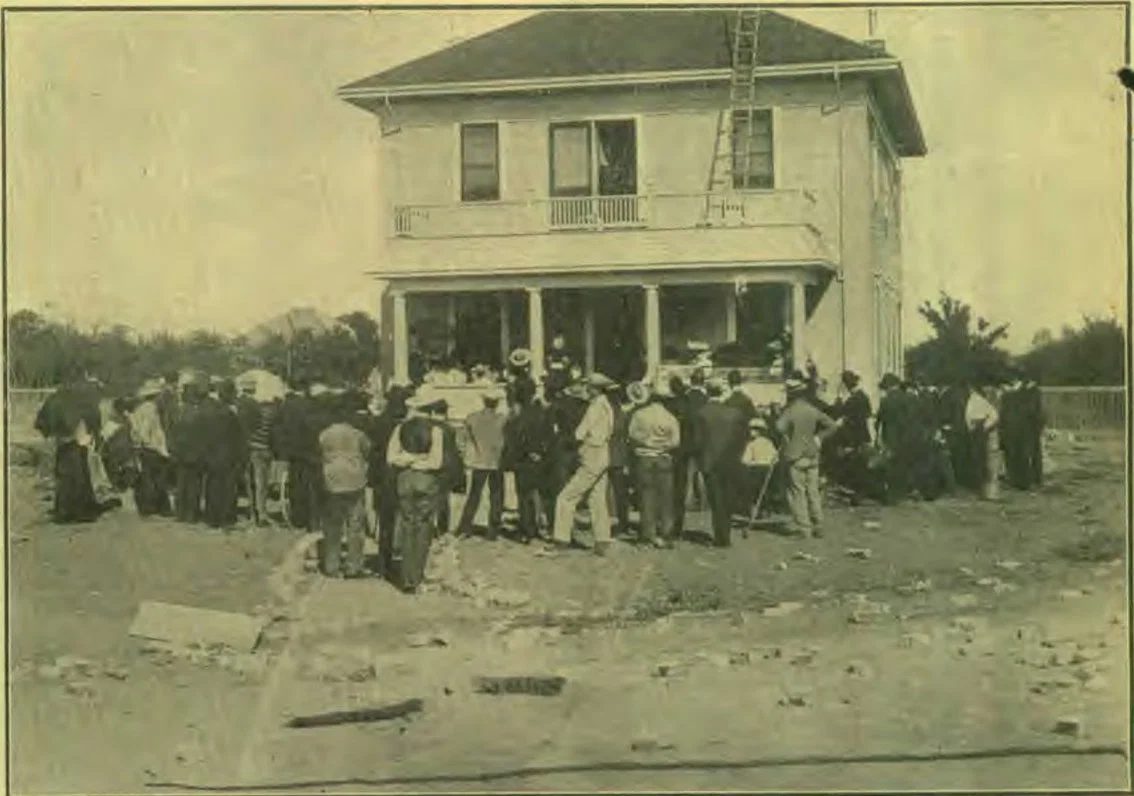
This cut appeared in our issue of August 8 as "Our First Sabbath Service." This was wrong; it should have been Our First Sunday Morning Chapel Service, after the fire, July 22, 1906, held in front of our boarding house.
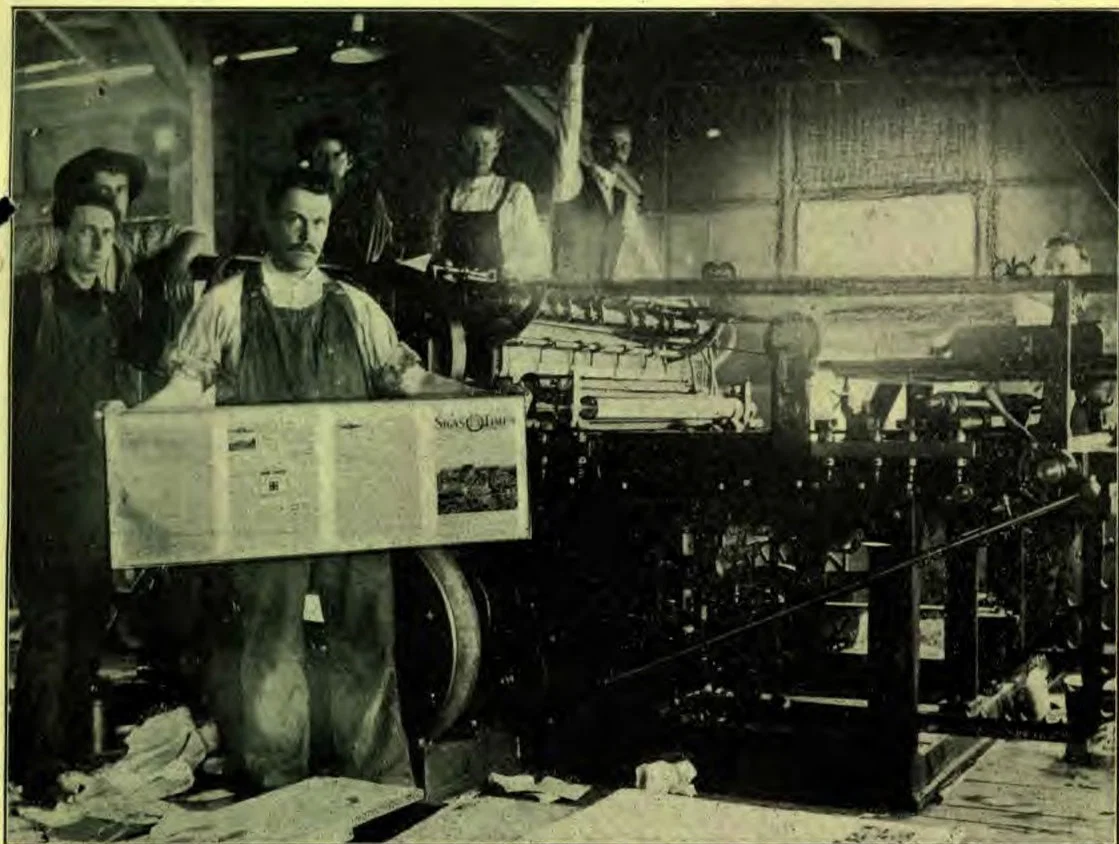
Our New Cottrell Press, on which the SIGNS was printed last week. The foreman of the press room in front.
OUR WORK AND WORKERS.
A CAMP-MEETING is to be held at Holly, Mich., September 27 to October 8.
AT the last quarterly meeting of the church at Arvilla, N. D., three persons were baptized.
IN the Wisconsin Reporter Brother S. Swinson notes the baptism of eight candidates at Rhinelander.
AT the last quarterly-meeting of the church at Bradford, Pa., two members were added. Brother J. W. Watt officiated.
FOR an "Outline of Courses of Study" at Loma Linda College of Evangelists, address Prof. W. E. Howell, Loma Linda, via Redlands, Cal.
THE visible fruit of tent labor at Double Creek, Md., as reported to the Gleaner by Brother John L. Jones, is represented in the baptism of five candidates.
OF the cause at Ithaca, Mich., Brother R. B. Thurber writes to the Banner that "the beautiful little new school building near the church is almost ready for occupancy, and is the wonder of the town."
FROM the Atlantic Union Gleaner we learn that on the 4th ult., a church of thirteen members was organized at Pittsfield, Mass. The day following three candidates were baptized. These services were conducted by Brother H. F. Ketring.
A NOTE in the Northern Union Reaper says: "A church of twenty-eight members was recently organized among the Russians south of Balfour, N. D. Twenty-one of these had just accepted the truth through the labors of Brother Bohienks, of Manitoba."
THE report of the General Conference Educational Convention, held at College View, June 29 to July 10, is now ready for distribution. It is of special value to teachers and to conference and school officers, and all interested in the education of our youth will find in it matter of much interest. Price, ten cents, or $9.00 a hundred, carriage prepaid. Address and make remittances payable to Union College Press, College View, Neb.
THE report of the president of the Texas Conference for the year ending June 30, showed encouraging progress. The tithe increased $4,157.49 over the previous year. This does not include the offerings to the amount of $3,870. The conference expended $1,887.95 for labor outside of the United States, and $384.85 for labor out of the state but in the United States. Brother C. Santee has been re-elected president. In connection with the late conference session and camp-meeting at Alvarado, twenty-four candidates were baptized.
ON the 3rd inst., at Oshkosh, Wis., three candidates were baptized in Lake Winnebago, and with two others were added to the church. The ordinance was administered by Brother J. S. Shrock.
THE Twelfth Annual Announcement of Oakwood Manual Training School, Huntsville, Ala., for 1906-1907, is a neat pamphlet of sixteen pages, illustrated with views of buildings and grounds. It contains quite full information concerning the purposes of the school, the requirements of students, courses of study, terms, etc. The fall term will commence September 19 and continue till December 11. "The Oakwood Manual Training School is devoted to the betterment of society through such culture of the Negro as will make him a more helpful servant, a more suitable neighbor, a more prosperous and law-abiding citizen, and a more intelligent Christian worker." Address, Oakwood School, Huntsville, Ala.
AT the recent educational convention held at College View, Neb., the following declaration was adopted: "We fully and firmly believe that the Holy Scriptures plainly teach: (1) That it is God's purpose to finish in this generation His work in behalf of mankind. (2) That this will be done by the proclamation to all the world of the Gospel as set forth in the great threefold message of Rev. 14:6-14. (3) That the proclamation of this message to the world will be made by the church, the Lord's people who are called out and developed by the message itself."
WANTED FOR MISSIONARY WORK.
(Always prepay postage.)
CLEAN copies of the SIGNS, Liberty, Life and Health. Address, Mrs. Della Gossage, West Scio, Ore.
Question Corner
1886.—The Time of the Last Wo.
When is the last wo given to the world? Is it before probation closes or after? What is the meaning of it? Is it the twelfth chapter of Revelation and the twelfth verse? If not, where is it?
E. B. A.
The record is found in Rev. 11:14-19. The last three trumpets are wo trumpets. The second wo trumpet closed in 1840; the third wo trumpet began its sounding in 1844; and the wo is made up of various calamities and judgments which follow from that time forward, until the judgment shall close. You will notice that it begins before probation ends, and extends until the judgment of God is finished. The seven last plagues are one of the items which fall under the great wo, included in the expression in verse 18, "And Thy wrath is come;" and the very closing part of God's judgments which will blot sin forever from the earth is expressed in the last clause of verse 18. Consequently the third wo would cover all of the great judgments of God.
1887.—**Marrying Outsiders
1887.—Marrying Outsiders.
Please state in the SIGNS if it is right for an Adventist to keep company with a person they know is not a Christian.
H. C. E.
By keeping company we suppose is meant with the intention of future union in marriage relationship. Mere friendship and common visiting is another thing. For Adventist please substitute Bible Christian, any one who follows the Lord Jesus Christ. For all such God has given instruction in His Word. Again and again in the Old Testament has He pointed the danger that follows marriage between believers and unbelievers, or those among His people uniting with those outside.
If a believer and an unbeliever marry, one of these things must follow: The unbeliever will become a believer, or the believer will become an unbeliever, or there will be a nominal union of years in which there is no real true heart-union, or separation will eventually take place. Now speaking after the world, the chances are altogether against the first supposition, and thousands upon thousands have found it so to their sorrow. Why not take right home to heart the instruction that God has given in 2 Cor. 6:14-16, beginning with: "Be ye not unequally yoked together with unbelievers." It seems to us that the closest and most sacred relation earth knows, in the light of Christianity ought not to be corrupted by setting Christ aside, or in forming unions which Christ Himself can not bless. The happiness of both parties will be conserved by waiting until there is union of religious principles and objects; and any Christian ought not to deal with these things in any other way but seriously. Of course, the question naturally arises, What about those marriages in which a husband or a wife becomes converted? Then, according to the advice of the apostle in 1 Cor. 7:13-15, let them abide as they are, and let the converted one do everything in his or her power to win the unconverted.
The Outlook
best express… communicat…… veying the… follows: "… lie and p… teachings… of Detroit,… tion, thus…
"Our ob…
The American Federation of Catholic Societies
(Reported for the SIGNS OF THE TIMES)
AS LOOKED AT BY A BIBLE PROTESTANT.
selves t… and no… federati… away fr… civil, ar… stitution… legislati… whether… claim o… as Ame… low citi…
THE Great National Convention of the American Federation of Catholic Societies is a thing of the past, but its influence is yet a matter of the future. The annual convention of this year, the fifth in the history of the organization, was held in Convention Hall, Buffalo, N. Y., July 29, to August 1, inclusive.
Truly, it was the most representative gathering of Catholic citizens since Columbus discovered America, and unfurled the papal flag of the Spanish sovereignty upon the virgin soil of a new continent.
What Is American Federation of Catholic Societies?
It is the grouping together of all the great and strong Catholic Societies, and even of the whole world, into one organized mass that can be wielded for and in the interest of the Roman Catholic religion and the Catholic Church, and directed by the masterly mind of a single individual. And to write the history of this Convention of Catholic Societies is simply to rewrite the history of that other great religious convention, the Inter-Church Conference on Federation of Protestant Churches, which met in New York City last November; for in the manner of its rise, its demands, its utterances, its organic action, avowed purpose and design, the Catholic Federation Convention was precisely like the Protestant Conference, with the one exception that there was absolutely no difference in the former upon points of doctrine or respecting the faith, and a possible single other exception unworthy of public notice. Indeed, it seems to one who was in constant attendance at both conferences, that the Catholic Conference was but an adjourned session of the Inter-Church Conference, so strong was the likeness of one to the other. And this is positively the most interesting feature, and the most significant item, to be noted in particular of these dual religious bodies.
The Object of Catholic Federation
may be ascertained from several reliable sources. The Rt. Rev. J. F. Regis Canevin, D.D., of Pittsburg, in a public discourse delivered just prior to the opening session of the convention, and which was listened to by the delegates in a body, stated the principal objects to be:
The Christian education of youth.
The sanctity and perpetuity of the Christian marriage as the basis of the family, and the preservative of the morality and happiness of the home.
To correct error and expose falsehood and injustice, whether in the misrepresentation of history, doctrine, or principles of morality.
To oppose and root out the great social and political evils which confront and menace us—socialism, anarchy, perversion of marriage, divorce, dishonesty in business, corruption in politics and offices of public trust, the lawlessness of wealth and the law-defeating power of money, the evasion of justice and widespread disregard for law.
And added:
We stand for sanctity of the Christian home and family, resting on the sacred and stable foundations of Christian marriage.
We maintain that man was created to know and serve God. Hence religion ought to be fostered and inculcated in every department of education from the lowest to the highest.
We wish Christian principles to rule every-
where; in the State, in business, in labor unions, in all the civic, social, financial, and industrial relations of men.
We must combat the materialism and secularism which are the sources of nearly all the great evils which threaten the country to-day.
Article II of the Constitution and By-Laws of the Federation, states:
The objects of this Federation are the cementing of the bonds of fraternal union among the Catholic laity and the Catholic societies of the United States; the fostering and protecting of Catholic interests and works of religion, piety, education, and charity; the study of conditions in
our social life; the dissemination of the truth and the encouragement of the spread of Catholic literature, and the circulation of the Catholic press.
Bishop James H. McFaul, thus defines its purpose:
"To realize the objects covered by the Constitution. Broadly stated, these objects are: (1) The unification of the Catholic nationalities in America; (2) the voicing of Catholic public opinion on the solution of modern problems; (3) the destruction of divorce; (4) the banishment of Socialism; (5) the education of all citizens to a realization of the injustice of taxing us to maintain a system of public instruction which we can not conscientiously patronize.
"Federation is not then a mere grievance committee, altho it will use its influence whenever possible to redress grievances. It is not a political party; it will not engage in partisan politics; yet there is no power known to American citizenship which it will not employ in the interests of Catholics."
Perhaps its greatest, all-absorbing purpose, is
best expressed in a sentence taken from the official communication of Cardinal Merry del Val's conveying the pope's blessing upon the convention, as follows: "Finally to endeavor to renovate public and private life in conformity with the teachings of Jesus Christ." Archbishop Messmer, of Detroit, at the very foundation of the Federation, thus tersely stated it:
"Our object is not political. We positively repudiate the charge. It is foreign to our intentions to become a political party or to affiliate ourselves to become a political party or to affiliate ourselves to any of the existing political organizations and no 'political jobbing' is to be allowed in our federation. Yet we can not and shall not keep away from politics. Catholic interests, religious and civil, are greatly affected in many of our public institutions, the management of which is subject to legislation and the rulings of public officers—whether State or Federal. It becomes necessary to claim or defend our full religious and civil rights as American citizens, or those of our Catholic fellow citizens in these public institutions; it must be done through political action and influence.
"Again, should the social questions and troubles of the day become a matter of public or political agitation, Catholic citizens will be found by a duty of religion as well as of citizenship, to take part in it. . . . While, therefore, in the very nature of the case this Federation is to be at certain times or under certain conditions forced to exert a political influence, yet it will never do so for mere temporal, material, or purely political purposes."
The question of purpose is well epitomized in the words of Pope Leo XIII., everywhere appearing upon the literature of the Federation:
"May the Faithful unite their efforts more efficaciously for the common good, and may their union rise like an impregnable wall against the fierce violence of the enemies of God."
While it disavows any intention to engage in partisan politics or to identify itself with political parties, or even to be purely political within itself, yet the Federation does frankly avow and declare its purpose and intention to exercise its influence in civic affairs, and to wield its power in the arena of politics. Nor can any one fail to see its political character in the sense that it will seek to control political parties. In this, it is exactly identical with the purpose and intention of Protestant federation. Since the Federation will not exert its influence for "mere temporal, material, or purely political purposes," there is only one other sphere that remains in which it may, and for which it may exert itself, and that is the domain of the spiritual, or religious. But since the spiritual is, and can be, no part of the temporal, we must15reach the unavoidable conclusion, that since the Federation does not desire to, and will, employ the temporal means and political ways, it is therefore not spiritual, and, necessarily, is altogether political. It will exert its influence and make its demands for creed and for church. As a matter of fact, the Catholic Federation is simply to become a great fighting machine in the political world to demand and to secure all that the church desires in her interest!
The object of Protestant Federation is "to secure a larger combined influence for the church of Christ in all the matters affecting the moral and social condition of the people, so as to promote the application of the law of Christ in every relation of human life."
The object of Catholic Federation is, in short, "to endeavor to renovate public and private life in conformity with the teachings of Jesus Christ." And it, too, designs to secure a "larger influence for the church of Christ in all matters affecting the moral and social conditions of the people." In addition, Cardinal Merry del Val said: "How much joy all this (the plan of federation) gave to the Sovereign Pontiff can be more easily imagined than described. For you are aware that he has
federation of this kind very much at heart because of the abundant blessings that accrue from them to society."
Federation is for the concentration of effort, for the removal of social evils, the cleansing of the centers of vice and corruption, and the promotion of temperance, Sabbath observance, and general morality. Hence it is evident the purpose and design of the religious federations are alike in every particular. There is unanimity of opinion startling in its significance. "Righteousness, God in the Home, the School, the Nation" was the watchword of both of these great religious conventions. This much anent the question of the uniformity of purpose upon the part of religious federations.
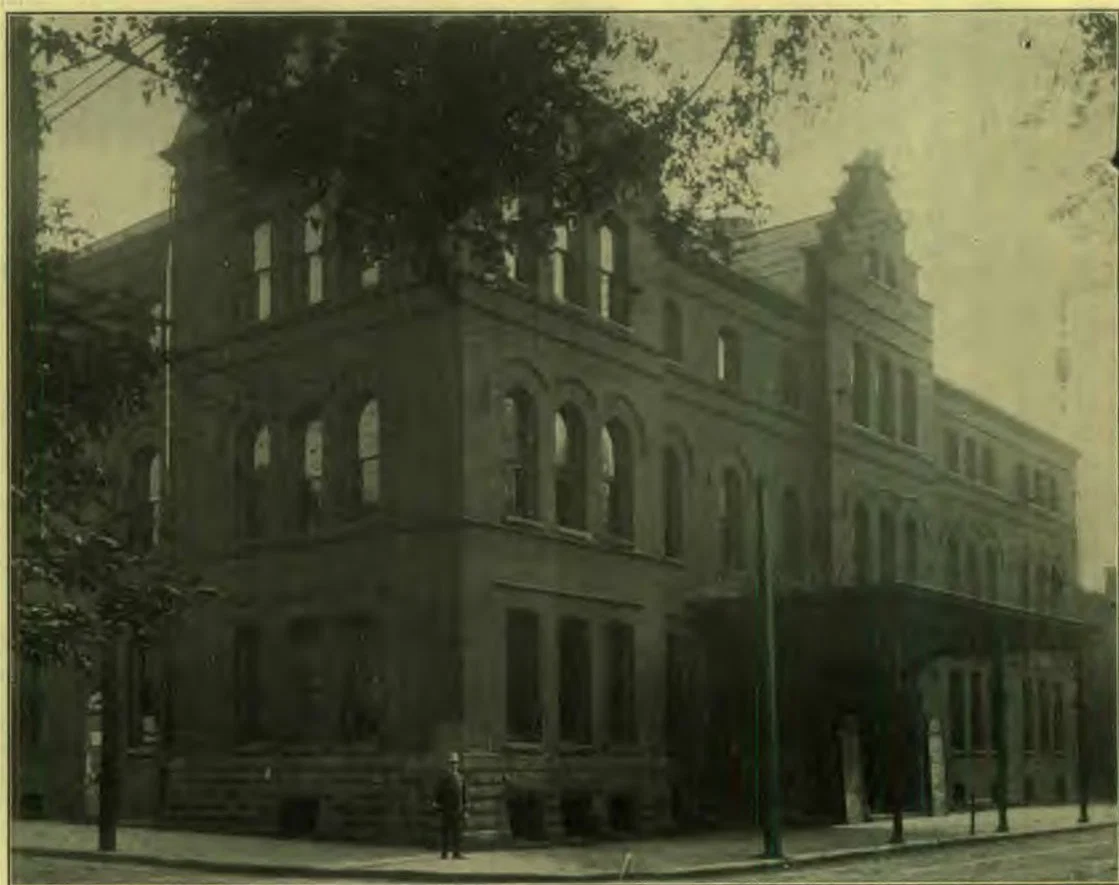
Convention Hall, Buffalo, where the Federation Meeting was held, July 29 to Aug. 1, 1906.